

RoxDogs
By pressing play, you agree that you are above legal age in your jurisdiction and that your jurisdiction allows online gambling.


Three Wild Dogs Take Over the Stage
Three oversized dog Wilds storm the stage and turn a cat band’s concert into feature-driven chaos.
According to Popiplay, RoxDogs is a high-volatility rock-band slot with a 97.03% RTP and 30,000x maximum win. It uses a 6-reel, 4-row board with 4,096 ways to win. Volatile-session fans get selectable free-spin features, unusual comic visuals, and three distinct Wild Headliners.
Key takeaways
- Best bonus: Start with standard play because I didn’t buy the feature or test any paid dog selection.
- RTP / volatility: A 97.03% theoretical RTP combines with high volatility, so your short results can swing hard.
- Max win: The win ceiling reaches 30,000x the bet, though you shouldn’t treat that cap as a likely target.
- Risk note: One 96x base-game win arrived on spin 17, then almost the entire gain disappeared across 83 spins.
- Bankroll note: Keep your stake low enough for featureless stretches instead of increasing it after several misses.

Table of Contents
- How RoxDogs Works
- Reading the paytable
- Oversized Wild dogs
- Theme and First Impressions
- Red Dog’s Amp Respins
- Choosing the Free Spins
- Marked reel multipliers
- Buying the Bonus
- What One Big Win Changed
- The late slide
- RTP, Volatility and Test Data
- Simulator projection
- Our 100-spin session
- RoxDogs FAQ
- Bottom Line
How RoxDogs Works
Wins form through 4,096 adjacent-reel ways on a 6×4 board, not fixed paylines. Matching symbols must connect from the left across neighboring reels. The game pays only the highest win on each way, then adds returns from separate winning ways. You’ll grasp the flow quickly, although the small regular payouts make the features far more important.
The stake range runs from $0.20 to $750.00. Turbo mode speeds up each result, while autoplay offers 10 to 1,000 rounds. The interface works cleanly across desktop and mobile screens, so you don’t lose essential controls when switching devices. I’d start slowly because turbo autoplay can make a rough stretch feel deceptively brief.
I began with a $1,000.00 play-money balance and used $0.20 stakes for 100 autoplay spins in turbo mode. RoxDogs is available for free demo and real play on SatoshiHero. Since the demo uses play money, I interpret outcomes mainly as bet multiples. My counted run produced no free spins, Wild Headliner round, or Buy Bonus experience, so I keep documented mechanics separate from firsthand results.
Reading the paytable
The Amp leads the regular symbols and pays 0.5x for two, 0.8x for three, 1x for four, 1.5x for five, and 3x for six. That early two-symbol return helps it connect more often than symbols needing three matches. Still, its top regular payout remains modest, which makes extended ways and Wild support matter. You shouldn’t expect the standard paytable alone to create the game’s main excitement.
Flute Cat and Singer Cat each pay 0.2x for three, 0.4x for four, 0.8x for five, and 2x for six. Triangle Cat and Drummer Cat start at 0.2x for three, then rise through 0.3x and 0.5x before reaching 1x for six. Their visual differences are obvious, so you can read settled combinations without studying every icon. In my view, that clarity matters more than the fairly plain values.
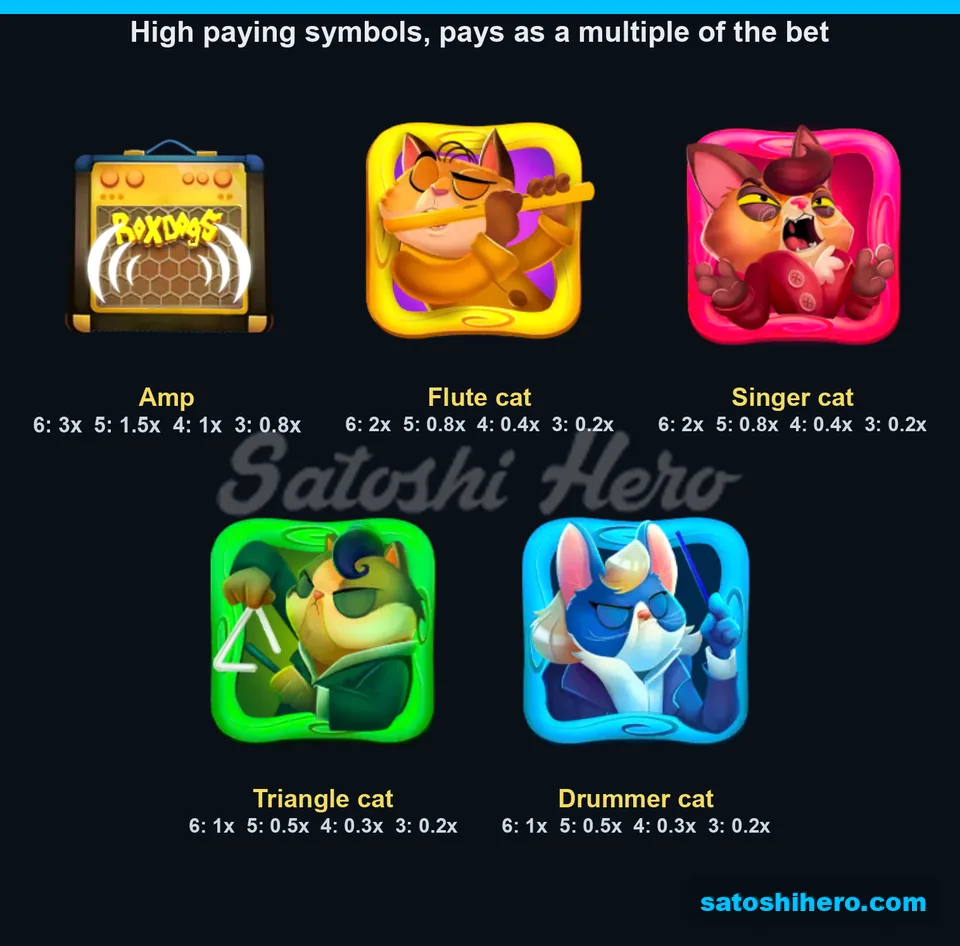
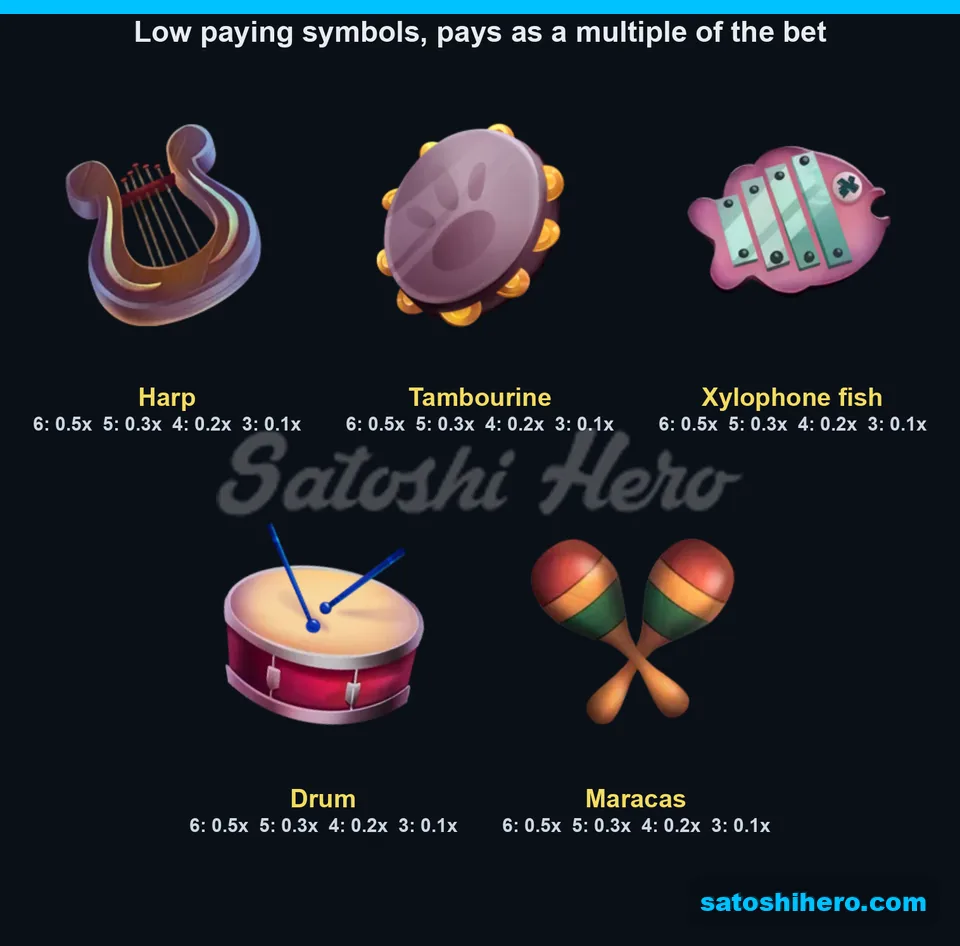
Five low symbols share one schedule. Harp, Tambourine, Xylophone Fish, Drum, and Maracas pay 0.1x for three, 0.2x for four, 0.3x for five, and 0.5x for six. The Guitar Pick Wild substitutes for everything except the Record Scatter and pays 3x for six. Record Scatters start free spins, making them much more meaningful than their vinyl artwork first suggests.
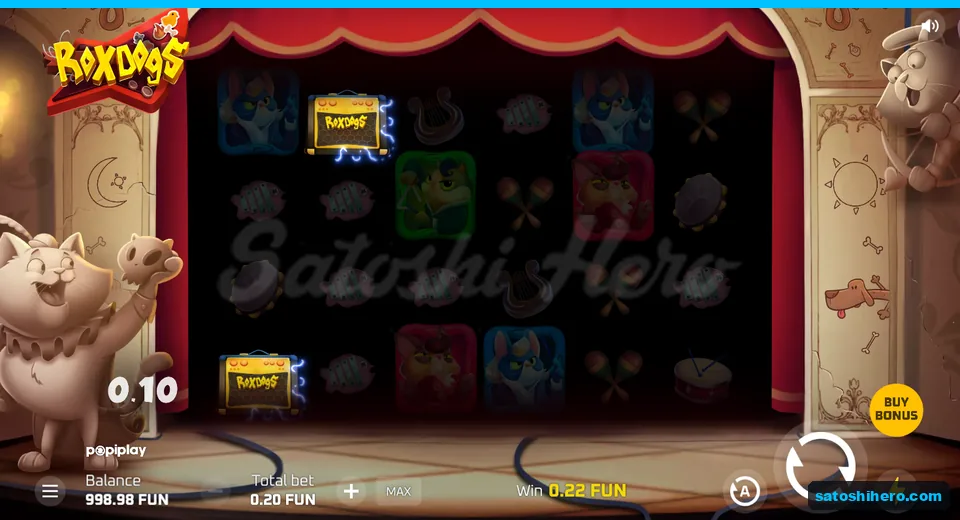
An extra spin outside my counted session returned $0.22 from a $0.20 stake, equal to 1.1x. It’s a useful base-game example, but I didn’t include it in the 100-spin totals. The symbol screenshots separate premium cats, low instruments, Wilds, Scatters, and Headliners more clearly than one dense table. Plain and simple, the regular values need stronger mechanics around them.
Oversized Wild dogs
Red, Green, and Blue Dogs appear at twice the size of normal symbols. Each Wild Headliner activates one base-game mechanic and carries a matching version into free spins. Their scale makes them easy to spot, which helps you understand why a spin suddenly changes. I like that visual hierarchy because complex feature slots often bury the important symbol.
Green scatters up to six new Wilds across the active spin. Its free-spin counterpart is Garage Practice. Blue turns its landing reel Wild and can convert up to three more reels, while Opera Takeover carries that behavior into the bonus. You can see why Blue targets longer connected ways, whereas Green spreads support around the board.
No dog activated during my counted run. These descriptions come from the documented rules, not something I watched pay in the test. That absence disappointed me, yet it also exposed how ordinary standard play can feel when the Headliners stay away.

Data Point: RoxDogs uses 4,096 adjacent-reel ways rather than traditional fixed paylines.
Each choice changes the whole round rather than adding a minor cosmetic effect.
Theme and First Impressions
The game turns a theatre stage into a deliberately silly animal rock show. Red curtains frame the 6×4 board while three bright dogs command the foreground. Cat musicians sing or play among amps, drums, harps, maracas, tambourines, and a xylophone fish. You’ll either enjoy the absurd cast or find it too cartoonish, and I don’t think there’s much middle ground.
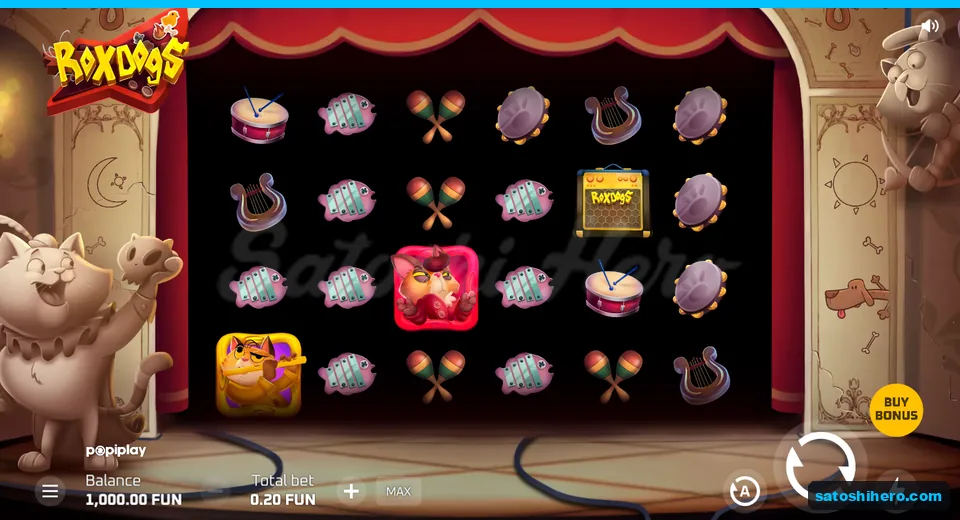
Red, Green, and Blue act like lead performers instead of ordinary Wilds. Their double-sized art keeps them prominent among smaller cats and instruments. This hierarchy feels clearer than many slots that pile several features onto similar-looking icons. You can identify the mechanic before reading every payline-style connection, even though the game actually uses adjacent-reel ways.
Journey to the West offers a mythology-led alternative when you prefer an adventure setting over a comic concert. This stage won’t satisfy anyone seeking a serious or realistic presentation. I still find its odd personality more memorable than another generic fruit machine, and the dogs provide a practical visual purpose.

Fun Fact: The stage casts three dogs as headliners while cats fill the supporting band, giving every feature symbol a clear theatrical role.
If you enjoy playful designs, the theme gives the mechanical choices a coherent identity. Realism fans should look elsewhere because subtlety isn’t part of this show.
Red Dog’s Amp Respins
The Red Dog starts a collection sequence where only Amp symbols can land. It can run for up to 24 respins, but that upper limit isn’t a normal expectation or promise. New Amps keep the sequence moving until no fresh Amp appears or the reels fill. The collected Amp result then pays, and World Tour brings the same concept into free spins.
This is the most collection-led Wild Headliner. Each added Amp extends the tension, while an empty respin can stop everything much earlier than the headline cap suggests. You might prefer Red when visible progress matters more than scattered Wilds or converted reels. I find collection rounds easy to follow, but their sudden endings can feel harsh.
Hot to Burn Hold and Spin is a useful alternative when respin-and-collection play forms your main priority. The comparison concerns feature style, not unprovided statistics or expected returns. Both concepts focus your attention on symbols that accumulate during a contained sequence. You should still judge Red on its own rules rather than expecting another game’s rhythm.
The feature didn’t activate during my 100 counted spins. I can explain how it operates, but I can’t claim that its Amp collection paid well or lasted near 24 respins. That distinction matters because maximum feature length says nothing about what your next trigger can deliver. Red looks appealing on paper, though my test gives no evidence that it performs better than Green or Blue.
Choosing the Free Spins
Three or more Record Scatters start free spins and set the number of rounds. Three Scatters award 8 spins, four award 12, five award 16, and six award 20. Before the round begins, you select one Wild Headliner for the entire feature. I like the meaningful choice, but no option comes with evidence of superior returns from my test.
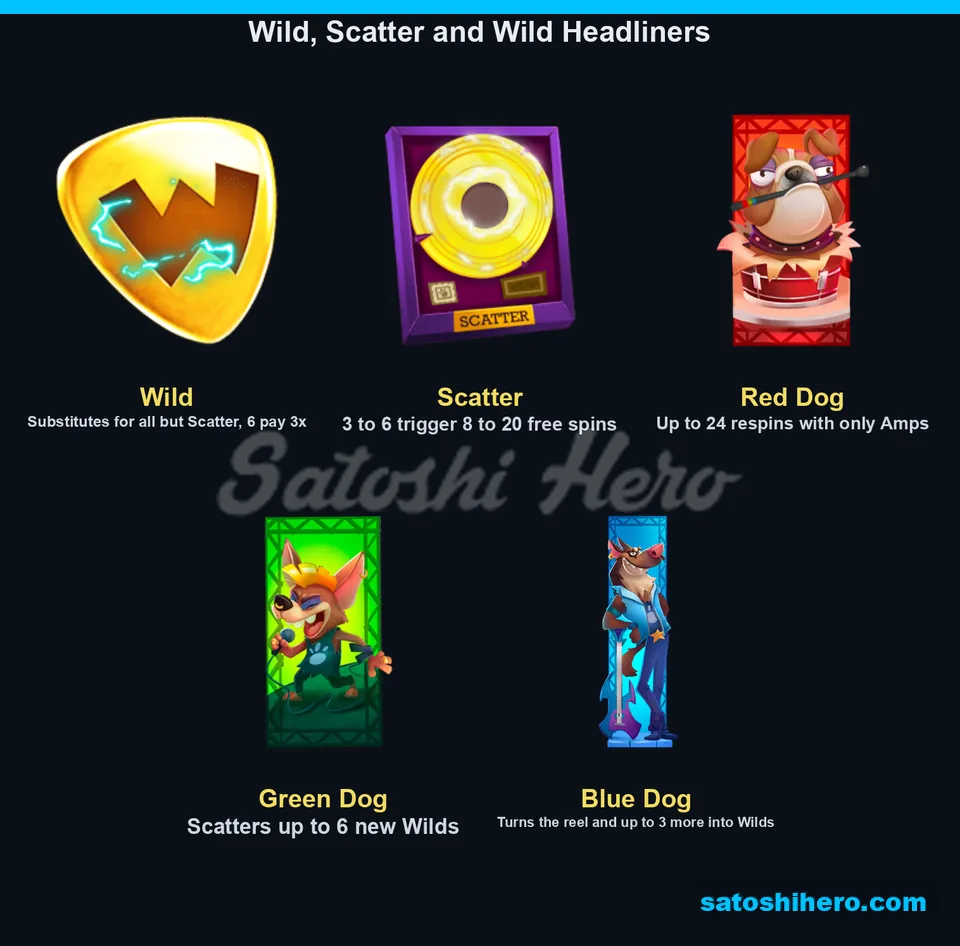
- Red: World Tour activates the Amp-only respin collection mechanic.
- Green: Garage Practice adds up to six Wilds across the reels.
- Blue: Opera Takeover converts its landing reel and up to three more into Wild reels.
The best selection depends on what you want to watch. Choose Red for a contained collection sequence, Green for distributed Wild support, or Blue for reel-wide conversions. You aren’t choosing a guaranteed outcome, only the mechanic that shapes possible wins. No sugarcoating, preference matters more than unsupported claims about which dog pays best.
Marked reel multipliers
Up to six reels can carry a 2x multiplier during the round. A winning way gains that multiplier when it passes through a marked reel, so the route across adjacent reels matters. Free spins retain the triggering stake and all 4,096 ways. Retriggers can extend the round, but you shouldn’t budget as though extra spins must appear.
Hot to Burn – 7 Deadly Free Spins gives bonus-focused readers another free-spins-centered option. Hot To Burn Multiplier makes more sense when multiplier-led bonus play matters more than choosing among three character mechanics. These comparisons concern player preference only, since no supporting figures were supplied for numerical claims.
My 100-spin run never triggered free spins. I didn’t see marked reels, retriggers, or any selected Headliner operate inside the round. That dry result felt disappointing because the three-way choice is the core attraction. Still, it provides an honest reminder that a short session can end before the headline feature appears.
Your practical choice comes down to collection respins, added Wilds, or Wild-reel conversions. Learn each pattern in demo play before attaching any confidence to a favorite.
Buying the Bonus
The Buy Bonus provides immediate free-spin entry with one selected Wild Headliner. It doesn’t guarantee a strong return, the longest award, or a successful feature sequence. The purchase grants the equivalent of three to six Scatters, and that random count determines whether you receive 8, 12, 16, or 20 spins. I wouldn’t mistake faster access for reduced variance.
You still choose Red, Green, or Blue before play starts. Direct entry removes the wait for a natural Scatter trigger, but the underlying round can remain uneven. Players should understand Amp respins, added Wilds, and Wild-reel conversions before paying for access. Here’s the deal: buying speed doesn’t buy certainty.
I didn’t purchase the feature during my short test. That means I can’t support a best paid entry, rank the dogs by observed return, or describe a tested purchase result. I also won’t invent a price, trigger rate, or mode-specific return. You deserve a clear evidence boundary instead of confidence built from an untouched button.

Suggestion: Try every Wild Headliner mechanic with play money before considering paid entry. My test found no evidence that one choice performs consistently better.
Hot to burn offers a simpler thematic alternative when you’d rather avoid choosing among three feature identities. In this game, the Buy Bonus makes most sense only after you know which mechanic you actually enjoy. Don’t purchase it simply because standard play has stayed quiet.
What One Big Win Changed
One 96x result created almost the entire positive outcome from my 100-spin test. That single event shows how sharply high volatility can shape a short session. My balance had fallen about 15x behind by spin 16, making the opening feel cold but manageable. You could easily misread the eventual profit if you looked only at the final number.
Spin 17 returned $19.20 from my $0.20 stake, equal to 96x. The hit moved my running position to roughly 80x ahead and became my largest win. It came from one base-game spin, not free spins or a Wild Headliner round. I enjoyed the jump, although its importance made the rest of the session feel increasingly fragile.
The late slide
Almost all that gain disappeared over the remaining 83 spins. Spin 97 paid 0.8x, while spin 99 returned 1.2x, and neither meaningfully changed the late slide. My ending balance reached $1,000.94, leaving a $0.94 profit equal to 4.7x the bet. A modest positive finish hid a much rougher path underneath.
Twenty-nine of 100 spins returned something, and the longest dry stretch lasted eight consecutive rounds. No free spins or dog features activated. Those paying spins often lacked enough size to protect the early surge. In my opinion, this is more revealing than the final profit because it shows how many small returns failed to hold the peak.
Don’t raise your stake after several misses. Previous losses don’t make a major result due, and the next spin carries no debt to your balance. Pick an amount that lets you absorb quiet runs without depending on a feature rescue. You should judge the path and concentration of returns, not just whether the closing balance shows green.

Watch Out: High volatility can make a short result depend on one event. The 96x hit rescued my test, but a similar win is never due or guaranteed.
Without spin 17, this session would tell a very different story. That’s why bankroll discipline matters more than chasing the result that happened once.
RTP, Volatility and Test Data
The decision profile combines a 97.03% theoretical RTP, high volatility, and a 30,000x maximum win. Those figures point toward wide short-session swings and a ceiling that remains extremely difficult to approach. You need enough budget room for uneven play, not a belief that the headline return controls each session. I consider the profile attractive but demanding.
Simulator projection
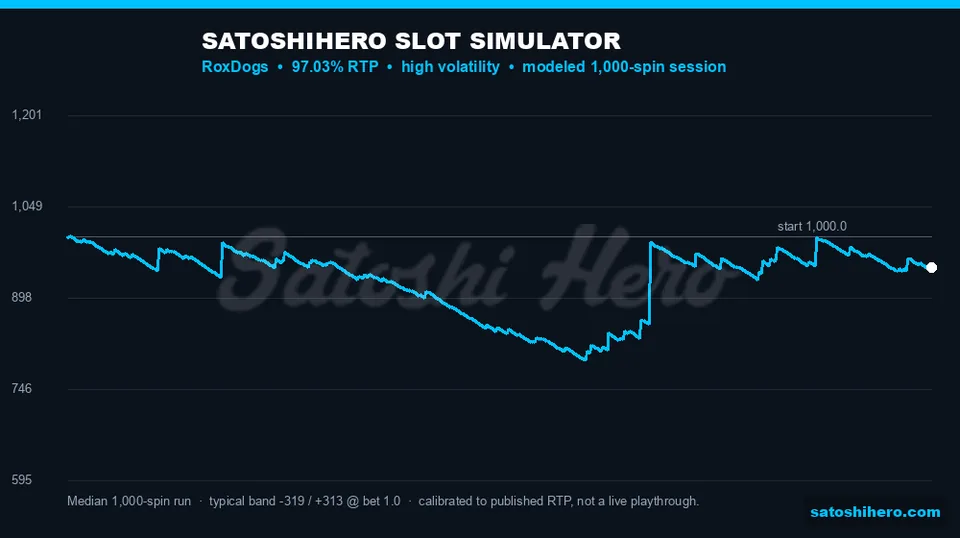
The SatoshiHero Slot Simulator used the supplied game profile, 1,000 spins, and a 1x stake. Its median session finished 51x down. The middle 90% stretched from 318.8x down to 312.7x up, showing a broad range around that midpoint. You should read this as modeled uncertainty, not a forecast for your balance.
Around 18% of simulated spins paid something. A feature appeared roughly once per 45 spins, while a result of 100x or more appeared about once per 1,608 spins. These rates aren’t countdowns, and earlier misses don’t move you closer to either event. I find the spread more useful than any single frequency because it exposes how far outcomes can diverge.
The blue curve resembles a bumpy decline interrupted by occasional jumps. That shape fits a high-volatility model where isolated events can alter the whole path. It doesn’t know how the real random number generator behaves, so the graph estimates a possible range rather than recreating live play. Treating it as a promise would be a serious mistake.
Our 100-spin session
My live run ended 4.7x ahead after 100 spins. Twenty-nine rounds paid, the longest dry spell covered eight spins, and my largest return reached 96x on spin 17. No free spins or Wild Headliner rounds appeared. You can see why the positive endpoint doesn’t describe the experience by itself.
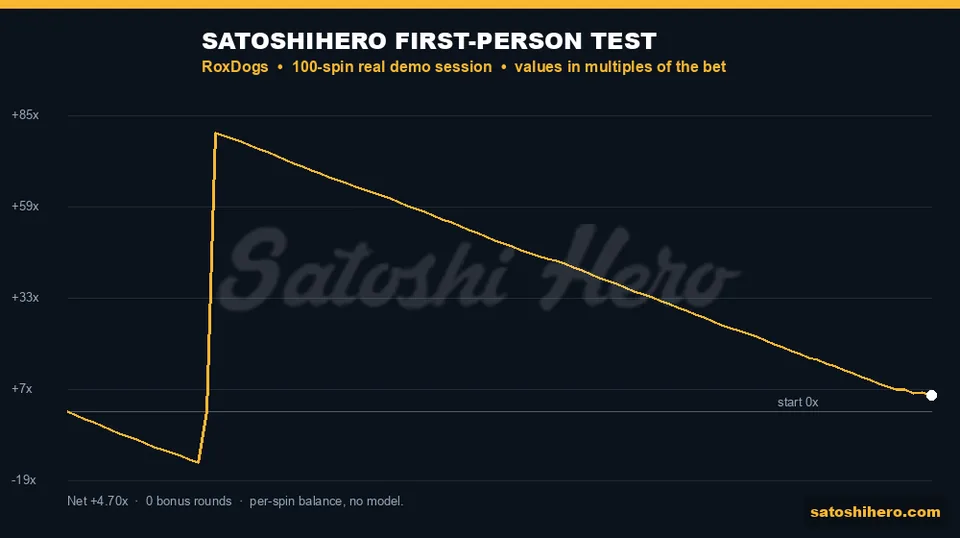
The observed paying-spin rate was 29%, compared with roughly 18% in the model. A 100-spin sample is far too small to establish a normal hit rate or disprove the simulator. Many observed returns were small, while one base-game event carried nearly all the profit. I’d trust neither percentage as a personal prediction.
Hot to Burn provides a stripped-back alternative when you prefer a more familiar presentation over three oversized feature characters. That comparison stays thematic because no reliable cross-game figures support a statistical ranking. You should choose based on mechanic preference, not an unsupported promise of easier wins.
The theoretical RTP is Popiplay’s published return, and one live session can’t alter it. The simulator estimates possible ranges without reproducing the game’s real random number generator, while any displayed mode-specific returns should remain tied to those modes. Neither my profitable test nor a modeled frequency predicts your next result.
Frequently Asked Questions
How many ways to win does RoxDogs have?
RoxDogs uses a 6×4 layout with 4,096 ways. Matching symbols connect from the left across adjacent reels, only the highest win on each way pays, and separate winning ways add together. You aren’t playing fixed paylines.
What is the RTP of RoxDogs?
The theoretical RTP is 97.03%, with high volatility and a 30,000x maximum win. Your short session can finish far above or below that return. I saw a profit, but one test can’t redefine the published figure.
How do free spins work in RoxDogs?
Three, four, five, or six Scatters award 8, 12, 16, or 20 spins. You choose one dog before the round, and up to six reels can carry 2x multipliers. Retriggers can extend play.
What do the Red, Green and Blue Dogs do in RoxDogs?
Red starts up to 24 Amp-only respins, Green adds up to six new Wilds, and Blue makes its reel Wild while potentially converting up to three more. You select the corresponding enhanced mechanic before free spins.
Does RoxDogs have a Buy Bonus?
Yes. It provides direct free-spin entry with one selected Wild Headliner and a random award from 8 to 20 spins. I didn’t purchase it, so I can’t rank its choices from experience.
What happened in the 100-spin RoxDogs test?
I finished 4.7x ahead with 29 paying spins. My largest win was 96x on spin 17, and no free spins or Wild Headliner activations occurred. You should read the small profit alongside that concentrated result.
What did the RoxDogs 1,000-spin simulator show?
The median ended 51x down, while the middle 90% ranged from 318.8x down to 312.7x up. This model offers a rough range, not a prediction. It can’t tell you what the next spin or session brings.
Bottom Line
RoxDogs stands out through three oversized dog mechanics and a meaningful pre-bonus choice. Its main weakness is simple: standard play can feel thin when none of those Headliners activates. You get a distinctive feature system, but access can be frustratingly uneven.

My Verdict
Patient high-variance fans should try standard demo play before touching the Buy Bonus. Expect modest regular symbols, occasional sharp jumps, and sessions that can finish without showing the main feature.
I like the clear differences between collection respins, added Wilds, and converted reels. I don’t like that my entire 100-spin test missed every dog feature and free-spin round. The 96x base-game hit saved the balance, yet it also exposed how dependent one short run can become on a single event.
RoxDogs remains most compelling when you value unusual characters and selectable bonus mechanics over steady feature access. The factual details and screenshots are checked regularly, and I keep observed results separate from documented rules.

Pros:
 Strong headline choice: Three dog mechanics give the free-spin decision real meaning.
- Clear visual hierarchy: Oversized Wilds make feature activations easy to recognize.
- Flexible pace controls: Turbo mode and broad autoplay options support different session speeds.
- Memorable presentation: The animal rock band avoids another generic fruit theme.

Cons:
 Featureless test: No dog mechanic or free spins appeared across 100 counted rounds.
- Modest regular pays: Standard symbols need Wild support or extended ways for stronger returns.
- Concentrated outcome: One 96x hit created almost the entire final profit.

Best For: High-variance fans who enjoy comic themes, selectable bonus identities, and clear feature symbols get the strongest match. If you need frequent bonus action or smooth returns, this stage can feel too quiet between major events.
Similar Games






















































Bets
All Bets
Game
Player
Date
Wager
Mult.Multiplier
Prize
 Reel Rider: Rapid Link
 Hidden
- 16:21:00
- 0×
- Luck of Panda: Bonus Combo
 mdp0fxo
- 16:21:00
- 0×
- Grand Koala: Hold ‘N’ Link
 mike_721
- 16:20:59
- 0×
- Reel Rider: Rapid Link
- Hidden
- 16:20:57
- 0×
- Luck of Panda: Bonus Combo
- mdp0fxo
- 16:20:57
- 0.6×
- Elephant's Gold: Bonus Combo
- nina87
- 16:20:56
- 0×
- Galaxy Glitter
- Hidden
- 16:20:55
- 0×
- Luck of Panda: Bonus Combo
- Hidden
- 16:20:55
- 0×
- Reel Rider: Rapid Link
- Hidden
- 16:20:54
- 0×
- Luck of Panda: Bonus Combo
- mdp0fxo
- 16:20:54
- 0×