

Pearls of the Ocean
By pressing play, you agree that you are above legal age in your jurisdiction and that your jurisdiction allows online gambling.

Pearls of the Ocean
RTP95.04%
VolatilityMedium–high
Max winx1,234
Lines40
Hit rate17.34%
ThemeUnderwater world
ReleasedJul 2022

Diving for Wild Stacks Beneath the Reels
Pearls of the Ocean slot drops you onto a 5×4 underwater grid with 40 fixed paylines.
Pearls of the Ocean is a medium-high volatility Platipus slot with a 95.04% RTP and 1,234x maximum win. Extended Mermaid Wilds connect Nudging Wilds, held-stack Respins, and Free Spins for patient bonus hunters. My 100 $0.80 spins returned $53.56 from $80.00, ending $26.44 down without a named feature, so the win cap feels modest.
Key takeaways
- Tested play: I tested ordinary $0.80 base spins, so you won’t find an unsupported Feature Buy ranking here.
- Return and risk: The 95.04% theoretical RTP comes with medium-high volatility.
- Win ceiling: The 1,234x maximum feels restrained when you weigh it against that risk.
- Feature costs: The three Free Spins buys cost 35x, 60x, and 100x, but I didn’t test them.
- Bankroll point: At my stake, the $80.00 top buy equals all 100 base spins I played.
These points tell you where the attraction and the main compromise sit. Plain and simple, the connected Wild mechanics carry more appeal than the capped prize.

Table of Contents
- How Pearls of the Ocean slot Works
- Line wins
- Symbol values
- Feature Buy Costs and Choices
- Three buy levels
- Bankroll trade-off
- Theme and First Impressions
- Nudging Wilds
- Trigger condition
- Full-reel movement
- Respins With Held Wilds
- Respin awards
- Held stacks
- Free Spins and Sticky Wilds
- Scatter triggers
- Extra-spin Wilds
- How the Base Game Played
- Session results
- What I saw
- RTP, Volatility and Our Test
- Simulator projection
- Our 100-spin session
- Frequently Asked Questions
- Bottom Line
How Pearls of the Ocean slot Works
You make wins across a 5×4 grid with 40 fixed paylines, starting left and continuing across adjacent reels. Only the highest win on each active line pays, so you shouldn’t count every matching symbol visible anywhere. The total bet ranges from $0.80 to $80.00. I used $0.80 throughout, which divided into 40 line bets of $0.02.
Scatters follow a different trigger rule and don’t need a payline pattern. This distinction matters because the Mermaid acts as both a substitute and a Scatter. You can play the same core grid, paytable, and controls on mobile or desktop. In my view, the conventional line system makes the more involved Wild rules easier to track.
Line wins
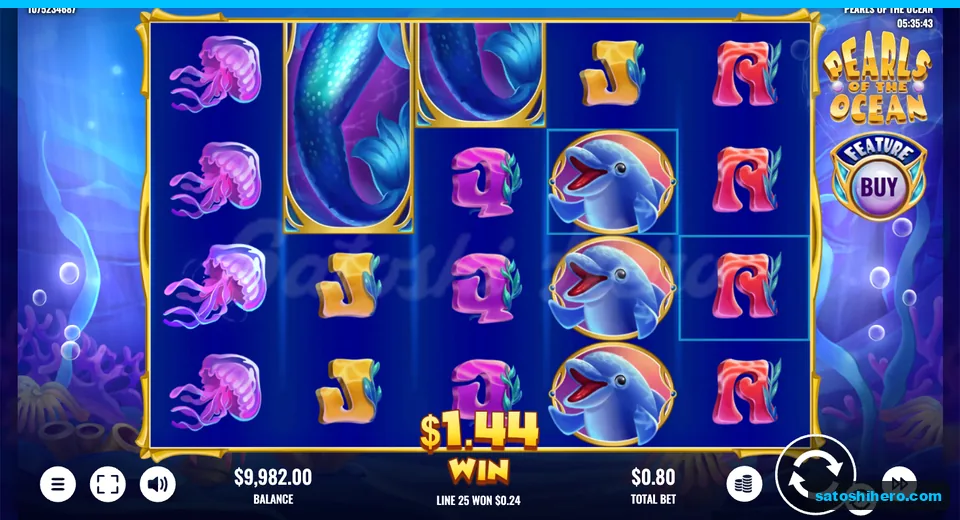
A settled $1.44 result showed how the line system works. Jellyfish, Mermaid Wilds, and dolphins connected across adjacent positions, with the Mermaid filling gaps. Trace the highlighted line before assuming every nearby match contributes. A tall Wild can assist several routes, but it doesn’t create an anywhere-pay system.
Symbol values
All values below use the $0.02 line bet from my $0.80 total wager. You get these awards for three, four, and five matching symbols:
- Dolphin: $0.60, $1.20, and $8.00.
- Clownfish: $0.40, $0.80, and $4.00.
- Hermit crab: $0.32, $0.80, and $2.40.
- Jellyfish: $0.24, $0.60, and $1.60.
- Starfish: $0.24, $0.48, and $1.60.
- Ace and King: $0.16, $0.40, and $1.00 each.
- Queen and Jack: $0.12, $0.32, and $0.80 each.
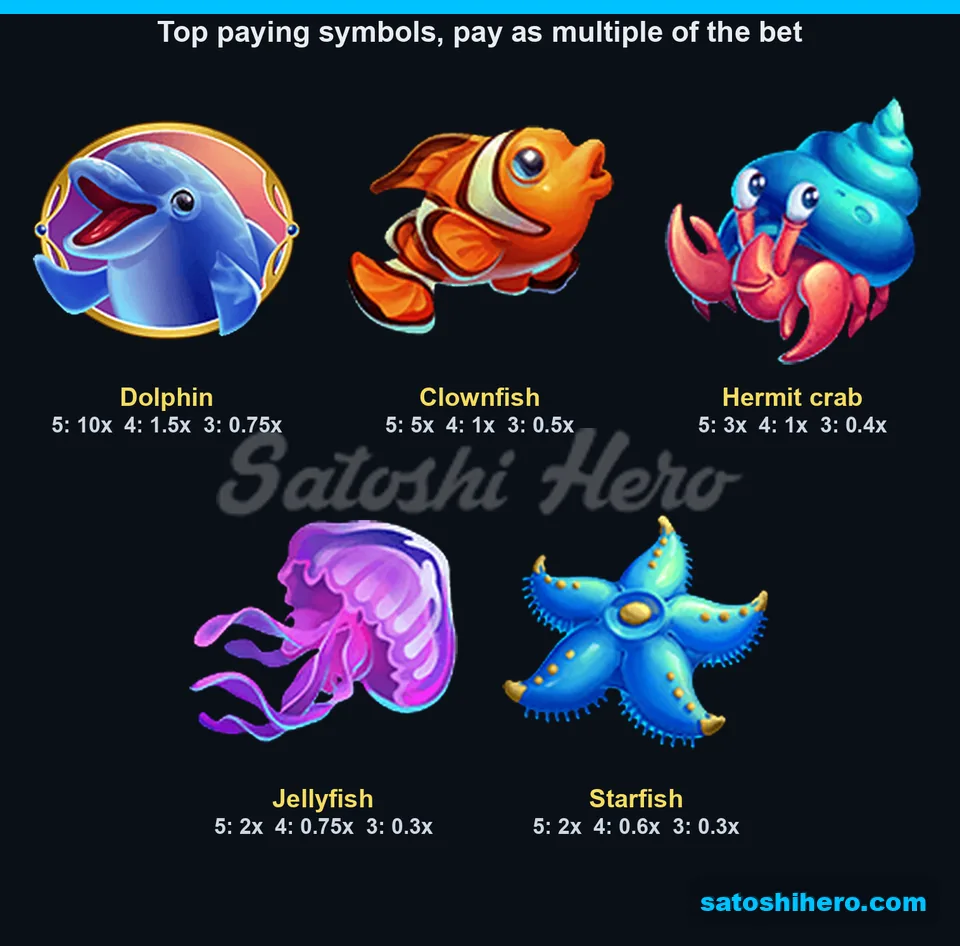
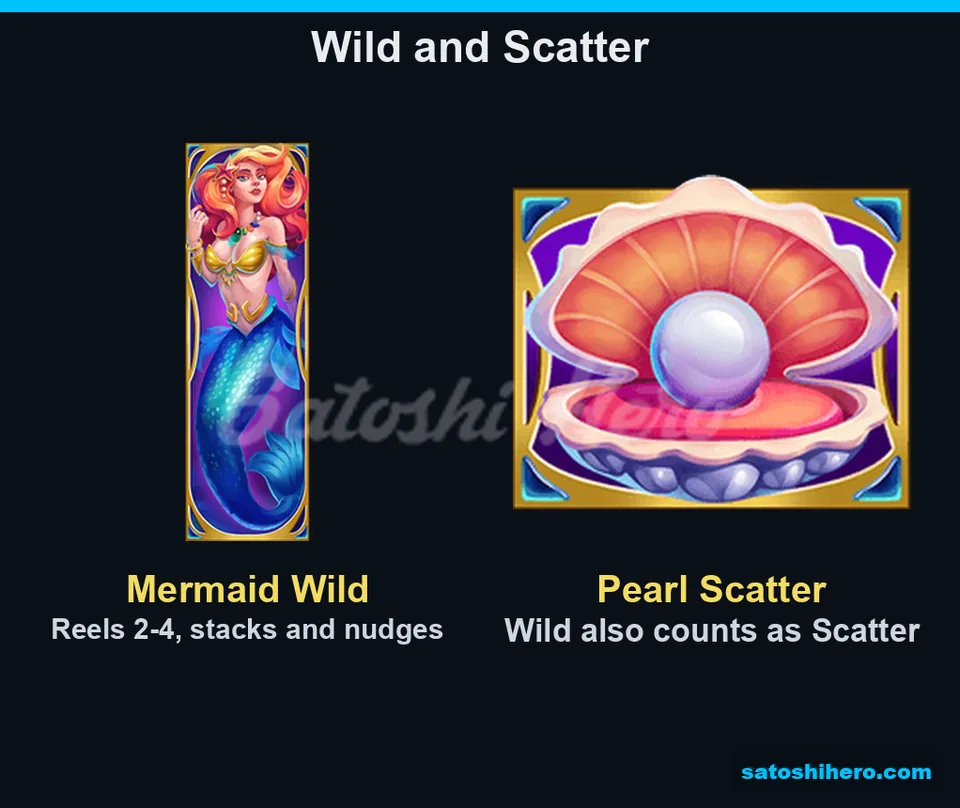
Nine regular paying symbols become 11 total symbols with the Mermaid Wild and Pearl Scatter. The Mermaid appears only on reels two, three, and four, extends across its reel, and replaces regular symbols. The Mermaid also counts as a Scatter during trigger checks. The Pearl Scatter can appear anywhere in the base game or during Respins.
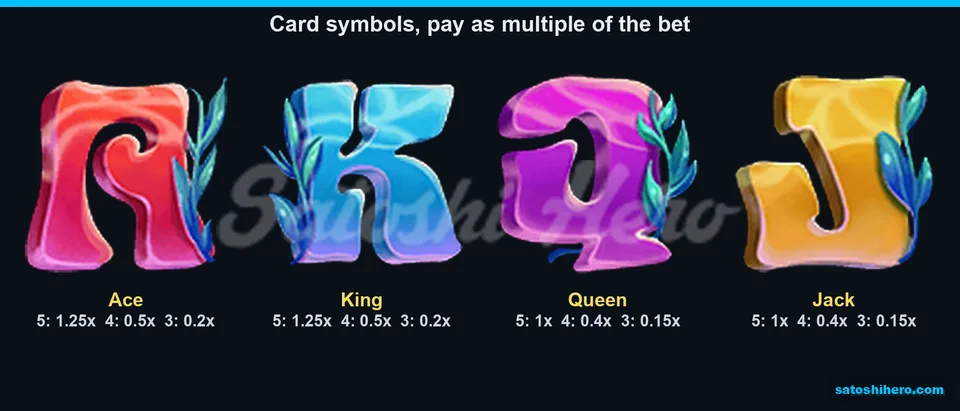

Data Point: A $0.80 total wager breaks into $0.02 on each of the 40 fixed paylines.
Those Pearls of the Ocean facts explain why line wins and feature triggers can overlap under different conditions. I think that clarity offsets the busy Wild artwork.
Feature Buy Costs and Choices
The Feature Buy menu forces a Free Spins trigger at one of three upfront prices, but I didn’t test or rank any choice. You choose a starting spin count and accept the full cost before the round begins. No sugarcoating, the top purchase is a major commitment beside the game’s restrained win cap. The menu offers access, not a documented profit edge.
Three buy levels
The three options are simple:
- 7 Free Spins cost 35x the bet, or $28.00 at $0.80.
- 9 Free Spins cost 60x the bet, or $48.00 at $0.80.
- 12 Free Spins cost 100x the bet, or $80.00 at $0.80.
Each price includes the triggering spin. A higher price gives you more starting spins, but it doesn’t prove better returns. You shouldn’t treat the 100x option as the automatic best value.
Bankroll trade-off
At my tested stake, the smallest purchase commits 35 ordinary spin stakes in one action. The middle choice uses 60 stakes, while the largest consumes the same $80.00 wagered across my entire test. You get less gradual exposure when you compress that spend into one result. I find the largest jump difficult to justify without mode-specific evidence.
The lowest price reduces your upfront commitment, not the uncertainty. My session supplies no first-hand evidence from any purchased round. Separate a buy budget from your base-spin budget before opening the menu.

Suggestion: Set your maximum spend before opening the menu. The $80.00 choice consumes 100 ordinary $0.80 stakes at once.
These options change the starting spins and entry cost, not any documented promise of profit. If you value session length, ordinary spins preserve far more decisions along the way.
Theme and First Impressions
The gold-framed reels, deep-blue reef, and tall Mermaid Wild give the familiar underwater setting one strong focal point. Sea creatures fill the premium positions, while coral-carved card letters handle the lower values. A red-haired mermaid stretches over full reels, placing the character art above the background details. You can see the Feature Buy button beside the reels and the main controls along the bottom.
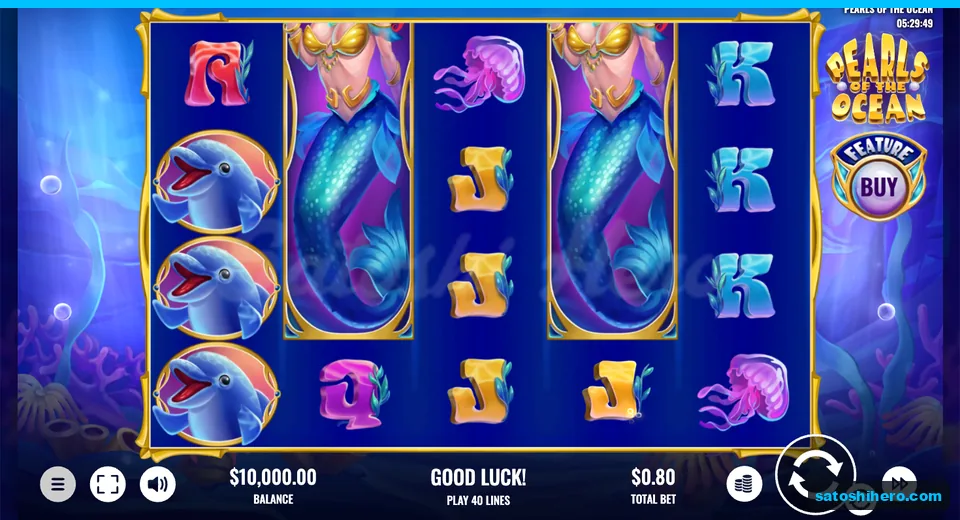
During ordinary spins, the full-reel mermaid looked busier than the quiet results suggested. The ocean theme won’t win originality awards, but its coherent palette kept the display readable.
Wizard of the Wild offers a magical wilderness aesthetic if you prefer spellcraft over marine scenery. Ways of the Gauls and Spirits of the Prairies offer two more Platipus themes to compare. Pearls of the Ocean slot instead leans on bright reef colors and prominent stacked character art. You should choose between those visual moods rather than expect a major mechanical comparison. The marine design feels conventional, but its focal character has real presence.

Fun Fact: Real pearls form when mollusks build layers of nacre around an irritant. The Pearl Scatter borrows that familiar ocean treasure image.
Names of pearls in the world concern real gems, not separate symbols here. You only distinguish the Pearl Scatter, Mermaid Wild, and nine paying icons. I appreciate that compact visual vocabulary because it reads quickly.
Nudging Wilds
When Wilds land on at least two reels in one spin, the Nudging Wilds feature has a chance to activate. The trigger creates an opportunity, not an automatic nudge. You can see qualifying Wilds without getting the movement sequence. I saw no activation during my 100-spin test, so the remaining details come from the documented game rules.
Trigger condition
Two or more Wild-bearing reels create the required setup. Each affected reel can then move independently if the feature activates. You shouldn’t read simultaneous Mermaid landings as proof that Respins must follow. I found this chance-based step less transparent than a direct trigger because the visible setup can end without a feature.
No named feature appeared in my session, despite several active-looking Mermaid landings. You get visual movement from ordinary Wilds, but not necessarily bonus progression. Even qualifying imagery can settle as an ordinary result.
Full-reel movement
After activation, each affected reel moves upward or downward until a complete Wild stack fills it. Successful completion starts Respins automatically, while the original spin waits for all nudging to finish. You should follow the final layout because the screen can change before the triggering payout settles. This delayed calculation prevents an early line reading from telling the full story.
I like how the motion links Mermaid landings to held stacks without another symbol. The sequence runs through setup, movement, settlement, and Respins. Nudging Wilds bridge ordinary coverage and feature play.
Respins With Held Wilds
Two complete Mermaid Wild stacks award two Respins, while three complete stacks award three. Every extra full stack adds one more Respin after the initial award. You should keep the starting quantity separate from later additions when tracking the round. Respins didn’t activate during my live session, so I won’t pretend to have an observed return.
Respin awards
The sequence begins after Nudging Wilds create the necessary completed stacks. Two stacks establish two attempts, and three establish three. Any later completed stack extends the counter by one rather than resetting it. I think the rule is easy to follow once you separate initial Respins from additions.
Isolated Mermaid fragments don’t start this feature without completed stacks. My test remained in the base game, so none of my $53.56 return came from held-Wild play. That absence explains why the session felt quieter than it looked.
Held stacks
Completed full-reel Wild stacks remain locked throughout the feature. Later outcomes build around fixed positions with more coverage than ordinary spins. I consider this the strongest mechanic because progress doesn’t vanish between attempts.
Free Spins can trigger during Respins only once. If both modes activate together, Respins play first and Free Spins follow afterward. You should expect a fixed sequence rather than two modes running at the same time. Held stacks drive the progression, although my test provided no first-hand example of that chain.
Free Spins and Sticky Wilds
Three, four, or five consecutive Scatter and Mermaid Wild symbols from the leftmost reel award 7, 9, or 12 Free Spins. The qualifying set can mix both special symbols, but it must begin on reel one. You can’t trigger the round from scattered appearances that leave a gap in that left-to-right sequence. I like this rule because the screen shows exactly where the trigger succeeds or fails.
Scatter triggers
The awards break down as follows:
- Three consecutive qualifying symbols: 7 Free Spins.
- Four consecutive qualifying symbols: 9 Free Spins.
- Five consecutive qualifying symbols: 12 Free Spins.
A qualifying symbol on reel one starts the chain, and each next reel must continue it. Pearl Scatters elsewhere don’t complete the trigger by themselves. You should read Mermaid Wilds as part of the same chain because they also count as Scatters. This dual use gives the tall Wild more purpose than a standard substitute.
My 100-spin run never produced a qualifying trigger, so I can’t attach a real return to these awards. Going 100 spins without Free Spins made the base game feel dry.
Extra-spin Wilds
Every Mermaid Wild appearing during the round nudges until it fills its reel. The completed Wild then adds one extra Free Spin and remains held for the rest of the feature. You can gain both more coverage and more attempts from the same landing. That combination makes sticky full-reel Wilds the round’s central progression mechanic.
Persistent reels can shape every remaining spin, while extra attempts create more chances for another stack. I didn’t reach Free Spins, so I observed none of this progression firsthand. That complete absence remains a fair concern about pacing.
How the Base Game Played
I wagered $80.00 across 100 spins and received $53.56 back, finishing $26.44 down. I played Pearls of the Ocean slot at $0.80 per spin from a $10,000.00 demo balance. You can play the same free demo or use real play on SatoshiHero. My test used autoplay in blocks of 75 and 25 to reach exactly 100 paid spins.
Session results
- Stake: $0.80 per spin.
- Paid spins: 100.
- Autoplay blocks: 75 spins, then 25.
- Starting balance: $10,000.00.
- Ending balance: $9,973.56.
- Total wagered: $80.00.
- Total returned: $53.56.
- Paying spins: 25.
- Best win: $8.52 on spin 87, equal to 10.65x the stake.
- Other leading wins: $4.80 and two results of $4.20.
- Session high: $10,003.16 on spin 13.
- Session low: the final $9,973.56 balance.
These figures describe one short base-game path, not the game’s theoretical return. I found the loss manageable, but missing every feature made the run feel longer. Even the late best win recovered little of my deficit.
What I saw
Most wins came from small three-symbol line combinations. The balance reached $10,003.16 on spin 13, then drifted downward through modest gains and repeated losing spins. You never saw one dramatic collapse in this path. Instead, the session lost ground in small steps until the closing balance became its lowest point.
The stretched Mermaid Wilds kept the grid visually active, even though Nudging Wilds, Respins, and Free Spins never started. My best $8.52 hit on spin 87 equaled 10.65x, while $4.80 and two $4.20 results followed behind. I thought the screen looked busy but played quietly. You could find that mismatch frustrating if bonus frequency matters more than artwork.
Twenty-five paying spins meant three quarters of the test returned nothing. That count isn’t a permanent hit rate, but it explains the rhythm. Small line wins interrupted the decline without reversing it.
RTP, Volatility and Our Test
The 95.04% theoretical RTP combines with medium-high volatility and a 1,234x maximum win. You should expect meaningful session swings despite that restrained ceiling. I consider this trade-off the game’s clearest weakness.
Official mathematics, simulator projections, and my observed play answer different questions. The first defines the product, the second models possible paths, and the third records one real session. You shouldn’t merge them into one performance claim. Keeping those evidence classes separate makes the risk easier to judge.
Simulator projection
The SatoshiHero Slot Simulator modeled 1,000 spins at a $0.80 bet. Its middle outcome finished $53.10 down, while 90% of modeled runs ranged from $206.50 down to $162.30 up. About 21% of all modeled spins returned something to the balance. A feature-sized result appeared roughly once per 46 spins, and an outcome of at least 100x appeared roughly once per 3,597 spins.
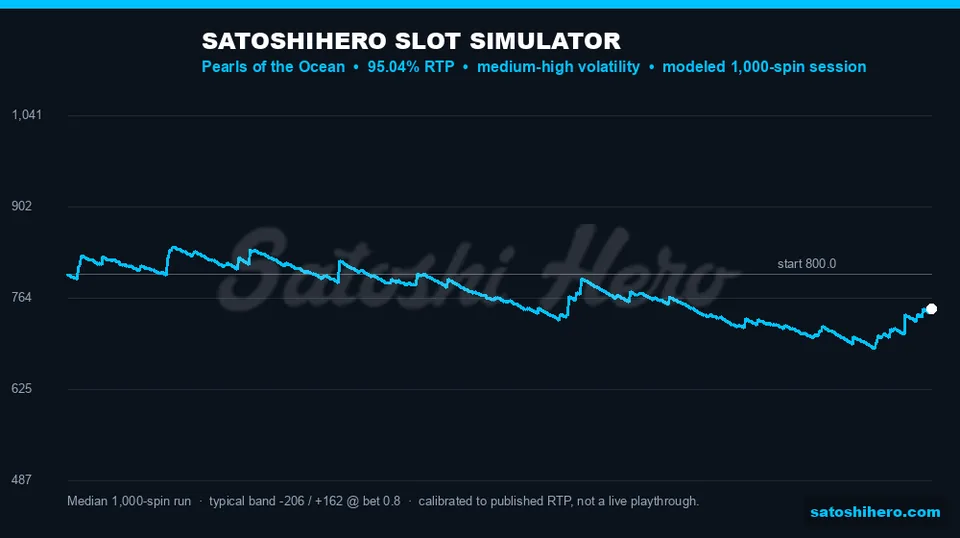
Those figures describe a distribution of possible sessions. They don’t predict your next spin, promise a feature within 46 attempts, or create a countdown toward a large result. I find the broad $368.80 span more useful than the middle result because it shows how far equal-length sessions can separate. You need enough bankroll flexibility to tolerate either side of that range.
A modeled average can include short gaps, long gaps, and featureless runs. My 100 spins landed in that last category. You shouldn’t treat statistical frequency as a schedule.
Our 100-spin session
My live session lost $26.44, returned $53.56, produced 25 paying spins, and topped out at an $8.52 win. Its balance followed a much narrower path than the simulator’s broad modeled range. The high arrived early on spin 13, while the final balance marked the low. I found the gradual decline less alarming than a sudden drop, but it offered little excitement.
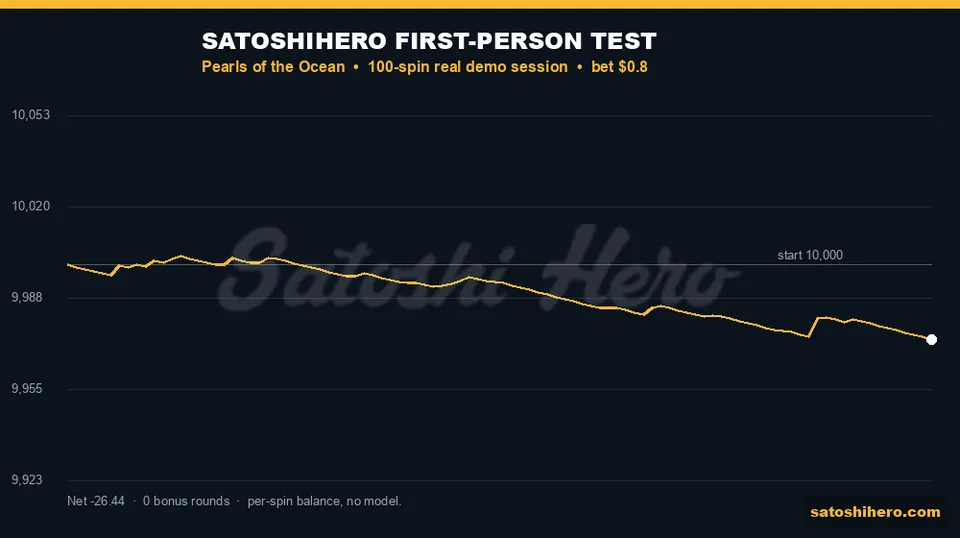
A 100-spin sample illustrates one experience and can’t test theoretical mathematics. Don’t label its observed return percentage as the game’s RTP. Every returned dollar came from base-game line wins.

Watch Out: Medium-high volatility can push your result far beyond my 100-spin path. Feature buys also compress 35 to 100 ordinary stakes into one decision.
The published theoretical return describes the game’s designed mathematics, while one live session doesn’t alter it. Our simulator models possible outcomes from the stated return, risk level, and prize limit rather than recording actual spins. Buy modes can use different mathematics by design, so I won’t invent mode-specific figures that weren’t provided.
Frequently Asked Questions
What is Pearls of the Ocean slot?
Pearls of the Ocean slot is an underwater Platipus game with a 5×4 grid and 40 fixed paylines. You also get an extended Mermaid Wild, Nudging Wilds, Respins, and Free Spins.
How do Respins work in Pearls of the Ocean slot?
Two full Wild stacks award two Respins, while three stacks award three. Each extra full stack adds another Respin, and every completed stack remains held throughout the feature.
Where do Free Spins start in Pearls of the Ocean slot?
Three, four, or five consecutive Scatter and Mermaid Wild symbols from reel one award 7, 9, or 12 spins. Each Wild during the round fills its reel, adds one spin, and stays held.
What do Nudging Wilds do in Pearls of the Ocean slot?
When Wilds appear on at least two reels, those reels can move independently and form complete Wild stacks. A successful activation starts Respins, but the qualifying setup doesn’t force a nudge.
Can you buy the bonus in Pearls of the Ocean slot?
Yes, the menu sells 7, 9, and 12 Free Spins for 35x, 60x, and 100x. Those prices equal $28.00, $48.00, and $80.00 at $0.80, and I didn’t buy any option.
Which reels carry the Mermaid Wild?
The extended Mermaid Wild appears on reels two, three, and four. It replaces regular symbols and also counts as a Scatter, so you can use it in line wins and trigger chains.
What did the Pearls of the Ocean slot simulator show?
The middle modeled 1,000-spin run ended $53.10 down. Across the model, 90% of runs ranged from $206.50 down to $162.30 up, which describes variation rather than forecasting your play.
How did the Pearls of the Ocean slot 100-spin test go?
My test returned $53.56 from $80.00 staked and ended $26.44 down. I logged 25 paying spins, an $8.52 best win, and no Nudging Wilds, Respins, or Free Spins.
What are the Pearls of the Ocean slot RTP and max win?
Pearls of the Ocean slot has a 95.04% theoretical RTP, medium-high volatility, and a 1,234x maximum win. You should weigh those figures against its featureless test.
Bottom Line
Pearls of the Ocean connects its Mermaid Wild, Nudging Wilds, Respins, and Free Spins coherently. Its restrained top prize and expensive buy menu are the main drawbacks.

My Verdict
Layered-Wild fans with controlled budgets should try the free demo before committing money. Expect readable line wins, attractive stacked art, and possible quiet stretches without a named feature.
I like how one Mermaid supports line wins, triggers, nudging, and held-stack progression. I don’t like that 100 spins missed every named feature and peaked at $8.52.
This Pearls of the Ocean slot guide is checked regularly for mechanics and test evidence. The feature design appeals, but its risk-to-ceiling trade-off limits the pull.

Pros:
 Connected features: One Mermaid Wild links line wins, triggers, Respins, and Free Spins.
- Readable paylines: Fixed routes make settled wins easy to verify after animations finish.
- Persistent progress: Full Wild stacks remain locked during Respins and Free Spins.
- Clear buy choices: Three upfront prices show the bankroll commitment before you proceed.

Cons:
 Modest ceiling: The top prize feels restrained beside the game’s elevated risk.
- Dry test: No named feature appeared across my 100 paid spins.
- Expensive top buy: The largest purchase equals 100 stakes at my tested bet.

Best For: Patient Wild-feature fans who can tolerate quiet base-game stretches get the clearest appeal. You should prefer connected progression mechanics over frequent bonuses or an enormous top prize.
Similar Games

































































Bets
All Bets
Game
Player
Date
Wager
Mult.Multiplier
Prize
 Mighty Stars
 nina87
- 10:20:00
- 0×
- Almighty Diamonds: Hold 'N' Link
 novaone948
- 10:20:00
- 0×
- Mighty Stars
- nina87
- 10:19:57
- 0×
- Elephant's Gold: Bonus Combo
- josh1998
- 10:19:56
- 0×
- Wild Buffalo Megaways: Hold N Link
 Hidden
- 10:19:55
- 0×
- Caribbean Escape: Rapid Link
- Hidden
- 10:19:55
- 0×
- Merry Cash Splash: Hold 'N' Link
- maya_81
- 10:19:54
- 0.4×
- Pelican's Bay: Rapid Link
 Hidden
- 10:19:54
- 0×
- Fortune Skulls
- mike_721
- 10:19:54
- 0.5×
- Mighty Stars
- nina87
- 10:19:54
- 0×