

Texas Dragons
By pressing play, you agree that you are above legal age in your jurisdiction and that your jurisdiction allows online gambling.

Texas Dragons
RTP95.5%
VolatilityHigh
Max winx1,057
Lines5
Hit rate8.24%
ThemeWild West
ReleasedAug 2024

Six-Shooters and Scales on a Tiny Frontier
Texas Dragons slot packs five fixed paylines and one multiplier feature into a compact 3×3 grid.
Texas Dragons is a high volatility slot from Onlyplay with 95.5% RTP and 1,057x max win potential. The game uses five fixed paylines and a three-Scatter Bonus Game with one 5x to 999x reveal. It targets classic-slot fans who accept uneven results and prefer a short feature over free spins.
Key takeaways
- Best bonus: Regular base spins at a sustainable stake provide the only tested approach; I didn’t test the 75x buy.
- RTP / volatility: The 95.5% RTP and high volatility create a risk-heavy mathematical profile.
- Max win: The 1,057x cap exceeds the separate 999x top Bonus Game multiplier.
- Risk note: My 100 spins at $1 lost $70, and only nine spins returned money.
- Bankroll note: The buy costs 75x your bet, so it costs $75 at the tested $1 stake.

Table of Contents
- How the Texas Dragons slot Works
- Symbol values
- Verified line win
- Bonus Game
- Wild West Theme and First Impressions
- 75x Buy Feature
- Maximum Win and Payout Potential
- RTP, Volatility and Our Test
- Simulator projection
- Our 100-spin session
- Bankroll Lessons From 100 Spins
- Who This Compact Slot Suits
- Frequently Asked Questions About Texas Dragons
- Bottom Line
How the Texas Dragons slot Works
The game uses three reels, three rows and five fixed paylines. You need three matching symbols across adjacent reels, read from left to right. Every paytable award scales from your selected total bet, which keeps the arithmetic simple.
The dollar bet ladder runs $1, $2, $5, $10, $20 and $50. My demo balance began at $10,000, while the controls selected $1 by default. Quick spin sits inside the autoplay panel, and I used both settings during my counted run. I like the clean controls, though you should confirm the stake before starting autoplay.
Symbol values
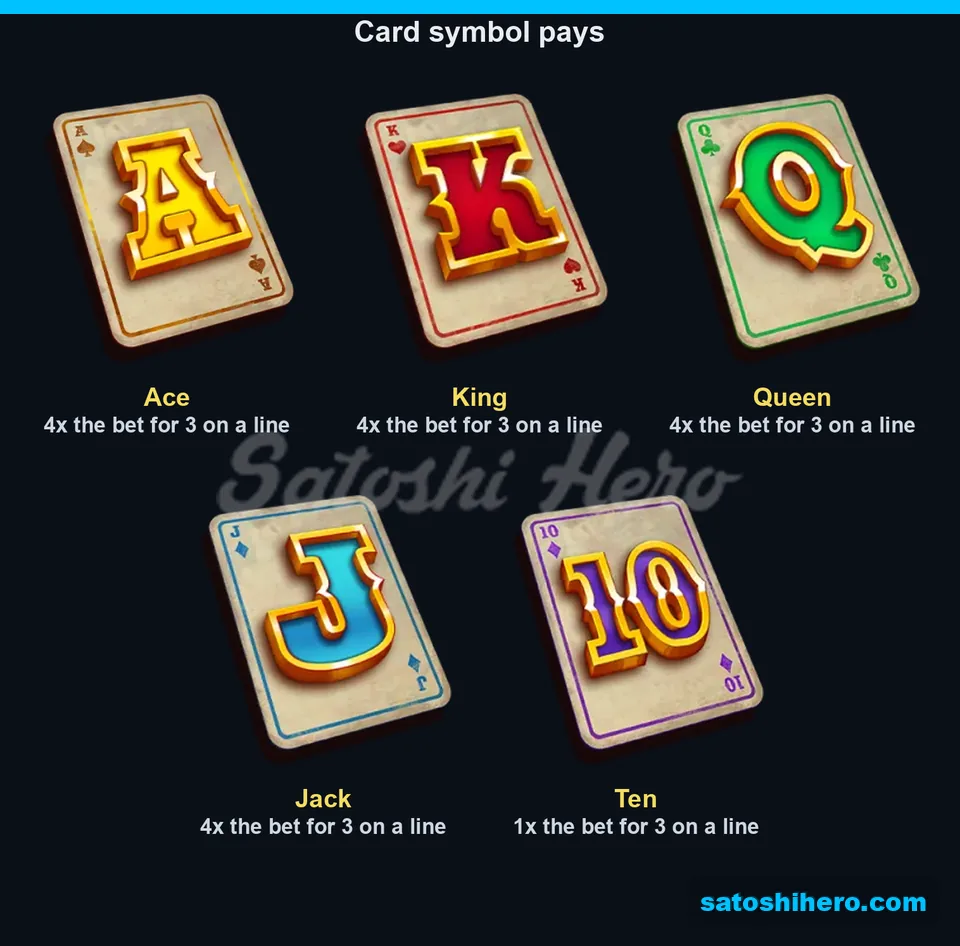
The sheriff badge tops the paytable at 60x the bet. Three money bags return 40x, while three dynamite bundles return 8x. Ace, King, Queen and Jack combinations each pay 4x, with the Ten paying 1x.
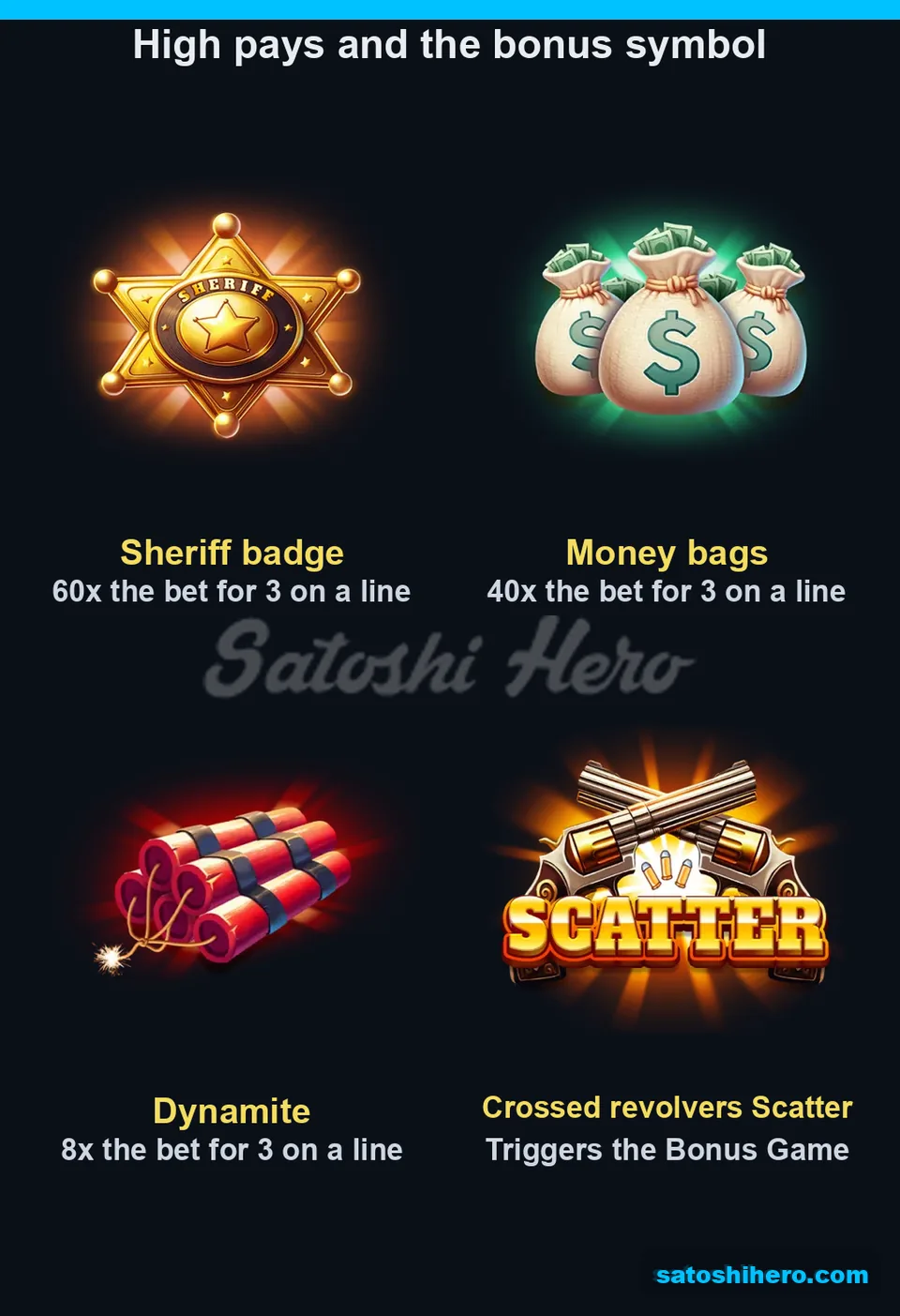
There isn’t a Wild, so you always need natural matches for line wins. Crossed revolvers act as Scatters and don’t pay by themselves. Each reel carries no more than one Scatter, and all three reels must show one to start the feature. You can trace those outcomes quickly because the board stays small.
Verified line win
I checked the card payout against an extra manual spin after my counted session. Three Jacks crossed the middle payline and returned exactly $4 from my $1 bet. That matched the listed 4x award, but it didn’t alter my recorded $70 loss.
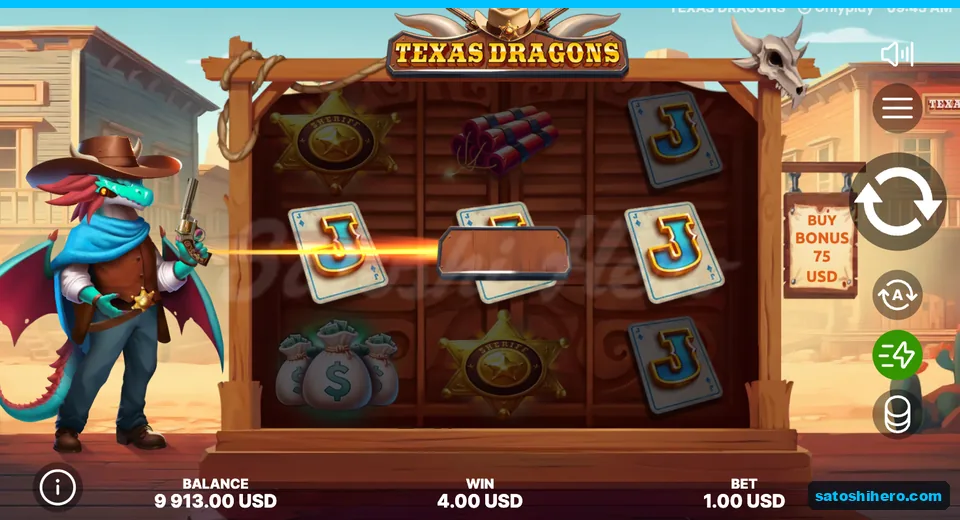
Multiple lines can activate on the same result, so inspect all five before the next spin. In my view, the readable line pattern is the strongest part of this stripped-back format. You won’t need to decode clusters, cascades or changing reel sizes.
The five-line structure also makes the $12 hit on spin 38 easy to reconstruct. Three separate 4x card lines combined into one return from the same $1 wager. That example matters because the top visible symbol doesn’t need to appear for several lines to pay together. You can compare each route with the paytable instead of trusting only the total shown.

Suggestion: Check the total bet before changing stakes because every award and the 75x buy price scale from it.
The grid makes each win easy to verify, even when your spin activates several paylines.
Bonus Game
Three crossed-revolvers Scatters trigger one random multiplier reveal. You need one Scatter on each of reels 1, 2 and 3, with no reel carrying a second one. The trigger rule is clear, but that simplicity leaves no alternative route into the feature.
Once triggered, a pop-up displays a three-reel line of numbers. Its digits spin and reveal from right to left, forming one multiplier between 5x and 999x. That completed number applies to your bet, then the feature ends. You get one reveal rather than a free-spins sequence.
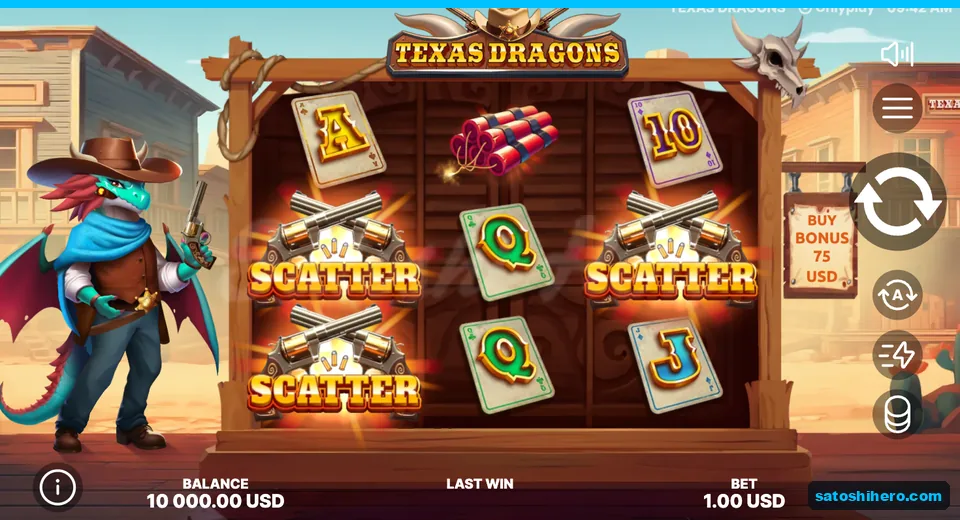
My counted 100 spins never opened the Bonus Game. I did see crossed revolvers on reels 1 and 3 together, while reel 2 stayed empty. That two-Scatter screen was only a near miss, not a partial trigger or paying result. No sugarcoating, I can’t judge the reveal’s pace or sound without seeing it complete.
If you spot two Scatters, don’t treat the final reel as overdue. Every spin remains separate, and all three reels must participate on the same result. The documented mechanics look easy to grasp, but my test offers no firsthand evidence about the completed reveal’s feel.

Data Point: The Bonus Game tops out at 999x, while the separate overall cap reaches 1,057x.
You can understand this feature in seconds, though triggering it could demand patience.
Wild West Theme and First Impressions
A friendly teal dragon sheriff anchors a bright cartoon frontier scene. The reels sit inside a wooden saloon frame, with a dusty town stretching behind them. You see a cowboy hat, blue scarf, sheriff star and revolver before your first spin.
The symbol set continues that playful Western look. Sheriff badges, money bags and dynamite sit beside card ranks and the crossed-revolvers Scatter. Nothing looks gritty, and the art keeps each object distinct at a glance. I think clarity matters more than dramatic detail on such a compact board.
Triple Dragons offers another dragon-themed visual treatment when you want the creatures without this saloon setting. Lucky Dragons and 888 Dragons provide two more dragon-themed alternatives. Here, the Western-dragon combination feels familiar rather than daring, but the teal lead character has enough charm. You won’t confuse this page with unrelated searches about real wildlife because every visual cue points toward a cartoon casino game.
My opening screen also showed the $10,000 balance, $1 bet and two-Scatter near miss without clutter. Your attention stays on the nine symbol positions instead of wandering across oversized side panels. The hanging buy sign remains visible on the right, yet it doesn’t block the reel frame.

Fun Fact: The friendly teal sheriff creates a lighter mood than the revolvers and dynamite suggest.
You can identify every symbol quickly, and that practical artwork serves clarity better than novelty.
75x Buy Feature
The BUY BONUS control sells direct Bonus Game access for 75x the current bet. Its hanging sign sits to the right of the reels and opens a confirmation card. That card gives you CANCEL and BUY controls before any purchase proceeds.
At my tested $1 stake, the displayed price was exactly $75. That equals the cost of 75 regular $1 spins, making the commitment easy to compare. A $2 stake raises the price because the purchase scales directly with your total bet. I prefer seeing a confirmation step when one click represents so many base spins.
I didn’t buy the feature during my short test. My evidence covers the displayed cost and interface, not the purchased result. You shouldn’t read the direct access as evidence of better value, and I can’t rank it above natural triggering. The control buys speed, nothing more that my session could prove.
Before opening the card, calculate your full purchase cost rather than focusing on one base spin. You should decide whether losing that whole amount fits your limit. That check matters because a fast purchase can compress a large stake into one event.

Watch Out: High volatility and a 75x purchase can drain your bankroll quickly. Choose stakes from the full buy price, not one spin’s cost.
The buy gives you immediate access, but my session found no proven value advantage.
Maximum Win and Payout Potential
The official maximum win is 1,057x the bet. Keep that overall ceiling separate from the Bonus Game’s 999x top reveal and the sheriff badge’s 60x line award. Those numbers describe different payout layers, not conflicting limits.
My best counted hit arrived on spin 38 and paid $12 from a $1 stake. Three paylines each returned 4x on a grid filled with matching cards. That result demonstrates how several fixed lines can pay together, even without a Wild. You can get overlapping line wins, but my run never approached the top prize.
The separate manual spin produced only one $4 middle-line win. I captured it to verify the card payout after the session, so it didn’t change the $9,930 closing balance. These two observed examples sat far below both headline multipliers. In practical terms, most of my paying spins returned just $1 or $2.
Even the top base symbol sits far below the feature ceiling at 60x. The five-line board allows combined returns, though my strongest example stopped at $12. You can verify each contributing line on the compact grid, which I value despite the modest upper limit.
Plain and simple, the ceiling feels restrained beside this risk level. You should weigh that capped upside against stretches with little feedback, especially if huge headline prizes drive your choices. Your preferred prize profile decides whether 1,057x feels sufficient, but the trade-off doesn’t impress me.
The payout structure favors compact, readable action over exceptionally large headline prizes.
RTP, Volatility and Our Test
The risk profile combines a 95.5% theoretical RTP, high volatility and a 1,057x maximum win. RTP describes the game’s mathematical return, not a promise for your session. High volatility can deliver uneven results and long runs with few paying spins.
A larger bankroll doesn’t improve the underlying mathematics. It only gives you more money to expose to the same game. Treat these figures as context rather than guarantees because your short result can differ sharply. I find the risk hard to ignore when the payout ceiling remains relatively contained.
Simulator projection
The SatoshiHero Slot Simulator modeled 1,000 spins at $1 each. Its median session ended $73.10 down, while the 5th percentile ended $324.10 down. At the 95th percentile, the modeled session finished $355.50 up. That wide band shows how varied the outcomes can become.
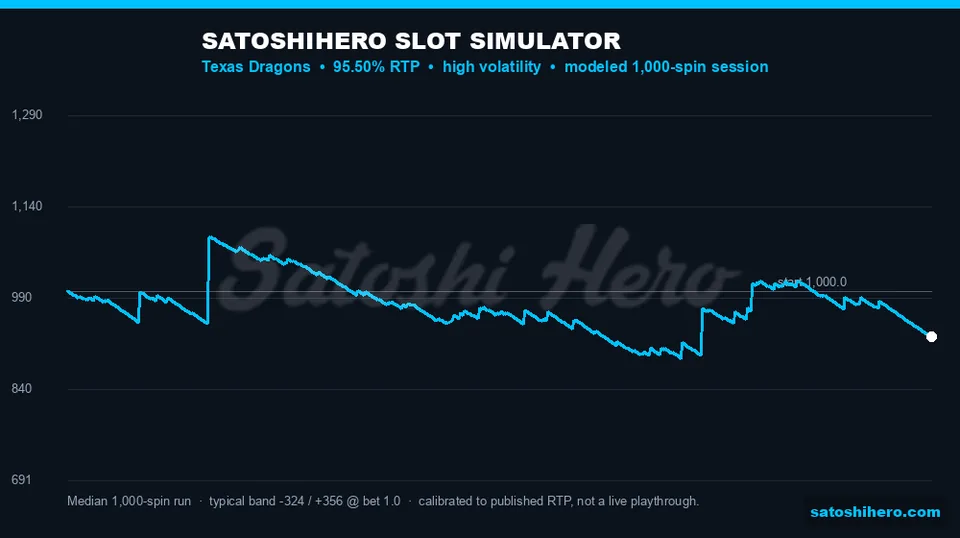
About 18% of modeled spins returned something. The model placed a bonus roughly once per 46 spins and a big win roughly once per 1,770 spins. You shouldn’t treat either frequency as a schedule or countdown. I see those estimates as useful scale markers, not promises about your next spin.
The percentile band deserves more attention than the median alone. A middle modeled outcome hides both the $324.10 downside case and the $355.50 upside case. Neither edge predicts your result, yet both show why a short balance path can separate sharply from the central estimate. You should plan around uncertainty rather than expecting the median to appear.
Our 100-spin session
I started with $10,000 and played 100 autoplay spins at $1 with quick spin active. My final balance was $9,930, leaving me $70 down. Only nine spins paid anything, and most returns were $1 or $2. That sparse rhythm made the session feel colder than the compact, cheerful screen suggests.
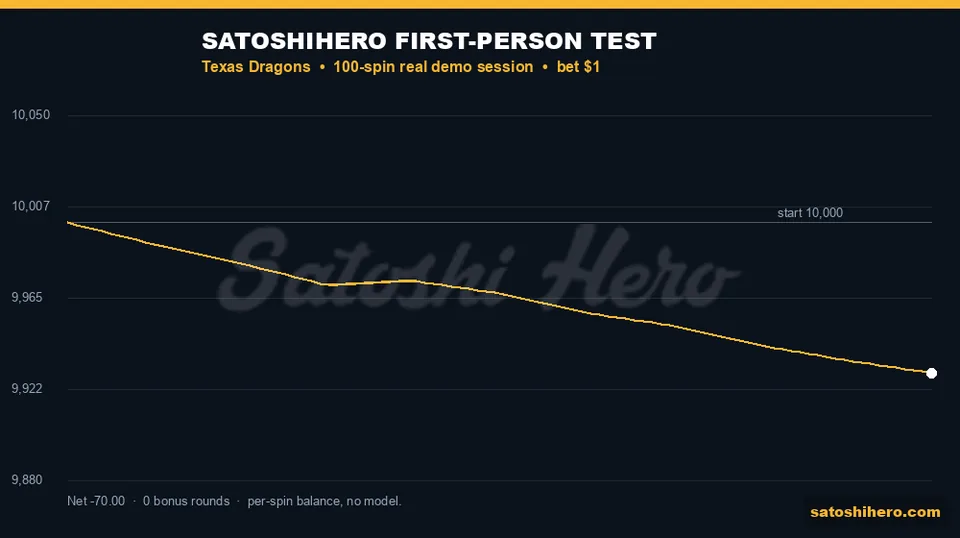
Spin 38 delivered my $12 high point through three simultaneous 4x card lines. The Bonus Game never triggered, and I never bought it. My $70 live loss was numerically smaller than the model’s $73.10 median loss, but those sessions used different spin counts. You can’t treat 100 observed spins and 1,000 modeled spins as equivalent samples.
The session path mostly moved downward in small steps because wins arrived infrequently. A $1 or $2 return softened individual losses without reversing the broader slide. My single $12 peak was noticeable, but it couldn’t offset the accumulated cost of the quiet spins. That pattern explains the ending balance more clearly than the net figure alone.
One short test can’t predict your next run. The 95.5% figure is the operator-published theoretical RTP, while the simulator supplies modeled projections. My live session neither changes nor validates that percentage. A separately configured bonus-buy return can differ slightly from base play by design, without changing what I observed.
The test demonstrates short-run variance, not a revised mathematical return.
Bankroll Lessons From 100 Spins
The quiet run shows how quickly a limited session budget can decline. A hypothetical $100 budget at my $1 stake would have fallen to $30 after the same $70 loss. You need to budget for losing spins before playing because nine returns across 100 rounds felt sparse.
One $75 feature purchase would consume three-quarters of that same $100 budget. You’d have only $25 left if the bought reveal returned nothing, compared with 75 separate base spins for the purchase price. That comparison doesn’t prove one path performs better. It simply exposes how much money the shortcut concentrates into a single event.
Within the $1, $2, $5, $10, $20 and $50 ladder, $1 is the most defensible starting point for a limited bankroll. I wouldn’t call any stake safe, and extra funds don’t improve the return percentage. Smaller stakes just stretch a fixed dollar limit across more decisions. Your stopping point should include the full buy cost before you open its card.
Quick spin changes pace, not probability or expected return. Fast autoplay can make a quiet decline feel less noticeable, so check your balance instead of watching only individual wins. In my view, the $70 slide mattered more than any convenience offered by faster animation.
A session limit works better when you express it in dollars before pressing spin. At $1, a $100 budget covers at most 100 full wagers before any returns extend play. At $5, that same amount covers only 20 wagers, while one buy costs $375. You should compare those exposures before selecting speed or autoplay settings.
Stake size matters more here than the quick-spin setting.
Who This Compact Slot Suits
The game fits classic-slot fans who enjoy three-reel action and accept uneven results. You get a tiny board, five fixed lines and one multiplier reveal instead of a layered free-spins round. I think that focus works when simplicity matters more than feature depth.
Likely matches include:
- Classic fans drawn to three-reel, five-line formats.
- Short-feature fans who prefer one multiplier reveal over lengthy free spins.
- Theme-led players attracted to bright dragon and Wild West artwork.
- Risk-tolerant players comfortable with high volatility and a 1,057x ceiling.
It makes less sense for:
- Players seeking Wild-heavy mechanics or expanding grids.
- Bonus hunters wanting layered or lengthy feature rounds.
- Players who prefer frequent feedback from their bankroll.
- Prize chasers seeking much larger upside relative to the risk.
Only nine of my 100 observed spins paid, and the Bonus Game neither triggered nor received a purchase. My recommendation rests on verified base-game play and documented feature rules. You should ask whether the clean format offsets quiet stretches for you. Your preferred prize ceiling also needs to match a capped high-risk profile.
Free demo and real play are available here on SatoshiHero, so you can inspect the controls directly. The mechanics and specifications are checked regularly, but my observed result remains one short session. I like the accessible format, though deeper bonus fans could find it thin.
Choose this compact game for simplicity, not constant action or oversized upside.
Frequently Asked Questions About Texas Dragons
How many paylines does the Texas Dragons slot have?
The Texas Dragons slot has five fixed paylines on a 3×3 grid. Three matching symbols must cross adjacent reels from left to right, and every award scales from your total bet.
What triggers the Bonus Game in the Texas Dragons slot?
One crossed-revolvers Scatter must land on each of reels 1, 2 and 3. The feature reveals one random multiplier from 5x to 999x, but it didn’t trigger during my 100-spin test.
Can I buy the Texas Dragons slot Bonus Game?
Yes, the BUY BONUS control charges 75x your selected bet. It showed a $75 price at my $1 stake, though I didn’t complete a purchase during the test.
What does the top symbol pay in the Texas Dragons slot?
Three sheriff badges pay 60x the bet on a fixed line. Money bags pay 40x, dynamite pays 8x, Ace through Jack pay 4x each, and the Ten pays 1x.
Does the Texas Dragons slot have a Wild?
No, the Texas Dragons slot has no Wild symbol. Crossed revolvers serve as the only special symbol, and they trigger the Bonus Game without paying by themselves.
What did the Texas Dragons slot simulator project?
The model projected a $73.10 median loss across 1,000 spins at $1. Its modeled range ran from $324.10 down at the 5th percentile to $355.50 up at the 95th percentile, not a prediction for one session.
How did the Texas Dragons slot perform over 100 spins?
My balance fell from $10,000 to $9,930, creating a $70 loss. Nine spins paid, my top hit was $12 on spin 38, and the Bonus Game didn’t trigger.
Which RTP and maximum win apply to the Texas Dragons slot?
Texas Dragons slot has 95.5% RTP, high volatility and a 1,057x maximum win. The separate Bonus Game multiplier reaches up to 999x the bet.
Bottom Line
Texas Dragons keeps everything compact through five fixed lines, clear symbols and one short multiplier feature. Its easy reading stands out, but the restrained ceiling weakens the appeal of its risk-heavy profile.

My Verdict
Classic-slot fans can appreciate the simple board and direct trigger rule. Expect uneven base play, sparse paying spins and no guarantee that a short session opens the feature.
I like how quickly I could verify paylines and symbol values. I don’t like losing $70 across 100 spins while seeing only nine returns, and the missing Bonus Game left the main feature untested.
The Texas Dragons slot guide is checked through direct play and documented mechanics. That evidence supports the simple format, while the test still argues for firm spending limits.

Pros:
 Readable grid: Nine positions make every winning line easy to trace.
- Verified paytable: My $4 Jack line matched the listed 4x award exactly.
- Simple feature: Three Scatters lead straight to one multiplier reveal.
- Clear buy price: The 75x cost scales transparently with your chosen bet.

Cons:
 Sparse returns: Only nine of my 100 counted spins paid anything.
- No Wild: Every base win needs natural matching symbols across one line.
- Restrained ceiling: The 1,057x cap feels modest beside high volatility.

Best For: Classic-slot fans who value clear lines, short features and playful Western artwork get the strongest match. You still need patience for quiet stretches and comfort with a limited top-end prize.


































































Bets
All Bets
Game
Player
Date
Wager
Mult.Multiplier
Prize
 Galaxy Glitter
 josh1998
- 06:22:15
- 0×
- Triple 5's: Megacharged
 Hidden
- 06:22:13
- 0×
- 5 Power Joker
 Gkc818
- 06:22:12
- 0×
- Triple 5's: Megacharged
- Hidden
- 06:22:12
- 2.19×
- Wild Cash x9990
 nymphetamine1231
- 06:22:12
- 0×
- 5 Power Joker
- Gkc818
- 06:22:11
- 0×
- Galaxy Glitter
- josh1998
- 06:22:10
- 0×
- 5 Power Joker
- Gkc818
- 06:22:09
- 0×
- Wild Cash x9990
- nymphetamine1231
- 06:22:09
- 0×
- Elephant's Gold: Bonus Combo
- Hidden
- 06:22:08
- 0×