

Teddy’s Quest
By pressing play, you agree that you are above legal age in your jurisdiction and that your jurisdiction allows online gambling.


Chasing Honey Through Teddy’s Woodland
Follow Hungry Teddy through Octoplay’s bright storybook woodland as he chases honey and collects a growing Prize Pot.
According to Octoplay, Teddy’s Quest slot has low-medium volatility, 95.81% RTP, and maximum wins of 5,000x the bet. Its 6×5 pay-anywhere grid rewards eight matching symbols without fixed paylines. Cheerful visuals, cascading wins, and regular small returns shape the experience. I lost $44.20 across 100 spins at $1, with 30 paying spins and no Free Spins. Bets span $0.10–$50, and I used Fast play while inspecting, but not buying, the 100x feature.
Key takeaways
- Best bonus: Regular base play has the firmest evidence because I inspected the Free Spins buy without purchasing it.
- RTP / volatility: The mathematical profile combines 95.81% RTP with low-medium volatility.
- Max win: The game caps any round at 5,000x the bet.
- Risk note: Thirty spins paid, yet most returns failed to cover my $1 wager.
- Bankroll note: One feature purchase costs 100 stakes, while my session lost 44.2 stakes across 100 spins.
These points separate rules, modeled possibilities, and my play. You shouldn’t treat an untested purchase as better value, and you can start with regular spins.

Table of Contents
- How Teddy’s Quest Works
- Symbol values
- Theme and First Impressions
- Prize Pot and Hungry Teddy
- Reading the pot
- Red Blaze and Blue Blaze
- Free Spins and the Honeycomb
- Building the pot
- Buying the Bonus
- How the Base Game Felt
- Session pattern
- RTP, Volatility and Our Test
- Simulator projection
- Our 100-spin session
- Teddy’s Quest slot FAQ
- Final Take
How Teddy’s Quest Works
You need at least eight identical symbols anywhere on the 6×5 grid to make a standard win. Teddy’s Quest slot has no fixed paylines, and matching icons don’t need to touch. Higher symbol counts improve payouts at 10+, 12+, and 15+ matches.
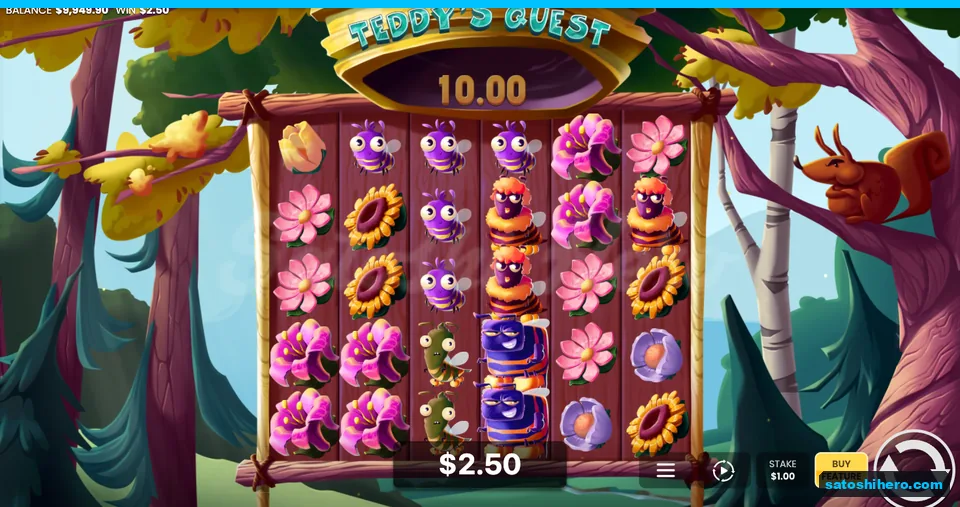
Winning symbols pay first, then disappear from the board. Remaining icons drop into each gap before new ones fall from above. Another qualifying group starts a fresh cascade, and the chain continues while wins keep forming. Every payout joins that spin’s total, so you should let the sequence finish before judging the result.
I found this structure easy once I stopped looking for lines. Scan the whole grid for repeated colors rather than tracing left-to-right routes. Several drops can make a low return look lively, but cascades don’t guarantee your stake back.
Symbol values
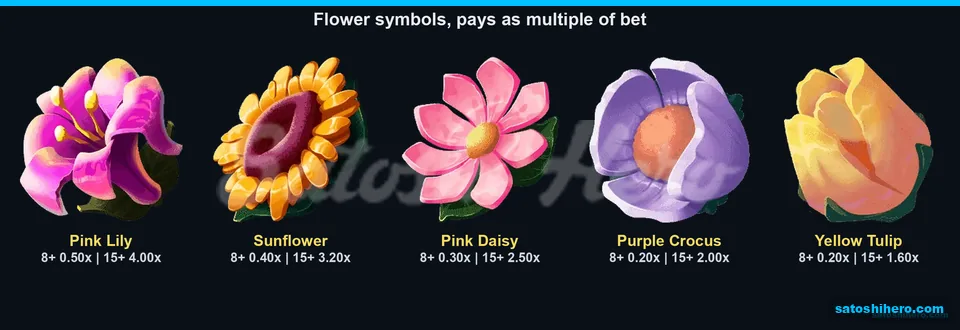
Each sequence below shows payouts for 8+, 10+, 12+, and 15+ matching symbols:
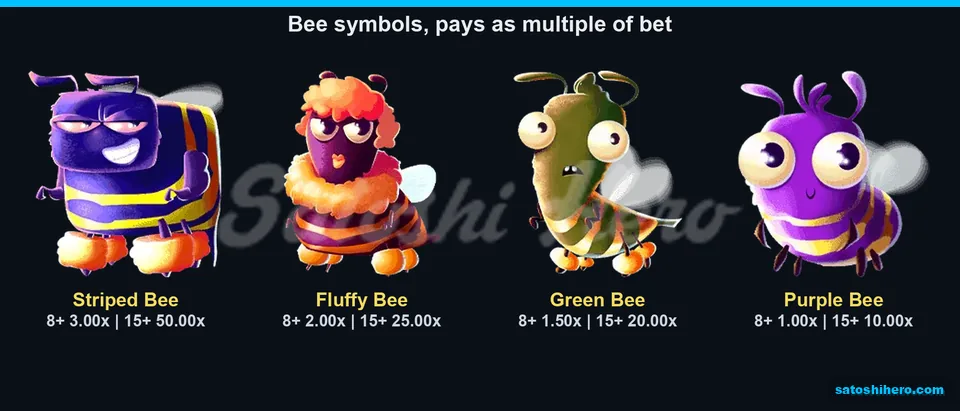
- Striped Bee: 3x, 6x, 15x, and 50x.
- Fluffy Bee: 2x, 4x, 10x, and 25x.
- Green Bee: 1.5x, 3x, 9x, and 20x.
- Purple Bee: 1x, 2x, 5x, and 10x.
- Pink Lily: 0.5x, 1x, 2x, and 4x.
- Sunflower: 0.4x, 0.8x, 1.6x, and 3.2x.
- Pink Daisy: 0.3x, 0.6x, 1.2x, and 2.5x.
- Purple Crocus: 0.2x, 0.5x, 1x, and 2x.
- Yellow Tulip: 0.2x, 0.4x, 0.8x, and 1.6x.
Bees occupy the stronger end, while flowers supply modest returns. Eight Purple Crocus symbols paid $0.20 at my $1 stake. That result showed why a visible win can still leave the spin down.
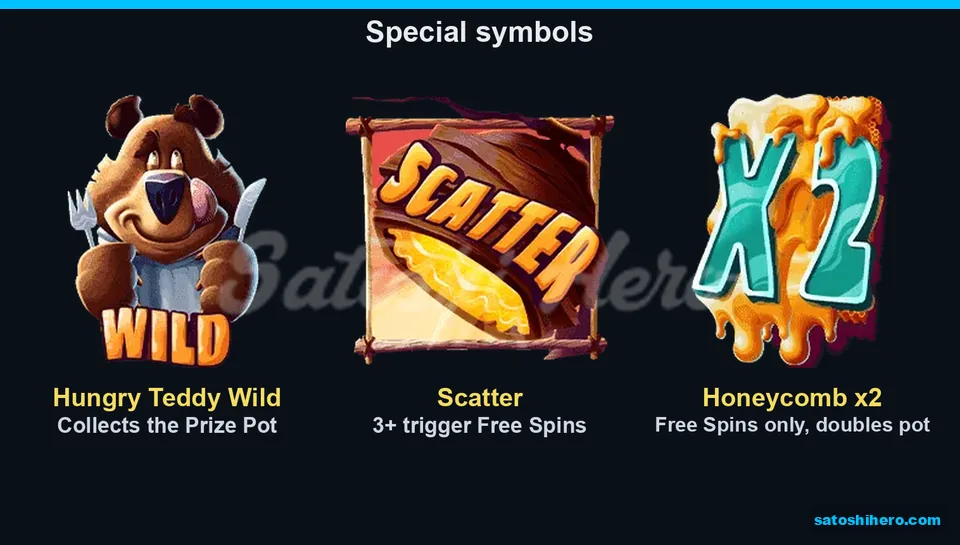
Hungry Teddy acts as the Wild and replaces every regular paying symbol. He can’t replace the Scatter, which pays nothing alone and triggers Free Spins instead. Controls and grid spacing remain practical on desktop and mobile screens, although smaller displays naturally compress the woodland art.

Factoid: Eight matching symbols can pay from anywhere on the grid. They don’t need to touch or land on a line.
You should read the final cascade total, not one animation in isolation. Symbol count, rather than symbol position, decides every regular win, and that simple rule keeps the grid approachable.
Theme and First Impressions
A soft woodland adventure frames Hungry Teddy’s search for honey. Bees and flowers cover the grid, while a honey-pot sign hangs above it. A squirrel watches from the tree at the right, adding a small storybook detail that I noticed before the first spin finished.
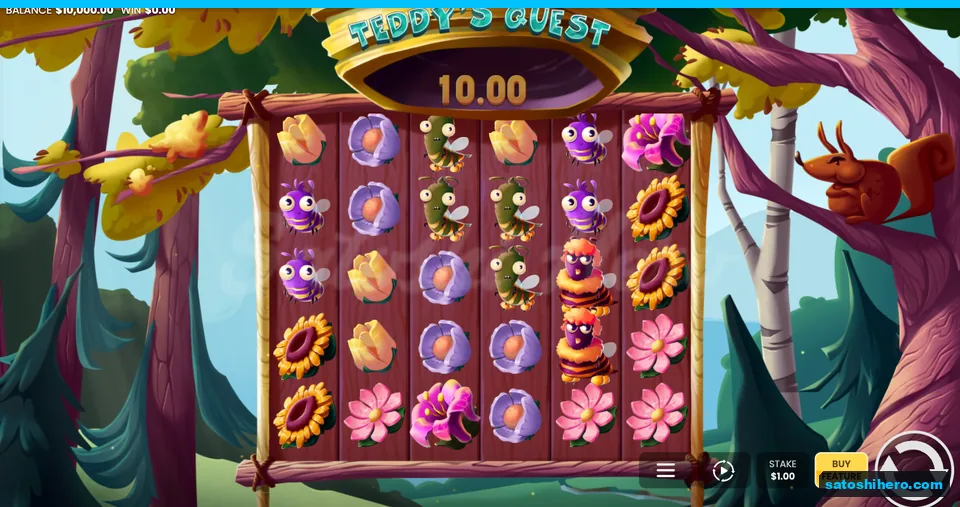
Octoplay keeps the palette bright and easy to separate. Stake, autoplay, and feature-buy controls sit below the board. You can focus on symbols without hunting through menus. In my view, that clarity matters more than the familiar premise.
The concept won’t win originality awards, but its cohesive art gives every icon a clear role. Bees look distinct from flowers, and each color remains readable during cascades. If you prefer cheerful cartoons over grim monsters or harsh industrial themes, you’ll feel at home here. Yeti Quest offers another creature-led journey, although its appeal starts with a colder fantasy atmosphere rather than this sunny woodland. Quest to the West, Indiana’s Quest, and Dungeon Quest provide three more quest-themed comparisons with western, explorer, and fantasy settings.

Discovery: The squirrel and honey-pot sign extend the woodland story beyond the reel symbols. Those background touches make the board feel like a tiny illustrated scene.
Sound and motion stay light rather than demanding attention. You can follow repeated drops without the presentation turning noisy, which helped during my autoplay test. I’d call the visual treatment pleasant rather than daring, and that restraint supports longer sessions. The style’s strongest practical benefit is clear symbol separation whenever the board refills.
Prize Pot and Hungry Teddy
The Prize Pot starts at 10x your selected stake, and Hungry Teddy collects it whenever he lands. At my $1 stake, the display showed 10.00 above the grid. That visible total tells you what Teddy can collect, rather than what the current cascade has already paid.
Reading the pot
Hungry Teddy occupies a tall 1×2 space and substitutes for regular paying symbols. He can’t replace the Scatter. Once he appears, he remains on the grid until that spin and every connected cascade finish. His size makes him easy to spot, which is useful when several flower icons fall around him.
The pot’s stronger growth loop belongs to Free Spins. You shouldn’t assume it steadily builds through ordinary base-game play, because the standard round doesn’t use the same win-feeding process. I watched the amount above the board and treated it as a separate feature meter. That distinction prevents a common mistake: confusing a cascade total with the available Prize Pot.
During bonus play, you should track three things separately: normal payouts, additions to the pot, and Teddy’s arrival. A large displayed pot still needs Hungry Teddy to collect it. What stands out is the tension between seeing value accumulate and waiting for the bear to appear.

Tactic: Watch the Prize Pot total during bonus play instead of judging the round only by each cascade. This helps you follow the feature but doesn’t change its random outcome.
I like how the interface keeps the amount visible without covering the action. Teddy performs the collection role, while symbol wins and Honeycomb landings handle the pot-building process. Keeping those jobs separate makes the feature much easier to understand.
Red Blaze and Blue Blaze
Red Blaze multiplies a marked symbol’s payout by 5, while Blue Blaze multiplies it by 10. Each modifier changes only the payout attached to that marked symbol. It doesn’t multiply your balance, the entire bonus round, or every value inside the Prize Pot.
The modifier fits naturally beside the pay-anywhere system. A marked icon can make a small qualifying group much more valuable, even though you still need eight matching symbols to start a win. You should identify the colored Blaze on the symbol, then check how that icon contributed when the win total settles.
My counted test didn’t record a separate Blaze result, so I’m describing the documented mechanic rather than claiming a firsthand hit. That boundary matters because a flashy modifier can sound more common than it really felt. I won’t estimate its frequency or attach a cash example that never appeared in my log.
Teddy’s Quest slot keeps the rule narrow enough to understand quickly. Red means five times that symbol’s normal payout, while blue means ten times. In my view, Blue Blaze carries the stronger visual promise, but neither color changes the trigger threshold.
Watch the marked icon through any cascade animation, since fresh symbols can alter the group around it. You should then read the completed spin total rather than assuming the whole result received the modifier. Blaze improves payout value, not the number of symbols counted toward a win.
Free Spins and the Honeycomb
Three or more Scatters award Free Spins, beginning with 10 spins. Every Scatter beyond the third adds two more, allowing a starting total of 22 spins. Three or more Scatters inside the feature add spins through the same rule.
During Free Spins, each symbol win pays normally and also enters the Prize Pot. The bonus-only 1×2 Honeycomb x2 can double the pot’s accumulated value whenever it lands. Hungry Teddy then collects the displayed amount when he appears. You need to watch all three events because a growing pot and a collected pot aren’t the same result.
Building the pot
The feature’s sequence is straightforward:
- Three Scatters start 10 Free Spins.
- Extra triggering Scatters add two spins each.
- Regular symbol wins also feed the Prize Pot.
- A Honeycomb x2 doubles the accumulated pot.
- Hungry Teddy collects the pot when he lands.
- More Scatters can extend the round.
Free Spins didn’t trigger during my 100 counted spins. I can explain the rules precisely, but I can’t present the bonus as something I experienced in that session. That absence also made the base-game rhythm more important, because cascades supplied all observed activity.
You should monitor regular payouts first, then the growing pot above the board. Honeycomb landings matter more after value has accumulated, yet their timing remains random. Teddy’s collection creates the release point, which gives this bonus a clearer arc than a basic free-spin multiplier.
The round ends early if the 5,000x maximum win is reached. I like the build-and-collect idea, although my test gave me no evidence about its typical returns. Teddy’s Quest slot creates its main bonus tension by making you watch value grow before the bear can collect it.
Buying the Bonus
The Buy Feature opens Free Spins for 100x your chosen stake. At the tested $1 stake, the panel showed a verified price of $100. I opened that panel to inspect the cost, then returned to ordinary spins without making the purchase.
One buy costs the same as 100 regular wagers at that stake. You should compare that commitment with the base spins your budget can support. A 100x entry price feels substantial because one decision places many stake units at risk immediately.
Buying the feature guarantees access to Free Spins, not a profit, certain Honeycomb action, or a particular Prize Pot. It also doesn’t prove better value than waiting for a natural trigger. I didn’t test the purchase, so I won’t estimate average returns, feature frequency, or a separate buy-mode return.

Proceed Carefully: The $100 buy at a $1 stake guarantees access to Free Spins, not a profit or a particular Prize Pot result.
If you use the option, base your choice on stake units. A lower stake reduces the cash price, but the cost remains 100 ordinary wagers. You can try the SatoshiHero demo first without turning the buy into a casual shortcut.
My preference from this evidence is regular base play, since that’s the mode I actually measured. Teddy’s Quest slot makes the purchase easy to find, but convenience doesn’t reduce its bankroll impact. Treat the feature buy as a separate budget decision, not a faster spin button.
How the Base Game Felt
Thirty of my 100 counted spins returned a payout, but most wins stayed small. Twenty-six paying spins returned between $0.20 and $1.70. The remaining four paid $4, $10, $10.60, and $12.70, so the distribution leaned heavily toward modest results.
Session pattern
My session high arrived on spin 98 through a cascade chain. That $12.70 result added late excitement without repairing the full session loss. No Free Spins appeared during the count. I found the board active, yet the balance still slipped because many paying spins returned less than my $1 stake.
A hit and a profit aren’t interchangeable. If a spin pays $0.20 after a $1 wager, you see a win animation but remain $0.80 down on that play. You should judge the balance movement alongside the hit count, especially when cascades make small returns feel more eventful.
Fast play and 100-round autoplay kept the rhythm brisk. I still logged the balance after every spin, which made partial stake returns easy to spot. The frequent board changes prevented long stretches from feeling empty, though the money result remained plainly negative.
Later spins used to capture a $2.50 base-game image weren’t included in any reported figure. I kept those screenshots separate so the counted sample stayed exactly 100 spins. That separation matters more than presenting a prettier win frame as part of the test.
Teddy’s Quest slot can look busier than its balance path suggests. You shouldn’t treat this sample as a forecast, because another random session can land anywhere across a much wider range. My mildly positive take is that the cascades kept me watching, even when their returns were tiny.
The base game stayed active and readable, but it didn’t produce a profitable test. That contrast captures the experience better than the 30 paying spins alone.
RTP, Volatility and Our Test
The mathematical profile combines 95.81% RTP, low-medium volatility, and a 5,000x maximum win. RTP describes the game’s theoretical return, not a promise for your next session. The ceiling is possible, but you shouldn’t read it as likely or expected.
Low-medium volatility fits my pattern of numerous small payouts and a few stronger hits. Still, one 100-spin test can’t prove a rating by itself. I think the profile feels gentler than a feast-or-famine slot, although the $44.20 loss shows that steady-looking action can still drain a balance.
Simulator projection
The SatoshiHero Slot Simulator modeled 1,000 spins at $1 using the stated mathematical profile. Its median session finished $42.60 down. The middle 90% ranged from $170.80 down to $94.90 up, showing how widely outcomes can spread around one central figure.
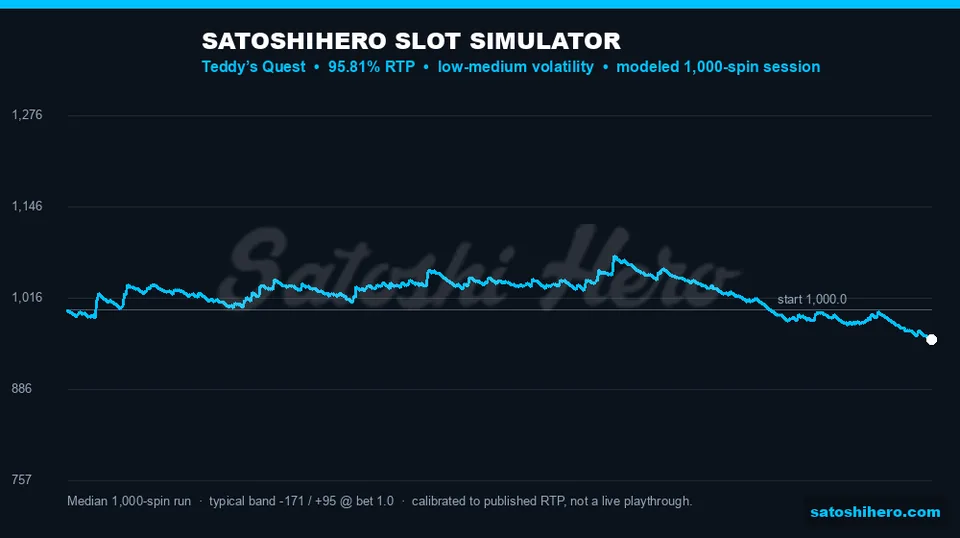
About 30% of modeled spins returned something. A feature-tier event appeared roughly once every 70 modeled spins, while a very large win appeared roughly once in 200,000 spins. Those frequencies describe the model, not a countdown. You can’t use them to predict the next trigger or influence the random-number generator.
The projection helps you picture session variation rather than forecast a balance. I find the wide middle range more useful than the median alone because it includes both meaningful losses and profitable runs. Teddy’s Quest slot can produce many paths, even when every modeled session uses identical inputs.
Our 100-spin session
My demo test ended $44.20 down after exactly 100 spins. I started with $10,000, wagered $1 per round, enabled Fast play, and set autoplay to 100 rounds. The ending balance was $9,955.80 after exactly 100 stakes had been debited.
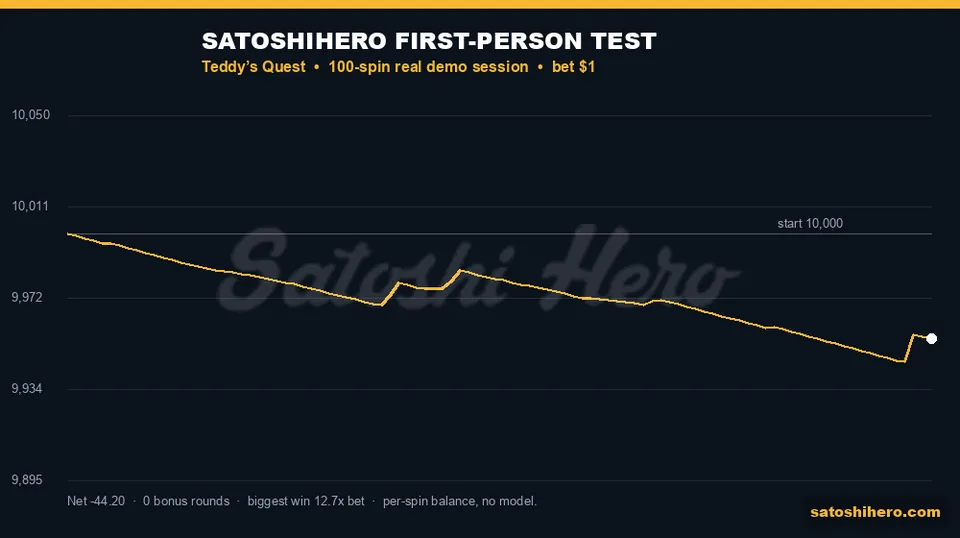
Thirty spins returned money, and the largest win reached $12.70 on spin 98. Twenty-six payouts fell between $0.20 and $1.70, while three others reached $4, $10, and $10.60. Free Spins never triggered, so every result came from the base game and its cascades.
The $44.20 live loss sits near the simulator’s $42.60 median by coincidence. Different sample sizes produced those figures, and their proximity doesn’t show that short sessions follow theoretical return. You should keep observed play separate from modeled outcomes, even when two headline numbers look similar.
The 95.81% figure is the operator-published theoretical return. One 100-spin session can’t alter, confirm, or disprove it, and I haven’t assigned a separate return to the untested bonus purchase. Modeled possibilities and my live observations answer different questions.
This test records one real playing experience, not a guaranteed pattern. I’d use it to understand payout shape and bankroll movement, never to predict what Teddy’s Quest slot does next.
Frequently Asked Questions
How does the pay-anywhere system work in Teddy’s Quest slot?
Eight or more matching symbols can win anywhere on the 6×5 grid. Payouts rise at 10+, 12+, and 15+ matches. Winning icons disappear, new symbols fall into place, and another qualifying group can continue the cascade within the same spin.
What does the Hungry Teddy Wild do in Teddy’s Quest slot?
Hungry Teddy is a 1×2 Wild that substitutes for every paying symbol except the Scatter. He remains through the spin’s connected cascades and collects the displayed Prize Pot whenever he lands. The pot starts at 10x your stake.
How do Free Spins work in Teddy’s Quest slot?
Three Scatters award 10 Free Spins, and each extra Scatter adds two more, up to 22 starting spins. Retriggers follow the same rule. Symbol wins also feed the Prize Pot, while Honeycomb x2 symbols can double it before Hungry Teddy collects it.
What do Red Blaze and Blue Blaze do?
Red Blaze multiplies its marked symbol’s payout by 5, while Blue Blaze multiplies it by 10. Neither modifier affects your whole balance, complete session, or every bonus payout. You still need the normal qualifying symbol count.
What happened in the Teddy’s Quest slot 100-spin test?
I started with $10,000 and ended with $9,955.80, creating a $44.20 loss at $1 per spin. Thirty spins returned payouts, my largest win was $12.70, and Free Spins didn’t trigger during the count.
What does the simulator suggest for Teddy’s Quest slot?
The 1,000-spin model produced a $42.60 median loss at $1 stakes. Its middle 90% ranged from $170.80 down to $94.90 up. That spread can’t predict an individual session.
What are the Teddy’s Quest slot RTP and maximum win?
Teddy’s Quest slot has 95.81% RTP, low-medium volatility, and a maximum win of 5,000x the bet. RTP remains theoretical, while the maximum marks a ceiling rather than an expected result.
Can I buy Free Spins in Teddy’s Quest slot?
Yes. The feature costs 100x your stake, producing a verified $100 price at $1 per spin. I inspected the purchase panel but didn’t buy the bonus during my test, so I make no claim about its typical return.
Final Take
Teddy’s Quest stands out through readable cascades and a clear build-and-collect bonus. Its drawback is that small wins can hide an ongoing balance decline.

My Read
Cheerful-theme fans who enjoy frequent grid movement should try the base game before considering the buy. Expect modest returns, occasional better cascades, and no assurance that Free Spins appear quickly.
I like the clean symbols and constant cascade motion. I don’t like how 26 paying spins returned no more than $1.70. The late $12.70 hit helped the mood, not my balance.
The Teddy’s Quest slot gives you simple rules with useful feature depth. This guide is updated periodically after fresh checks.

Pros:
 Readable grid: Clear colors help you follow matching symbols through every cascade.
- Simple win rule: Eight matching icons can pay without fixed line patterns.
- Visible Prize Pot: The display makes bonus value easy to track.
- Active base play: Cascades created regular movement throughout my counted session.

Cons:
 Small returns: Most paying spins barely covered or missed the $1 wager.
- Costly bonus access: The feature buy consumes 100 stakes in one decision.
- No tested bonus: Free Spins never appeared during my 100-spin sample.

Best For: Cheerful slot fans who value simple pay-anywhere rules, bright art, and frequent cascade motion get the clearest appeal. Careful budgeters should stay with measured base play before risking 100 stakes on direct bonus access.
Similar Games


































































Bets
All Bets
Game
Player
Date
Wager
Mult.Multiplier
Prize
 Pelican's Bay: Rapid Link
 josh1998
- 21:00:36
- 0×
- Clovershot
 Hidden
- 21:00:36
- 7.16×
- Katana Klash: Hold'n'Link
- nina87
- 21:00:35
- 0×
- Clovershot
- Hidden
- 21:00:34
- 0.5×
- Pelican's Bay: Rapid Link
- josh1998
- 21:00:33
- 3.7×
- Clovershot
- Hidden
- 21:00:30
- 0×
- Pelican's Bay: Rapid Link
- josh1998
- 21:00:30
- 1.7×
- Katana Klash: Hold'n'Link
- nina87
- 21:00:30
- 0×
- Clovershot
- Hidden
- 21:00:29
- 0×
- Clovershot
- Hidden
- 21:00:28
- 0×