

Spirit Blast
By pressing play, you agree that you are above legal age in your jurisdiction and that your jurisdiction allows online gambling.


Totem Storms and Cascading Wins
Spirit Blast slot is an Octoplay pay-anywhere game built around cascades, symbol-specific Blaze boosts and persistent Free Spins multipliers.
Spirit Blast slot has low-medium volatility, 95.83% RTP and a 9,000x maximum win. Its 5×6 grid pays for eight matching symbols anywhere, fitting you if frequent small returns and multiplier-led bonuses sound appealing. I tested 100 fast autoplay spins at $1 from a $10,000 demo balance, losing $41.50 with 40 paying spins, a $7.30 top win and no Free Spins. Stakes run from $0.10 to $100.00, while demo and real play sit here on SatoshiHero.
Key takeaways
- Best bonus: Regular base-game spins at a manageable stake gave me measured evidence; the Buy Feature was available but remained untested.
- RTP / volatility: The calm profile matched frequent small returns, though those hits didn’t stop a steady balance decline.
- Max win: The 9,000x cap marks the possible ceiling, not a routine target you should expect.
- Risk note: Forty paying spins still left my 100-spin run $41.50 down at a constant $1 stake.
- Bankroll note: Choose within $0.10 to $100.00 and fix your spin budget, since small wins don’t protect your balance.
The practical lesson is simple: you should track net movement, not celebrate every paying grid. I found the calmer rhythm easy to follow, but the base game felt subdued without its bonus.

Table of Contents
- How the Spirit Blast slot Works
- Pay-anywhere rules
- Cascade sequence
- Theme and First Impressions
- Test-screen impression
- Symbols and Pay Steps
- Lower-value symbols
- Premium pay ladder
- Red Blaze and Blue Blaze
- Symbol-specific boosts
- Premium-symbol impact
- Lightning Multipliers
- Collecting a multiplier
- Adding values together
- Free Spins and Persistent Multipliers
- Trigger and spin count
- Persistent multiplier
- How the 100-Spin Test Felt
- Session result
- Pace and win size
- RTP, Volatility and Simulator Test
- Simulator projection
- Our 100-spin session
- Frequently Asked Questions About Spirit Blast
- Final Take
How the Spirit Blast slot Works
You need at least eight copies of one symbol anywhere on the fixed 5×6 grid. Prizes increase at ten copies and again at twelve or more, with no horizontal, diagonal or left-to-right alignment required.
Pay-anywhere rules
Five reels hold six symbols each, creating thirty positions. The Scatter starts Free Spins but pays no direct prize, and the paytable contains no Wild. Browser play works on desktop and mobile, with the same readable layout.
Rocket Blast Megaways offers changing reel configurations, while this game keeps every position stable. I prefer the fixed grid when checking exact symbol counts because you always know where the thirty spaces sit. You should scan the complete board rather than search for familiar paylines.
A captured $2.60 frame came from two extra spins after my counted test. I excluded it from every session total, so it doesn’t alter the $41.50 result.
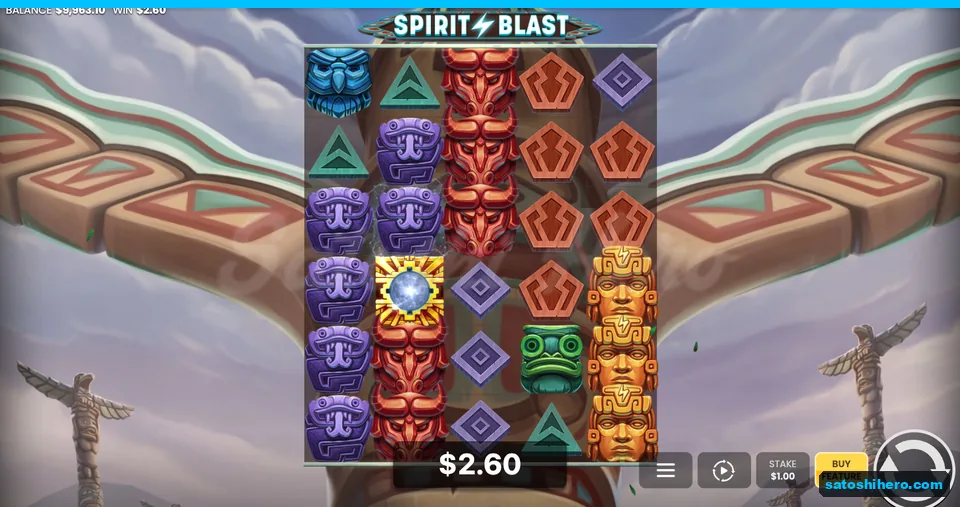

Tactic: Scan the whole grid instead of searching for conventional lines. Eight matching symbols can pay wherever they land.
Cascade sequence
Each qualifying win pays first, then its symbols disappear. Symbols above drop into the gaps, fresh pieces enter from the top, and another cascade starts if eight matching copies form again. Every step uses the same threshold, so a nearly complete group still pays nothing.
One paid spin can create several consecutive returns without another stake. I found that chain more engaging because a weak opening can expose a useful second grid.
Cascades don’t guarantee growth, and low-tier groups can return very little. Still, they make even a small first hit worth watching until the final symbols settle.
Theme and First Impressions
Spirit Blast slot uses a stormy carved-totem setting with bold symbols designed for its tall grid. The wooden totem rises beneath grey and sky-blue clouds, while carved eagles watch from hills on both sides.
Lightning flashes around multiplier numbers and gives the calm screen an occasional spark. Chunky stone shapes fill the lower tier, while animal carvings and masks carry the premium values. Purple, teal, blue, orange, green, red and gold keep crowded groups visually separate.
The Spirit Blast slot design looks cohesive, though the mystical totem idea won’t win points for originality. Firebird Spirit offers glowing elemental imagery instead of carved stone and storm clouds. Visual style doesn’t change random outcomes, so you should choose by atmosphere.
Test-screen impression
My resting test screen showed stacked masks mixed with several red bulls. Its displayed $9,958.50 balance records the end of the counted run, not a separate deposit or later session. I liked how quickly the colors revealed repeated symbols even when the board looked packed.
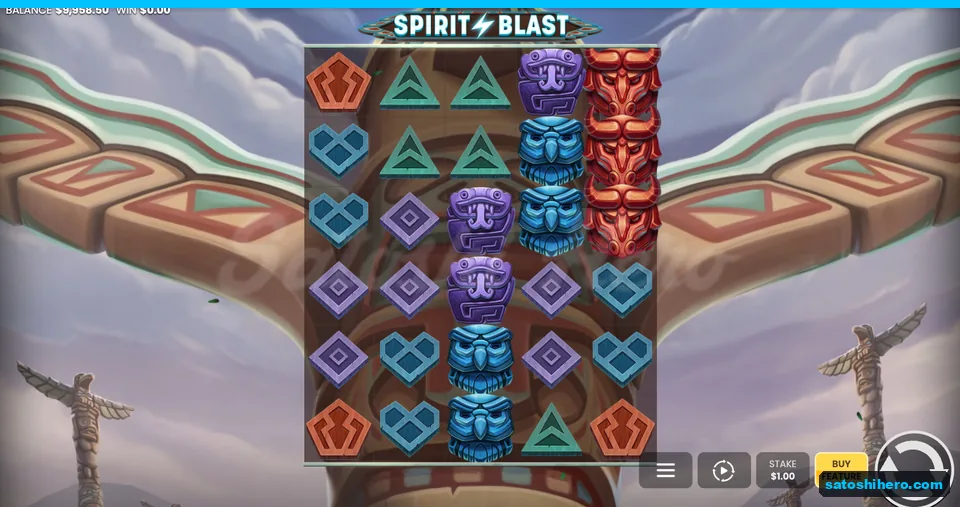

Discovery: The masks, animal figures and carved eagles draw on a broad storm-and-totem fantasy, while lightning supplies the scene’s supernatural energy.
Clear color coding does practical work here. You can separate purple diamonds from serpents before counting, and the busy grid stays readable.
Symbols and Pay Steps
Every listed prize uses a multiple of your active stake. Each regular symbol pays at eight, ten and twelve or more matching copies, so both its tier and final count shape the return.
Lower-value symbols
- Purple diamond: 0.10x for 8, 0.20x for 10 and 0.40x for 12 or more.
- Teal triangle: 0.10x for 8, 0.30x for 10 and 0.50x for 12 or more.
- Blue heart: 0.20x for 8, 0.40x for 10 and 0.80x for 12 or more.
- Orange pentagon: 0.20x for 8, 0.50x for 10 and 1.00x for 12 or more.
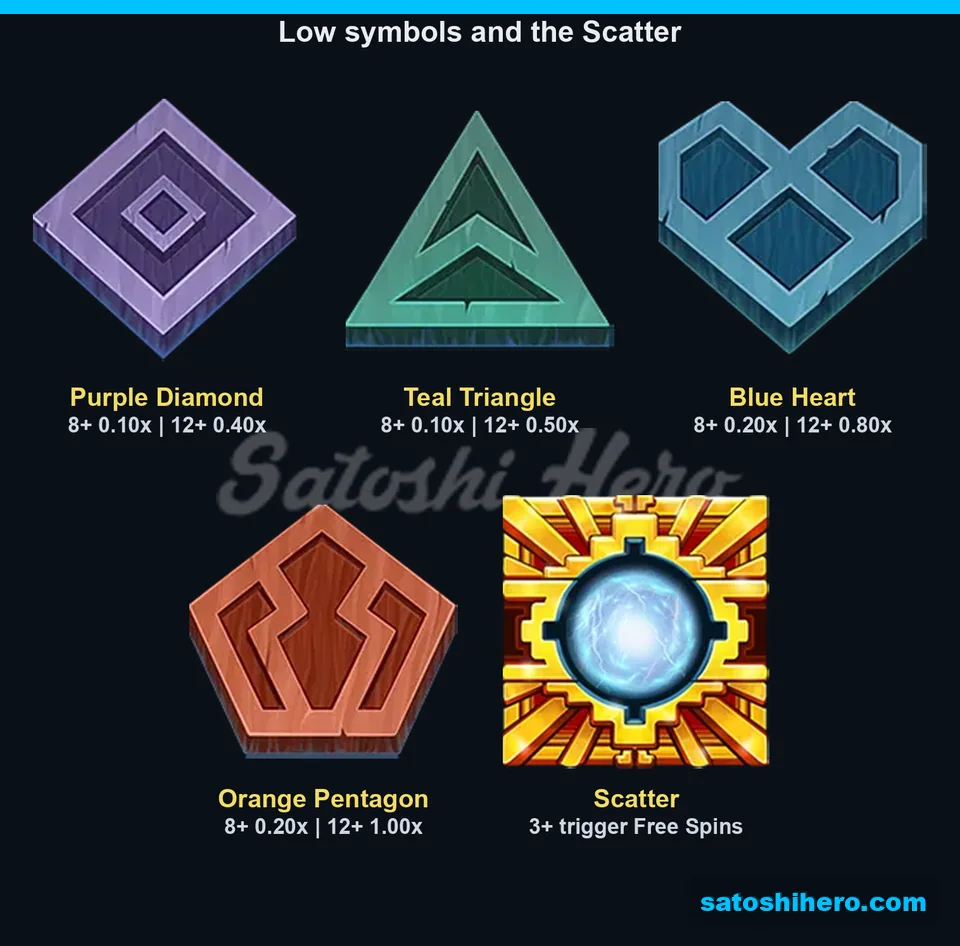
The gold tile with a glowing blue orb acts as the Scatter. It can start Free Spins but carries no direct prize, which keeps it separate from ordinary symbol groups. You shouldn’t count a visible Scatter toward any colored shape.
At a $1 stake, eight purple diamonds return only $0.10 before other wins or modifiers. That example explains why a paying spin can still lose $0.90 of its stake. I think this distinction matters more than the raw hit count because frequent tiny returns can flatter the action.
Premium pay ladder
- Purple serpent: 0.50x for 8, 1.00x for 10 and 2.00x for 12 or more.
- Green frog: 0.80x for 8, 1.60x for 10 and 3.20x for 12 or more.
- Blue owl: 1.20x for 8, 2.50x for 10 and 5.00x for 12 or more.
- Red bull: 2.00x for 8, 4.00x for 10 and 8.00x for 12 or more.
- Gold mask: 3.00x for 8, 6.00x for 10 and 20.00x for 12 or more.
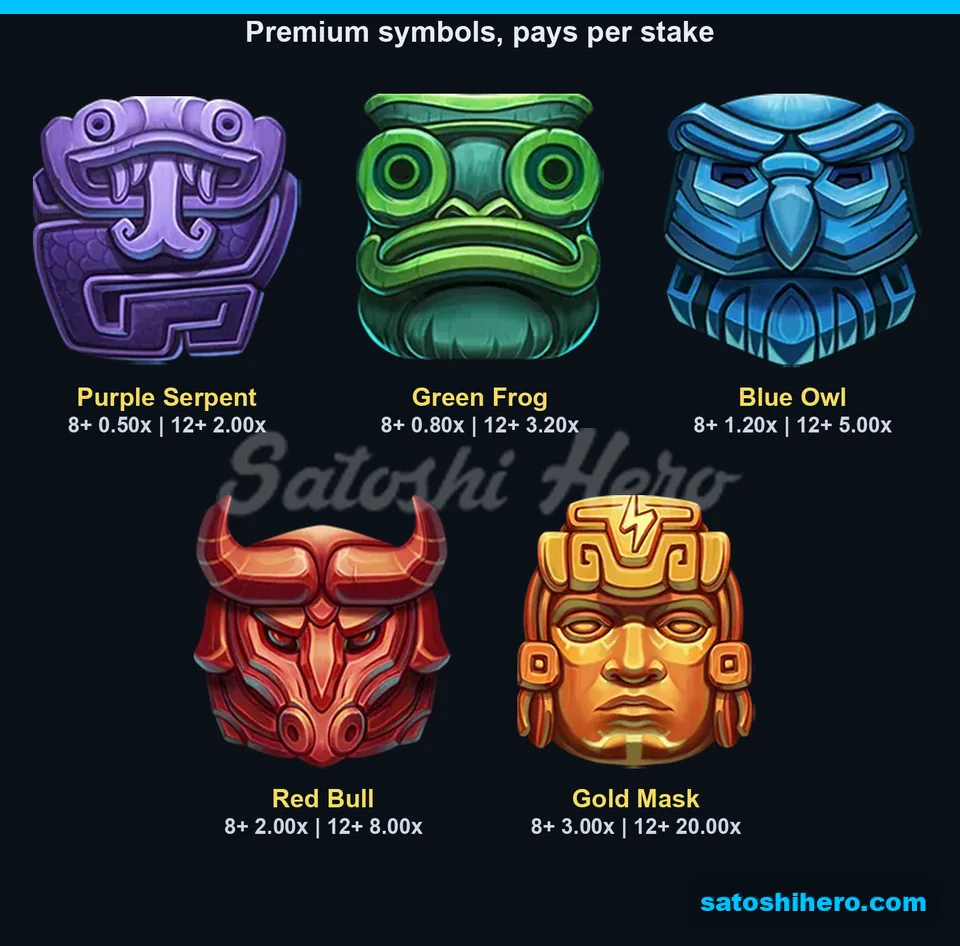
The gold mask leads the regular paytable, and its top step creates a huge gap over low-tier shapes. Twelve gold masks pay 20.00x before modifiers, while twelve purple diamonds pay 0.40x. That contrast makes premium density far more interesting than a bare minimum group.
A crowded board isn’t automatically valuable. You should identify the symbol tier first, count its copies second, and then look for any Blaze or Lightning help. I found that order faster than counting every repeated shape equally.
Red Blaze and Blue Blaze
Red Blaze multiplies its affected symbol payout by five, while Blue Blaze multiplies it by ten. Neither modifier applies across the whole spin, so you need a qualifying group around the marked symbol.
Symbol-specific boosts
A Blaze belongs only to the symbol carrying it. The mark adds no standalone prize when that symbol appears fewer than eight times, even if another group wins elsewhere. A cascade can create the missing copies later, but the same pay-anywhere threshold still controls activation.
This rule looked simpler once I stopped treating Blaze as a full-grid multiplier. You identify the marked piece, find every matching copy, and check whether the count reaches eight. I like that clarity, though an impressive mark can feel hollow when its group misses by one.
Lightning Multipliers
Lightning can mark random grid positions with x2, x3, x5, x10 or x20. A value activates only when the symbol occupying that position joins a qualifying pay-anywhere win.
Collecting a multiplier
A visible number doesn’t guarantee an enhanced return. The piece above it must belong to a group of at least eight, while Blaze follows its separate symbol-specific rule. Lightning contributes to the final spin-level multiplier after qualifying positions become active.
You should check which marked spaces actually joined wins before expecting a boost. I find that positional test less intuitive than Blaze at first, because a bright x20 can remain inactive. The mechanic becomes readable once you connect each number to the symbol directly above it.
Adding values together
All Lightning values collected during one paid spin are added together. If an x2 and x5 activate, the combined value becomes x7 rather than x10, and that x7 applies to the spin’s total win.

Factoid: Collected Lightning values are added, not multiplied together. An x2 and x5 create x7, not x10.
That addition rule rewards several useful positions without creating a multiplication chain between them. You still need ordinary symbol wins to collect anything, so empty promise spots contribute no value alone. I think inactive marks look more exciting than they play, but active combinations give cascades a sharper finish.
Free Spins and Persistent Multipliers
Three or more Scatters trigger ten Free Spins, and each Scatter above three adds two more. The starting round can contain up to 25 spins, giving you extra chances to build its persistent multiplier.
Trigger and spin count
Three or more Scatters during the feature add spins under the same rule. Scatters remain separate from regular pay symbols because they carry no direct prize. The Buy Feature sits beside the stake control, but I didn’t purchase it or assign it any price, value or expected result.
Regular base play remains the only approach measured in my session. I won’t rank an untested purchase above spins I completed. You need to decide whether direct access fits your budget without treating it as a shortcut to profit.
Persistent multiplier
Collected Lightning Multipliers stay active between Free Spins instead of resetting after each one. Their running total can grow from spin to spin and stops at x100, which gives the feature more momentum than the base game.
I didn’t trigger Free Spins during the 100-spin test, so this description comes from the documented rules rather than observed bonus play. That absence was the session’s biggest weakness because I never saw the central persistence idea develop. You need the Scatter trigger before any multiplier can carry forward.
Spirit of Adventure offers a broader exploration mood if theme drives your choice, while this bonus focuses tightly on building storm multipliers. The persistent total sounds compelling, but my test can’t tell you how a live round feels.
How the 100-Spin Test Felt
My 100-spin test lost $41.50 at a constant $1 stake. I began with $10,000, finished at $9,958.50 and used fast autoplay throughout the run.
Session result
- Spins: 100 autoplay rounds with fast play enabled.
- Stake: A constant $1 on every counted spin.
- Balance: $10,000 at the start and $9,958.50 at the end.
- Net result: A $41.50 loss.
- Paying spins: 40 of 100.
- Largest wins: $7.30 on spin 76 and $6.50 on spin 5.
- Typical returns: Most paying results fell between $0.10 and $3.
- Bonus use: No Free Spins and no Buy Feature purchase.
Forty spins returned something, but many didn’t recover the $1 stake. Paying-spin count and profit measure different things, so you should focus on the final net result.
Pace and win size
The balance slid steadily instead of jumping sharply in either direction. My second-largest result arrived early on spin 5, while the $7.30 high came much later on spin 76. Neither win changed the overall direction for long.
Most payouts sat between $0.10 and $3, so the action felt calm but underpowered. I liked the smooth pace, yet the missing bonus left too little contrast.

Proceed Carefully: Forty paying spins didn’t produce a profit. Budget around total stake spent and possible net loss, not how often the grid returns something.
Shinobi Spirit offers another spirit-themed presentation if you prefer a martial setting over carved totems. That visual comparison doesn’t imply matching mathematics or mechanics. You should treat my short run as one firsthand snapshot, not a rule for your next session.
RTP, Volatility and Simulator Test
According to Octoplay, the official profile combines a 95.83% theoretical RTP, low-medium volatility and a 9,000x maximum win. That top figure is a cap, not a likely session target, and the calmer rating doesn’t remove losing stretches.
Frequent small returns and a steady decline felt consistent with a gentler rhythm. However, 100 spins can’t establish the game’s usual behavior. I found the pace controlled, but the modest hits never threatened the headline ceiling.
Simulator projection
The SatoshiHero Slot Simulator modeled 1,000 spins at a constant $1 stake. Its median session ended $44.80 down, with the 5th percentile finishing $170 down and the 95th percentile ending $100.60 up. That range shows how widely outcomes can spread around a single middle result.
About 30 spins per 100 paid in the model. Free Spins appeared approximately once in 68 spins, while a result near the cap appeared roughly once in 125,000. These figures are projections, not promises, countdowns or observations from the game’s random-number system.
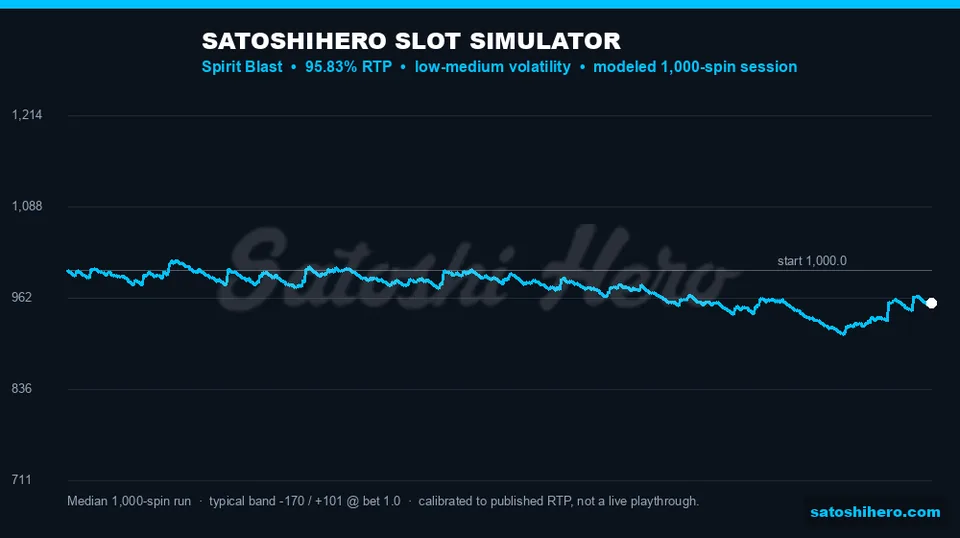
The model can’t predict what you will receive. I use it to frame a range, not to time features or justify raising stakes.
Our 100-spin session
My live run lost $41.50, placing its net result close to the modeled $44.80 median loss. That resemblance counts only as loose alignment because one set covers 100 spins and the other summarizes modeled 1,000-spin sessions. It isn’t a successful prediction.
The live paying-spin rate reached 40%, compared with approximately 30% in each modeled 100-spin block. Even with more paying grids, my run stayed negative because many returns fell below the $1 stake. You shouldn’t read frequent hits as proof of favorable net movement.
No live bonus appeared, despite the modeled frequency of approximately one round per 68 spins. That outcome remains plausible across 100 spins and invalidates neither the test nor the projection. I found the dry bonus result disappointing, but random play doesn’t owe a feature when an illustrative average passes.
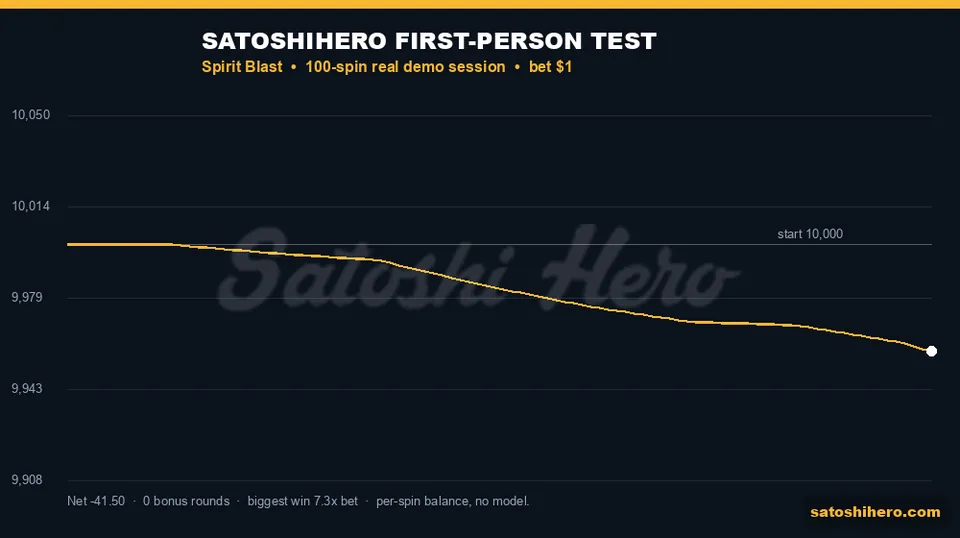
The published theoretical RTP describes the game’s return framework, while one live session doesn’t alter it. Simulator figures illustrate possible ranges and can’t predict an individual run; separate bonus modes can use different theoretical returns by design. I assign no figure to the untested purchase option, and verified changes prompt updates.
Judge risk through your stake size and total spend rather than the maximum-win headline. That approach stayed useful even when the frequent small payouts made the session look busier than its balance suggested.
Frequently Asked Questions About Spirit Blast
How do wins work in the Spirit Blast slot?
Eight or more matching symbols pay anywhere on the 5×6 grid, with higher prizes at ten and twelve or more. Winning symbols disappear and replacements drop from above, so one paid spin can chain several wins. You don’t need horizontal, diagonal or left-to-right alignment.
What do Red Blaze and Blue Blaze do in the Spirit Blast slot?
Red Blaze multiplies the affected symbol’s payout by five, while Blue Blaze multiplies it by ten. The boost applies only to the marked symbol, not the complete grid or total spin. That group still needs eight matching copies to pay.
How do Lightning Multipliers work in the Spirit Blast slot?
Lightning can leave x2, x3, x5, x10 or x20 values on random positions. A value activates when the symbol above it joins a win, then collected values are added and applied to the spin’s total payout. An x2 and x5 create x7.
What triggers Free Spins in the Spirit Blast slot?
Three or more Scatters trigger ten Free Spins. Each Scatter above three adds two spins, up to a 25-spin starting maximum. Retriggers follow the same rule, while collected Lightning Multipliers persist through the feature up to x100.
Did the Spirit Blast slot simulator match the live test?
The modeled 1,000-spin median showed a $44.80 loss, while my real 100-spin test lost $41.50. Those results look loosely aligned, but the sample sizes differ too much to confirm predictive accuracy. The simulator can’t know your future outcome.
How did the 100 live Spirit Blast slot spins go?
My balance moved from $10,000 to $9,958.50, leaving a $41.50 loss. Forty spins paid, the top win reached $7.30, no Free Spins triggered and I didn’t use the Buy Feature. Most returns ranged from $0.10 to $3.
What are the Spirit Blast slot RTP and maximum win?
The theoretical RTP is 95.83%, volatility is low-medium and the maximum win is 9,000x the bet. You should treat that maximum as a cap rather than an expected result. My short test can’t change any official specification.
Final Take
Spirit Blast stands out through pay-anywhere cascades, distinct modifiers and a persistent Free Spins multiplier. Its drawback is base play that felt flat when my test missed the bonus.

My Read
Small-return fans can appreciate the calm rhythm and clear counting rules. Expect modest hits rather than constant drama, and control your stake because paying grids can still leave you behind.
I like the readable grid and clear difference between Blaze and Lightning. I don’t like how little impact most wins had, especially when 40 paying rounds produced a $41.50 loss.
The Spirit Blast slot guide is checked regularly, while my recorded test remains a fixed firsthand snapshot rather than a promise about your play.

Pros:
 Readable grid: Strong colors make matching groups quick to count across thirty positions.
- Simple cascades: Consecutive drops extend one paid spin without taking another stake.
- Distinct modifiers: Blaze boosts symbols while Lightning enhances the total spin result.
- Persistent bonus: Collected Lightning can build across Free Spins up to x100.

Cons:
 Weak small hits: Many paying grids can return less than the active stake.
- Subdued base play: Missing Free Spins left my session short on meaningful variation.
- Misleading activity: Frequent returns can hide a steady net balance decline.

Best For: Careful grid readers and low-medium volatility fans get a measured pace with occasional modifier potential. You should enjoy counting symbol groups and watching cascades without expecting every paying spin to recover its stake.
Similar Games































































Bets
All Bets
Game
Player
Date
Wager
Mult.Multiplier
Prize
 Pelican's Bay: Rapid Link
 josh1998
- 20:51:00
- 0×
- Pelican's Bay: Rapid Link
- josh1998
- 20:50:57
- 0×
- Bunny's Bounty: Hold`n`Link
 zelencov2309
- 20:50:56
- 0×
- Bunny's Bounty: Hold`n`Link
- zelencov2309
- 20:50:54
- 0×
- Elephant's Gold: Bonus Combo
 Hidden
- 20:50:54
- 0×
- Pelican's Bay: Rapid Link
- josh1998
- 20:50:54
- 0.7×
- Rocket Dice
 Hidden
- 20:50:52
- 5.85×
- Bunny's Bounty: Hold`n`Link
- zelencov2309
- 20:50:52
- 0×
- Pelican's Bay: Rapid Link
- josh1998
- 20:50:51
- 0×
- Bunny's Bounty: Hold`n`Link
- zelencov2309
- 20:50:50
- 0×