

Pearly Shores
By pressing play, you agree that you are above legal age in your jurisdiction and that your jurisdiction allows online gambling.


Chasing Cascades Along Pearly Shores
Pearly Shores slot delivers bright pay-anywhere cascades, but my test’s many small returns couldn’t recover its $31.80 loss.
Pearly Shores slot is Octoplay’s tropical medium volatility game, with a 5×6 grid, 95.84% RTP, and 11,000x max win potential. Eight matching symbols pay anywhere, while Free Spins and Pearl multipliers target cascade fans who value quick action and frequent small returns. I played 100 spins at $1.00 with Fast play, from a $10,000 balance, and one bonus paid $8.60 despite 48 paying spins.
Key Takeaways
- Best bonus: Regular paid spins provide the clearest tested option because I didn’t purchase the Buy Feature.
- RTP / volatility: The 95.84% theoretical RTP combines with medium volatility and an active, uneven balance pattern.
- Max win: The maximum prize reaches 11,000x the stake, far beyond anything seen in my test.
- Risk note: My $1.00 session lost $31.80, while its only Free Spins round returned 8.60x.
- Bankroll note: Frequent paying spins didn’t stop gradual losses because most returns covered fractions of my stake.

Table of Contents
- How Pearly Shores Works
- Symbol Paytable
- Cascades and Blazes
- Theme and First Impressions
- RTP, Volatility and Test Data
- Simulator Projection
- Our 100-Spin Session
- Free Spins
- Pearl Multipliers
- Multiplier Growth
- Combined Payout
- Buying the Bonus
- Session Pace and Bankroll
- Frequently Asked Questions About Pearly Shores
- Final Take
How Pearly Shores Works
Pearly Shores slot uses a 5×6 pay-anywhere grid instead of fixed paylines. You need eight or more copies of one paying symbol anywhere on screen to create a win. Payouts rise when that count reaches ten, then climb again at twelve. I found this system easier to read than a dense web of crossing lines.
Every displayed award represents a stake multiplier. At my $1.00 stake, a 1.00x award therefore equaled $1.00. You can play comfortably on desktop or mobile, and the settled grid remains clear on either screen. What stands out is how quickly you can check a result by counting symbols.
Stakes run from $0.10 to $100.00, giving you broad control over the cost of each spin. My demo opened at $10,000, and I kept the stake at $1.00 throughout the counted session. I think that fixed setup made the later balance drift much easier to judge. Changing stakes mid-test would have blurred the value of each cascade.
Symbol Paytable
Nine regular symbols use three award levels for eight, ten, or twelve matching copies. These figures are multipliers in that order:
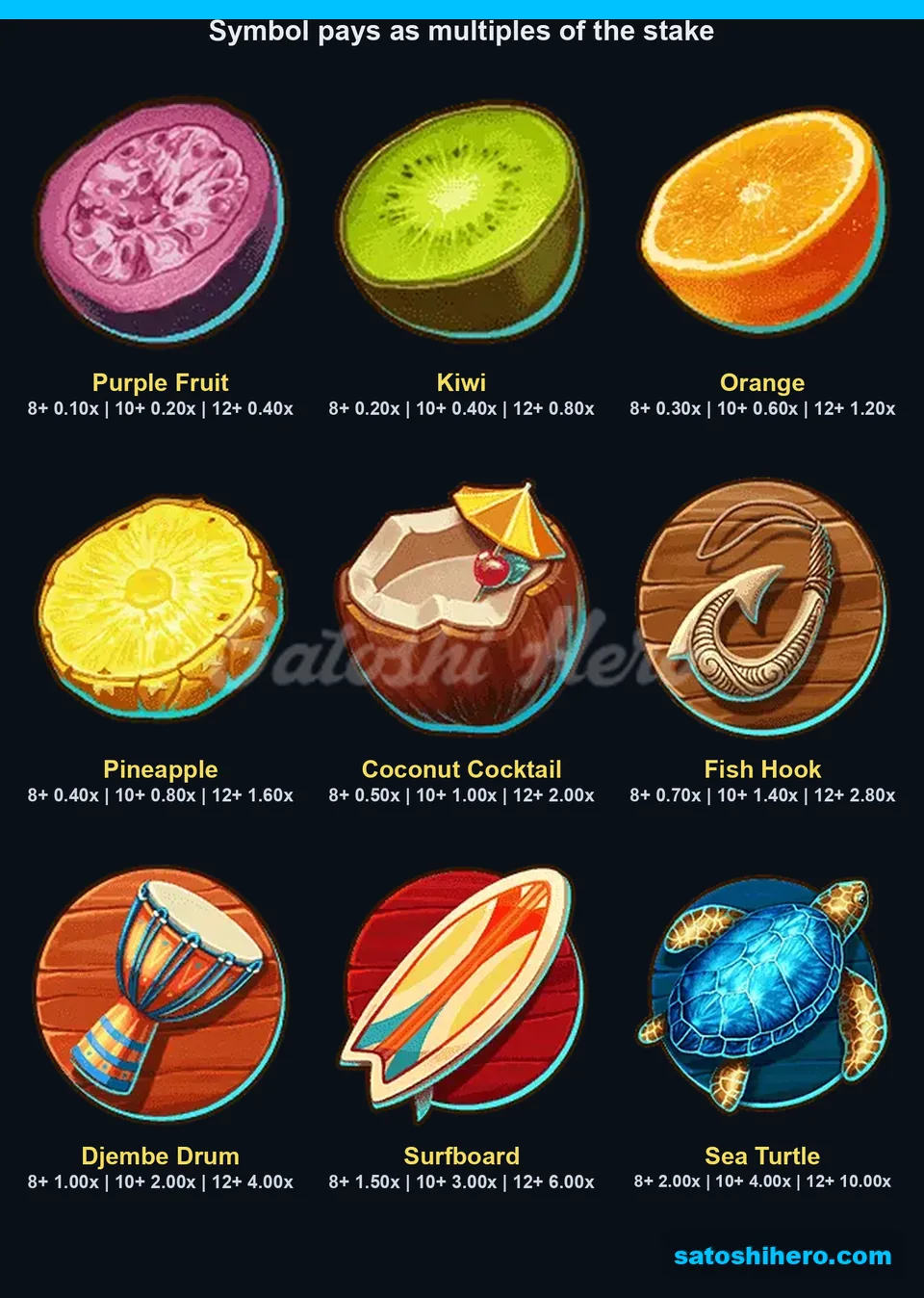
- Purple Fruit: 0.10x, 0.20x, and 0.40x.
- Kiwi: 0.20x, 0.40x, and 0.80x.
- Orange: 0.30x, 0.60x, and 1.20x.
- Pineapple: 0.40x, 0.80x, and 1.60x.
- Coconut Cocktail: 0.50x, 1.00x, and 2.00x.
- Fish Hook: 0.70x, 1.40x, and 2.80x.
- Djembe Drum: 1.00x, 2.00x, and 4.00x.
- Surfboard: 1.50x, 3.00x, and 6.00x.
- Sea Turtle: 2.00x, 4.00x, and 10.00x.
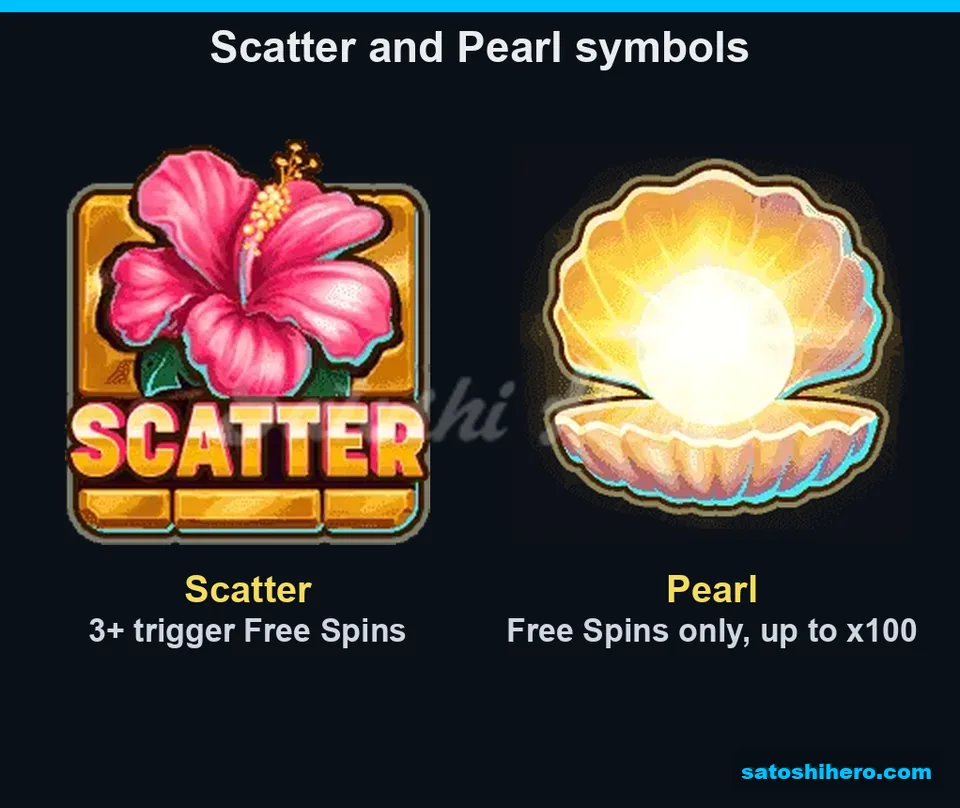
The Sea Turtle gives you the strongest regular-symbol payout, while Purple Fruit sits at the bottom. A hibiscus serves as the Scatter, and Pearls appear only as multiplier symbols during Free Spins. There isn’t a regular Wild, which keeps the base game focused on raw symbol counts. I like that restraint because you can understand each win without decoding substitutions.
Cascades and Blazes
Winning symbols disappear after their award, then the remaining symbols fall into the empty spaces. Fresh symbols enter from above, so one paid spin can create several consecutive wins. You see each stage separately, which makes the running total easy to follow. In my view, those clean tumbles carry more appeal than the familiar beach setting.
Red Blaze and Blue Blaze add sharper moments to that basic rhythm. Red Blaze increases an affected symbol’s payout fivefold, while Blue Blaze raises it tenfold. During my $1.90 base-game win, fish hooks in two columns carried the visible fire effect. You still need enough matching symbols, so a Blaze doesn’t replace the pay-anywhere rule.
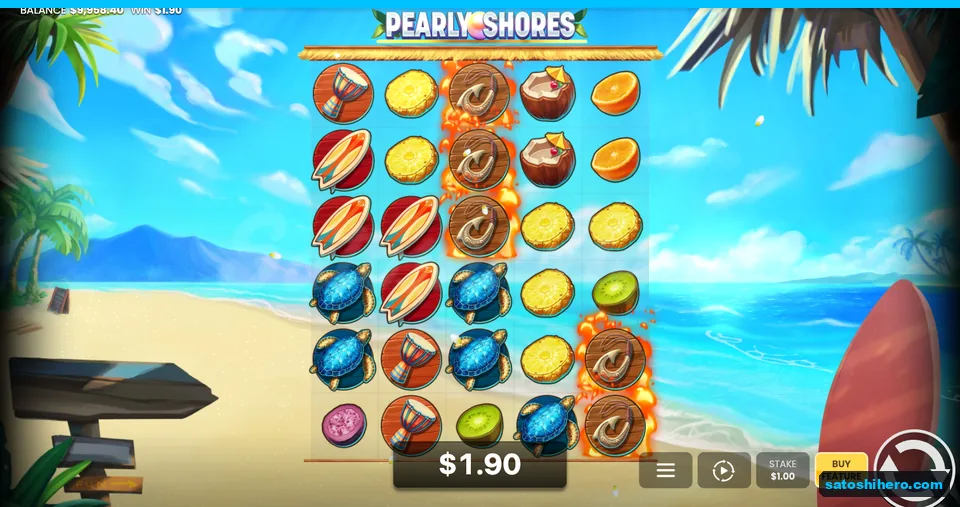

Factoid: Pearly Shores slot doesn’t use paylines. The total number of matching symbols anywhere on the grid determines the payout.
Blazes can make a modest count more valuable, yet they don’t promise a large chain. My observed example stayed small despite the striking effect. You should follow the count first, then note which matching symbols carry colored fire. That order keeps every cascade straightforward.
Theme and First Impressions
The slot uses a bright tropical beach setting that feels familiar but remains easy to read. Turquoise water sits behind the grid, while palm fronds frame the sunny shoreline. You can separate symbols quickly because the colors and silhouettes stay distinct. I don’t think the theme wins originality awards, but its clarity serves the game well.
Island fruit fills the lower end of the paytable, joined by fish hooks, surfboards, drums, and turtles. Beach props keep the mood playful without crowding the 5×6 layout. A glowing shell and Pearl form the visual focus during bonus play. What stands out is the shell’s stronger glow against the softer coastal background.
The resting screen made my setup easy to confirm. I could see the $10,000 balance, $1.00 stake, and settled grid together. That clear presentation helps you check your spending before another spin.
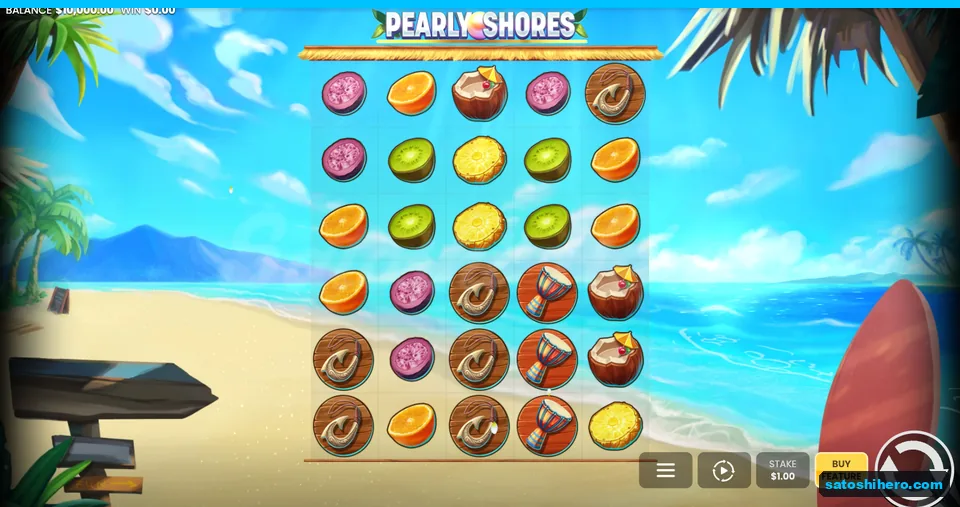
Wins change the pace immediately. Symbols tumble away, new icons drop, and vivid Blaze effects mark boosted positions. The movement feels light rather than dramatic, which fits Fast play nicely. You won’t get a tense cinematic build, but you can track each change without losing the result.

Discovery: The Pearl looks central to the beach artwork, yet it appears only during Free Spins rather than as a regular paying symbol.
Pearly Shores slot keeps its visuals secondary to the count-based mechanic. You always know where the important action sits. For me, the clean art supports the cascades instead of distracting from them.
RTP, Volatility and Test Data
The math produced an active session with frequent small returns, but those returns didn’t protect my balance. Pearly Shores slot carries a 95.84% theoretical RTP, medium volatility, and an 11,000x maximum win. You can see regular activity without receiving enough back to recover each stake. I found that contrast more important than the raw number of paying spins.
Medium volatility doesn’t mean your balance moves smoothly. My test mixed many fractional returns with occasional wins between $3.00 and $6.60, then finished clearly behind. You should treat the large prize cap as distant upside, not a likely session target. I think the test showed how mild-looking losses can accumulate under an active surface.
Simulator Projection
The SatoshiHero Slot Simulator modeled 1,000 spins at a $1.00 stake. Its median finish came to $52.20 down, while the 5th percentile ended $219.20 down. At the other side, the 95th percentile reached $152.60 up. These outcomes describe a broad modeled spread, so you can’t use them to predict your next session.
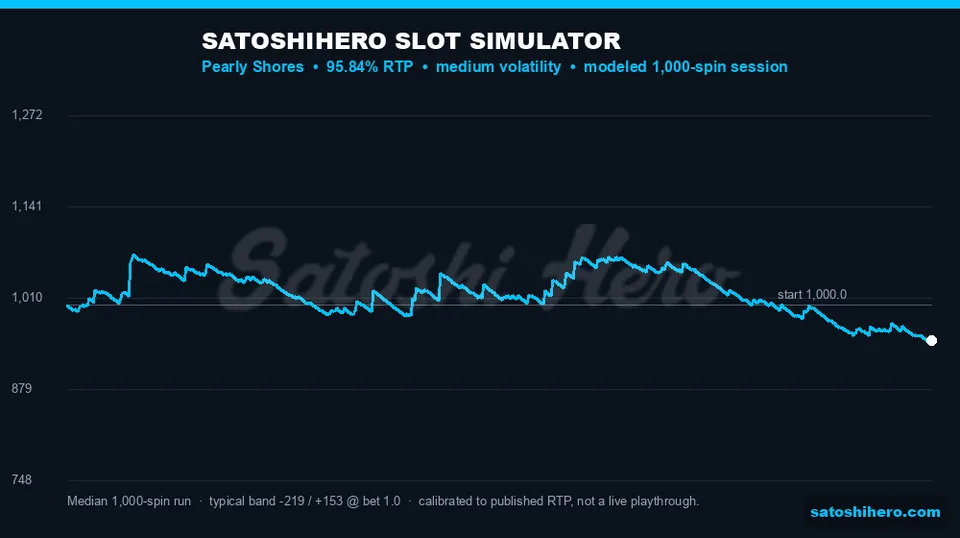
About 25% of modeled spins returned something. Wins of 10x or more appeared roughly once per 50 spins, while 100x or more appeared around once per 13,889 spins. The 11,000x ceiling sits much deeper in the statistical tail than a short run can reasonably illustrate. In my opinion, that gap makes the maximum prize interesting but practically remote.
Those frequencies aren’t countdowns. Going 49 spins without a 10x result doesn’t make one due on the next turn. You can also finish above the modeled upper band or below its lower band because percentiles aren’t hard limits. The projection works best as a picture of possible variation, not a session forecast.
Our 100-Spin Session
I played 100 paid spins at $1.00 and finished $31.80 down. My balance fell from $10,000 to $9,968.20, equal to a loss of 31.80 stakes. Forty-eight spins returned something, which made the game look busier than the result suggests. You shouldn’t confuse frequent win animations with profit.
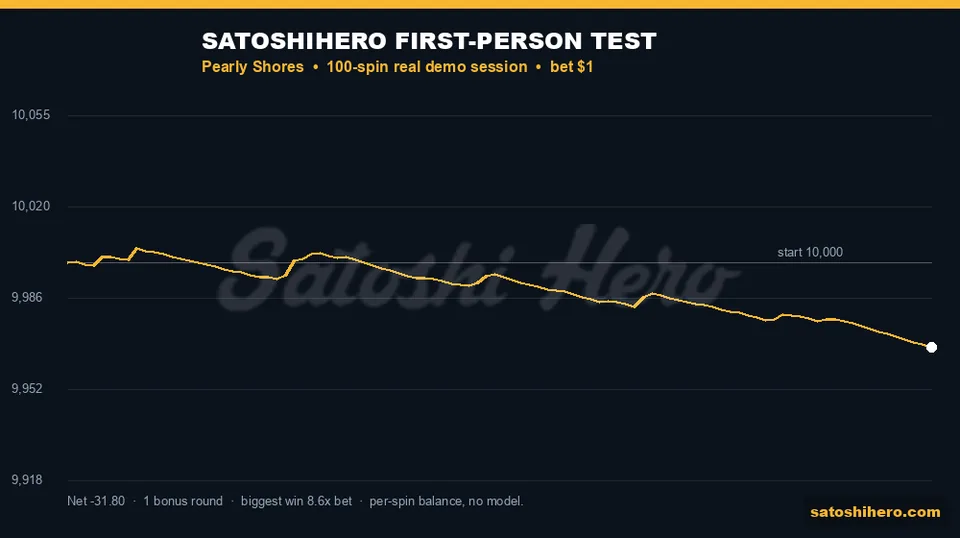
My largest base-game spin paid $5.80 on spin 8. Free Spins arrived on spin 26 and returned $8.60, becoming my biggest total win. A later spin paid $6.60 on spin 67, while several other returns landed between $3.00 and that amount. I found the long pattern more draining than dramatic because most losses arrived in small steps.
Most paying spins covered only a few tenths of the $1.00 stake. Cascades created movement, yet many stopped before building a meaningful recovery. You could see the balance soften even while wins appeared at a healthy count. That is the clearest practical lesson from my session.

Proceed Carefully: Medium volatility doesn’t mean low risk. My session had 48 paying spins and still lost 31.80 stakes because most returns were small.
The live loss sat inside the simulator’s broad modeled range, but neither result predicts another run. My 100 spins captured one possible path with one bonus and no large hit. I think keeping those evidence types separate gives you a more honest picture.
The theoretical RTP comes from Octoplay and describes the game’s published return. One 100-spin session doesn’t alter that figure, and simulator outcomes remain projections rather than promises. Feature-specific returns can differ slightly from base play by design. You should read every number in its proper context.
Free Spins
Three or more hibiscus Scatters in one spin start Free Spins. Three Scatters give you 10 spins, and each extra Scatter adds two more. The opening award can reach 25 spins, while three or more Scatters inside the feature add spins on the same scale. I like that the trigger and retrigger rules remain easy to remember.
My feature triggered once, on paid spin 26, at the $1.00 stake. The complete round returned $8.60, making it my largest total win across 100 spins. You get a clear bonus event, but a trigger alone doesn’t guarantee recovery. That 8.60x result couldn’t reverse the session’s downward direction.
The feature also changes how autoplay behaves. Autoplay pauses on the Free Spins introduction card, and you must click that card to begin. It resumes after the feature ends without requiring another setup. I found the pause useful because you can’t miss the transition into multiplier play.
Inside the round, cascades matter because Pearls can amplify the final spin win. You need paying symbols to connect with useful multiplier growth. One weak round can’t define the feature’s range, though it shows a lower-key outcome you might encounter.
Pearly Shores slot keeps the same pay-anywhere counts while Pearl multipliers add the main source of extra potential. You can follow the familiar grid and focus on whether each tumble improves the Pearls. For me, that continuity makes the bonus approachable, even when its payout disappoints.
Pearl Multipliers
Pearls appear only during Free Spins and multiply the final win from their spin. Each Pearl carries its own multiplier, which changes during cascades before that spin settles. You won’t see these symbols adding value across the entire feature as one persistent meter. I think the spin-by-spin structure creates clear bursts of anticipation.
Multiplier Growth
Every cascade doubles each visible Pearl multiplier. An individual Pearl can climb as high as x100, although that level didn’t appear in my recorded test. Extra tumbles therefore matter twice: they can add symbol wins and strengthen any Pearls still present. You should watch the full sequence before deciding whether a bonus spin was weak.
The x100 ceiling describes capacity, not a common result. A Pearl needs enough cascades to keep doubling, and the spin still needs a win for the multiplier to enhance. I never saw evidence that simply landing a Pearl guarantees a useful payout. That dependency makes the system exciting, but it also explains why my round stopped at $8.60.
Combined Payout
The game completes every cascade before calculating the final multiplier. It then adds all visible Pearl multipliers together and applies that combined value to the spin’s total win. Pearls don’t multiply the win separately in a chain. You can estimate the final boost by summing the values once the grid settles.
For example, several modest Pearls can matter collectively even when none approaches x100. Their sum applies once, which prevents you from overstating the result by multiplying each value against the others. I find this order of operations much easier to understand than stacked multiplier systems. It also makes each extra cascade visibly important.

Tactic: Watch the full cascade sequence before judging a bonus spin. Each extra tumble can double a Pearl’s multiplier before the final combined value applies.
Pearly Shores slot needs two ingredients for a standout bonus spin. Useful pay-anywhere wins must develop while Pearls gain strength through repeated tumbles. My full feature returned only 8.60x, showing that the multiplier ceiling alone doesn’t ensure a large payout. You need both sides to cooperate before the round feels exceptional.
Buying the Bonus
The Buy Feature provides direct entry to Free Spins with Pearl multipliers, but I didn’t purchase it during testing. I can confirm the destination feature, yet I can’t compare a bought round against my regular-spin result. You shouldn’t treat an untested shortcut as the best play. My evidence comes from 100 paid spins and one naturally triggered bonus.
Pearly Shores slot places more bankroll into one event when you choose the purchase route. That concentration changes the spending pattern even though the destination uses familiar Free Spins rules. I think a fixed session limit matters more here than assumptions about what the feature might return. You can decide whether one concentrated event fits that limit without inventing an advantage.
Regular paid spins remain the documented mode here. They showed the cascades, Blaze effects, natural trigger, and $8.60 feature result. My test gives no firsthand basis for ranking the purchase’s value.
Before using the option, compare its displayed cost with your session limit. A purchase can compress many ordinary-spin stakes into one short round. You still need useful cascades and Pearl growth after entry.
The Buy Feature remains a confirmed route into the multiplier-led round, nothing more in this test. I didn’t record a purchased result or performance advantage. You have a clear evidence boundary rather than a sales pitch. Other Octoplay alternatives on SatoshiHero include Wish for a Cash Star, Wilfred’s Wheel, Vegas Blitz: Hold & Win, and Twice as Nice.
Session Pace and Bankroll
Fast play and frequent cascades created an active rhythm, but my balance still fell in small steps. Forty-eight spins returned something, while most paid only a few tenths of the stake. I found that pattern more deceptive than a quiet session.
Occasional base-game wins landed between $3.00 and $6.60. Free Spins appeared once, and no large hit arrived during the counted run. The $8.60 bonus topped my result list but remained too small to repair earlier losses. You might feel busy throughout, yet the balance tells the more useful story.
My 100 paid spins created $100 of turnover at the fixed $1.00 stake. The final loss equaled $31.80, or 31.80 stakes. I prefer tracking total exposure and net change instead of celebrating each paying animation.
Quick cascades can make repeated spins feel cheaper than their combined cost. One press can contain several tumbles, but the next paid spin adds another $1.00. You should set a spending limit before Fast play shortens the gaps between decisions.
Pearly Shores slot fits active-tumble fans better than bonus-frequency hunters. I got one feature in 100 paid spins and no large base-game hit. You can enjoy the rhythm without expecting each Blaze to rescue the balance.
The demo and real game are available here on SatoshiHero. You can learn symbol counts, Blaze colors, and autoplay pauses before risking money. I think that practice matters because the fast pace can hide cumulative spend.
Frequently Asked Questions About Pearly Shores
How does the Pearly Shores slot pay?
Eight or more matching symbols anywhere on the 5×6 grid create a win. Awards rise at ten and twelve matches, then winning symbols disappear so new symbols can cascade into their spaces.
What triggers Free Spins in the Pearly Shores slot?
Three or more hibiscus Scatters in one spin trigger the feature. Three give 10 spins, each extra Scatter adds two, and the opening total can reach 25 spins.
How do Pearl multipliers work in the Pearly Shores slot?
Pearls appear during Free Spins and double with every cascade, up to x100 each. The game adds all visible Pearl multipliers and applies their combined value to that spin’s total win.
What do Red Blaze and Blue Blaze do in the Pearly Shores slot?
Red Blaze increases the affected symbol’s payout fivefold. Blue Blaze raises that symbol’s payout tenfold, while the usual matching-symbol requirement still applies.
Which RTP, volatility, and maximum win does Pearly Shores use?
Pearly Shores has 95.84% RTP, medium volatility, and a maximum win of 11,000x the stake. The RTP is theoretical rather than a promised session return.
What did the Pearly Shores 1,000-spin simulator show?
At $1.00 per spin, the model produced a median loss of $52.20. Its 5th-to-95th-percentile range ran from $219.20 down to $152.60 up.
How did my 100-spin Pearly Shores test go?
My $1.00 session fell from $10,000 to $9,968.20, finishing $31.80 down. Free Spins triggered on spin 26 and returned $8.60.
Final Take
Pearly Shores stands out through cascades, Blaze boosts, and growing bonus multipliers. Its drawback came through: small returns couldn’t stop a $31.80 loss. You get activity, but that doesn’t mean recovery.

My Read
Choose it when you value quick cascades, simple symbol counting, and multiplier-led Free Spins. Expect many returns to cover only part of your stake. I find the system engaging, though my tested bonus felt modest.
I easily followed each count, Blaze, and tumble during Fast play. I didn’t like that 48 paying spins left my balance 31.80 stakes lower. The $8.60 bonus added variety without changing the session’s direction.
This Pearly Shores slot guide is checked regularly and updated periodically, with mechanics and supporting figures kept clear for you. My recorded session remains a fixed firsthand sample.

Pros:
 Readable wins: Count-based awards let you understand every cascade quickly.
- Useful Blaze effects: Fivefold and tenfold boosts add clear base-game potential.
- Growing Pearls: Bonus cascades can double visible multipliers up to x100.
- Flexible stakes: The $0.10 to $100.00 range supports varied budgets.

Cons:
 Small returns: Many paying spins recovered only fractions of my stake.
- Modest tested bonus: My only Free Spins round returned just $8.60.
- No regular Wild: Base-game wins rely entirely on matching-symbol counts and Blazes.

Best For: Active-cascade fans who accept gradual balance swings should feel comfortable here. You need patience for modest returns and realistic bonus expectations. Frequent big-hit hunters can find my tested pattern too restrained.



































































Bets
All Bets
Game
Player
Date
Wager
Mult.Multiplier
Prize
 San Chong Baozha Blue: Bonus Combo
 mdp0fxo
- 00:20:30
- 0×
- Wild Buffalo: Megaways
 mike_721
- 00:20:29
- 0×
- Royal Fruits 9: Hold 'n' Link
 Hidden
- 00:20:29
- 0×
- Elephant's Gold: Bonus Combo
- Hidden
- 00:20:27
- 0×
- Royal Fruits 9: Hold 'n' Link
- Hidden
- 00:20:26
- 1.99×
- Mr. Crystalman: Hold 'N' Link
- Hidden
- 00:20:24
- 0×
- Royal Fruits 9: Hold 'n' Link
- Hidden
- 00:20:23
- 0×
- Royal Fruits 9: Hold 'n' Link
- Hidden
- 00:20:20
- 0×
- Royal Fruits 9: Hold 'n' Link
- Hidden
- 00:20:18
- 0×
- Mr. Crystalman: Hold 'N' Link
- Hidden
- 00:20:17
- 0×