

The Wildwood Curse
RTP94.3%
VolatilityMedium–high
Max winx10,000
Lines19
Hit rate40.76%
ReleasedOct 2025

Blood in the Trees and Wilds That Won’t Let Go
The Wildwood Curse looks like an old slasher film, but the real question is whether its sticky Wilds and Cursed Cluster multipliers can overcome a very swingy base game.
The Wildwood Curse is a medium-high volatility slot from Hacksaw Gaming with 96.3% RTP and 10,000x max win potential. It runs on 6 reels, 5 rows and 19 fixed left-to-right paylines, with Nightmare Respins, Cursed Clusters and three bonus routes. Horror-slot fans, sticky Wild chasers and feature hunters get the sharpest value from The Wildwood Curse slot.
Key takeaways
- Best bonus: The Playground cost $600.00 at a $2.00 bet and paid $791.80, the strongest buy in my sample.
- RTP / volatility: The official RTP is 96.3% and the volatility rating is medium-high.
- Max win: The maximum win is 10,000x the bet in every mode, and the round ends immediately if that cap lands.
- Risk note: My 500-spin session lost $513.00 with no bonus round, so the base game can drain a balance fast.
- Bankroll note: Bonus buys are costly at $2.00 stakes, with The Swamp at $160.00 and The Playground at $600.00.

Table of Contents
- How The Wildwood Curse Works
- Symbols and pays
- Line-win setup
- Theme & First Impressions
- Slasher-film setup
- Horror prop symbols
- Nightmare Respins
- Sticky Wild chain
- Test-session feel
- Cursed Clusters
- Three cursed characters
- Multiplier stacking
- FeatureSpins Modes
- Bonushunt option
- Cursed option
- The Swamp
- Trigger and rules
- Bought result
- The Playground
- Cluster-heavy bonus
- Bought result
- No Escape
- Five-scatter trigger
- Why it matters
- Bonus Buy Results
- Buy test setup
- What paid better
- RTP, Volatility & Our Test
- Simulator projection
- Our 500-spin session
- Frequently Asked Questions About The Wildwood Curse
- Final Verdict
How The Wildwood Curse Works
The Wildwood Curse is a 6×5 fixed-payline slot where wins connect left to right across 19 lines, while Wilds start the sticky respin engine. You get a traditional line setup, not scatter-pay chaos, so every Wild still needs symbols in the right places.
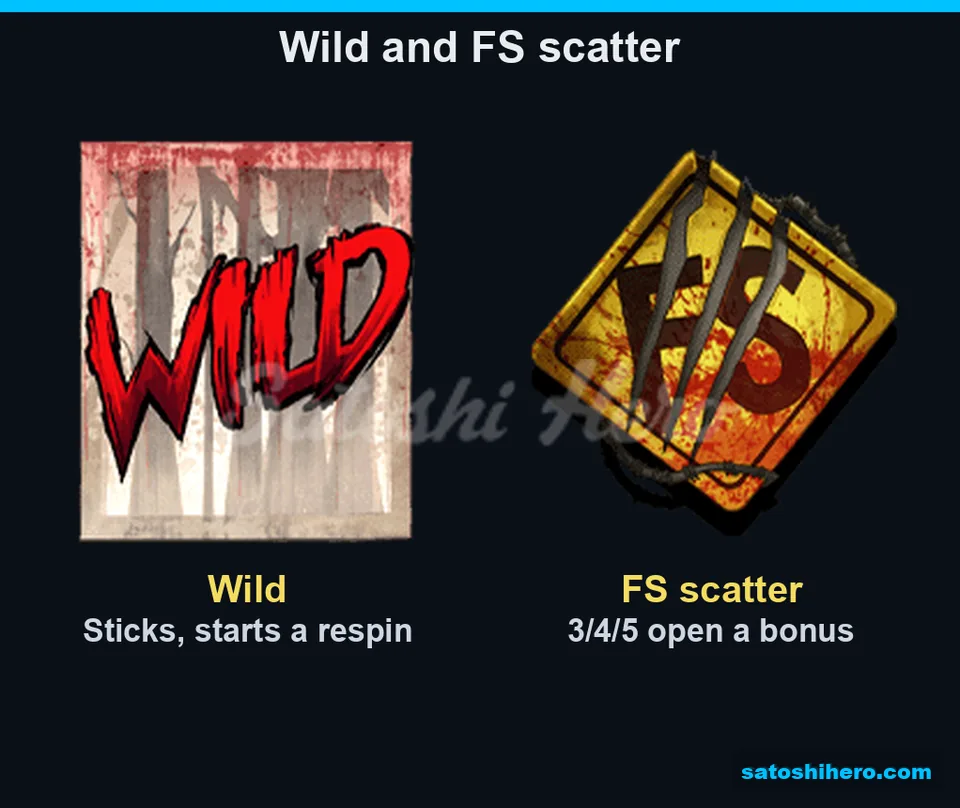
There are 8 paying symbols plus the Wild and FS scatter. The Wild substitutes for every paying symbol, while the FS scatter opens the bonus routes with 3, 4 or 5 scatters. You won’t see that scatter during Nightmare Respins or inside bonuses, which keeps the respin action focused on Wilds.
The Wildwood Curse play experience on SatoshiHero runs in browser on desktop and mobile with the same grid and buy menu. I like that consistency because you don’t need to relearn the feature buttons when you switch screens.
Symbols and pays
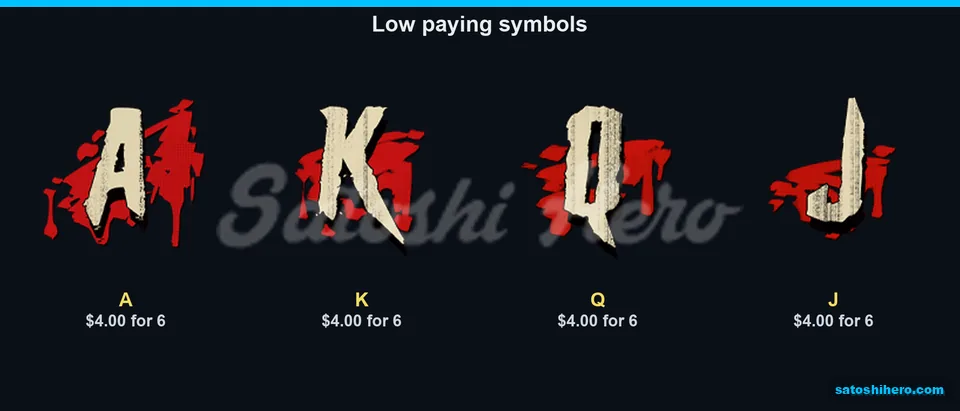
At my $2.00 stake, six jarred hands or flashlights pay $20.00. Six bloody knives or cassette tapes pay $10.00, while six J, Q, K or A symbols pay $4.00. The Wild also pays $20.00 for six, which gives it real symbol value beyond substitution.
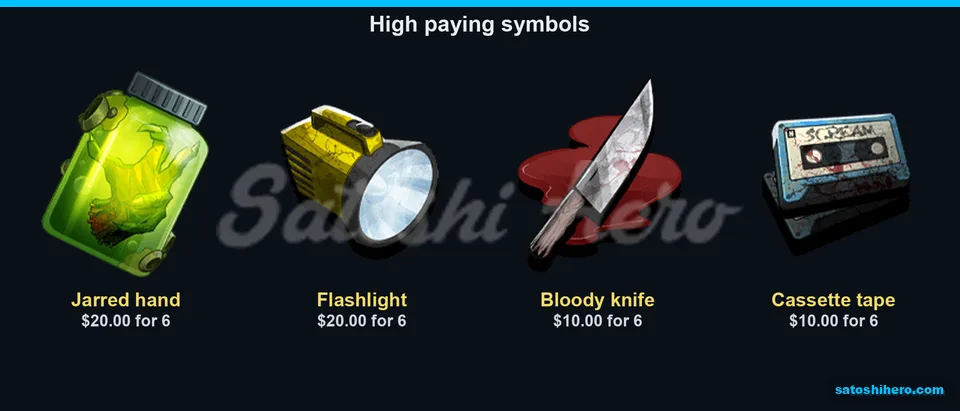
Five matching premium symbols pay $10.00 on the hand and flashlight, $4.00 on the knife and cassette, and $2.00 on the royals. Four pays $5.00, $2.00 or $1.00 across those same tiers. Three pays $2.00, $1.00 or $0.40, so weak lines won’t save a cold run.
Line-win setup
Wilds and multipliers still need line connections. My base-game $6.00 flashlight win showed the point well: the screen looked busy, but only connected lines counted. You should read the 6×5 grid through payline logic, not cluster logic.
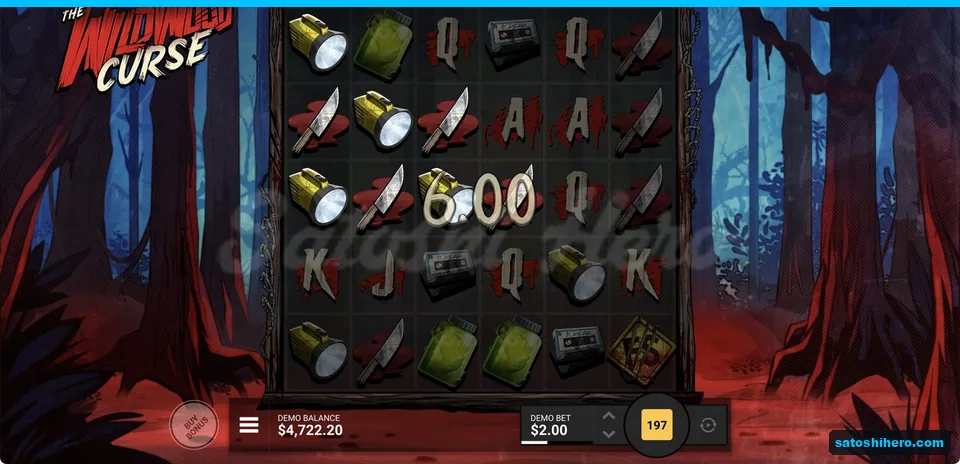

Key Stat: Despite the multiplier-heavy features, this is still a fixed-payline slot. Wins need to connect left to right on the 19 lines.
That payline setup matters because even strong Wild positions can miss if the lines stay thin.
Theme & First Impressions
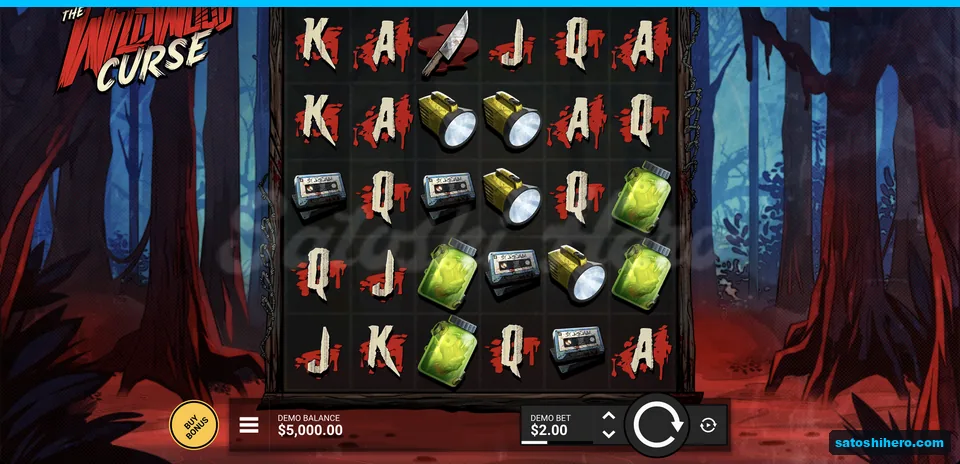
The slot sells its horror mood fast, with a slasher-film forest, three killers and prop symbols that make the theme easy to read. You know the tone within a few spins, and I think the presentation beats the base-game pacing.
Slasher-film setup
Hacksaw Gaming builds Wildwood like a campsite nightmare. A hooded Psycho carries a blade, a swamp Monster rises from the lake, and pale conjoined Twins whisper to the dead. Blood-red trees and a rough wooden frame give the reels a grim, boxed-in feel.
The theme won’t win originality awards, but the execution is solid and clear. If you like darker character-led moods, The Count has a similar taste for menace, though Wildwood leans harder into forest-slasher panic. The Bowery Boys gives another Hacksaw character setup if you want a related-game comparison with a different tone.
Horror prop symbols
The symbols help you read fast spins without squinting. A SCREAM cassette, bloody knife, yellow flashlight and severed hand in a jar mark the premium tier quickly. Blood-splashed royals fill the lower pays without breaking the mood.

Insight: Slasher films often turn ordinary props into warning signs. Wildwood uses the same trick, so the flashlight and cassette feel like clues, not random icons.
I like the theme most when a Wild sticks and the forest holds its breath. The mood works because it supports the respin tension rather than sitting on top of it.
Nightmare Respins
Nightmare Respins start whenever a Wild lands, then continue while new Wilds keep sticking to the grid. You get suspense on almost any Wild, but my test showed a single sticky tile usually doesn’t mean much by itself.
Sticky Wild chain
When a Wild lands, it sticks and triggers one respin. Any new Wild on that respin also sticks, and the chain keeps going while fresh Wilds arrive. Wins pay on every respin, so a useful Wild column can collect several times.
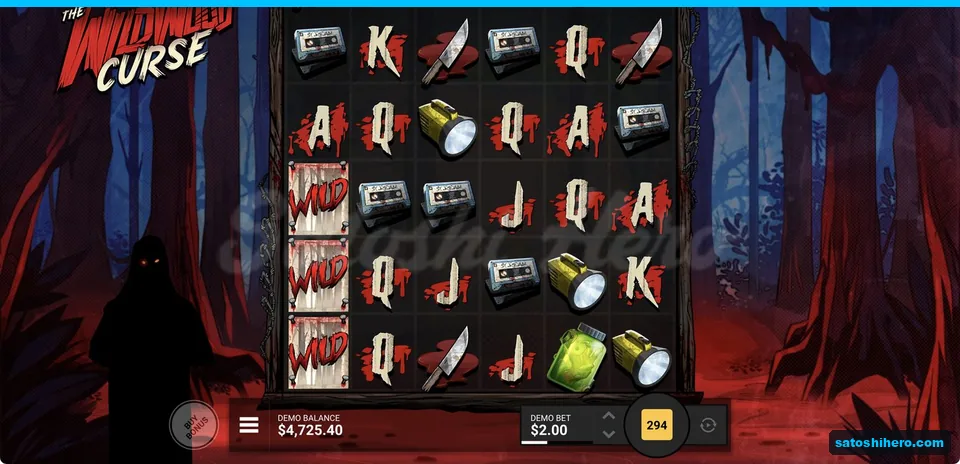
You still need connected paylines underneath that sticky action. A lone Wild often looked promising, then paid $0.40 to $2.00 because the line shape stayed weak. Numbers indicate the mechanic needs either several Wilds or a Cursed Cluster to become dangerous.
Test-session feel
In my 500-spin session, Nightmare Respins fired often enough to keep me watching. They didn’t protect the balance, though, because small royal lines and isolated Wilds kept landing. That gap between activity and payout defines the base game.

Strategy Insight: Don’t overrate a single sticky Wild. In testing, it usually needed a cluster or several connected paylines before the respin felt dangerous.
The Respinners makes repeated-respin tension the whole attraction, while Wildwood adds horror characters and payline pressure to that same stop-start rhythm. Nightmare Respins create most of the suspense here, but they need clusters to feel powerful.
Cursed Clusters
Cursed Clusters form when four Wilds land in an exact 2×2 square, turning into Psycho, Monster or Twins multiplier characters. This is where The Wildwood Curse stops feeling like small respin taps and starts showing real hit potential.
Three cursed characters
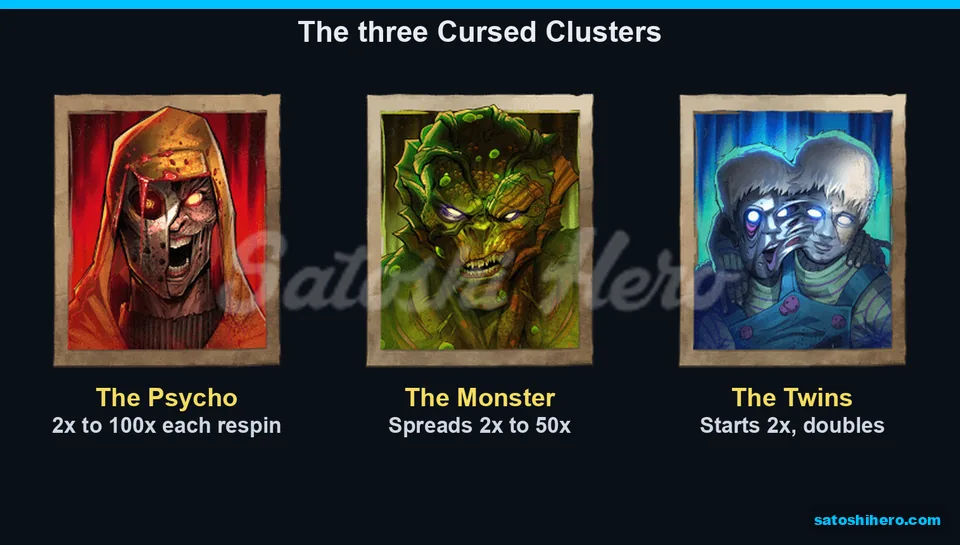
The Psycho reveals a random multiplier on every Nightmare Respin. Its range runs from 2x through 15x, then 25x, 50x or 100x. In my counted session, a Psycho cluster showing 10x near spin 278 paid about $117 and gave the balance its only real lift.
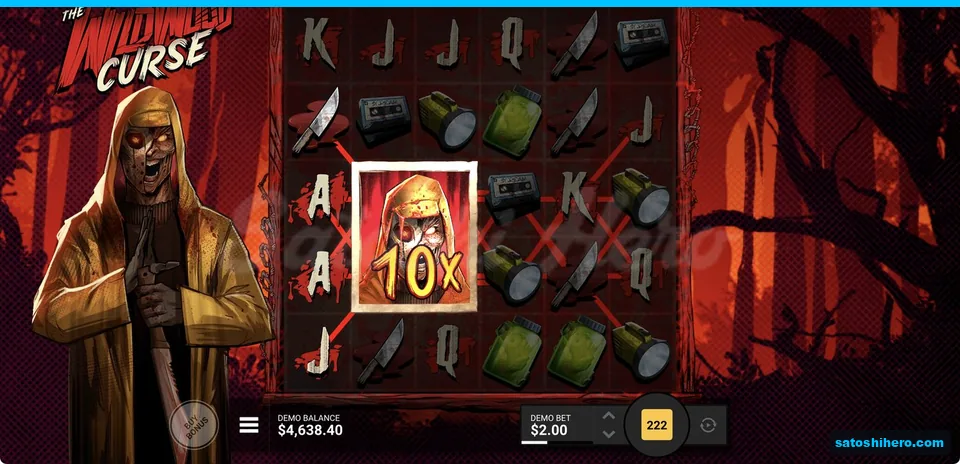
The Monster spreads multipliers across random grid positions as soon as it forms. Values run from 2x to 10x, plus 25x or 50x, and several can stack additively on one position. The Twins start at 2x and double on every Nightmare Respin up to 1000x.
Multiplier stacking
Cursed Characters substitute for paying symbols, which helps them join line wins. Up to 6 Cursed Clusters can sit on the grid at once, and several multipliers in one win add before the total applies. That additive rule matters because it can turn ordinary symbol lines into serious payouts.
Monster spreads clear and refresh on each new respin. I like that rule because it keeps every extension alive, but it also means a nice spread can vanish fast. You need both timing and line connections.
The Twins can climb to 1000x, but they need respin continuation to get there. Cursed Clusters are the clearest reason to keep watching through cold base-game stretches.
FeatureSpins Modes
FeatureSpins are optional paid spin modes that stay active until disabled, but my test only checked the menu and didn’t buy them. You should treat these as costlier shortcuts, not normal low-pressure spins.
Bonushunt option
Bonushunt FeatureSpins cost $6.00 per spin at a $2.00 base stake. The mode makes each spin five times more likely to trigger a bonus and carries a 96.29% return. That sounds useful, but it still doesn’t promise a bonus on any given spin.
I didn’t buy Bonushunt, so I can only judge the menu math and the price. At triple the base stake per spin, it asks you to pay for better access rather than bigger line wins. That trade-off feels fair only if you really hate waiting.
Cursed option
Cursed FeatureSpins cost $150.00 per spin at the same $2.00 base stake. They guarantee at least one Cursed Cluster every spin, carry a 96.23% return, and block FS scatters from landing. That scatter lock changes the mode sharply.
I like the guaranteed cluster idea, but the price is huge beside normal play. You can burn a $5,000 balance quickly if a few paid spins miss strong lines. FeatureSpins are best treated as high-cost shortcuts, not casual extensions of normal play.
The Swamp
The Swamp is the 3-scatter bonus, giving 8 free spins with the base mechanics and a raised chance of landing Wilds. You get the sticky Wild engine more often, but my bought round showed cheaper doesn’t always mean safer.
Trigger and rules
Three FS scatters in the base game open The Swamp. The bonus keeps all base-game mechanics active and raises the chance of landing Wilds, so the round depends on Nightmare Respins chaining well. The buy option costs 80x the bet, which meant $160.00 at my $2.00 stake.
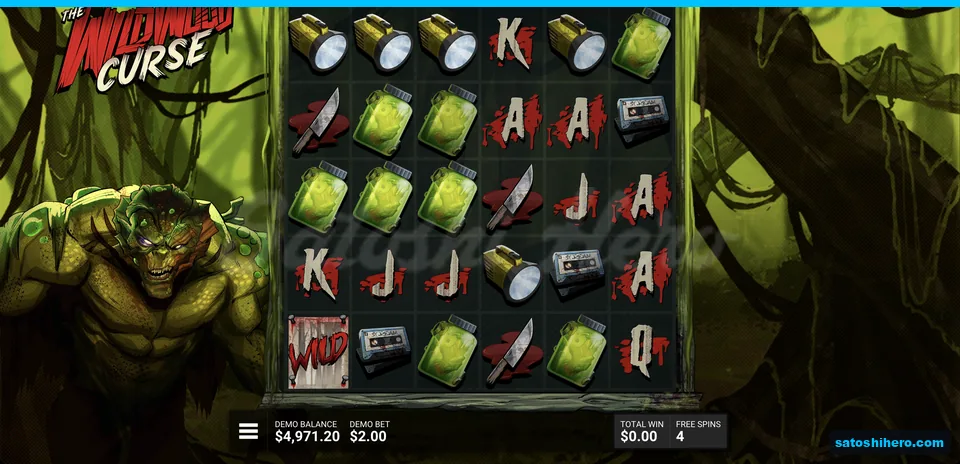
The listed return for this buy is 96.26%. That number sits close to the main RTP, but your result can still swing hard. The Swamp also needs line connections, so sticky Wild chains can look better than they pay.
Bought result
I opened BUY BONUS, pressed BUY on The Swamp card at $160.00, confirmed it, and entered 8 free spins on a fresh $5,000 balance. Wilds stuck early, reel 1 filled with Wilds, and a Twins cluster doubled from 2x to 4x across respins. The paylines stayed thin, which killed the result.
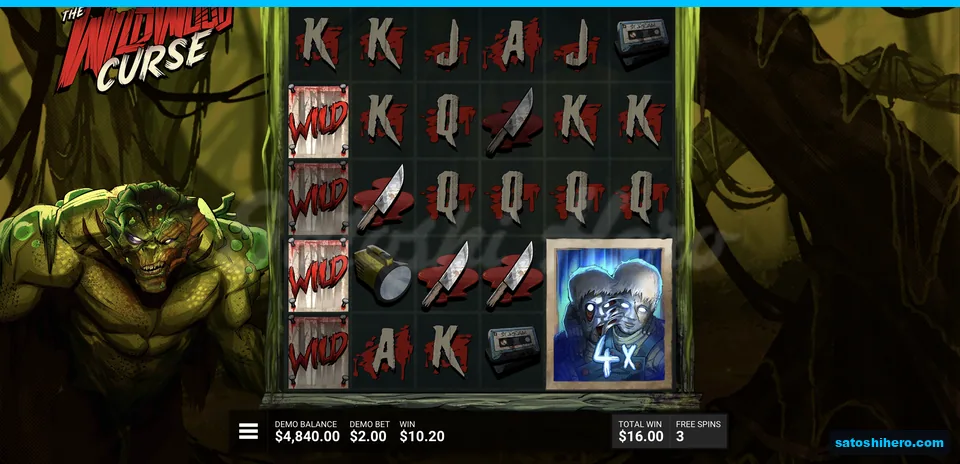
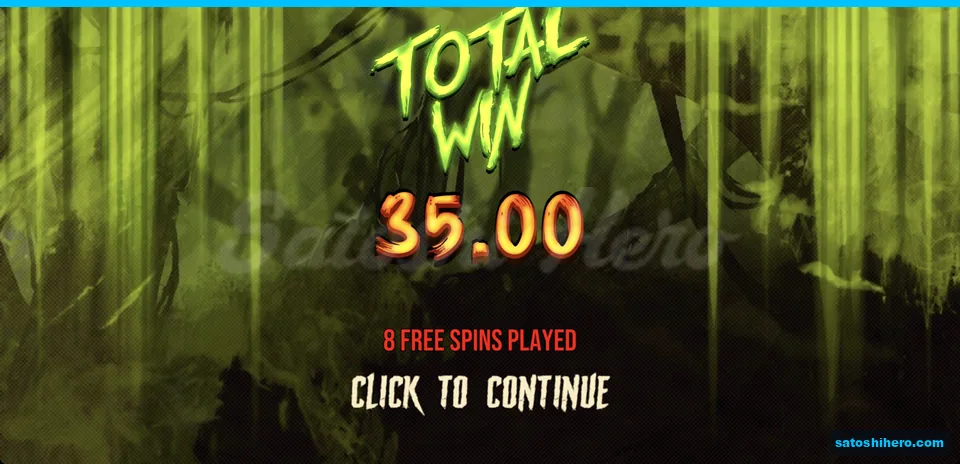
The round paid $35.00, equal to 17.5x the bet and about one fifth of the buy cost. An excluded server-error session also had a Swamp worth $444.20, so the bonus can matter, but that run doesn’t count toward my official 500 spins. The Swamp gives access to the feature engine, yet my bought result showed how cold it can still run.
The Playground
The Playground is the 4-scatter bonus, and it gave the strongest tested result because it raised the chance of Cursed Clusters. You pay much more for entry, but the main mechanic showed itself more clearly here.
Cluster-heavy bonus
Four FS scatters award 10 free spins. The Playground keeps Swamp rules and adds a raised chance of landing Cursed Clusters, so Monster and Twins action appears more likely than in the cheaper buy. The buy costs 300x the bet, or $600.00 at my $2.00 stake.
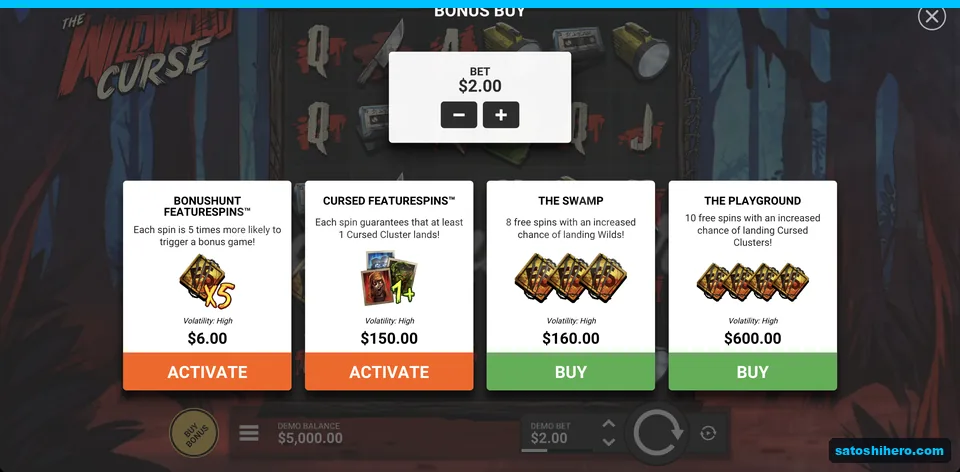
The return is 96.28%, which is slightly above The Swamp’s buy return. That doesn’t make it the better buy every time. It only means the menu math sits close while the cost and variance climb hard.
Bought result
On a fresh $5,000 balance, I bought The Playground for $600.00. A Monster Cursed Cluster formed early, and one Nightmare Respin chain carried the round from $0.40 to $296.80. Multipliers of 2x, 3x, 4x, 6x, 7x and 17x appeared across sticky Wilds.
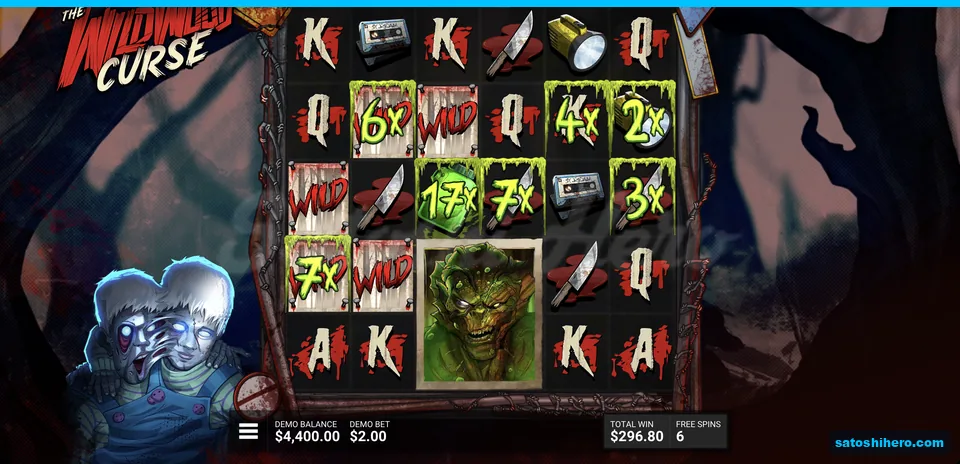
A later Twins cluster added more, and the 10 spins closed at $791.80. That returned 395.9x the bet and about 1.3 times what I paid. The Playground felt like the cleaner route to seeing the core system work, though that sample can’t predict your next buy.
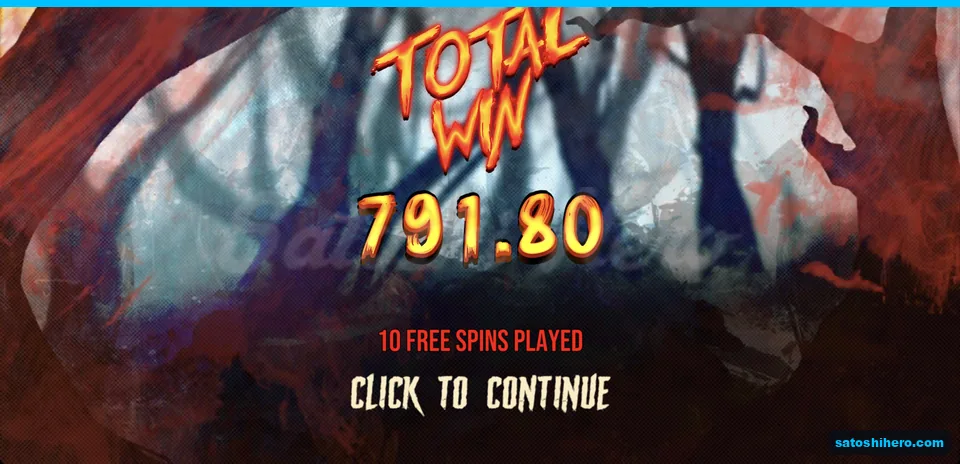
The Playground had the best tested upside, but the buy price demands a serious bankroll.
No Escape
No Escape is the hidden 5-scatter epic bonus, with 10 free spins where every spin guarantees at least one Cursed Cluster. It can’t be bought, and I didn’t trigger it during the counted 500-spin session.
Five-scatter trigger
Five FS scatters open No Escape from the base game. The round uses Swamp rules and gives 10 free spins, but the major change is cluster certainty on every spin. You don’t get a menu shortcut into it.
That matters because the slot’s biggest tension lives in Cursed Characters. If every spin can start with at least one cluster, the feature puts Psycho, Monster and Twins at the center instead of making them occasional surprises.
Why it matters
No Escape looks like the dream route on paper. It removes the biggest frustration from The Playground, where you still pay $600.00 and hope clusters arrive at useful times. The trade-off is simple: you can’t buy it, so you wait for five scatters.
I won’t invent a result for a bonus I didn’t hit. The best I can say is that guaranteed clusters make it the most attractive route, while my test never reached it.
Bonus Buy Results
The bought Playground beat The Swamp in my test, but the sample is too small to call it the better buy every time. You should read these results as session evidence, not a promise.
Buy test setup
I opened the BUY BONUS menu and bought The Swamp and The Playground on fresh $5,000 balances. Both tests used a $2.00 stake. I didn’t buy either FeatureSpins mode, because $6.00 and $150.00 per spin needed a separate test plan.
The setup measured feel, cost pressure and actual outcomes. It didn’t measure guaranteed value, and it didn’t prove one bonus has better future results. That distinction matters when buy costs jump from $160.00 to $600.00.
What paid better
The Swamp cost $160.00 and returned $35.00. The Playground cost $600.00 and returned $791.80, helped by Monster spreads and a later Twins cluster. Data shows the expensive buy gave better access to the main mechanic in my sample.

Warning: At $2.00 stakes, one Playground buy costs $600.00. That’s not casual-spinning money, even with a 96.28% buy RTP.
The cheaper buy can still miss badly when paylines stay thin. The expensive buy can show the best mechanics faster, but it also raises bankroll pressure sharply.
RTP, Volatility & Our Test
The Wildwood Curse has 96.3% RTP, medium-high volatility and a 10,000x max win, and my test showed the risk behind those numbers. The max win is available in every mode, and hitting it ends the round immediately while discarding remaining free spins.
Simulator projection
I fed the SatoshiHero Slot Simulator a 96.3% return, high volatility input, the 10,000x cap and a $2.00 stake across 1,000 spins. The median session finished $131.70 down. The middle 90% of runs landed between $637.50 down and $732.20 up.
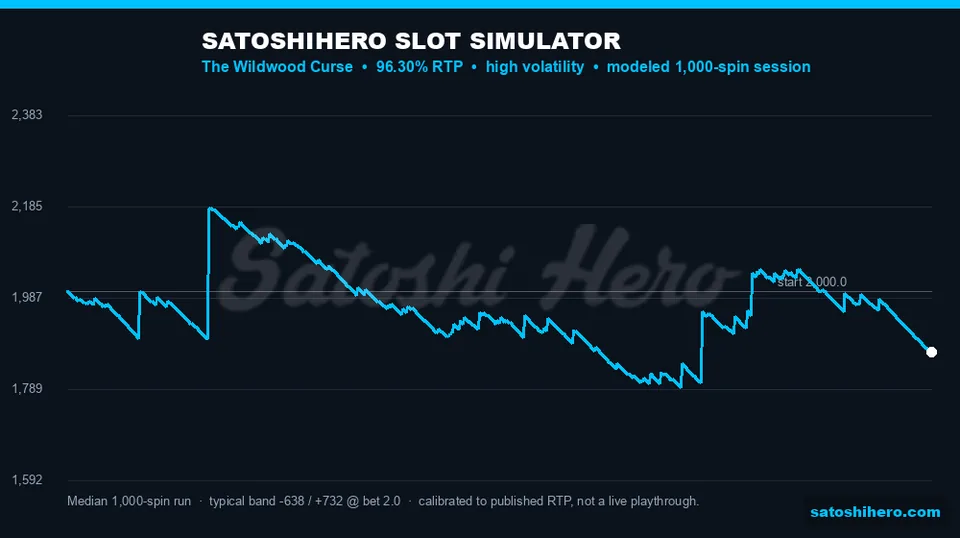
Around 18% of spins returned something, and a feature-sized hit appeared about once every 45 spins. A win of 100x or more appeared roughly once every 1,748 spins. The math suggests you need patience, because ordinary returns don’t carry the session alone.
The simulator models spread, not your next outcome. It also explains why The Luxe may appeal if you prefer bigger session swings with a different luxury tone, while Tai the Toad offers a lighter feature hunt with less slasher pressure.
Our 500-spin session
I opened The Wildwood Curse demo on SatoshiHero at $2.00 with a fresh $5,000 balance. I played 500 spins in Super Turbo autoplay and finished at $4,487.00, down $513.00. No bonus round landed in those 500 spins.
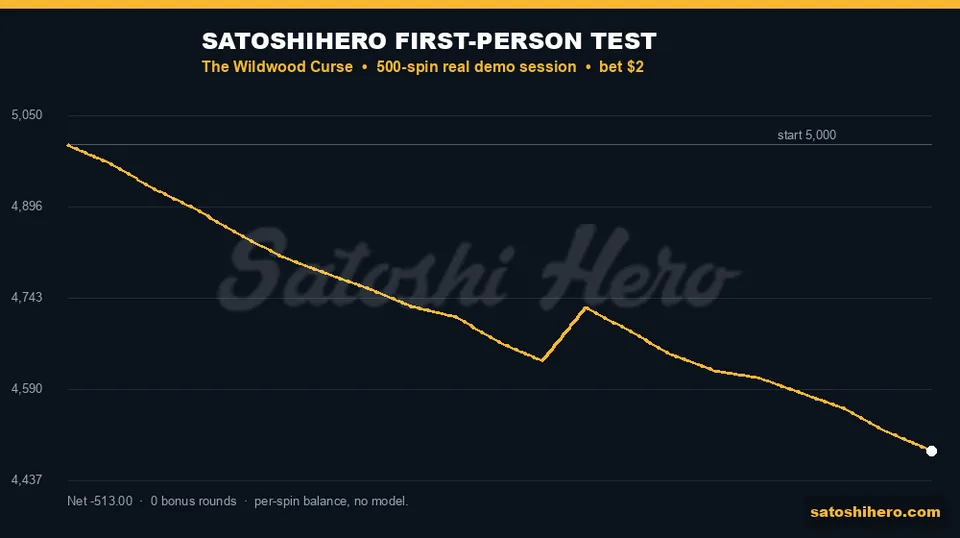
Nightmare Respins fired often, but single sticky Wilds usually paid only $0.40 to $2.00. My best hit came near spin 278, when a Psycho Cursed Cluster showed 10x and paid about $117. That hit briefly lifted the balance to $4,727 before the slide returned.
An earlier excluded session ended at spin 418 because of a server error. It included three Swamps and a Playground, with a $444.20 Swamp and $966.40 Playground showing the upside locked inside bonuses. I don’t count that run in the official result, but it explains why the slot feels so bonus-dependent.
The 96.3% RTP is the operator-published theoretical figure. A single live 500-spin session doesn’t prove or disprove that return, and bonus-buy or FeatureSpins returns sit slightly apart from the base by design. My test shows variance and session feel, not a prediction.
The numbers fit the test: good theoretical RTP, real feature upside and a base game that can feel harsh.
Frequently Asked Questions About The Wildwood Curse
How do Nightmare Respins work in The Wildwood Curse?
Any Wild that lands sticks and triggers a respin. New Wilds on that respin also stick, and the respins continue while fresh Wilds keep landing or until no positions remain. Wins pay on each respin.
What are the three Cursed Characters in The Wildwood Curse?
Four Wilds in a 2×2 square form a Cursed Cluster that becomes the Psycho, the Monster or the Twins. The Psycho reveals 2x to 100x each respin, the Monster spreads 2x to 50x multipliers across the grid, and the Twins start at 2x and double every respin up to 1000x.
How much do The Wildwood Curse bonus buys cost at $2.00?
The Swamp costs $160.00 for 8 free spins, while The Playground costs $600.00 for 10 free spins. No Escape, the 5-scatter bonus, can’t be bought from the menu.
What did the 1000-spin simulator show?
At $2.00 with a 96.3% return, the median 1,000-spin session ended $131.70 down. The middle 90% of runs landed between $637.50 down and $732.20 up.
How did your 500-spin session in The Wildwood Curse go?
I went from $5,000 to $4,487.00, down $513.00, with no bonus round in 500 spins. The best moment was a Psycho Cursed Cluster at 10x paying about $117 near spin 278.
What happened when you bought The Wildwood Curse bonuses?
The Swamp cost $160.00 and paid $35.00. The Playground cost $600.00 and paid $791.80 after a Monster cluster spread multipliers up to 17x across sticky Wilds.
What is The Wildwood Curse RTP and max win?
The RTP is 96.3% and the maximum win is 10,000x the bet. That cap is available in every game mode.
Final Verdict
The Wildwood Curse stands out because its horror theme, sticky Wilds and Cursed Clusters all point toward the same tension. The drawback is clear too: the base game can feel punishing when bonuses don’t land.

My Take
Feature hunters with patience should get the most from this slot, especially if they understand how costly the buy menu can become. Expect busy respins, long dips and occasional sharp multiplier moments rather than steady line wins.
I like the way Monster and Twins clusters changed the bought Playground round from a small start into a $791.80 finish. I don’t like how 500 base spins dropped $513.00 without a bonus, because that pace asks a lot from your bankroll.
The Wildwood Curse is checked regularly, and the best reason to play remains the same: clusters can turn a dull spin into a serious horror-show payout.

Pros:
 Strong RTP: The 96.3% figure gives the math a fair base.
- Clear feature identity: Sticky Wilds and clusters drive every meaningful moment.
- Useful buy testing: Real $160.00 and $600.00 buys show bankroll pressure clearly.
- Readable horror theme: Props and killers make fast spins easy to follow.

Cons:
 Cold base game: My 500 spins lost $513.00 without a bonus.
- Expensive shortcuts: The $600.00 Playground buy demands strict bankroll control.
- Line dependence: Strong Wild screens can still miss thin paylines.

Best For: Horror-slot fans, feature hunters and patient bankroll managers should enjoy this one most. You need comfort with medium-high volatility, because the best action sits behind sticky Wild chains, Cursed Clusters and expensive bonus routes.






















































Bets
All Bets
Game
Player
Date
Wager
Mult.Multiplier
Prize
 Luck of Panda: Bonus Combo
 mike_721
- 09:06:27
- 0×
- Luck of Panda: Bonus Combo
 Hidden
- 09:06:27
- 0×
- Luck of Panda: Bonus Combo
- mike_721
- 09:06:24
- 0×
- Luck of Panda: Bonus Combo
- Hidden
- 09:06:24
- 0×
- Big Banker Bonanza
- nina87
- 09:06:22
- 0×
- Luck of Panda: Bonus Combo
- mike_721
- 09:06:21
- 0×
- Luck of Panda: Bonus Combo
- Hidden
- 09:06:21
- 0×
- Mardi Gras Queen
- josh1998
- 09:06:19
- 0×
- Piggy Bankroll: The Big Stash
 davidm5
- 09:06:19
- 0×
- Piggy Bankroll: The Big Stash
- davidm5
- 09:06:18
- 0×