

Ocean's Call
By pressing play, you agree that you are above legal age in your jurisdiction and that your jurisdiction allows online gambling.


Sirens, Storms and Harp Scatters at Sea
Ocean’s Call slot is a Habanero Systems seafaring slot built around sirens, harp Scatters and free games with Anchor extensions.
Ocean’s Call is a medium volatility slot from Habanero Systems with 98% RTP and 2,000x max win potential. It uses a 5-reel, 3-row grid with 20 fixed paylines, harp Scatters, Wilds on reels 2 to 5, and no bonus buy. Patient line-slot fans get the clearest fit here, especially if they like features that arrive through normal spins.
Key takeaways
- Best play: There’s no bonus buy, so you trigger the feature only by landing 3 or more harp Scatters in the base game.
- RTP / volatility: Ocean’s Call has a 98% RTP and medium volatility, which gives the math a strong headline.
- Max win: The official maximum win is 2,000x the bet, so don’t inflate the ceiling in your expectations.
- Risk note: The simulator still puts a typical 1000-spin session about 26.7x down, so high RTP doesn’t make short sessions safe.
- Bankroll note: My first 60 test spins stayed almost flat before one free games round drove the result.

Table of Contents
- How Ocean’s Call slot Works
- Reels and lines
- Symbol pay values
- Theme & First Impressions
- Seafaring design
- Stormy bonus mood
- Bet Setup and Base Play
- Default demo stake
- No bonus buy
- Wilds, Scatters and Anchors
- Wild symbol rules
- Scatter and Anchor
- Free Games and Anchor Extensions
- Trigger and rules
- Our feature result
- Progressive Jackpot
- Random trigger
- Test result
- RTP, Volatility & Our Test of Ocean’s Call slot
- Simulator projection
- Our 100-spin session
- How It Played in 100 Spins
- Base-game rhythm
- Feature-led profit
- Frequently Asked Questions About Ocean’s Call
- Final Take
How Ocean’s Call slot Works
Ocean’s Call slot works like a traditional 5-reel, 3-row Habanero slot with 20 fixed paylines. You get left-to-right line wins from the leftmost reel, and only the highest win on each line pays.
Reels and lines
The layout feels easy to read because each spin uses a simple grid. Wins on different lines add together, then the game multiplies line wins by the bet per line. That matters because a small symbol hit can still stack with another line hit.
You don’t need to learn cluster rules, expanding reels, or ways mechanics here. The Ocean’s Call slot keeps the old-school rhythm intact, which helps when you want to understand what your balance is doing. It also ran smoothly for me on desktop and mobile, without changing the basic read of the reels.
Symbol pay values
The slot symbols are Scroll, Crown, Sailor, and five different Sirens. The Scroll is the top payer, giving 100x total bet for five of a kind, 25x for four, and 2.5x for three. The Crown pays 50x, 10x, and 1x.
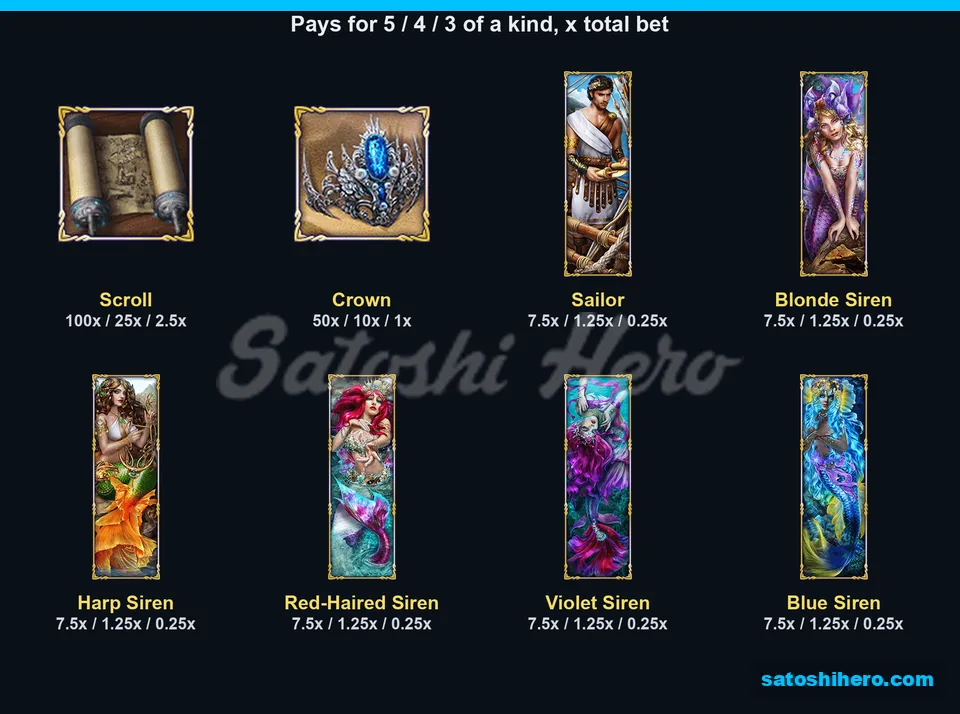
The Sailor and all five Sirens pay 7.5x for five, 1.25x for four, and 0.25x for three. I checked that low end during play: three Sirens paid $2.50 on my $10.00 bet, exactly 0.25x. That proof point helps, because the lower symbols appear often enough that you’ll notice them.

The surprise here is how plain the system feels in a good way. You spin, read the 20 paylines, and know why the balance moved.
Theme & First Impressions
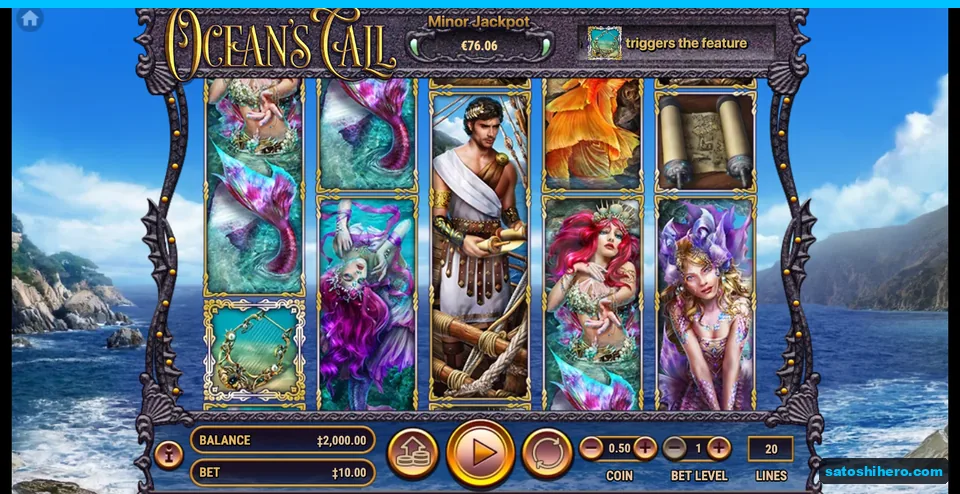
The theme gives Ocean’s Call slot a familiar mermaid-and-siren setup, but the storm shift during free games adds useful drama. You see mermaids, sirens, and a Greek sailor inside a bright seafaring frame.
Seafaring design
The reels sit inside a carved shell frame over blue sea and cliffs. The sirens use purples, reds, and teals, so the grid has more color than the simple rules suggest. I wouldn’t call the setup fresh, but it does enough to make each symbol easy to spot.
What stands out is the way the harp idea ties into the bonus. The game’s own story points to a mermaid’s harp bringing both free games and stormy weather. That link makes the feature feel less bolted on.
Stormy bonus mood
During free games, the sky darkens and the sea gets rougher. I liked that shift because the bonus feels like a real change of scene, not just the same board with a counter added.

Discovery: The feature’s stormy sky mirrors the harp story in the game’s own setup, so the bonus round changes the mood as well as the mechanics.
Both this game and Waltz Beauty lean on character art, but they take different routes. This one pushes sea-myth drama, while Waltz Beauty fits a softer taste for elegance and romance. If you enjoy a familiar theme with a theatrical bonus mood, this visual style lands well.
Bet Setup and Base Play
You can start testing Ocean’s Call from the demo setup, where the default $10.00 stake splits across 20 fixed lines. SatoshiHero offers demo and real play, and my clean test used the demo for a controlled read.
Default demo stake
The play-money demo opens with a $2,000 balance. Its default stake is $10.00, built from 20 lines at $0.50 per line and one bet level. I kept that stake unchanged for the full 100-spin session.

Factoid: At the default demo setup, a $10.00 spin is split across 20 paylines at $0.50 per line.
That fixed stake matters more than it sounds. It made the test easier to read, because every win and loss came back to the same bet size. You can compare the early grind, the feature spike, and the late giveback without adjusting for stake changes.
No bonus buy
There’s no bonus buy in Ocean’s Call slot. Every result I logged came from base-game spins, line wins, Scatters, and the free games that those Scatters opened.
I like that cleaner setup, though impatient bonus hunters may not. You can’t skip straight into the feature, so the base game carries more weight. That makes discipline important, especially if you feel tempted to raise stake after a quiet patch.
Wilds, Scatters and Anchors
The special symbols are simple: Wilds help line wins, harp Scatters trigger and pay, and Anchors extend free games. Ocean’s Call slot doesn’t ask you to juggle many side rules.
Wild symbol rules
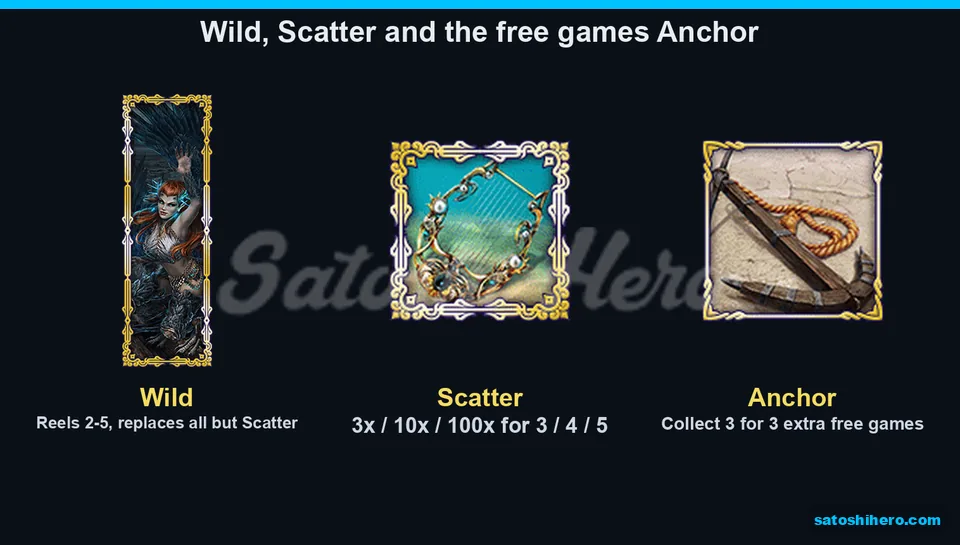
The Wild appears only on reels 2, 3, 4, and 5. It substitutes for every paying symbol except the Scatter, so it mainly helps complete left-to-right line wins. Since reel 1 has no Wild, you still need the opening reel to cooperate.
That choice gives the Wild a practical limit. I prefer that clarity over a vague “anything can happen” feature, because you can see why some near-misses stay near-misses. The Wild helps, but it doesn’t rescue every spin.
Scatter and Anchor
The Scatter is the harp symbol. It pays anywhere on the board, with 3x total bet for three, 10x for four, and 100x for five. Scatter wins add to any line wins, so the trigger spin can matter before free games even start.
Discovery: The harp Scatter pays even before the free games start, so the trigger spin can add an instant 3x, 10x or 100x win.
The Anchor appears during free games. Collecting 3 Anchors adds 3 extra free games, and that rule became the most important part of my feature. Simple symbols carry the whole bonus structure here, which keeps the game easy to follow.
Free Games and Anchor Extensions
The free games trigger from 3 or more harp Scatters, then Anchors can extend the round by adding 3 extra games at a time. This is the main event in Ocean’s Call slot, and my test leaned hard on it.
Trigger and rules
Three or more harp Scatters anywhere in the base game award 10 free games. The round uses the same lines and bet as the spin that triggered it. Scatters can’t retrigger the feature, so Anchor top-ups are the only way it runs longer.
There’s also no bonus buy, which changes how you should approach the game. You need the Scatters to land naturally, and the simulator places the trigger near one in 48 spins. That doesn’t mean a feature arrives on schedule, but it gives you useful context.

Tactic: Because there’s no bonus buy, don’t chase the feature by raising your stake after a dry patch. The Scatters stay random, and a bigger stake doesn’t make them kinder.
Our feature result
My trigger landed on spin 61. The three Scatters paid 3x by themselves, then the round started with 10 free games. The surprise came from Anchor top-ups, which stretched the feature to 40 total games.
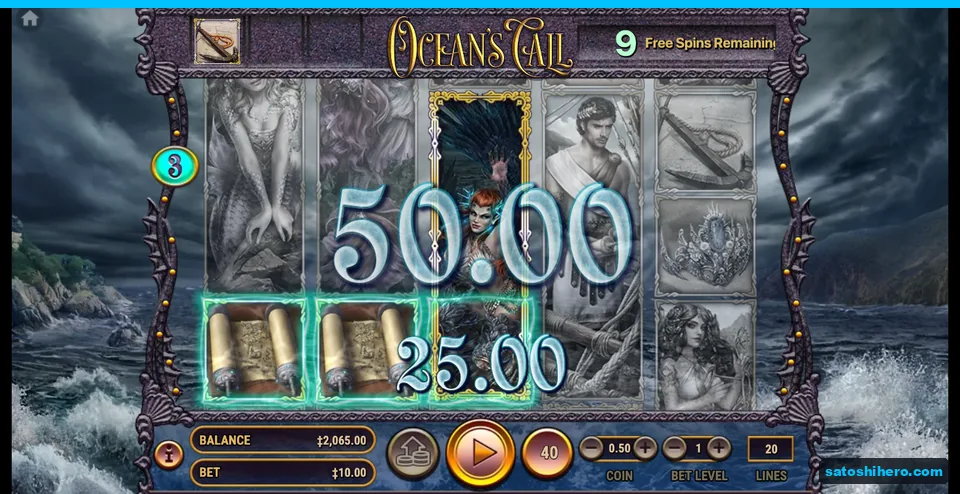
That feature paid 112.25x the bet. My best single result also came inside free games, with one spin paying 57.75x. I liked the way the round kept finding extra life, though you shouldn’t expect every trigger to stretch that far.
Ocean’s Call offers a naturally triggered free-games route, while Return to the Feature may appeal if you want a different feature-led slot experience. Here, the bonus feels earned through the base game rather than bought. That gives the result a stronger session story.
Progressive Jackpot
The Progressive Jackpot is a random background feature that can hit at the end of any game. It doesn’t need a symbol combination, which makes it separate from the line-win and Scatter systems.
Random trigger
A Progressive Jackpot can be won at the conclusion of any game. The trigger happens at random, and any jackpot win gets added to other wins from that spin. That means it can sit behind the action without changing your basic spin decisions.
I’d treat it as background upside, not a target. The game gives you no symbol route or visible meter strategy for aiming at it. That may disappoint jackpot chasers who like a clear collection path.
Test result
I didn’t hit the jackpot in my 100 spins. That tells you almost nothing about the feature’s real rhythm, because a short test can’t meaningfully rate a random progressive. It only confirms that the main gameplay did not need the jackpot to create a strong result.

Proceed Carefully: A random progressive trigger isn’t something you can aim for with symbol strategy. Treat it as an extra possibility, not the reason to stretch your bankroll.
The jackpot adds background upside, but the free games drove my actual session. If you’re deciding how this game plays, focus on Scatters and Anchors first.
RTP, Volatility & Our Test of Ocean’s Call slot
Ocean’s Call slot has a 98% RTP, medium volatility, and a 2,000x max win, but my test still shows why short sessions can swing. The headline math looks strong, yet one feature carried nearly everything.
Simulator projection
Our simulator used 98% RTP, medium volatility, and a 2,000x top win across 1000 spins. Every figure came back in multiples of the bet. The typical session ends about 26.7x down, which cuts against the lazy idea that high RTP protects every short run.
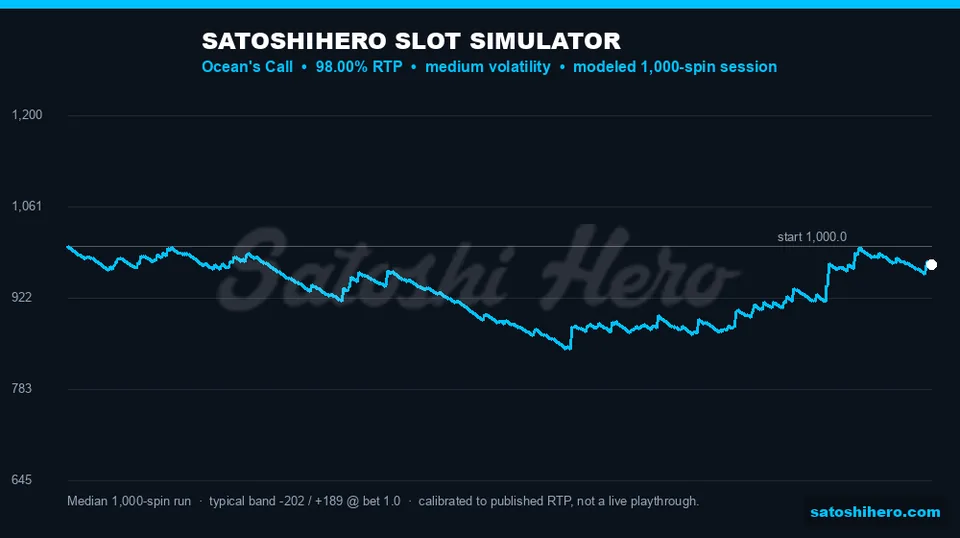
The 5th percentile sits 201.8x down, while the 95th percentile sits 188.6x up. Most sessions fall inside that band. That spread gives you a better risk picture than the RTP alone.
The model hits a win on roughly one spin in four. It lands the free games trigger about one spin in 48, and top-end wins about one in 12,658 spins. The model is illustrative, not a prediction, and it doesn’t know the real random number generator.
Ocean’s Call tested as medium-volatility with a flat start and one feature spike. The Dead Escape may interest you if you want a darker mood while comparing risk feel. For this game, the risk comes less from chaos and more from waiting for the right Scatter moment.
Our 100-spin session
I restarted after a timed-out five-spin attempt and began the clean session from a $2,000 balance. I played 100 spins at $10.00 each, then finished at $2,967.50. That put me 96.75x the bet up.
The first 60 spins felt flat. I sat only 0.5x down at spin 60, so the base game felt steady rather than dead. Then spin 61 landed three Scatters, paid 3x, and opened the free games.
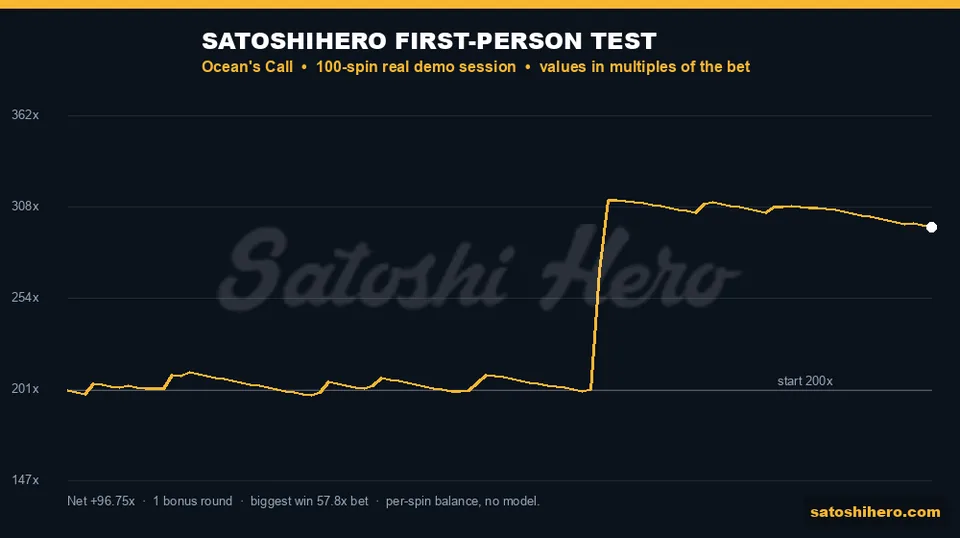
That round paid 112.25x after Anchor top-ups took it to 40 total free games. After the feature, the base game gave back about 17x over the last 39 spins. I also saw 25 paying spins from 100, which matched the model’s one-in-four feel.
One free games round in 100 spins arrived earlier than the model’s one-in-48 average would suggest. I also let autoplay take a 101st losing spin, but I excluded it from the totals. That small housekeeping point matters, because clean testing should keep the numbers consistent.
The 98% RTP is the operator-published theoretical return, a single live demo session doesn’t change that figure, and simulator plus session data are illustrative rather than predictive. Per-feature returns can differ slightly from base play by design, and these figures are checked regularly and updated periodically.
High RTP improves the starting math, but it doesn’t protect a short bankroll. You still need enough room for quiet stretches before the feature does anything useful.
How It Played in 100 Spins
The Ocean’s Call demo felt steady before the feature, then one extended free games round carried the whole profit. I liked that the base game didn’t feel empty, even when it wasn’t doing much.
Base-game rhythm
The first part of the test had a slow, level rhythm. I saw enough small pays to keep the session moving, and 25 paying spins from 100 matched the simulator’s one-in-four estimate. That gave the base game a fair medium-volatility feel.
Still, most base-game wins didn’t change the story. The best base-game spin paid 11.25x, which helped, but it didn’t compare with the bonus. If you want constant fireworks, this pace may feel too controlled.
I also noticed how readable the 20 paylines made the session. You can see low Siren hits, small line wins, and the occasional better connection without studying a complex paytable every spin. That matters when you’re testing a game rather than just clicking through it.
Feature-led profit
The free games clearly carried the result. My round paid 112.25x, while the final 39 base spins gave back about 17x. That contrast showed both sides of the game in one short run.
I liked that the session didn’t feel dead before the feature, but the free games clearly carried the result. That’s the honest read. The base game can keep you near level for a while, yet the round with Anchor extensions did the real work.
This pacing fits patient bankroll managers better than high-speed thrill seekers. You need to tolerate quiet stretches while waiting for a feature spike. When the Anchor top-ups arrive, the game finally feels like its stormy theme promised something bigger.
Frequently Asked Questions About Ocean’s Call
What is the RTP and volatility of Ocean’s Call slot?
Ocean’s Call has a 98% RTP and medium volatility. In my test, 25 of 100 spins paid something, which matched that medium-volatility feel.
How many paylines does Ocean’s Call slot have?
Ocean’s Call slot has 20 paylines on a 5-reel, 3-row board. Wins pay left to right, and only the highest win on each line pays.
What is the maximum win in Ocean’s Call slot?
The maximum win is 2,000x the bet. My best tested single result was 57.75x, so the cap sits far above a normal short-session hit.
How do you trigger the free games in Ocean’s Call slot?
Land 3 or more harp Scatters anywhere in the base game to get 10 free games at the triggering lines and bet. Collecting 3 Anchors adds 3 extra games, and there’s no bonus buy.
Can the free games be retriggered in Ocean’s Call slot?
Scatters can’t retrigger the feature, but 3 collected Anchors add 3 more free games. My tested round started with 10 games and ran 40 in total.
How did the Ocean’s Call simulator compare with my real session?
The simulator’s typical 1000-spin session ends about 26.7x down. My real 100-spin test finished 96.75x up because one free games round paid 112.25x, so treat that run as a sample.
How much does a spin cost in the Ocean’s Call demo?
The demo opened at $10.00 per spin from a $2,000 play-money balance. That stake used 20 lines at $0.50 per line and one bet level, and I kept it unchanged.
Final Take
Ocean’s Call stands out because its classic line-slot setup hides a productive free-games feature. The main drawback is simple: the base game can feel calm until Scatters and Anchors finally do the heavy lifting.

My Read
I’d play this when I want a clean, medium-volatility session with clear rules and one main bonus path. Expect steady base-game pacing, then hope the harp trigger arrives with enough Anchor support to matter. Don’t treat the 2,000x ceiling as a normal target.
I like the 98% RTP, the easy 20-payline read, and the way my feature stretched to 40 free games. I don’t like that the jackpot gives you no real decision point, and the base game gave back balance after the big round. The test felt fair, but it still leaned on one strong feature.
The Ocean’s Call slot deserves attention if you value transparent mechanics over noisy extras. Its best moments come from free games, not from constant base-game bursts.

Pros:
 Strong RTP: The 98% figure gives the game a sharp mathematical headline.
- Readable rules: Fixed paylines make every spin easy to follow.
- Productive feature: Anchor extensions turned my bonus into the session’s main profit.
- Clear theme shift: Stormy free games give the bonus real visual lift.

Cons:
 Quiet base play: Small hits often maintain balance rather than build profit.
- No bonus buy: You must wait for natural Scatter triggers.
- Random jackpot: The progressive adds upside without useful player control.

Best For: Classic slot fans with patient bankroll habits get the cleanest experience here. The best match is a player who likes fixed paylines, medium swings, and feature rounds that can stretch through extra games. If you need constant modifiers on every spin, this sea may feel too calm.


































































Bets
All Bets
Game
Player
Date
Wager
Mult.Multiplier
Prize
 Wild Buffalo Megaways: Hold N Link
 tomstacey1993
- 22:20:30
- 1.69×
- Wild Buffalo Megaways: Hold N Link
- tomstacey1993
- 22:20:26
- 0×
- Super Hotfire Diamonds
 Hidden
- 22:20:23
- 0×
- Caribbean Escape: Rapid Link
 mdp0fxo
- 22:20:23
- 0×
- Rich Piggies: Bonus Combo
 mike_721
- 22:20:23
- 0.47×
- Wild Buffalo Megaways: Hold N Link
- tomstacey1993
- 22:20:23
- 0×
- Triple 5's: Megacharged
 oliveramuniz205
- 22:20:22
- 1.49×
- 777 Coins
 racefreak5263
- 22:20:22
- 0×
- Super Hotfire Diamonds
- Hidden
- 22:20:20
- 0×
- 777 Coins
- racefreak5263
- 22:20:19
- 0×