

Luke E. Chance and the Book of Luck
By pressing play, you agree that you are above legal age in your jurisdiction and that your jurisdiction allows online gambling.

Luke E. Chance and the Book of Luck
RTP94.41%
VolatilityHigh
Max winx10,000
Lines10
Hit rate28.73%
ThemeBook of…
ReleasedMay 2023

Cracking the Book in Luke E. Chance’s Egyptian Quest
Luke E. Chance and the Book of Luck sends you through a high-volatility Egyptian treasure hunt from Gaming Corps.
Luke E. Chance and the Book of Luck is a high volatility slot with a 96.37% theoretical RTP and 10,000x maximum win. This 5-reel, 3-row game uses 10 fixed paylines and expanding-symbol Free Spins, yet my 100 spins lost $74.00, topped at $3.50, and triggered no feature. You can expect long gaps, so try the SatoshiHero demo before real play.
Key takeaways
- Best bonus: Redraw when Free Spins first select a lowest-paying symbol, though the replacement remains random.
- Bonus buy: The panel appeared, but I didn’t use it, so I can’t rank any purchased option.
- RTP / volatility: The slot combines 96.37% RTP with high volatility, creating sharp short-session swings.
- Max win: The prize cap reaches 10,000x your bet, but you shouldn’t treat it as an expectation.
- Risk note: My $1.00 spins lost $74.00 without either feature, so set your session limit first.

Table of Contents
- How Luke E. Chance and the Book of Luck Works
- Grid and win rules
- Premium and royal values
- Theme and First Impressions
- Egyptian treasure hunt
- Lucky Chance Re-Spin
- Held-reel re-spin rules
- Lucky Bet
- Free Spins and Expanding Symbols
- Expanding symbol choice
- Retriggers and limits
- Controls and Session Pace
- RTP, Volatility and Our Test
- Simulator projection
- Our 100-spin session
- Maximum Win and Bankroll Fit
- Frequently Asked Questions About Luke E. Chance and the Book of Luck
- Wrap-Up
How Luke E. Chance and the Book of Luck Works
Luke E. Chance and the Book of Luck pays across 10 fixed paylines on a 5×3 grid. Wins begin on the leftmost reel and continue through adjacent reels, giving you a traditional line system rather than clusters or pay-anywhere wins.
Grid and win rules
Each spin places 15 symbols across five reels and three rows. The line pattern stays fixed, so your stake covers all 10 paylines on every spin. Only the highest win on each line pays, which keeps the result panel readable when several matching groups appear.
My extra spins produced a visible $3.50 Bastet line after the counted test. The highlighted route showed exactly how matching Bastet symbols connected from the first reel across adjacent reels. You can read that line beside the win field, but one clean frame doesn’t suggest a typical return.
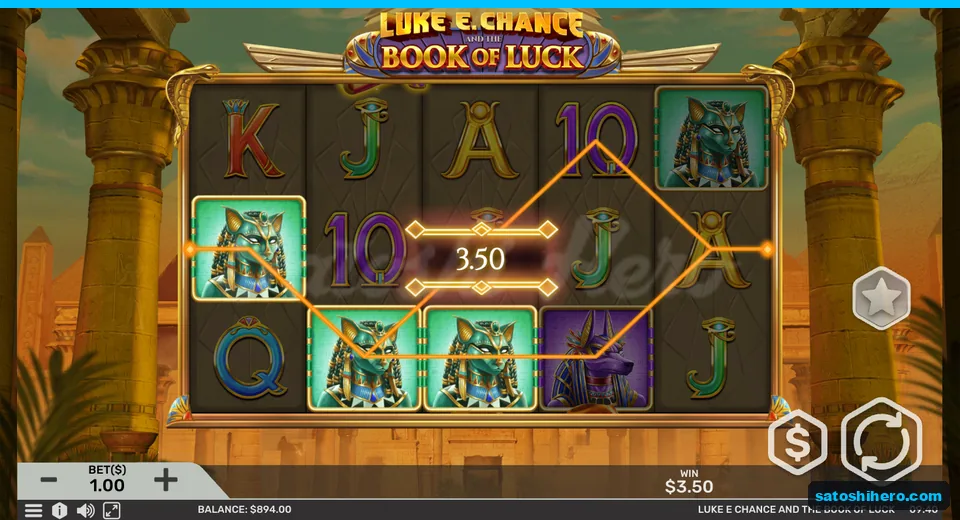
That screenshot came after my 100 counted spins, so it doesn’t change the recorded totals. Honestly, fixed lines feel easy to audit beside huge way counts.
Premium and royal values
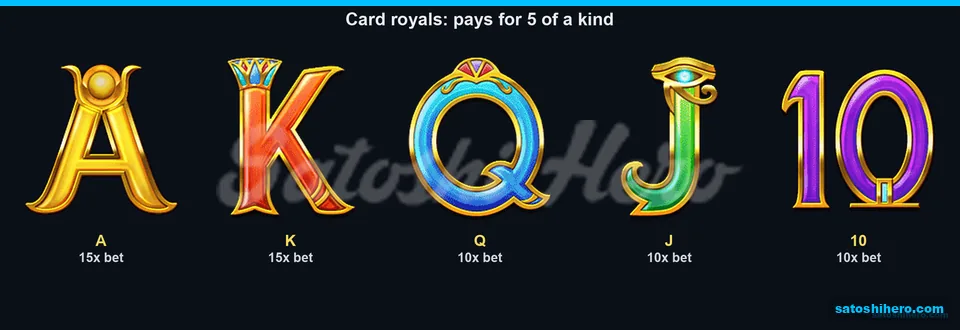
The paytable lists five-symbol returns as bet multiples. At a $1.00 stake, those multipliers translate directly into dollar values:
- Explorer: 500x
- Ra: 200x
- Anubis: 75x
- Bastet: 75x
- A and K: 15x
- Q, J, and 10: 10x

Three low royals pay 0.5x, matching the $0.50 returns I logged. Those small hits broke quiet runs but rarely repaired much of the falling balance. They don’t signal an approaching feature.
The Book handles two jobs. As a wild, it replaces every other symbol; as a scatter, it pays anywhere at 100x for five, 5x for four, and 1x for three. Two Books open the Lucky Chance Re-Spin, while three or more start Free Spins.

Stat Check: This is a genuine 10-payline slot, not a cluster, all-ways, or variable-ways game.
John Hunter and the Book of Tut offers a familiar 5×3 Book format with expanding-symbol play, making it a useful reference point. Still, you shouldn’t assume its payouts or feature rules match this game’s setup.
Once you understand the fixed lines and dual-purpose Book, every later feature becomes easier to follow.
Theme and First Impressions
The game delivers a clear Egyptian treasure hunt, although its Book theme won’t win originality awards. You get an instantly readable adventure scene, and that clarity matters during quick line checks.
Egyptian treasure hunt
A fedora-wearing explorer leads the artwork, while sandstone pillars frame the reels. A pyramid rises behind the grid, giving each spin an obvious archaeological setting without cluttering the symbols. Anubis, Bastet, and Ra form the premium tier, so you can spot stronger combinations quickly.
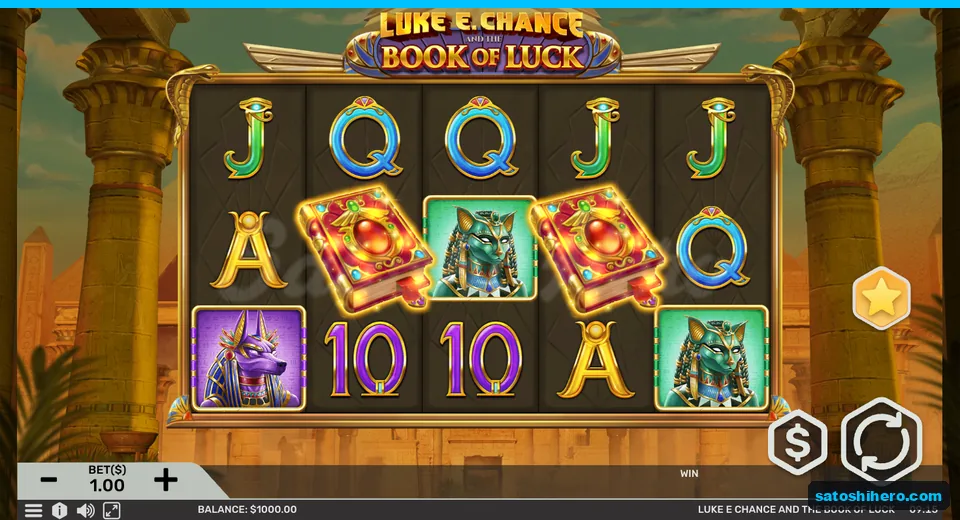
A, K, Q, J, and 10 fill the lower tier with Egyptian-styled lettering. I found the hierarchy clear during manual play.
Luke E. Chance and The Inca Sun God follows the same explorer into another archaeological setting. Choose its Inca adventure if temples appeal more, while this game gives you pyramids, Egyptian deities, and the familiar mystical Book.

Fun Detail: The Book isn’t merely decorative Egyptian scenery. Two Books open another chance at Free Spins, making the central image mechanically important.
Let me be real, the setting feels familiar because Book slots have visited Egypt many times. Yet the clean design supports the traditional mechanics, and you won’t waste time wondering which symbols carry the most value.
Lucky Chance Re-Spin
Two Book symbols anywhere trigger one Lucky Chance Re-Spin with their reels held. That makes a two-Book result a genuine feature opportunity instead of a decorative near miss for you.
Held-reel re-spin rules
The game pays any base-spin win before the extra spin starts. Each reel showing a Book then stays locked, while every other reel spins once more. If another Book appears, you enter Free Spins.
I didn’t trigger this feature during my 100 counted spins. That absence matters because it shows how a basic trigger can remain out of reach during a short high-variance session. I can confirm what the rules provide, but I won’t pretend that I tested its live behavior.
The held Books create tension because you can see what remains missing. I like that active bridge into Free Spins, although my session never reached it.
John Hunter and the Book of Tut Respin also explores the second-chance appeal around Book-triggered bonus play. It can help you judge whether re-spin suspense interests you, but the two games shouldn’t be treated as mechanically identical.
You may reach the bridge quickly or miss it entirely. My test landed on the colder side, proving that the re-spin can stay absent longer than you expect.
Lucky Bet
Lucky Bet is a base-game toggle that raises each chosen stake to 1.6x and doubles your chance of triggering Free Spins. It changes the spin mode rather than launching a separate bonus.
You can find the switch on the right side of the reels. The documented benefit covers trigger chance only, so don’t infer stronger symbols, better Free Spins, a favorable expanding-symbol draw, or a higher RTP. More trigger opportunities still don’t promise a profitable result.
I left Lucky Bet off throughout all 100 counted spins. As a result, I didn’t assess its live cost pattern or see whether it would have changed my feature count. That choice kept every manual spin at the standard $1.00 stake and made the session totals easy to follow.
The 1.6x charge drains your balance faster because each attempt costs more. A doubled chance sounds powerful, but random gaps can still stretch beyond your comfort point.
Before switching it on, set a total budget and calculate how many higher-cost spins that budget allows. You shouldn’t activate it halfway through a losing run just because the Books haven’t appeared. Use Lucky Bet only when you accept its larger spin cost before the session starts.
Free Spins and Expanding Symbols
Three or more Books award 10 Free Spins and choose one regular symbol for the expanding mechanic. This is the main attraction, but you may need patience because my test never triggered it.

Expanding symbol choice
Before the first free spin, the Book reveals a special symbol. Any regular icon can qualify, but the Book itself can’t. A gold highlight marks that selection for the whole round, helping you track which landings matter.
You may reject the first symbol and draw once more. The only supported tactical choice is taking that redraw when the original pick sits among the lowest-paying symbols. You give up the first result permanently, and the replacement remains random.

Player Hint: Redraw an initially selected low-paying symbol. The second pick may still be weak, so don’t expect Explorer, Ra, Anubis, or Bastet.
That decision adds agency without changing the randomness. I like the option, but you could exchange one low symbol for another.
Retriggers and limits
When enough chosen symbols land, each qualifying icon expands to fill its entire reel. Expanded symbols pay as scatters, meaning they don’t need positions on adjacent reels. That rule separates the bonus from the fixed left-to-right structure used in the base game.
Three or more Books during the round retrigger Free Spins. Repeated retriggers can extend the feature to 100 free spins, which gives the bonus a large theoretical ceiling for duration. You shouldn’t read that limit as a normal feature length, since it marks the cap rather than an expected result.
My 100-spin test never reached the opening 10 spins, so I have no firsthand bonus payout to report. The missing trigger was frustrating after clicking every spin manually. Still, that result gives you a more honest picture than describing the feature as though it appeared on demand.
Book of the Fallen offers another route for readers drawn to Book-style Free Spins and special-symbol mechanics. Its appeal overlaps at a broad level, though you shouldn’t expect matching triggers, limits, values, or math.
Free Spins hold the biggest gameplay hook here. The expanding scatter behavior can create dramatic coverage, but patience comes before any chance to see it.
Controls and Session Pace
The tested demo offered no autoplay or turbo, so I clicked all 100 counted spins manually. That slower rhythm made every dry stretch feel deliberate, and you couldn’t skip through weak results quickly.
Every counted spin used a $1.00 stake from a $1,000.00 starting balance. Most returns fell between $0.50 and $2.50, with neither Lucky Chance Re-Spin nor Free Spins appearing. Small line hits kept arriving, yet they did little to slow the overall decline.
A separate bonus-buy panel appeared beside the main game, but I didn’t use it. I can’t rank or recommend a purchased route without testing one, and you shouldn’t treat its presence as evidence of value. Keeping it untouched also preserved a clean base-game session.
Luke E. Chance and the Book of Luck free play on SatoshiHero lets you learn the paytable and controls without risking a real balance. You can also play Luke E. Chance and the Book of Luck free before deciding whether manual pacing feels comfortable.
The game worked properly in my tested setup, though I won’t assume every device or version shows the same controls. Observed control details are compared often with the SatoshiHero version, grounding these notes in the playable game.
Manual input helped me count each result, but it amplified the quiet session. The demo teaches you the rules, yet it can’t promise smoother real play.
RTP, Volatility and Our Test
The slot has a 96.37% theoretical RTP, high volatility, and a 10,000x maximum win. Those figures describe strong headline potential with uneven delivery, so you shouldn’t expect a short session to track the theoretical return.
I kept two evidence sets separate. The simulator models a possible range across 1,000 spins, while my manual test records 100 spins that actually happened. Neither set predicts what you may receive next.
Simulator projection
The SatoshiHero Slot Simulator modeled 1,000 spins at a $1.00 stake. Its median ending result sat $70.40 down, while the fifth-to-95th-percentile band stretched from $334.80 down to $346.10 up. That broad range captures the sharp spread you can see under high volatility.
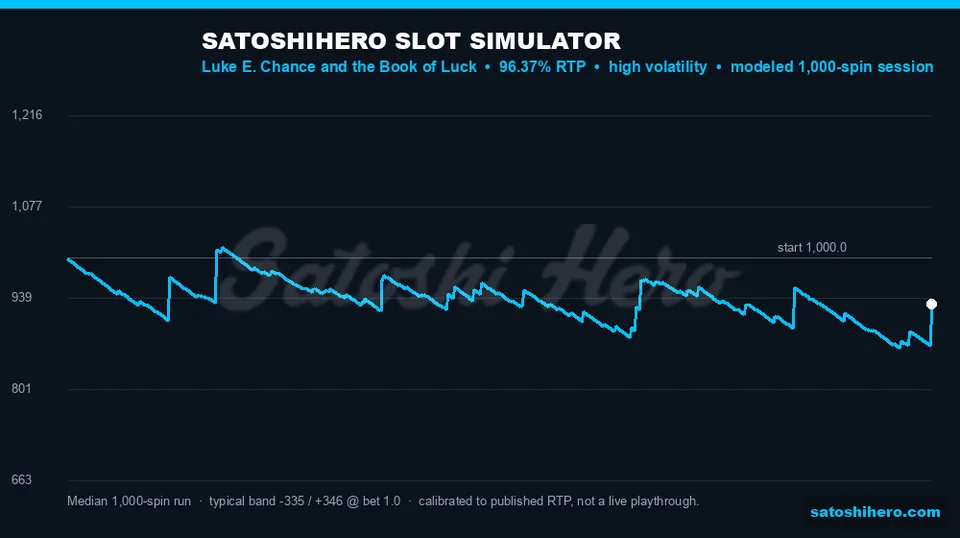
About 18% of modeled spins returned something. A feature-tier outcome appeared roughly once per 46 spins, while a result worth 100x or more appeared around once per 1,675 spins. These are model outputs, not measured properties of the game’s random number generator.
The once-per-46 figure isn’t a countdown. If you reach spin 45 without a feature, the next click doesn’t become due, and your personal gap can run much longer. I find this distinction vital because averages often tempt people into chasing a supposedly late event.
The 100x figure also shouldn’t be confused with the maximum prize. It describes one modeled threshold, not the frequency of hitting the cap. Use the projection to picture variance, never to schedule your bankroll around a promised event.
Our 100-spin session
I started with $1,000.00 and made 100 manual spins at $1.00 each. My ending balance reached $926.00, leaving a net loss of $74.00. The largest counted win was $3.50 on spin 53, while most returns ranged from $0.50 to $2.50.
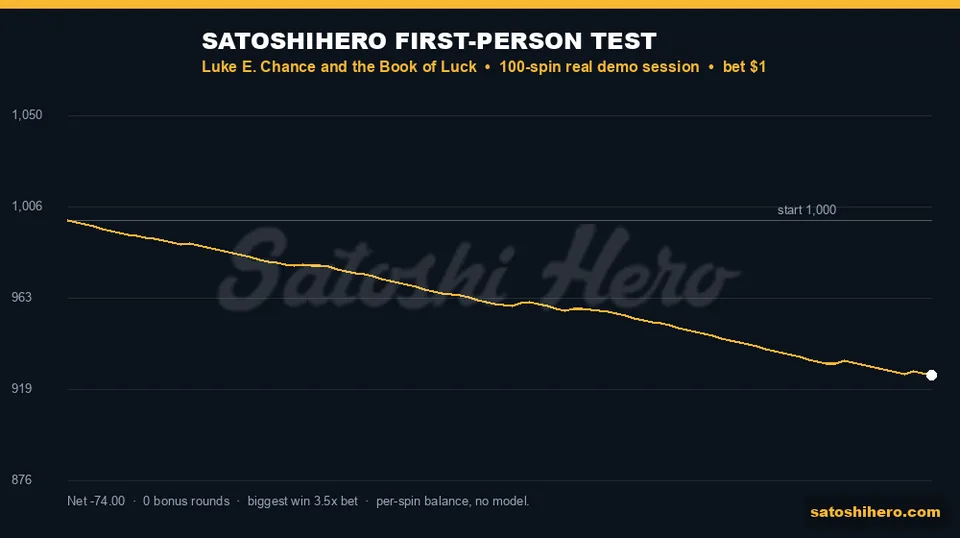
Neither main feature triggered. Lucky Bet stayed off, and I didn’t open a bonus purchase. Those choices mean the result reflects standard base play rather than an enhanced mode or bought round.
Small wins couldn’t offset the total stake. This one surprised me because repeated little hits felt active, while the result still represented a 74-stake drawdown.
A separate screenshot shows another $3.50 Bastet line from extra spins after the count. That image demonstrates the payline, but it doesn’t change my $926.00 ending balance or any recorded outcome. Keeping that distinction prevents a useful visual from distorting the test.

Beware: My session consumed 74 standard stakes without either main feature. Set your total budget first, and don’t raise the stake to chase a trigger.
Theoretical RTP is the operator-published return, and one live session doesn’t alter that figure. The simulator only models variance, while my session records actual play; bonus modes can carry slightly different designed returns, so I infer nothing about the untested purchase.
My real result demonstrates short-session risk, while the projection supplies broader context. You can use both to set expectations, but neither can tell you what your next spin contains.
Maximum Win and Bankroll Fit
The 10,000x maximum win gives this high-volatility slot a substantial ceiling, but my short test showed almost none of that potential. You need patience and strict stake control more than faith in the headline prize.
My session produced small line wins, a $3.50 best result, no feature, and a 74-stake drawdown. Those outcomes show how distant the maximum can feel. The modeled 100x frequency doesn’t represent your chance of reaching the cap.
Honestly, the prize ceiling feels substantial enough for this risk level. The harder issue is feature access because dry spells can frustrate anyone seeking frequent bonus action. You may spend an entire short session seeing only base-game lines, just as I did.
A stronger match looks like this:
- You enjoy classic Book mechanics and fixed paylines.
- You accept long waits between the main features.
- You choose a stake that leaves room for a prolonged dry spell.
- You can stop at a preset loss without chasing Books.
A weaker match looks different:
- You expect bonus rounds to arrive frequently.
- You prefer a smooth balance curve with steadier returns.
- You raise bets after losses or near misses.
- You treat modeled averages as trigger schedules.
Don’t budget around the modeled once-per-46-spin feature-tier output. An average inside a simulator doesn’t make any feature due after a fixed number of clicks. Basing your stake on that figure can leave you underfunded for a much longer gap.
Choose your full session budget first, then pick a stake that leaves a comfortable number of possible spins. I prefer this order because it stops the headline maximum from dictating the risk. Patience and stake control matter far more than chasing the cap.
Frequently Asked Questions About Luke E. Chance and the Book of Luck
How many paylines does Luke E. Chance and the Book of Luck have?
Luke E. Chance and the Book of Luck has 10 fixed paylines across a 5×3 grid. Wins start on the leftmost reel and continue across adjacent reels, and only the highest win on each payline pays. You always play every fixed line with your selected stake.
What does the Book symbol do in Luke E. Chance and the Book of Luck?
The Book acts as both wild and scatter. It replaces regular symbols as a wild and pays on any reel as a scatter. Two Books trigger the Lucky Chance Re-Spin, while three or more award Free Spins.
How do Free Spins work in Luke E. Chance and the Book of Luck?
Three or more Books award 10 Free Spins and select one regular expanding symbol. You may accept one optional redraw before the round starts. Qualifying symbols fill their reels and pay as scatters, while retriggers can extend the round to 100 free spins.
What is the Lucky Chance Re-Spin?
Two Books lock their reels while the remaining reels spin once more. The game pays any original base win first, and another Book on the re-spin opens Free Spins. You may not see this bridge quickly because my 100-spin session missed it entirely.
What are the RTP and maximum win in Luke E. Chance and the Book of Luck?
Luke E. Chance and the Book of Luck has a 96.37% theoretical RTP, high volatility, and a 10,000x maximum win. These figures don’t promise any return during your own session.
What happened during the Luke E. Chance and the Book of Luck 100-spin test?
My $1.00 session fell from $1,000.00 to $926.00, creating a $74.00 loss. The best counted win reached $3.50, and neither main feature triggered. Lucky Bet remained off, and I didn’t buy a bonus.
What did the 1,000-spin simulator show?
The median modeled result was a $70.40 loss. Its fifth-to-95th-percentile range ran from a $334.80 loss to a $346.10 profit. The simulator illustrates variance, but it can’t predict what you will see in an individual session.
Wrap-Up
Luke E. Chance and the Book of Luck combines readable fixed lines, a clever two-Book re-spin, and expanding-symbol Free Spins. Its main drawback is simple: you might not reach either feature during a short session.

My Verdict
Patient Book-slot fans should try the demo before committing a real balance. Expect small base wins and possible feature droughts, then judge whether the manual pace keeps you engaged.
I like the clear payline feedback and the meaningful second chance created by two Books. I don’t like how my 100 clicks ended $74.00 down without showing either main feature, even though small wins appeared throughout.
Luke E. Chance and the Book of Luck remains an honest high-risk choice for disciplined feature hunters. This guide is updated periodically as tested details change.

Pros:
 Clear paylines: Fixed routes make every winning combination easy to verify.
- Useful re-spin: Two Books create a real second chance at Free Spins.
- Flexible symbol draw: One redraw lets you reject a weak expanding symbol.
- Strong ceiling: The top prize gives patient high-risk play meaningful upside.

Cons:
 Long feature gaps: My full test ended without either main feature.
- Costly Lucky Bet: Enhanced trigger chances require a much larger stake.
- Manual pacing: Missing autoplay and turbo makes cold runs feel slower.

Best For: Disciplined Book-slot fans who accept long bonus gaps and prefer transparent fixed paylines. You should set a firm budget, keep stakes steady, and treat every feature as uncertain.






























































Bets
All Bets
Game
Player
Date
Wager
Mult.Multiplier
Prize
 Rocket Dice
 krisattalla
- 00:19:32
- 0×
- Wild Buffalo: Megaways
 mike_721
- 00:19:32
- 0×
- Galaxy Glitter
- nina87
- 00:19:29
- 0×
- Royal Fruits 9: Hold 'n' Link
 Hidden
- 00:19:29
- 0×
- Galaxy Glitter
- josh1998
- 00:19:28
- 0×
- Rocket Dice
- krisattalla
- 00:19:27
- 0×
- Royal Fruits 9: Hold 'n' Link
 tess1973
- 00:19:27
- 0×
- Royal Fruits 9: Hold 'n' Link
- Hidden
- 00:19:26
- 3.99×
- Rocket Dice
- krisattalla
- 00:19:24
- 0×
- Royal Fruits 9: Hold 'n' Link
- Hidden
- 00:19:23
- 0×