

Luke E. Chance and The Inca Sun God
By pressing play, you agree that you are above legal age in your jurisdiction and that your jurisdiction allows online gambling.

Luke E. Chance and The Inca Sun God
RTP94.49%
VolatilityMedium
Max winx5,000
Lines25
Hit rate32.79%
ReleasedApr 2024

Chasing the Sun Mask Through the Inca Temple
Luke E. Chance and The Inca Sun God sends you across a 5×3 grid with 25 fixed paylines, a Second Chance Re-Spin, and wheel-selected Free Spins. Gaming Corps wraps this medium volatility slot in an Inca-inspired jungle, with 96.49% RTP and 5,000x maximum win potential. Traditional line players get bonus triggering, a Divine Wheel choice, and Free Spin multipliers reaching 25x.
Honestly, the feature structure beat its payout in my test. One bonus paid only its $3.00 Scatter return, and I finished $56.80 down. The win cap feels respectable, not exceptional.
Key takeaways
- Best bonus: There’s no bonus buy, and the rules recommend Spin Again after an opening award of 12 or fewer Free Spins.
- RTP / volatility: The 96.49% theoretical RTP pairs with medium volatility and traditional fixed-line play.
- Max win: The maximum prize caps every possible result at 5,000x the bet.
- Risk note: My test included 13 blank spins in succession and ended $56.80 down.
- Bankroll note: My 100 spins at $1.00 created $100.00 turnover, so leave enough room for a meaningful session.

Table of Contents
- How Luke E. Chance and The Inca Sun God Works
- Paytable highlights
- Wilds and Scatters
- Theme and First Impressions
- Temple setting
- Character design
- Second Chance Re-Spin
- Trigger conditions
- Test conversion
- Free Spins and the Divine Wheel
- Wheel decision
- Random multipliers
- Sun Spins
- Locked multiplier
- Extra spins
- No Bonus Buy Option
- Natural triggering
- What 100 Spins Felt Like
- Early peak
- Slow decline
- RTP, Volatility and Our Test
- Simulator projection
- Our 100-spin session
- Frequently Asked Questions
- Wrap-Up
How Luke E. Chance and The Inca Sun God Works
Luke E. Chance and The Inca Sun God uses five reels, three rows, and 25 fixed paylines. Regular combinations start on reel one, then run left to right across adjacent reels. Only the highest combination on each line pays, while Scatters can pay from any reel.
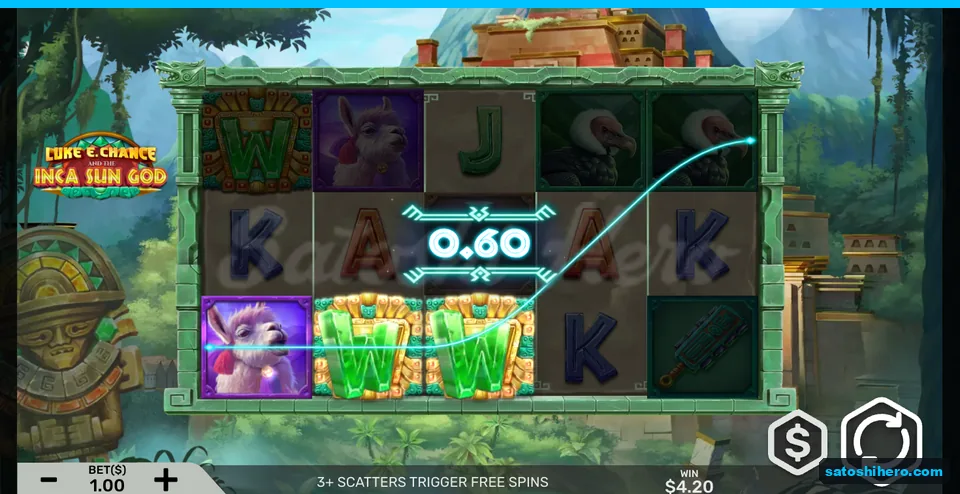
I tested 100 manually clicked spins at $1.00 each from a $1,000.00 balance. That stake made every paytable multiplier easy to read as a dollar return. You can also try the demo or real play here on SatoshiHero. The uncluttered grid stays readable on desktop and mobile, so you won’t need separate controls or rules.
Because the wager covers all 25 lines, a displayed paytable value applies to the total bet rather than one isolated line stake. That kept my log simple: a 0.6x combination became $0.60, while a 3x Scatter return became $3.00. I think this direct relationship makes the game unusually easy to audit as you play.
Paytable highlights
Luke E. Chance pays 12x, 3x, and 0.8x for five, four, or three matching symbols. The Warrior returns 10x, 2x, and 0.6x, while the Llama gives 8x, 1.6x, and 0.6x. Vultures pay 5x, 1x, and 0.4x. Both the Weapon and Vase pay 4x, 1x, and 0.4x.
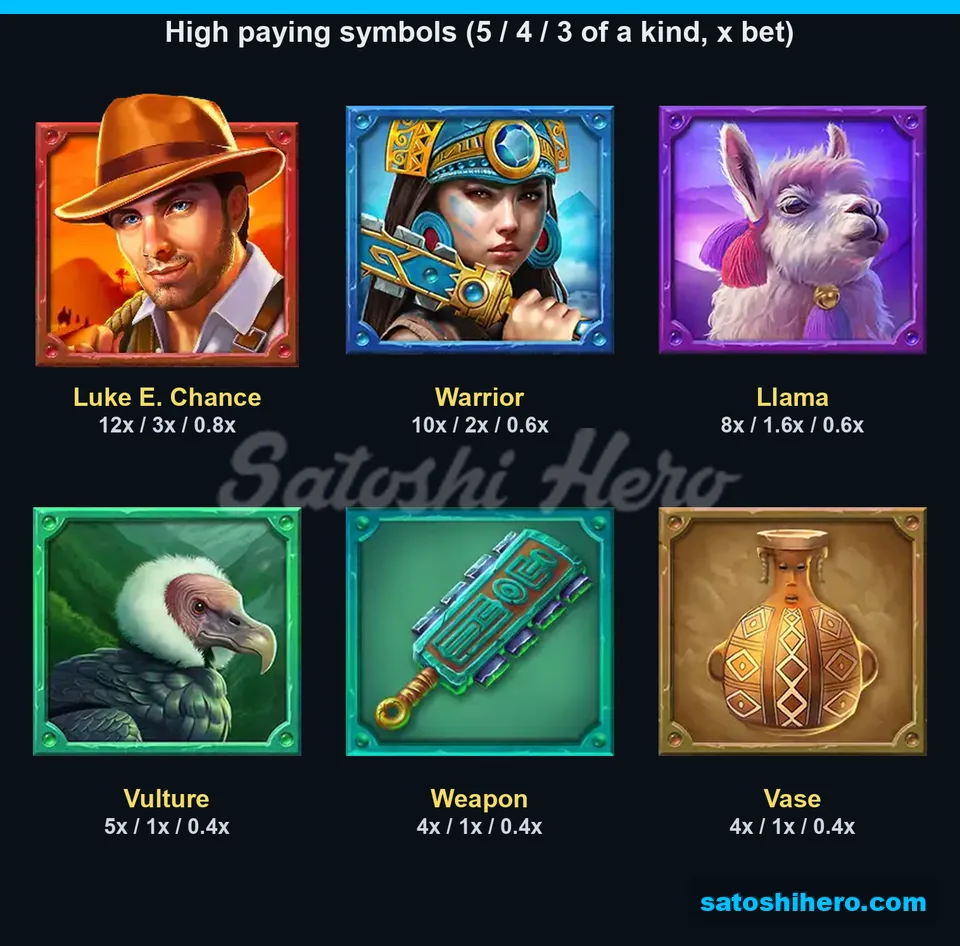
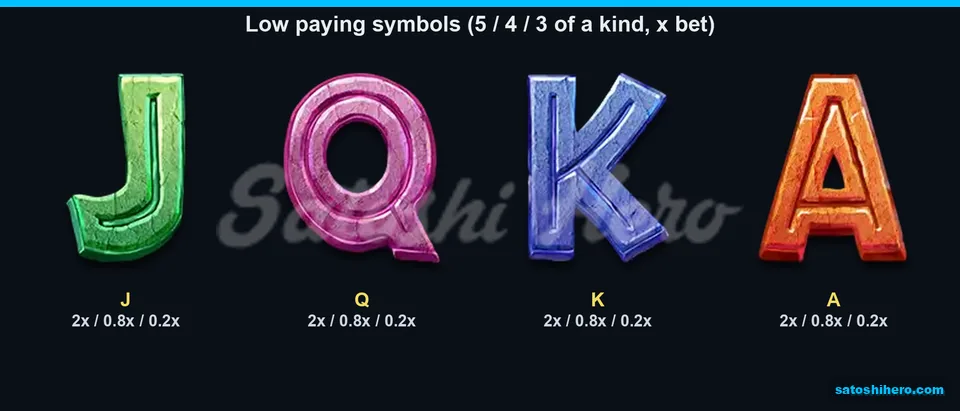
The J, Q, K, and A symbols share values of 2x, 0.8x, and 0.2x. I logged three llamas for $0.60, exactly matching the listed 0.6x return at my stake. Honestly, that small hit shows why a paying spin doesn’t always protect your balance.
Wilds and Scatters
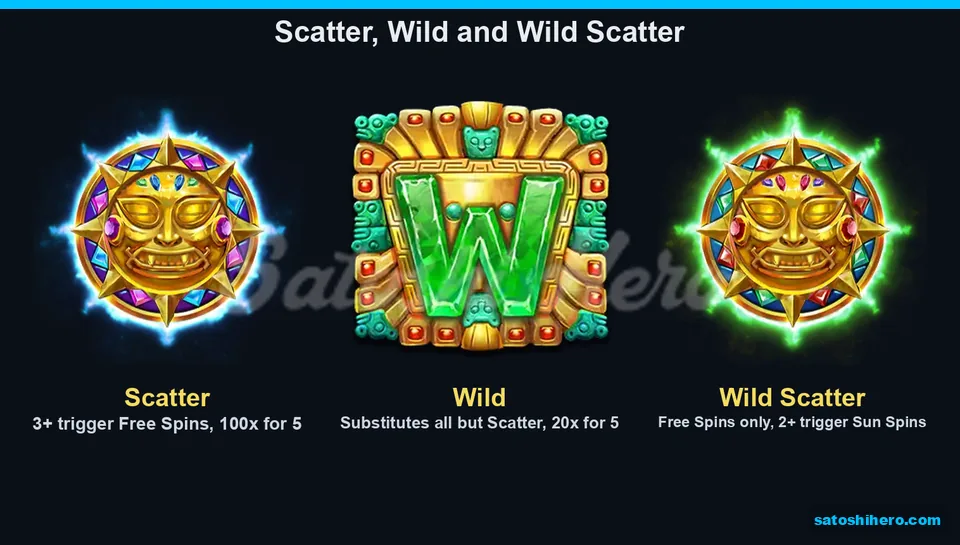
The green W Wild substitutes for every regular symbol, but it can’t replace the Scatter. Three, four, or five Wilds pay 1.2x, 4x, or 20x. The gold sun-mask Scatter pays 1x for two, 3x for three, 10x for four, and 100x for five.
I saw two Scatters return $1.00 and three return $3.00, exactly as the table indicated. During Free Spins, that mask becomes a green-lit Wild Scatter and can also substitute. John Hunter and the Book of Tut offers an explorer-led setting with left-to-right line wins, though you shouldn’t assume its math or features match this game.
Scatter behavior also separates the two core win types cleanly. Line symbols need consecutive reels from the left, while gold masks can contribute from anywhere. You can read that distinction quickly, and I never struggled to identify why a logged return appeared.

Stat Check: At my $1.00 total stake, a three-llama line paid $0.60, matching its listed 0.6x value.
Familiar line rules make most results easy to follow. You can see where each combination formed without decoding clusters, symbol counts, or shifting reel sizes.
Theme and First Impressions
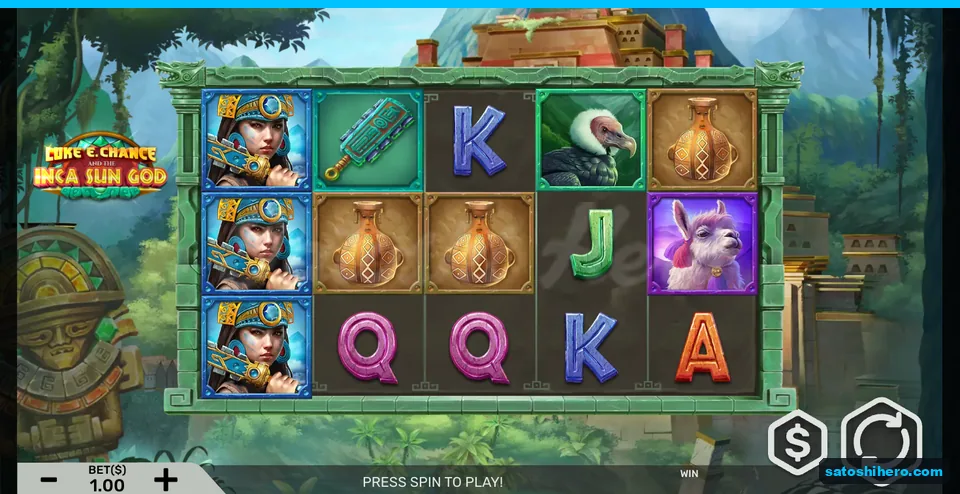
The slot presents its Inca-inspired expedition clearly, although the lost-temple idea feels familiar. A stone reel frame sits before a stepped temple, with misty mountains behind it and a carved totem beside the grid. You can track paylines easily because the art never overwhelms the 5×3 layout.
Temple setting
Jungle plants, distant peaks, and temple stonework build a simple adventure scene. Gold sun imagery connects the title with Inti, the Inca sun god, but the game uses stylized entertainment rather than detailed history. I like the visual clarity, though the setting won’t surprise anyone who has spun many expedition slots.
Warm golds pull your eye toward the Scatter, while cool green light marks its Wild version. That color contrast helps you separate base-game masks from bonus symbols immediately. In my view, practical symbol clarity matters more here than elaborate scenery.

Fun Detail: Inti held a central place in Inca religion, and the gold sun-mask Scatter echoes that association.
Character design
Luke appears in an explorer hat beside an Inca warrior, llama, vulture, carved weapon, and clay vase. Stone-cut J, Q, K, and A symbols complete the set. You’ll recognize every symbol quickly, which matters when 25 fixed lines can light up.
John Hunter and the Mayan Gods covers a comparable explorer-led temple adventure, while this game keeps its own Inca-inspired look. Jane Hunter and the Mask of Montezuma takes masked-deity imagery in another ancient-American direction. Aladdin and the Sorcerer offers another adventure-themed comparison with a fantasy setting rather than an Inca-inspired temple. The concept won’t win originality awards, but I think its readable execution serves traditional line play well.
Second Chance Re-Spin
Exactly two Scatters lock their reels and spin all remaining reels once more. That single attempt looks for a third Scatter to start Free Spins. An opening result with three or more Scatters skips this feature and triggers the bonus directly.
Trigger conditions
The held masks make the extra attempt easy to understand. You get another trigger opportunity without placing a separate wager, but activation doesn’t guarantee Free Spins. I enjoyed the sudden pause because it added tension to otherwise simple base play.
Test conversion
I saw the Re-Spin on spins 1, 77, 82, and 83. The first three missed, while spin 83 found the third Scatter and opened Free Spins. That means one of my four observed attempts converted, but you shouldn’t treat such a tiny sample as a dependable rate.
The spacing also shaped how the mechanic felt. One activation appeared immediately, then 76 spins passed before another chance arrived. You can’t derive frequency from that pattern, yet it shows how uneven a short session can feel.
Let me be real, the mechanic improved anticipation more than my balance. Most attempts still failed, and only the final one converted during my session.
Free Spins and the Divine Wheel
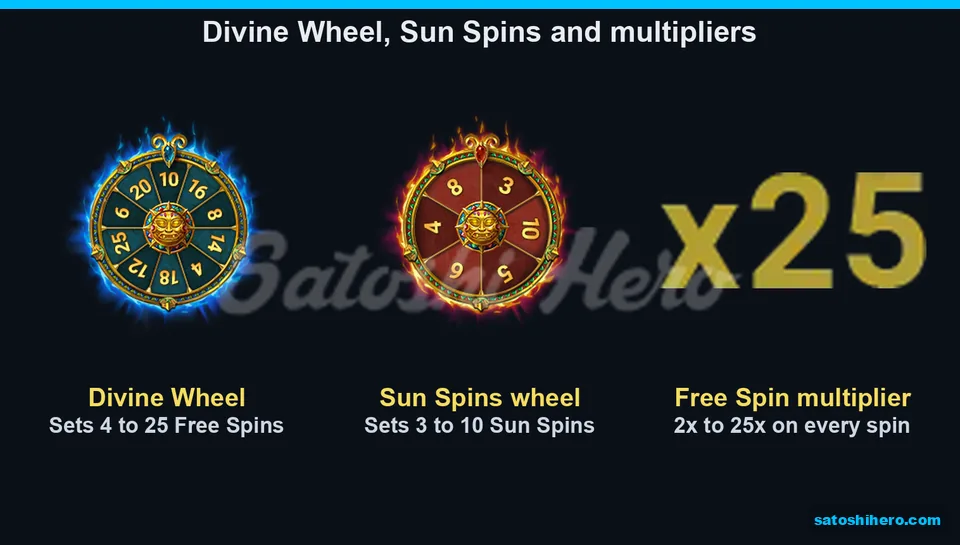
Three or more Scatters trigger Free Spins and open the Divine Wheel. Its first award can be 4, 6, 8, 10, 12, 14, 16, 18, 20, or 25 spins. You can accept that result or press Spin Again once, but the replacement becomes final.
Wheel decision
The rules recommend Spin Again when the first award gives 12 or fewer spins. My spin 83 trigger paid $3.00 for three Scatters, then the wheel stopped on four Free Spins. I pressed Spin Again in line with that guidance. Every Free Spin played blank, so the round added nothing beyond the Scatter payment.
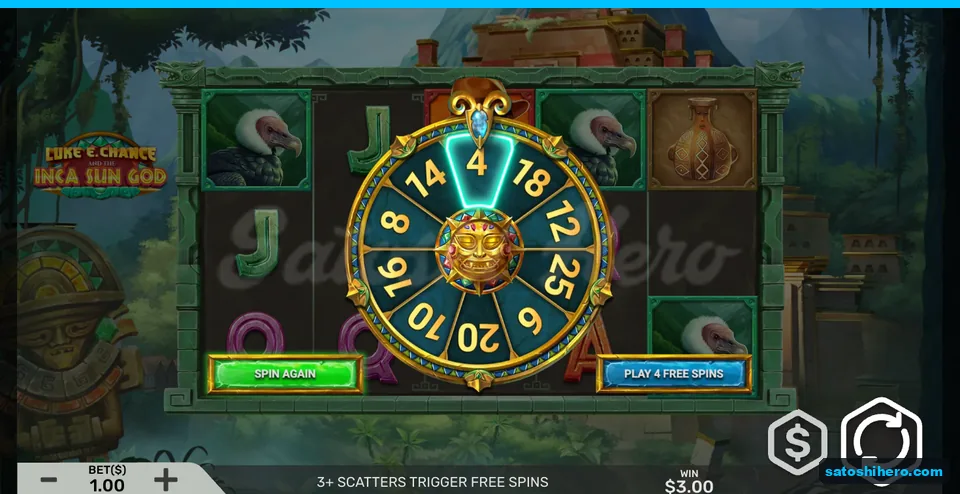

Player Hint: Use Spin Again after an opening award of 12 or fewer spins if you follow the rules guidance. You must accept the replacement.
Honestly, the choice feels meaningful because you can reject a low number. It also carries real risk, since the second result can’t be refused. The wheel and button both appeared during my session, but the poor outcome showed that extra spins still need winning symbols.
My four-spin opening award sat at the bottom of the wheel’s range, making the recommended choice straightforward. The replacement didn’t rescue the round, which is an important distinction between gaining another draw and gaining better results. You control the decision once, not the outcome that follows.
Random multipliers
Each Free Spin receives one random multiplier: 2x, 3x, 4x, 5x, 8x, 10x, or 25x. That value applies to every win formed on its individual spin. The complete range comes from the rules because my Free Spins returned no wins to multiply.
Luke E. Chance and The Inca Sun God makes its strongest decision before the spins begin. I like that small burst of agency, yet the tested bonus was undeniably flat and paid no extra money.
Sun Spins
Sun Spins form a secondary feature available only within Free Spins. Two or more Wild Scatters trigger a second wheel, which awards 3, 4, 5, 6, 8, or 10 Sun Spins. My session never reached this stage, so these details come from the game rules rather than observed play.
Locked multiplier
Sun Spins retain the multiplier attached to the triggering Free Spin. A locked 25x value looks powerful on paper, while a lower multiplier gives the feature less obvious punch. I find that carryover more interesting than resetting the value, but you can’t infer typical returns from an untriggered feature.
This structure links the secondary round’s appeal directly to its trigger spin. You would enter with a known multiplier rather than drawing another one immediately. That continuity sounds exciting, although my blank bonus offered no firsthand evidence of its payout strength.
Extra spins
Two or more Wild Scatters during Sun Spins activate the wheel again. Added awards can build the total toward a 100-spin cap, though you shouldn’t expect that ceiling from one trigger. The retained multiplier makes this the deepest mechanic, yet my test couldn’t show how often you’ll see it.
No Bonus Buy Option
No bonus buy appeared in the tested game. You must reach Free Spins naturally through three opening Scatters or a successful Second Chance Re-Spin after exactly two Scatters.
Natural triggering
You can’t pay to skip the base game, so choose your stake around a full run of paid spins. Raising the wager doesn’t make a bonus due and shouldn’t become a chasing tactic. I don’t see the missing buy as a flaw, but impatient bonus hunters could find the wait frustrating.

Beware: Don’t increase your stake to chase Free Spins. My test needed 83 paid spins to reach them, and one session can’t establish a reliable trigger interval.
A comfortable stake gives you room to handle failed Re-Spins and blank stretches. That plan matters more than trying to force the feature through bigger wagers.
What 100 Spins Felt Like
My session started at $1,000.00 and finished at $943.20 after 100 spins at $1.00. I clicked every spin manually in one continuous run because the game offered no autoplay or turbo mode. The $56.80 loss turned a steady opening into a persistent grind.
Early peak
Spin 7 returned $3.00, followed by $4.20 on spin 9. My best hit arrived on spin 20, paying $10.80 and lifting the balance to its $1,003.80 peak. That 10.8x line win remained the session leader, and I expected the calm opening to hold longer than it did.
Slow decline
The balance generally slipped after that early high. Thirty-one spins returned something, but many payouts fell below the $1.00 wager. A 13-spin blank run created the roughest patch, while spin 83 produced the sole Free Spins trigger and its $3.00 Scatter return.
My ending balance also marked the session low. Medium volatility doesn’t promise smooth movement or frequent meaningful returns, and this run proved that point sharply. If you prefer another ancient-American treasure hunt, John Hunter and the Aztec Treasure provides a thematic alternative without implying matching math or feature behavior.
The 31 paying spins looked healthy at first glance, but hit count alone hid the damage. Returns below my $1.00 stake still reduced the balance, only more slowly than blank spins. That’s why I tracked dollar movement instead of treating every symbol win as progress.
You should treat these results as one recorded path, not an expectation. I found the opening calm, but the later sequence felt stubborn once smaller returns stopped covering the stake.
RTP, Volatility and Our Test
The published return is a theoretical figure, not a prediction for your next session. According to Gaming Corps, Luke E. Chance and The Inca Sun God has 96.49% RTP, medium volatility, and a 5,000x maximum win. Neither my live run nor the SatoshiHero Slot Simulator came remotely close to that prize ceiling.
Simulator projection
Our simulator used a $1.00 bet across 1,000 spins with the stated game settings. Its median finish landed about $39.40 down. The approximate fifth-to-ninety-fifth-percentile band stretched from $202.90 down to $155.30 up, showing how widely modeled sessions can separate.
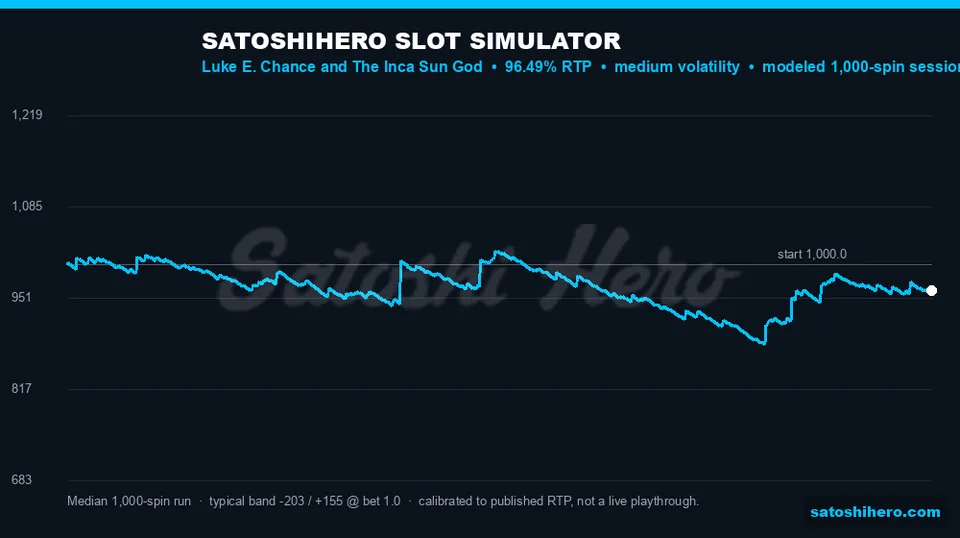
Any-win frequency reached roughly 25% of spins in the model, while a feature appeared about once per 50 spins. A result of 100x or higher appeared around once per 13,333 spins. You shouldn’t read those outputs as promises, countdowns, or measurements of the game’s random number generator.
I find the wide spread more useful than the median alone. It shows why a central estimate can hide both a substantial modeled loss and a profitable finish. You still can’t use it to forecast your own balance.
The rare 100x estimate also puts the 5,000x ceiling in perspective without predicting it. A top prize can exist far beyond what a modest sample displays. I’d use the simulator to understand possible spread, never to decide that a large hit is approaching.
Our 100-spin session
I began with $1,000.00 and ended on $943.20, leaving me $56.80 down. Thirty-one of 100 spins paid something. My top win was $10.80, or 10.8x the stake, on spin 20, and the single bonus arrived on spin 83.
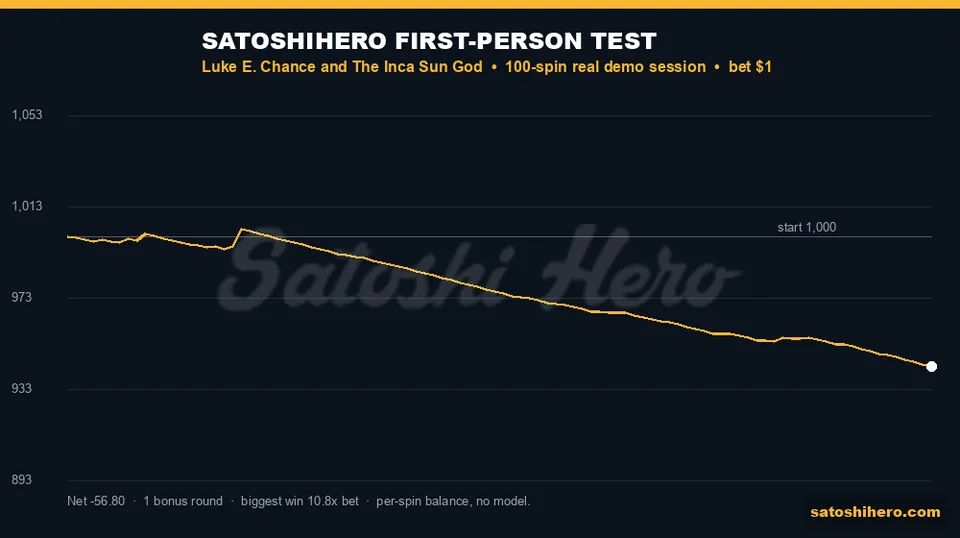
The longest non-winning sequence lasted 13 spins. My observed 31% paying-spin rate neither replaces nor contradicts the model’s approximate 25%, since the samples and evidence types differ. In my view, the live run felt harsher than the medium label might suggest, despite never moving roughly 6% beyond its start.
The bonus counts differ for the same reason. My run found one feature in 100 spins, while the model places one around every 50 spins on average. You can see both outcomes together without calling either one a schedule or a contradiction.
The theoretical RTP is the operator’s published game figure, and one 100-spin session doesn’t alter it. Simulator results are projections based on the game settings, not live outcomes. Any feature-level return needs its own documented setting, so I won’t blend one into my observed results.
This test shows one possible route through the slot. Your own sequence can follow a very different balance curve.
Frequently Asked Questions
What are the RTP and maximum win in Luke E. Chance and The Inca Sun God?
Luke E. Chance and The Inca Sun God has 96.49% RTP, medium volatility, and a 5,000x maximum win. My balance stayed within roughly 6% of its starting point, but one short session can’t define your results.
How many paylines does Luke E. Chance and The Inca Sun God have?
The game uses 25 fixed paylines on a 5×3 grid. Regular wins start on reel one and run left to right across adjacent reels. My $1.00 test stake made paytable multiples easy to compare with the recorded dollar returns.
How do Free Spins start in Luke E. Chance and The Inca Sun God?
Three or more Scatters trigger Free Spins, then the Divine Wheel awards between 4 and 25 spins from its fixed options. My trigger arrived on spin 83 after a Second Chance Re-Spin found the third Scatter.
What is the Second Chance Re-Spin in Luke E. Chance and The Inca Sun God?
Exactly two Scatters lock while the remaining reels spin once more. I recorded four activations, on spins 1, 77, 82, and 83. Only the final attempt found a third Scatter and triggered the feature.
Which Free Spins multipliers appear in Luke E. Chance and The Inca Sun God?
Each Free Spin can receive 2x, 3x, 4x, 5x, 8x, 10x, or 25x. The selected value multiplies every win on that spin. This full list comes from the rules because my observed Free Spins returned blank.
What are Sun Spins in Luke E. Chance and The Inca Sun God?
Two or more Wild Scatters during Free Spins trigger Sun Spins. The wheel awards 3, 4, 5, 6, 8, or 10 spins while retaining the triggering multiplier. Further Wild Scatters can add spins up to 100 total, but I didn’t reach this feature.
Does the slot have a bonus buy?
No bonus buy appeared in my test. You must trigger Free Spins through a normal three-Scatter result or a successful Second Chance Re-Spin.
What does the 1,000-spin simulator project?
The model’s median session finishes about $39.40 down at a $1.00 bet. Its approximate range runs from $202.90 down to $155.30 up across the stated percentile band. Those figures can’t predict one individual session.
How did the 100-spin test finish?
I started with $1,000.00 and finished at $943.20, losing $56.80. My best win paid $10.80, 31 spins returned something, and Free Spins triggered once on spin 83.
Who was the Inca sun god referenced by Luke E. Chance and The Inca Sun God?
Inti was the Inca sun deity. The game uses that association as inspiration for its golden mask, temple setting, and title. Its stylized visuals don’t provide a complete account of Inca beliefs.
Wrap-Up
Luke E. Chance and The Inca Sun God stands out through its Re-Spin rescue, Divine Wheel choice, and layered Sun Spins. Its main drawback is practical: my only bonus returned nothing beyond the $3.00 Scatter payment.

My Verdict
Traditional line fans can appreciate the readable wins and naturally triggered bonus path. Expect simple base play, occasional Re-Spin tension, and no assurance that the wheel feature pays well.
I like the one-time Spin Again decision because it gives the bonus a genuine moment of choice. I don’t like how my four observed Free Spins all ended blank after an 83-spin wait. Honestly, the feature idea beat the actual payout by a wide margin.
Luke E. Chance and The Inca Sun God remains a clear, feature-led expedition with a familiar skin. Test details and game information are checked regularly, so you can judge it against verified play evidence.

Pros:
 Clear line rules: Familiar left-to-right wins keep every result easy to inspect.
- Re-Spin rescue: Two Scatters can gain one extra chance without another wager.
- Meaningful wheel choice: Spin Again lets you reject one low opening award.
- Layered bonus: Retained multipliers give Sun Spins genuine on-paper depth.

Cons:
 Blank tested bonus: Four observed Free Spins added nothing beyond the Scatter payment.
- No bonus buy: You can’t skip the base game for direct feature access.
- Familiar theme: The explorer-and-temple setup brings few visual surprises.

Best For: Traditional-payline fans and patient bankroll planners get the clearest value here. You’ll need comfort with natural bonus triggering, small base returns, and a wheel choice that can still end poorly.



























































Bets
All Bets
Game
Player
Date
Wager
Mult.Multiplier
Prize
 Rocket Dice
 krisattalla
- 00:19:32
- 0×
- Wild Buffalo: Megaways
 mike_721
- 00:19:32
- 0×
- Galaxy Glitter
- nina87
- 00:19:29
- 0×
- Royal Fruits 9: Hold 'n' Link
 Hidden
- 00:19:29
- 0×
- Galaxy Glitter
- josh1998
- 00:19:28
- 0×
- Rocket Dice
- krisattalla
- 00:19:27
- 0×
- Royal Fruits 9: Hold 'n' Link
 tess1973
- 00:19:27
- 0×
- Royal Fruits 9: Hold 'n' Link
- Hidden
- 00:19:26
- 3.99×
- Rocket Dice
- krisattalla
- 00:19:24
- 0×
- Royal Fruits 9: Hold 'n' Link
- Hidden
- 00:19:23
- 0×