

Tales of the Serpent Maiden
By pressing play, you agree that you are above legal age in your jurisdiction and that your jurisdiction allows online gambling.

Tales of the Serpent Maiden
RTP96.45%
VolatilityHigh
Max winx6,605.2
Hit rate34.64%
ThemeAsia
ReleasedJan 2025

When the Serpent Starts the Cascades
Tales of the Serpent Maiden slot turns a 7×7 cluster grid into a chain reaction, with each cascade charging the five-part Snake Box.
GameArt wraps its blossom garden in high volatility, a 96.45% RTP, and 6,605x maximum win potential. Cluster fans who enjoy chained modifiers and sharp balance swings should feel at home, though the prize ceiling feels modest for this risk level.
Key takeaways
- Best bonus: Standard spins are the only tested method, so I can’t identify a preferred purchase.
- RTP / volatility: The 96.45% theoretical RTP combines with high volatility and uneven session results.
- Max win: The top payout reaches 6,605x the bet.
- Risk note: Cascades and queued features replace free spins, but neither mechanic promises a profitable round.
- Bankroll note: My 100-spin run lost 53.48x, while modeled sessions covered a much broader range.

Table of Contents
- How the Tales of the Serpent Maiden slot Works
- Symbol pay values
- Base game mechanics
- Theme and First Impressions
- The Snake Box
- Magic Light and Hiss in Swap
- Shared Love
- The White Touch
- Power in Plenty
- Buy Bonus Menu
- RTP, Volatility and Test Results
- Simulator projection
- Our 100-spin session
- Tales of the Serpent Maiden slot Frequently Asked Questions
- Closing Thoughts
How the Tales of the Serpent Maiden slot Works
You win by forming clusters of five or more identical symbols across the 7×7 grid. Each symbol must touch another horizontally or vertically, so a diagonal connection alone doesn’t count. Tales of the Serpent Maiden slot uses cluster pays, not fixed paylines. You should scan broad groups rather than trace paths from left to right.
Winning symbols disappear, replacements fall into their spaces, and another cascade begins when a fresh cluster forms. The sequence stops once a refill creates no new win. Every paying cascade also feeds the Snake Box, making longer chains far more interesting than isolated clusters. I find this loop easy to read, yet its deeper meter rules take a few rounds to absorb.
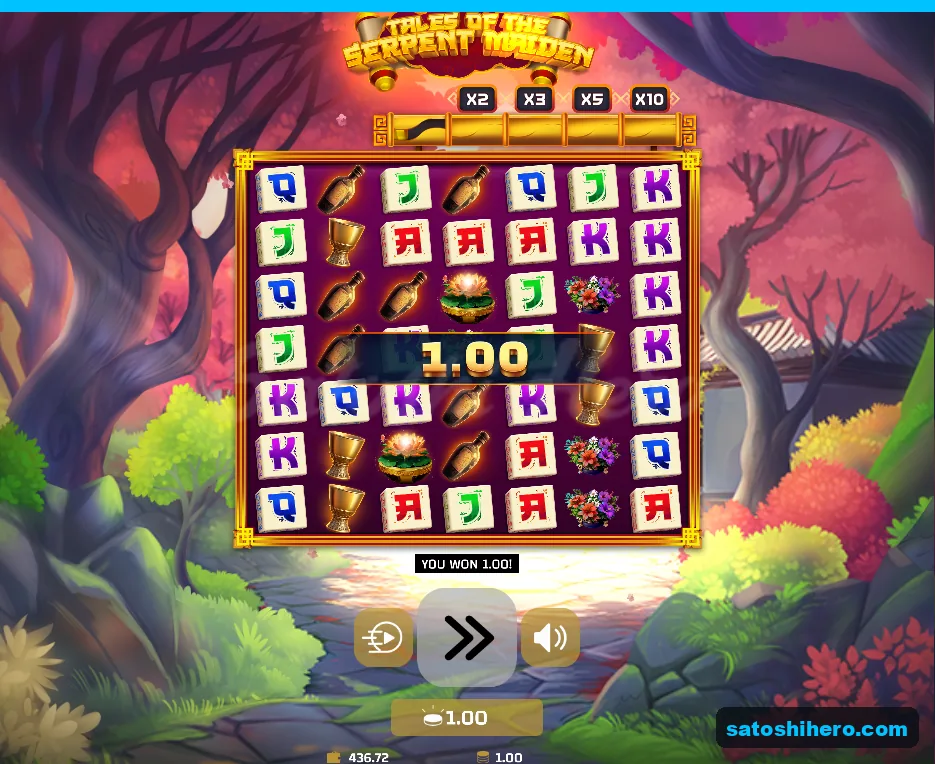
The regular Wild substitutes for every paying symbol. Bai Su Zhen acts as a portrait Wild during Hiss in Swap and Shared Love. There are no scatter symbols or free spins. Bets run from $0.25 to $200.00, and the complete grid remains visible on desktop and mobile screens.
Symbol pay values
At my $1.00 stake, each multiplier matched its cash value directly. The lotus bowl pays 1x for five symbols, rising through 1.4x, 2x, 3x, and 4x for six to nine. It then pays 10x for ten or eleven, 20x for twelve to fourteen, and 60x for fifteen or more. You can quickly see why extending a premium cluster matters.

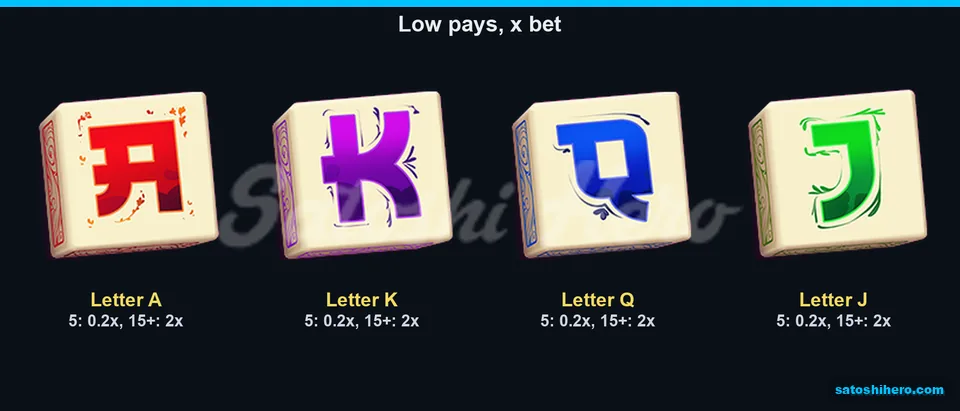
The gold goblet ranges from 0.6x to 20x. The wine bottle starts at 0.4x and tops out at 10x, while the flower basket spans 0.28x to 6x. A, K, Q, and J all share one table, beginning at 0.2x for five and reaching 2x for fifteen or more. My smallest logged returns, 0.2x and 0.28x, matched those low endpoints exactly.
Base game mechanics
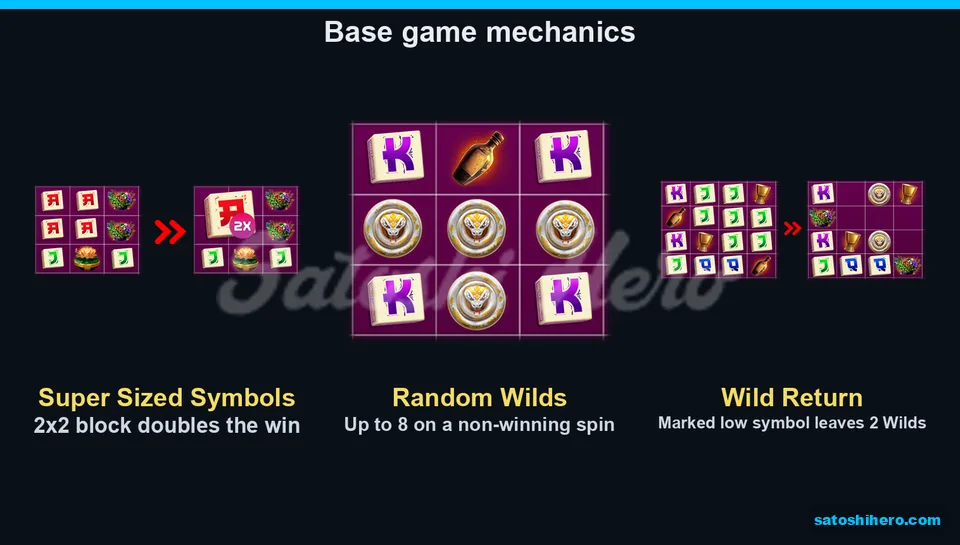
Four matching pay symbols in a square merge into one 2×2 Super Sized Symbol. Any qualifying cluster containing that merged block pays double, which gives square formations genuine value. An initial losing spin can also receive up to eight Random Wilds. You won’t see either modifier as a reliable rescue, but both can reshape a weak board quickly.
Wild Return highlights one random low symbol on every spin. When a winning cluster removes a highlighted copy, it leaves two 1×1 Wilds behind. I like how this mechanic links a small low-symbol hit to the next refill. You still need the resulting symbols to connect properly.

Fast Fact: Diagonal matches don’t qualify, even when identical symbols appear to form a clear line.
The Way of the Dead offers another darker mythic setting, but this game takes a brighter cluster-led approach. Focus on the entire refill because one ordinary win can become a useful meter-building chain.
Theme and First Impressions
The game places its cluster action inside a polished blossom garden. Pink-leafed trees arch over a stone path and tiled pavilion, while a gold frame holds the board. Scroll-shaped meters sit above the grid, giving the Snake Box a natural place within the scene. You get a clean view without the background fighting for attention.
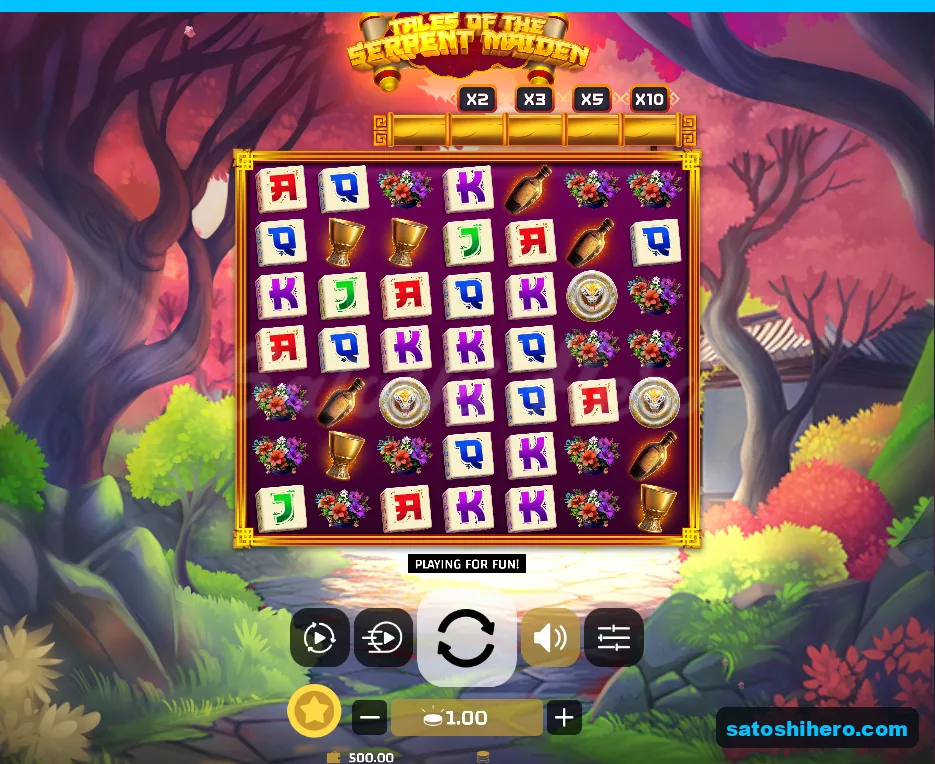
Cream mahjong-style tiles carry the letters, while a lotus bowl, gold goblet, wine bottle, and flower basket fill the premium ranks. The coiled white snake inside a silver ring makes the Wild easy to spot. Bai Su Zhen’s portrait adds the strongest character detail. I think the garden-and-gold style looks refined, though it feels traditional rather than daring.
King Of Wealth is a natural alternative when you want another wealth-and-folklore theme. This design stays calmer, and you read the whole board instead of following paylines. Clean silhouettes help you track crowded drops, especially when Wilds and merged symbols share the grid.

Trivia: Bai Su Zhen appears as a separate portrait Wild during two colour-coded features, Hiss in Swap and Shared Love.
Searches for a Tales of the Serpent Maiden trailer or Tales of the Serpent Maiden Wikipedia page can miss the practical detail visible during play. You learn more by watching how the crisp shapes survive busy cascades, and that clarity is the art team’s best decision.
The Snake Box
The Snake Box is a five-segment meter that queues colour-coded features as cascade wins fill it. It drives the central loop rather than opening a separate free-spins round. You can watch the five scroll segments above the board as each paying sequence contributes progress. In my view, this persistent visual goal gives modest clusters a purpose.
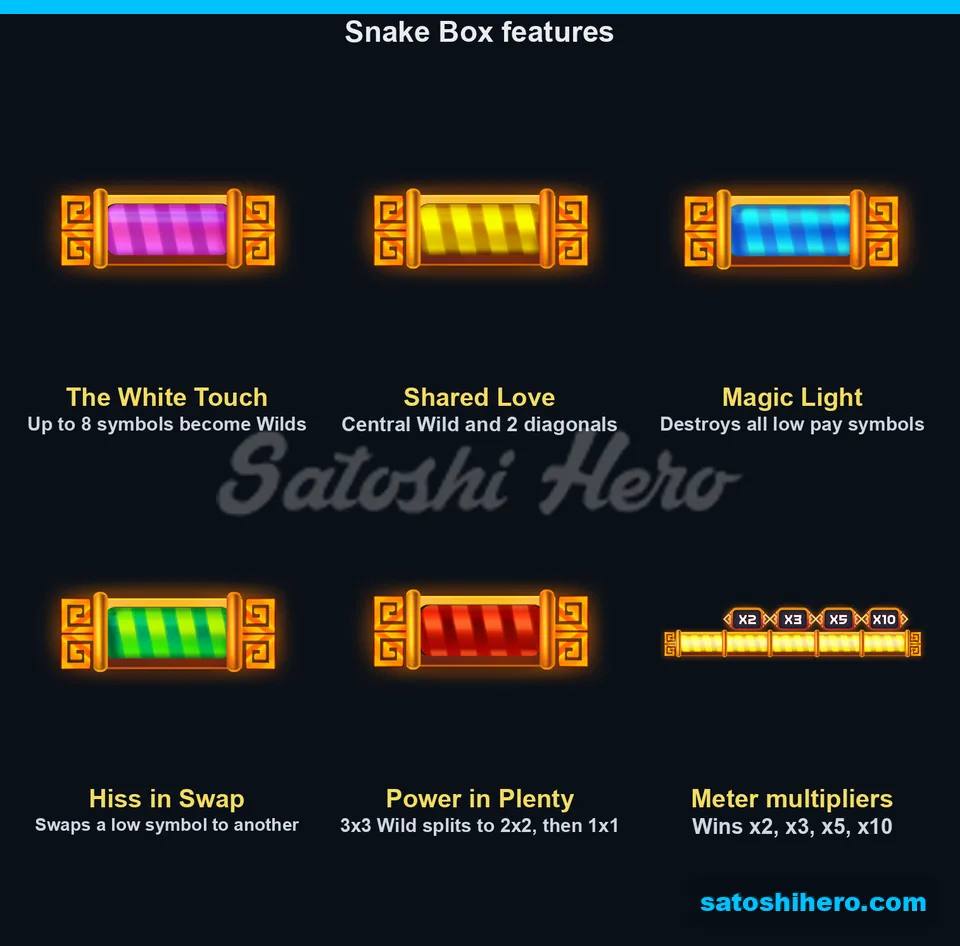
Filling a segment places its matching feature into a queue. Once the active cascade chain stops, queued features activate in order. Feature-created wins can restart cascades and charge any unfilled segments. The meter resets only after the complete round finishes without another paying cluster, so you should watch every refill before judging the spin.
The purchase menu shows the order clearly. Two features activate blue and green, three add yellow, four add purple, and five add red. After the spin, a total-win multiplier matches the number of features triggered during that round. Displayed levels above the meter read x2, x3, x5, and x10.
A small cluster can charge the Snake Box, but meter progress never promises profit. Let the entire chain finish before assessing your return.
I didn’t count Snake Box activations during my test, so I won’t invent a trigger rate. The mechanic can extend one paid sequence through several modifiers, yet it never becomes a separate bonus round. You get continuity rather than a clean break from base play.
Magic Light and Hiss in Swap
Magic Light is the blue feature, and it clears every A, K, Q, and J tile. New symbols fall immediately into the empty spaces, reducing low-paying clutter without ensuring another cluster. You should judge it by the rebuilt layout, not the removal animation. I like the clean reset, but its value depends entirely on what drops next.
My 100-spin log didn’t isolate Magic Light activations or their returns. That limit matters because a dramatic clear can still end without a useful connection. You can get extra meter progress only when the replacement grid forms a valid cluster.
Hiss in Swap fills the green segment. It selects one random low symbol and converts every matching copy into another symbol. If no low symbols remain, it can choose another available symbol instead. The conversion can build or enlarge a group, though horizontal or vertical contact still decides whether it pays.
Bai Su Zhen appears here as a portrait Wild and can bridge nearby groups. She also appears during Shared Love, so the artwork signals a functional role rather than decoration. I didn’t log a specific conversion or isolated payout, and you shouldn’t read one crowded board as a typical outcome. Both features live or die by the layout they leave behind.

The White Touch
The White Touch is purple and can transform up to eight symbols into Wilds. It also removes symbols beside those transformed positions, opening spaces for immediate replacements. You can gain value from the Wild coverage, the refill, or both parts together. I find that two-stage effect more interesting than a simple Wild drop.
New Wilds can bridge nearby clusters across the board. Cleared neighbours then create room for symbols to fall, which can start another cascade from a different area. Up to eight transformations sound generous, yet they don’t ensure a large return. You still need useful positions and matching groups after the change.

Tip: Watch both the new Wild positions and the refill before judging The White Touch. Either part can create the useful connection.
I didn’t record a standalone trigger count or feature payout in my session. You should treat each activation as a fresh layout problem rather than attach an expected return. The refill can matter as much as the first Wild placement, and sometimes it matters more. That uncertainty fits the game’s risk profile, though it can make a flashy activation feel flat.
Power in Plenty
Power in Plenty is the red, fully charged feature, supplying Wild coverage across three cascade phases. A 3×3 Wild first lands at a random grid position. Once its cascades end, that block changes into two 2×2 Wilds. After those cascades finish, the feature ends with nine 1×1 Wilds.
New symbols fill the grid before each transformation, giving every stage another chance to form a cluster. You get several waves of differently sized Wild coverage instead of one static block. I think this is the most elaborate Snake Box modifier, although a full meter still leaves the payout random. More opportunities don’t equal a guaranteed result.
The original 3×3 Wild divides into smaller Wild groups over successive phases, changing how it covers the grid each time.
I didn’t attach a tested return or trigger frequency because my log didn’t isolate either figure. You should resist ranking it from appearance alone, especially since position and refill quality drive each phase. Gold Of Ra offers a different gold-heavy mythic atmosphere, while this feature focuses attention on evolving Wild geometry. The phased breakdown gives the cascade engine several chances to continue.
Buy Bonus Menu
The gold star opens four purchases that pre-charge different numbers of Snake Box features. At my $1.00 stake, two features cost 30x, or $30.00, and three cost 100x, or $100.00. Four cost 300x, or $300.00, while all five cost 500x, or $500.00. You can inspect these options on SatoshiHero in free demo or real play.
Confirming a purchase deducts the full cost and activates that selected level. Blue and green appear first, followed by yellow, purple, and red as the price rises. I opened the menu and read every option, but I didn’t buy one. Standard spins remain the only play method supported by my firsthand results.

Alert: A 300x or 500x purchase can consume a session bankroll in one action. Paying the entry cost doesn’t make the outcome predictable.
The jump from $100.00 to $300.00 sharply increases your exposure, and the final step risks the full $500.00 test balance. You shouldn’t treat pre-charged features as a shortcut to profit. I prefer the transparency of named feature counts, though the upper prices demand serious restraint. This menu offers a costly route into known mechanics, nothing more.
RTP, Volatility and Test Results
Tales of the Serpent Maiden slot has high volatility, and my real 100-spin session ended with a substantial loss. Published mathematics, modeled outcomes, and live observations answer different questions. You should never blend them into one promise. I value the clear separation because short tests can look wildly unlike the headline profile.
Simulator projection
The SatoshiHero Slot Simulator modeled 1,000 spins at a 1x stake. Its median result finished about 63.9x down, while the middle 90% ranged from 313.1x down to 328.5x up. About 18% of modeled spins paid something. The larger feature tier appeared roughly once per 46 modeled spins.
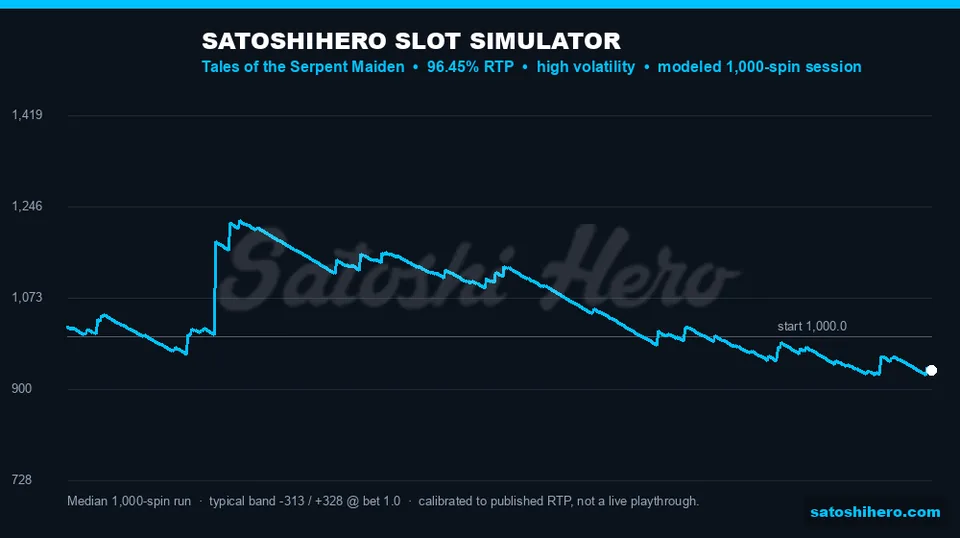
A win of at least 100x appeared about once per 1,623 modeled spins. Those frequencies aren’t countdowns, guarantees, or forecasts for your next session. The model has no access to the live game’s random number generator. I think the huge range matters more than any single midpoint because it shows how sharply outcomes can split.
Use this projection only to understand possible spread. You could finish outside its middle band, and your live sequence won’t follow its sample rhythm. That limitation doesn’t make the tool useless; it keeps the result in proper context.
Our 100-spin session
I ran 100 autoplay spins at turbo speed with a $1.00 stake and fresh $500.00 balance. Stop-on-bonus stayed disabled, so nothing paused the run. I finished with $446.52, a loss of 53.48x my bet. Logged returns totaled 46.52x, and my largest single-spin win reached 8.84x.
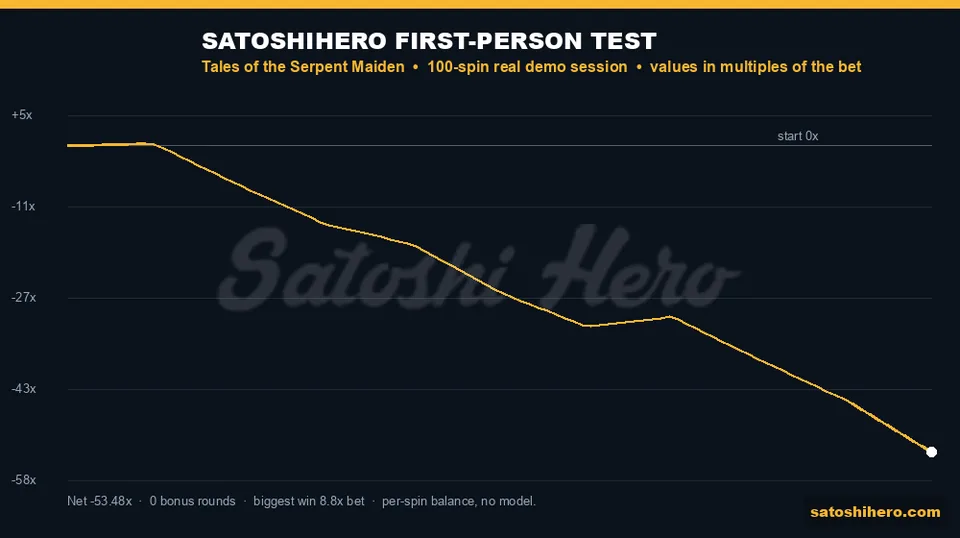
Most paying spins returned between 0.2x and 1x. My balance slid in small steps, interrupted by modest bumps rather than one smooth decline. I didn’t count Snake Box activations, which prevents any honest feature-frequency claim from this session. You might see a completely different path across the same number of spins.
Manual spins taken later for a clean screenshot don’t appear in these figures. That boundary keeps the counted run intact, and I think it makes the result more useful. It also shows why a $500.00 starting balance can still fall quickly under repeated small losses.
The 96.45% figure is the operator’s published theoretical return, while one live session neither proves nor disproves it. The simulator illustrates possible distribution and doesn’t forecast live results. Purchase configurations can use different returns by design, but no per-purchase figures appear here. Short sessions can vary sharply from the theoretical profile.
Tales of the Serpent Maiden slot Frequently Asked Questions
What are the RTP, volatility, and maximum win of Tales of the Serpent Maiden slot?
The theoretical RTP is 96.45%, volatility is high, and the maximum win is 6,605x the bet. These figures describe the game profile, not what you should expect from one short session.
How do wins work in Tales of the Serpent Maiden slot?
You need at least five matching symbols connected horizontally or vertically on the 7×7 grid. Winning symbols disappear, replacements drop, and cascades repeat until no new cluster forms. Every paying cascade also charges the Snake Box.
What is the Snake Box in Tales of the Serpent Maiden slot?
It is a five-segment meter that queues colour-coded features as wins charge it. Queued modifiers activate after the active cascade ends, and their wins can restart cascades. The meter resets once the complete round ends without another paying cluster.
Which five features appear in the Snake Box?
Magic Light clears low symbols, while Hiss in Swap converts copies of a selected symbol. Shared Love adds a central Wild and matching diagonals. The White Touch creates Wilds and clears neighbours, while Power in Plenty breaks one large Wild into smaller groups.
How does the total win multiplier work in Tales of the Serpent Maiden slot?
The multiplier applies after the spin and follows the number of Snake Box features triggered during that round. The displayed levels are x2, x3, x5, and x10.
What are Super Sized Symbols, Random Wilds, and Wild Return?
A 2×2 square of matching symbols can merge, doubling a qualifying win that includes it. An initial losing spin can gain up to eight Random Wilds. Wild Return leaves two 1×1 Wilds after a highlighted low symbol joins a win.
Can you buy the bonus in Tales of the Serpent Maiden slot?
Yes. Two features cost 30x, three cost 100x, four cost 300x, and five cost 500x. I inspected the menu but didn’t purchase any option, so I can’t rank their returns.
How did the 100-spin Tales of the Serpent Maiden slot test go?
I started with $500.00 at a $1.00 stake and finished with $446.52. That equals a 53.48x loss, while my largest single-spin win reached 8.84x.
What does the Tales of the Serpent Maiden slot simulator show?
The modeled median ended about 63.9x down across 1,000 spins. Its middle 90% stretched from 313.1x down to 328.5x up. That range illustrates possible spread rather than predicting your result.
Closing Thoughts
Tales of the Serpent Maiden slot stands out through its cluster cascades and five-step modifier queue. Its strongest feature ideas create layered rounds, but long weak stretches limit the appeal.

My Verdict
Cluster fans with patient bankroll habits should try standard play before touching the purchase menu. Expect many small returns, occasional linked modifiers, and balance swings that can outpace the calm garden setting.
I like how the Snake Box gives every cascade a second purpose. I don’t like that my $500.00 balance fell to $446.52 without any hit above 8.84x, though one short run can’t define yours.
The Tales of the Serpent Maiden slot remains mechanically distinctive, and its verified specifications and game details are checked regularly.

Pros:
 Clear cluster rules: Simple connections make busy cascades easy to follow.
- Layered meter: Queued modifiers can extend one round through several stages.
- Readable design: Clean symbols stay distinct during crowded grid changes.
- Transparent purchases: Named feature counts show exactly what each price activates.

Cons:
 Sharp variance: Repeated losses can erode a session balance quickly.
- No free spins: Players seeking a separate bonus round won’t find one here.
- Costly access: Upper purchase levels can consume large bankroll portions instantly.

Best For: Patient cluster fans who enjoy tracking board changes and queued modifiers get the strongest match. You should accept uneven returns, control your stake, and treat each Snake Box chain as uncertain.



































































Bets
All Bets
Game
Player
Date
Wager
Mult.Multiplier
Prize
 Rich Piggies: Bonus Combo
 mike_721
- 11:57:55
- 0×
- Galaxy Glitter
 Hidden
- 11:57:52
- 0×
- Frontier Falcon: Hold 'N' Link
- josh1998
- 11:57:52
- 0×
- Luck of Panda: Bonus Combo
- Hidden
- 11:57:49
- 0×
- Caribbean Escape: Rapid Link
 mdp0fxo
- 11:57:49
- 0×
- Rich Piggies: Bonus Combo
- mike_721
- 11:57:48
- 0.24×
- Big Banker Bonanza
 maya_81
- 11:57:47
- 1.38×
- Frontier Falcon: Hold 'N' Link
- josh1998
- 11:57:47
- 0.34×
- Luck of Tiger: Bonus Combo
- Hidden
- 11:57:47
- 0×
- Pelican's Bay: Rapid Link
 blazecraft
- 11:57:46
- 0×