

Night at KTV
By pressing play, you agree that you are above legal age in your jurisdiction and that your jurisdiction allows online gambling.


Karaoke Cascades Under Neon Rain
Night at KTV slot is a low-volatility GameArt release built around cascading line wins, combo-triggered free spins and a dice bonus.
Night at KTV is a low volatility slot from GameArt with 96% RTP and 390x max win potential. Its neon karaoke theme frames a 5×3 grid and 15 fixed paylines, while my 100-spin test used $500.00 and $0.75 spins. Gentle-balance fans get natural features rather than buys; SatoshiHero offers demo and real play, and this guide helps you judge the modest ceiling.
Key takeaways
- Best bonus: Four consecutive winning cascades unlock free spins, while three BONUS symbols trigger One and Six.
- RTP / volatility: The official figures are 96% RTP and low volatility.
- Max win: The maximum return is 390x the total bet, which looks modest beside jackpot-style caps.
- Risk note: You can still lose; my test dropped $4.75, equal to 6.3x my $0.75 bet.
- Bankroll note: You should track whole chains; spin 17 returned $6.50 entirely from its triggering cascades.

Table of Contents
- Neon Karaoke Theme and Design
- How Night at KTV slot Works
- Lines and payouts
- Wild and bonus symbols
- Cascade Feature
- RTP, Volatility and Our Test
- Simulator projection
- Our 100-spin session
- Math and source note
- Free Spins
- One and Six Bonus
- Gamble Feature and Risk
- Bonus Buy Availability
- Frequently Asked Questions About Night at KTV
- Closing Thoughts
Neon Karaoke Theme and Design
A rainy neon karaoke street gives the game its clear visual identity. Glowing KTV signs rise behind the reels, while parked sports cars line the screen’s lower edge. You get a vivid city night KTV atmosphere without much clutter around the grid. I think the rain-soaked treatment carries a familiar concept better than expected.
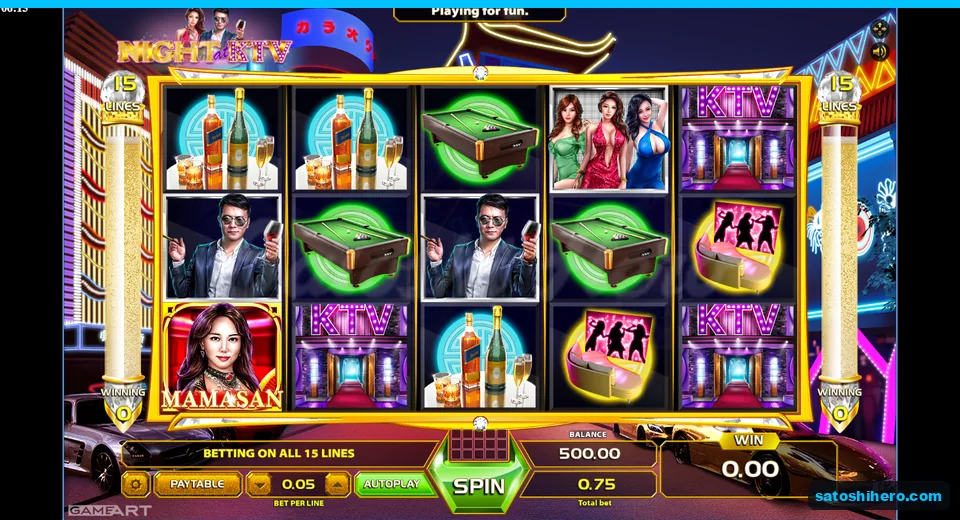
Painted symbols show three women in cocktail dresses, a man holding a glass, whisky and champagne, and a pool table. Lower-value pictures feature dancers on a sofa screen, a KTV doorway, and a microphone. KTV commonly means private-room karaoke, which explains the cast and props. You won’t need outside theme knowledge to read the symbols quickly.
The demo showed plain play-money figures without a currency sign, though I report every test amount in dollars and bet multiples here. You can therefore compare each observed return with my $0.75 stake. In my view, that consistent format makes the test far clearer.
You can expect saturated pink, blue, and purple lighting across the same coherent nightlife scene. The concept won’t win originality awards, but the rainy street gives it more character than a generic karaoke room. If you enjoy nightlife art, you should find the presentation easy to follow. Every pictured prop also connects cleanly with a symbol used during play.
How Night at KTV slot Works
The game uses five reels, three rows, and 15 fixed paylines paying from left to right. Only the highest combination on each line counts, while separate winning lines combine in one result. Each line prize uses your bet per line, not the whole stake. I like this familiar structure because you can verify a result without decoding a complex win system.
My $0.75 total stake divided into $0.05 across each of the 15 lines. The paytable displayed values at that selected stake and rescaled after a bet change. You should check both the highlighted line and bet-per-line figure before comparing symbols with the table. The same 5×3 layout and line rules apply on mobile or desktop through SatoshiHero.
Lines and payouts
My first observed spin confirmed the paytable: three pool tables crossed one line and paid $0.50. That result matched the listed three-symbol value at a $0.75 total bet. You can read the tested symbol returns as total-bet multiples:

- Three women: 100x, 13.3x, and 1x for five, four, and three symbols.
- Man with a glass: 33.3x, 4x, and 1x.
- Whisky and champagne: 13.3x, 3x, and 0.7x.
- Pool table: 6.7x, 2x, and 0.7x.
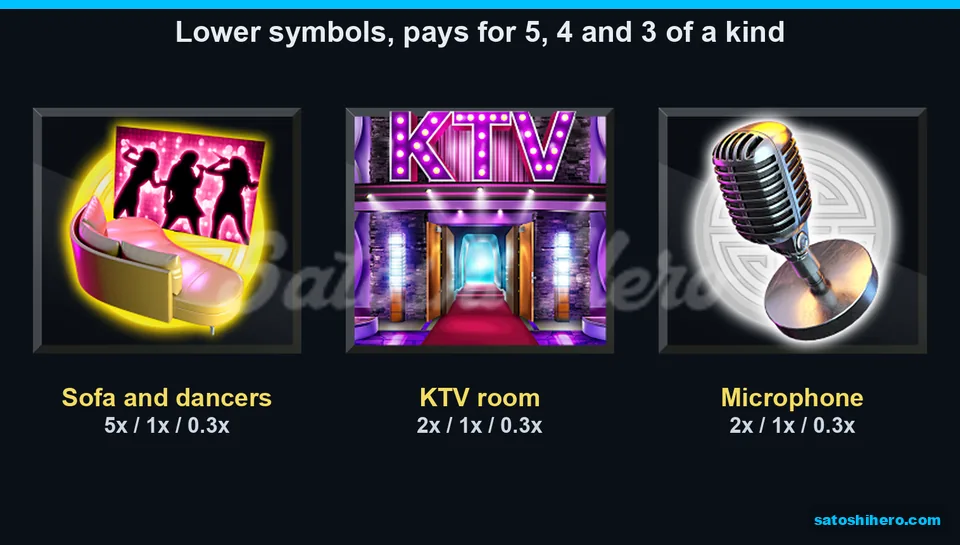
- Sofa with dancers: 5x, 1x, and 0.3x.
- KTV doorway: 2x, 1x, and 0.3x.
- Microphone: 2x, 1x, and 0.3x.
Those multipliers describe the relationship to my selected total stake, while the displayed dollar pays scale with your bet. The three-women portrait leads the regular symbols by a wide margin. I find the lower symbol spread fairly restrained, which fits the game’s softer mathematical profile. You still need the correct left-to-right line path for any listed combination to count.
Wild and bonus symbols
The Mamasan wild can land on any reel and substitutes for every regular symbol except BONUS. It carries no separate paytable prize, so its value comes entirely from completing line combinations. You should treat it as a connector rather than a paying picture. That simple role keeps wild-assisted results easy to understand.
BONUS appears as a dice table with a hostess and only lands on reels 1, 2, and 3. One symbol on each of those reels can open the dice feature. In my 100 spins, that full set never appeared, so I can’t attach a live payout to it. I prefer that clear disclosure over pretending the pay formula shows how the feature feels.

Fast Fact: Five three-women symbols pay the highest regular line prize at 100x, while the overall cap remains 390x.
Paylines establish the first win, wild substitutions can complete it, and cascades then refresh the grid. You can follow each stage on-screen rather than treating the round as one hidden calculation. The structure feels conventional at first, yet the cascade counter gives every paid spin a second purpose.
Cascade Feature
Every winning line starts a cascade that can create another payout from the same paid spin. Winning symbols explode, symbols above drop into the gaps, and fresh pictures enter from the top. A new line win pays before the process repeats. I found the sequence clear because the game visibly removes each contributing symbol.
The chain stops once the refreshed layout contains no paying line. That entire chain belongs to one paid base-game spin, not several separately charged spins. You can watch the accumulated-win display to track the complete return. This distinction matters when a long animation makes one round feel like several results.
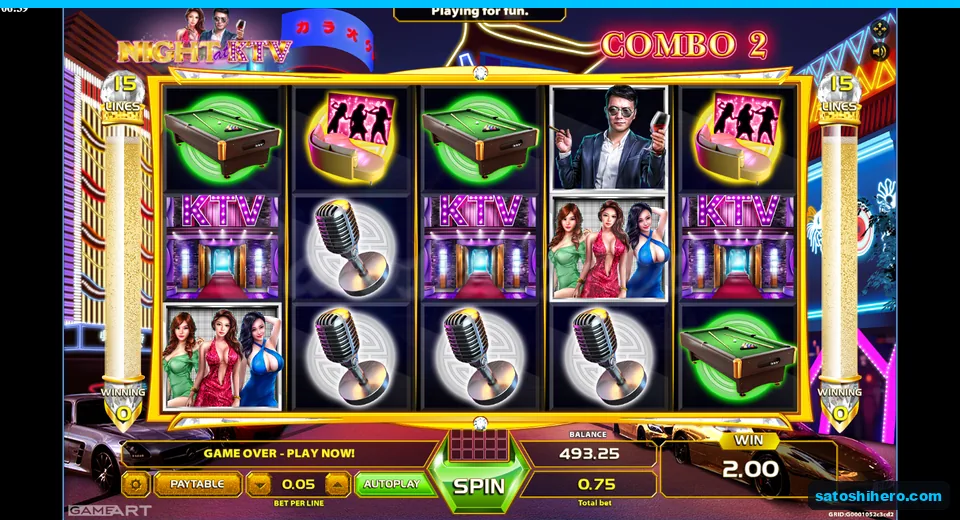
A counter in the upper corner marks COMBO 1, COMBO 2, and each later winning layout. My test reached COMBO 4 on spin 17, crossing the first free-spin threshold. You should watch that number when a chain grows because the fourth consecutive win changes the round. In my opinion, this counter creates more tension than the modest line prizes alone.

Tip: Watch the COMBO counter because the fourth consecutive winning layout reaches the first free-spin threshold.
The counter also prevents confusion about whether a fresh drop qualified. You can compare its number with the accumulated total after every explosion. Short chains add immediate value, while longer chains also open feature access. Cascade length therefore shapes both the round’s payout and its chance of continuing into free spins.
RTP, Volatility and Our Test
According to GameArt, the key figures are 96% theoretical RTP, low volatility, and a 390x maximum win. My live results matched the expected narrow balance movement, though a short session can’t validate the mathematics or predict your outcome. You should separate published specifications, simulator estimates, and observed results. I think that separation matters more than any isolated winning spin.
Verified details can change if the SatoshiHero version changes. A softer profile doesn’t promise steady profit or constant features. You can still hit losing runs, as my eight-spin dry stretch showed. The small session loss felt consistent with the profile, not proof of it.

Alert: Softer balance movement can’t remove loss risk. You can still lose your stake and encounter dry spells.
Simulator projection
The 1,000-spin model produced a broad outcome range, not a dependable personal forecast. I set the model to a $1 bet and used the published game inputs. Its middle outcome finished about 39.1x the bet down. You should focus on the spread rather than treating that middle result as an expected loss.
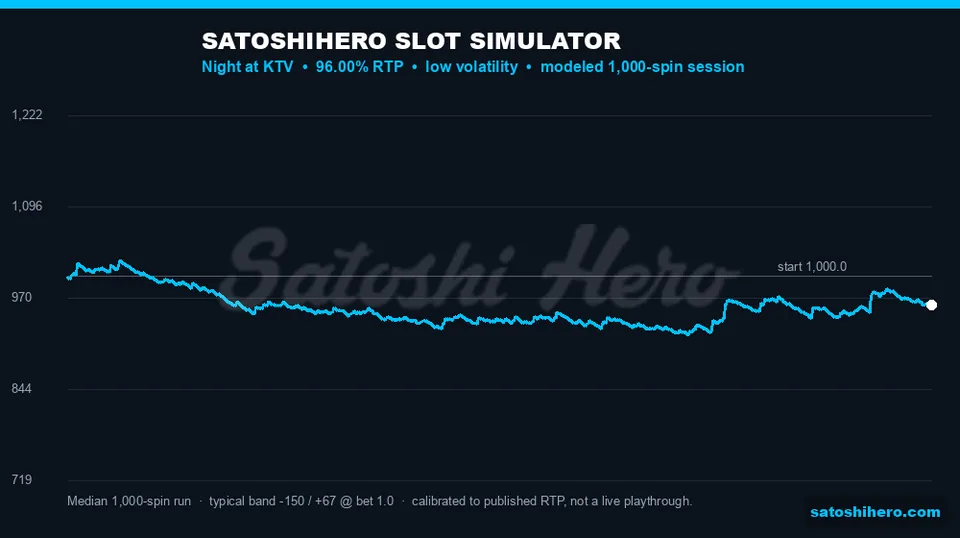
The fifth-to-95th-percentile band ran from roughly 149.6x down to 67.1x up. Any win appeared on about 34% of modelled spins, while a feature arrived approximately once per 124 spins. A result of 100x or more appeared around once per million spins in the model. I find that last estimate useful mainly because it shows how little the top regular outcomes influence a short sample.
These projections don’t predict your next session or test the random number generator behind the demo. You can use the band to see how widely identical settings can finish. The model adds context, but it can’t replace observed play or guarantee a feature schedule.
Our 100-spin session
My 100-spin run moved from $500.00 to $495.25, a $4.75 loss equal to 6.3x my $0.75 bet. Of those paid spins, 43 returned something, and free spins triggered once on spin 17. The balance peaked at $510.75 after that feature-triggering round. You can see why I describe the overall ride as gentle despite the losing finish.
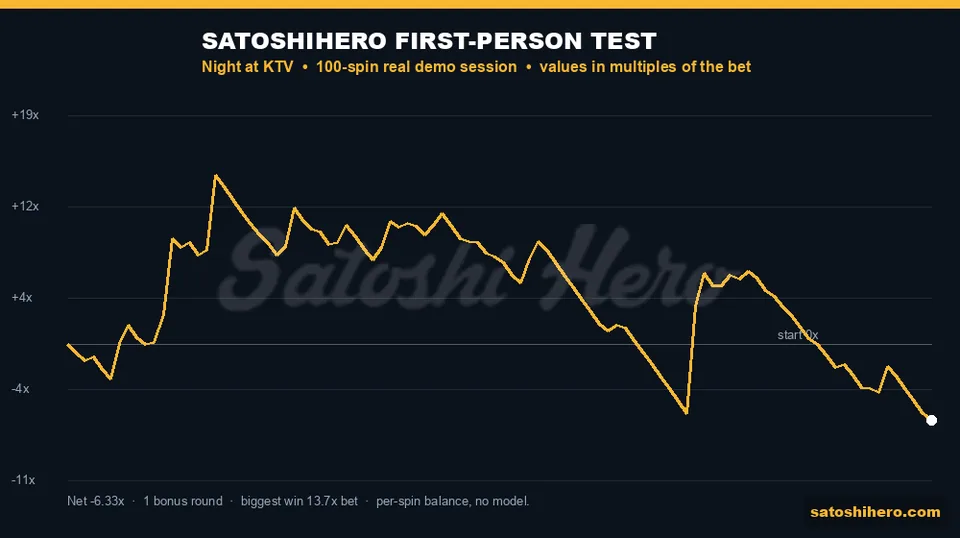
Spin 73 delivered my best single-spin result of $10.25, about 13.7x the bet. The longest losing run covered eight consecutive spins, which felt noticeable but never wrecked the balance. I logged the running total after every round. In my experience, the mix of small pays and brief dry patches supported the low-volatility feel.
I began with a 100-spin autoplay sequence, but the free-spin introduction stopped it. After clicking through the feature, I restarted autoplay for 75 spins and played the final rounds manually. The balance carried forward throughout, so the graph and net result cover one continuous 100-spin run. You should read that interruption as interface behavior, not a break in the test.
One and Six never triggered, leaving the cascade feature as the session’s only bonus route. That absence also shows why an average model frequency isn’t a countdown. You could see a feature sooner, later, or not at all within the same sample length. I liked the controlled pace, though jackpot-focused play would feel underpowered here.
Math and source note
The theoretical return is the operator’s published figure, while one demo session has no bearing on that percentage. Feature-level returns can differ slightly from the base configuration by design. You should use both the simulator and my test as context, not forecasts for your own result. Keeping theory, modelling, and observed play separate gives you the most honest reading.
Free Spins
Consecutive winning cascades trigger free spins instead of scatter symbols. The award depends on the final combo count, so the trigger grows with the same chain producing the paid result. You can qualify through these thresholds:
- Four consecutive combos award 4 free spins.
- Five combos award 6 free spins.
- Six combos award 10 free spins.
- Seven or more combos award 20 free spins.
Cascade chains inside the feature can add more spins under those same thresholds. That structure gives every free round a possible extension without changing the trigger logic. You should keep watching the combo count rather than looking for scatter pictures. I like the consistency, although reaching four straight winning layouts remains demanding.
My spin 17 chain reached four combos and awarded four free spins. Autoplay paused at the introduction card, then waited for my click before continuing. The four free rounds produced no extra payout. That flat feature was disappointing, but it gives a much clearer picture than quoting the trigger return as bonus winnings.
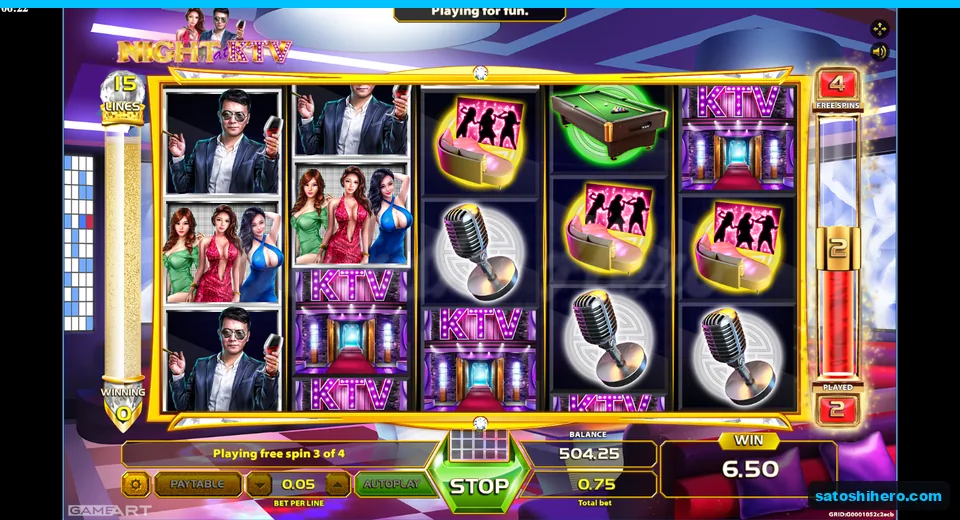
The displayed $6.50 round total, about 8.7x my $0.75 bet, came entirely from the cascade chain that unlocked the feature. You should separate money earned before the introduction from wins created inside free spins. In this case, the trigger did all the work. Retriggers add potential on paper, yet my tested feature contributed nothing beyond the original cascade.
One and Six Bonus
Three BONUS symbols, one on each of reels 1, 2, and 3, start the One and Six dice contest. The same reel-specific trigger can also appear during free spins. You need the complete three-symbol set before the game moves to the hostess table. I never reached it in 100 paid spins, so I can’t judge its practical return.

Both sides begin with five dice and shake them together. Each owner removes dice showing one, while every six transfers to the opponent. All other values stay in play for another throw. You win by reaching zero dice while the hostess retains at least one.
If both sides lose their final dice together, nobody wins. A successful result pays 10 times the total bet, multiplied by the sum of the hostess’s remaining dice. You can therefore understand the formula without assuming any result I didn’t observe. I find the rules unusual enough to distinguish this feature from a standard pick bonus.

Trivia: A six transfers the die rather than removing it, so the number of dice can move in both directions.
That transfer rule can lengthen the contest because either side can gain dice after a throw. You still don’t make a strategic choice during the sequence; the values determine the movement. Since the feature didn’t trigger, I won’t invent a hit pattern or describe its rewards as generous. Its odd rules add variety, but my test couldn’t assess how the payout feels in practice.
Gamble Feature and Risk
The optional gamble control lets you risk a completed win on a red-or-black prediction. A correct choice doubles the amount at risk, and a successful win can enter the gamble up to five times. You can switch the control on or off in settings. I left it disabled throughout the recorded session.
The control doesn’t operate during autoplay, so it never interrupted my automated sequence. Because I didn’t use it, I have no firsthand gamble result to present. You shouldn’t confuse the possible double with a slot feature payout. In my view, the binary choice adds little to the stronger cascade mechanic.
One wrong prediction removes the amount you risked. Repeated doubles can also turn a fairly steady session into much sharper bankroll swings. You can leave the control disabled when preserving a completed payout matters more than chasing a larger amount. That choice changes your risk around one win, but it doesn’t alter the game’s official mathematical classification.
Careful stake control matters even with a softer play pattern. A $0.75 spin exposed only the selected stake, while gambling could put a completed return back at risk. You should decide before playing whether that extra swing belongs in your plan. The button remains an optional side bet, not part of the core slot mathematics.
Bonus Buy Availability
No Bonus Buy option appeared in the version I tested. There is no purchase price, boosted setting, or instant-feature comparison to make. You must reach both main bonuses through ordinary paid spins. I think that makes the experience more coherent, though impatient feature hunters could find it slow.
Free spins require at least four consecutive cascade wins from one paid round. One and Six instead needs three BONUS symbols across its restricted reels. You can chase neither through a menu shortcut. The two routes therefore reward attention to different events on the grid.
Natural access fits anyone who enjoys watching cascades develop. It won’t satisfy someone seeking immediate paid entry. Every attempt still begins with another base-game stake. Low volatility can soften movement, but it can’t make that chase free.
At SatoshiHero, you can use the demo to see whether the cascade-driven route holds your interest before real play. Don’t treat a quiet spell as evidence that a feature is due. I prefer the absence of a purchase prompt, yet the choice is clearly restrictive. Both main bonuses remain tied to normal play, with no instant shortcut. Other GameArt options on SatoshiHero include Xtreme Summer Hot, Xtreme Hot, Xmas Express, and Wolf Hunt.
Frequently Asked Questions About Night at KTV
What are the RTP and maximum win of Night at KTV slot?
Night at KTV slot has a 96% theoretical return, low volatility, and a 390x-the-bet maximum win. My tested balance stayed near its $500.00 starting point, but your result can differ.
How many paylines does Night at KTV slot have?
Night at KTV slot uses 15 fixed paylines on a 5×3 grid. Wins run left to right, only the highest result on each line counts, and I staked $0.05 per line for a $0.75 total bet.
How do you trigger free spins in Night at KTV slot?
Four combos award 4 spins, five award 6, six award 10, and seven or more award 20. Spin 17 triggered four spins, which added nothing beyond the existing $6.50 cascade win.
What is the One and Six bonus in Night at KTV slot?
Three BONUS symbols on reels 1, 2, and 3 start the dice game. Ones leave play, sixes transfer, and a win pays 10 times the total bet multiplied by the hostess’s remaining dice total. It didn’t trigger in my test.
Does Night at KTV slot have a Bonus Buy?
No Bonus Buy appeared in the tested Night at KTV slot. Free spins and One and Six both require ordinary paid play.
What did the Night at KTV slot simulator show?
The model produced a 39.1x-down middle outcome, a band from 149.6x down to 67.1x up, and an approximate one-in-124 feature frequency. Those figures don’t predict an individual session.
How did the 100-spin Night at KTV slot test finish?
My balance moved from $500.00 to $495.25, a loss equal to 6.3x my bet. Among 100 spins, 43 paid, free spins triggered once, and my best single-spin return reached $10.25.
What does KTV nightlife mean in Night at KTV slot?
KTV commonly means private-room karaoke entertainment. That meaning shapes the microphone, KTV doorway, drinks, hostess characters, and neon nightlife imagery.
Closing Thoughts
Night at KTV stands out through cascades that double as its free-spin trigger and an unusual reel-restricted dice bonus. You get clear progress, but the modest top prize limits the excitement. My tested free spins also returned nothing.

My Verdict
You should try the demo if visible cascade progress matters more than a huge prize ceiling. Expect frequent small balance changes, naturally reached bonuses, and no instant feature purchase.
I liked how the COMBO counter made an ordinary $0.75 spin feel meaningful as each layout changed. I didn’t like seeing four earned free spins add $0, while One and Six never appeared across my 100 paid rounds.
The Night at KTV slot guide is updated periodically when verified rules or the playable version changes. That keeps the mechanics and test context useful without turning one session into a promise.

Pros:
 Clear cascades: Visible explosions and counters make each chain easy to track.
- Gentle movement: My balance stayed close to its starting point across 100 spins.
- Distinct dice game: One and Six offers rules beyond a standard pick feature.
- Natural bonuses: Both features emerge through ordinary play without purchase prompts.

Cons:
 Modest ceiling: The capped return offers limited appeal for jackpot-focused play.
- Flat free spins: My only feature added no payout beyond its triggering cascade.
- Elusive dice trigger: One and Six never appeared during the recorded session.

Best For: Cascade fans who prefer softer balance movement and bonuses earned through base play should feel comfortable here. Jackpot hunters and instant-bonus buyers will probably find the ceiling and natural triggers restrictive.

































































Bets
All Bets
Game
Player
Date
Wager
Mult.Multiplier
Prize
 Mighty Stars
 nina87
- 10:19:48
- 6×
- Caribbean Escape: Rapid Link
- Hidden
- 10:19:47
- 0×
- Mighty Stars
- nina87
- 10:19:45
- 0×
- Almighty Diamonds: Hold 'N' Link
 novaone948
- 10:19:45
- 0×
- Pelican's Bay: Rapid Link
 Hidden
- 10:19:44
- 3.5×
- Mardi Gras Queen
- mdp0fxo
- 10:19:43
- 3×
- Merry Cash Splash: Hold 'N' Link
- maya_81
- 10:19:43
- 0×
- Starlight Princess
 stepanyan-hrach
- 10:19:42
- 1.25×
- Mighty Stars
- nina87
- 10:19:42
- 0.5×
- Luck of Panda: Bonus Combo
 Hidden
- 10:19:41
- 0.39×