


Temple Cascades in Aztec Clusters
I tested Aztec Clusters by Bgaming to see whether its 6×8 cluster-pay board could turn cascades into real pressure.
According to Bgaming, Aztec Clusters is a very-high volatility slot with 97% RTP and 10,000x max win potential. It uses a 6 reel by 8 row board with cluster pays, so 5 or more matching symbols must touch horizontally or vertically, not fixed paylines. Aimed at patient cluster fans with appetite for free spins and repeated cascades.
Key takeaways
- Best bonus: Organic free spins carried my test; the 100x free spins buy was visible but unused.
- RTP / volatility: The slot has 97% RTP with very-high volatility, so you need room for swings.
- Max win: The official ceiling is 10,000x, and that upside depends on stacked cascade value.
- Risk note: Base-game hits landed often enough, but most paid small amounts in my session.
- Bankroll note: Size your bets for slow drops and sudden jumps, not steady returns.

Table of Contents
- Theme & First Impressions
- How Aztec Clusters Works
- Cluster wins
- Symbol values
- Cell Multipliers
- Marked cells
- Added multipliers
- Dug-Up Special Symbols
- Dug-up symbols
- Board impact
- Free Spins
- Trigger rules
- Sticky upgrades
- Bonus Buy and Wild Spin Options
- Free spins buy
- Wild Spin mode
- RTP, Volatility & Our Test
- Simulator projection
- Our 100-spin session
- How It Played in Practice
- Base-game pace
- Bonus dependence
- Frequently Asked Questions About Aztec Clusters
- Summing It Up
Theme & First Impressions
The theme is clear, familiar and easy to read, which matters more here than originality. You get an Aztec temple scene in front of a jungle waterfall, with the 6 reel by 8 row board taking center stage. Purple, red and green carved masks sit beside four gem colours and a golden scatter coin. I like the clean layout because you can follow clusters without fighting the background.
At rest, the base game screen shows the board, Buy Bonus and Wild Spin panels, a $0.75 bet and my $1,000.00 starting balance. That screen also proves why mobile and desktop play feel practical here: the symbols stay separated, and the cascade area doesn’t look cramped. The theme won’t win originality awards, but the board reads well when wins explode and refill.

Aztec Magic Megaways shares the same adventure mood, but it points you toward a Megaways format rather than cluster pays. If you prefer shifting reel heights, that comparison matters. Here, you judge the action by touching symbols, marked cells and refill chains. That makes the slot feel more tactical than the usual temple hunt.
How Aztec Clusters Works
Aztec Clusters pays when 5 or more matching symbols touch horizontally or vertically on the 6×8 board. The Aztec Clusters slot has no fixed paylines, so you should watch the whole grid rather than the left edge. Winning clusters explode, new symbols drop from above, and one paid spin can keep going through several cascades. That mechanic gives the game its best moments, even when the first hit looks tiny.
Cluster wins
Every winning group clears from the board, which opens spaces for fresh symbols. You can get a small cluster first, then a better refill if the new symbols connect. I found the base game easy to read because masks and gems use distinct colours. Still, the mechanic doesn’t hand you drama on every spin, and you need patience when the cascades stop early.
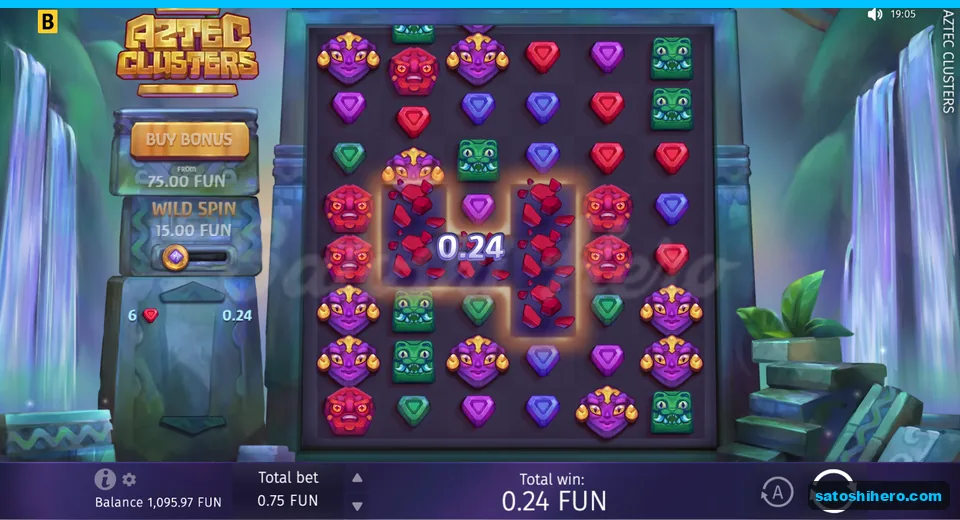
Scatter coins can land anywhere and trigger free spins, but they don’t join clusters. Wilds substitute for paying symbols except the Scatter, and they can help connect awkward shapes. Wild Clusters is a useful follow-up if you like this pacing and want another cluster-style game with a similar stop-start rhythm. This format rewards board awareness more than quick line counting.
Symbol values
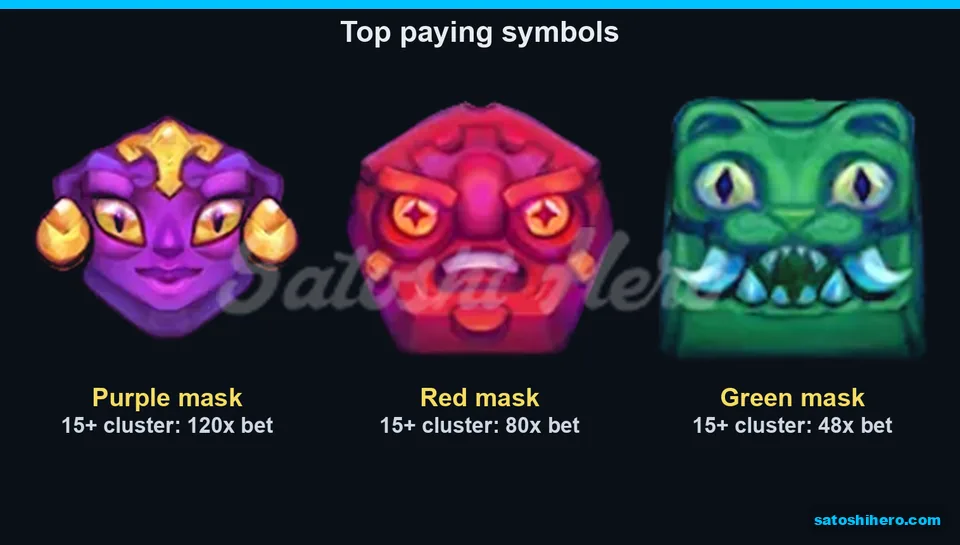
There are 7 paying symbols, and the three masks pay the most. The purple mask pays 0.8x for 5, 56x for 14, and 120x for 15 or more. The red mask pays 0.6x for 5 and 80x for 15 or more, while the green mask pays 0.4x for 5 and 48x for 15 or more. Those jumps are steep, so you don’t just want frequent hits, you want size.
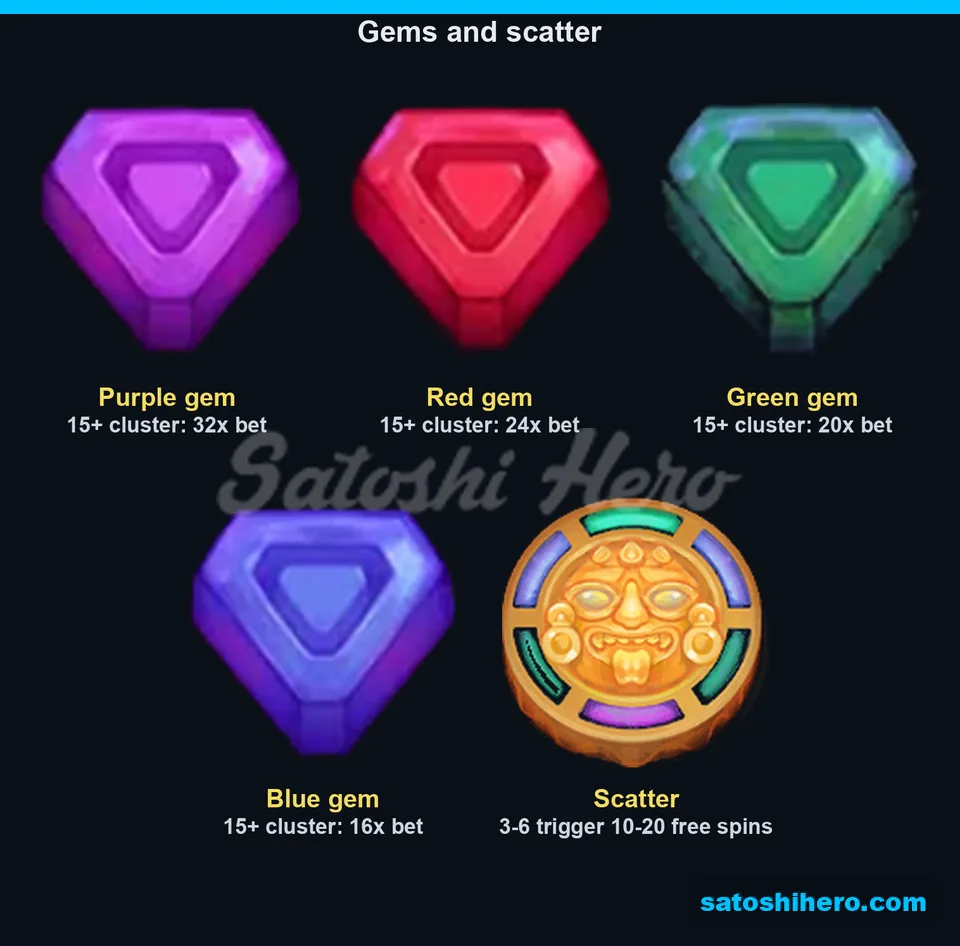
The gems sit below the masks. For 15 or more, the purple gem pays 32x, red pays 24x, green pays 20x, and blue pays 16x. At 5 symbols, they pay about a third of the bet or less, which matched my small base-game results. You can enjoy plenty of paid spins here, but many wins feel like setup rather than payoff.
Cell Multipliers
Cell multipliers matter because repeat cascades over the same spaces can turn plain clusters into stronger results. Every winning cluster marks the cells it covered, and a later win on a marked cell gives that cell a x2 multiplier. Each further win on that cell adds another x2. If one cluster covers several multiplied cells, the game adds those multiplier values together.
Marked cells
You can think of marked cells as pressure points on the board. A spin may start quietly, then improve when fresh symbols keep landing on spaces that already paid. The base game can look flat during early cascades, but these marks explain why you shouldn’t judge a spin too soon. I found myself watching positions, not only symbol counts.
The 6×8 board gives enough space for chains to grow without becoming unreadable. You still need the right refills, and many spins end before the system matters. But when a few clusters keep returning to the same area, the board starts to feel alive. That is the strongest mechanical idea in the game.
Added multipliers
Added multipliers create the real tension because several marked cells can combine inside one cluster. You might see a modest gem group become meaningful if it lands across enough boosted spaces. That doesn’t make every cascade exciting, but it gives you a reason to track the full path of a spin. My practical takeaway is simple: watch where clusters land, not just how large they look.

Highlight: Multipliers are added together when a cluster covers multiple multiplied cells. During a long cascade, that can move a routine hit into much better territory.
Dug-Up Special Symbols
Dug-up special symbols can appear after a cluster clears, giving the refill phase extra value. After winning symbols explode and before empty cells refill, the game can dig up a bonus symbol in one of the gaps. You can see a Wild, Scatter, Booster or Destroyer. I like this touch because it makes the space between wins feel active, not just decorative.
Dug-up symbols
Wilds substitute for paying symbols and stay sticky until the refill sequence ends. Scatters can help push you toward free spins, though they still don’t join cluster wins. The Booster upgrades every multiplier on the board, then disappears. The Destroyer clears all low-paying symbols without paying for them, then leaves the board.
This feature doesn’t appear on every cascade, and you shouldn’t expect it to rescue every weak spin. When it does show up, it can change the shape of the refill quickly. A sticky Wild may hold a key position, while a Destroyer can clear clutter before the next drop. That makes the feature more useful than it first looks.
Board impact
The practical value comes from timing. A plain cluster clears, a dug-up symbol appears, and the refill suddenly has a better chance to connect. In my view, this gives the base game enough movement to avoid feeling static, though it still needs strong follow-through. You get the most from the mechanic when you watch the board after the win clears.

Expert Advice: Watch the board after a cluster clears, not just before the spin lands. A dug-up symbol can separate a dead refill from a proper cascade.
Free Spins
Free spins are the strongest feature because triggering Scatters turn into sticky Wilds or x10 cell multipliers. You need 3 Scatters for 10 free spins, 4 for 12, 5 for 15, and 6 for 20. Landing the same number of Scatters during the round can retrigger the feature. This is where the slot becomes most dangerous and most interesting.
Trigger rules
The round starts with an immediate upgrade, since the triggering Scatters convert into sticky Wilds or x10 cell multipliers. That matters because you don’t begin from a blank slate. You already have boosted spaces or sticky help on the board. I prefer that design because the feature gets a stronger opening position than many scatter bonuses.
During my test, the feature arrived late and changed everything. The base game had kept me mostly in small-hit territory, so the bonus felt like the first real chance to break the pattern. You can see why the game carries very-high volatility once the free spins begin. The base mode chips away, then the feature can swing the session.
Sticky upgrades
In my second free spin, I saw a purple gem cluster paying under a x10 cell multiplier. Later in the same round, a golden sticky Wild showing x50 sat on the board while the total climbed quickly. That visual did more to sell the feature than any paytable line could. The free spins feel built around compounding value, not just extra attempts.


Notable Detail: The Scatters that trigger free spins don’t just disappear. They convert into sticky Wilds or x10 cell multipliers, giving the round a stronger starting position.
You still need the board to cooperate. A sticky Wild looks exciting, but empty refills can waste good placement. Even so, I liked the feature potential far more than the base game. If you play this slot, free spins are the event you wait for.

Bonus Buy and Wild Spin Options
The bonus buy and Wild Spin modes let you pay for feature access, but they raise the risk sharply on a very-high volatility slot. The free spins buy starts from 100x the bet, and bought Scatters turn into x10 cell multipliers or sticky Wilds. Wild Spin costs 20x the bet per spin. It guarantees at least 1 Wild dug up at the start of each spin until you switch it off.
Free spins buy
The 100x buy was visible in the game panel, but I didn’t use it during my test. I wanted the live result to reflect organic play, so the two bonus rounds came from natural Scatter hits. That choice matters because bought features can change the rhythm and risk profile. You should judge my $96.72 profit from the standard game only.
A 100x buy may appeal if the base-game grind tests your patience. Still, that cost is high beside a normal spin, especially when very-high volatility can punish weak bonus rounds. I don’t mind the option existing, but I wouldn’t treat it as a shortcut to profit. It is more like paying to reach the swingy part faster.

Risk Note: Because Aztec Clusters is very-high volatility, a 100x bonus buy carries serious risk. Treat it as a shortcut to variance, not a route to guaranteed profit.
Wild Spin mode
Wild Spin takes a different route by charging 20x the bet for a spin with at least 1 Wild dug up at the start. That sounds tempting because Wilds can connect awkward clusters and hold during refill sequences. I didn’t test this mode, so I won’t dress it up beyond the rules shown in the panel. The price alone tells you it belongs in the high-risk column.
If you use either mode, lower stakes deserve serious consideration. You pay several normal spins upfront, then still need cascades to form around the help. My honest view is that organic play gives the cleaner read on the slot. Paid modes add convenience, but they also compress your risk into fewer decisions.
RTP, Volatility & Our Test
Bgaming lists the official 97% RTP, but very-high volatility means your session can still swing hard. Aztec Clusters has 10,000x maximum win potential, which gives the math real upside. You shouldn’t read that as steady value on ordinary spins, because my live session showed small base-game hits doing most of the early work. The evidence points to a slot where one feature needs to carry much of the result.
Simulator projection
Our simulator model used 97% RTP, very-high volatility and a 10,000x maximum win over 1,000 spins at a one-unit stake. The median session ends about 97x down, while the typical band runs from roughly 432x down to 688x up. A bonus round appears about once every 54 spins in the model. A very large win appears about once in 799 spins.
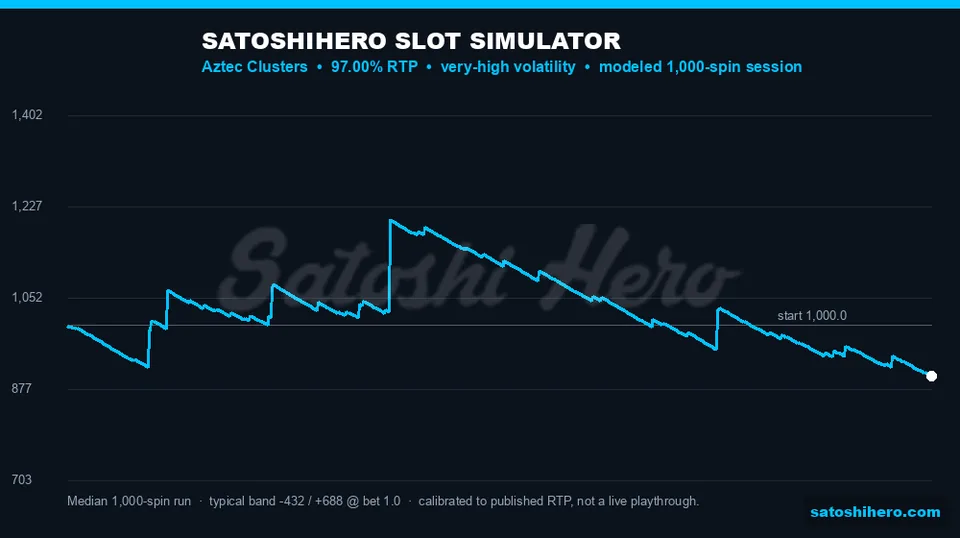
Those figures describe spread, not your next result. You might hit the bonus quickly, or you might sit through a dry patch that makes the board feel stubborn. I like that the simulator shows both sides rather than pretending the high RTP smooths everything out. With this volatility level, bankroll planning matters more than optimism.
Our 100-spin session
Data from my SatoshiHero demo test shows I played 100 spins at a $0.75 bet, starting from $1,000.00 and finishing at $1,096.72. That left me about 129x my bet up, but the route wasn’t smooth. At spin 80, my balance sat around $977.17, roughly 30x down. The session looked like a slow bleed until free spins triggered after spin 81 and again after spin 86.
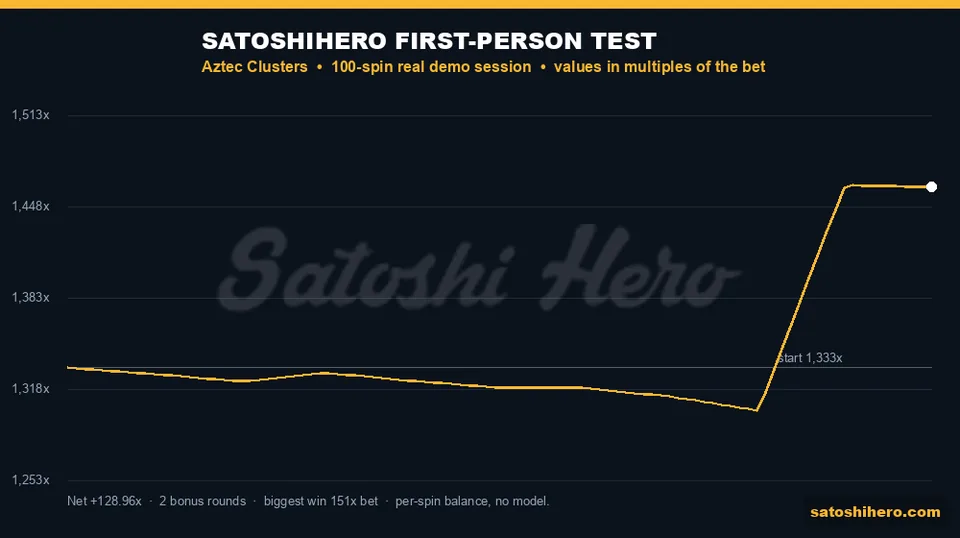
The first free spins round paid $113.37, equal to 151x the bet, and it carried the whole run. The second round paid $9.36, about 12x, which felt minor beside the first. Across the test, 45 of 100 spins paid, but the best base-game spin reached only about 5.5x. That mix explains the game better than the headline RTP alone.
Theoretical RTP is the operator-published return figure. One live session doesn’t prove or change RTP, and bonus-buy or mode-specific returns can differ slightly by design. Simulator figures describe distribution, not a promise about your next session.
How It Played in Practice
The test felt bonus-dependent: the base game paid often enough, but one free spins round did the real work. I saw 45 paid spins from 100, yet most of those hits barely moved the balance. That isn’t a flaw by itself, but it shapes the player experience. You need to enjoy waiting for one sharp climb.
Base-game pace
The base game gave me action without much weight. Small clusters and short cascades appeared often enough to keep the board moving, but they rarely changed the balance in a serious way. My best base-game result was about 5.5x, which feels modest for very-high volatility. I liked the clarity, yet I wanted more bite from ordinary cascades.
By spin 80, I was roughly 30x down despite plenty of visible activity. That gap between motion and profit defines the base game. You may feel involved while still drifting lower. This is where lower bets can help, because the slot asks for patience before it gives you a real swing.
Bonus dependence
The profit came from one strong 151x bonus, not steady base-game grinding. Without that round, my session would have felt fairly dry. I liked the feature potential more than the base game, and I don’t think that is a harsh take. The design clearly saves its punch for free spins.
The demo and real play are available on SatoshiHero, and the Aztec Clusters demo made that swing easy to test with play money. Aztec Magic Bonanza offers another Aztec-themed route if you prefer a different bonus rhythm or presentation. Aztec Magic Deluxe gives a more classic-feeling temple slot contrast if clusters and cascades feel too busy. Pick your style by pace, not just by theme.
Frequently Asked Questions About Aztec Clusters
How did Aztec Clusters play over 100 live spins?
I played 100 spins at a $0.75 bet from a $1,000.00 balance and finished at $1,096.72, about 129x the bet up. Most of the run drifted down before one free spins round paid 151x the bet and pushed the session positive.
How often did free spins trigger in Aztec Clusters during the test?
Free spins triggered twice in 100 spins, after spin 81 and after spin 86. That ran hotter than the simulator’s one bonus per 54 spins, so don’t treat this small sample as a trigger rate.
What was the biggest win in Aztec Clusters?
The biggest result was the first free spins round, which paid $113.37 on a $0.75 bet, equal to 151x. The best base-game spin paid about 5.5x.
How do cell multipliers work in Aztec Clusters?
Each winning cluster marks its cells. A later win on a marked cell gives that cell a x2 multiplier, and every further win on it adds another x2. If one cluster covers several multiplied cells, their multipliers are summed.
What does the 1,000-spin simulator say about Aztec Clusters?
With 97% RTP, very-high volatility and a 10,000x cap, the median 1,000-spin session ends about 97x down. The typical band runs from about 432x down to 688x up, so very different outcomes are normal.
Does Aztec Clusters have paylines?
No. It uses cluster pays, where 5 or more matching symbols must touch horizontally or vertically on the 6×8 board.
Can you play Aztec Clusters demo on SatoshiHero?
Yes. This guide uses SatoshiHero demo testing with play money, and the game is available here in demo and real-play modes.
Summing It Up
Aztec Clusters stands out through its readable 6×8 cluster board, cell multipliers and free spins upgrades. Its main drawback is clear too: the base game can feel light until a bonus lands. If you want steady base-game weight, this one may test your patience.

My Call
Patient cluster fans should try it for the free spins potential, not for constant base-game hits. Expect small wins, quiet stretches and the chance of one round changing everything. Keep the bet size sensible because very-high volatility can punish rushed decisions.
I like the way sticky Wilds, x10 cells and marked positions create real tension during features. I don’t like how modest the base game felt before the late bonus run. My test ended ahead, but one 151x feature did nearly all the heavy lifting.
Aztec Clusters is a strong pick when you value transparent mechanics and can handle dry spells. My test notes are checked regularly, especially around bonus behavior, simulator spread and feature wording.

Pros:
 Strong RTP: 97% RTP gives the game a competitive published return.
- Readable board: Clear symbols help you track cascades and marked cells.
- Feature upside: Sticky Wilds and x10 cells make free spins genuinely tense.
- Flexible options: Buy Bonus and Wild Spin add paid routes to features.

Cons:
 Harsh volatility: very-high volatility can drain impatient bankrolls quickly.
- Light base hits: Many paid spins barely move the balance.
- Costly shortcuts: Paid modes demand large stakes before results appear.

Best For: Bonus-focused cluster players get the most from this slot’s rhythm. You need patience for modest base-game hits and enough discipline to treat paid modes carefully. If you prefer simple line wins, the cascade-heavy board may feel too busy.
































































Bets
All Bets
Game
Player
Date
Wager
Mult.Multiplier
Prize
 Luck of Panda: Bonus Combo
 tomstacey1993
- 20:16:56
- 0×
- Mr. Crystalman: Hold 'N' Link
 Hidden
- 20:16:55
- 0×
- Bunny's Bounty: Hold`n`Link
 szilagyi.nikolett.93
- 20:16:54
- 0×
- Mr. Crystalman: Hold 'N' Link
- Hidden
- 20:16:54
- 0×
- Mr. Crystalman: Hold 'N' Link
 zr0407
- 20:16:54
- 0×
- Wild Buffalo Megaways: Hold N Link
 josh1998
- 20:16:54
- 0×
- Mr. Crystalman: Hold 'N' Link
- Hidden
- 20:16:53
- 0×
- Luck of Panda: Bonus Combo
- tomstacey1993
- 20:16:53
- 0×
- Mr. Crystalman: Hold 'N' Link
- Hidden
- 20:16:52
- 0×
- Luck of Panda: Bonus Combo
- tomstacey1993
- 20:16:51
- 0.14×