

Take Olympus
By pressing play, you agree that you are above legal age in your jurisdiction and that your jurisdiction allows online gambling.

Take Olympus
RTP95.49%
VolatilityLow
Max winx2,328
Lines50
ThemeAncient civilizations
ReleasedFeb 2021

Testing the God Cycle on Mount Olympus
Take Olympus puts Betsoft’s Greek gods into a steady 5×4 payline slot. I tested the Take Olympus slot at a $0.50 stake, and its 95.49% RTP, low volatility, and 2,328x max win make the ceiling feel controlled.
Take Olympus is a low volatility slot from Betsoft with 95.49% RTP and 2,328x max win potential. The game features a 5-reel, 4-row layout with 50 fixed paylines and rotating god powers. Steady-session bankroll managers get visible build-ups, and I lost $5.70 across 100 spins while one organic Free Spins round delivered my best hit.
Key takeaways
- Best bonus: Zeus Free Spins create the strongest moments, especially when Zeus borrows Apollo, Aphrodite, Hades, or Poseidon powers.
- RTP / volatility: Take Olympus has 95.49% RTP and low volatility, so you can expect more small pays than wild swings.
- Max win: The 2,328x max win cap keeps the game grounded, which fits the low-risk feel.
- Risk note: My 100-spin test paid 33 times and finished $5.70 down from a $1,000.00 start.
- Bankroll note: A $0.50 spin felt playable, but the cap means jackpot hunters may want a bigger-ceiling slot.

Fast Fact: The same god never rules twice in a row, so every 10-spin cycle changes the reel behavior.

Table of Contents
- How Take Olympus Works
- Lines and wins
- Symbol values
- Theme & First Impressions
- Olympus setting
- Changing scenery
- The Cycle of the Gods
- Ten-spin cycles
- God Event timing
- Apollo Wilds
- Marked positions
- Final-spin wilds
- Aphrodite Mystery Boxes
- Marked symbols
- Mystery reveal
- Poseidon Free Respins
- Respin counter
- Free Respin limit
- Hades Multiplier
- Multiplier buildup
- Final-spin payout
- Zeus Free Spins
- Trigger condition
- Zeus powers
- RTP, Volatility & Our Test
- Simulator projection
- Our 100-spin session
- Frequently Asked Questions About Take Olympus
- Closing Thoughts
How Take Olympus Works
Take Olympus works as a 5-reel, 4-row line slot with 50 fixed paylines. Wins pay left to right on adjacent reels, the highest win on each line pays, and separate line wins add together.
You play Take Olympus by picking a stake, spinning the reel set, and watching symbols connect across fixed paths. This is a traditional 50-payline slot, not cluster pays, pay-anywhere, or Megaways. I like that clarity because you always know what the game wants from you.
Lines and wins
Every paying line needs matching symbols on connected reels from the left side. A small $0.10 win under Poseidon in my test showed the base game doing exactly that: short, modest, and easy to read.
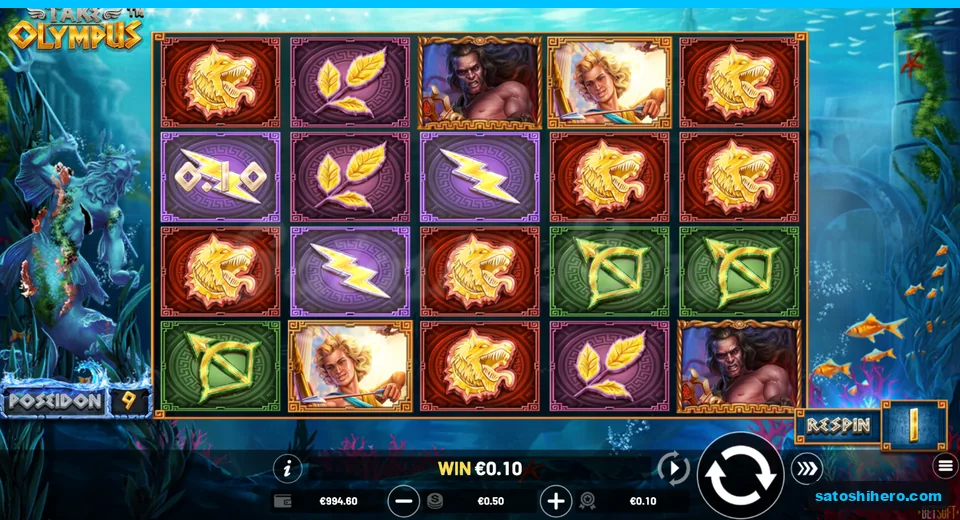
Desktop and mobile play use the same 5×4 reel layout, payline logic, and god-cycle information. You don’t need a separate mental model when you switch screens, which helps when you’re tracking the final spin of a cycle.
Payouts scale with your stake, so the $0.50 examples below move up or down with the bet. That matters because the same symbol mix can feel very different when you raise your spin size. I wouldn’t increase stakes until you’ve watched a few cycles finish.
Symbol values
Zeus sits at the top of the paytable. At my $0.50 stake, Zeus pays $3.00 for five, $0.60 for four, and $0.20 for three. He also acts as a wild in every form and can appear as a tall stack.
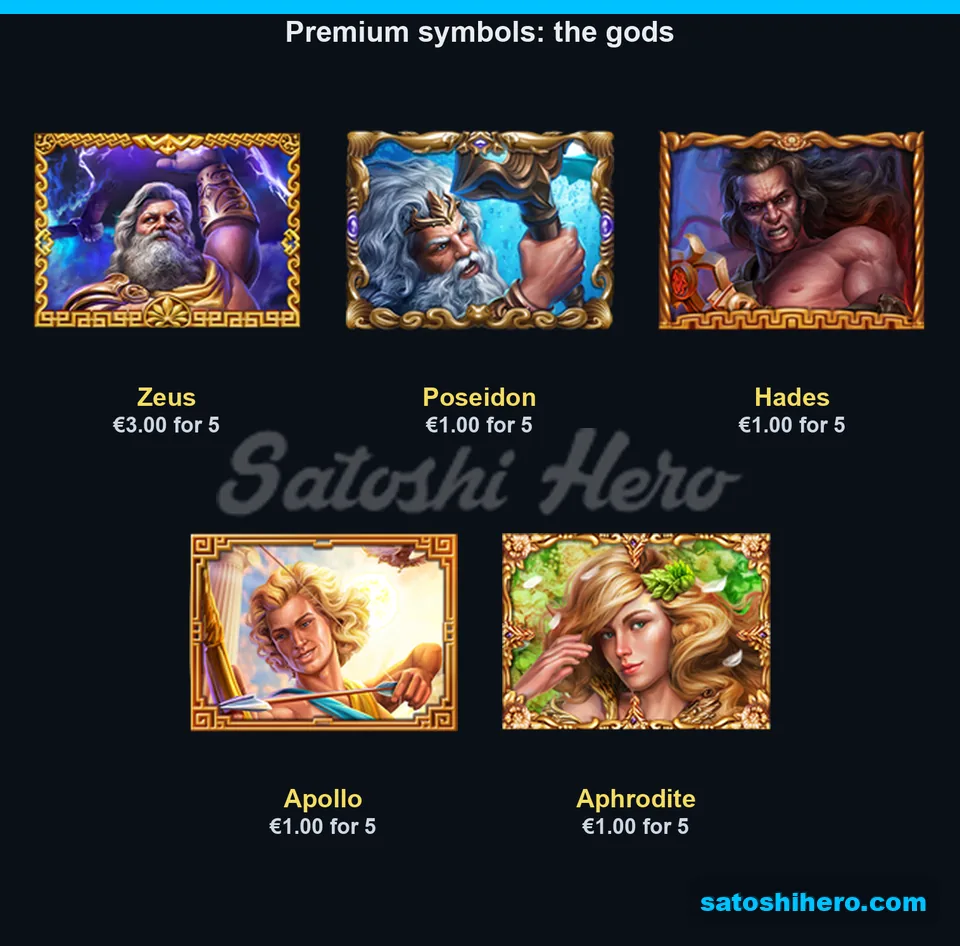
Poseidon, Hades, Apollo, and Aphrodite each pay $1.00 for five, $0.30 for four, and $0.15 for three. Those gods matter beyond payouts because each one also powers a 10-spin feature cycle. You can read the active god quickly without opening the paytable.
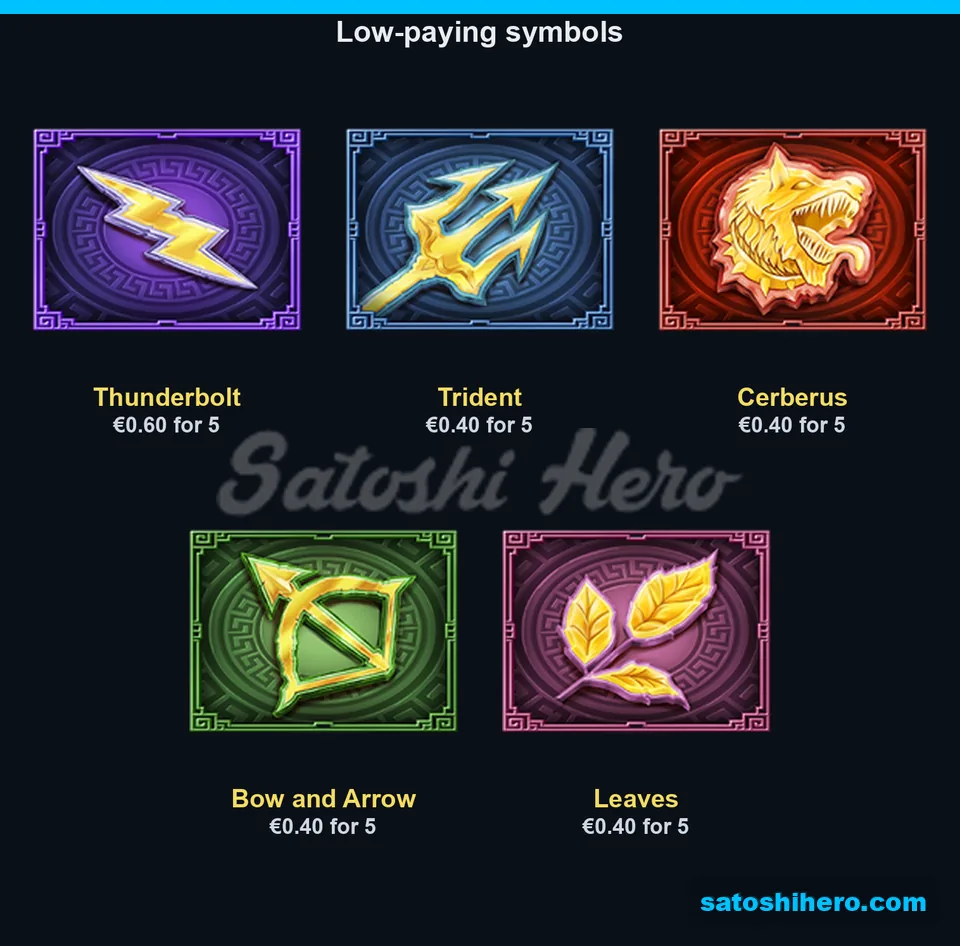
The lower symbols are Thunderbolt, Trident, Cerberus, Bow and Arrow, and Leaves. Thunderbolt pays $0.60 for five, $0.20 for four, and $0.10 for three. Trident, Cerberus, Bow and Arrow, and Leaves pay $0.40, $0.10, and $0.05.
Apollo-marked spaces can turn into wilds, and those wilds substitute for everything except Zeus. That simple payline base matters because every god power still has to connect through the 50 fixed lines.
Theme & First Impressions
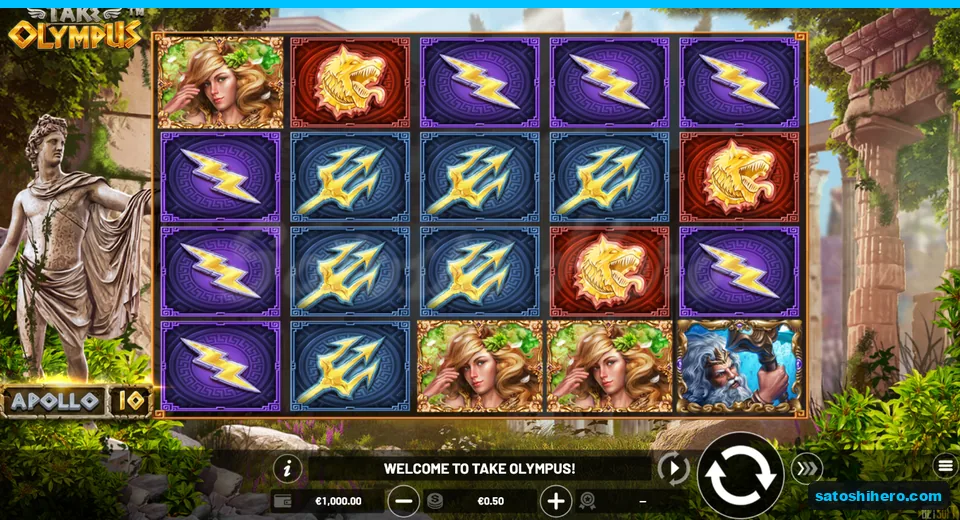
The theme is a polished Mount Olympus setup where each ruling god changes the mood of the reels. You see Greek god portraits, carved symbols, a left-side statue, and shifting scenery that makes each 10-spin cycle feel visible.
Five framed god portraits sit above a clean 5×4 board, while five carved low symbols appear in coloured medallions. The marble statue on the left shows the active god, so you can spot the cycle state fast. The Greek-gods idea won’t win originality awards, but Betsoft’s presentation has real lift.
Olympus setting
Bright temple ruins appear for Apollo, Poseidon brings an underwater scene, and Zeus turns the backdrop into stormy purple skies. The lighting and soundtrack shift with those scenes, which gives each cycle a clear personality.
Betsoft’s 3D style makes the gods look rich without crowding the reels. You still see the symbols clearly, and that matters more than decoration. If you enjoy the Olympus theme but want a different format from a 50-payline slot, Olympus Plinko gives that setting a very different rhythm.
Changing scenery
The scenery isn’t just cosmetic. When the background changes, you instantly know which feature to track. That helped me during autoplay because I could glance at the statue and counter instead of pausing for the paytable.
You might find the theme familiar, but the shifting scenery makes the cycle feel more alive than a static mythology slot. The best design choice is readability, not flash, and that keeps the feature build-up easy to follow.
The Cycle of the Gods
The Cycle of the Gods is the main engine: every 10 spins, a random god takes over and fires a God Event on the final spin. The same god never rules twice in a row, so you always get a fresh cycle after the counter resets.
A small counter beside the statue shows how many spins remain. I watched the counter roll over every 10 spins as expected, and that rhythm shaped the whole session. You shouldn’t judge a cycle by the first few quiet spins because the payoff event comes at the end.
Ten-spin cycles
Each cycle starts with a random god taking charge of the reels. Apollo marks future wilds, Aphrodite builds Mystery Boxes, Poseidon counts respins, and Hades builds a multiplier. Zeus appears as the Free Spins trigger rather than a normal 10-spin ruler.
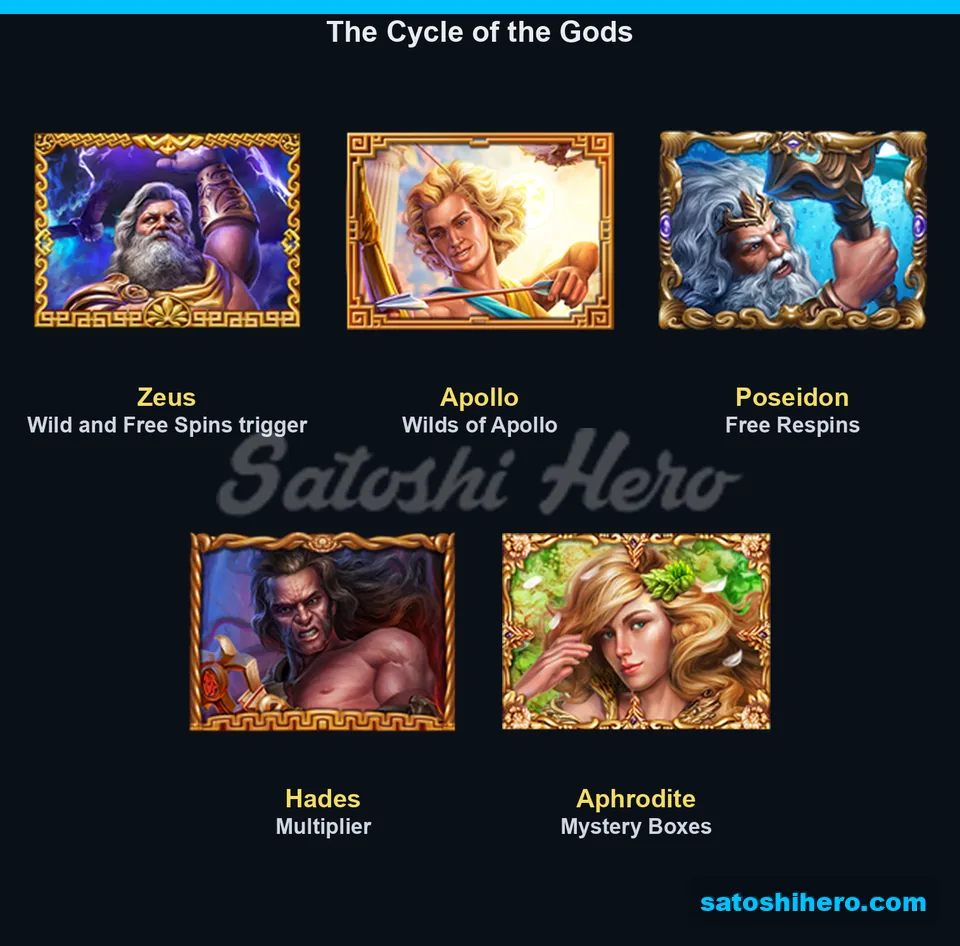
That structure gives the base game a steady pulse. You get ordinary line wins between events, then the final spin adds a small burst of tension. I like this more than hidden feature meters because you can see exactly what you’re waiting for.

Tip: Watch the cycle counter. The tenth spin is where the god power fires, so don’t judge a cycle only by the first few quiet spins.
God Event timing
The final spin matters because the built power fires there. More marks, higher counters, or bigger multipliers can improve the setup, yet the paylines still need matching symbols.
This timing makes the slot feel more deliberate than a plain line game. You get a reason to follow every cycle, even when the first spins look quiet. The cycle gives the base game its rhythm without pretending every event turns into a major hit.
Apollo Wilds
Apollo Wilds turn marked reel positions into wilds on the tenth spin of Apollo’s cycle. You can see the setup build because Apollo and Bow and Arrow symbols leave marks that stay for all 10 spins.
During my test, an Apollo cycle fired its wilds exactly as the counter reached the final spin. The feature felt easy to follow because the marked spaces stayed visible. I like features that show their work, and Apollo does that cleanly.
Marked positions
Every Apollo or Bow and Arrow symbol that lands during the cycle gets marked. Those marks stay locked in place until the tenth spin, so you can watch the board grow more interesting.
Spread matters here. A few marks across useful reels feel better than several marks trapped in awkward places. You still need left-to-right line connections, which keeps the upside controlled.
Final-spin wilds
On the tenth spin, Apollo’s light turns every marked space into a wild. These wilds substitute for everything except Zeus, and they can help ordinary symbols connect across the fixed paylines.
The feature works as a build-up, not an instant bonus. You might get a neat final-spin improvement, or you might watch the wilds miss the right lines. Apollo feels clear and readable, but it isn’t automatically explosive.
Aphrodite Mystery Boxes
Aphrodite Mystery Boxes turn marked spaces, and the paths between them, into matching non-wild symbols on the final spin. This can make the board look more connected than the original marks suggest.
During Aphrodite’s cycle, each Aphrodite or Leaf symbol that lands gets marked. Those marks remain for the full 10-spin cycle, which gives you time to judge the shape. I found this feature the neatest visual trick because the final reveal can change a wider area than expected.
Marked symbols
Spread-out marks can matter more than they first appear. On spin 10, every marked position becomes a Mystery Box, and the path between Mystery Boxes also changes into Mystery Boxes.

Trivia: Aphrodite’s path mechanic can turn spaces between marked symbols into Mystery Boxes too, so the final setup can be larger than the marks you first saw.
You should watch distance, not just count. Two marks with space between them can create a more interesting final setup than two marks sitting together.
Mystery reveal
All Mystery Boxes reveal one randomly chosen non-wild symbol. That shared reveal can create more connected line potential, but symbol choice and line alignment still decide the result.
I wouldn’t treat Aphrodite as a guaranteed rescue feature. It can make the board look beautifully connected, then still miss the payline shape you need. The visual twist is strong, though the final pay still needs line alignment.
Poseidon Free Respins
Poseidon Free Respins are the easiest god feature to track because a visible counter shows how many respins you’re building. Each Poseidon or Trident symbol adds 1 to the counter during the cycle.
The counter starts at 1 on spin 1. On spin 10, Poseidon awards Free Respins equal to the counter, and the counter can’t grow during those respins. In my session, I saw the respin counter sitting on screen while Poseidon’s cycle ran.
Respin counter
This feature gives you the clearest expectation before the God Event. You know the number you’re chasing, and every Poseidon or Trident symbol feels useful even before the final spin.
That visible count makes the cycle feel fairer to follow. You may still get weak respins, but you won’t wonder what the feature has built. If you like structured fantasy pacing, Take The Kingdom has a character-led feel that makes a useful comparison.
Free Respin limit
The counter freezes once the Free Respins begin. That limit keeps the feature from snowballing into something far outside the game’s low profile.
You might find Poseidon less dramatic than Zeus, yet it gives the base game a nice sense of progress. Poseidon gives you the most visible feature count, but the respins still need winning lines.
Hades Multiplier
Hades builds a multiplier during his 10-spin cycle, then applies it to the final spin win. The catch is simple: the final spin still needs a paying result worth multiplying.
During Hades’ cycle, every Hades or Cerberus symbol on the reels raises the multiplier. That creates suspense as the counter grows, but it doesn’t change the basic need for a connected line win. I like the tension, though the feature can feel flat when the last spin misses.
Multiplier buildup
The multiplier build gives Hades a darker, slower feel than Apollo or Poseidon. You watch the number rise and hope the final spin lands something worth boosting.
Don’t judge the multiplier alone. A strong number means little if the last spin produces no meaningful line pay. That blunt rule keeps Hades exciting without making it a runaway feature.
Final-spin payout
The finished multiplier applies to the win on the last spin of Hades’ cycle. When that final spin connects, Hades adds bite to a game that usually keeps wins small.
Still, the feature fits the low profile. It can sharpen a result, but it doesn’t turn the slot into a giant-ceiling machine. Hades is exciting when the last spin connects, and quiet when it doesn’t.
Zeus Free Spins
Zeus Free Spins trigger when Zeus lands as a 4-symbol-tall stack and all four other gods also appear on the reels. The trigger awards 10 Free Spins, and Zeus can borrow the powers of the other gods during the round.
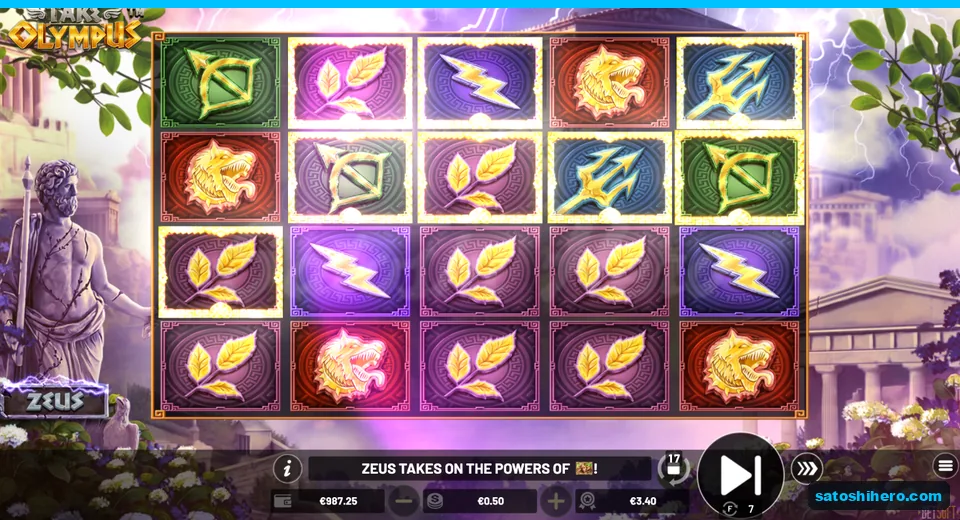
Zeus is wild in any configuration, so he matters even outside the bonus. My organic Free Spins round landed on spin 83 under the purple Zeus scene. That round produced my biggest hit, $17.45, or 34.9x my $0.50 bet.
Trigger condition
The trigger needs a tall Zeus plus Apollo, Aphrodite, Poseidon, and Hades on the reels. That makes the moment feel more specific than a simple scatter count.
I didn’t see a buy feature button in the demo, so I treated this as an organic-bonus slot. When you play Take Olympus, that distinction matters because the base game and cycle features do the heavy lifting between bonuses.
Zeus powers
During Free Spins, Zeus can take on other god powers. Apollo power gives 5 or more wilds anywhere, Aphrodite power makes 5 or more symbols become mystery symbols, Hades power applies a large multiplier, and Poseidon power awards random extra Free Respins.
The round I triggered showed the free-spins counter and a running win total, with $3.40 displayed partway through. It didn’t explode, but it gave the session its clear peak. Zeus gives the slot its best moments, even though the ceiling remains controlled.
RTP, Volatility & Our Test
The math profile matches the test feel: Take Olympus has 95.49% RTP, low volatility, and a 2,328x the bet maximum win. In practice, that meant frequent small pays, limited balance movement, and a modest ceiling compared with high-volatility slots.
This doesn’t promise what happens in any single session. The SatoshiHero Slot Simulator and my play notes show possible shapes, not a script for your next run. I found the slot steady, but steady isn’t the same as safe.
Simulator projection
Our simulator ran 1,000 spins at a $0.50 stake using 95.49% RTP, low volatility, and the 2,328x win cap. The median session ends about $23.60 down. The 5th to 95th percentile band runs from $73.00 down to $31.00 up.
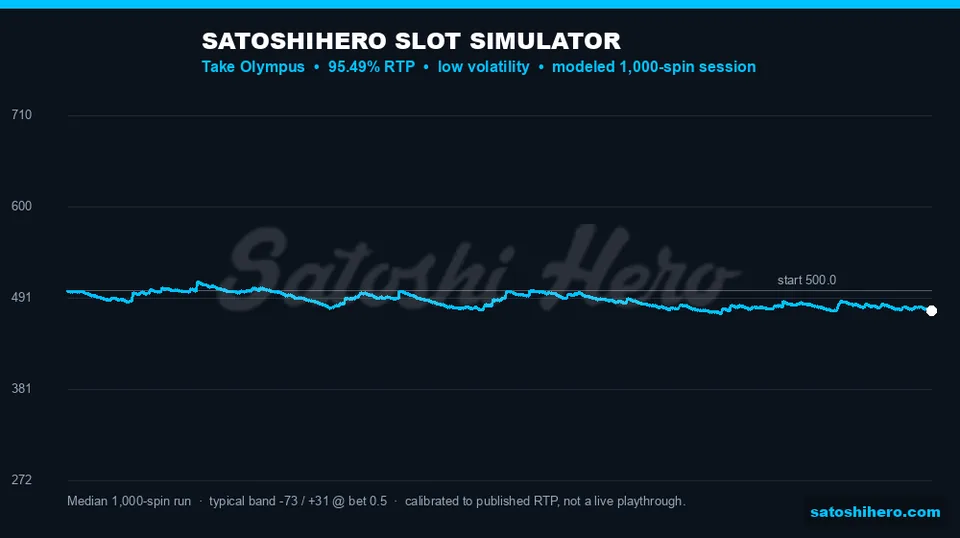
About 34% of spins pay something in the model. A feature round appears roughly once every 125 spins, while wins of 100x or more look very rare, around 1 in 500,000 spins. The model can’t predict your next session or the game’s real random number generator.
That spread explains the feel I got from the base game. The model shows many small pays and a narrow session band, not a slot built around rare giant hits. If you prefer a more direct action theme than mythology, Take the Shot may feel punchier, but this game gives you clearer feature tracking.
Our 100-spin session
I played 100 autoplay spins at $0.50 on a fresh $1,000.00 balance. I finished at $994.30, a net loss of $5.70, and 33 spins paid something. My lowest point sat around $984.65, while the highest balance reached about $1,001.90.
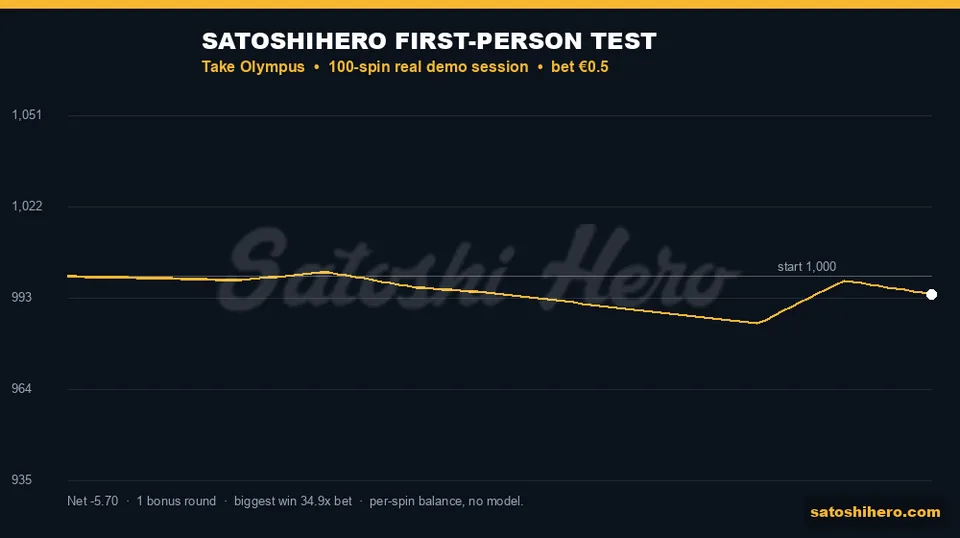
My biggest hit came from organic Free Spins on spin 83 and paid $17.45. The best base-game win was $6.80, which tells you plenty about the low-volatility feel. I also saw Apollo wilds, Poseidon respins, and clean 10-spin god-cycle changes.
One Free Spins round in 100 spins broadly fits the simulator’s roughly 1 in 125 feature estimate. That doesn’t make the next 100 spins predictable, but it made my session feel aligned with the model.

Alert: Low volatility doesn’t remove risk. My 100-spin test stayed controlled, but the 95.49% RTP still sits below 100%, so losses remain the default expectation over time.
The theoretical RTP is the operator-published return figure. A single live 100-spin session has no bearing on the return profile, simulator results show a possible session shape, and bonus behavior can sit slightly differently from the base-game rhythm by design. The session felt stable, but stability should never be mistaken for safety.
Frequently Asked Questions About Take Olympus
How many reels, rows and paylines does Take Olympus have?
Take Olympus has 5 reels, 4 rows, and 50 fixed paylines. Wins pay left to right on adjacent reels, the highest win per line pays, and wins on different lines add together.
What is the Cycle of the Gods in Take Olympus?
Every 10 spins, a random new god takes over the reels. The same god never rules twice in a row, and each god fires a God Event on the final spin.
How do you trigger Free Spins in Take Olympus?
Zeus must land in a 4-symbol-tall configuration while all four other gods also appear. That awards 10 Free Spins, where Zeus can take on the powers of the other gods.
What does Zeus pay and what does he substitute for?
At a $0.50 stake, Zeus pays $3.00 for five, $0.60 for four, and $0.20 for three. He is wild in any configuration.
What are the RTP, volatility and max win in Take Olympus?
Take Olympus has 95.49% RTP, low volatility, and a 2,328x maximum win. Those figures match the steady feel I saw during testing.
Which result did the 1000-spin simulator show?
At a $0.50 stake, the median session ends about $23.60 down, with a band from $73.00 down to $31.00 up. About 34% of spins pay, and a feature round lands roughly once every 125 spins.
How did the 100-spin Take Olympus test go?
I played 100 spins at $0.50 and moved from $1,000.00 to $994.30, a $5.70 loss. 33 spins paid, and the biggest hit was $17.45 from organic Free Spins on spin 83.
Where can you play Take Olympus online?
You can play Take Olympus online on SatoshiHero in demo or real mode. Choose your stake, spin the 5×4 reels, track the god cycle, and watch for Zeus with the four other gods.
Closing Thoughts
Take Olympus stands out because the 10-spin god cycle gives a simple line slot a visible rhythm. Its main drawback is the controlled ceiling, which may feel modest if you chase huge bonus swings.

My Verdict
Try this game when you want steady mythology play with clear feature tracking. A typical session can feel measured, with small hits carrying you between cycle events. Don’t expect a monster-slot mood, because the best moments stay fairly contained.
I like how the counter, statue, and changing scenery made my test easy to follow. I don’t like that some built features can end quietly when the final spin misses. My Free Spins hit saved the session from feeling flat, but it still paid a modest $17.45.
Take Olympus is checked regularly on SatoshiHero, and this guide reflects first-hand demo testing plus simulator work. I would treat it as a calm line slot with clever feature pacing, not as a high-ceiling chase.

Pros:
 Readable cycles: The counter and statue show what you’re tracking each spin.
- Steady profile: Low volatility keeps balance swings calmer during short tests.
- Useful god variety: Each god changes the reel goal in a clear way.
- Strong presentation: Betsoft’s 3D scenes make the cycle easy to read.

Cons:
 Modest ceiling: The win cap may feel small beside tougher slots.
- Quiet events: Built features can miss if the final spin fails.
- Specific bonus trigger: Zeus Free Spins need a demanding symbol mix.

Best For: Steady bankroll managers and mythology fans get the most from this slot. You’ll enjoy it more if you like watching visible meters and counters build toward a final spin. Huge-win hunters may find the controlled ceiling too tame.































































Bets
All Bets
Game
Player
Date
Wager
Mult.Multiplier
Prize
 Royal Fruits 9: Hold 'n' Link
 nina87
- 04:20:11
- 0×
- Galaxy Glitter
- Hidden
- 04:20:10
- 1×
- Royal Fruits 9: Hold 'n' Link
- mike_721
- 04:20:09
- 0×
- Royal Fruits 9: Hold 'n' Link
 mdp0fxo
- 04:20:08
- 0×
- Luck of Panda: Bonus Combo
- Hidden
- 04:20:08
- 0×
- Penny Pelican
 jdelfino102
- 04:20:04
- 0.99×
- Penny Pelican
- jdelfino102
- 04:20:03
- 0×
- Big Banker Bonanza
- josh1998
- 04:20:03
- 0×
- Royal Fruits 9: Hold 'n' Link
- nina87
- 04:20:02
- 0×
- Penny Pelican
- jdelfino102
- 04:20:00
- 0×