

Voltage Cash
By pressing play, you agree that you are above legal age in your jurisdiction and that your jurisdiction allows online gambling.

Voltage Cash
RTP96%
VolatilityMedium
Max winx2,500
Lines20
Hit rate13.57%
ThemeRetro
ReleasedMay 2024

Neon Fruit and Lightning-Fast Line Wins
Voltage Cash throws you onto a neon 5×3 fruit board with 20 fixed paylines and an anywhere-paying Scatter ladder.
According to Barbara Bang, Voltage Cash is a medium volatility slot with a 96% RTP and 2,500x max win potential. It targets fixed-line fans who prefer rapid spins, familiar fruit, and one clear prize feature, with no free spins or bonus buy. The 0.10 to 500 range opens at $1.00 with $1,000.00 in play money; I ran 100 fast autoplay spins, and both demo and real play are available here on SatoshiHero.
Key takeaways
- Best bonus: Play the 20 fixed-payline base game and treat the Scatter ladder as the main prize feature.
- RTP / volatility: The theoretical RTP is 96%, paired with medium volatility and uneven short-session results.
- Max win: Filling all 15 positions with Scatters pays the 2,500x cap in one immediate award.
- Risk note: A wrong Risk/Gamble card guess can erase the entire completed win placed at risk.
- Bankroll note: Only 13 of my 100 tested spins paid, so you need room for dry stretches.
These points cover the essentials. I value the transparent rules, but the missing bonus round narrows the game’s appeal.

Table of Contents
- Theme and First Impressions
- How Voltage Cash Works
- High-paying symbols
- Lower-paying symbols
- The 20-Line Win System
- My lemon example
- Scatter Pays and the Prize Ladder
- Complete prize ladder
- Risk/Gamble After a Win
- RTP, Volatility and Test Data
- Simulator projection
- My 100-spin session
- What the 100 Spins Felt Like
- Pace and bankroll
- Who gets the most from it
- Frequently Asked Questions About Voltage Cash
- Summing It Up
Theme and First Impressions
The presentation combines a classic fruit machine with bright neon arcade styling. Deep blue and purple shades frame electric streaks, while a lightning-charged hexagon logo crackles above the reels.
Cherries, lemons, BAR plates, golden bells, blue horseshoes, purple stars, and red sevens glow clearly against the darker background. You can identify each symbol quickly, even when fast play cuts the pause between spins. I found the contrast strong on both larger and smaller screens, though the fruit theme won’t win originality awards.
A prize ladder stays visible above the reels and identifies the Scatter as the main target. Before your first spin, you can see how six matching logos start the ladder and how a full board reaches its peak. That immediate visual hierarchy feels more useful than a flashy animation hiding basic information.
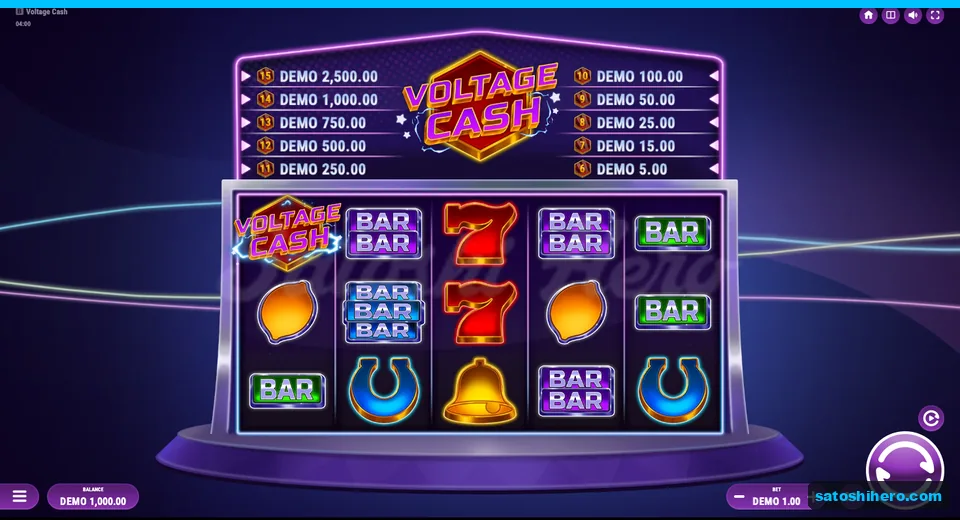

Highlight: The visible ladder starts at 5x for six Scatters and rises to 2,500x when all 15 positions show Scatters.
The lightning adds energy without clutter. You know where the reels end, which symbols connected, and where to check direct prizes. Cash Surge offers a louder cash-game feel, whereas this design stays closer to a traditional fruit cabinet.
Spins move quickly, wins pause long enough to register, and the interface avoids cinematic clutter. I liked that restraint, although feature hunters could find it plain. You won’t need several spins to understand the main target, and that’s a genuine strength.
How Voltage Cash Works
Regular wins need at least three matching symbols from reel 1 across adjacent reels. The slot uses five reels, three rows, nine regular symbols, one Scatter, and no wild symbol.
Each regular award uses a multiple of the total bet for every completed payline. I checked that rule against an observed lemon win, where three orange lemons returned 0.6x on each line they formed. You should read the paytable per line rather than treating one symbol pattern as one combined award.
The game runs in a browser on desktop and mobile through SatoshiHero. You can test the line rules in demo mode before using real funds, which I strongly recommend because overlapping paths aren’t always obvious at first glance. Cash Chips is a useful contrast when you want a more overt cash-symbol focus instead of this compact fruit paytable.
High-paying symbols
The red seven leads the regular paytable with 5x for three, 10x for four, and 15x for five. A golden bell returns 4x, 8x, or 12x across the same symbol counts.
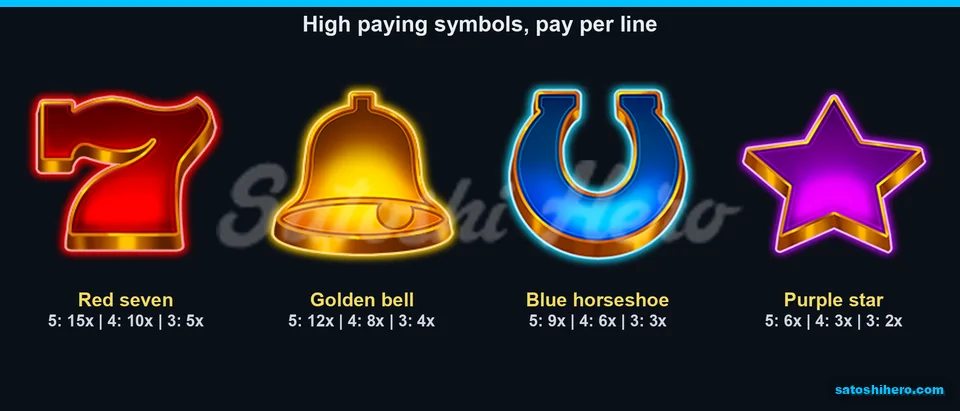
Blue horseshoes pay 3x, 6x, and 9x. Purple stars return 2x, 3x, and 6x. You can see a clear step between these symbols, but even the top five-symbol line remains modest beside the Scatter ladder.
I found the hierarchy easy to remember after a few spins. Red sevens matter most, bells sit second, and the two colored shapes fill the remaining high-value positions. You won’t need to reopen the paytable constantly once those four rankings settle in your head.
Lower-paying symbols
Triple BAR pays 1x for three, 2x for four, and 4x for five. Double BAR returns 0.8x, 1.6x, and 3.5x, while single BAR pays 0.7x, 1.4x, and 3x.
Orange lemons return 0.6x, 1.2x, and 2.5x. Red cherries sit last at 0.5x, 1x, and 2x. These values look small alone, yet overlapping fixed lines can turn one board into a more useful combined result.

Expert Advice: Read every regular symbol award as a per-line payout. One arrangement can complete several paylines and repeat the same symbol payment across those lines.
The hexagon Scatter ignores lines, and it doesn’t replace regular symbols. That distinction matters because you can collect its direct award alongside completed line wins on the same spin. I like the clean separation, although a wild would have created more routes into regular combinations.
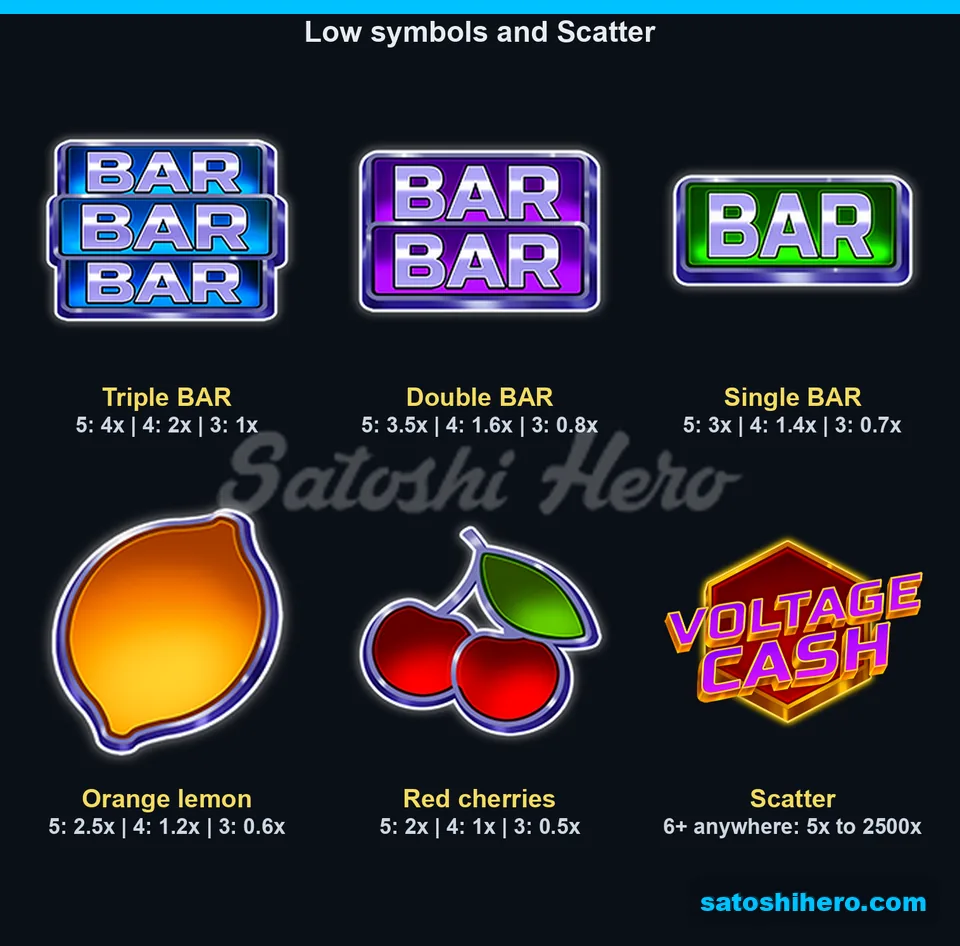
You can learn this compact paytable quickly. The absence of a wild limits combination building, but it also keeps every result straightforward to audit.
The 20-Line Win System
The 20 figure means fixed paylines, not ways, clusters, or pay-anywhere combinations. Every regular win starts on reel 1, continues across adjacent reels, and requires at least three matching symbols.
Only the highest award counts on each individual line. Wins from separate lines combine into the final spin total, so one layout can score several times. You need to check every highlighted path rather than judging a result from the middle row alone.
My lemon example
My clearest example came from orange lemons connecting across reels 1 to 3. That arrangement completed multiple fixed paylines, and each line returned 0.6x for a combined 8.4x result. The board looked modest at first, but the overlapping paths made it one of the best teaching examples in the test.
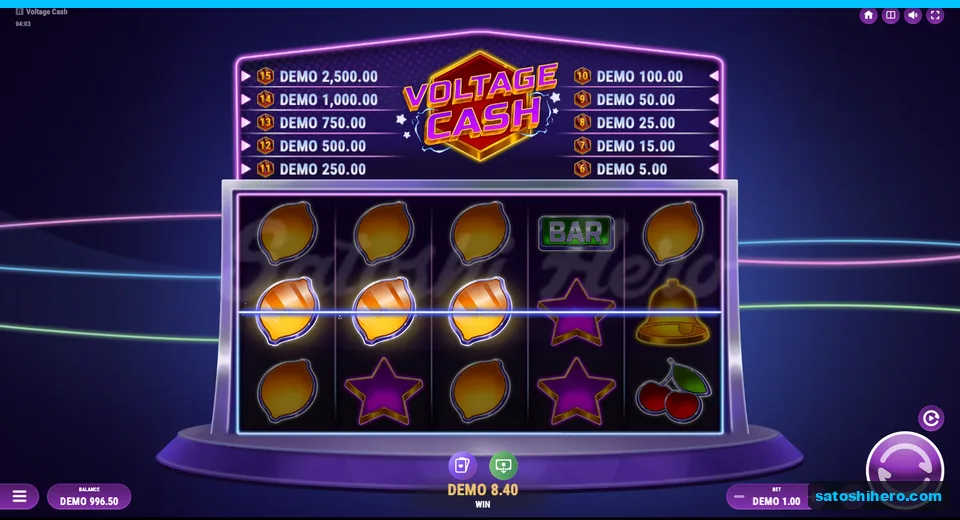
I captured that lemon result one spin after the counted session. It demonstrates the system, but I excluded its 8.4x return from all session figures. Keeping it separate prevents a useful mechanics example from distorting the measured run.

Notable Detail: Classic fruit machines made simple symbols readable at a glance, and this neon treatment preserves that practical visual tradition.
Lower symbols can still create useful totals when they stretch across many line shapes. You shouldn’t dismiss lemons or BAR plates just because their single-line values sit below the premium icons. In this case, several small awards mattered more than one isolated high symbol.
The fixed layout also changes how you read near misses. Matching symbols on reels 2, 3, and 4 don’t form a regular win because reel 1 must begin the chain. I think this rule is easy to grasp, yet fast autoplay can hide the reason behind a zero return unless you pause.
Cash Box could appeal more when you prefer a stronger box-based cash motif, while this system stays anchored to traditional left-to-right evaluation. Checking all active paths matters more than following one visible row.
Scatter Pays and the Prize Ladder
The hexagon Scatter pays anywhere when at least six symbols land on the 5×3 board. Those positions don’t need to follow paylines, and the direct prize joins any regular line awards from the same spin.
Complete prize ladder
The complete ladder is:
- 6 Scatters: 5x.
- 7 Scatters: 15x.
- 8 Scatters: 25x.
- 9 Scatters: 50x.
- 10 Scatters: 100x.
- 11 Scatters: 250x.
- 12 Scatters: 500x.
- 13 Scatters: 750x.
- 14 Scatters: 1,000x.
- 15 Scatters: 2,500x.
A full board of 15 Scatters reaches the official maximum win. This is an immediate cash award, not a trigger for free spins or entry into another bonus stage. You know the full result as soon as the game counts the logos.
I find the ladder exceptionally easy to follow because every extra Scatter has a listed value. Six logos start with a fairly modest 5x, but later steps grow sharply from 250x through 2,500x. You can verify the count against the top-row display without opening a separate information panel.
No Scatter threshold appeared during my counted session. That absence made the run feel sparse, but it can’t predict your next qualifying board. My 50x high point came from ordinary line play.
The design offers clarity at the cost of depth. Expanding-modifier fans could find one direct ladder too bare. I still prefer this honest presentation to crowded rules.
Cash Elevator offers a more progressive cash fantasy, while this slot keeps every Scatter count visible. The ladder remains the easiest feature to audit.
Risk/Gamble After a Win
The optional Risk/Gamble feature lets you stake a completed win on a card guess, and a wrong choice loses the amount risked. A card icon appears beside the win total after a paying spin and opens the card-based choice.
I didn’t use the option during any of my 100 counted spins. Leaving it untouched preserved clean results from the reel outcomes, which made more sense during a short controlled test. You can see the temptation after a small return, but I don’t regard a completed win as disposable test material.
I won’t infer the success chance, available picks, reward multiple, or maximum level. My session only confirmed the icon, card format, and risk of losing the staked win.

Risk Note: A failed card guess can turn a completed win into a loss. Don’t use this feature to chase money lost on earlier spins.
Voltage Cash has no free spins, bonus round, or bonus-buy mode. Base-game paylines, direct Scatter prizes, and this optional post-win decision make up the full feature set. I think that stripped-back structure has charm, but it won’t satisfy readers chasing layered bonus sequences.
If you use the gamble, decide before spinning how much you’re prepared to lose. Don’t treat the choice as a recovery tool after a weak run, because it can’t change the underlying return or rescue earlier losses.
The card guess adds tension without changing the rules. You control the exposure, while skipping it preserves the payout.
RTP, Volatility and Test Data
The official profile combines a 96% theoretical RTP, medium volatility, and a 2,500x maximum win. Medium volatility can still produce long gaps between meaningful returns, as my sparse 100-spin sample demonstrated.
Published mathematics, modeled projections, and played results answer different questions. You should use the first to understand design, the second to see possible spread, and the third as one observed experience. I consider that separation essential because one positive finish can otherwise look more predictive than it is.
Simulator projection
The SatoshiHero Slot Simulator modeled 1,000 spins at one bet unit per spin. Its inputs used the stated return, the top-prize cap, and a medium-volatility band rather than my live sequence.
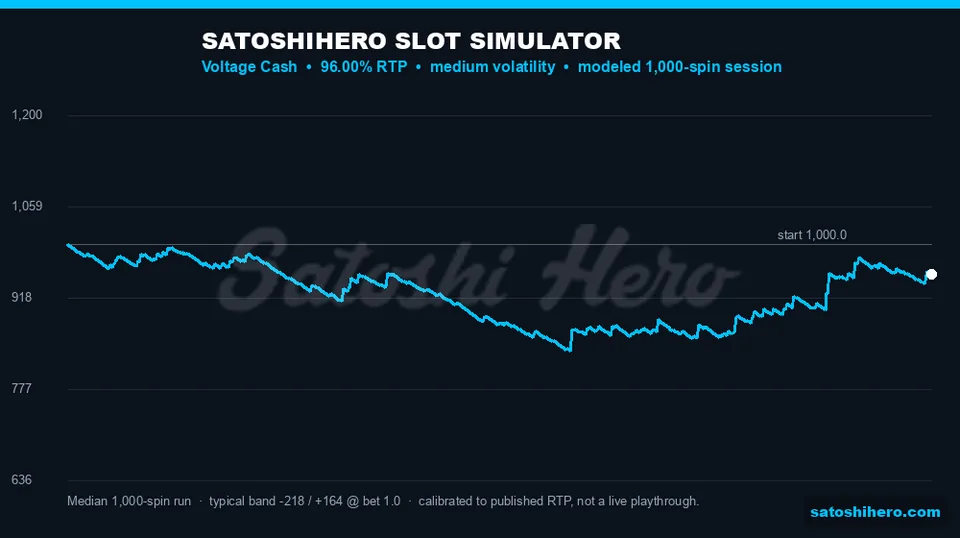
The median modeled run finished 46.6x the bet down. The central 90% range stretched from 218.1x down to 164.4x up, showing how widely sessions with the same settings can separate. You shouldn’t read either boundary as a promised limit.
Paying spins appeared about once in four within the model. A feature-sized return appeared roughly once in 50 spins, while a very large win appeared approximately once in 13,333 spins. I find the gap between common small returns and rare large outcomes more useful than a single average.
These are modeled frequencies, not a countdown. They can’t predict which spin pays, when a Scatter board arrives, or whether wins cluster early. Your sequence can sit anywhere within or beyond the illustrated range.
My 100-spin session
I started with a $1,000.00 play-money balance and used the default $1.00 stake throughout. Fast play and autoplay stayed active for all 100 spins, so the pace remained consistent from start to finish.
My balance ended at $1,001.50, leaving the run 1.5x the bet ahead. Only 13 spins paid anything, and the 50x result on spin 10 lifted the balance to its $1,043.00 peak. That early jump carried nearly the entire session.
The balance then declined for most of the remaining spins. It reached about $986.70 around spin 93 before a 15x win on spin 94 and several 5x returns produced a late recovery. My second-largest result was 15x, far below the early high point.
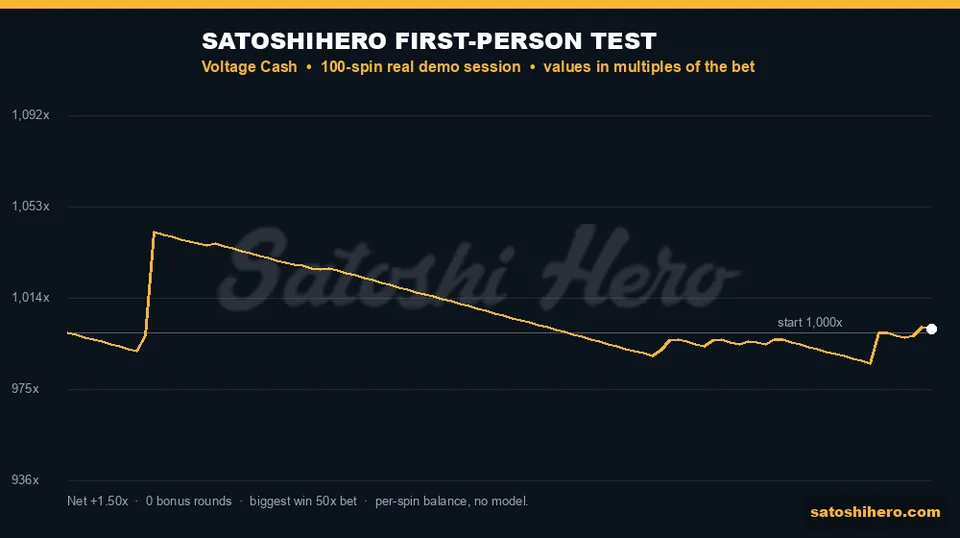
I experienced the run as one sharp rise, a long bleed, and a partial rescue near the end. You could easily focus on the positive finish and miss how close the balance came to a meaningful loss. The max win feels reasonable for this risk level, but the observed path was less smooth than the medium label might suggest.
The theoretical percentage is Barbara Bang’s published return. One short session doesn’t alter it, and the simulator describes a modeled range rather than predicting results. Scatter prizes and line payouts belong to the designed pay structure, while any short run can finish far above or below expectation.
What the 100 Spins Felt Like
The session felt fast but uneven, with only 13 paying spins and one early 50x result carrying most of the run. Autoplay and fast play matched the stripped-back format, although the repeated empty outcomes became more noticeable without bonus anticipation.
Spin 10 created an early lead and pushed my balance to $1,043.00. From there, most spins returned nothing, and the balance eventually fell below its $1,000.00 starting point. I found that long decline more representative of the experience than the small final profit.
A 15x return on spin 94 changed the closing shape. Several 5x wins then nudged the balance to $1,001.50, producing a finish just 1.5x ahead. You shouldn’t interpret that recovery as steady performance because a few concentrated results did almost all the work.
Pace and bankroll
An early large hit doesn’t mean your session stays profitable. Choose a stake that leaves room for extended non-paying sequences, especially when fast play compresses many outcomes into a short period. The upper 500 step belongs to the available bet ladder and isn’t a suggested starting amount.
My default $1.00 stake provided 1,000 starting bets in demo funds. Even with that depth, the fall from the peak felt pronounced because the middle of the run offered little support. I think slower manual play could make the same drought feel longer, not safer.
You should judge affordability before activating autoplay. A fixed stop point helps you avoid raising the stake just because several empty spins arrived together. The game offers no feature purchase that changes the session rhythm, so your only direct controls are stake, speed, and stopping.
Who gets the most from it
Fixed-line traditionalists, fruit-symbol fans, and readers who like one visible Scatter target can appreciate this format. If you value clear payouts and rapid decisions, the absence of layered modifiers keeps each spin easy to read.
Feature-heavy slot fans will probably find it bare. There are no free spins, expanding mechanics, feature chains, or buy choices to break up the base game. I enjoyed the simplicity across a short test, but I wouldn’t choose it for a long session built around bonus variety.
Your preferred feature depth matters more here than the neon polish. The positive finish came from a few concentrated wins rather than steady returns, and that distinction should shape your stake choice.
Frequently Asked Questions About Voltage Cash
How many paylines does Voltage Cash have?
Voltage Cash has 20 fixed paylines on a 5×3 board. Regular wins run left to right from reel 1 across adjacent reels, and only the highest award counts on each line. You need at least three matching symbols, while separate line wins combine.
What are the best-paying symbols in Voltage Cash?
The red seven is the top regular symbol, paying 5x for three, 10x for four, and 15x for five. Golden bells, blue horseshoes, and purple stars follow it. I found that order simple to remember, though line overlap often matters more than one symbol’s face value.
How does the Scatter work in Voltage Cash?
Six or more hexagon Scatters pay anywhere on the board. The ladder starts at 5x for six and reaches 2,500x for 15, with that award added to any regular line wins. It pays immediately rather than opening free spins.
Does Voltage Cash have free spins or a bonus buy?
No, the slot has no free spins, bonus round, or bonus-buy option. Play centers on 20 fixed paylines, direct Scatter awards, and an optional Risk/Gamble choice after a win. I find the structure clear but deliberately sparse.
What is the Voltage Cash Risk/Gamble feature?
It is a post-win card guess that lets you risk a completed payout. A wrong choice loses the amount placed at risk. I didn’t use it during my test, so I won’t speculate about unobserved options or chances.
What does the 1,000-spin Voltage Cash simulator show?
The model produced a median finish 46.6x down and a central range from 218.1x down to 164.4x up. It estimated a feature-sized win about once in 50 spins. These modeled figures don’t predict your result or the order of wins.
How did the 100-spin Voltage Cash test finish?
I started with $1,000.00 and finished at $1,001.50 after 100 spins at $1.00. Thirteen spins paid, my largest win reached 50x, and the balance peaked at $1,043.00 after spin 10. The positive finish relied on a few concentrated returns.
What are the Voltage Cash RTP, volatility, and maximum win?
The slot has a 96% theoretical RTP, medium volatility, and a 2,500x maximum win. Those figures describe the designed payout profile, not a guaranteed result for your session. My test finished slightly ahead despite long non-paying stretches.
Summing It Up
Voltage Cash stands out through transparent fixed lines, a visible Scatter ladder, and fast fruit-machine play. Its main drawback is equally clear: no free spins or layered bonus round breaks up the base game.

My Call
Traditional slot fans should try the demo and judge whether the simple rhythm holds their interest. Expect clusters of modest line returns, dry stretches, and rare direct Scatter prizes rather than frequent feature sequences.
I liked the readable board and the way one lemon pattern demonstrated multiple simultaneous line wins. I didn’t like how bare the long decline felt after my early 50x hit, even though the late 15x return rescued the finish.
Voltage Cash keeps prize formation clear. You can compare your experience with test notes that are checked regularly.

Pros:
 Clear paytable: Every regular symbol and Scatter threshold has an easy-to-check value.
- Readable lines: Highlighted fixed paths explain how overlapping symbol awards combine.
- Fast pacing: Quick spins complement the compact base-game structure without hiding core controls.
- Visible target: The top ladder keeps every Scatter threshold in sight.

Cons:
 No wild: Regular combinations get no substitution help across the five reels.
- Sparse features: No free spins or bonus buy interrupts repeated base-game spins.
- Risky gamble: One wrong card guess can erase a completed payout.

Best For: Fixed-line traditionalists and fruit-slot fans get the clearest value here. You’ll appreciate medium volatility, rapid spins, and one direct prize ladder.



































































Bets
All Bets
Game
Player
Date
Wager
Mult.Multiplier
Prize
 Bunny's Bounty: Hold`n`Link
 nina87
- 08:22:21
- 0×
- Three Piglets
- josh1998
- 08:22:21
- 0×
- Bunny's Bounty: Hold`n`Link
 whodey39311
- 08:22:20
- 0×
- Reel Rider: Rapid Link
 szilagyi.nikolett.93
- 08:22:20
- 0×
- Royal Fruits 9: Hold 'n' Link
 Hidden
- 08:22:19
- 0×
- Royal Fruits 9: Hold 'n' Link
- Hidden
- 08:22:18
- 0×
- Bunny's Bounty: Hold`n`Link
- nina87
- 08:22:18
- 1.4×
- Bunny's Bounty: Hold`n`Link
- whodey39311
- 08:22:17
- 0×
- Royal Fruits 9: Hold 'n' Link
 Hidden
- 08:22:17
- 9.99×
- Royal Fruits 9: Hold 'n' Link
- Hidden
- 08:22:15
- 0×