

Shark's Bay
By pressing play, you agree that you are above legal age in your jurisdiction and that your jurisdiction allows online gambling.

Shark's Bay
RTP94.31%
VolatilityHigh
Max winx9,550
Ways117,649
ThemeUnderwater world
ReleasedJun 2022

Riding the Wild Current in Shark’s Bay
Spin the Shark’s Bay slot and its six reels shift in height, changing the number of winning ways with each result.
Shark’s Bay is a bright underwater slot from Zillion Games, built for high-volatility play and moving multiplier Wilds. Its six reels can expand to seven rows, creating up to 117,649 changing ways. The 94.31% RTP and 9,550x maximum win demand a healthy budget, especially if you dislike sharp balance swings.
Key takeaways
- Best bonus: You should start with the base game or free demo because my test couldn’t support a preferred bonus purchase.
- RTP / volatility: The theoretical RTP is 94.31%, while volatility is high and dry spells can run long.
- Max win: The game caps any result at exactly 9,550x the total bet.
- Risk note: Free spins offer Wild Wave or Bubbles Up, both using x1, x2 and x3 multiplier Wilds.
- Bankroll note: My 100-spin test lost 39.7x, while one bonus purchase could consume 40x of your selected stake.

Table of Contents
- How Shark’s Bay Works
- Win formation
- Symbol values
- RTP, Volatility and Test Results
- Simulator projection
- Our 100-spin session
- Theme and First Impressions
- Buy Free Spins
- Price seen in testing
- Bankroll impact
- Free Spins
- Trigger and choice
- Multiplier wilds
- Wild Wave
- Moving wild path
- Bubbles Up
- Vertical wild movement
- Choosing a mode
- Frequently Asked Questions About Shark’s Bay
- Final Word
How Shark’s Bay Works
This is a six-reel variable-ways slot, not a traditional fixed-payline game. Reel heights can reach seven rows, so each spin may present a different number of combinations. You can read the live total above the reels rather than searching for fixed lines. I find that counter essential because the board’s changing shape can otherwise look more complex than it is.
Wins connect matching symbols across adjacent reels, beginning on the leftmost reel. Every award uses a multiple of your total bet, making results easy to compare across stake sizes. The Shark’s Bay slot offers free-demo and real-play options at SatoshiHero on mobile and desktop. Taller layouts give you more possible combinations, but they never ensure a payout.
Win formation
My clearest low-value example landed three Kings at a $2.00 stake. They paid $0.20, matching the listed 0.1x award for three Kings. That result confirms how the ways system reads from left to right without a visible payline. You only need matching symbols to continue across adjacent reels from the first reel.
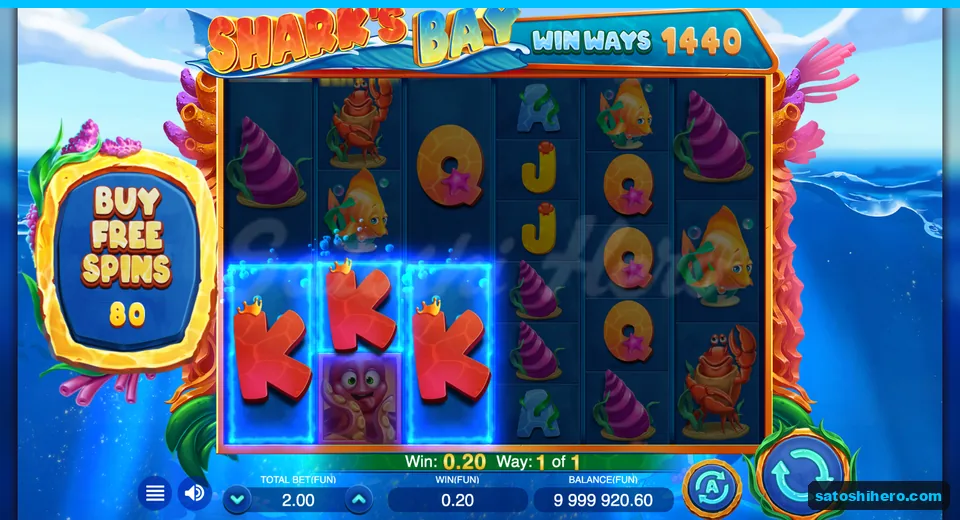
The swimmer on her pink ring acts as the Wild. She replaces every paying symbol except the Shark scatter, which keeps the two roles easy to distinguish. Three Shark scatters on one spin can activate free spins. I like that visual separation, although the base game’s smallest connections can feel almost meaningless beside the stake.
Symbol values
The paytable lists these awards from highest to lowest. Each sequence covers six, five, four and three matching symbols:
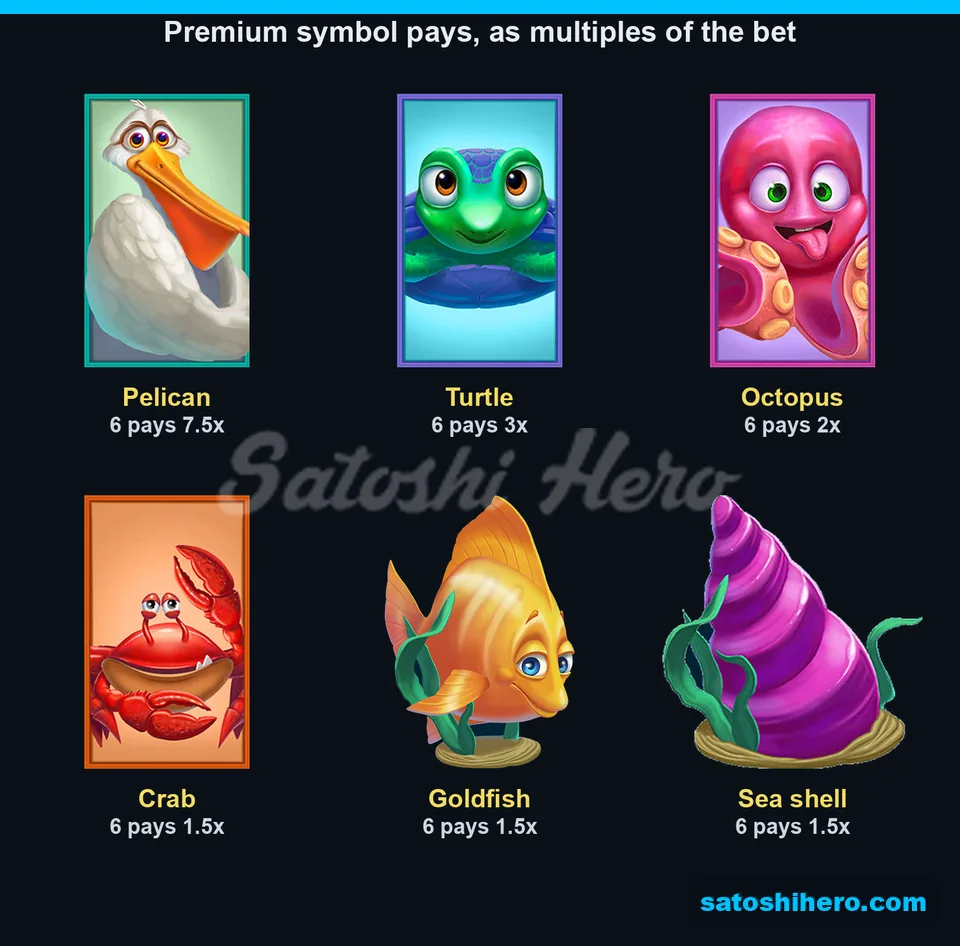
- Pelican: 7.5x, 3x, 2x and 0.75x.
- Turtle: 3x, 1.5x, 1x and 0.5x.
- Octopus: 2x, 1x, 0.75x and 0.35x.
- Crab: 1.5x, 0.75x, 0.5x and 0.2x.
- Goldfish and purple shell: 1.5x, 0.5x, 0.4x and 0.15x.
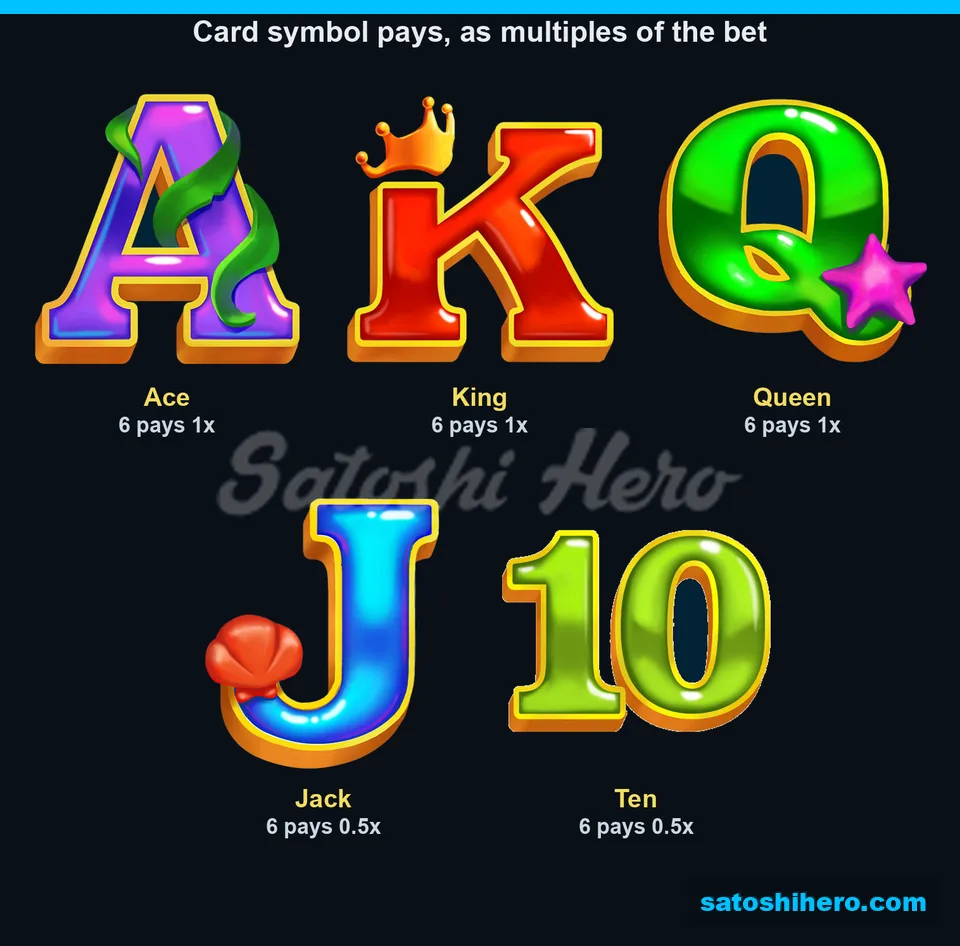
- Ace, King and Queen: 1x, 0.3x, 0.2x and 0.1x.
- Jack and Ten: 0.5x, 0.2x, 0.1x and 0.05x.
The Pelican’s 7.5x six-symbol award feels modest for a top regular symbol. You need combined ways, taller reel layouts or bonus mechanics to build a more exciting total. On one hand, several simultaneous connections can stack together. The trade-off is that many ordinary hits barely slow a losing run.

Recommendation: Follow the live ways counter instead of looking for a fixed payline total. Taller layouts create more combinations, but they don’t ensure a payout.
RTP, Volatility and Test Results
According to Zillion Games, the math profile combines a 94.31% theoretical RTP, high volatility and a 9,550x maximum win. That mix can create long losing stretches, small returns and occasional sharp lifts. You should size each stake around a sustained dry spell, not around the headline cap. In my view, the ceiling looks substantial, but the lean return makes this cheerful game tougher than its artwork suggests.
The recorded specifications give you a grounded picture, though neither a model nor my short session can predict your outcome. I used play money at the default $2.00 stake. Results below use bet multiples, letting you compare performance without confusing it with stake size.
Simulator projection
The SatoshiHero Slot Simulator modeled 1,000 spins at a 1x stake. Its median session ended 84x down, while the typical range stretched from 331x down to 314x up. About 18 spins in every 100 paid in the projection. That broad spread matters more than any single midpoint because it shows how differently equal-length sessions can finish.
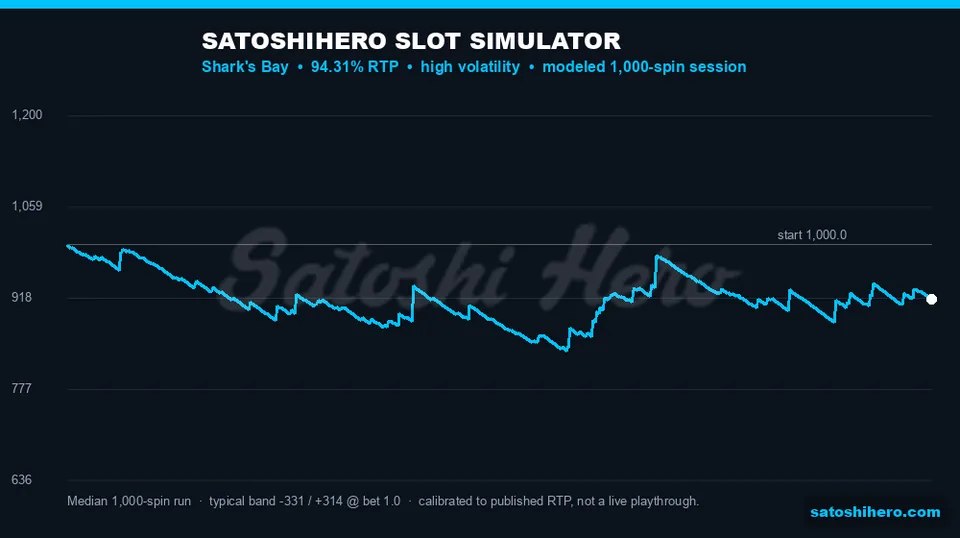
A feature round appeared roughly once every 47 modeled spins. Results of at least 100x appeared approximately once in 1,618 spins, making them rare within a short session. You shouldn’t read either frequency as a countdown. I think the projection succeeds as a risk picture, but it would mislead anyone treating averages as promises.

Caveat: High volatility, a 94.31% RTP and a 40x feature cost can drain a small budget quickly. Set your limit before choosing a stake or buying free spins, since 9,550x is a cap rather than an expected result.
Our 100-spin session
My play-money test finished 39.7x down after 100 base spins at a $2.00 stake. The displayed balance moved from $10,000,000.00 to $9,999,920.60. I recorded 27 paying spins, yet many returns hovered near 0.1x. You’d have seen frequent movement on the meter without much protection for the starting balance.
The decline stayed fairly steady through roughly 80 spins. A 12.2x result on spin 11 ranked second, but it couldn’t stop the longer slide. My best hit arrived on spin 86 and paid 28.8x, recovering about 27x at once. I enjoyed that late jolt, though one decent result couldn’t repair the full session loss.
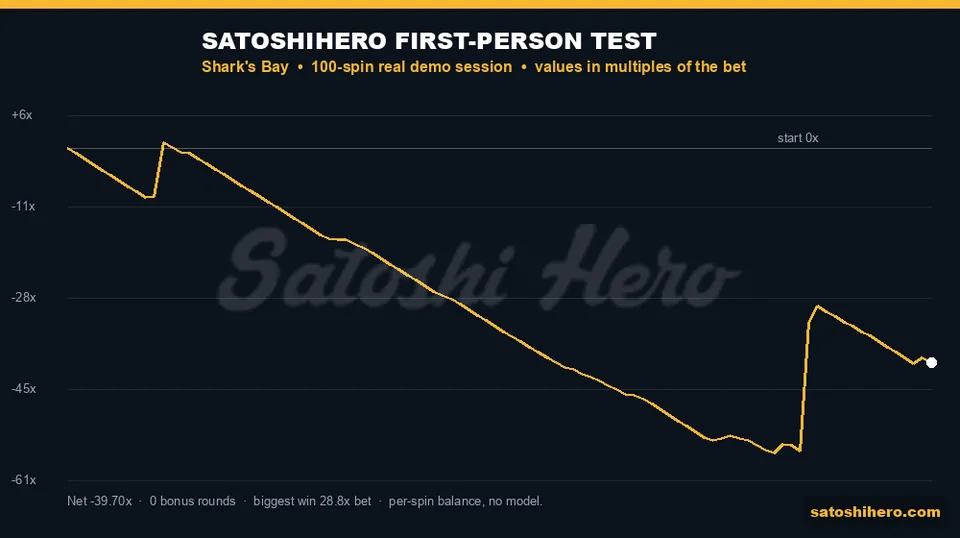
No three Shark scatters aligned, so I didn’t enter either free-spin mode. That absence made the base game’s dependence on small symbol connections especially clear. You shouldn’t treat my 27 paying spins as a fixed hit rate or expect a late rescue. The run shows one plausible high-variance path, nothing more.
The theoretical RTP is the operator-published return for the game, and one 100-spin session can’t alter or prove it. Our simulator illustrates a range rather than forecasting your balance, while separately configured bonus modes can carry slightly different theoretical returns by design.
Theme and First Impressions
The Shark’s Bay slot uses a bright, readable underwater setting with familiar sea life and a relaxed holiday mood. A blonde swimmer floats on a pink ring above a crystal-clear bay, framing the six-reel board. You get clean blues, warm coral shades and sharply outlined creatures instead of murky deep-sea horror. I find the cheerful treatment pleasant, although the theme won’t win originality awards.
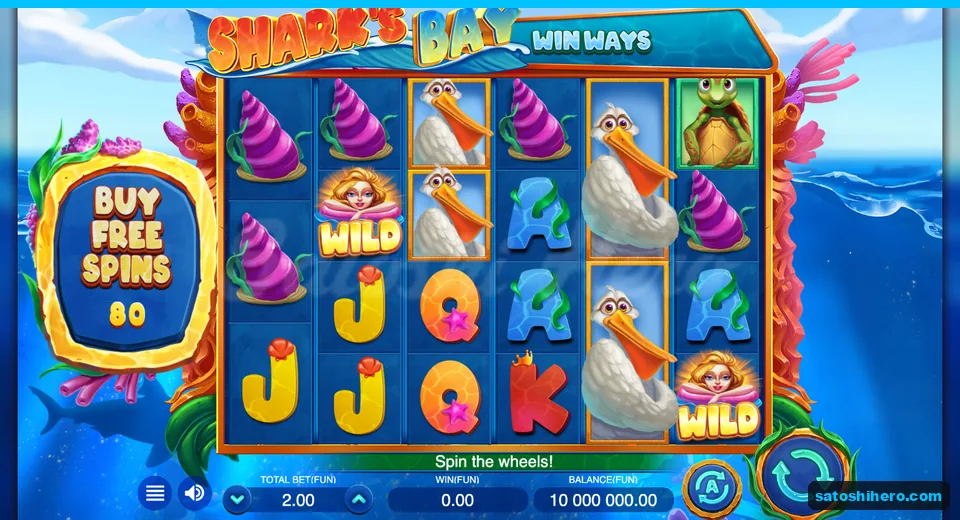
A Pelican leads the regular symbols, followed by a Turtle, Octopus, Crab, Goldfish and purple shell. The Shark appears only as the scatter rather than a paying animal. That choice gives you an instant visual cue when bonus potential enters the board. Card ranks fill the cheaper positions, and their simpler shapes keep crowded seven-row layouts readable.
The live ways counter sits above the reels, while sound and menu controls remain at the lower left. A Buy Free Spins sign floats beside the board. Hot to burn takes a plainer fruit-machine route, whereas this slot uses animated sea creatures and a holiday palette. I prefer this board’s clarity, even if its visual idea feels familiar.
The design focuses entirely on symbols, controls and live ways information. Strong colors make important icons easy to separate at a glance. Clarity, rather than originality, remains the art direction’s main strength.
Buy Free Spins
The Shark’s Bay slot offered direct bonus entry for $80 at my tested $2.00 stake. That price equals 40x the selected bet, placing a full block of base-spin stakes at risk immediately. I left the purchase untouched, so my test doesn’t support a preferred free-spin mode. You should view the sign as a bankroll decision rather than a shortcut to better returns.
Trying the free demo first lets you learn both Wild movement styles without committing the purchase price. A bought entry doesn’t raise the maximum-win cap, and I saw no evidence that it improves the theoretical return. Hot to Burn Extreme may appeal more if you prefer a simpler, fiery presentation over selectable underwater Wild movement. The purchase here feels expensive beside my short test loss, though direct access may still appeal when you dislike waiting for scatters.
Price seen in testing
The observed calculation is straightforward: $80 divided by $2.00 produces a 40x cost. If you change your selected stake, the displayed purchase amount changes proportionally. You still commit forty base bets in one action. I prefer seeing that ratio before clicking because the raw price alone can hide its effect on a session budget.
Bankroll impact
One purchase cost slightly more than my full 39.7x loss across 100 base spins. The comparison only shows scale; it doesn’t prove that base play offers an advantage. You could lose the purchase price quickly or receive a strong bonus, since every outcome remains random. I wouldn’t spend that amount unless it already fit inside my complete session limit.

Metric: One observed purchase cost 40x the stake, slightly more than the entire 39.7x loss across my 100 base spins.
Free Spins
Three Shark scatters trigger free spins in the Shark’s Bay slot, while the sign beside the reels provides paid entry. My 100-spin session neither triggered nor purchased the feature, so all behavior here comes from the in-game rules. Before the round starts, you choose Wild Wave or Bubbles Up. I like having a clear choice, but my test gives you no sound basis for calling either mode stronger.
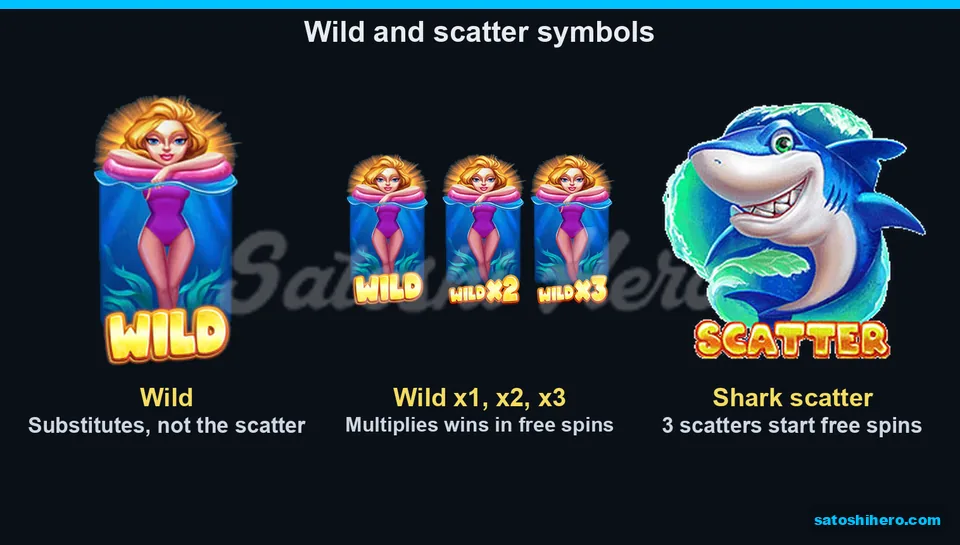
Wilds can appear as x1, x2 or x3 variants during free spins. A qualifying win that uses one of those Wilds receives its shown multiplier. The rules don’t promise a fixed progression, appearance rate or minimum return. You should treat each multiplier as possible help, not as a guaranteed ladder toward a large prize.
Trigger and choice
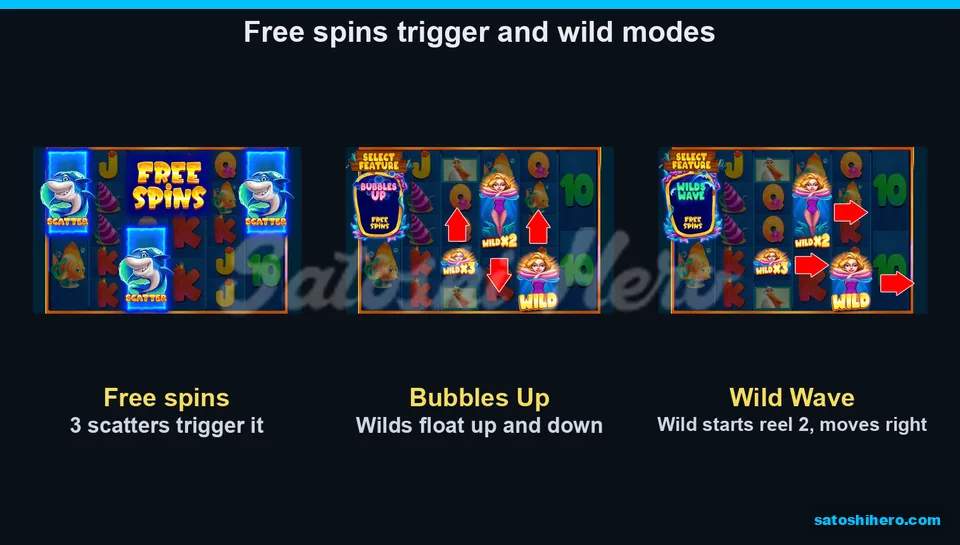
All three Shark scatters must land together on one spin. After natural or paid entry, the game asks you to select one movement style before play continues. Wild Wave moves horizontally, while Bubbles Up works vertically on one reel. That selection changes how you watch the Wild travel, not any verified return advantage.
Hot to Burn – 7 Deadly Free Spins centers its identity more directly on a free-spin sequence. Shark’s Bay instead makes the moving Wild choice the feature’s defining decision. You may prefer the former when a focused bonus theme matters more than variable reel motion. I find this game’s two-path setup more distinctive, even without enough evidence to rank its results.
Multiplier wilds
The x1, x2 and x3 Wilds multiply qualifying wins during free spins only. They also substitute for normal paying symbols, so their placement can help complete adjacent-reel combinations. Neither the rules nor my base-game test establish how often each multiplier appears. You shouldn’t assume that a low multiplier must grow on the next spin.
My session ended without a bonus, which means I recorded no average feature value or live multiplier sequence. That gap prevents a fair claim about bonus frequency from 100 spins. The simulator’s modeled feature interval describes a distribution, not my observed play. In my opinion, the mechanic sounds engaging, but documented rules can’t replace a triggered result.
Wild Wave
Wild Wave places a Wild on the second reel from the left, then shifts it one reel right after each free spin. Its size and multiplier can change while it travels across the board. My session didn’t activate this mode, so its behavior comes from the in-game rules. I like the visual logic, though movement alone never guarantees a useful symbol connection.
You can follow its path easily because it mirrors normal left-to-right win formation. Different reel positions create fresh chances for the Wild to join adjacent symbols. Changing size can cover more visible spaces, while x1 to x3 values can alter qualifying wins. You still face random symbol placement around it on every spin.
Moving wild path
The Wild begins on reel two, leaving the first reel responsible for starting standard symbol matches. Each later free spin moves it one reel toward the right edge. That visible progression gives you a simple point of focus throughout the round. To be fair, anticipation doesn’t establish payout quality, and the surrounding reels decide whether its position matters.

Footnote: Real sharks use highly developed senses to track movement underwater. Here, the Shark stays a scatter while the swimmer takes the Wild role.
Hot To Burn Multiplier makes multiplier action a broader part of its identity. Wild Wave instead ties x1 to x3 values to a traveling free-spin Wild. You may favor the former when direct multiplier branding matters most. I prefer the moving path as a visual story, but I can’t claim it produces better results.
The Wild’s changing size adds another layer because a larger image can occupy more reel positions. Its multiplier may also change, yet the rules don’t establish a fixed order. Every resulting combination remains random, even when the path looks predictable. You should enjoy the movement as presentation rather than read it as a signal.
Bubbles Up
Bubbles Up moves its Wild vertically on one reel across successive free spins. Its size and multiplier can change as the bubbles rise, creating a less linear display than Wild Wave. My test didn’t activate this mode, so I recorded no direct result. I find the vertical idea more playful, but it offers no verified mathematical edge.
You watch one reel rather than tracking a journey across the whole board. I can’t assign the mode a hit rate, average return or performance advantage. The rules establish motion, changing size and x1 to x3 multipliers, nothing more. You should choose it for its floating presentation rather than an unsupported expectation of better payouts.
Vertical wild movement
The Wild moves upward and downward within its reel from one spin to the next. As its size changes, it can cover a different amount of visible reel space. Its multiplier can shift too, but no fixed sequence guarantees growth. I like the busier animation, although it may feel less easy to track than the horizontal alternative.
Journey to the West offers a very different fantasy journey when you want character-led spectacle instead of a seaside bonus. Bubbles Up keeps attention on one floating Wild and the symbols surrounding it. The narrower focus helps the feature remain readable on tall layouts. Still, clear animation doesn’t make any combination less random.
Choosing a mode
Pick Wild Wave when you prefer an obvious horizontal progression across successive spins. Choose Bubbles Up when vertical motion and changing reel coverage hold more appeal. Neither preference demonstrates a stronger theoretical return in my test. I would try both through the free demo before risking a 40x purchase.
Frequently Asked Questions About Shark’s Bay
What does the top symbol pay in the Shark’s Bay slot?
The Pelican ranks as the top-paying regular symbol. Six Pelicans pay 7.5x the bet, five pay 3x, four pay 2x and three pay 0.75x. You may combine several winning ways in one result, although the single-symbol award remains modest. I think the paytable makes expanded layouts and features more important than one regular icon.
How many ways to win does the Shark’s Bay slot have?
The six-reel board can reach seven rows and create up to 117,649 ways. Its live count changes between spins and appears above the reels. You should follow that counter instead of searching for a fixed payline total. Taller layouts increase possible combinations but don’t promise a win.
How do free spins start in the Shark’s Bay slot?
Three Shark scatters on one spin activate free spins, or you can buy entry beside the reels. The round then offers Wild Wave or Bubbles Up. I didn’t reach either mode during my 100-spin test. You shouldn’t infer a preferred option from rules alone.
What separates Wild Wave from Bubbles Up?
Wild Wave starts a Wild on reel two and shifts it right after each spin. Bubbles Up moves its Wild vertically on one reel while size and multiplier can change. You can pick the clearer horizontal route or the more fluid vertical display. Neither choice carries a verified return advantage in this game.
What did the Shark’s Bay slot simulator project over 1,000 spins?
The median modeled session ended 84x down, with a typical range from 331x down to 314x up. About 18 of every 100 spins paid in the projection. You should read those figures as possible variation, not a prediction. The broad downside makes the risk especially clear.
What happened in the 100-spin Shark’s Bay slot test?
My play-money session finished 39.7x down, and 27 of 100 spins paid. The largest hit reached 28.8x on spin 86, while no free spins started. You would have seen a long decline before that late recovery. I found the result harsh but consistent with a volatile short run.
Which RTP and maximum win apply to the Shark’s Bay slot?
The theoretical RTP is 94.31%, volatility is high and the maximum win is 9,550x the total bet. These values describe the game’s math profile rather than your next session. You can still finish above or below the starting balance. My 100-spin loss shows why short play shouldn’t define theoretical return.
Final Word
Shark’s Bay stands out through changing reel heights and two moving-Wild bonus choices. Its clear underwater art can’t hide severe swings. You need patience for low-value hits and long stretches without a feature.

My Verdict
Try the free demo if you can accept sharp balance movement. Expect modest connections, uncertain bonus access and occasional stronger lifts rather than steady returns.
I like the live counter, readable symbols and contrasting Wild movement. Still, I don’t like how 27 paying spins ended 39.7x down without a bonus. The untested 40x purchase leaves too little evidence for recommending either mode.
The Shark’s Bay slot delivers stronger mechanics than its familiar theme suggests, but careful stake sizing matters from the first spin. Its recorded specifications are checked regularly for accuracy.

Pros:
 Changing ways: Expanding reels create up to 117,649 possible combinations.
- Clear interface: Distinct symbols and a live counter simplify each shifting layout.
- Bonus choice: Two moving-Wild styles give free spins different visual rhythms.
- Multiplier Wilds: x1, x2 and x3 Wilds can strengthen qualifying bonus wins.

Cons:
 Lean return: The 94.31% theoretical figure leaves little room for weak sessions.
- Severe swings: High volatility can produce long, costly dry spells.
- Expensive entry: One feature purchase consumes 40 base-spin stakes immediately.

Best For: Patient variable-ways fans who enjoy moving Wilds and can budget for uneven results fit this game. Small-bankroll players or anyone seeking frequent bonus access may find the swings uncomfortable.
































































Bets
All Bets
Game
Player
Date
Wager
Mult.Multiplier
Prize
 Galaxy Glitter
 nina87
- 12:21:24
- 0×
- Elephant's Gold: Bonus Combo
- mike_721
- 12:21:24
- 0×
- Fortune Skulls
 mdp0fxo
- 12:21:24
- 0×
- San Chong Baozha Blue: Bonus Combo
- Hidden
- 12:21:22
- 0×
- Fortune Skulls
- mdp0fxo
- 12:21:21
- 0×
- Fortune Skulls
- mdp0fxo
- 12:21:18
- 0.4×
- Royal Fruits 9: Hold 'n' Link
 blazecraft
- 12:21:17
- 0×
- Red Hot 50
 mbongigycolombe
- 12:21:15
- 0×
- Red Hot 50
- mbongigycolombe
- 12:21:14
- 0×
- Red Hot 50
- mbongigycolombe
- 12:21:12
- 0×