

Leprechaun's Gold
By pressing play, you agree that you are above legal age in your jurisdiction and that your jurisdiction allows online gambling.


Chasing Fortune Through the Mossy Glade
Spin Leprechaun’s Gold slot and you get a high-volatility, 5×3 fixed-payline game from Zillion Games, tested directly at a $2.00 stake.
Leprechaun’s Gold is a high volatility slot with a 96.11% RTP, 10 fixed paylines, and 907x maximum win potential. It targets fans of simple line mechanics, natural bonuses, and sharp swings. My 100-spin test ended 13.8x down, peaked at a 32.4x win, and never reached free spins.
Key Takeaways
- Best bonus: Free spins require three natural scatters because you can’t buy the feature.
- RTP / volatility: The official figures pair 96.11% RTP with high volatility.
- Max win: The 907x cap feels modest beside the game’s severe balance swings.
- Risk note: Fairy Luck doubles only a winning line containing both the fairy and wild.
- Bankroll note: Set a limit because my balance fell 24x before a 32.4x recovery.

Table of Contents
- How the Leprechaun’s Gold slot Works
- Line Win Rules
- Theme and First Impressions
- Symbol Values and Line Payouts
- High-Paying Symbols
- Card Symbol Returns
- Wild, Scatter and Maximum Win
- Wild Payouts
- Scatter Prizes
- Fairy Luck
- What 100 Spins Actually Felt Like
- Biggest Session Swing
- Small-Win Pattern
- Free Spins
- Trigger Conditions
- Triple Prizes
- RTP, Volatility and Test Results
- Simulator Projection
- Our 100-Spin Session
- Leprechaun’s Gold slot FAQ
- Final Word
How the Leprechaun’s Gold slot Works
Leprechaun’s Gold slot uses a 5×3 grid and 10 fixed paylines. Standard wins begin on the leftmost reel, then continue across adjacent reels on one active line. The pot-of-gold scatter ignores those line positions and pays anywhere. You should treat that as a separate rule, not a different ways-to-win system.
The paytable states prizes against the smaller line bet. I converted those figures into total-bet multiples, which makes each result easier to judge. Beneath the reels, a simple control bar shows your stake and FUN balance. The same clean arrangement remains readable across desktop and mobile screens, although the design feels functional rather than ambitious.
You can try the demo or real play on SatoshiHero. My $2.00 test began with a $10,000,000.00 FUN balance. No bonus buy or gamble option appeared.
Line Win Rules
Read every highlighted payline from left to right. For example, four Aces formed a valid combination when matching positions continued across neighboring reels from the first reel. That line returned $20.00 from my $2.00 total stake, equal to 10x. Fairy Luck changed this result because the same line also held a wild and fairy.
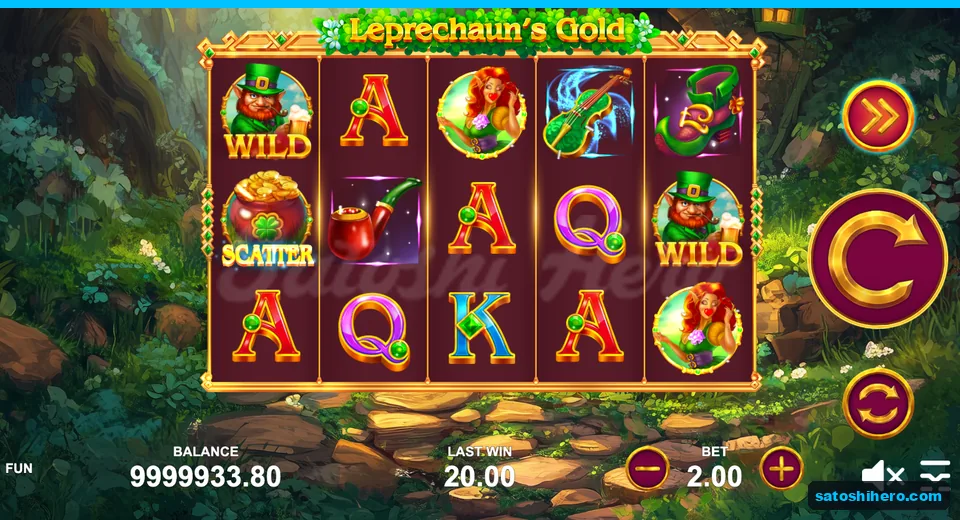
A highlighted path tells you which symbols formed the win. It doesn’t mean every visible match contributed, so check each marked route separately. You also shouldn’t compare a line-bet paytable number directly with your total stake. In my view, that conversion is the only mildly awkward part of an otherwise clear setup.

Metric: This is a genuine 10-payline game, not a ways, cluster, or pay-anywhere slot.
Once you convert each result, the mechanics become pleasantly direct. Judge every displayed prize against your total stake rather than the smaller line bet.
Theme and First Impressions
The Irish forest setting looks familiar, coherent, and easy to read during play. A mossy glade surrounds the reels, while a cobbled path crosses beneath them. Behind the grid, you see a round cottage door and glowing lantern. The scene won’t win originality awards, yet its restraint helps each symbol stand apart.
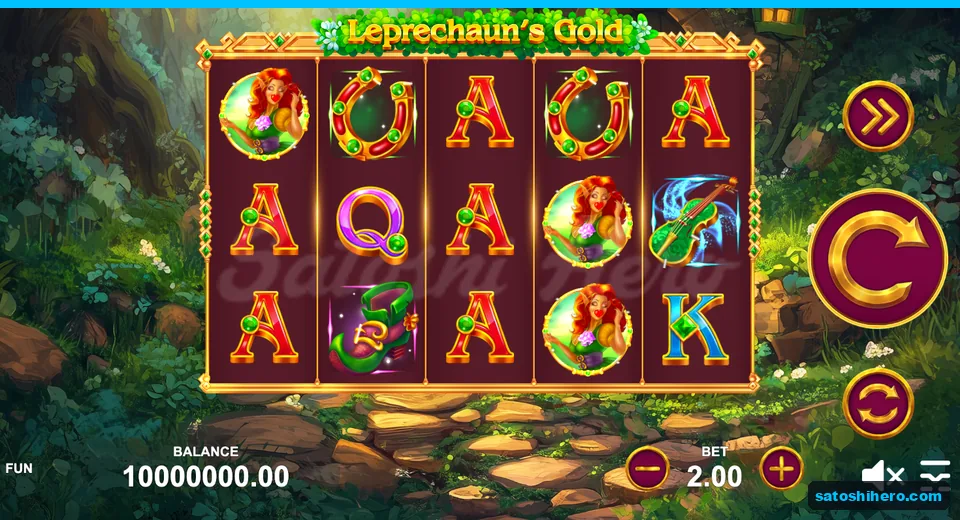
A grinning leprechaun carries a pipe and pint as the wild. The pot of gold serves as the scatter, while a red-haired fairy acts as a premium symbol and powers Fairy Luck. You can identify all three quickly, even when a line animation flashes over them. I value that clarity because busy artwork often hides why a payout occurred.
Rainbow Gold offers another light-hearted mix of folklore, rainbows, and treasure imagery if that mood appeals to you. Other gold-themed visual alternatives include Wolf Gold, Pirate Gold, Mustang Gold, and Gold Train. This comparison concerns theme alone, since Leprechaun’s Gold slot builds its own identity around a woodland cottage. The visual direction remains conventional, but it never becomes messy or hard to scan.
Traditional folklore depicts leprechauns as solitary tricksters guarding hidden treasure. You notice those cues before spinning, although the game takes few creative risks.

Footnote: Irish folklore links leprechauns with guarded treasure and mischievous bargains, which explains the hidden woodland-gold setting.
Clear symbols matter on a compact 10-line grid. Here, the presentation favors quick recognition over novelty, and that choice supports the straightforward format.
Symbol Values and Line Payouts
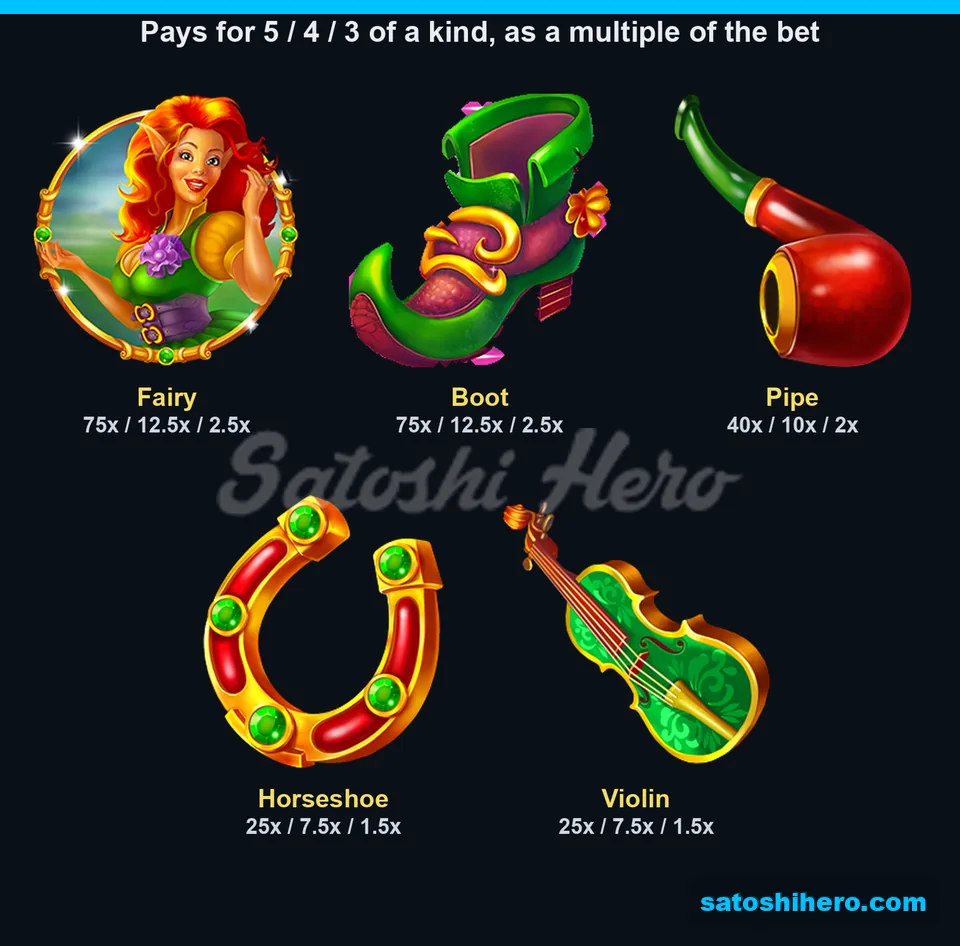
The fairy and boot are the strongest regular symbols, while the leprechaun wild delivers far larger line prizes. Every value below uses a multiple of the total bet after conversion from the line-bet table. You can compare them directly with any chosen stake. I find this format far more useful than reproducing the game’s smaller line-bet figures.
High-Paying Symbols
- Fairy and boot: 75x for five, 12.5x for four, 2.5x for three, and 0.2x for two.
- Pipe: 40x for five, 10x for four, and 2x for three.
- Horseshoe and violin: 25x for five, 7.5x for four, and 1.5x for three.
The fairy keeps its normal payout role even when no wild appears beside it. Its feature function doesn’t replace the standard symbol prize. The boot matches every regular fairy value, making both symbols equally important for line value. You need either one across several reels before a base-game return starts feeling substantial.
The hierarchy is clear, but three-symbol premium wins remain small. High symbols can appear without repairing a deeper drawdown.
Card Symbol Returns
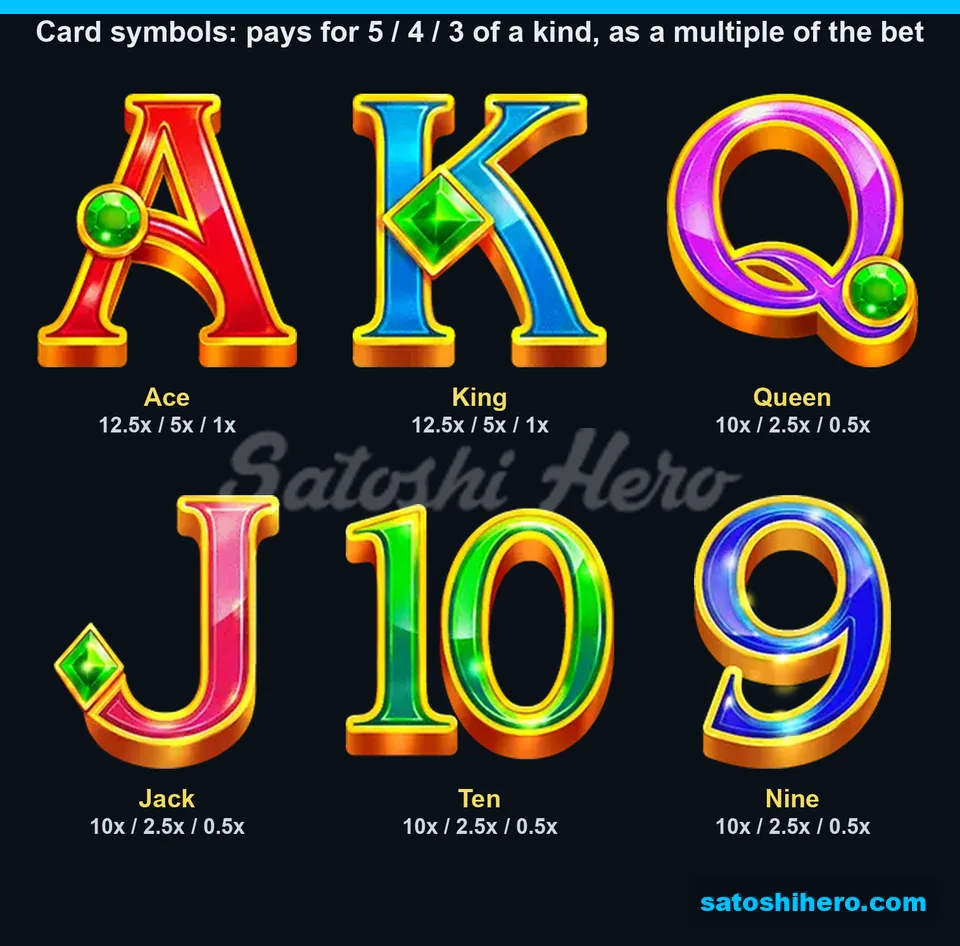
- Ace and King: 12.5x, 5x, and 1x for five, four, and three.
- Queen, Jack, and Ten: 10x, 2.5x, and 0.5x across those same match lengths.
- Nine: 10x, 2.5x, and 0.5x, plus 0.2x for two.
These lower symbols produce many modest base-game returns. Most paying spins in my session returned less than 4x. Your balance can move often without gaining meaningful ground.

Recommendation: The original paytable uses line-bet values. Use these total-bet multiples when judging the practical size of a payout.
Low symbols keep the reels active, though they rarely change a difficult session alone. You need premium combinations, wilds, or feature help to move beyond the frequent small returns.
Wild, Scatter and Maximum Win
The game’s overall maximum win is 907x the bet, while a five-wild payline has a 900x symbol-table payout. Those figures describe different limits: one belongs to a symbol combination, while the other caps the complete result. You shouldn’t treat the 900x line value as a separate headline ceiling. I consider 907x restrained for a game built around sharp risk.
The leprechaun wild substitutes for every symbol except the scatter. That flexibility can complete ordinary line wins, support premium combinations, or activate Fairy Luck beside a fairy. The pot-of-gold scatter follows its own anywhere-pay rule. You can land it outside the leftmost reel and still receive its listed prize.

Wild Payouts
- Five wilds on one payline pay 900x.
- Four wilds pay 250x.
- Three wilds pay 25x.
- Two wilds pay 1x.
The five-wild pattern sits at the top of the wild symbol’s paytable. The steep jump from 250x to 900x gives the symbol genuine headline weight, although reaching that top pattern demands a very specific line. On one hand, wild substitution improves many normal combinations. The trade-off is that most wild-assisted wins won’t approach the top line prize.
A wild can complete an Ace line without paying its own 25x three-symbol award. Check the highlighted route before judging its contribution.
Scatter Prizes
- Five scatters pay 500x.
- Four scatters pay 20x.
- Three scatters pay 5x and trigger free spins.
Scatter wins don’t need leftmost or adjacent positions. Three symbols can pay and open the bonus anywhere. I like the clean rule, though the overall cap limits its upside.
Risk appetite should guide your decision here. The wild offers exceptional line value, but its ceiling can feel low beside the accepted risk. Fans of bounded outcomes could tolerate that compromise.
Fairy Luck
Fairy Luck doubles a winning line only when that line contains both a fairy and wild. A fairy without a wild behaves like an ordinary paying symbol. You must inspect the highlighted line rather than the whole grid, because symbols elsewhere don’t qualify. I think this condition adds character without making the base game hard to understand.
I observed Fairy Luck on a four-Ace line during a spare spin after my recorded 100-spin test. The combination returned $20.00 from a $2.00 stake, equal to 10x the total bet. A x2 badge appeared over the fairy while the qualifying route stayed lit. That clear visual confirmation made the multiplier easy to verify.
I kept that spare-spin result outside the counted totals. It confirmed the mechanic without changing my recorded 13.8x loss.
Only the qualifying line receives the doubling effect. Other wins keep normal values unless they independently meet the same condition.
A fairy still carries strong regular values, so it isn’t wasted without the feature. Yet Fairy Luck needs a precise overlap among a valid line, a wild, and that fairy. You should view it as helpful base-game support, not a dependable rescue mechanism. In my opinion, this is the game’s most distinctive idea despite its limited scope.
The feature gives ordinary line wins a welcome twist. Its exact symbol condition keeps that extra value occasional rather than constant.
What 100 Spins Actually Felt Like
My 100-spin session finished 13.8x down despite 30 spins returning a prize. I started with a $10,000,000.00 FUN balance and used $2.00 per spin. The final balance reached $9,999,972.40, a $27.60 loss. You can see why paying-spin count alone says little about whether a session finished ahead.
Most wins returned less than 4x, so repeated small payouts couldn’t sustain the balance. Free spins never triggered during the recorded run. The action didn’t feel completely dry, but much of it lacked enough force to offset accumulated stakes. I found that contrast more revealing than the raw count of 30 paying spins.
Biggest Session Swing
By spin 35, my balance sat 24x below its starting point. Spin 36 then produced $64.80, equal to 32.4x my stake. That single hit pushed the session to 7.4x above its opening balance. The recovery felt dramatic because it erased the entire early decline at once.
The improvement didn’t hold. Much of the second half sat between 2x and 14x below the start. Don’t raise your stake after one turnaround, because each spin remains independent.
The 32.4x payout reversed a difficult stretch, but ordinary outcomes erased that lead. You need discipline to avoid treating recovery as proof conditions improved.
Small-Win Pattern
Thirty paying spins created regular flashes of activity, yet most returns stayed below 4x. A payout smaller than the stake still appears as a win animation, while modest profits rarely rebuild a deep deficit quickly. You should watch the balance rather than count celebrations. That habit gives a more honest picture of performance.
The base game carried the full session because no feature round appeared. Its 32.4x peak felt memorable, but the surrounding pattern remained unrewarding.
Set a preset spin count or loss ceiling before you begin. My test fell 24x before recovering, and chasing that recovery with larger stakes would have increased exposure. The session felt active at points, but its small-win structure still ended in a clear loss.
Free Spins
Three scatters trigger free spins, and every prize during the round pays at triple value. The bonus keeps the same stake used on the triggering spin. Since Leprechaun’s Gold slot offers no bonus buy, you must land the scatters naturally. I like the simple enhancement, though the lack of direct access demands patience.
No free spins appeared during my 100 recorded spins. That absence means I can confirm only the written trigger, retained stake, and 3x prize rule. I won’t invent a spin count, retrigger condition, or hidden multiplier behavior. You deserve a clear boundary between a documented rule and something I personally observed.
Trigger Conditions
Three pot-of-gold scatters can activate the round from any positions. They don’t need adjacent reels or a leftmost starting point because scatter evaluation ignores paylines. The trigger also pays 5x under the standard scatter table. That dual outcome gives the entry spin some value before bonus prizes begin.
Natural triggering changes how you should budget a session. A short run can end without the required symbols, just as mine did. Raising your stake won’t help the trigger, yet it makes every miss more expensive.
With no purchase route, a traditional trigger preserves anticipation but can make waiting frustrating. Choose a stake that remains comfortable if the bonus never arrives.
Triple Prizes
Every prize inside free spins receives the 3x treatment. The rule enhances regular symbol, wild, and scatter results within the round, but it doesn’t guarantee a profit. A triple-value small win can remain small relative to the cost of reaching the feature. I find the modifier appealing because it’s clear, not because it promises a particular outcome.
The triggering stake remains throughout the feature, so you can’t increase it after entry. Your initial stake should fit the bankroll available for natural triggering.
Leprechaun’s Gold slot gives the bonus one direct advantage rather than layers of extra rules. The 3x treatment is meaningful, but access depends entirely on three scatters. Patience and stake control matter more than feature-chasing here.
RTP, Volatility and Test Results
The 96.11% RTP represents the game’s theoretical return, while high volatility permits sharp short-session swings. Its 907x win cap keeps the top end relatively contained despite that uneven risk. My observed balance path matched the broad feel of volatility, but one test can’t validate the published math. You should read the live and modeled results as context, not promises.
I separate simulator projections from played results because they answer different questions. That comparison gives you a fairer risk picture.
Simulator Projection
The SatoshiHero Slot Simulator produced a median result of 68.7x down across its 1,000-spin model. Its typical range stretched from 313.0x down to 308.1x up. That wide spread shows how far sessions can separate even under the same inputs. You shouldn’t read either edge as a target or fixed boundary.
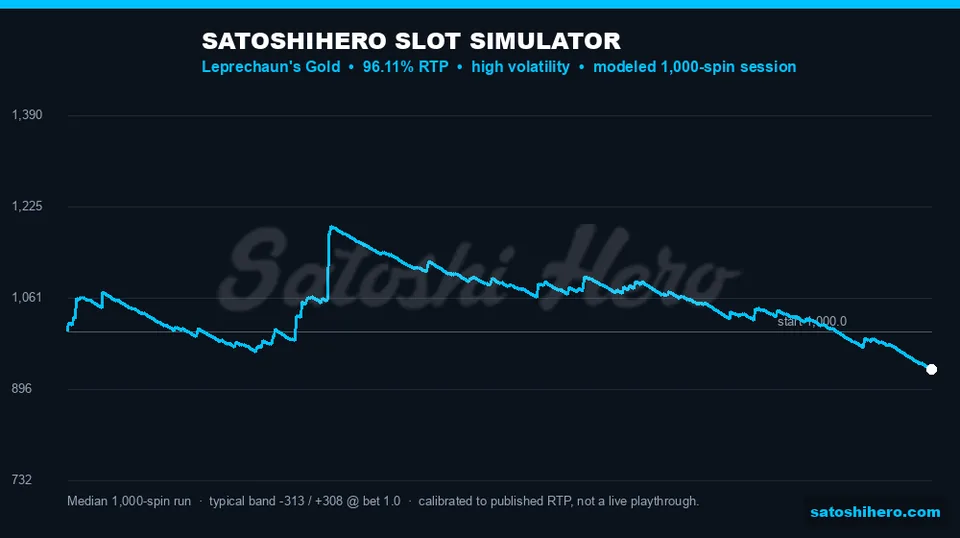
The model estimated about 18 paying spins per 100. It placed a feature round roughly once every 46 spins and a 100x win around once every 1,623 spins. These frequencies are projected averages, not schedules. Your chosen session could contain several features or none.
The spread captures uneven upside and substantial downside. I find it most useful as a warning against expecting a smooth path.
Our 100-Spin Session
My live run lost 13.8x across 100 spins. Thirty spins returned prizes, the largest logged win reached 32.4x on spin 36, and free spins never triggered. Those results differed from the model’s projected paying-spin rate and feature frequency. You should expect your own sequence to differ from both samples.
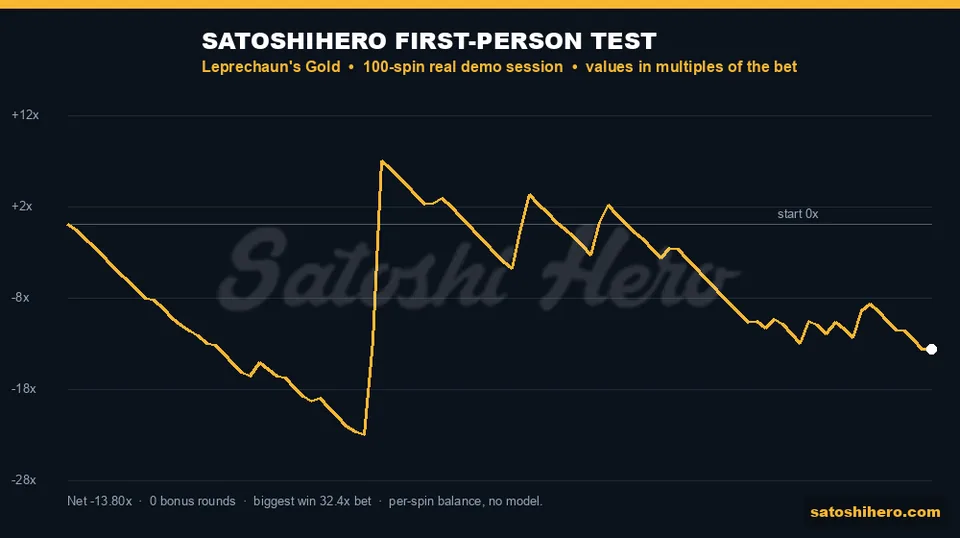
The early 24x decline, sudden profit, and final slide created a jagged balance path. That sequence felt consistent with the risk label without proving other outcomes. I don’t regard 100 spins as enough to judge the theoretical percentage.

Caveat: High volatility can produce deep or prolonged drawdowns. The theoretical RTP won’t protect a short bankroll.
The theoretical RTP is the operator’s published mathematical figure, and one live session doesn’t alter it. Simulator frequencies remain projections rather than guaranteed trigger intervals, while base-game and feature returns can differ by design when mode-specific figures apply.
Uneven outcomes define the practical experience more than the clean headline percentage. This slot favors readers comfortable with swings rather than anyone seeking steady returns.
Frequently Asked Questions
What does the leprechaun wild pay in the Leprechaun’s Gold slot?
Five wilds pay 900x, four pay 250x, three pay 25x, and two pay 1x. The wild also substitutes for every symbol except the pot-of-gold scatter, supporting both substitution wins and direct wild payouts.
How does Fairy Luck work in the Leprechaun’s Gold slot?
Fairy Luck doubles one winning line when that line contains both a fairy and wild. I observed four Aces return $20.00, equal to 10x my $2.00 stake, while a x2 badge marked the fairy.
How do you trigger free spins in the Leprechaun’s Gold slot?
Three scatters trigger free spins at the same stake as the activating spin. All prizes during the round receive triple value, although no trigger appeared during my 100-spin test.
How many paylines does the Leprechaun’s Gold slot have?
The game uses 10 fixed paylines across a 5×3 grid. Standard line wins run left to right through adjacent reels and must begin on the leftmost reel.
What are the RTP, volatility and maximum win in Leprechaun’s Gold?
The Leprechaun’s Gold slot has a 96.11% RTP, high volatility, and a 907x maximum win. These figures pair uneven risk with a restrained ceiling.
What happened during the Leprechaun’s Gold 100-spin test?
My $2.00-stake session finished 13.8x down after 100 base spins. The largest logged win reached 32.4x on spin 36, while free spins didn’t trigger.
What did the Leprechaun’s Gold 1,000-spin simulator project?
The model projected a 68.7x median loss and a typical range from 313.0x down to 308.1x up. You could see different timing because features averaged one per 46 spins and 100x wins one per 1,623 spins.
Final Word
Leprechaun’s Gold pairs readable fixed lines with Fairy Luck and triple-value free spins. Its restrained top prize remains the main drawback. You get clarity, but not enormous potential.

My Verdict
Traditional line-slot fans with firm limits should appreciate the clean rules and visible feature conditions. Expect small returns, sharp recoveries, and bonus rounds that can remain absent during short play.
I like how Fairy Luck clarified my $20.00 four-Ace result. I don’t like that 30 paying spins still left me 13.8x down without free spins. The 32.4x peak couldn’t hold the balance above its start.
This Leprechaun’s Gold slot guide is checked regularly, including its paytable conversions, simulator context, and direct test notes. You can use those details to decide whether bounded upside and sharp swings match your budget.

Pros:
 Clear paylines: Ten fixed lines make every highlighted result easy to trace.
- Distinctive multiplier: Fairy Luck can double qualifying wild-and-fairy line wins.
- Strong wild value: Five wilds offer a substantial 900x single-line prize.
- Readable design: Clean symbols prevent the woodland artwork from hiding outcomes.

Cons:
 Restrained ceiling: The 907x cap feels modest beside the uneven risk.
- No bonus buy: Free spins depend entirely on landing three natural scatters.
- Small-win drag: Frequent low returns can mask a steadily falling balance.

Best For: Patient fixed-line fans who value readable rules, natural triggers, and controlled top-end potential. You need firm limits because small wins might not protect your balance.



































































Bets
All Bets
Game
Player
Date
Wager
Mult.Multiplier
Prize
 Mardi Gras Queen
 Hidden
- 12:19:22
- 0×
- Luck of Panda: Bonus Combo
 Hidden
- 12:19:21
- 0×
- Fortune Skulls
- mdp0fxo
- 12:19:21
- 0×
- Galaxy Glitter
 nina87
- 12:19:20
- 0.67×
- Mardi Gras Queen
- Hidden
- 12:19:19
- 0.04×
- Royal Fruits 9: Hold 'n' Link
 Hidden
- 12:19:18
- 0×
- San Chong Baozha Blue: Bonus Combo
- Hidden
- 12:19:18
- 0.29×
- Fortune Skulls
- mdp0fxo
- 12:19:18
- 0×
- Fortune Skulls
- mdp0fxo
- 12:19:15
- 0×
- Galaxy Glitter
- maya_81
- 12:19:14
- 0×