

15 Coins Grand Gold Edition
By pressing play, you agree that you are above legal age in your jurisdiction and that your jurisdiction allows online gambling.


Hunting Five Coins on the Midnight Board
15 Coins Grand Gold Edition turns every spin into a hunt for five middle-row coins and the Hold the Jackpot feature.
15 Coins Grand Gold Edition is Voltent’s high volatility slot, pairing a midnight coin-collection theme with 96.18% RTP and 2,000x maximum win potential. Its 3-row by 5-column board targets sticky-symbol fans who accept frequent spins without returns. SatoshiHero offers demo and real play. My 100-spin demo test used a $1.00 default bet and measured pacing rather than future results.
Key takeaways
The core experience is easy to grasp, but its bonus-only payout model demands patience and disciplined staking. The test tracked ordinary base-game play rather than a purchased feature, so its results reflect the same trigger process available with Chance Level off. That distinction matters because the balance moved only when Hold the Jackpot started, leaving no smaller line wins to soften the gaps.
- Best bonus: I tested base-game play with Chance Level off, and I didn’t purchase a bonus.
- RTP / volatility: The 96.18% theoretical return and high volatility create an uneven session profile.
- Max win: Filling all 15 cells awards the 2,000x GRAND instead of the displayed board total.
- Risk note: Two bonuses paid 29x and 47x, yet my 100 spins finished 3.0x down.
- Bankroll note: Every non-triggering spin returns nothing, so you need room between features.

Table of Contents
- Theme and first impressions
- Visual presentation
- First session feel
- How 15 Coins Grand Gold Edition works
- Coin values
- Mystery symbols
- Sticky to Infinity
- Sticky coin behavior
- Changing your settings
- Hold the Jackpot bonus
- Trigger and respins
- Prize calculation
- Chance Level
- Cost and trigger chance
- Tested setting
- Buy Feature and play controls
- Bonus purchase menu
- Speed and Gamble
- What happened over 100 spins
- Session conditions
- Bonus results
- RTP, volatility and test data
- Simulator projection
- Our 100-spin session
- Frequently asked questions
- Final Word
Theme and first impressions
The sparse, dark coin board makes the collection objective clear within your first spin. Gold and red coins carry the visual weight, while four jackpot plaques establish the goal above the cells. The presentation keeps open positions prominent, so you can distinguish locked symbols from cells that remain available during respins. Readers comparing other board sizes in the same series can also consult 12 Coins Grand Gold Edition, 16 Coins Grand Gold Edition and 20 Coins Grand Gold Edition.
Visual presentation
A midnight-blue board sits against a deep magenta background, with a faint “15” emblem behind each position. MINI, MINOR, MAJOR and GRAND plaques line the top edge. Because all 15 cells spin independently, the grid looks more like a prize board than conventional reel strips. The contrast between the dark cells and bright symbols also makes landed values readable without crowding the screen with decorative objects.
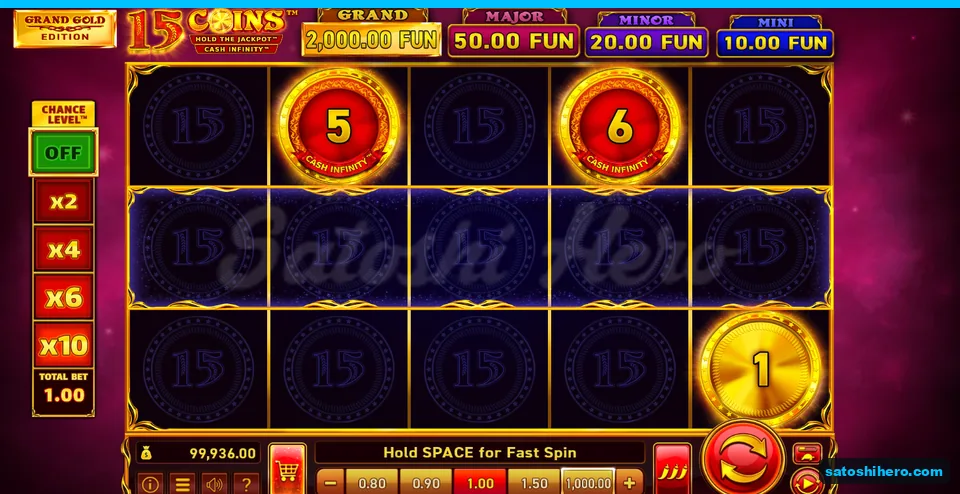
Limited symbol variety keeps your eyes on Cash, Cash Infinity and jackpot coins. On one hand, the clean design makes every useful position easy to identify. The trade-off is a theme that won’t win originality awards, even though its execution stays readable on desktop and mobile screens. In the captured base-game frame, the 5x and 6x red symbols remain distinct from the gold Cash symbol in the lower corner, while the jackpot plaques provide an immediate reference for the fixed prizes.

Footnote: Gold coin imagery has represented stored value across many cultures, which makes the collection theme instantly readable. The presentation uses that familiar idea without building a deeper story around it.
First session feel
Each cell stops in its own rhythm, creating scattered movement across the board. You quickly notice that the middle row matters more than decorative motion elsewhere. During my test, two red Cash Infinity coins remained on the top row for long stretches while the other positions kept changing. Their persistence made consecutive spins feel connected even when the balance registered another full-stake loss.
Those sticky 5x and 6x coins created more tension than the many non-triggering spins around them. I could see potential value waiting, but neither coin paid before a bonus finished. To be fair, that delayed promise gives the sparse base game its strongest visual hook. It also clarifies the central risk: a visible amount is only pending value until the required middle-row trigger starts the feature and the round reaches its settlement.
My demo opened with a $100,000.00 play-money balance and a $1.00 default bet. I ended the counted run at $99,997.00 after two bonus rounds, then excluded later screenshot spins from every result. The design feels functional rather than elaborate, and you’ll know quickly whether that narrow focus appeals. The large play-money balance removed practical budget pressure from the test, but I still tracked the one-bet declines because they reveal how the game behaves between bonus rounds.
How 15 Coins Grand Gold Edition works
The slot has no paylines or ordinary symbol wins, so a spin pays only after starting Hold the Jackpot. Its 3-row by 5-column grid contains 15 independent reels, with each cell generating its own outcome. A normal spin without five middle-row Bonus symbols returns $0. This means a gold value appearing outside a completed feature isn’t equivalent to a conventional reel win, even though the amount remains visible on its symbol.
You should judge each spin by trigger potential and useful sticky positions, not matching combinations. Bonus symbols receive their value only when the feature finishes. The browser layout keeps the same board and core controls across desktop and mobile screens, which makes switching devices straightforward. With no paylines to inspect, the practical information is concentrated in three places: the middle-row trigger, retained Cash Infinity positions and the respin counter once the feature starts.
Coin values
The paytable uses bet multipliers rather than conventional symbol combinations. Every amount scales from the selected stake, so a value such as 5x describes the same proportional prize at any permitted bet. That multiplier format also makes the screenshots comparable with the test record even though the demo displays dollar-denominated play money:
- Gold Cash coins pay 1x to 10x the bet.
- Red Cash Infinity coins pay 5x to 15x.
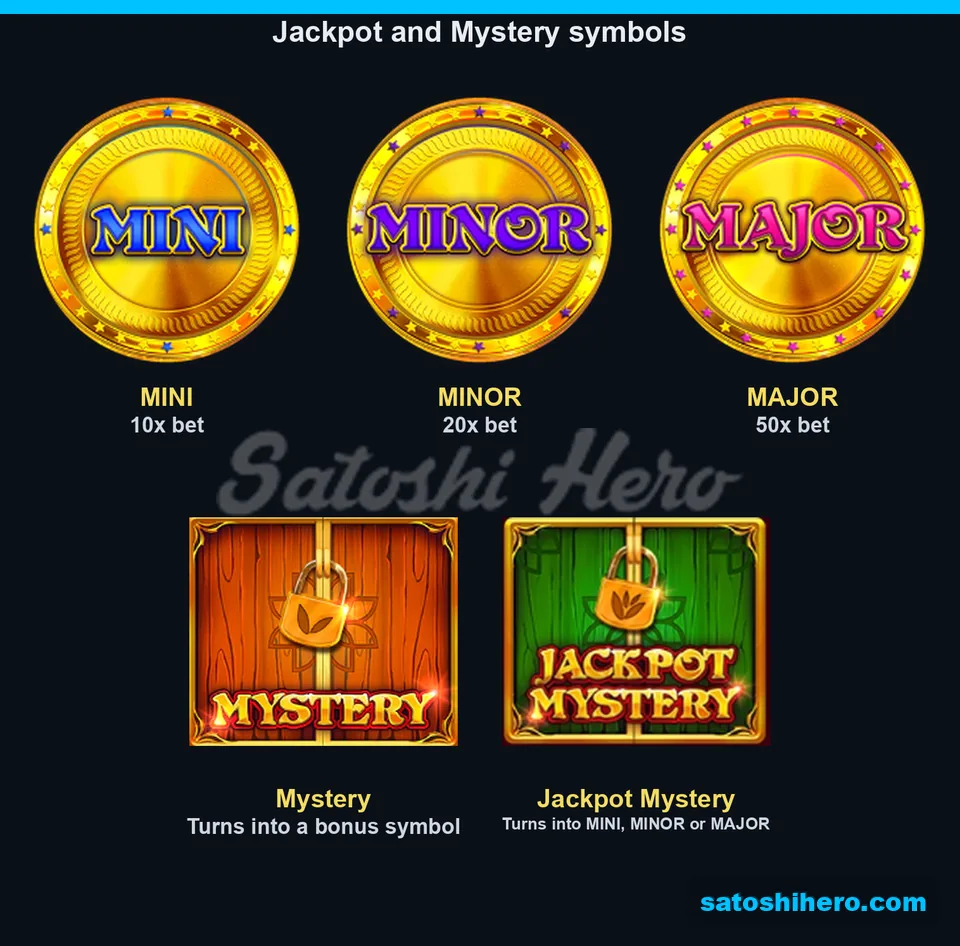
- MINI pays 10x.
- MINOR pays 20x.
- MAJOR pays 50x.
- GRAND pays 2,000x when all 15 cells fill.
- Collector combines Cash and Cash Infinity values, then applies a random 1x to 20x multiplier.
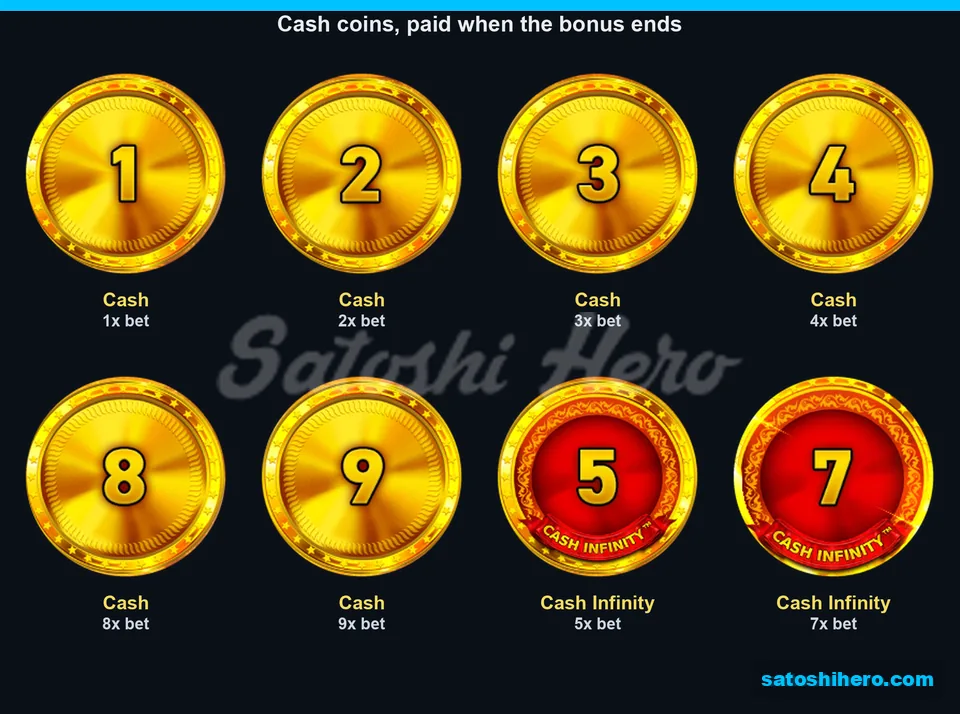
At my $1.00 setting, I saw gold Cash values of $1, $2, $3, $4, $5, $8 and $9. Red Cash Infinity symbols appeared at $5, $6, $7 and $13. I didn’t land a Collector, so its behavior comes from the in-game rules rather than my played result. According to Voltent’s in-game rules, that symbol combines the relevant Cash amounts before applying its multiplier, rather than multiplying every jackpot prize on the board.
Mystery symbols
According to Voltent’s in-game rules, Mystery can transform into any Bonus symbol except Cash Infinity. Jackpot Mystery has a narrower range and may reveal MINI, MINOR or MAJOR. Both types open individually when the feature ends, making the final count more suspenseful than the base spins. The staged reveal also prevents you from knowing the complete payout while unrevealed planks remain on the settled board.
A full board changes the calculation completely. It awards the GRAND instead of adding every displayed symbol value together. You need to separate visible coin amounts from settled prizes, since nothing becomes payable until Hold the Jackpot concludes. This replacement rule is important when assessing a nearly complete grid because the value of the final open position includes the possibility of converting the whole board into the fixed top award.
Sticky to Infinity
Cash Infinity coins can land before the bonus and remain locked until the next Hold the Jackpot round ends. Unlocked cells continue producing random outcomes while those occupied positions stay fixed. The sticky coins add anticipation, but they don’t create immediate base-game payouts. They instead preserve a symbol and its stated multiplier for the next feature attached to the same setting.
Sticky coin behavior
Two Cash Infinity coins occupied my top row for long stretches. Seeing them survive spin after spin gave an otherwise empty sequence a sense of continuity. Yet top-row positions don’t help complete the required middle-row trigger, so their presence looked more promising than it actually was. They contributed stored value if the feature began, but they couldn’t replace either of the five middle-row symbols needed to start it.
A sticky Cash Infinity coin on the middle row improves your chance of forming the five-symbol trigger row. Its 5x to 15x value joins the payout only after the bonus ends. You still need the remaining middle cells to cooperate, and every unlocked cell continues to resolve randomly. A retained middle position therefore has two roles: it carries a pending prize and reduces the number of fresh middle-row symbols required on a triggering spin.
The mechanic creates tension between stored value and delayed access. Visible coins may sit there while your balance keeps falling one stake at a time. That separation between what appears on the board and what reaches the balance is the defining feature of base play. It can make a promising screen feel active even when the immediate financial result remains $0.
Changing your settings
Changing the bet or Volatility Level hides sticky coins connected to the previous setting. Restore that level and those symbols return to their original positions. You should inspect the board before adjusting either control, especially when a valuable coin occupies the middle row. The hidden symbol hasn’t converted into a payout or moved elsewhere; it remains associated with the configuration on which it first appeared.

Recommendation: Check your current bet and Volatility Level before switching settings. Visible sticky coins remain tied to the level where they landed.
This isn’t evidence of a hot or cold setting. It simply means each configuration preserves its own useful positions. In my view, leaving a middle-row sticky coin behind makes little practical sense unless the new stake better protects your budget. A lower affordable setting can still be the sounder choice when continuing at the original level would leave too few spins for the feature to develop naturally.
Hold the Jackpot bonus
Five Bonus symbols across the middle row trigger three respins, and every new symbol resets the counter. All existing Bonus symbols lock when the round begins. The feature ends when the counter reaches zero or all 15 positions fill. Symbols already retained through Sticky to Infinity enter the round as occupied cells, while every remaining position continues to search for another qualifying symbol.
Trigger and respins
The bonus keeps the same bet and Volatility Level as its triggering spin. Introductory slides preview Mystery transformations and show the Collector multiplying a board total. Once play starts, you should watch open cells, the remaining respins and any unrevealed Mystery symbols. Those three details explain both how long the round can continue and which parts of the eventual total remain unknown.
Each new Bonus symbol restores three respins rather than adding three to the current count. That distinction keeps the round easy to follow. I found the reset rhythm effective because a late coin can revive a board that looked one spin from ending. Several empty respins can still finish the feature quickly, so the locked values don’t guarantee that many additional positions become occupied.
The first feature started on spin two during my counted session. It paid $29, or 29x my $1.00 bet, after all values settled. That early trigger softened the opening, though it didn’t make the later empty stretches feel less severe. Because it arrived so quickly, the result also showed how a positive early balance can still erode when ordinary spins have no independent payout route.
Prize calculation
The final total includes Cash and Cash Infinity values plus MINI, MINOR and MAJOR prizes. Repeated copies of the same jackpot can contribute separately. Collector effects apply to the relevant combined Cash total, while Mystery and Jackpot Mystery symbols reveal one at a time. The total therefore remains provisional until every reveal and collection animation has completed.
My second feature arrived around spin 40 and paid $47, the largest return in the test. Both bonuses felt meaningful because ordinary spins couldn’t pay anything. Still, those results describe my session only and shouldn’t be treated as a typical bonus average. The larger round recovered many preceding losses, but it didn’t change the underlying pattern of full-stake declines whenever the middle row failed to trigger another feature.
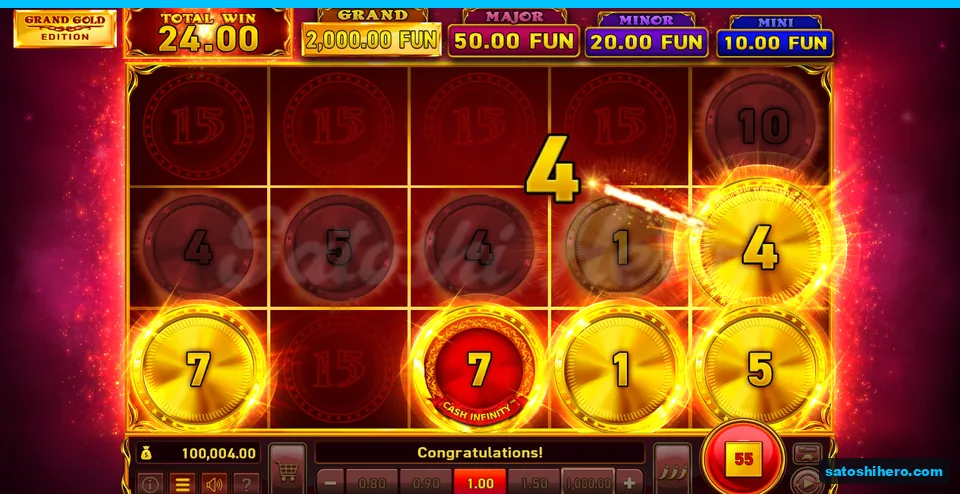
Filling every position replaces the visible board calculation with the 2,000x GRAND. The game doesn’t add individual coin and jackpot values on top. That rule makes a full board simple to settle, although the cap feels modest beside the risk and long empty stretches. It also means the displayed running total isn’t the final basis for payment if the last open cell fills before the respins expire.

Metric: Filling all 15 cells awards the GRAND instead of adding 2,000x to the other board values. You receive the fixed top prize for that completed board.
Chance Level
Chance Level raises the Hold the Jackpot trigger chance by increasing the total stake in the same proportion. It changes neither Cash values nor jackpot amounts. You pay more for greater feature probability, not richer symbols. The selected multiplier therefore changes session speed and exposure without altering what a displayed 5x, MINI or MAJOR symbol is worth relative to the base bet.
Cost and trigger chance
The available settings are simple. Each option connects a proportional stake increase with the same proportional increase in trigger chance, leaving the underlying symbol ranges unchanged:
- Off uses the base stake and standard trigger chance.
- x2 costs twice the stake for twice the trigger chance.
- x4 costs four times the stake for four times the trigger chance.
- x6 costs six times the stake for six times the trigger chance.
- x10 costs ten times the stake for ten times the trigger chance.
A higher setting isn’t an automatic improvement because your budget also drains faster. You should compare the extra cost with the number of spins you can afford. On one hand, more trigger opportunities can reduce the wait; the trade-off is far greater exposure on every failed spin. Since a non-trigger still returns $0, the highest option can remove ten base stakes from the balance in the same single-spin interval.
Tested setting
I kept Chance Level off throughout all 100 counted spins. That choice ties the 29x and 47x results to ordinary base-game play. I can’t make performance claims about the higher settings because I didn’t test them. Keeping the control unchanged also prevented a boosted stake from complicating comparisons between the opening balance, the two feature returns and the final result.
Higher trigger frequency doesn’t remove the uneven payout structure. Non-triggering spins still return nothing, while sticky coins remain pending until a bonus ends. You should choose a level by total session cost rather than assuming frequent features automatically mean better value. More feature opportunities and a proportionally larger stake can coexist without making the individual Cash or jackpot symbols more valuable.

Caveat: The x10 setting costs ten base bets per spin. High volatility and frequent $0 results make that increase especially important for your bankroll.
Changing this control alters how quickly the same budget can disappear. I prefer the off setting because it preserves more spins, while the steepest option looks unforgiving. That preference reflects pacing and budget tolerance rather than a claim that the base option changes the game’s theoretical return or guarantees a better session result.
Buy Feature and play controls
The Buy Feature button opens the purchase menu, while speed and Gamble control separate parts of play. Only the purchase route changes access to higher play settings. Speed affects pacing, and Gamble risks a settled win without changing the reels. Treating those controls separately avoids confusing a faster animation with a different probability model or mistaking Gamble for part of Hold the Jackpot.
Speed and Gamble
The speed button cycles through three settings, and I used the fastest option for 100 autoplay spins. It handled the run cleanly and made the empty results pass quickly. You may prefer a slower pace during the bonus, where individual coin landings and counter resets deserve attention. The quickest mode is useful for observing balance movement across a fixed sample, but it can make long losing sequences feel compressed.
Gamble lets you risk a win for a chance to double it. I didn’t send either bonus return into Gamble, so the $29 and $47 results remained intact. Faster play changes convenience only, while Gamble changes what happens to money you already won. Excluding Gamble kept each logged return tied directly to the amount produced by Hold the Jackpot.
Speed doesn’t alter symbol values or outcome structure. Maximum speed makes the stripped-back base game manageable, but it can accelerate spending when you stop watching the balance. Autoplay and fast animations reduce the time between stakes, so a sensible spin limit matters even though neither control changes the mathematical result of an individual spin.
What happened over 100 spins
My counted session finished 3.0x down after two Hold the Jackpot rounds returned 29x and 47x. The small closing loss hides an uneven path of repeated one-bet drops and two sharp recoveries. You should read the test as pacing evidence, not a forecast. The ending balance alone doesn’t show how heavily the result depended on two isolated features inside a sequence where every other spin returned nothing.
Session conditions
I used these settings and limits. Keeping them fixed made the balance changes easy to express as multiples of the same stake and prevented Chance Level adjustments from altering the cost of later spins:
- 100 autoplay spins.
- Fastest speed.
- $1.00 default bet.
- Chance Level off.
- $100,000.00 starting play-money balance.
- $99,997.00 finishing play-money balance.
Every failed trigger reduced my balance by $1.00 because ordinary symbols couldn’t produce a return. Sticky Cash Infinity coins sometimes remained visible during those declines, but they paid nothing immediately. That disconnect can feel harsh when value sits on screen while the balance keeps moving down. It also explains why visual progress and financial progress aren’t the same thing in this game.
I used play money for this controlled run. The huge starting balance removed bankroll pressure, though I tracked every counted spin and excluded later screenshot play. Keeping the capture spins outside the sample protected the stated finishing result from activity performed only to document the board, paytable and feature presentation.
Bonus results
The first round began on spin two and returned $29. A second trigger appeared around spin 40, producing the session-best $47 result. Both jumps recovered most losses built during the $0 spins between them. Their timing also split the test into an unusually strong opening, a longer decline and a second recovery before the final stretch.
After the second feature, the balance resumed its steady one-bet decline. I didn’t count any later screenshot spins, so the final $3.00 loss reflects exactly 100 autoplay outcomes. You may experience the route as more severe than the finish suggests because the balance receives no small line wins for support. A near-flat ending can therefore mask an extended period where each unsuccessful trigger removed another complete stake.
A 100-spin sample can’t establish future expectations or a reliable feature average. It can show how bonus-only payouts shape your experience. My practical takeaway is simple: choose a stake that leaves enough room for long trigger gaps, even after an early feature pays. The first round on spin two didn’t prevent later declines, and the larger return near spin 40 couldn’t stop the remaining empty spins from taking the finish below the starting point.
RTP, volatility and test data
The theoretical return sits beside high volatility and a restrained maximum, creating a wide range of possible session outcomes. All-or-nothing base play supports that risk level because your balance may decline until Hold the Jackpot begins. In my view, the top cap feels modest for such sharp short-session swings. The combination is easier to understand when the simulator’s distribution and the observed session are treated as context rather than promises.
Simulator projection
The SatoshiHero Slot Simulator modelled 1,000 spins at one bet unit. Its median run ended 67.0x down, while the central 90% range stretched from 319.6x down to 364.4x up. That broad span matters more than any single midpoint because it shows how differently equal-length sessions may finish. The negative and positive boundaries also demonstrate why a theoretical return can’t describe the balance path of one isolated run.
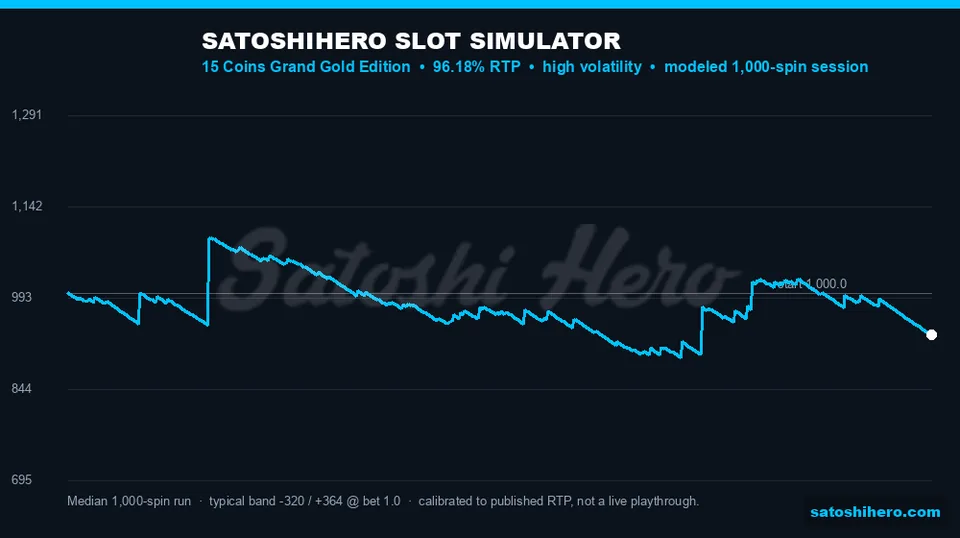
A feature-sized win appeared about once per 45 spins in the model. Very large wins occurred roughly once per 1,754 spins. Those frequencies describe the simulated distribution and don’t predict your next feature, bonus value or sequence of results. They provide scale for the gaps and larger events represented in the model without turning either frequency into a schedule.
You should focus on the distance between the negative and positive edges. A player can follow the same rules and stake for 1,000 spins yet land far from the median. The simulator makes that uncertainty visible without pretending to know the next outcome. High volatility produces a distribution where similar starting conditions can lead to sharply different finishing balances.
Our 100-spin session
My real balance path showed steady $1.00 declines interrupted by two bonus jumps. The run ended $3.00 down, even though its largest single return reached $47. That contrast explains why the closing figure alone doesn’t capture how exposed the bankroll felt between triggers. Most movement followed a predictable one-stake decline, while both recoveries arrived as concentrated feature payouts.
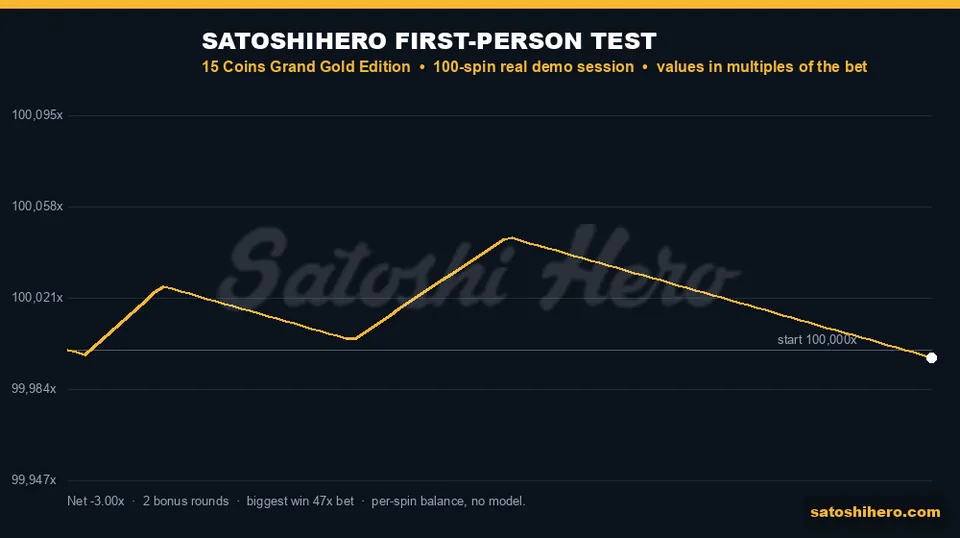
The first jump came almost immediately, while the second arrived near spin 40. Neither bonus prevented later empty spins from eroding the recovered balance. You need enough funds to survive the route, not merely confidence that one decent feature can repair it. The plotted line makes that sequence clearer than the final loss because it preserves both recovery points and the declines around them.
My short session adds firsthand context but can’t validate or replace theoretical math. Likewise, the simulator maps possible results rather than promising them. The operator-published theoretical RTP represents the game’s designed return, and one 100-spin session doesn’t alter it. Feature or purchase modes may use different designed returns, so only verified mode-specific figures belong in comparisons. The two datasets answer different questions: the model illustrates dispersion, while the recorded spins show how that uneven structure felt in one controlled base-game sample.
Frequently asked questions
What is 15 Coins Grand Gold Edition?
It is Voltent’s Grand Gold entry in the 15 Coins series, played on a 3-by-5 board with 15 independent reels. Regular symbols don’t pay, and every prize comes through Hold the Jackpot.
How does Hold the Jackpot work in 15 Coins Grand Gold Edition?
Five Bonus symbols on the middle row trigger the feature. All Bonus symbols lock, three respins begin and each new symbol resets the counter to three. The round ends when no respins remain or all 15 cells fill.
What can the symbols in 15 Coins Grand Gold Edition be worth?
Cash coins pay 1x to 10x, while Cash Infinity pays 5x to 15x. MINI, MINOR and MAJOR pay 10x, 20x and 50x. Filling every position awards the 2,000x GRAND.
What do Mystery symbols do in 15 Coins Grand Gold Edition?
Mystery can become any Bonus symbol except Cash Infinity. Jackpot Mystery can reveal only MINI, MINOR or MAJOR, and both types open when the bonus ends.
What does the Collector do in 15 Coins Grand Gold Edition?
Collector totals Cash and Cash Infinity values before applying a random 1x to 20x multiplier. None appeared in my test, so this explanation comes from the in-game rules.
What is Chance Level in 15 Coins Grand Gold Edition?
The x2, x4, x6 and x10 choices multiply both your stake and trigger chance proportionally. Symbol values don’t change, and I kept Chance Level off throughout the test.
Can you buy the bonus in 15 Coins Grand Gold Edition?
Yes. Buy Feature opens the purchase menu and provides access to Extreme and Double Extreme. I didn’t test either purchase, so I make no claim about their value.
What did the 1,000-spin simulator show for 15 Coins Grand Gold Edition?
The median modelled result finished 67.0x down. Its central 90% range ran from 319.6x down to 364.4x up, describing possible session variation rather than predicting your result.
How did the 100-spin test of 15 Coins Grand Gold Edition go?
I finished 3.0x down after two Hold the Jackpot rounds paid 29x and 47x. The larger return arrived around spin 40 and became my best result.
What are the RTP and maximum win in 15 Coins Grand Gold Edition?
The game has a 96.18% theoretical RTP, high volatility and a 2,000x maximum win. Those figures define the published math, not a guaranteed session result.
Final Word
15 Coins Grand Gold Edition stands out through bonus-only payouts and sticky Cash Infinity tension. Its clean board makes the goal obvious, but the modest cap doesn’t fully match the harsh empty-spin rhythm. The strongest part of the design is the continuity created by retained symbols, while the weakest is the absence of smaller returns between bonus triggers.

My Verdict
Patient bonus hunters may enjoy watching sticky positions develop before Hold the Jackpot starts. Expect long $0 stretches, sharp feature jumps and a game that asks you to manage stake size carefully.
I like how the two retained top-row coins gave my session a continuing thread. I don’t like relying entirely on bonus triggers, although the $29 and $47 rounds nearly repaired 100 spins of steady losses. That near recovery made the final balance look mild, yet the route still depended on two concentrated returns rather than consistent base-game support.
15 Coins Grand Gold Edition offers focused collection play rather than a broad feature showcase. Its mechanics and test notes are updated periodically.

Pros:
 Clear objective: Five middle-row symbols make every trigger easy to understand.
- Sticky tension: Cash Infinity coins preserve anticipation across otherwise empty spins.
- Simple respins: New Bonus symbols reset the counter without complicated extra rules.
- Readable board: Limited symbols keep values and open positions easy to track.

Cons:
 Empty base game: Every non-triggering spin returns $0 and steadily drains funds.
- Restrained ceiling: The top prize feels modest beside the severe session swings.
- Costly chance boosts: Higher Chance Levels consume the same bankroll much faster.

Best For: Patient bankroll managers who value sticky-coin suspense over frequent small wins get the clearest appeal. You should accept long empty runs, keep stakes controlled and treat every visible coin as pending value.

































































Bets
All Bets
Game
Player
Date
Wager
Mult.Multiplier
Prize
 Galaxy Glitter
 mike_721
- 04:15:29
- 2.5×
- Galaxy Glitter
 Hidden
- 04:15:29
- 0×
- Royal Fruits 9: Hold 'n' Link
 josh1998
- 04:15:27
- 0×
- Santa's Bag
 corasped
- 04:15:26
- 0×
- Luck of Tiger: Bonus Combo
- nina87
- 04:15:26
- 0.04×
- Galaxy Glitter
- Hidden
- 04:15:26
- 0×
- Golden Tree
- mdp0fxo
- 04:15:24
- 0×
- Santa's Bag
- corasped
- 04:15:23
- 0×
- Galaxy Glitter
- Hidden
- 04:15:22
- 0.88×
- Santa's Bag
- corasped
- 04:15:20
- 0×