

Sunstrike Supernova
By pressing play, you agree that you are above legal age in your jurisdiction and that your jurisdiction allows online gambling.

Sunstrike Supernova
RTP94.06%
VolatilityVery high
Max winx5,000
Hit rate27%
ThemeSpace
ReleasedDec 2022
Live game stats
Real RTP72.40%
Spins203
Players1
Biggest win$14.67

Sunstrike Supernova slot Guide: How It Works and Our 100-Spin Test
Sunstrike Supernova finished my test $30.40 down after 100 spins at $1 each. Its naturally triggered free spins supplied my largest win, returning $29.30.
According to TrueLab, Sunstrike Supernova is a space slot with very-high volatility, a 95.62% RTP, and 5,000x maximum win potential. This 6×5 game uses scatter pays, cascades, additive stars, and persistent feature multipliers. Sunstrike Supernova online runs in demo and real mode on SatoshiHero, aimed at risk-tolerant players chasing concentrated feature action.
Key Takeaways
- Best bonus: My naturally triggered Sunstrike Spins round paid $29.30, while I didn’t test the Buy Bonus.
- RTP / volatility: A 95.62% theoretical return combines with very-high volatility, creating uneven short sessions.
- Max win: The top prize reaches 5,000x the bet, though that cap feels modest beside the risk.
- Risk note: Small ordinary cascades dominated my play, while one feature supplied most of the recovery.
- Bankroll note: A $100 Buy Bonus at a $1 stake costs as much as 100 standard spins.
These figures make the trade-off clear before you spin. I think the Sunstrike Supernova slot deserves your attention for concentrated bonus potential, not frequent large base-game hits.

Table of Contents
- How Sunstrike Supernova Works
- Symbol Values And Scatters
- Cascades After Each Win
- Supernova Multipliers
- Theme and First Impressions
- Sunstrike Spins
- Bonus Bet
- Buy Bonus
- RTP, Volatility and Our Test
- Simulator Projection Results
- Our 100-Spin Session
- Frequently Asked Questions
- Wrap-Up
How Sunstrike Supernova Works
Eight or more identical regular symbols anywhere on the 6×5 board create a win. The Sunstrike Supernova slot has no fixed paylines, so position and left-to-right alignment don’t matter. Awards rise again when you collect 10 or 12 matching symbols. Count every matching icon across the board instead of searching for conventional reel patterns.
You can open the game through a compatible desktop or mobile browser on SatoshiHero. Both demo and real modes use the same readable layout. I found the wide board easy to scan, even when several drops followed one paid spin. Your attention belongs on the full symbol count after every replacement.
Symbol Values And Scatters
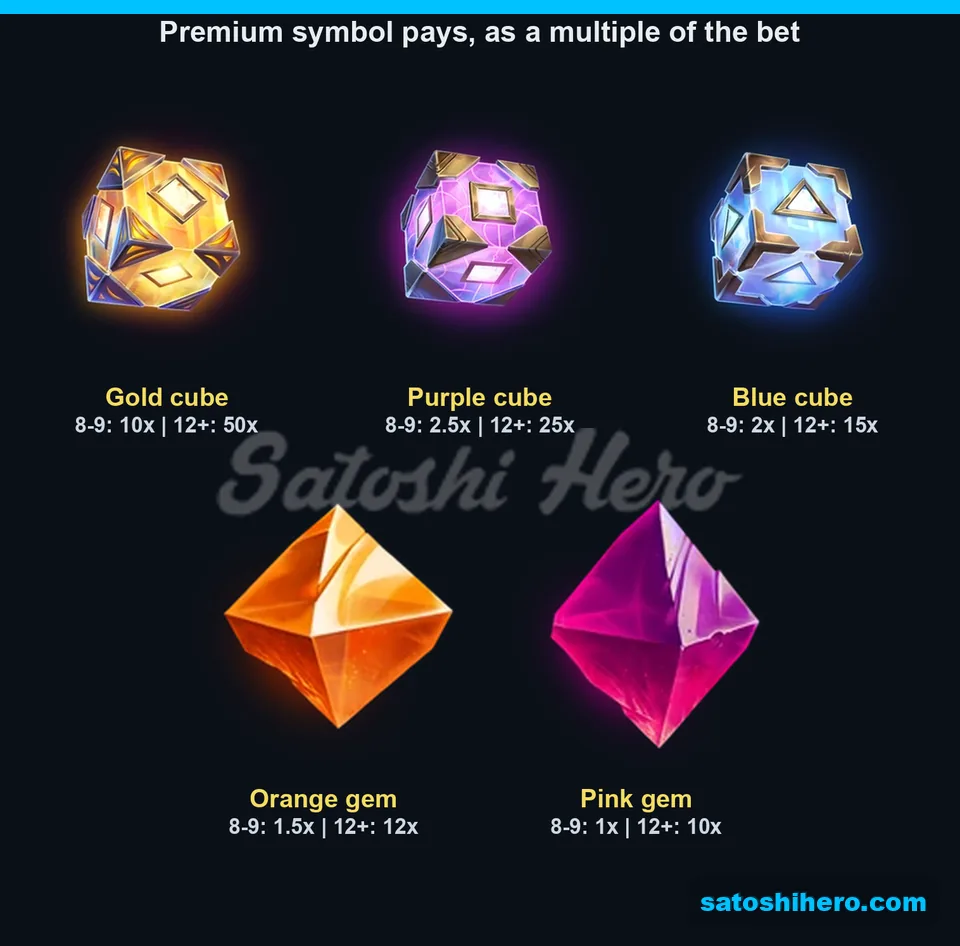
Nine regular symbols fill the board, split between three cubes and six gems. Every listed value multiplies your total bet. The cubes carry the strongest regular awards:
- Gold cube: 10x for 8 or 9, 25x for 10 or 11, and 50x for 12.
- Purple cube: 2.5x, 10x, and 25x across those count bands.
- Blue cube: 2x, 5x, and 15x across the same bands.
The gem values step down, but their larger groups can still extend a cascade:
- Orange gem: 1.5x, 2x, and 12x.
- Pink gem: 1x, 1.5x, and 10x.
- Violet gem: 0.8x, 1.2x, and 8x.
- Green gem: 0.5x, 1x, and 5x.
- Cyan gem: 0.4x, 0.9x, and 4x.
- Blue gem: 0.25x, 0.75x, and 2x.
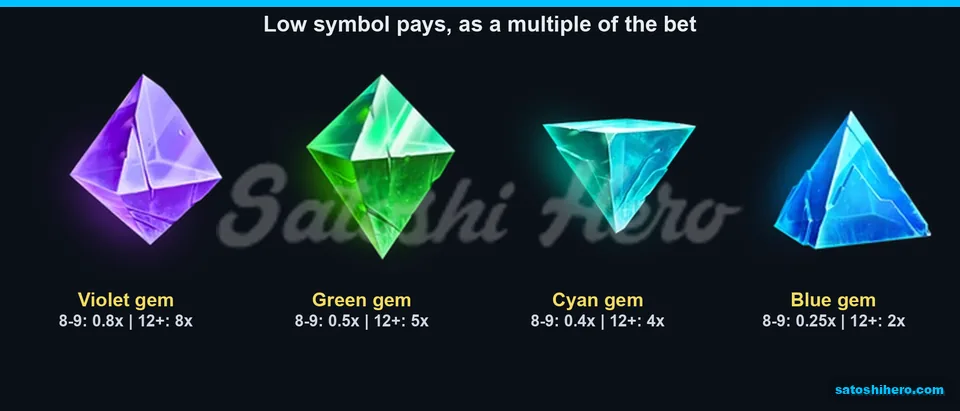
I verified the table during play when eight blue cubes returned $2 at my $1 stake. That direct match made the scatter-pays system simple to trust. You don’t need to convert anything mentally beyond multiplying the displayed pay by your bet.
There is no Wild symbol. Four Scatters pay 3x, five pay 5x, and six pay 100x. Landing four or more also starts free spins. Honestly, removing a Wild keeps the rules clean, though it leaves regular symbols to do all the base-game work.
Cascades After Each Win
Winning symbols disappear, and replacements fall from above. The chain continues until a drop creates no further award. One paid spin can therefore contain several separate wins, which the left rail lists individually. A total above the board combines the complete cascade for you.
My clean captured example ended at $2.50. Eight blue cubes contributed $2, then eight green gems added another $0.50. I recorded that image after the counted test, so it doesn’t alter my $30.40 net loss. It still shows exactly how the Sunstrike Supernova slot presents component wins and their combined value.
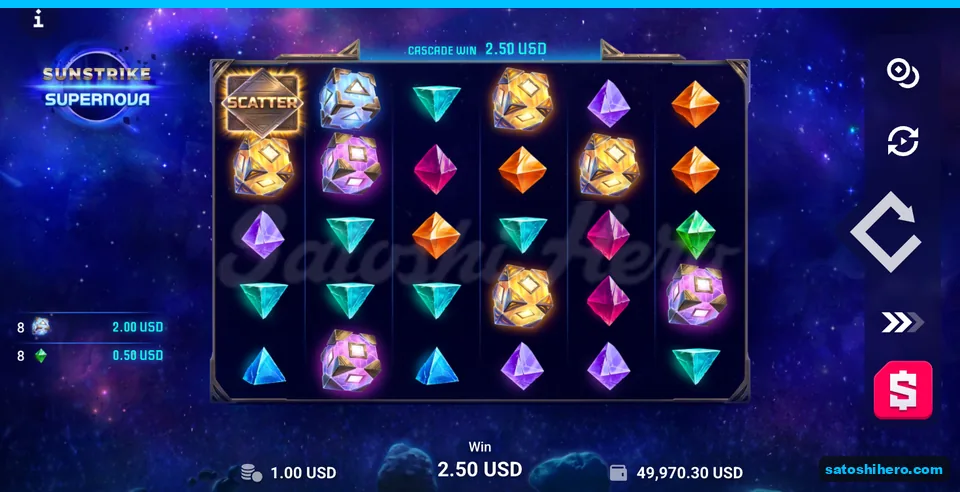

Player Hint: Count matching symbols across the whole board instead of looking for reel lines. Eight symbols can pay wherever they land.
I like how quickly each drop resolves without hiding its component awards. You should watch every new position because one replacement can begin another chain.
Supernova Multipliers
Multiplier stars add their displayed values, then affect a spin only when that spin wins. They can appear during the base game and free spins, with more frequent appearances inside the feature. The Sunstrike Supernova slot divides them into three clear colour bands:
- Blue stars: x2 to x9.
- Gold stars: x10 to x90.
- Red stars: x100 or higher.
- Exploding red star: can grow as high as x500.
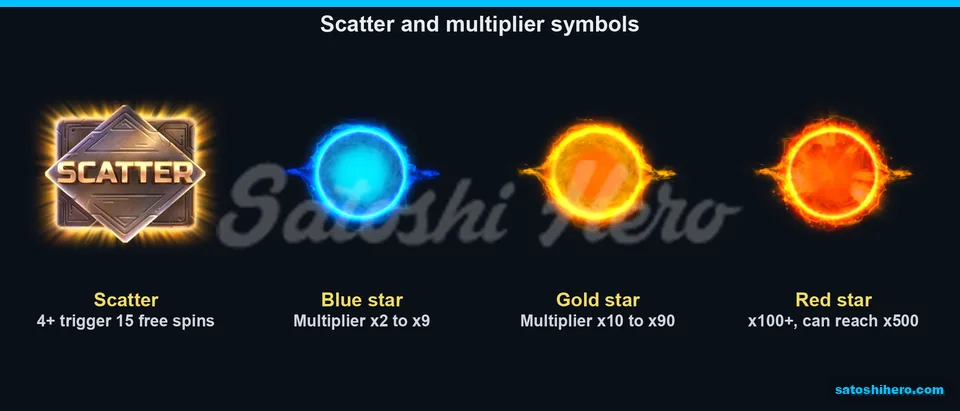
Those values add rather than multiply. An x2 star beside an x3 star creates x5, not x6. The x500 star remains an individual multiplier value and never raises the overall 5,000x game cap. I think that distinction matters because the explosive animation can make the star look more powerful than its actual role.
A base-game multiplier follows a strict order. First, at least one regular win must form. All cascades then finish before the game totals the landed star values. That sum multiplies the full cascade award, after which it resets for your next base-game spin.
Stars on losing spins contribute nothing, even when their values look exciting. This creates a sharp two-part requirement: you need both a paying symbol count and useful stars. Without both pieces, the visual burst has no cash effect. Let me be real, watching a strong star miss a qualifying win stings more than an ordinary blank spin.

Stat Check: Multiplier values add together instead of multiplying each other. A star on a losing spin contributes nothing.
The mechanic becomes meaningful when a solid cascade and several stars arrive together. You should treat every star as conditional until the board confirms a win.
Theme and First Impressions
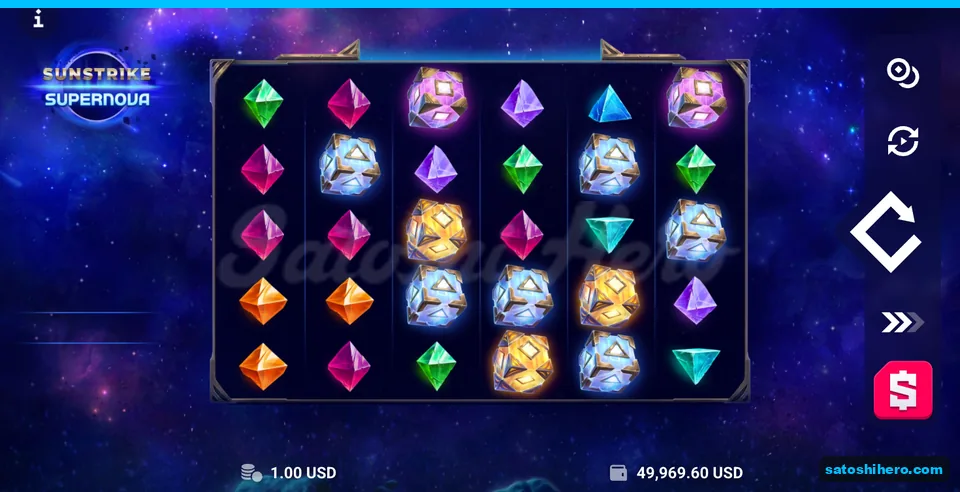
A clean deep-space scene frames bright gems, glowing cubes, and readable effects. Drifting purple nebulae sit behind the dark six-reel, five-row board. Flaring suns and star multipliers create the clearest link to the Supernova name. Strong contrast helps you follow symbols as wins disappear and replacements drop.
The space-and-gems theme won’t win originality awards. Still, the Sunstrike Supernova slot communicates important moments well, especially when coloured stars flare across the board. I could track cascades without fighting excessive animation. Your eyes stay on the action rather than decorative clutter.
Players comparing related cosmic games can also examine Diamond Supernova 100, Diamond Supernova 20, Diamond Supernova 5, and Diamond Supernova 40 on SatoshiHero.
Sound follows the same restrained approach. The soundtrack sits behind cascade impacts and multiplier effects instead of competing with them. I prefer that balance because repeated spins don’t become noisy. You can still hear when a stronger event starts without enduring constant fanfare.

Fun Detail: Star colours signal their multiplier bands, tying the cosmic artwork directly to each value shown on the board.
My settled-board image showed the 6×5 layout at a $1 stake and the $49,969.60 post-test balance. A few manual spins helped me capture that clean frame, but none entered the official session result. The design favours clarity over novelty, and that choice helps you read chained wins quickly.
Sunstrike Spins
Four or more Scatters anywhere on the board award 15 free spins at the triggering stake. Extra triggering Scatters also pay their listed value. Three Scatters during the feature add five spins, and retriggers have no stated limit. Your original triggering bet remains active throughout the round.
The persistent total multiplier provides the main attraction. A star landing on a winning feature spin adds its value to the running total. That accumulated figure remains until the feature ends. It applies again only when another multiplier arrives as part of a winning spin.
A star on a losing feature spin neither advances nor applies the total. That rule makes timing crucial, since impressive stars can appear without helping your result. I like the build-up when the total grows, but the Sunstrike Supernova slot still asks winning symbols and stars to connect. You can’t judge the round from its multiplier display alone.
My feature triggered naturally with four Scatters on spin 76. The 15-spin round returned $29.30 at my $1 stake, making it the largest win of the test. It lifted my balance from roughly $49,955 to around $49,979 before the decline resumed. With seven spins remaining, my captured frame showed a $20.40 running total and the active cascade awards.
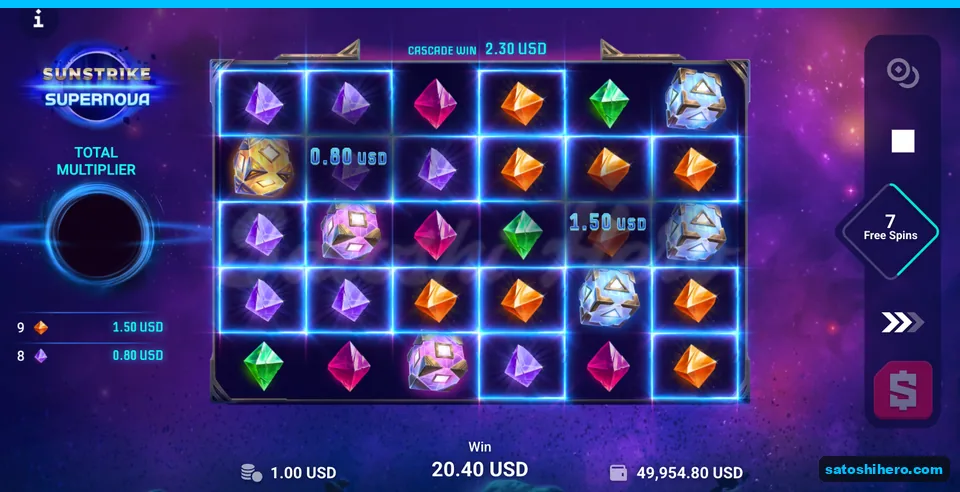
That single round supplied most of my meaningful recovery. Most ordinary base-game wins had stayed near $1 to $3, so the jump felt substantial beside earlier results. However, one trigger can’t tell you what every future round might return. Your stars, cascades, and multiplier timing can create a very different outcome.
The feature feels strongest when early winning stars establish a useful total for later spins. My result showed its recovery power without approaching the game ceiling. You should expect the persistent multiplier to create anticipation, not a guaranteed profit.
Bonus Bet
Bonus Bet raises every spin’s cost by 25% and doubles the chance of triggering Sunstrike Spins. At a selected $1 stake, your paid spin costs $1.25 while the toggle remains active. It doesn’t raise symbol pays, multiplier values, or feature quality. You pay more for a better trigger probability, not an upgraded prize table.
The option stays active until you switch it off. That recurring charge can reshape a session much faster than a one-time choice, especially across autoplay. I think the toggle looks simple enough to underestimate. Your planned number of spins matters as much as the displayed base stake.
I left Bonus Bet off for all 100 counted spins. My naturally triggered feature therefore came from standard play, and I can’t claim a firsthand performance difference between modes. Neither should you treat the toggle as an automatic improvement. It changes feature access while leaving each triggered round exposed to the same underlying variance.
Suppose you prefer more attempts at reaching the persistent multiplier. The higher cost offers that trade-off without skipping straight to the bonus. Yet there is no guarantee your extra spending produces a trigger inside a short session. I would compare the full recurring cost with your session budget before switching it on.
Buy Bonus
Buy Bonus costs 100x the selected stake and starts Sunstrike Spins immediately with at least four Scatters. At my tested $1 stake, that purchase costs $100. It removes the wait for a natural trigger, but it doesn’t remove the risk attached to the resulting round. Your feature can still finish below its purchase price.
The two paid options serve different purposes:
- Buy Bonus: Makes one 100x purchase and immediately launches the feature.
- Bonus Bet: Adds 25% to each ordinary spin and only doubles the trigger chance.
I didn’t purchase a feature during the recorded session. That evidence boundary matters because I can’t offer an observed average return, likely profit, or preferred buying strategy. Honestly, calling either option superior without repeated verified tests would mislead you. The natural $29.30 feature result also says nothing about what a purchased round might return.

Beware: At a $1 stake, one Buy Bonus costs $100, matching the outlay for 100 standard $1 spins. Very-high volatility means immediate access doesn’t guarantee recovery.
Buying can appeal when waiting through base spins isn’t your priority. Yet the Sunstrike Supernova slot charges a meaningful upfront amount for access, not safety. You should view the purchase as faster entry into the same volatile feature.
RTP, Volatility and Our Test
The Sunstrike Supernova slot carries a 95.62% theoretical RTP, very-high volatility, and a maximum win of 5,000x the bet. Results can arrive unevenly, with dry stretches interrupted by a feature or multiplied cascade. That ceiling remains substantial, but I find it relatively restrained for this risk level. You should size stakes for losing runs rather than assume a feature arrives before your budget falls.
TrueLab built the game around concentrated outcomes, and my session matched that character. Small base wins did little until the late free-spins round restored much of the decline. Your short run can look completely different from the published return profile. The useful question isn’t whether one result matches the headline percentage, but whether your stake leaves enough room for variance.
Simulator Projection Results
The SatoshiHero Slot Simulator modelled 1,000 spins at $1 each using the published game profile. Its median projected session ended $123.60 down. The 5th percentile finished $463.50 down, while the 95th percentile reached $722.50 up. That wide spread shows why one central result can’t describe every path.
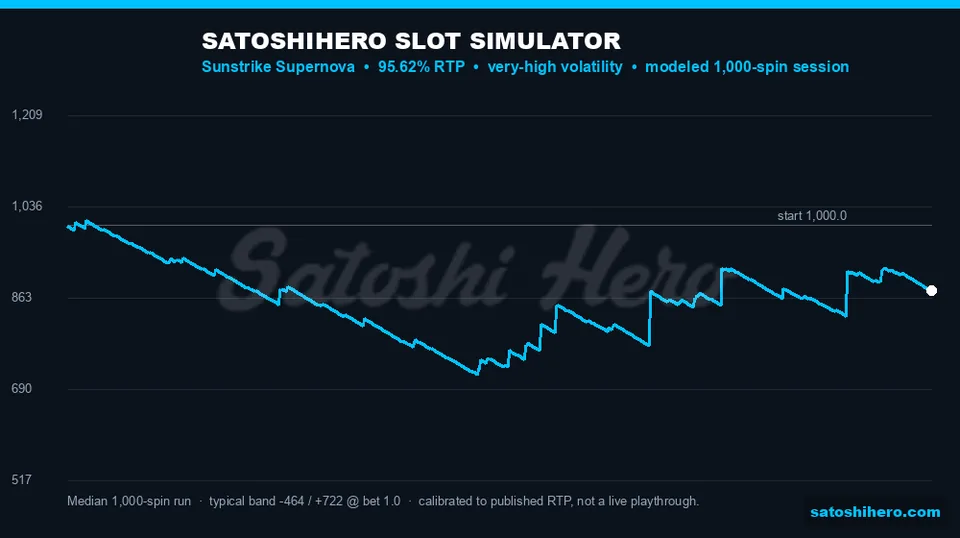
- Median result: $123.60 down.
- 5th percentile: $463.50 down.
- 95th percentile: $722.50 up.
- Modelled win frequency: About 14% of spins.
- Modelled feature frequency: Roughly once per 55 spins.
- Modelled big-win frequency: Roughly once per 819 spins.
These frequencies aren’t schedules, promises, or countdowns. Your play can produce much shorter or longer gaps because each spin remains independent. I view the percentile range as more informative than the median alone. It shows how strongly the Sunstrike Supernova slot can separate losing and winning session paths.
Our 100-Spin Session
My 100 autoplay spins at $1 reduced the demo balance from $50,000 to $49,969.60. That produced a $30.40 loss, with the free-spins stop option disabled. Twenty-five spins returned something, while most base-game cascades paid roughly $1 to $3. My strongest base-game spin reached only $3.50.
Four Scatters triggered free spins on spin 76. That $29.30 round became my largest result and caused the clearest upward move in the test graph. The balance then slipped again before spin 100. I didn’t buy a bonus, and extra manual screenshot spins remained outside the recorded total.
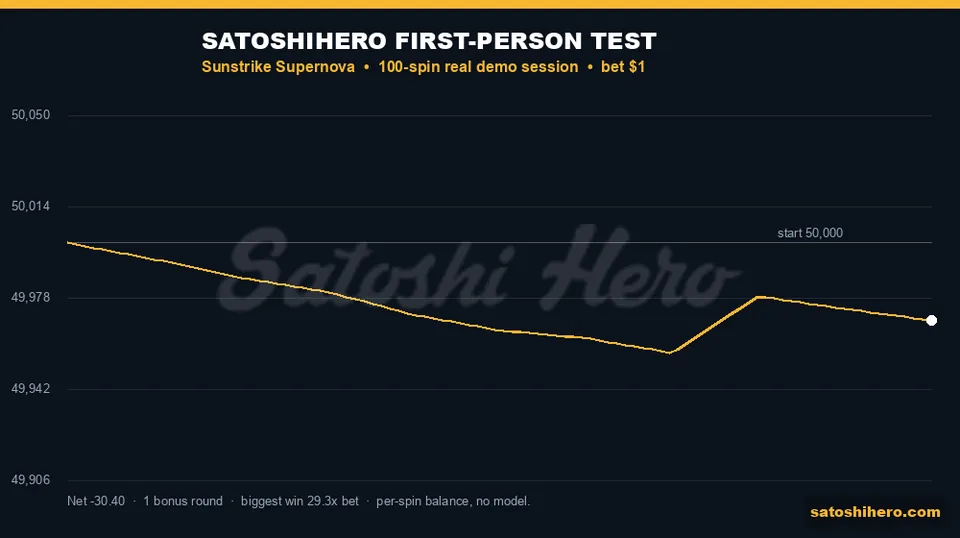
The test sat comfortably inside the broad modelled spread. Its 25% paid-spin rate shouldn’t be compared directly with the simulator’s modelled 14% figure because the samples and measurement contexts differ. I think the key observation is simpler: one late feature changed the shape of my session without turning it profitable. Your result can hinge on a similarly concentrated event.
The 95.62% figure represents TrueLab’s theoretical return, while one 100-spin session can’t confirm, disprove, or alter it. Simulator outputs are modelled projections rather than observed casino outcomes, and any verified mode-specific returns can differ by design. The live test illustrates short-session variance, while the theoretical figure remains the proper return reference.
Frequently Asked Questions
How do wins work in the Sunstrike Supernova slot?
Any eight or more matching regular symbols anywhere on the 6×5 board pay. The game has no fixed paylines, so left-to-right alignment doesn’t matter. Awards increase at 10 and 12 matching symbols. Winning icons disappear, replacements cascade from above, and the chain ends when a drop creates no further win. You should count matching symbols across the complete board after every cascade.
How do free spins trigger in the Sunstrike Supernova slot?
Four or more Scatters award 15 free spins at the triggering stake. Three Scatters during the round add five spins, with no stated retrigger limit. My feature appeared naturally on spin 76 and returned $29.30 at a $1 stake. Your outcome can differ because winning stars and symbol cascades determine how the persistent multiplier develops.
How large are the Sunstrike Supernova slot multipliers?
Blue stars carry x2 to x9, gold stars x10 to x90, and red stars start at x100 or higher. An exploding red star can reach x500. Values add together and affect only winning spins. During free spins, qualifying stars also feed the persistent total, which remains active through the round under the feature rules.
What does the Sunstrike Supernova slot Buy Bonus cost?
The Buy Bonus costs 100x your selected stake and starts free spins with at least four Scatters. At a $1 stake, you pay $100. Bonus Bet works differently because it adds 25% to each standard spin and doubles the trigger chance. Neither option improves symbol values or guarantees that your feature returns its cost.
What are the Sunstrike Supernova slot RTP and maximum win?
The verified profile lists a 95.62% theoretical RTP, very-high volatility, and 5,000x maximum win potential. That combination can create uneven short sessions with meaningful losing stretches. You should choose a stake that leaves room for dry runs rather than treating the return percentage as a promise for one session.
What did the 1,000-spin simulator show?
The $1-per-spin median projection finished $123.60 down. Its modelled 5th-to-95th-percentile range stretched from $463.50 down to $722.50 up. About 14% of spins won, features appeared roughly once per 55 spins, and big wins appeared near once per 819 spins. These figures describe a model, not guaranteed timing for your play.
How did the 100-spin test go?
My $1-per-spin session fell from $50,000 to $49,969.60, leaving a $30.40 loss. Twenty-five spins returned something, and Sunstrike Spins delivered the largest win at $29.30 on spin 76. Most ordinary cascades stayed between $1 and $3. Later manual screenshot spins didn’t affect the recorded total.
Wrap-Up
Sunstrike Supernova stands out through whole-board scatter pays, additive stars, and a persistent free-spin multiplier. Its main drawback is the mismatch between fierce risk and a comparatively restrained prize ceiling. You get clear mechanics, but the base game can feel quiet between meaningful events.

My Verdict
I recommend measured stakes and enough budget to absorb uneven runs. Expect modest base cascades, then occasional concentration around free spins or a multiplied chain. The feature is engaging, though its access never guarantees recovery.
I liked how my natural feature lifted the balance by $29.30 after many small results. I didn’t like watching most base-game wins stop near $1 to $3, especially with such sharp variance. The untested paid options also don’t earn an automatic recommendation from me.
The Sunstrike Supernova slot makes most sense when you value clear scatter pays and persistent multiplier tension over steady base-game rewards. Testing details undergo routine checks, and this guide is updated periodically.

Pros:
 Clear scatter pays: Whole-board counts make every winning condition easy to follow.
- Persistent feature multiplier: Winning stars can build tension across the full bonus round.
- Readable presentation: Bright symbols stay distinct against the dark space background.
- Transparent cascades: Separate awards and the combined total remain visible during chains.

Cons:
 Harsh variance: Long losing stretches can drain a short session quickly.
- Modest ceiling: The top prize feels restrained beside the game’s risk level.
- Weak base recovery: Most tested cascades returned only $1 to $3.

Best For: Risk-tolerant cascade fans who enjoy watching additive stars build a persistent feature total. You should also accept small base-game returns and budget carefully for uneven stretches.






























































Bets
All Bets
Game
Player
Date
Wager
Mult.Multiplier
Prize
 Black Bullion: Cash Pool
 Hidden
- 15:49:03
- 0×
- Mr. Crystalman: Hold 'N' Link
 nina87
- 15:49:03
- 6.3×
- Fortune Skulls
- mike_721
- 15:49:02
- 0×
- Black Bullion: Cash Pool
- Hidden
- 15:49:00
- 0×
- Elephant's Gold: Bonus Combo
- josh1998
- 15:49:00
- 0×
- Mr. Crystalman: Hold 'N' Link
- nina87
- 15:49:00
- 0.09×
- Galaxy Glitter
 blazecraft
- 15:48:59
- 0×
- Joker's Jewels Cash
 Hidden
- 15:48:59
- 0×
- Merry Cash Splash: Hold 'N' Link
- maya_81
- 15:48:58
- 0×
- Super Gummy Strike
 dmour265
- 15:48:58
- 0×