

Gates of Santa
By pressing play, you agree that you are above legal age in your jurisdiction and that your jurisdiction allows online gambling.

Gates of Santa
RTP92.03%
VolatilityVery high
Max winx15,000
Lines8
Hit rate22.55%
ThemeChristmas & New Year
ReleasedDec 2024

Crashing Santa’s Snowy Gate
Gates of Santa replaces fixed win lines with pay-anywhere hits across a packed 6×5 grid.
Gates of Santa is a very-high volatility Christmas slot from TrueLab with 96.07% RTP and 15,000x max win potential. Cascades, additive Santa Sack multipliers, and free spins drive the action. Risky bonus hunters who can handle quiet stretches should feel at home.
Key takeaways
- Best bonus: The standard free-spins trigger is the strongest documented route because I tested neither paid option.
- RTP / volatility: The theoretical RTP is 96.07%, paired with a very-high volatility profile.
- Max win: The 15,000x cap equals $18,000 at the tested $1.20 stake.
- Risk note: Eight matching symbols can pay anywhere, but no fixed paylines guide your eye.
- Bankroll note: A $120 Buy Feature equals every wager from my counted 100 standard spins.

Table of Contents
- How Gates of Santa Works
- Pay-anywhere wins
- Symbol values
- Theme and First Impressions
- Festive gate setting
- Visual feedback
- Cascades and Tumble Chains
- How tumbles continue
- When wins settle
- Santa Sack Multipliers
- Additive values
- No carry-over
- Free Spins
- Trigger and retriggers
- Multiplier potential
- Buy Feature and Bonus Bet
- Direct bonus entry
- Enhanced trigger chance
- What Happened in 100 Spins
- Session result
- Hit distribution
- RTP, Volatility and Our Test
- Simulator projection
- Our 100-spin session
- Frequently Asked Questions About Gates of Santa
- Wrap-Up
How Gates of Santa Works
Eight or more matching symbols win anywhere across the 6×5 grid. Although the interface lists eight lines, those aren’t fixed paylines, and wins don’t trace left-to-right paths. You simply count identical symbols across all positions. I find that approach cleaner than checking lines, though the full board takes practice to scan quickly.
Every payout uses the total bet and rises through three bands: 8-9, 10-11, and 12-plus symbols. You can play through SatoshiHero in free-play or real mode. Ignore the listed-line display because symbol count decides the base payout.
Pay-anywhere wins
Matching symbols can sit in separate corners and still create one win. The game has no wild, so ordinary matches never need a substitute. I like the direct counting rule because you can verify a hit without tracing a route.
Snow Globes act as scatters and pay anywhere. Four pay 3x, five pay 5x, while six or more pay 100x the bet. Four or more also open the free-spins round. You should count Globes separately from regular symbols because their awards and trigger follow different rules.
One extra spin after my counted test produced a $2.40 mid-cascade result. The image illustrates an anywhere win, but I excluded it from every 100-spin total. You deserve clean test figures.
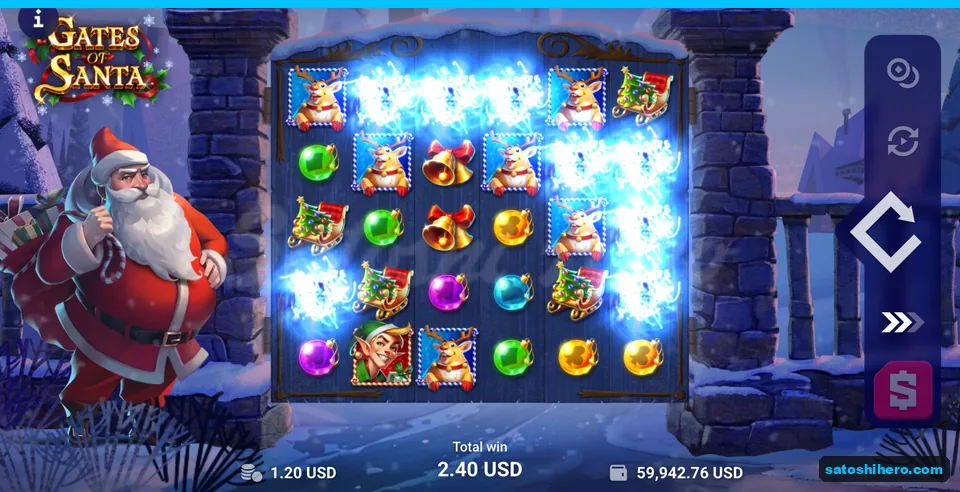

Stat Check: Eight matching symbols can win anywhere, so don’t treat the eight listed lines as fixed paylines.
Symbol values
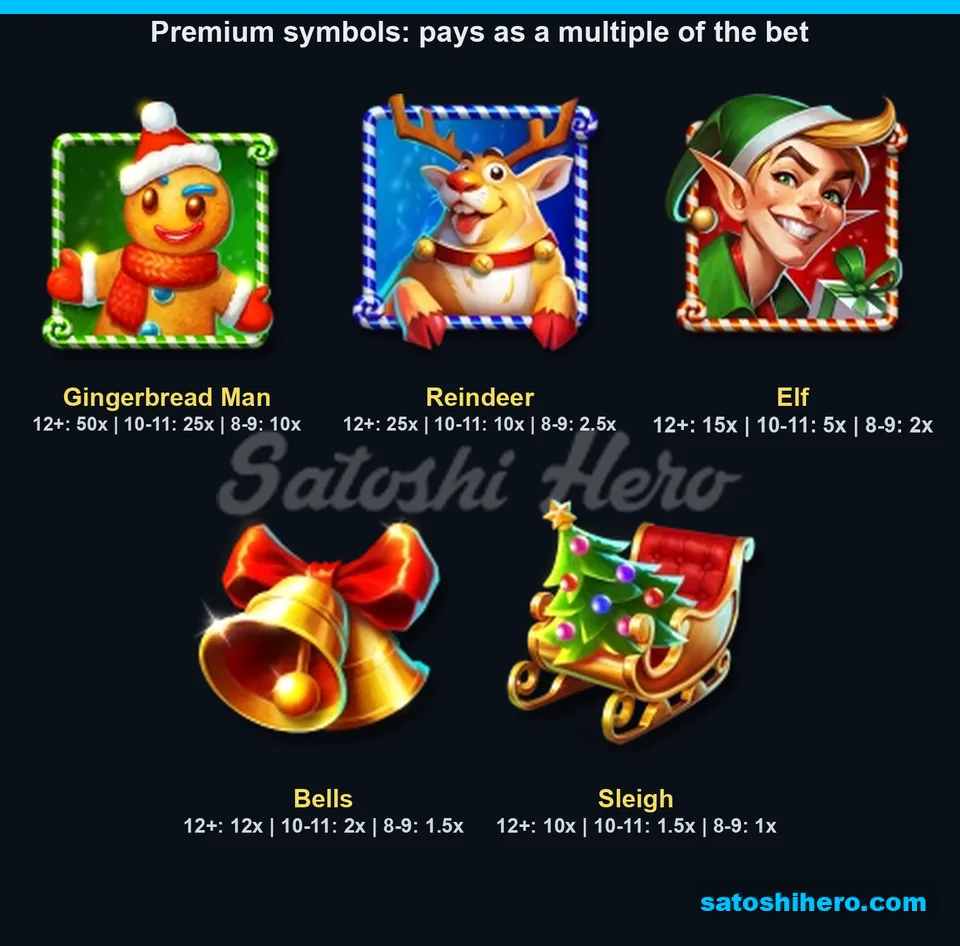
Premium symbols pay the following bet multiples across the 8-9, 10-11, and 12-plus count bands:
| Symbol | 8-9 | 10-11 | 12+ |
|---|---|---|---|
| Gingerbread Man | 10x | 25x | 50x |
| Reindeer | 2.5x | 10x | 25x |
| Elf | 2x | 5x | 15x |
| Bells | 1.5x | 2x | 12x |
| Sleigh | 1x | 1.5x | 10x |
At my $1.20 stake, 12 or more Gingerbread Men pay $60. That gives you a useful scale for crowded results.
Four glass baubles cover the lower values:
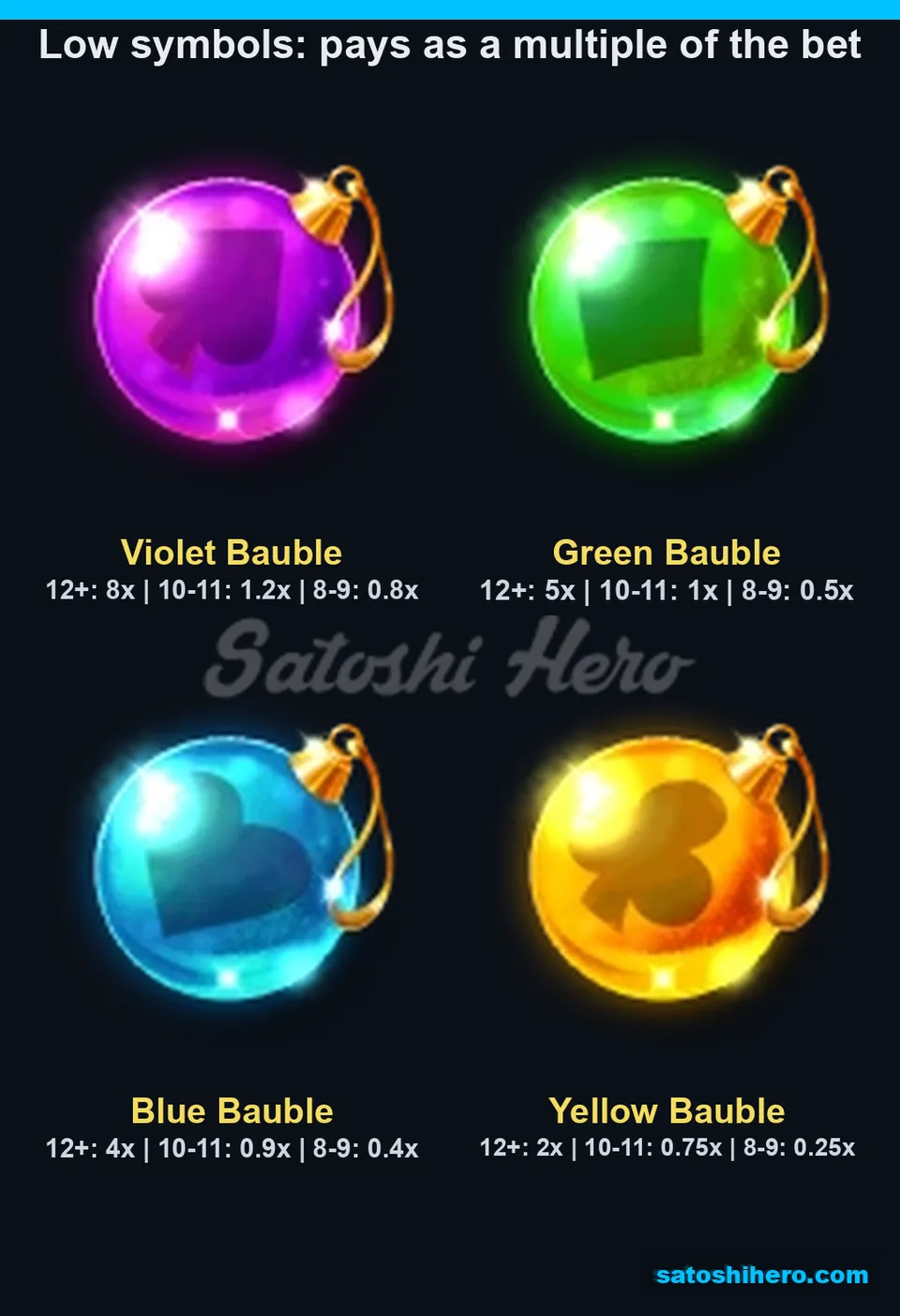
- Violet pays 0.8x, 1.2x, and 8x.
- Green pays 0.5x, 1x, and 5x.
- Blue pays 0.4x, 0.9x, and 4x.
- Yellow pays 0.25x, 0.75x, and 2x.
Low bauble hits mattered more to my small returns than premium-symbol fireworks. You can read the board faster after several spins, though colors crowd together during tumbles. Symbol count always determines the base value.
Theme and First Impressions
The 6×5 board sits outside a snowy stone gate, with a grinning Santa leaning beside it. Drifting snow frames gingerbread men, reindeer, elves, bells, sleighs, and bright glass baubles. You see the festive setting before touching spin, while icy bursts make winning groups easy to follow. I think the polished look carries the familiar Christmas idea better than the theme itself does.
TrueLab built the Gates of Santa game around snow, gifts, and expressive character art. My demo opened at the $1.20 default stake with a $60,000 balance. You can play Gates of Santa online at SatoshiHero in free-play or real mode.
Festive gate setting
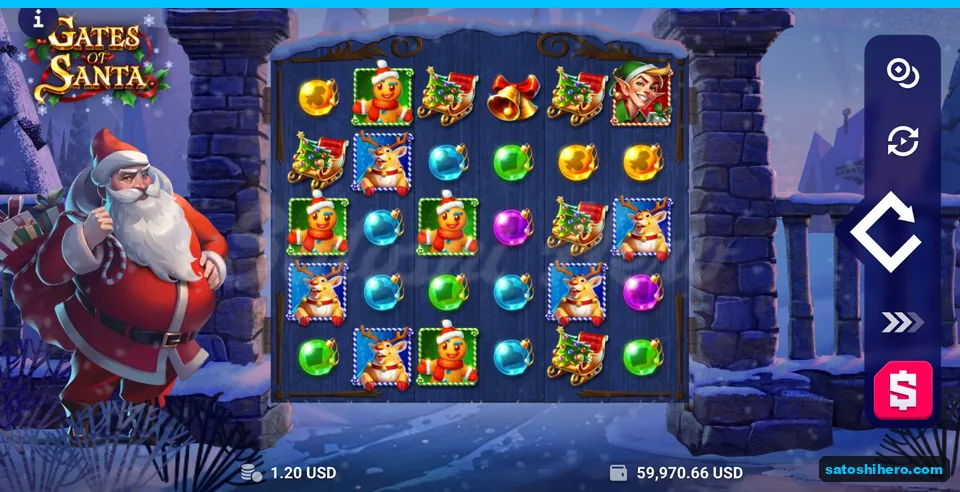
A large stone entrance fills the background, edged by frost and steady snowfall. Santa’s broad grin adds personality without covering the reels. The base-game image shows the board at rest, my $1.20 stake, and the $59,970.66 ending balance.
Readers wanting darker Norse imagery around a monumental entrance could prefer Gates of Valhalla. Players drawn to an underworld theme can also compare Gates of Hades. Here, you get a brighter scene with readable symbols. The concept isn’t daring, but its clean execution works.

Fun Detail: Winning symbols burst into frost, linking the cascade animation directly to the snowy Christmas setting.
Visual feedback
Winning symbols vanish in a crisp frost spray before new icons fall. That clear removal helps you track where each tumble starts, even when the board looks busy. You can watch gaps refill without guessing which symbols paid.
The theme won’t win originality awards, but the frosty effects and expressive Santa create a distinct seasonal identity. Sound and motion never hid the outcome during my session. In my view, the design supports the mechanics instead of distracting from them.
Cascades and Tumble Chains
Every winning symbol disappears, then symbols above drop into each empty space. Those replacements can create another anywhere win without charging you for another spin. Tumbles continue until the grid finds no fresh match. You should treat the result as active until that sequence stops, and only then regard your paid spin as complete.
This system can turn one wager into several connected payouts. Yet most wins in my session stayed small. I enjoyed the suspense, but short chains often looked more dramatic than their value.
How tumbles continue
First, a qualifying group pays and disappears. Replacements fall, the grid checks again, and another match can repeat that cycle. You don’t pay for these follow-up drops. One initial spin can therefore contain several wins, though nothing guarantees a second useful hit.
My session produced low returns rather than a major chain. You see potential whenever symbols keep falling, but animation alone says little about value. A long sequence can still finish modestly.
When wins settle
The complete spin settles only after the final cascade finds no new win. Any Santa Sack multipliers from that sequence apply to the completed cascade total, not each disappearing group. You need that distinction when checking why the displayed payout changed at the end.

Player Hint: Judge the result after the tumble chain ends because multipliers affect the completed cascade total, not each group separately.
Delayed settlement adds tension while you wait for the last drop. I like that rhythm, although small chains can oversell the outcome through motion. Extra tumbles cost nothing, but they promise no extra payout.
Santa Sack Multipliers
The red Santa Sack carries values from x2 through x2025. A Sack matters only when the same Gates of Santa spin wins. You add every Sack from one cascade sequence, then apply that sum to the completed total. Don’t expect carry-over.
I didn’t see a top-end Sack during the counted session. That absence made ordinary spins feel flat whenever the red symbol appeared without enough payout behind it. The range looks thrilling, but useful timing matters more than the printed number.
Additive values
All Sacks appearing during one cascade sequence add together. An x2 and x3 create x5, not x6. The combined figure then multiplies the completed cascade total, so you should wait for settlement before checking the calculation.
The red Sack isn’t the Snow Globe scatter. Sacks multiply qualifying wins, while Globes pay through their table and can open free spins. If you know Gates of Olympus, the tumble-and-multiplier appeal feels familiar, but these additive Sack rules give this slot its own structure. Gates of Olympus Dice offers another related take on multiplier-driven play.
No carry-over
Every multiplier resets after its paid or free spin. The x2025 ceiling supports the largest-win potential, yet it never appeared in my run. You shouldn’t read a dormant Sack as progress because nothing accumulates across spins.
This reset makes each attempt self-contained and keeps the top values rare in practical play. I find the rule easy to understand but harsh during a cold stretch. A Sack needs both a winning spin and enough cascade value to matter.
Free Spins
Four or more Snow Globes open 10 Gates of Santa free spins at the triggering stake. Three or more during the round add five spins, creating more chances to connect wins with Sacks. You need four Globes initially, while a retrigger needs three. That lower threshold looks attractive, though I never reached it.

Extra scatters also pay through the same scatter table. Their awards remain separate from Sack effects, which apply only after a qualifying cascade total forms. I like the rule set on paper, but the absent trigger made the chase feel dry.
Trigger and retriggers
Four, five, or six-plus Snow Globes pay 3x, 5x, or 100x the bet. Four or more also start the round, and three or more inside it add five spins. You can gain extra attempts and a scatter payout from the same feature event.
My 100 standard spins produced no free-spins trigger. I also didn’t purchase entry, so I have no firsthand bonus payout to report. You can try Gates of Santa free through SatoshiHero’s free-play mode before putting a real balance behind that chase.
Multiplier potential
Santa Sack multipliers provide the feature’s main upside. Multiple values add within a spin, then multiply its completed cascade total before resetting. You still need a worthwhile win beneath those values, so a large printed multiplier isn’t useful by itself.
The rules create clear upside, but my failed trigger shows how quiet the chase can feel. I won’t invent an average payout or pretend the feature appeared. Documented mechanics look exciting here, while my live test offers no bonus result.
Buy Feature and Bonus Bet
Gates of Santa offers two paid routes: a 100x Buy Feature and a Bonus Bet adding 25% per spin. The purchase opens free spins, while the enhanced stake doubles their trigger chance. You should separate their costs because they change different parts of play. I tested neither, so I can’t rank them.
At the default stake, both choices can raise spending much faster than standard spins. Check your whole session budget before selecting either route. In my opinion, the direct purchase feels expensive without firsthand payout evidence.
Direct bonus entry
The Buy Feature costs 100x the bet and enters free spins immediately. At $1.20, that means one $120 purchase. You would spend the same amount as my entire counted set of 100 standard wagers in one action.
I didn’t use the purchase during testing. That means you get a verified price comparison here, not a claim about value. Let me be real, concentrating a full session’s wager into one click creates a much sharper decision.
Enhanced trigger chance
The Bonus Bet increases each spin’s cost by 25% and doubles the free-spins trigger chance. It changes trigger probability, not the documented prize values. You pay more on every attempt, even if the round never appears.
I didn’t enable this option either. Its slower cost increase can look gentler than a direct buy, but repeated spins still drain a budget. You should compare the added cost against your planned spin count before opting in.

Beware: Very-high volatility plus a 100x purchase creates concentrated risk. At $1.20, one buy costs $120, so keep a separate feature budget.
Neither paid route comes with evidence from my play session. Their rules are clear, but their value remains untested here.
What Happened in 100 Spins
My 100-spin session ended $29.34 down after I wagered $120 at $1.20 per spin. I started with $60,000 and finished at $59,970.66 after receiving $90.66 back. You can treat these figures as one firsthand observation, not a forecast. Your own run can move very differently, especially if free spins or a strong Sack combination appears.
The balance slipped rather than collapsing. Still, no bonus arrived to create meaningful upside. I found the run calmer than the volatility label might suggest, but the weak return distribution kept it flat.
Session result
| Test measure | Result |
|---|---|
| Starting balance | $60,000 |
| Ending balance | $59,970.66 |
| Total wagered | $120 |
| Total returned | $90.66 |
| Net result | $29.34 down |
| Observed session return | 75.55% |
The 75.55% figure describes only this session. It isn’t Gates of Santa’s theoretical return, and you shouldn’t expect it. Small hits controlled my balance drift, but the missing bonus blocked recovery.
Hit distribution
Twenty-three of the 100 spins returned something, and most paid $2.40 or less. My largest result was $14.40, equal to 12x, on spins 17 and 34. Three other spins paid $12 each, or 10x. You might call 23 paying spins active, yet the small values made that count feel less lively.
Free spins never triggered. The extra $2.40 gallery frame came from one additional spin, so I kept it outside every total above. That separation gives you a more honest picture than folding an uncounted hit into the test.
Regular small wins kept appearing, but no bonus or multiplier surge pushed the session into profit. That distribution mattered more than the raw number of paying spins.
RTP, Volatility and Our Test
Gates of Santa combines 96.07% theoretical RTP, very-high volatility, and a 15,000x maximum win. This profile can create sharp gaps between wagers and returns. Reaching the ceiling needs rare productive cascades with large Sack values. You should expect uneven results and never treat modeled frequencies as countdowns.
At my $1.20 stake, the cap equals $18,000. I consider that substantial, though the demanding route matters more than the headline figure. You need a budget that can withstand long quiet patches without chasing losses.
Simulator projection
The SatoshiHero Slot Simulator modeled 1,000 spins at $1.20. Its median result ended $149.70 down, with the 5th percentile at $533.40 down and the 95th percentile at $707.60 up. About 14% of modeled spins paid something. A bonus-sized hit appeared roughly once per 54 modeled spins, while a 100x result appeared around once per 843 modeled spins.
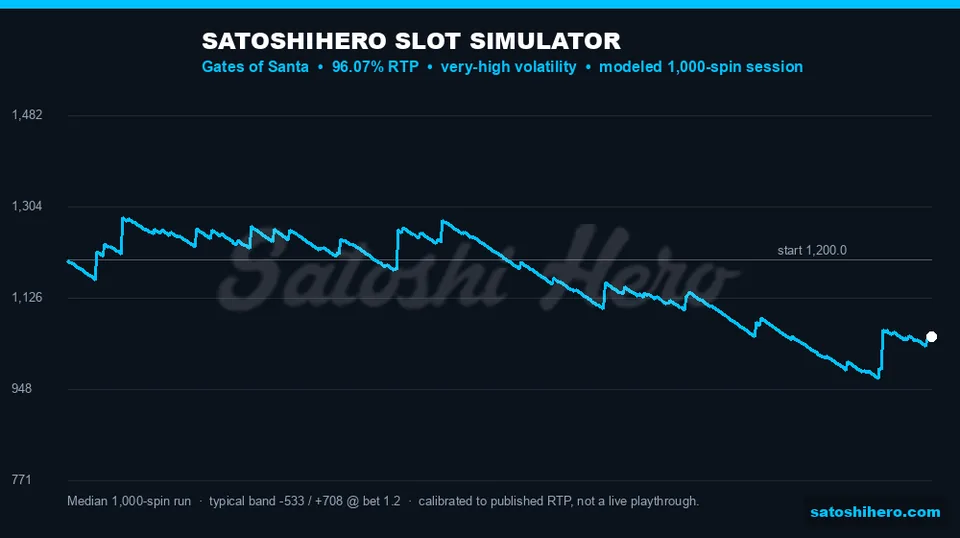
Those outputs aren’t guaranteed frequencies or predictions. A real session can finish beyond either end of that range. You shouldn’t assume a bonus becomes due after 53 misses, because each result remains independent.
The wide spread matters more than the median alone. I think it captures the game’s risk better than one average-looking result ever could.
Our 100-spin session
My real $29.34 loss sits well inside the simulator’s broad range. I recorded 23 paying spins, a 12x top hit twice, and no free-spins trigger. The balance trace showed a gradual decline rather than a severe collapse or sudden bonus jump. You can see a mild losing run here, but you can’t use it to predict your next session.
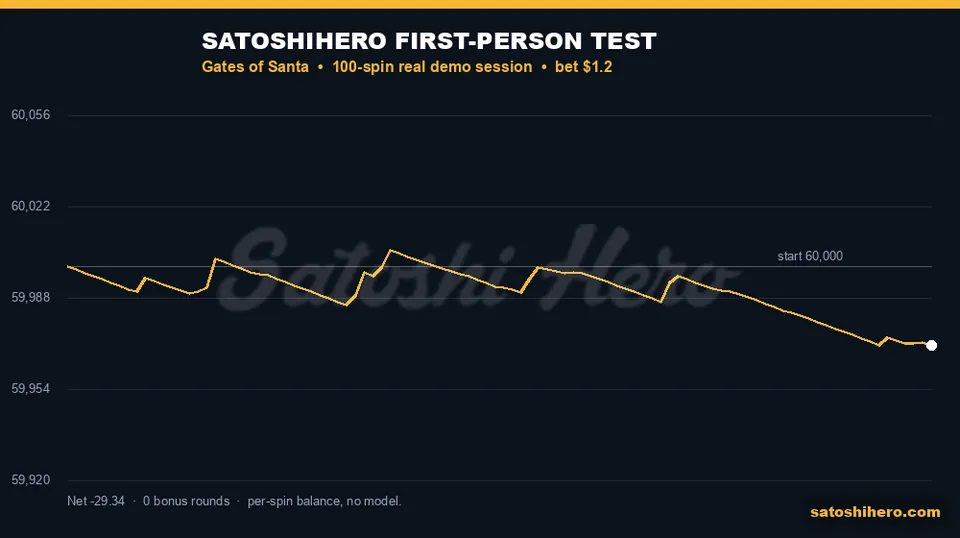
The simulator explores possible outcomes, while my test records events that actually happened. That distinction matters because the model produced bonus-sized and 100x frequency estimates, yet my short run delivered neither. In my view, the contrast explains very-high volatility more clearly than the label alone.
The 96.07% figure is TrueLab’s theoretical return, and one 100-spin session can’t confirm, disprove, or alter it. Simulator results are modeled projections rather than live outcomes. Feature-specific returns can differ slightly by design, so I won’t assign an unsupplied separate figure.
My test ended with a mild loss, while the model showed how much wider longer-session outcomes can become. Keep both evidence types separate when judging the risk.
Frequently Asked Questions About Gates of Santa
How do wins form in Gates of Santa?
Eight or more matching symbols pay anywhere on the 6×5 grid across 8-9, 10-11, and 12-plus count bands. The Gingerbread Man tops out at 50x, while the yellow bauble starts at 0.25x. You don’t trace the eight listed lines because they aren’t fixed paylines.
What happens during Gates of Santa free spins?
Four Snow Globes open 10 free spins at the triggering stake, and three or more during the round add five. Santa Sack values from x2 through x2025 add within each spin before applying to its cascade total. I didn’t trigger the feature during my counted test, so you get no invented payout claim.
Which RTP, volatility, and maximum win apply to Gates of Santa?
The game has 96.07% theoretical RTP, very-high volatility, and a 15,000x maximum win. That cap equals $18,000 at a $1.20 stake. My observed session return was separate and doesn’t replace the theoretical figure.
What happened in the 100-spin Gates of Santa test?
I lost $29.34 after 100 spins, with 23 paying results and a $14.40 largest win. Free spins never triggered. I excluded the extra $2.40 gallery spin because it occurred after the counted test.
How did the 1,000-spin simulator project the session?
The model’s median result was $149.70 down. Its range ran from $533.40 down at the 5th percentile to $707.60 up at the 95th percentile. These figures model possible outcomes rather than predict what you can receive.
Can you buy the bonus in Gates of Santa?
Yes. The Buy Feature costs 100x, equal to $120 at a $1.20 stake. The Bonus Bet adds 25% to each spin and doubles the free-spins trigger chance. I used neither paid option during my test, so you should treat this as rules information only.
Wrap-Up
Gates of Santa stands out through pay-anywhere wins, crisp cascades, and additive Sack multipliers. Its dry feature chase left my counted session without free spins. You get an easy core mechanic, but the upside can stay distant.

My Verdict
Bonus hunters with patient budgets can enjoy the sharp multiplier potential and simple symbol counting. Expect many modest results between meaningful events, and don’t let an absent bonus push you beyond your limit.
I like how quickly the anywhere-win system becomes readable. I don’t like that 23 paying spins returned only $90.66 from $120 wagered. My best $14.40 hit helped, but no tested bonus supports stronger claims.
Gates of Santa rules, figures, and SatoshiHero availability are checked regularly. That process keeps the guide grounded in verified mechanics and my documented play.

Pros:
 Simple win checks: Counting matching symbols feels faster than tracing fixed paylines.
- Strong multiplier ceiling: Additive Sacks can amplify a productive completed cascade.
- Clear tumble feedback: Frost bursts show exactly which winning symbols disappear.
- Flexible access: Standard spins and two optional paid routes support different budgets.

Cons:
 Dry bonus chase: My 100 spins never opened the free-spins round.
- Concentrated buy risk: One $120 purchase matched my full standard-spin wager.
- Small-hit weight: Most paying spins returned $2.40 or less.

Best For: Patient bonus hunters who enjoy pay-anywhere tumbles and can accept quiet stretches. You should prefer visible multiplier mechanics, firm session limits, and simple symbol counting.



































































Bets
All Bets
Game
Player
Date
Wager
Mult.Multiplier
Prize
 Galaxy Glitter
 mike_721
- 18:22:14
- 0×
- Master Joker
 SolesCums
- 18:22:14
- 0×
- Elephant's Gold: Bonus Combo
- nina87
- 18:22:13
- 0×
- Big Bass Halloween 2
 davidm5
- 18:22:13
- 0×
- Master Joker
- SolesCums
- 18:22:12
- 0×
- Phoenix Queen: Hold 'N' Link
 koldun181035
- 18:22:12
- 4.5×
- Big Bass Halloween 2
- davidm5
- 18:22:11
- 1.99×
- Pompeii Gold: Rapid Link Bonus Buy
 mdp0fxo
- 18:22:11
- 0×
- Big Bass Halloween 2
- davidm5
- 18:22:10
- 0×
- Master Joker
- SolesCums
- 18:22:10
- 0×