

PiggyBank - Stacked Fortune
RTP95.83%
VolatilityMedium–high
Max winx1,000
Lines30
Hit rate27.2%
ThemeLuxury life

Chasing Stacked Riches Under the Stage Lights
Spinomenal puts stacked money symbols onstage and lets me choose how the free spins unfold.
PiggyBank – Stacked Fortune is a medium-high volatility slot with 95.83% RTP and 1,000x max win potential. Its 5×3 grid uses 30 fixed paylines, stacked symbols, and selectable Free Spins. Traditional line-slot fans who value clear rules and bonus choice should feel at home.
Key takeaways
- Best bonus: My natural 20-spin mode retriggered to 25 spins and returned 58x.
- RTP / volatility: The theoretical return is 95.83%, paired with medium-high volatility.
- Max win: The 1,000x ceiling feels modest beside this risk level.
- Risk note: You face a 35x Buy Feature price, though I didn’t purchase it.
- Bankroll note: Budget your spins for possible 18-spin droughts and broad modeled outcomes.

Table of Contents
- How PiggyBank – Stacked Fortune works
- Line-win rules
- Wild and stacks
- Free Spins mode choice and test result
- Two mode choices
- My 58x result
- Theatre theme and first impressions
- Symbol values and stacked payouts
- Premium symbols
- Card symbols
- Buy Feature cost
- What the 100-spin session felt like
- Win distribution
- Dry spell and balance
- RTP, volatility and test projections
- Simulator projection
- Our 100-spin session
- Frequently Asked Questions About PiggyBank – Stacked Fortune
- Final Take
How PiggyBank – Stacked Fortune works
PiggyBank – Stacked Fortune uses five reels and three rows, with wins following 30 fixed paylines from left to right. You need at least three matching regular symbols beginning on reel one. I found this structure refreshingly direct, especially after playing slots with less transparent win systems.
My test used $0.01 per line, creating a $0.30 total stake across all 30 lines. The demo opened with a $5,000.00 play balance, and I completed 100 spins. You can try the free demo or real-play game here on SatoshiHero, though your results can differ sharply from mine.
Line-win rules
Matching symbols must start on the leftmost reel and continue across adjacent reels. Every regular symbol pays from three matches, while only the highest award on each payline counts. Separate line wins combine, which can make a plain-looking stop more useful than it first appears.
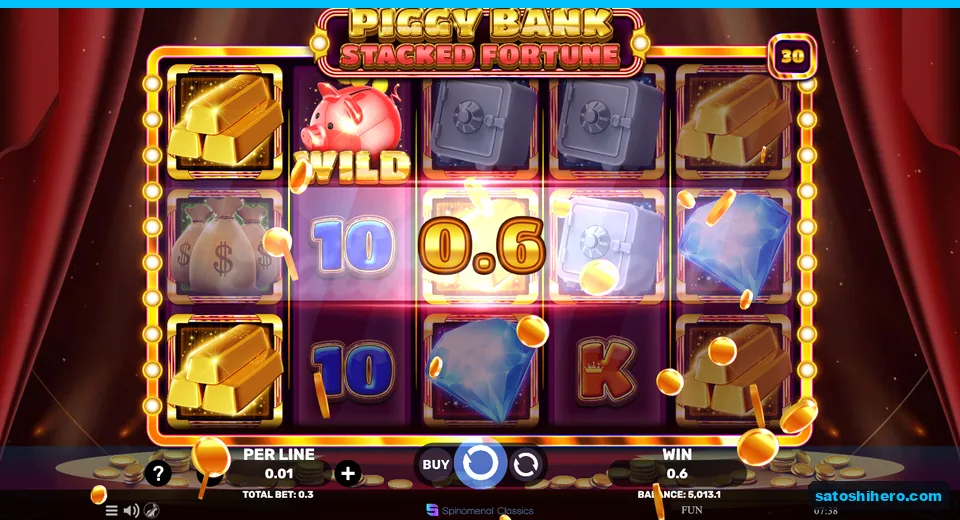
The rules panel lists awards in line-bet units rather than total-stake multiples. I divided those figures by 30 because my $0.30 total bet covered 30 lines at $0.01 each. On spin one, three money bags paid $0.25, exactly matching 25 line bets.
That unit difference matters when you inspect the paytable. You should compare each displayed award with your line stake before judging its value against the full wager. In my view, the game could explain this conversion more clearly inside the interface.
A later $2.00 hit on spin 63 combined nine separate lines using gold bars, safes, and tens. Wild substitution helped some mixed patterns during the test, although the biggest value came from several lines paying together. The fixed-line structure gives you a clean audit trail once you understand the units.
Wild and stacks
The pink piggy bank Wild replaces every symbol except the Free Spins symbol. Five Wilds on one payline pay 33.33x the total stake. A Wild appeared somewhere on 53 of my 100 spins, but you shouldn’t treat that small sample as a formal frequency.

Diamonds, gold bars, money bags, and safes can occupy 1×2 or 1×3 reel spaces. Each stacked version keeps the same value per symbol while covering more positions. You can then connect several paylines through one large premium image, which gives the base game its main spark.
The interface stayed readable on my desktop and at mobile-sized dimensions. Bright premium shapes remained easy to separate from the card symbols, even when stacks filled much of a reel. I think that clarity matters more here than elaborate animation.

Factoid: A displayed 1,000x Wild award uses the line bet. Across 30 paylines, it equals 33.33x the total stake.
Stacked premiums can support several line wins at once, so you should judge the full result rather than one highlighted path. Despite the number in its title, the separate slot Valentine Collection – 10 Lines doesn’t describe this game’s layout; PiggyBank – Stacked Fortune uses 30 fixed paylines. Vegas – Chase’N’Win provides another cash-themed Spinomenal comparison. PiggyBank – Stacked Fortune remains simple, but its overlapping payouts reward careful reading.
Free Spins mode choice and test result
Three or more Free Spins symbols anywhere trigger a choice between 20 spins with 1×2 stacks or 10 spins with 1×3 stacks. Neither option proved mathematically stronger in my test. What grabbed me was the meaningful choice between more attempts and larger symbol coverage.
Two mode choices
The longer mode gives you 20 free spins, with every medium symbol appearing as a 1×2 stack. The shorter mode supplies 10 spins and expands those symbols to 1×3. I chose the 20-spin version because I wanted more chances to see how the feature developed.

Three or more Free Spins symbols during the round add five further spins. A retrigger preserves your chosen mode and stake, while the betting controls remain disabled. You can’t switch stack size midway, which keeps the round consistent but removes any chance to adapt.
In practice, the trade-off felt easy to understand. You get twice as many initial attempts in the longer mode, while the shorter choice fills more of each reel with medium symbols. The decision adds useful agency without pretending that skill changes the random outcome.
My 58x result
My only natural trigger arrived on spin one and returned 58x after the retrigger. Three Free Spins symbols landed again on free spin 15, extending the round from 20 to 25 spins. That immediate hit made the opening unusually exciting, but it also shaped the whole session.
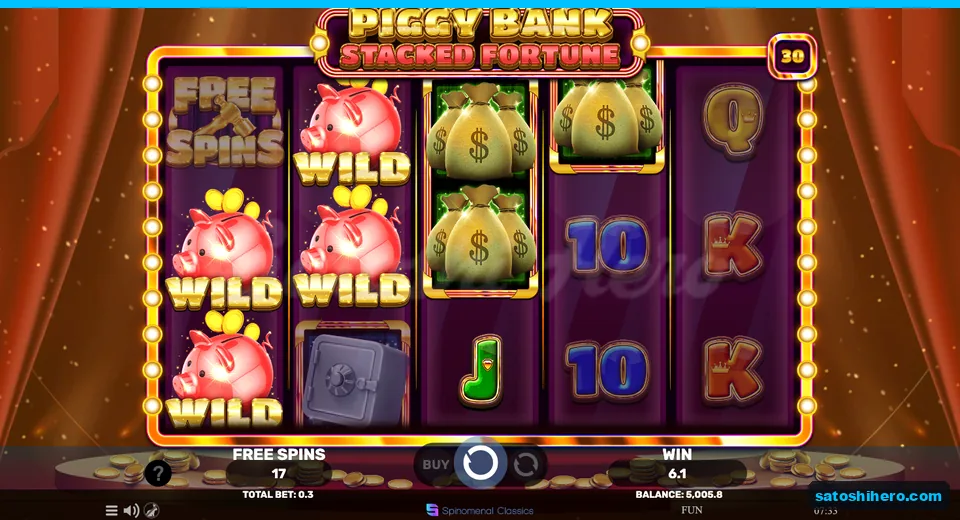
Nine feature spins paid. The leading return was $5.60 on free spin eight, followed by $3.80 on spin ten and $3.25 on spin three. Those three results carried much of the bonus, so the extra spins didn’t create a steady flow of equal wins.
The collect panel showed $17.40, including the $0.25 line win attached to the trigger. My balance moved from $4,999.95 after that line award to $5,017.10 when the feature ended. I liked the visible accounting because it made the 58x result easy to verify.


Tactic: The 20-spin mode offers more attempts with 1×2 stacks, while the 10-spin mode uses larger 1×3 stacks. My 58x result doesn’t establish a stronger long-term choice.
You shouldn’t treat one lively round as proof that longer play performs better. The retrigger helped, yet nine paying spins from 25 still left plenty of blanks. For me, this selectable feature was the clear highlight of PiggyBank – Stacked Fortune.
Theatre theme and first impressions
Spinomenal frames the reels as a theatre stage with red curtains, gold trim, and bright bulbs. The clean scene helps you read stacked symbols quickly. I wouldn’t call the concept original, but it serves the mechanics better than a cluttered backdrop would.
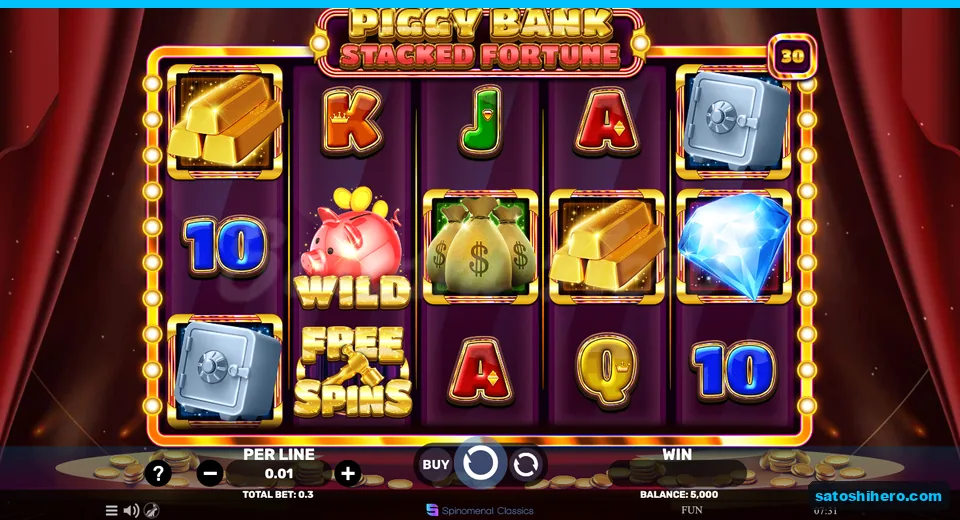
PiggyBank – Stacked Fortune belongs to the Spinomenal Classics range. Its medium symbols show a blue diamond, gold bars, money bags, and a steel safe. A pink piggy bank acts as the Wild, while a dedicated Free Spins symbol handles the bonus trigger.
Ace, king, queen, jack, and ten fill the lower end of the paytable. These card faces won’t win originality awards, though their plain design makes the colorful money symbols stand apart. You can spot premium stacks almost instantly because their shapes and tones differ clearly.

Discovery: The theatre stage is decorative. The main visual idea comes from money symbols expanding into stacked forms across the reels.
My test used a play-money balance, and every amount here appears in dollars and total-bet multiples for consistency. The opening display showed $5,000.00, with a $0.01 line stake and $0.30 total wager. I appreciated seeing both stake levels without opening another menu.
The full frame remained orderly when large symbols landed. Nothing important hid behind the curtains or decorative lights, and the pay information stayed legible. PiggyBank – Stacked Fortune chooses clarity over spectacle, which feels like the right call for its traditional format.
Symbol values and stacked payouts
Diamonds lead the regular paytable, while card symbols mostly produce modest returns. You generally need stacked premiums, overlapping paylines, or Wild help for a meaningful base-game payout. I saw that pattern clearly, as my best separate base hit combined nine winning lines.
Card symbols
| Symbol | Five of a kind | Four of a kind | Three of a kind |
|---|---|---|---|
| Ace | 1.67x | 0.83x | 0.5x |
| King | 1.33x | 0.67x | 0.33x |
| Queen | 1.33x | 0.67x | 0.33x |
| Jack | 1x | 0.33x | 0.17x |
| 10 | 1x | 0.33x | 0.17x |
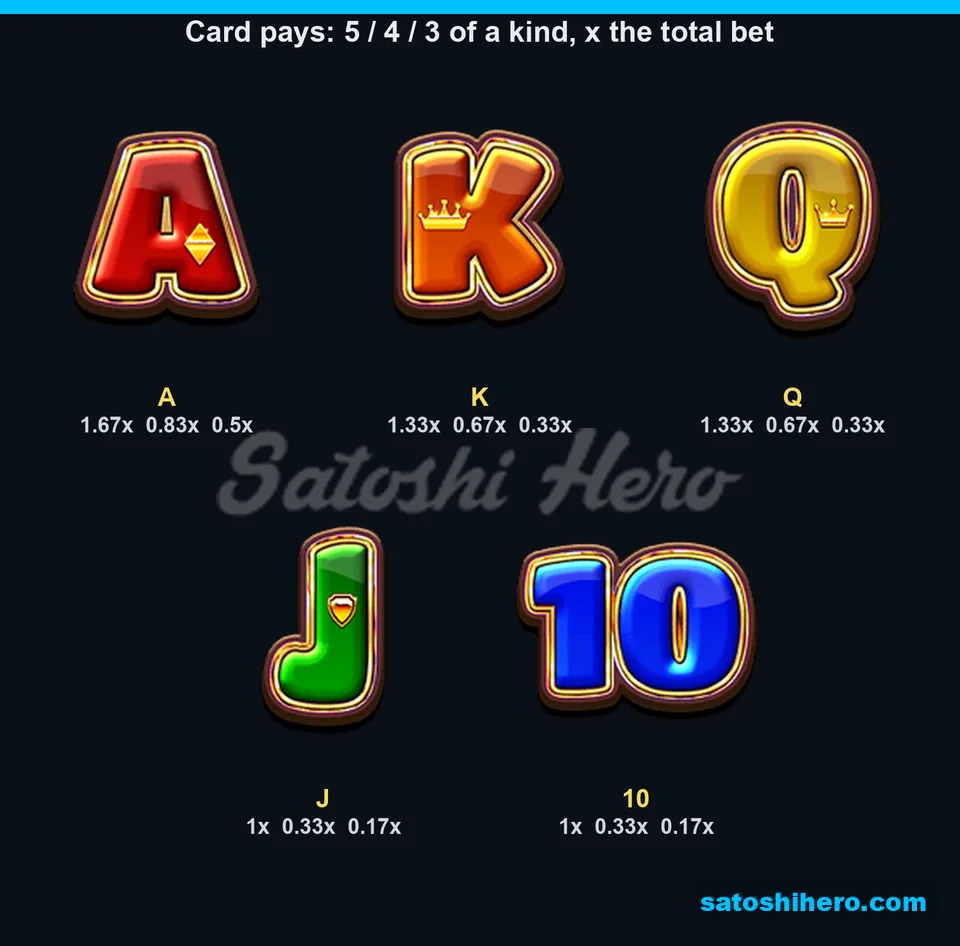
Card symbols commonly return less than the full wager when they pay alone. Several paylines can still combine into something useful, particularly when a Wild links mixed positions. You shouldn’t dismiss a crowded card screen until the game finishes counting every active line.
Valentine’s Fortune feels warmer if you favor romance over cash imagery. Wild Santa – Hold & Hit offers a festive Hold & Hit alternative, while Wild Sailors – Tides Of Adventure shifts the theme to seafaring action. This title makes symbol hierarchy its strongest visual tool, and premium stacks drive its better base-game possibilities.
Buy Feature cost
The Buy Feature showed a 35x price and would start Free Spins immediately. I inspected the window but didn’t buy the bonus, so I have no purchased-round result to report. That evidence limit matters because a natural 58x return says nothing about a paid entry.
At my $0.30 total stake, the displayed purchase price was $10.50. The window let me select a wager before calculating the cost, equal to 35 standard spins. You can understand the commitment instantly, which I prefer over bonus menus with several poorly explained levels.
A 35x entry looks accessible, but the modest top prize changes the risk calculation. You concentrate many wagers into one uncertain round, so I wouldn’t assume better value than a natural trigger.

Proceed Carefully: A feature purchase concentrates 35 regular-spin stakes into one round. My natural trigger returned 58x, but that doesn’t predict a bought round or guarantee cost recovery.
Set a fixed feature-buy budget before opening the window, then judge the $10.50 cost against your full session allowance. You should also remember that the simulator modeled wide outcomes even without treating a buy as guaranteed value. Concentrated risk can shorten a planned session quickly.
I didn’t test another buy setting, average return, or purchased bonus behavior. The cost feels approachable, yet it still compresses 35 spins of exposure into one result.
What the 100-spin session felt like
My 100-spin session finished 11x ahead, but almost all that advantage came from the opening feature. Later play felt far less generous than the closing balance suggests. You should read the positive finish as one bonus-led path, not a typical outcome.
Win distribution
I started with $5,000.00 and finished at $5,003.30 after staking $0.30 per spin. Twenty-four spins paid, including the first-spin feature trigger. I liked finishing ahead, though the underlying distribution looked much rougher than that simple result.
Five wins returned less than 1x, and another five landed between 1x and under 2x. Eleven ranged from 2x to under 5x, while only three reached at least 5x. Most paying stops lacked enough force to rebuild the early peak.
The 58x feature stood far above everything else. Excluding that trigger, my best base result was 6.67x on spin 63, followed by 6.33x on spin 41. You can’t treat the observed 24% paying-spin share as a guaranteed hit rate from such a short test.
Dry spell and balance
My balance reached $5,017.10 immediately after the opening feature. Spins two and three each returned exactly the $0.30 stake, then the balance stayed below its peak from spin four onward. The session never crossed beneath its $5,000.00 starting point.
The longest blank stretch ran for 18 spins, covering spins 45 through 62. Spin 63 finally broke it with the $2.00 combined-line result. I found that drought noticeable because the session had already lost much of its opening momentum.
The lowest balance was the final $5,003.30 reading after spin 100. That odd shape means the session finished ahead while also ending at its weakest post-feature point. You need a spin budget that can absorb uneven spacing, even when one early bonus creates a temporary cushion.
One early event shaped the entire test, making the final 11x profit less impressive than it first sounds.
RTP, volatility and test projections
The theoretical return sits at 95.83%, the volatility is medium-high, and the maximum win reaches 1,000x the stake. This setup can bring dry stretches, while the top prize remains a ceiling rather than a likely result. Frankly, 1,000x feels modest for this risk profile.
You can still see smaller line wins with some regularity, yet their spacing and size can vary sharply. My 18-spin drought and bonus-led finish showed both sides. The simulator offers broader context, but it doesn’t turn random play into a forecast.
Simulator projection
The SatoshiHero Slot Simulator modeled 1,000 spins at a $0.30 stake using the listed game settings. Its median finish landed 52.7x below the starting point. The fifth-to-95th-percentile range stretched from 258x below to 234x above, showing just how broad modeled outcomes can become.
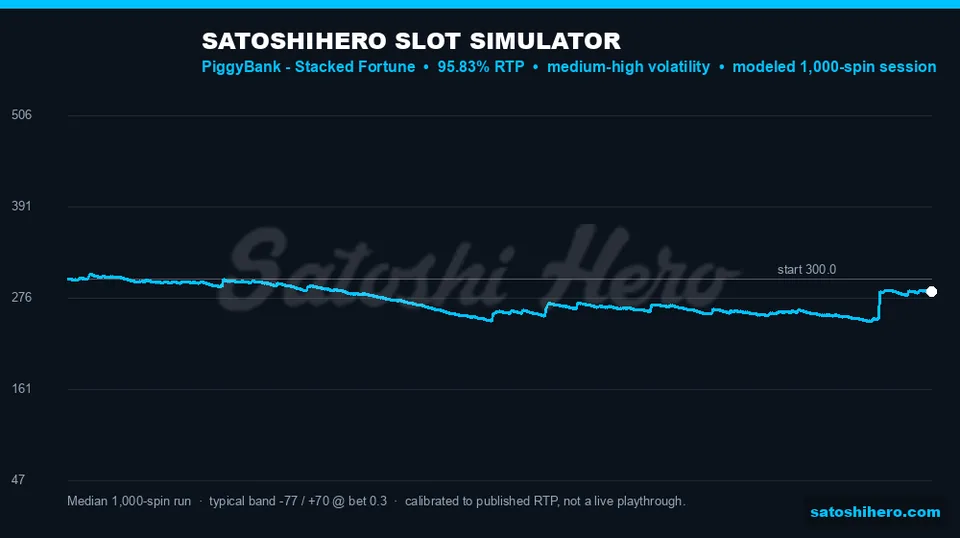
About 21% of modeled spins produced a payout. A feature-sized win appeared roughly once per 45 spins, while a top-end result appeared about once per 3,636 spins. Those estimates describe the model, not a payout schedule or promise for your next session.
You should use the range to understand uncertainty rather than predict a closing balance. A 492x span separates the lower and upper modeled boundaries, so short-term paths can diverge dramatically. I find that spread more useful than the median alone because it exposes the risk directly.
Our 100-spin session
My live test produced 24 paying spins, an opening 58x feature, and an 11x net gain. The balance never dropped below its starting point, although it declined from the feature peak for almost the entire run. That path looked stronger than the model median because a large payout arrived immediately.
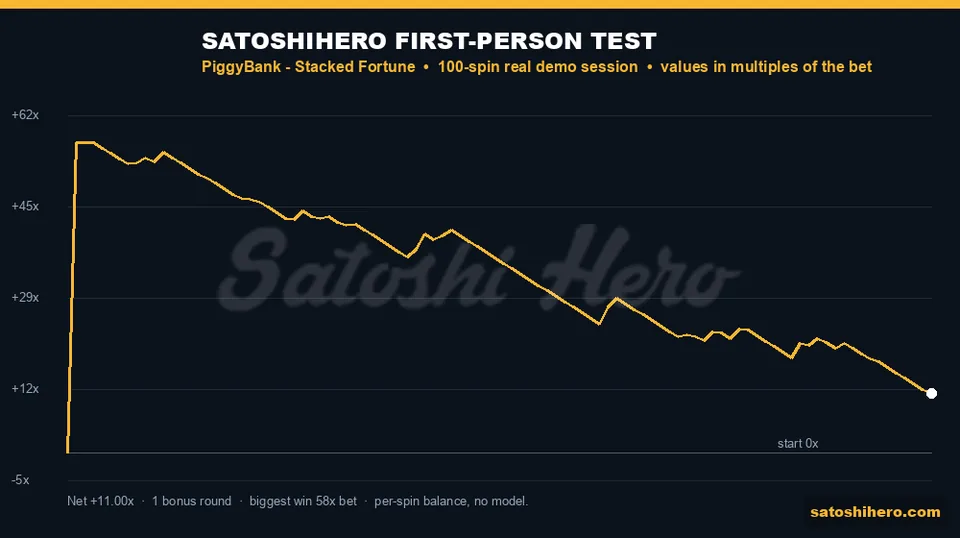
The sample also covered only one tenth of the simulator’s spin count. A lucky first stop protected the balance from the later 18-spin drought and many small wins. You should treat my test as firsthand evidence of session shape, not a forecast.
The 24% observed share and 21% modeled rate don’t prove a trend. I care more that one feature dominated everything that followed.
The 95.83% figure is the operator’s published theoretical return, and one live session doesn’t alter it. The simulator models possibilities rather than predicting anyone’s next result, while feature-specific returns can differ by design. Bankroll planning matters more than expecting either path to repeat.
Frequently Asked Questions About PiggyBank – Stacked Fortune
What are the RTP, volatility, and maximum win of PiggyBank – Stacked Fortune?
PiggyBank – Stacked Fortune has 95.83% theoretical RTP, medium-high volatility, and a 1,000x maximum win. You play five reels, three rows, and 30 fixed paylines. I consider that prize cap fairly restrained beside the risk level.
How do Free Spins work in PiggyBank – Stacked Fortune?
Three Free Spins symbols anywhere let you choose 20 spins with 1×2 medium stacks or 10 spins with 1×3 stacks. Three more trigger symbols during the feature add five spins. My chosen 20-spin mode retriggered to 25 spins and returned 58x, but that doesn’t prove superiority.
What does the piggy bank Wild do in PiggyBank – Stacked Fortune?
The piggy bank Wild replaces every symbol except the Free Spins symbol. Five Wilds on one payline pay 33.33x the total stake. I saw a Wild somewhere on 53 of 100 tested spins, though that isn’t a formal frequency.
How much does the Buy Feature cost in PiggyBank – Stacked Fortune?
The displayed Buy Feature price was 35x the selected total bet. At $0.30, the window showed $10.50 for immediate Free Spins access. I inspected the purchase screen but didn’t buy the round, so no bought result formed part of my test.
What did the 1,000-spin simulator show?
The model’s median finish was 52.7x below the start, with a range from 258x below to 234x above. About 21% of modeled spins paid, and a top-end win appeared roughly once per 3,636 spins. These estimates aren’t a prediction or payout schedule.
How did the 100-spin PiggyBank – Stacked Fortune test go?
I began with $5,000.00 and finished at $5,003.30, an 11x gain. Twenty-four spins paid, while the first-spin feature returned 58x. My best separate base hit was 6.67x, and the balance never fell below its starting point.
Final Take
PiggyBank – Stacked Fortune stands out through clear fixed lines, readable stacks, and a real Free Spins choice. Its main drawback is a restrained prize ceiling beside uneven play.

My Read
Choose this slot when you value transparent paylines and a bonus decision that changes stack size. Expect modest line wins, possible dry spells, and features carrying much of the session value.
I liked my 58x natural feature and its retrigger to 25 spins. I didn’t like how the next 99 spins steadily cut into that early gain. The base game rarely created comparable excitement.
PiggyBank – Stacked Fortune remains a tidy traditional option, with test details checked regularly. You can understand every result, though the risk-to-reward balance won’t satisfy bigger-prize hunters.

Pros:
 Clear paylines: Fixed left-to-right rules make every combined payout easier to verify.
- Useful choice: Two Free Spins modes offer distinct spin-count and stack-size trade-offs.
- Readable stacks: Bright premium symbols stay clear across desktop and mobile-sized screens.
- Accessible buy: The 35x feature price costs less than many bonus entries.

Cons:
 Modest ceiling: A 1,000x cap feels limited beside medium-high volatility.
- Bonus dependence: One early feature created nearly all my session profit.
- Low card values: Many ordinary line wins return only small stake multiples.

Best For: Traditional slot fans who enjoy fixed paylines, stacked premiums, and selectable Free Spins should connect with this format. Careful budget setters can handle its uneven spacing better than anyone chasing constant action.



































































Bets
All Bets
Game
Player
Date
Wager
Mult.Multiplier
Prize
 Luck of Panda: Bonus Combo
 josh1998
- 16:42:36
- 0×
- Le Gift Grabber
 davidm5
- 16:42:33
- 0×
- Winter Express - Triple Train Collect 3x3
 hans.bligx33
- 16:42:33
- 0.99×
- Gems Bonanza
- rsbam242997
- 16:42:31
- 0×
- Le Gift Grabber
- davidm5
- 16:42:31
- 0×
- Gems Bonanza
 jdelfino102
- 16:42:31
- 0×
- Aztec Magic Deluxe
 Hidden
- 16:42:30
- 3.6×
- Gems Bonanza
- rsbam242997
- 16:42:30
- 0.4×
- Gems Bonanza
- jdelfino102
- 16:42:29
- 2.84×
- Winter Express - Triple Train Collect 3x3
- hans.bligx33
- 16:42:28
- 0×