

Frozen Fruits - Chase'N’Win
RTP95.42%
VolatilityMedium–high
Max winx5,000
Lines5
Hit rate17.55%
ThemeFruits

Chasing Heat Across the Frozen Reels
Frozen Fruits – Chase’N’Win packs persistent reel lights, re-spins, and multiplier free spins into Spinomenal’s compact 3×3 fruit slot.
Frozen Fruits – Chase’N’Win is a medium-high volatility slot with 95.42% RTP and 5,000x max win potential. Five fixed paylines and visible bonus progress reward patient line-slot fans, though my $0.05 test lost $4.35 across 100 spins. You can try the free demo or real play on SatoshiHero, but the cold result demands measured stakes.
Key takeaways
- Best bonus: Ten bought free spins cost 102x, but I didn’t test that purchase.
- RTP / volatility: The game carries a 95.42% theoretical return and medium-high volatility.
- Max win: The maximum award reaches 5,000x your total bet.
- Risk note: Two separate 30-spin droughts helped leave my session 87x down.
- Bankroll note: Keep stakes modest because one lit reel doesn’t put free spins within easy reach.

Table of Contents
- How Frozen Fruits – Chase’N’Win Works
- Five-line wins
- Symbol values
- Chase! Scatter and Re-spins
- Lighting the reels
- What happened live
- Theme and First Impressions
- Chase’N’Win Free Spins
- Multiplier progression
- Extra free spins
- The 102x Buy Feature
- How the 100 Spins Played
- Winning spins
- Longest dry spells
- RTP, Volatility and Our Test
- Simulator projection
- Our 100-spin session
- Is the Risk Profile a Good Fit?
- Frozen Fruits – Chase’N’Win FAQ
- Final Take
How Frozen Fruits – Chase’N’Win Works
This three-reel, three-row slot pays matching symbols from left to right across five fixed paylines. Every standard win needs three matching symbols because the grid has only three reels. If several prizes appear on one line, only its highest prize counts. You can check each outcome quickly on mobile or desktop because the small grid stays clear.
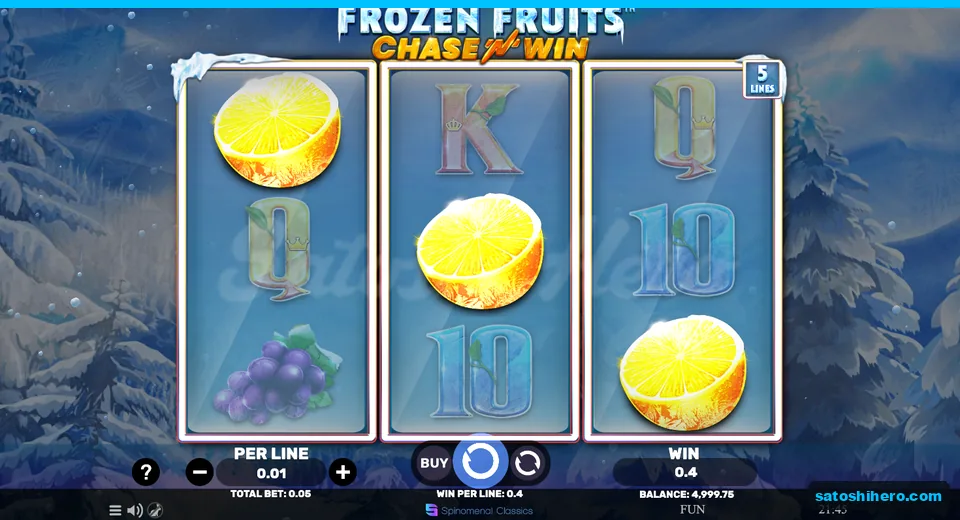
The rules express prizes against my $0.01 line bet, not the complete $0.05 wager. Dividing a listed line prize by five converts it into total-bet multiples. I confirmed that unit on spin 14, when three oranges paid $0.40. That result equals 40 line bets, yet only 8x my full wager.
Five-line wins
These are genuine paylines rather than a ways-to-win mechanic. Each line traces a fixed route through the three reels, including straight and diagonal patterns. A match must begin on the leftmost reel and continue across all three positions. You don’t receive a standard symbol payout for two matching icons.
To read any paytable figure, compare it first with your line stake. Then compare the cash result with the combined cost of all five lines. This distinction matters because the displayed values can look far larger than their full-wager equivalents. I like the quick verification here, since a 3×3 result never needs much untangling.
Symbol values
The fruit paytable keeps a short, familiar hierarchy. These values use your total bet:
- Three watermelons pay 24x.
- Three bunches of grapes pay 12x.
- Three oranges pay 8x.
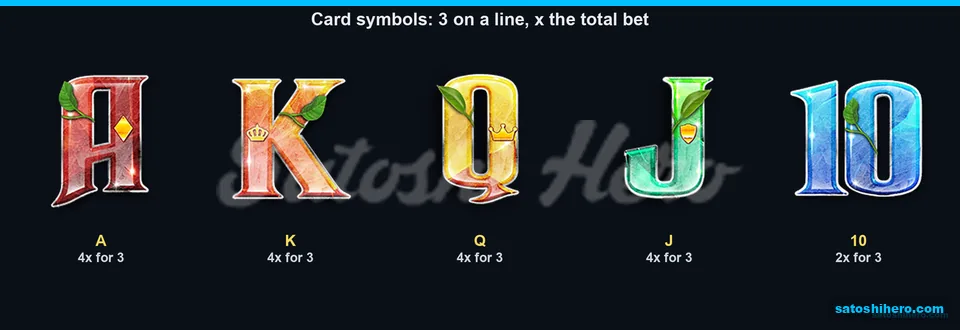
- Three A, K, Q, or J symbols pay 4x.
- Three tens pay 2x.
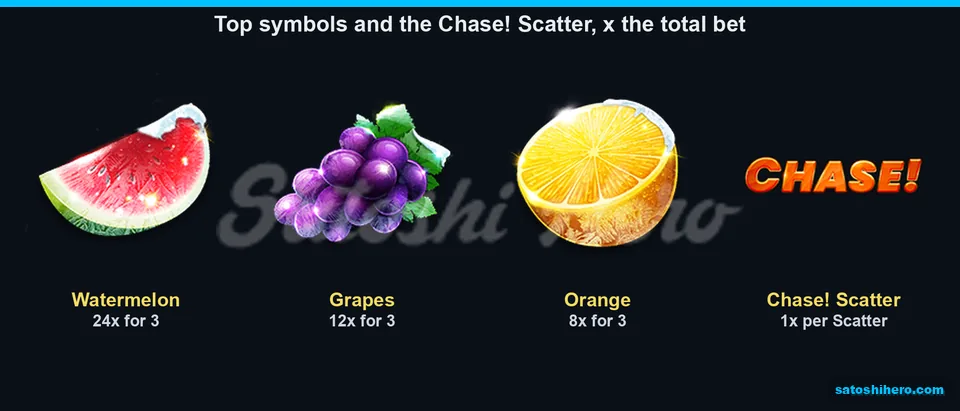
No Wild appears in the rules, so you need natural matches on the fixed paylines. Watermelon offers the strongest regular line prize, while the card ranks fill out the lower end. If you enjoy icy fruit art but prefer more lines, Fruits On Ice Collection – 40 Lines offers a denser layout than this deliberately compact setup.

Factoid: The displayed 40x orange prize uses the line bet, so it equals 8x the complete five-line wager.
Understanding those line-bet units stops the prize list from looking five times more generous than it is.
Chase! Scatter and Re-spins
Each Chase! Scatter pays 1x your total bet, lights its reel, and can begin one re-spin. One or two lit reels grant a re-spin, while every active light persists through that sequence. Lighting all three reels starts ten free spins. You can separate the instant Scatter payment from the larger three-light objective.
Two Chase! symbols on one result pay 2x, while three pay 3x. The payment counts each symbol, but the progression counts which reels become lit. That difference is simple once you see it, and I find the visual feedback clearer than many hidden collection meters.
Lighting the reels
A single Chase! activates only the reel where it lands. Its light matters if another Chase! appears during the following re-spin, allowing the sequence to continue. Without that follow-up, the short route ends before you build meaningful momentum. You shouldn’t read one orange word symbol as proof that the bonus sits close.
The persistence sounds generous, yet it only operates during consecutive feature activity. Once the re-spin chain stops, that attempt hasn’t completed the three-reel target. This mechanism creates visible tension without making the trigger complicated. For you, patience matters more than trying to predict the next symbol.
What happened live
Single Chase! symbols appeared on spins 6, 45, and 83 during my 100-spin run. Each one returned $0.05, exactly 1x my bet, and granted a single re-spin. None of those re-spins produced another Chase! or any extra payment. I saw three promising starts, but every sequence ended immediately.
That observed pattern doesn’t establish a trigger rate. It simply shows how quickly one lit reel can fizzle when the follow-up misses. You still receive the 1x Scatter payment, although that small return barely softens the cost of surrounding losses.

Tactic: One Chase! gives you only one re-spin, so don’t increase your stake because the free spins seem close.
The route makes sense after one encounter, but completing all three reel lights can demand real patience.
Theme and First Impressions
A snowy pine forest, white ice frame, and frost-covered fruit give this classic theme a crisp winter finish. Snow caps the reel housing, while frosted lettering sits above the uncluttered 3×3 grid. Watermelon, grapes, and orange arrive dusted with ice. You can follow line wins and lit reels without visual clutter, which is the design’s strongest quality.
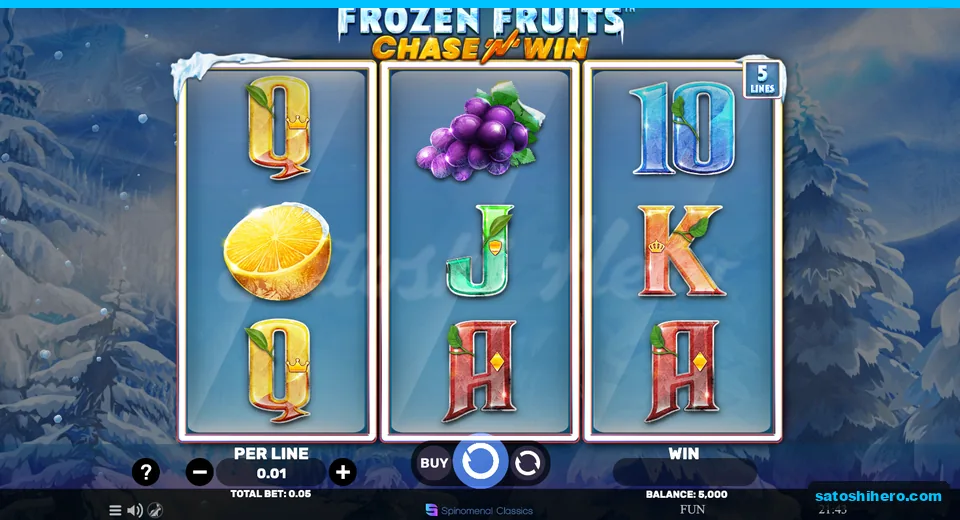
Leaf-marked A, K, Q, J, and 10 symbols fill the lower ranks. The orange Chase! word symbol cuts sharply through the blue-white scene, making feature activity obvious. My demo balance appeared as play money, though I recorded every stake and return in dollars. I don’t think the fruit theme wins originality points, but the cold treatment looks clean.

Discovery: Orange Chase! lettering breaks the blue-white palette, helping you spot the feature symbol against the frozen backdrop.
Mega Wild Fruits – Xmas offers another seasonal spin on familiar fruit symbols if the wintry backdrop attracts you. Frozen Fruits – Chase’N’Win feels more restrained, with its tiny reel set and strong focus on lit-reel progress. That restraint works well on a small screen, where busy animation could obscure the five line paths.
Fruits On Ice Collection – 30 Lines takes chilled fruit styling into a denser line format. This game’s tighter presentation gives you fewer routes to inspect and a faster visual read. The trade-off is a plainer base screen with less spectacle between feature symbols. You’ll appreciate it most when clean, readable reels matter more than elaborate animation.
Chase’N’Win Free Spins
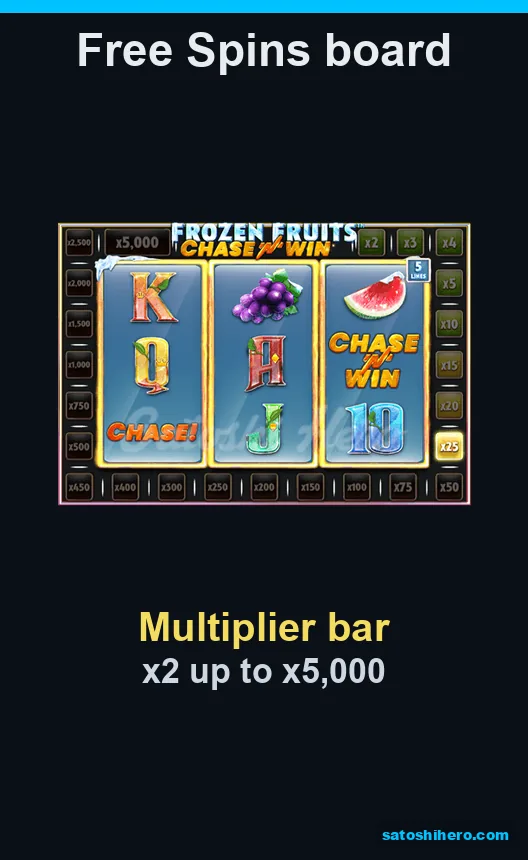
Lighting all three reels awards ten free spins and activates a multiplier-cell frame around the grid. The feature didn’t trigger during my 100 spins, so the description here comes from the rules and feature display. You should treat it as documented behavior rather than my observed outcome. That distinction matters because I can’t judge its typical return from play.
Multiplier progression
The frame runs from x2 through x5,000. Every Chase’N’Win symbol fills one cell, and the last filled cell determines the final total-bet multiplier. This isn’t a standard multiplier attached to every line win during the round. Progress through the frame drives the final feature award instead.
That structure makes each special symbol more important than ordinary line accumulation. Reaching a later cell can increase the closing value, but nothing in my test supports assuming deep progress. I like the visible ladder because you can understand the goal instantly. Still, the top cell represents a ceiling, not a likely stopping point.
Extra free spins
Every Chase! Scatter inside the feature adds five free spins. Your line bet remains the same as the triggering spin, keeping the original five-line stake in place. Extra spins create more opportunities to fill cells, but they don’t promise a particular multiplier. You need both added time and further Chase’N’Win symbols for progress.
Keep this behavior separate from the base-game re-spins. Chase! extends the bonus after activation, whereas the lit-reel sequence opens the bonus beforehand. That clean split makes the rules easier to follow than the feature name first suggests. In practical terms, the last filled cell matters more than ordinary line wins here.
The 102x Buy Feature
The BUY button can start ten Chase’N’Win free spins for 102x your total bet. At my $0.05 stake, the window quoted $5.10 for immediate entry. I didn’t purchase it, so I have no first-person buy return to report. You get convenience, but you also compress 102 standard wagers into one outcome.
That concentration changes the session more than the modest cash figure first suggests. My entire 100-spin base test cost less in gross stakes than one purchase price, before accounting for returns. I prefer the lower-stake base route on this evidence because it gives the Chase! sequence more chances to develop. The buy could finish quickly without delivering a result that covers its cost.
Ask yourself whether you’re comfortable risking 102 wagers before opening the window. No tested evidence supports calling the purchase stronger than ordinary play, and I won’t imply an improved return. It simply skips the reel-light chase and places you inside the multiplier feature. That shortcut has value only if concentrated exposure matches your tolerance.

Proceed Carefully: A 102x purchase can remove a large share of your session balance in one result, especially with medium-high volatility.
Immediate access is convenient, but the concentrated cost makes restraint the stronger default.
How the 100 Spins Played
My 100-spin session finished $4.35, or 87x, down after only five paying spins. I started with $5,000.00 and ended at $4,995.65 while betting $0.01 on each line. The five-line total was $0.05 per spin. You shouldn’t treat this short sample as a replacement for the game’s theoretical math.
The balance peaked at $4,999.95 after spin 1 and never returned to its starting point. My finishing balance also marked the session low. That one-way drift made the run feel colder than its few winning moments suggest. You could see every small recovery disappear beneath the steady cost of non-paying results.
Winning spins
Only five spins returned money. Three single Chase! results each paid $0.05, while three tens on spin 52 paid $0.10. My best hit came on spin 14, when three oranges crossed a diagonal line for $0.40. That 8x result moved my balance from $4,999.40 to $4,999.75.
The three Chase! payments landed on spins 6, 45, and 83. Each subsequent re-spin lost, and the free-spins feature never opened. An 8x high point couldn’t offset the repeated $0.05 deductions. I found the gap between visible feature teases and actual progress rather severe.
You can also see how the paytable behaves in cash terms. The 2x tens result recovered two wagers, while the best fruit hit recovered eight. Neither outcome produced lasting balance momentum. Small line prizes need broader support when the paying-spin count falls this low.
Longest dry spells
The first 30-spin losing stretch ran from spins 15 through 44. A second drought of equal length covered spins 53 through 82. Together, those gaps dominated the session’s rhythm and made each lone Chase! feel more hopeful than valuable. You need room for quiet sequences if your play resembles this sample.
A short test can run much colder than a broader model without changing the underlying game. Even so, lived variance matters when deciding whether the pace feels enjoyable. I didn’t enjoy watching both brief recoveries dissolve across long blank runs. The sparse five-win sample made modest staking essential, especially after the balance failed to recover from spin 1.
RTP, Volatility and Our Test
The official profile combines 95.42% RTP, medium-high volatility, and a 5,000x maximum win. That return describes the game’s theoretical math, not a promise for your session. Uneven payouts and extended quiet periods fit the stated risk level. I find the win cap substantial for such a small grid, though an upper-end hit remains rare.
Published math, simulated paths, and live play answer different questions. The RTP defines the mathematical return, the model explores possible distributions, and my session records one real sequence. You should use all three without treating any short run as destiny.
Simulator projection
The SatoshiHero Slot Simulator modelled 1,000 spins at a $0.05 total bet. Its median session finished 64x below the starting balance. The fifth-to-95th-percentile range stretched from 270x down to 230x up, showing a wide set of plausible paths. Roughly 21% of modelled spins paid.
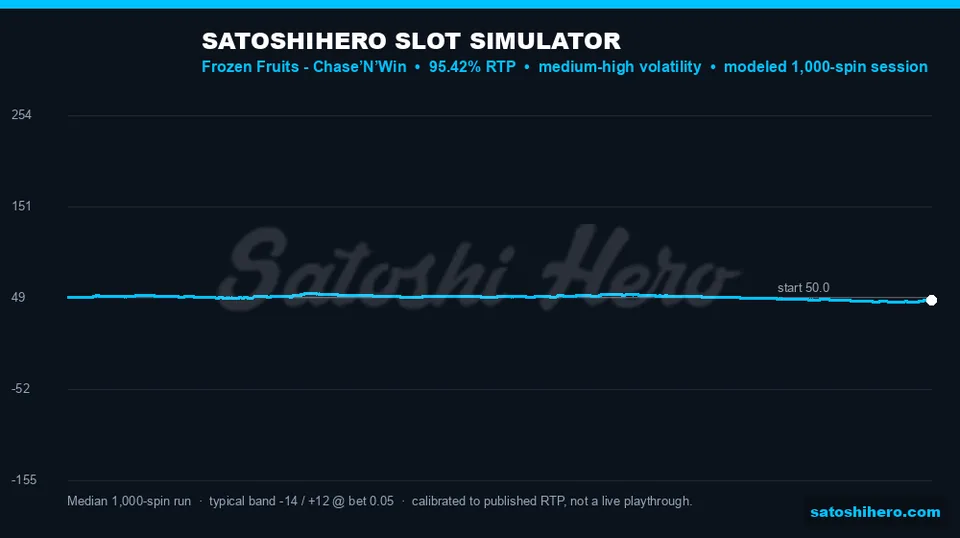
A top-end win appeared approximately once per 3,460 modelled spins. That estimate isn’t a countdown, and you shouldn’t expect a peak result after any set number of attempts. The blue graph represents one simulated route rather than a forecast for your balance. I find the broad outcome range more useful than the single path line.
The negative median doesn’t mean every 1,000-spin run loses exactly 64x. Sessions can sit elsewhere inside or outside the central range. Variance spreads results unevenly, especially when rare large prizes influence the game math. Treat the model as a risk map, not a schedule.
Our 100-spin session
My observed paying-spin rate was 5%, far below the model’s approximate 21%. The sample also shrank from 1,000 modelled spins to 100 live spins, so the methods and sizes differ sharply. My balance fell from $5,000.00 to $4,995.65. Both 30-spin droughts show how violently a small sample can diverge from a broader projection.
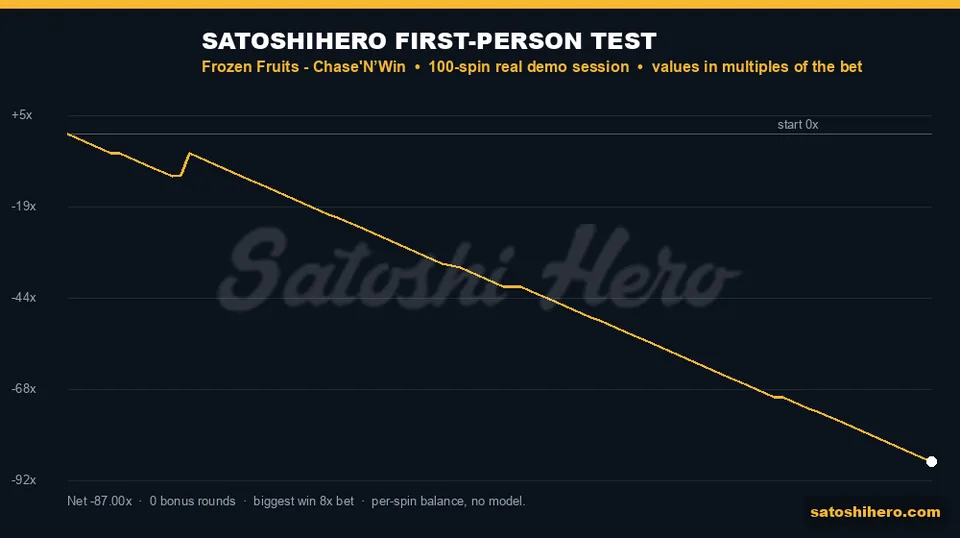
That contrast doesn’t prove the model wrong or redefine the game. It captures a cold live path with too few events to resemble the larger distribution. You can encounter a similarly harsh spell even when the model reports more frequent returns overall. I value this mismatch because it exposes practical short-run risk better than a smooth average does.
The 95.42% figure is the operator’s published theoretical return, while one 100-spin session doesn’t alter it. The simulator models possible outcomes rather than recording actual play. Feature-specific returns can differ by design when the interface supplies them, but I haven’t inserted a separate figure here. My test reveals short-run risk, while the published math remains the right basis for understanding the game.
Is the Risk Profile a Good Fit?
This slot fits patient fixed-line fans better than anyone seeking frequent base-game returns. You get simple line evaluation, visible reel-light progress, and a meaningful prize ceiling. In exchange, you must accept long quiet runs before the three-reel Chase! sequence completes. I think that trade feels demanding on such a small, traditional grid.
Frozen Fruits – Chase’N’Win makes sense when you value a clear feature target over constant feedback. One Scatter isn’t evidence that free spins sit nearby, as all three of my re-spins ended without progress. The two 30-spin droughts also show why modest base stakes matter. You shouldn’t assume a larger balance changes the odds or prevents a cold sequence.
Frequent-win seekers could find the base game too sparse. The 102x buy also looks uncomfortable when you dislike placing many wagers into one result. Still, the rules stay simple, and each reel light tells you exactly what remains. That transparency gives the chase more purpose than a hidden meter would.
Choose modest base-game stakes if you value the mechanic. Look elsewhere when frequent feedback matters more than the top prize.
Frequently Asked Questions
What are the RTP, volatility, and maximum win in Frozen Fruits – Chase’N’Win?
Frozen Fruits – Chase’N’Win has a 95.42% RTP, medium-high volatility, and a 5,000x maximum win. It uses three reels, three rows, and five fixed paylines. Three matching symbols must connect from left to right for a standard line prize.
How do the Chase! Scatter and re-spins work in Frozen Fruits – Chase’N’Win?
Every Chase! pays 1x the total bet and lights the reel where it lands. One or two lit reels grant one re-spin, and those lights persist through consecutive re-spins. Lighting all three reels starts ten free spins.
What happens in the Frozen Fruits – Chase’N’Win free spins?
A multiplier frame runs from x2 to x5,000 around the grid. Each Chase’N’Win symbol fills one cell, and the last filled cell sets the final total-bet multiplier. Every Chase! adds five spins, but the feature didn’t trigger during my test.
Can you buy the free spins in Frozen Fruits – Chase’N’Win?
Yes. The purchase opens ten Chase’N’Win free spins and cost $5.10 at my $0.05 total bet, equal to 102x. I didn’t buy it, so I can’t report a first-person purchase result.
What did the Frozen Fruits – Chase’N’Win 1,000-spin simulator show?
The median modelled run ended 64x down. Its fifth-to-95th-percentile range spanned 270x down to 230x up, with roughly 21% of spins paying. A top-end result appeared approximately once per 3,460 modelled spins, but those outcomes aren’t promises.
How did my 100 spins on Frozen Fruits – Chase’N’Win go?
I lost $4.35, equal to 87x my $0.05 bet, and only five spins paid. Three oranges on spin 14 delivered my best result at $0.40, or 8x. Two 30-spin droughts occurred, and free spins never triggered.
Final Take
Frozen Fruits – Chase’N’Win turns a tiny fruit grid into a clear chase through reel lights and multiplier cells. My cold session exposed its slow, unforgiving base-game pace.

My Read
Patient line-slot fans can enjoy the visible Chase! progression at modest stakes. You should expect uneven feedback, short re-spin teases, and free spins that could remain out of reach.
I like how quickly I can verify every line and understand the bonus target. I don’t like that three Chase! starts produced no progress during two long droughts. The untested buy costs too much for me to treat it casually.
Frozen Fruits – Chase’N’Win earns attention through clarity rather than spectacle. Its paytable and mechanics are checked regularly, making disciplined base play sensible.

Pros:
 Clear progression: Lit reels show how close the free-spin trigger sits.
- Readable grid: Three reels make every line result quick to verify.
- Useful ceiling: The top prize adds ambition to a compact format.
- Distinct feature symbol: Orange lettering stands out immediately against the icy palette.

Cons:
 Cold base game: Two 30-spin droughts made my session feel punishing.
- Weak re-spins: All three observed re-spins ended without another payment.
- Costly purchase: The 102x buy concentrates too much risk into one result.

Best For: Patient fixed-line fans who value simple rules, visible progress, and a substantial ceiling. You need comfort with sparse returns and should keep base stakes modest.
Similar Games

































































Bets
All Bets
Game
Player
Date
Wager
Mult.Multiplier
Prize
 Luck of Panda: Bonus Combo
 josh1998
- 16:52:36
- 0.29×
- Luck of Panda: Bonus Combo
- josh1998
- 16:52:33
- 0×
- Pompeii Gold: Rapid Link Bonus Buy
 mdp0fxo
- 16:52:33
- 0×
- Gems Bonanza
 rsbam242997
- 16:52:29
- 0.2×
- Winter Express - Triple Train Collect 3x3
- hans.bligx33
- 16:52:28
- 0×
- Aztec Magic Deluxe
 Hidden
- 16:52:28
- 0×
- 3 Royal Bags. Christmas edition
 jdelfino102
- 16:52:28
- 0×
- Gems Bonanza
- rsbam242997
- 16:52:27
- 0×
- Red Hot 100
 Hidden
- 16:52:25
- 0×
- Gems Bonanza
- rsbam242997
- 16:52:25
- 0.2×