

The Dog House Megaways
By pressing play, you agree that you are above legal age in your jurisdiction and that your jurisdiction allows online gambling.

The Dog House Megaways
RTP96.55%
VolatilityVery high
Max winx12,305
Ways117,649
ThemeFantasy
ReleasedAug 2020

Backyard Dogs With Bite
The Dog House Megaways looks cheerful at first, but its very-high volatility bites fast. The Dog House Megaways is a bonus-hunt slot built around shifting Megaways reels, tumbles, and multiplier wilds rather than steady base-game drip. My test session showed the main trade clearly: long cold stretches can drain the balance, then one Sticky Wilds round can flip the result. Demo mode is the right first stop if you want to feel that swing before playing for real on SatoshiHero.
Key takeaways
The Dog House Megaways is a very-high volatility slot from Pragmatic Play with 96.55% RTP and 12305x max win potential. The game uses a 6-reel Megaways layout with up to 117,649 ways and two distinct free-spin choices, so the main appeal is feature pressure rather than steady base-game income. Bonus hunters with enough patience for dry stretches can test $0.20 to $100 bets, demo play, and real-money play on SatoshiHero, while jackpot seekers should know there is no separate progressive prize above the stated cap.
- Best bonus: Sticky Wilds gives you locked multipliers and patient build-up, while Raining Wilds gives you more spins and faster action.
- RTP / volatility: The official RTP is 96.55%, volatility is very-high, and you should expect sharp swings.
- Max win: The top prize is 12305x your stake, driven by wild multipliers inside free spins.
- Risk note: The slot uses up to 117,649 Megaways, not fixed paylines, so bigger grids can appear without steady wins.
- Bankroll note: My 500-spin demo session finished +$50.30 only because one Sticky Wilds feature landed near spin 350.

Table of Contents
- How The Dog House Megaways Works
- Ways, not lines
- Symbol pay tiers
- Theme & First Impressions
- Backyard setup
- Cute but sharp
- Tumbles and Wild Multipliers
- Tumble chains
- Multiplier stacking
- Sticky Wilds Free Spins
- Locked wilds
- Best-fit player
- Raining Wilds Free Spins
- Fresh wild drops
- Spin volume
- Bonus Buy Testing
- Sticky buy result
- Raining buy result
- RTP, Volatility & Our Test
- Simulator projection
- Our 500-spin session
- How It Played at $2 Stakes
- Cold base game
- One-round swing
- Frequently Asked Questions About The Dog House Megaways
- Final Thoughts
How The Dog House Megaways Works
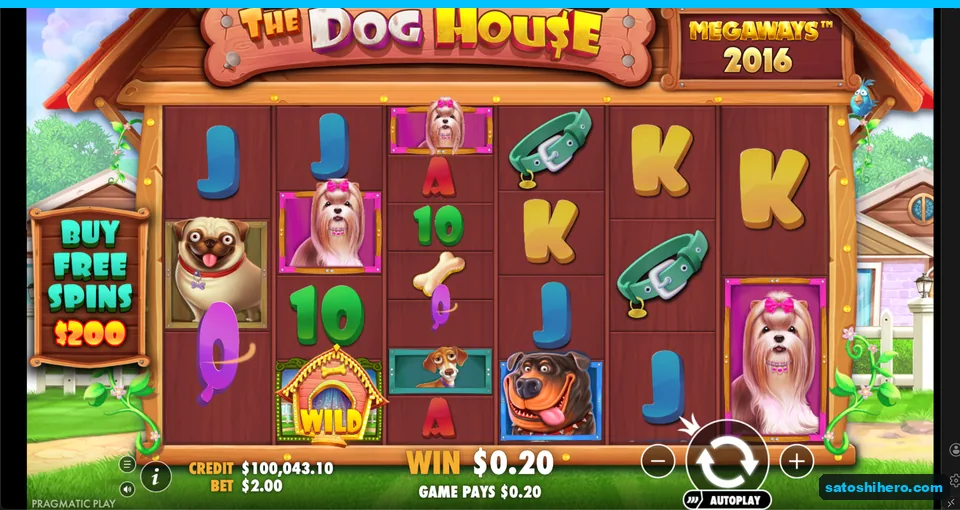
The Dog House Megaways uses a 6-reel Megaways engine, so changing reel heights create up to 117,649 ways to win. You don’t play fixed paylines here; wins pay left to right across adjacent reels from the leftmost reel, with only the highest win per way counted. I like that The Dog House Megaways makes this clear once you check the rules screen, because calling it a payline game would misrepresent how the board pays.
Ways, not lines
Each reel can show a different number of symbols, so the grid shifts on every spin. You might see a tight board one moment, then a much wider setup on the next paid spin. That makes the base game feel more animated, but it doesn’t turn every tall grid into a meaningful hit.
Mobile and desktop play use the same core mechanics, so you aren’t losing features when you switch screens. I’d still test the pace in the demo first, because tumbles and multipliers can make the round feel faster than the stake suggests.
Symbol pay tiers
The four dog symbols sit at the top of the paytable at my $2 stake: the Rottweiler pays $15 for six, $6 for five, $4 for four, and $1.50 for three. The Yorkshire terrier pays $6, $3, $2, and $1, while the pug pays $4, $2, $1.50, and $0.70. The beagle pays $3, $1.50, $1, and $0.40, so the premium ladder is clear but still dependent on width, adjacency, and multiplier placement.
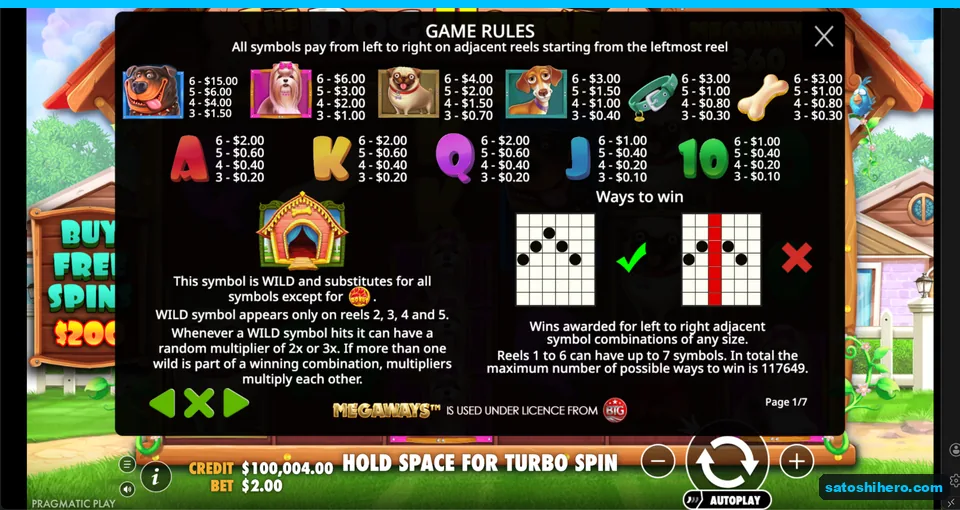
The collar and bone biscuit share the next tier, paying $3, $1, $0.80, and $0.30. A, K, and Q pay $2, $0.60, $0.40, and $0.20, while J and 10 pay $1, $0.40, $0.20, and $0.10. Bigger grids help because they create more available ways, but the real volatility comes from multiplier wilds connecting during tumbles and free spins.
Theme & First Impressions
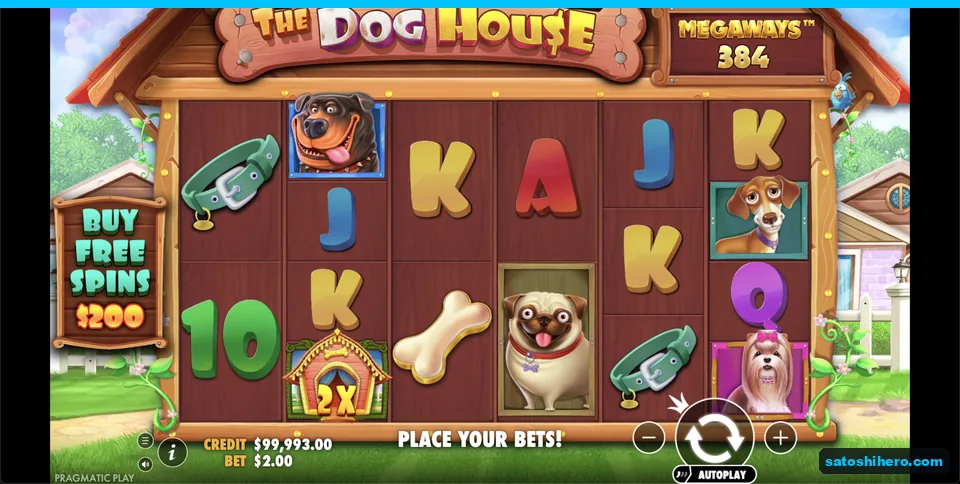
The theme looks light and friendly, but the game plays much sharper than its sunny backyard suggests. You get a bright suburban yard, white fences, blue sky, and a wooden kennel packed with cartoon dogs. It feels familiar from The Dog House, though this version swaps the steadier classic frame for wider Megaways variance. I think the friendly theme won’t fool you after a few cold base-game stretches.
Backyard setup
The art keeps everything readable. Dogs fill the premium symbol set, the kennel anchors the background, and the low symbols stay easy to separate at speed. You don’t need a noisy screen to understand what matters, which helps when tumbles start moving quickly.
The Dog House – Royal Hunt leans into another character-led branch of the same family feel, but this slot keeps the garden setting closer to the original tone. That comparison helps if you like the brand style yet want a harsher math profile.
Cute but sharp
I like the contrast between the soft art and the rough volatility. It makes the cold spells feel more surprising, especially when nothing meaningful lands for several spins. You see cheerful dogs, but the bankroll line tells a tougher story.

Did You Know? Backyard dog themes work because they feel safe and familiar, which makes the sharp math underneath feel even more dramatic.
The presentation stays clean rather than flashy. That’s fine by me, because the game’s bite comes from the feature system, not from visual noise. You get a simple look, but the math profile remains unforgiving.
Tumbles and Wild Multipliers
Every win triggers a tumble, and wild multipliers can turn one paid spin into a much larger chain. Winning symbols clear, new symbols drop into place, and one spin can produce several paid steps before the grid settles. That keeps you watching even during smaller hits, because a fresh drop can connect with a wild. I think The Dog House Megaways gets most exciting when a modest way suddenly gains multiplier pressure.
Tumble chains
Tumbles matter because they give each paid spin extra chances to improve. You don’t just collect the first win and move on. The board keeps trying until no new winning way forms, which can feel strong even though many chains still end quickly.
The doghouse wild substitutes for every symbol except the Bonus scatter. In the base game, it only appears on reels 2, 3, 4, and 5. You should care about that reel range, because wilds need useful positions to shape real wins.
Multiplier stacking
Base-game wilds carry random 2x or 3x multipliers. If more than one wild joins the same winning way, those multipliers multiply together instead of adding. Two 2x wilds make 4x, while a 2x and 3x make 6x.

Quick Fact: Wild multipliers multiply together when they join the same winning way, which is why one feature can escalate fast.
I watched a 2x and 3x doghouse sit together in the base game, and that’s where the cute slot starts showing its teeth. You still need them inside a paying way, though. Wilds look exciting on screen, but they matter most when they connect with real symbol paths.
Sticky Wilds Free Spins
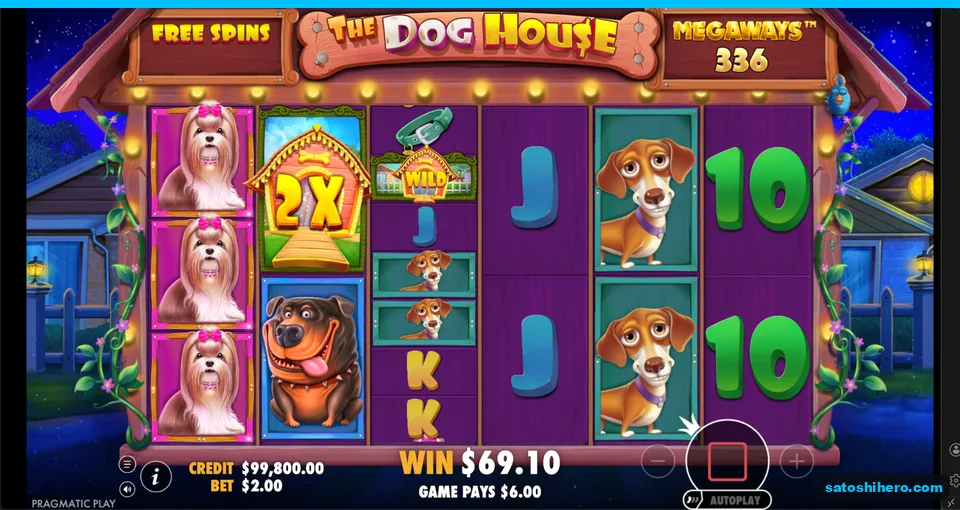
Sticky Wilds is the slower free-spin path, but it gives the best build-up because wilds lock for the full round. Three or more Bonus scatters trigger the feature choice. You get 7 spins for three scatters, 12 for four, 15 for five, and 20 for six. I like this path more when I’m willing to wait, because locked multipliers can change the whole board late.
Locked wilds
Every wild that lands stays locked until the feature ends. It keeps its 1x, 2x, or 3x multiplier, and the reel holding it stays at least as tall as the number of locked wilds. That rule gives the bonus a gradual accumulation pattern rather than a single-spin lottery feel.
Sticky Wilds can’t be retriggered, so you need the original spin count to do the work. The Dog House Multihold also plays with held-value tension, but this feature uses locked wild positions to create its pressure. You feel that build more clearly when the reels start preserving height.
Best-fit player
Sticky Wilds rewards patience. The first few spins can look quiet, then one tumble can pull the whole round into shape. I think this path gives the cleaner route to a serious multiplier stack, even though it can feel slow at first.
In my feature, the real value came from waiting for the board to improve rather than expecting instant fireworks. You need to be comfortable watching dead or low-value spins inside the bonus. Sticky is the path for patient bonus hunters who can sit through quiet spins while the grid builds.
Raining Wilds Free Spins
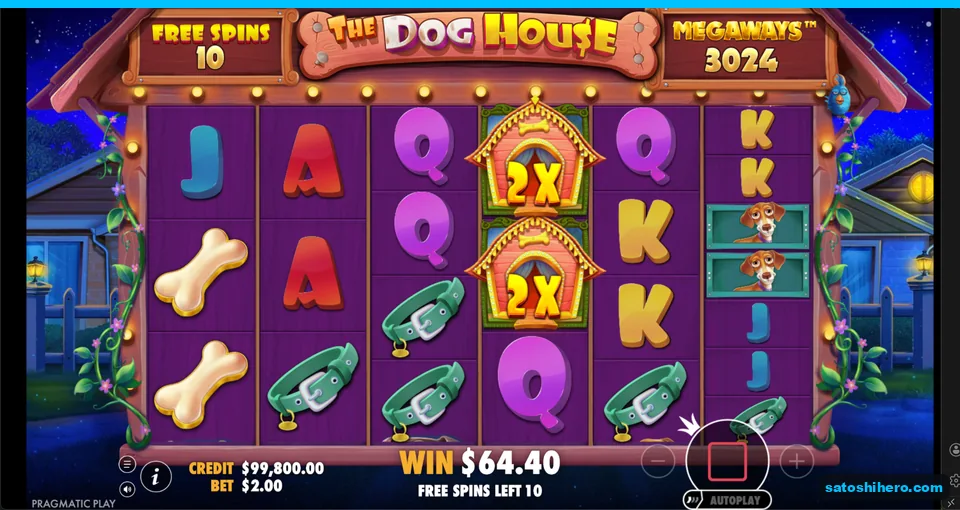
Raining Wilds gives more spins and more visible action, but the wilds don’t stay locked. You get 15 spins for three scatters, 18 for four, 25 for five, and 30 for six. Up to six fresh wilds can drop into random spots on every spin. I think it feels busier right away, which you may prefer if Sticky feels too slow.
Fresh wild drops
Each Raining Wilds spin brings a new chance for 1x, 2x, or 3x wild multipliers. Nothing stays on the grid, so every spin starts with fresh hope and fresh risk. That makes the bonus feel lively, but it removes the long build-up that Sticky gives you.

Pro Tip: Choose Sticky if you prefer build-up and locked multipliers. Choose Raining if you prefer more spins and constant wild drops.
You still need wilds to land in useful paying spots. A screen can look busy without paying much, especially if the wilds miss premium connections. That’s the trade-off, and I don’t think the flashier option always gives the stronger chance.
Spin volume
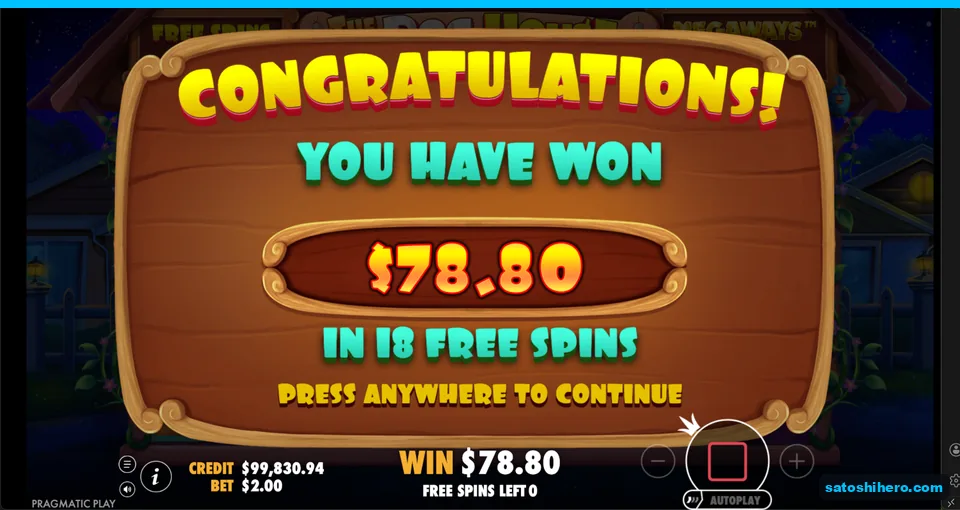
More spins help the round feel smoother. In my bought Raining Wilds feature, four scatters gave me 18 spins, and the result climbed more steadily than the Sticky buy. The total still came in under cost, which says plenty about the volatility.
Raining Wilds can’t be retriggered, so the extra volume must count the first time. You get more action, but not a safer path. Sticky feels more strategic to me, while Raining feels more active and easier to watch spin by spin.
Bonus Buy Testing
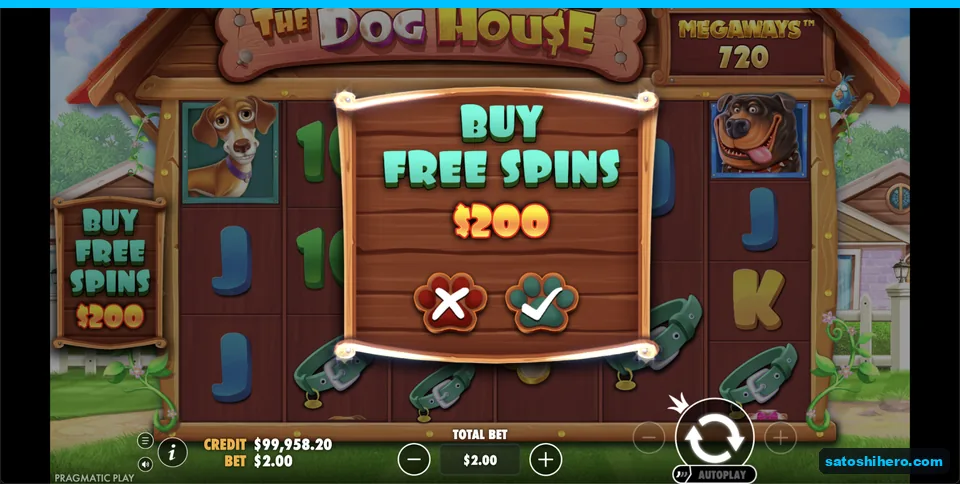
The bonus buy gives instant feature access for 100x stake, but my two tested buys both returned less than cost. At $2 a spin, each buy cost $200; the buy lands a random 3 to 6 scatters, then lets the feature path play out. I’d use the The Dog House Megaways demo to test the buy flow before risking real money, because the price becomes significant once several attempts stack together.
Sticky buy result
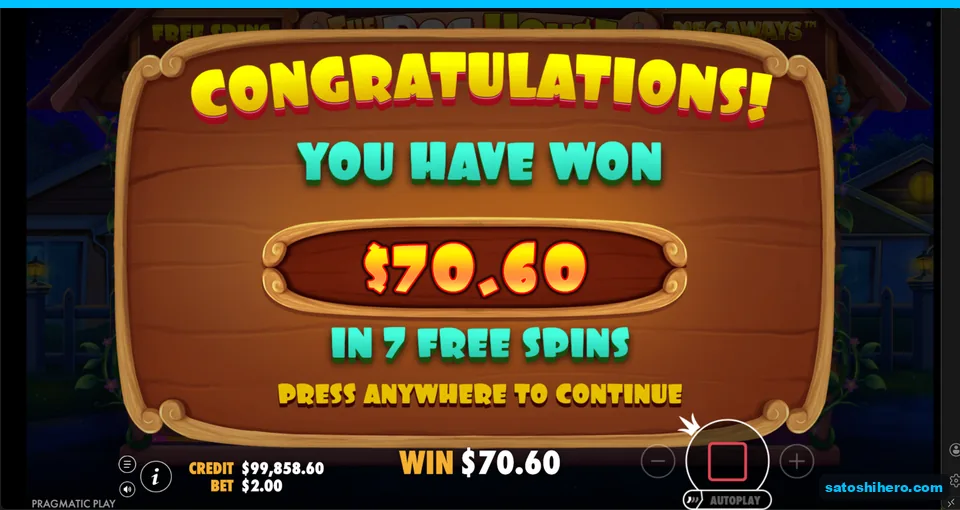
I bought Sticky Wilds from a fresh $100,000 balance. It landed three scatters, gave 7 spins, and returned $70.60. That equals 35.3x the stake, which sounds decent until you compare it with the $200 cost.
The round built quietly before a final tumble pushed it to a Mega result. I liked the shape of the finish, but the return still didn’t cover the buy. You get direct feature access, not a cleaner route around variance.
Raining buy result
I bought Raining Wilds separately from another fresh $100,000 balance. It landed four scatters, gave 18 spins, and returned $78.80. That equals 39.4x the stake, again below the $200 cost.

Caution: A 100x buy can still return far below cost. In my test, both bought features did.
I don’t mind bonus buys when the player understands the trade. You skip the base-game wait, but you don’t skip the very-high math. The buy fits feature-access chasers, not anyone looking for a safer route.
RTP, Volatility & Our Test
The official RTP is 96.55%, volatility is very-high, and my testing showed the sharp swings that rating suggests. The maximum win is 12305x, with no jackpot sitting above it. This section combines the SatoshiHero Slot Simulator and one real 500-spin demo session. You should treat The Dog House Megaways RTP as a published return figure, while the live test shows one possible session shape.
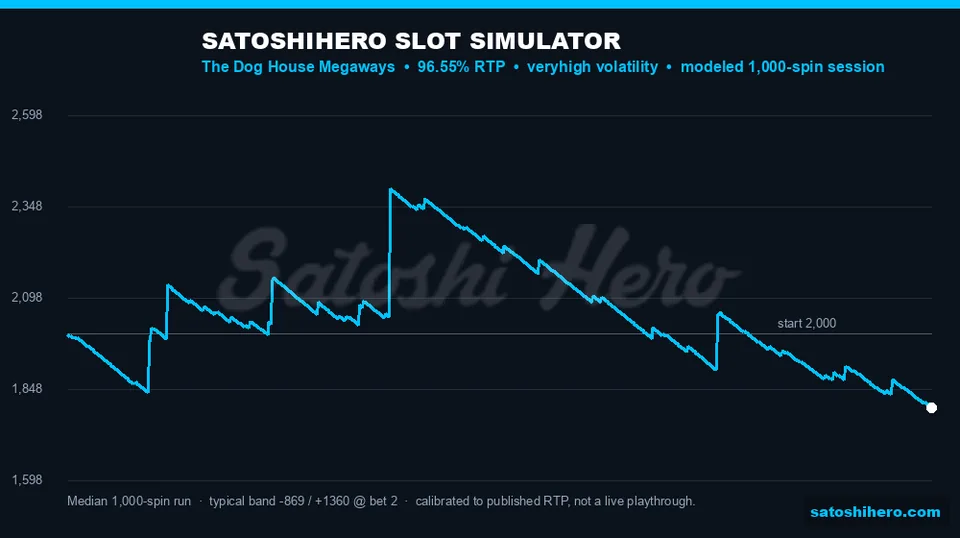
Simulator projection
The simulator ran a 1,000-spin sample at $2 a spin using the published 96.55% RTP, very-high volatility, and 12305x cap. Its median run finished about $203 down. The typical band stretched from about $869 down at the 5th percentile to about $1,360 up at the 95th.
That spread tells you more than the headline RTP alone. The model also estimated a feature-level hit around 1 in 54 spins. It put a 100x-or-better win around 1 in 807. I think those numbers explain why you can feel close to action while still losing ground.
Did You Know? The median 1,000-spin projection still finished down despite the 96.55% RTP because very-high volatility creates wide short-term swings.
Our 500-spin session
I played 500 demo spins at $2 from a fresh $100,000 balance, using turbo mode with no limits set. The base game ran cold for long stretches. One Sticky Wilds feature triggered naturally around spin 350 and paid about $455.
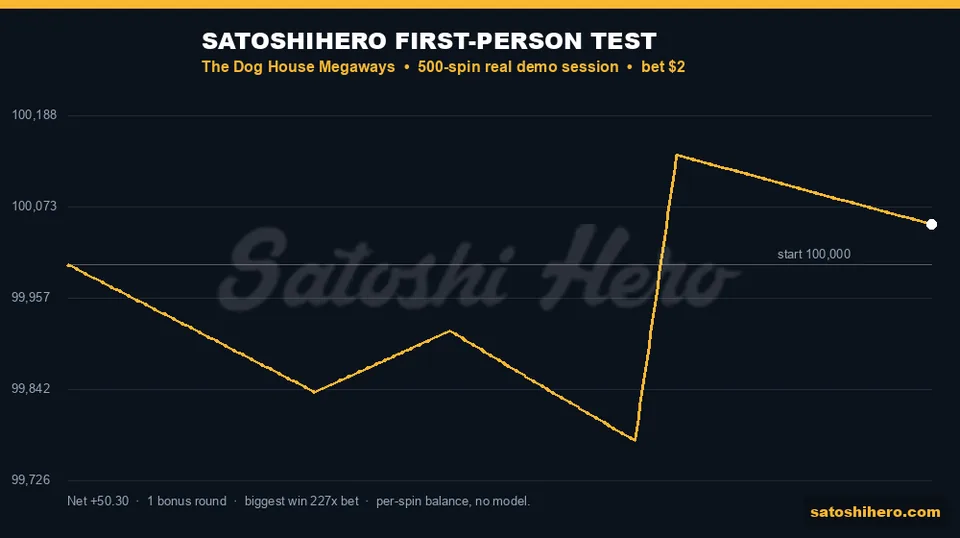
The final balance landed at $100,050.30, so my net result was +$50.30. That looks positive, but it leans hard on one feature. Take that Sticky round away and the session closes clearly down.
Theoretical RTP is the operator’s published return figure, not a promise for your next session. A single live or demo run doesn’t change that figure. Bonus-buy and feature paths can sit slightly different to the base by design, so you need a patient, risk-aware approach.
How It Played at $2 Stakes
At $2 stakes, my session felt cold for long stretches and depended on one strong Sticky Wilds round. The base game didn’t drip-feed enough to feel gentle. The 5 of 5 feel matched the official very-high volatility. I wouldn’t treat the cheerful look as a sign this is forgiving, because it plays like a proper high-variance bonus hunt.
Cold base game
The quiet stretches mattered because $2 spins add up quickly. You can sit through many spins where small tumbles don’t offset the steady cost. That makes bankroll planning more important than the cartoon theme suggests.
The Dog House Dice Show gives a different style of Dog House experience, while this one stays firmly in Megaways bonus-hunt territory. The Dog House – Muttley Crew also changes the family pace, but this game leans harder on multiplier build-up and sudden feature swings. You should pick the version that matches your patience level.
One-round swing
My final result finished slightly up, but I don’t see that as the expected shape. The Sticky Wilds feature near spin 350 carried the run and paid about $455. Without it, the balance line tells a much harsher story.
Bonus buys also felt expensive next to the base stake. A $200 feature buy at a $2 stake sounds simple, yet two under-cost returns show the danger. This slot suits disciplined bonus hunters who can handle long quiet runs before the feature decides the session.
Frequently Asked Questions About The Dog House Megaways
How do Sticky Wilds free spins work in The Dog House Megaways?
Sticky Wilds gives 7 spins for three scatters, 12 for four, 15 for five, and 20 for six. Every wild that lands stays locked on its reel for the rest of the round, keeping its 1x, 2x, or 3x multiplier. The reel stays at least as tall as the number of stuck wilds, so the board can build slowly. The feature can’t retrigger.
What does the Raining Wilds option do differently in The Dog House Megaways?
Raining Wilds gives 15 spins for three scatters, 18 for four, 25 for five, and 30 for six. Up to six fresh wilds can drop into random positions on every spin, each with a 1x, 2x, or 3x multiplier. Nothing stays locked, so the round feels busier but depends on each spin landing useful wilds.
Why do two wilds in one win pay more?
Two wilds pay more because their multipliers multiply together rather than add. Two 2x wilds make 4x, while a 2x and 3x make 6x. In the base game, wilds appear only on reels 2 through 5. Inside free spins, this compounding creates the path toward the 12305x ceiling.
What did the SatoshiHero simulator project over 1,000 spins?
The simulator used the 96.55% RTP, very-high volatility, 12305x cap, and $2 spin sample. Its median 1,000-spin run finished about $203 down. The typical band ran from about $869 down to $1,360 up. It estimated a feature-level hit around 1 in 54 spins and a 100x win around 1 in 807.
What happened in the 500-spin first-person test?
I played 500 demo spins at $2 from a $100,000 starting balance. The final balance was $100,050.30, giving a net result of +$50.30. One Sticky Wilds feature triggered near spin 350 and paid about $455. Without that feature, my session would have ended clearly down.
Are the bonus buys worth the $200 cost?
Neither tested buy returned its cost. Sticky Wilds cost $200 and paid $70.60, while Raining Wilds cost $200 and paid $78.80. I treat the buy as feature access, not an edge. You can skip the wait, but you still face the same very-high volatility.
What is The Dog House Megaways RTP and maximum win?
The Dog House Megaways has 96.55% RTP and a maximum win of 12305x your stake. Volatility is very-high, bets run from $0.20 to $100, and the game uses up to 117,649 ways. The biggest wins come from wild multipliers inside free spins, not from a fixed jackpot.
Is The Dog House Megaways a volatile slot?
Yes, The Dog House Megaways is officially very-high volatility. My 500-spin test matched that rating with long cold base-game stretches before one Sticky Wilds round changed the result. You need patience, a clear stake plan, and comfort with sudden swings.
Is Megaways a good slot format for The Dog House Megaways?
Yes, Megaways fits The Dog House Megaways because changing reel heights, tumbles, and multiplier wilds support its swingy bonus potential. The format gives the slot room to build big boards, then lets wild multipliers create the real drama.
Final Thoughts
The Dog House Megaways stands out because it turns a cute backyard theme into a sharp bonus-hunt slot. The main drawback is simple: the base game can feel cold, and bonus buys can punish you fast. I think its best moments come when Sticky Wilds starts building pressure.

My Verdict
Patient bonus hunters get the most value from this slot. Expect dry runs, sudden feature swings, and a real chance that one round decides your session. I’d start in demo mode before pushing bigger stakes.
I like the Sticky Wilds build-up and the way multiplier wilds can change a plain-looking grid. I don’t like how quickly the 100x buys can miss the mark, especially after both tested purchases returned under cost. My 500-spin result ended up positive, but one feature carried it.
The Dog House Megaways deserves attention if you enjoy high-risk Megaways play with clear feature choices. My testing notes are checked regularly, and the numbers here stay tied to the official specs and my actual session results.

Pros:
 Strong feature choice: Sticky and Raining paths give you two clear bonus styles.
- Big ways count: Up to 117,649 ways creates strong tumble potential.
- Clear math profile: Very-high volatility matches the sharp session swings.
- Readable theme: Clean symbols help you follow fast tumbles easily.

Cons:
 Cold base game: Long quiet stretches can drain impatient bankrolls.
- Costly buys: 100x feature buys can return well below cost.
- No jackpot: The 12305x cap relies on feature multiplier compounding.

Best For: Patient bonus hunters and Megaways fans get the clearest value here. You’ll enjoy it more if you can handle cold base play, test feature choices, and accept that one bonus may shape the whole session.















































Bets
All Bets
Game
Player
Date
Wager
Mult.Multiplier
Prize
 Halloween Harvest: Rapid Link
 Hidden
- 00:20:36
- 0×
- Royal Fruits 9: Hold 'n' Link
- nina87
- 00:20:36
- 0×
- Halloween Harvest: Rapid Link
- Hidden
- 00:20:35
- 0×
- Halloween Harvest: Rapid Link
- Hidden
- 00:20:34
- 0.19×
- 3 Witches: Bonus Combo
 bjgrandy149
- 00:20:34
- 24.05×
- Royal Fruits 9: Hold 'n' Link
 mdp0fxo
- 00:20:32
- 0×
- Luck of Panda: Bonus Combo
- Hidden
- 00:20:31
- 0×
- Halloween Harvest: Rapid Link
- Hidden
- 00:20:31
- 0.69×
- 4 Lucky Nuggets
 whodey39311
- 00:20:29
- 0×
- Aztec Magic Deluxe
 RicoSoul
- 00:20:28
- 0×