

Red Hot Luck
By pressing play, you agree that you are above legal age in your jurisdiction and that your jurisdiction allows online gambling.

Pragmatic Play🔥 Hot
Red Hot Luck
RTP96%
VolatilityHigh
Max winx5,000
ReleasedFeb 2024
Live game stats
Real RTP103.86%
Spins773
Players2
Biggest win$145

Volcanic Clusters and Cold Luck
Red Hot Luck fires up a 7 by 7 cluster grid with PowerPays points, tumbling wins, and multiplier scatters. Red Hot Luck is a high volatility slot from Pragmatic Play with 96% RTP and 5,000x max win potential. The game looks energetic from the first spin, but the test showed that movement alone doesn’t mean a balance recovery.
Key takeaways
The game has no fixed paylines, so wins come from connected clusters of 5 or more matching symbols. Aimed at high-volatility cluster fans who prefer fiery grids, the Red Hot Luck slot can grind hard, while the Red Hot Luck demo on SatoshiHero lets you test the $0.20 to $240.00 bet range before real play.
- Best bonus: Free spins carry the biggest upside because scatter multipliers feed a growing total meter.
- RTP / volatility: Red Hot Luck has 96% RTP and high volatility, so you need patience.
- Max win: The cap sits at 5,000x the bet, and free spins end if that cap lands.
- Risk note: The $200 feature buy at $2.00 returned $33.90 in my test. It is a paid game feature, not a promotional casino bonus.
- Bankroll note: You should expect cold stretches, because my 500-spin session lost about $208.

Table of Contents
- How Red Hot Luck Works
- Cluster win rules
- Symbol value tiers
- Theme & First Impressions
- Volcanic forge style
- Sound and pacing
- PowerPays Points System
- Points to payouts
- Why cascades matter
- Tumble Feature
- Chain reaction wins
- Base-game feel
- Free Spins
- Trigger and retrigger
- Multiplier meter
- Bonus Buy Tested
- Buy cost
- Test result
- RTP, Volatility & Our Test
- Simulator projection
- Our 500-spin session
- How It Played Over 500 Spins
- Cold-session rhythm
- Bankroll takeaway
- Frequently Asked Questions About Red Hot Luck
- Final Thoughts
How Red Hot Luck Works
Red Hot Luck pays through clusters, not paylines. You need 5 or more matching symbols connected horizontally or vertically on the 7 by 7 grid, and those groups can form anywhere. The important point is that diagonal touches do not count, so a strong-looking patch still needs direct side contact before it enters the points meter.
Cluster win rules
There’s no left-to-right line check here. The game looks for touching blocks, removes winners, drops symbols down, and keeps the spin alive while fresh clusters connect.
That makes Red Hot Luck play feel busier than a normal line slot. You can see plenty of movement without a strong payout, though I like how clear the grid stays even when several blocks break apart.
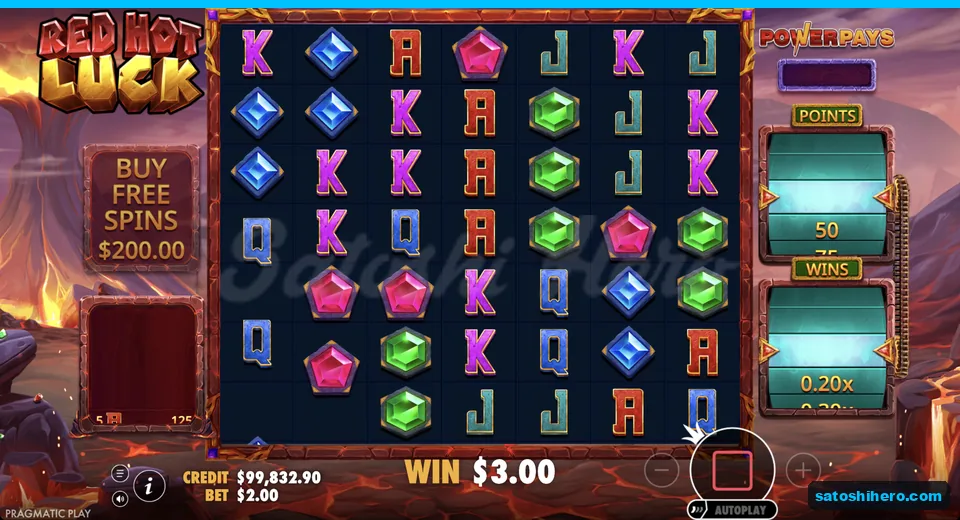
The game runs smoothly on mobile and desktop, with the same grid, meters, and buy controls. You still need to watch the points meter, because the final payout comes after tumbles finish. That delayed conversion changes the feel of each spin, since an early cluster is only the start of the calculation and not the whole result.

Quick Fact: Red Hot Luck uses points first, then converts those points into bet multipliers, so a win screen feels different from a normal cash-pay slot.
Symbol value tiers
The pink ruby, green emerald, and blue sapphire lead the pay table. Ace, King, Queen, and Jack sit below them, so gem clusters matter more when you’re trying to push the meter up.
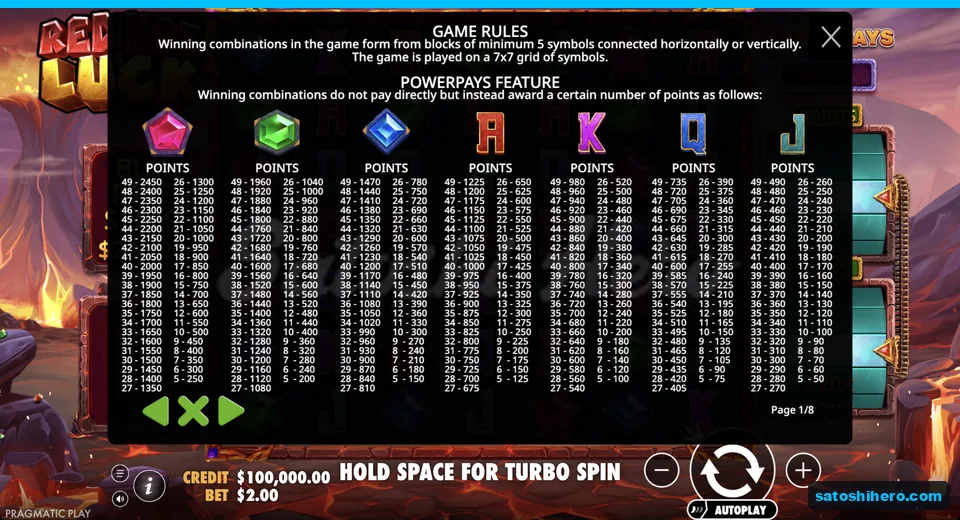
Symbols don’t pay cash directly. Each winning cluster awards points based on size and rank, then the game converts the spin’s total points into a bet multiple. That makes premium symbols valuable twice over: they help the meter climb faster, and they make bigger connected blocks feel far more important than scattered small royals.
The flaming star scatter can land anywhere and stays through tumbles. It carries a random multiplier from 2x to 500x, which gives the game more bite than Hot To Burn Multiplier, even though that title has a more familiar heat-themed multiplier feel.
Theme & First Impressions
The theme is a volcanic forge with a gemstone grid, molten frame, and punchy audio. I think the look fits the high volatility rhythm because every cluster feels hot, quick, and slightly unstable.
Volcanic forge style
Red Hot Luck drops you into a lava-lit screen where gemstones sit between two side meters. Sparks kick out after wins, symbols fall hard, and the whole layout pushes the idea of chain reactions.
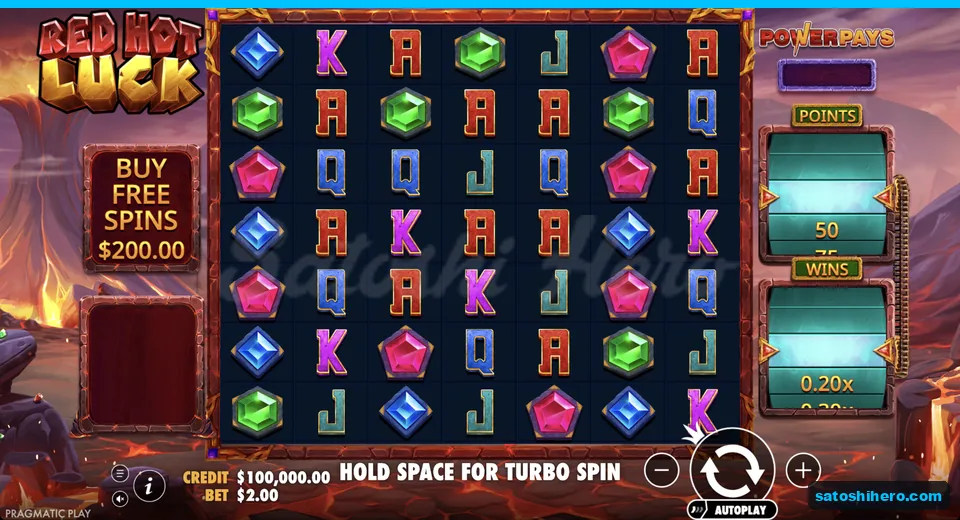
The theme won’t win originality awards. Still, the molten frame and glowing backdrop make even small cascades look more dramatic than they really are. I also liked that the pay information sits close to the action, so checking the meter never pulled me away from the grid.
If you like fiery slots but want a cleaner, more traditional presentation, Hot to Burn has a simpler pace. This game feels more restless because the grid keeps shifting after every connected block.

Did You Know? The forge theme works because every winning cluster bursts apart before new symbols drop into the hot grid.
Sound and pacing
The audio gives spins a tense, busy feel. You hear the grid crackle, symbols crash down, and meters react as points build.
I like the pace because it doesn’t drag between tumbles. You can follow the action without losing track of the bet, although small wins sometimes sound more exciting than their payout deserves.
Those side meters also help the screen feel alive. You always have something to watch, even when the balance moves in the wrong direction. That matters on a cold run, because the visual feedback can make a losing spell feel more active than the cash result says it is.
PowerPays Points System
PowerPays is the core system because it turns cluster points into bet multipliers. The final payout depends on the total points collected across one paid spin and all its tumbles.
Points to payouts
PowerPays replaces standard cash-paying line wins. Every winning cluster feeds one total points meter, and the game pays only after the tumble sequence ends.
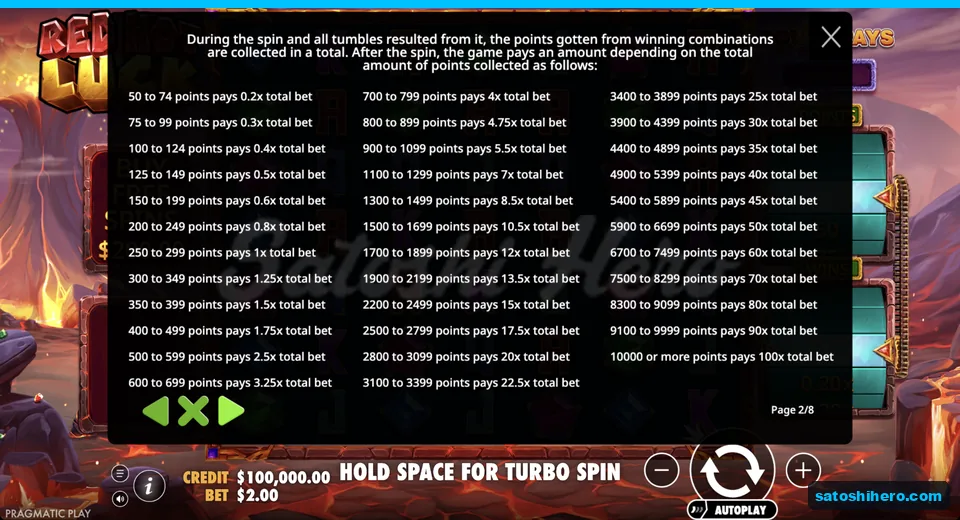
The conversion table matters. 50 points returns 0.2x, 250 points returns 1x, 1,000 points returns 5.5x, and 10,000 or more points pays 100x the bet.
I felt this system most during the 500-spin test. The meter kept teasing stronger tiers, but many spins stalled before the payout became meaningful. A few drops looked promising when they cleared space for gems, yet the next symbols often failed to connect and left the spin at a small return.

Pro Tip: Don’t judge a spin too early. In this game, the important number is the final points total after all tumbles finish.
Why cascades matter
Only the highest points value counts per combination, but multiple blocks in the same tumble can still add together. That means one messy screen can move faster than several neat little wins.
You need several clusters or strong gem groups to push into the better payout levels. Low royal clusters keep the screen moving, but they don’t always protect your balance. The lower symbols can clear room for another drop, so they still matter, but they need help from a larger chain before the payout tier starts to feel useful.
I like the idea more than the average result I saw. The points system gives every tumble purpose, yet it can feel stingy when the grid refuses to link premium symbols.
Tumble Feature
The tumble feature gives every winning cluster another chance to extend the spin. Winning symbols explode, the rest fall down, and new symbols drop from above.
Chain reaction wins
Any winning cluster can start a tumble. The process repeats until no new connected group appears, then the game adds the points and pays the spin.
You’ll see this feature often because small clusters form across the grid. I don’t think that always means strong value, but it does keep the base game from feeling flat.
One paid spin can include several separate clusters before the game calculates the final payout. That structure gives you a shot at snowballing points, especially when gems connect after a drop. The catch is that each extra tumble still needs quality symbols, because a long chain of low-value royals can look better than it pays.
Base-game feel
In my 500-spin session, tumbles produced modest hits but never built a large base-game result. Most of the better spins landed at a few times the bet, then died before the meter reached a serious tier.
That’s the main lesson for you. Movement isn’t the same as profit, and a busy grid can still chip away at your balance.
I like the visual energy, but the base game felt colder than it looked. You need the tumbles to connect with premium symbols or scatter momentum before the slot really wakes up. The base game can still give enjoyable rhythm, but the test reminded me not to confuse frequent animations with a healthy hit size.
Free Spins
Free spins are the main upside feature because scatter multipliers can build a running total multiplier. Landing 4 or more flaming scatters anywhere awards 10 free spins.
Trigger and retrigger
Four scatters trigger the round, and 4 more scatters during the feature add 5 extra spins. The trigger can land anywhere, so you don’t need a payline setup or reel pattern.
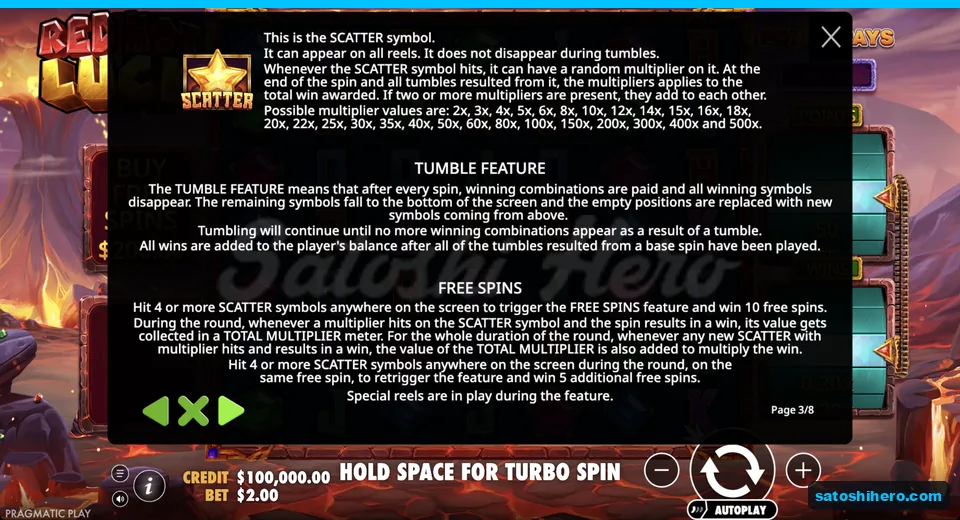
The feature still needs winning clusters. If scatters appear without helpful connections, the round can look promising and still pay weakly.
In my Red Hot Luck demo test, the bought round started with 10 spins and built only a 3x total multiplier. That number looked alive on screen, but it never turned into a large final hit. The result made the feature feel volatile in a very direct way: the mechanic was working, but the symbol flow did not give it enough fuel.
Multiplier meter
Scatter multipliers collect into a total meter when they land on a winning spin. New scatter multipliers can add their own value and the existing meter value to wins.
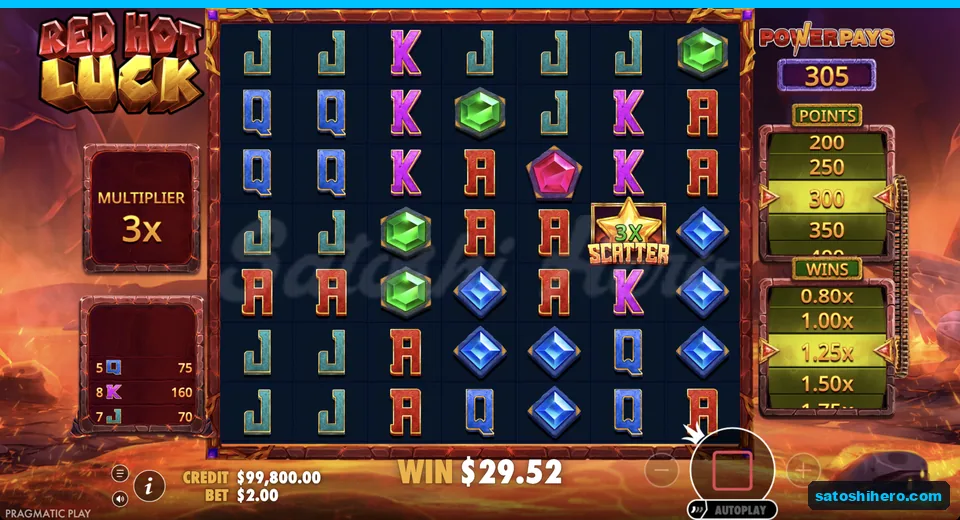
That mechanic creates the best path toward the 5,000x cap. I like the upside on paper, but the feature felt harsh when my meter stayed low.
The round pushed a running win to about $29.50 before landing at $33.90. You can see why the feature matters, yet you can also see how fast a weak bonus disappoints.
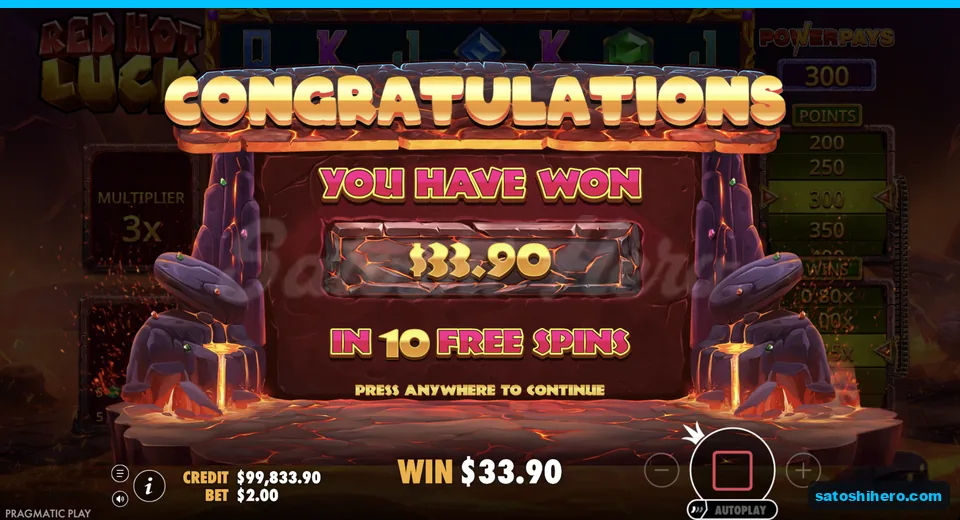
Quick Fact: Scatter multipliers matter most when they land alongside winning clusters, not when the grid fails to connect.
Bonus Buy Tested
The bonus buy costs 100x your total bet, and my test showed it can still miss badly. At the $2.00 stake, the $200 buy returned $33.90.
Buy cost
You trigger the Buy Free Spins option from the furnace sign on the left rail. The game then asks for confirmation, and the green tick drops you into the 10-spin round.
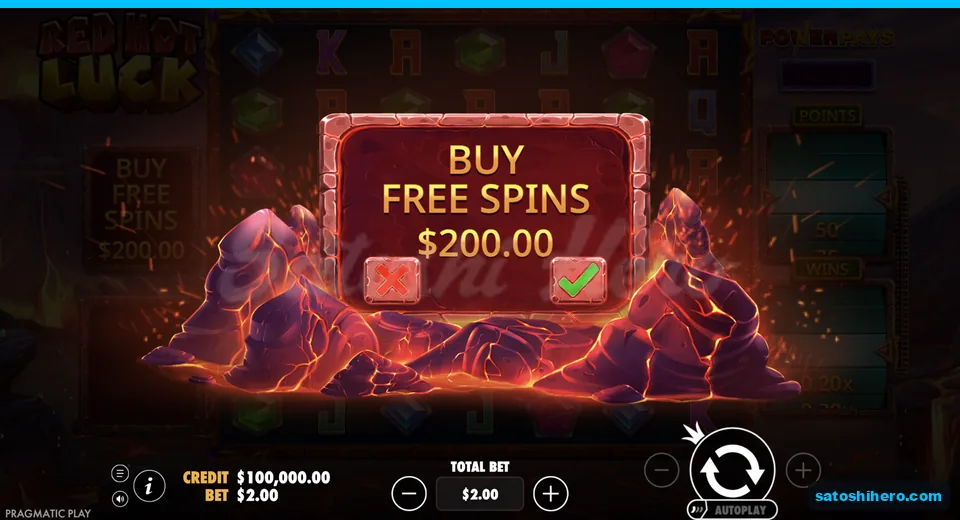
That shortcut saves time, but it doesn’t soften the high volatility. I think base-game spins give you more time on the same balance, while the buy turns the risk up fast.
At $2.00, the cost equals $200. That price feels steep when the feature depends on scatter multipliers and winning clusters lining up. This is a paid feature-buy stake inside the game, not a promotional casino bonus; any separate SatoshiHero offer uses its own displayed T&Cs and wagering rules before opt-in.

Caution: This is a high-volatility slot, and the bonus buy can still miss badly. In my test, the $200 buy returned $33.90. Treat that result as one paid feature sample rather than a promise about future rounds or any promotional reward.
Test result
The bought feature built a 3x total multiplier. A scatter reveal pushed the running win near $29.50, then the round collected at $33.90.
That equals 16.95x the bet, far below the 100x buy cost. You shouldn’t treat the buy as a value promise, because it can run cold like the base game. The gap between the paid entry and the collect screen is the clearest risk signal from my session.
I’d use it only when speed matters more than sample length. Patient play at smaller stakes gives your bankroll more room to absorb dry patches.
RTP, Volatility & Our Test
Red Hot Luck has 96% RTP, high volatility, and a 5,000x maximum win. My simulator and live-style session show session risk, not a change to the official number.
High volatility means results can swing hard because much of the upside sits in scatter and free-spins momentum. I think the 5,000x ceiling is respectable, though it feels a little modest for a game this spiky.
Simulator projection
I modelled 1,000 spins at $2.00 using the published 96% RTP, high volatility, and 5,000x ceiling. The median result finished about $137.50 down.
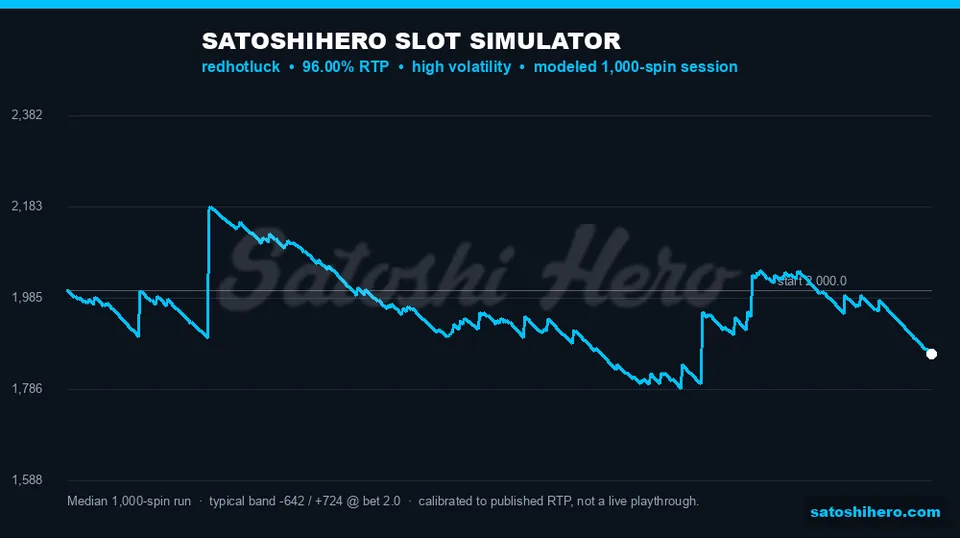
The middle band ran from roughly $641.80 down at the 5th percentile to about $723.70 up at the 95th. That spread tells you how wide the outcomes can feel, even before a huge feature appears.
The model hit a paying cluster on around 18% of spins. It flagged a feature roughly once every 45 spins and a 100x-plus event about once every 1,757 spins.
What it can’t tell you is when your own scatter multipliers may line up. That uncertainty is the real edge and the real pain point. The projection also explains why short sessions can feel unfair: the math can still allow long losing patches before one strong feature changes the graph.
Our 500-spin session
I played 500 spins at $2.00 from a fresh $100,000 demo balance. The session ended about $208 down at roughly $99,792.
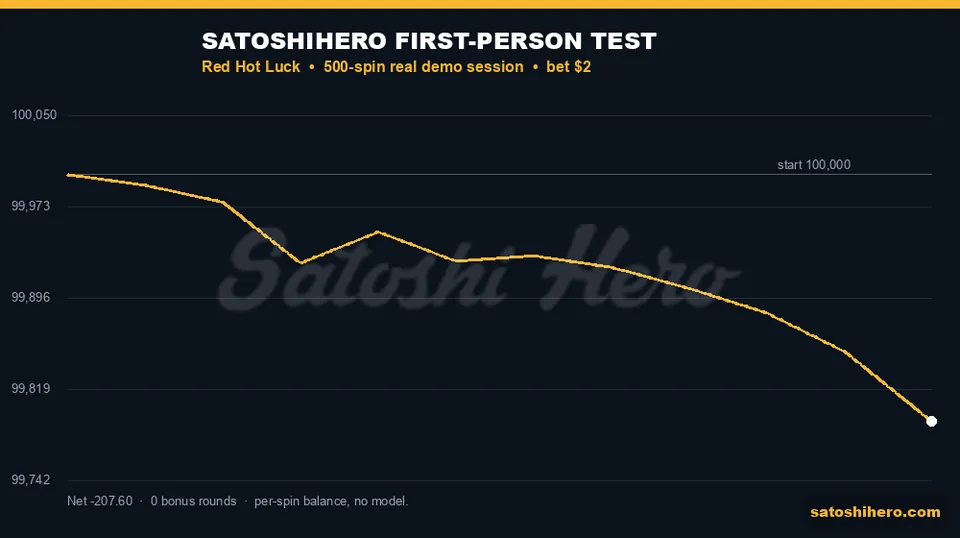
The base game paid a steady drip of small cluster wins. No big scatter cluster landed, and my best base hits were modest tumbles worth a few times the bet.
The points meter kept teasing me toward higher payout tiers without getting there. That’s exactly how high volatility feels when the game stays active but refuses to deliver the feature sequence you need. The chart looked like a slow bleed rather than a collapse, which made the loss feel more grindy than dramatic.
The theoretical RTP is the operator-published return figure. A single live or demo session doesn’t change that return, and bonus-buy returns can sit slightly apart from base play by design, while this guide uses 96% RTP as the core figure.
How It Played Over 500 Spins
The 500-spin session felt cold and grindy despite regular small cluster wins. The main lesson is simple: this slot can look active without paying heavily.
Cold-session rhythm
I saw steady small clusters, frequent tumbles, and lots of near-misses on the points meter. That kept the screen busy, but it didn’t create meaningful profit.
The lack of a strong scatter sequence defined the result. I kept waiting for the free-spins momentum to shift, yet the grid never gave me the right multiplier setup.
Red Hot Luck can produce movement without a strong balance recovery. If free spins and multiplier scatters stay quiet, your bankroll can bleed even while hits appear often. That is why I’d treat the base game as a patience test first and a feature hunt second.
Bankroll takeaway
Smaller stakes make sense if you want a longer sample. The $2.00 demo default gave a clear test window, but high volatility can punish a fixed budget quickly.
I’d rather stretch the session than chase the bonus after a cold spell. You need enough spins to survive the quiet runs, not just enough cash for one dramatic shortcut.
Fortune-style fans with a taste for different pacing may prefer Peking Luck. This volcanic cluster grind has more moving parts and a harsher feel when the multipliers stay asleep.
Frequently Asked Questions About Red Hot Luck
How does Red Hot Luck pay without fixed lines?
Red Hot Luck uses cluster pays on a 7 by 7 grid. You need at least 5 matching symbols connected horizontally or vertically, and each cluster awards points rather than direct cash. Your total points across the spin and tumbles convert into bet multiples from 0.2x at 50 points up to 100x at 10,000 points.
What triggers free spins in Red Hot Luck?
Four or more flaming scatters anywhere on the screen trigger 10 free spins. During the round, scatter multipliers collect into a growing total multiplier meter when they land on winning spins. Four more scatters can retrigger the feature and add 5 extra spins.
Can I buy the bonus in Red Hot Luck?
Yes, the Buy Free Spins option costs 100x your total bet. At a $2.00 stake, that cost was $200 in my test. The bought round returned $33.90, so you should treat it as a high-risk paid feature, not a promotional casino bonus; separate SatoshiHero offers show their own T&Cs and wagering rules before opt-in.
What is the Red Hot Luck RTP and maximum win?
The official RTP is 96%, and the maximum win is 5,000x the bet. The cap applies in the base game and free spins. Volatility is high, so your results can swing sharply from one session to another.
How did the simulator compare with the real session?
The simulator projected a median around $137.50 down over 1,000 spins at $2.00. My 500-spin session finished about $208 down. Both outcomes fit a high-volatility slot where the biggest upside depends on scatter and free-spins momentum.
Final Thoughts
Red Hot Luck stands out through its PowerPays meter, volcanic cluster grid, and scatter multiplier free spins. The drawback is just as clear: the base game can stay busy while your balance still slips.

My Verdict
High-volatility cluster fans should expect cold stretches and sharp bonus swings. I’d play this at smaller stakes first, then raise only if the session budget can handle long dry runs. The feature has bite, but it doesn’t forgive impatient play.
I like the point-conversion system because it gives every tumble a clear purpose. I don’t like how my $200 buy returned only $33.90, and the 500-spin grind showed how little small clusters can matter without scatter help.
Red Hot Luck remains a strong pick if you enjoy volatile grids, but it needs discipline. I keep rules, screenshots, and test notes checked regularly against the live game.

Pros:
 Clear cluster rules: You can understand wins quickly without payline confusion.
- Strong feature idea: Scatter multipliers give free spins real upside.
- Busy base game: Frequent tumbles keep the grid active between features.
- Wide bet range: Stakes from $0.20 to $240.00 fit many bankroll sizes.

Cons:
 Cold stretches hurt: High volatility can drain balances despite regular small hits.
- Bonus buy risk: A $200 buy returned only $33.90 in testing.
- Modest ceiling: The 5,000x cap feels restrained for such a spiky setup.

Best For: Patient bankroll managers and cluster-slot fans get the most value here. The theme adds heat, the math adds pressure, and the play style rewards people who can accept quiet stretches without chasing.


























































Bets
All Bets
Game
Player
Date
Wager
Mult.Multiplier
Prize
 Aztec Magic Deluxe
 RicoSoul
- 00:19:48
- 0×
- Luck of Panda: Bonus Combo
 Hidden
- 00:19:47
- 0×
- Aztec Magic Deluxe
- RicoSoul
- 00:19:46
- 0×
- 4 Lucky Nuggets
 whodey39311
- 00:19:45
- 0×
- Galaxy Glitter
 Hidden
- 00:19:45
- 0×
- Big Banker Bonanza
- josh1998
- 00:19:45
- 0×
- Royal Fruits 9: Hold 'n' Link
- mike_721
- 00:19:43
- 0×
- Halloween Harvest: Rapid Link
- Hidden
- 00:19:41
- 0×
- 4 Lucky Nuggets
- whodey39311
- 00:19:40
- 1.33×
- Halloween Harvest: Rapid Link
- Hidden
- 00:19:40
- 0×