

Mermaid's Treasure Trove
By pressing play, you agree that you are above legal age in your jurisdiction and that your jurisdiction allows online gambling.

Mermaid's Treasure Trove
RTP96.54%
VolatilityVery high
Max winx10,000
ThemeUnderwater world
ReleasedOct 2025

Deep-Sea Wilds and Treasure Chases
Mermaid’s Treasure Trove looks bright and busy, but the real game is whether its multiplier wilds can survive long enough to merge into something meaningful.
Mermaid’s Treasure Trove is a very-high volatility slot from Pragmatic Play with 96.54% RTP and 10,000x max win potential. It uses a 7×7 cluster-pay grid with no fixed paylines, so wins need 5+ matching symbols connected horizontally or vertically. It targets bonus chasers who like volatile wild merging, but it can feel flat when free spins refuse to land.
Key takeaways
- Best bonus: The standard free spins buy at 100x showed the feature clearly without the huge 400x super buy cost, though my test still returned slightly under cost.
- RTP / volatility: The official RTP is 96.54% with very-high volatility, so small cluster wins often won’t cover your spin cost.
- Max win: The game caps wins at 10,000x the bet, and you need strong wild interaction to threaten that ceiling.
- Risk note: The largest payouts rely on persistent wilds merging or catching high symbol multipliers, not steady base-game wins.
- Bankroll note: My 500-spin test lost $301.20 at $2 per spin without triggering free spins naturally, so you need patience.

Table of Contents
- How Mermaid’s Treasure Trove Works
- Cluster pays
- Wild multipliers
- Theme & First Impressions
- Underwater setting
- Board presence
- Free Spins
- Scatter trigger
- Persistent wilds
- Bonus Buy Options
- Standard buy
- Super buy
- Ante Bet Strategy
- Ante effect
- Flat-bet choice
- Bought Free Spins Test
- Mid-round build
- Final payout
- How It Played Over 500 Spins
- Base-game rhythm
- Biggest base hit
- RTP, Volatility & Our Test
- Simulator projection
- Our 500-spin session
- Frequently Asked Questions About Mermaid’s Treasure Trove
- Final Thoughts
How Mermaid’s Treasure Trove Works
Mermaid’s Treasure Trove pays through clusters on a 7×7 board, not fixed paylines. You need 5+ matching symbols connected horizontally or vertically anywhere on the grid, and I think that shape fits the tumbling wild system well.
You can play the slot on desktop or mobile with the same board structure, buy panel and ante switch. The large grid still reads clearly on a phone, though you may watch the wild positions more carefully on a wider screen.
Cluster pays
Winning clusters vanish, symbols drop down, and fresh symbols fall into the open spaces. If another connected block forms, it pays too. That tumble chain keeps going until no new win appears. You get plenty of movement, but movement alone doesn’t mean profit.
At my $2 test stake, the crown was the top symbol at $300 for a block of 15 or more. The treasure chest paid $200, the harp paid $180, and the horn paid $160. The gold fish paid $120, while the starfish paid $80 and the shell paid $40.
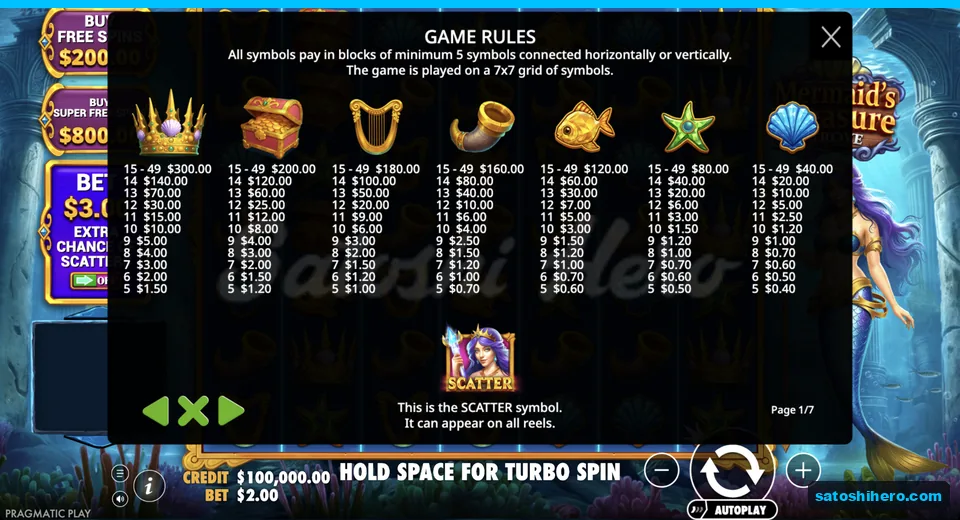
The mermaid acts as the scatter and doesn’t pay by herself. She can land on every reel, and she matters because she opens the free spins. I like that the game skips card ranks, because the wreck-treasure symbols make the board easier to scan.

Quick Fact: This is a cluster-pay slot, not a paylines slot. Five or more connected matching symbols are what matter.
Wild multipliers
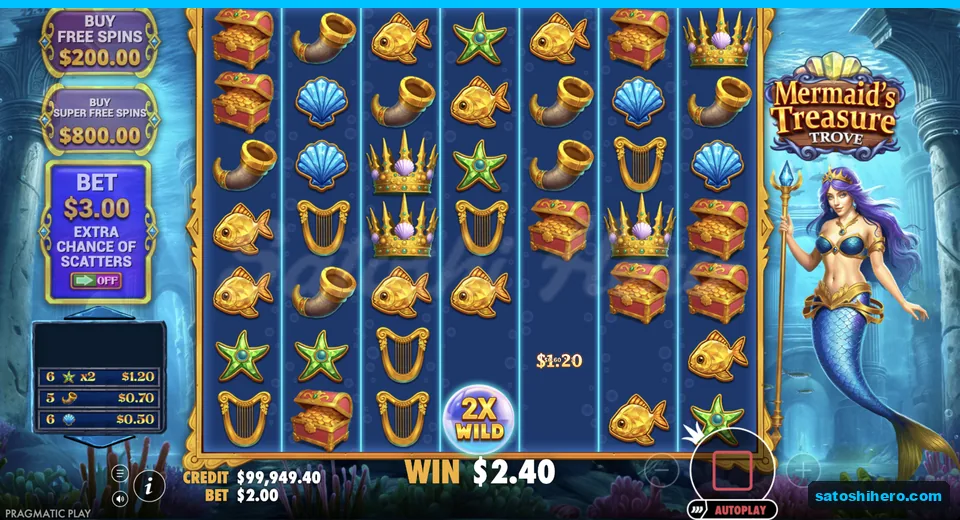
The multiplier wild is the main event. Every winning block without a wild spawns one inside the area that block covered. It starts at 1x, then gains +1 whenever it helps a win. After each explosion, it shuffles one space inside its birth area.
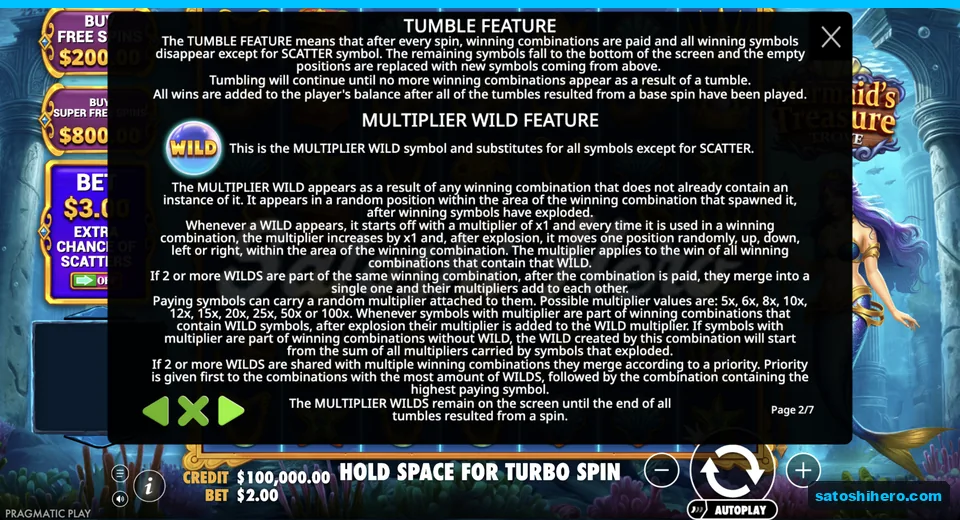
In the base game, the wild stays only until that spin’s tumble chain ends. That can feel cruel, because I saw plenty of 2x and 3x wilds vanish just as the grid looked ready. You need the next cluster to catch the moving wild quickly.
Two extra rules give the mechanic bite. Multiple wilds in the same winning block merge and add their multipliers together. Paying symbols can also carry 5x, 6x, 8x, 10x, 12x, 15x, 20x, 25x, 50x or 100x multipliers, which stack on top.
That is why a small starfish or shell block can suddenly matter. You aren’t just chasing the symbol pay. You are trying to catch a wild at the right moment, then push it into another paying area before the tumble chain dies.
Theme & First Impressions
The game uses a bright underwater treasure theme, with the real visual focus sitting on the large collapsing grid. Mermaid’s Treasure Trove Pragmatic Play polish shows in the crisp symbols and quick tumbles, though the theme itself won’t shock anyone.
Underwater setting
A mermaid with a trident stands beside the board, and gold framing wraps the play area. The sea-floor backdrop gives you coral, treasure glow and a clean blue-green palette. I think the art works because it never hides the grid.
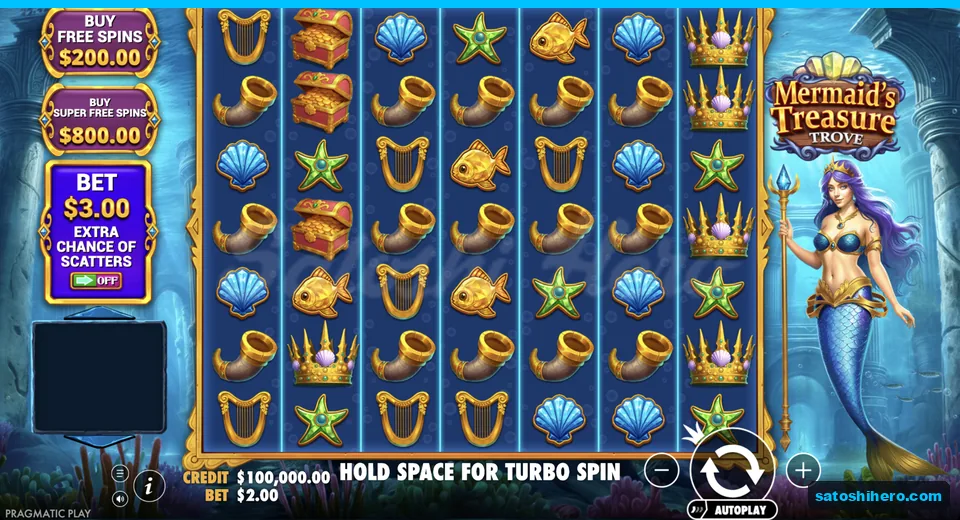
The symbols lean into wreck treasure rather than generic card ranks. You see crowns, chests, harps, horns, gold fish, starfish and shells. Treasure Island may appeal more if you want a classic island-treasure mood, while this slot keeps the action underwater.

Did You Know? The whole symbol set leans into wreck treasure rather than card ranks. That choice makes the sea-floor theme feel more complete.
Board presence
The 7×7 board takes up serious space, and that matters more than the mermaid art. Most spins ask you to watch where blocks vanish, where wilds spawn, and whether the next drop can connect. You spend more time reading movement than admiring the background.
I like the settled screen because the buy options and ante switch sit close to the grid. You can see your choices without hunting through menus. The layout won’t win originality awards, but it does keep the important pieces close.
When the board starts collapsing, the slot feels busier than a standard reel game. That can trick you into thinking more is happening financially. In my test, many active-looking spins still returned less than the $2 cost.
Free Spins
Free spins matter because multiplier wilds persist for the whole round instead of clearing after one base-game tumble chain. That single change turns short-lived wilds into growing assets, and you should treat the feature as the real hunt.
Scatter trigger
Three mermaid scatters award 10 free spins, four award 12, five award 14, six award 16, and seven award 18. Each extra scatter during the round adds one more spin. You don’t get a scatter cash prize, so the feature trigger carries all their value.
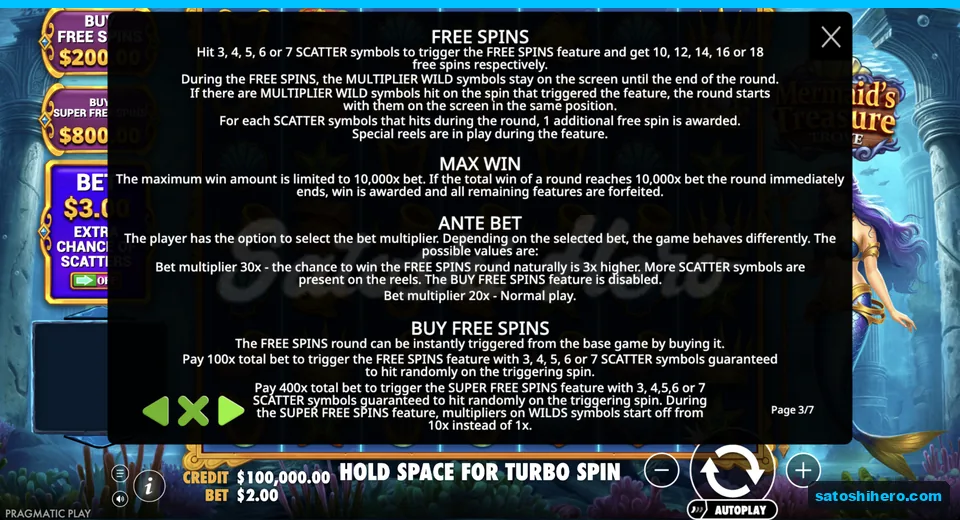
The trigger can be stubborn. I played 500 spins at $2 and never landed the natural round. That didn’t surprise me after seeing the very-high volatility label, but it still made the base game feel harsher than the bright artwork suggests.

Pro Tip: In free spins, don’t judge the round too early. The value often comes late, after wilds have had time to climb and overlap.
Persistent wilds
Inside free spins, multiplier wilds stay for the whole round. They keep moving, they keep climbing, and several can sit on the grid together. You want one paying cluster to cover more than one big wild, because that merge can change everything fast.
This is where the 10,000x ceiling feels most reachable. A round can build a 15x wild in one area and a 7x wild somewhere else, yet still miss the key connection. I saw exactly that in my bought feature, so I wouldn’t call persistence a shortcut.
You need patience with this bonus. Early wilds create hope, but the board still has to cooperate. A good-looking setup can finish ordinary if the clusters keep landing in separate pockets.
Bonus Buy Options
There are two bonus buys, and the super version costs much more because its wilds start stronger. I tested the standard buy, and I think most cautious bonus hunters should understand that one before even considering the larger swing.
Standard buy
The standard free spins buy costs 100x the bet. At my $2 stake, that meant $200. The feature opened with 10 spins, which gave enough time to see wilds spawn, move and climb without taking the huge super-buy hit.
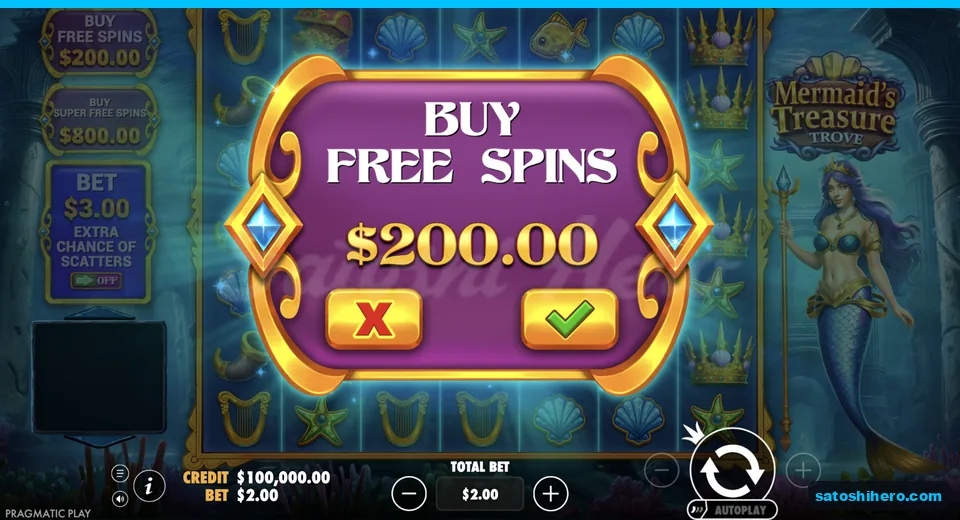
You can try Mermaid’s Treasure Trove free in demo mode on SatoshiHero before risking a paid buy. That matters here, because the mechanics look friendly until you see how often good wilds fail to connect. Demo play gives you a feel for the spacing.
The regular buy already feels expensive for a very-high volatility slot. Treasure Wild may tempt bonus-focused treasure fans too, but this game leans harder on wild persistence and cluster timing. You shouldn’t treat the 100x price as mild.
Super buy
Super free spins cost 400x the bet. At my $2 stake, that meant $800. The reason is simple: every multiplier wild starts at 10x instead of 1x, which gives the round a much stronger first step.
That price is the honest tell. Starting multiplier value matters so much that the game charges four times the standard buy. I see the super option as a bigger swing, not a safer path, because a large price still needs the board to connect.
If your bankroll can’t absorb several failed standard buys, the super buy deserves extra caution. You may love the idea of 10x starting wilds, but the grid can still strand them apart. Bigger entry cost doesn’t remove volatility.
Ante Bet Strategy
The ante bet raises spin cost by half in the tested setup, but gives a 3x higher chance of triggering free spins naturally. You trade cleaner $2 bankroll tracking for more scatter pressure, and I don’t think either route is automatically better.
Ante effect
The ante switch sits on the left rail near the buy signs. Turning it on raised my tested stake from $2 to $3. It also added more scatters to the reels and gave a 3x better chance of triggering free spins naturally.
The catch is easy to miss. Once ante is active, the purchase option switches off. You can’t use it as both a cheaper bonus-chase tool and a buy-ready setup at the same time, so your session plan changes.
Flat-bet choice
I left ante off and ran the main test at a flat $2 bet. That made the 500-spin result easier to read, because every spin carried the same cost. You can judge the balance slide more clearly when the stake doesn’t jump.
Flat betting also keeps the bonus buy separate. I prefer that when testing a volatile slot, because it stops natural-spin costs and purchase costs blending together. If you want more natural bonus-chasing, ante has a clear role.
Your choice should match the job you want the session to do. Use ante when you accept the 50% higher cost for more scatter attempts. Stick with flat bets when you want cleaner bankroll control and a separate buy decision.
Bought Free Spins Test
The tested standard buy cost $200 and returned $188.70, so it showed the feature without beating the purchase price. I didn’t hate the round, but I wouldn’t dress it up as a win either.
Mid-round build
I bought one standard free spins round on a fresh $100,000 balance. It opened with 10 spins at the $2 stake. Wilds spawned early, which is exactly what you want from this bonus, because early wilds get more time to climb.
By the middle, I had a 15x wild in the top half and a 7x wild in the bottom half. Both stayed parked in useful areas, and both kept growing when clusters touched them. The screen looked ready for something better than an average return.
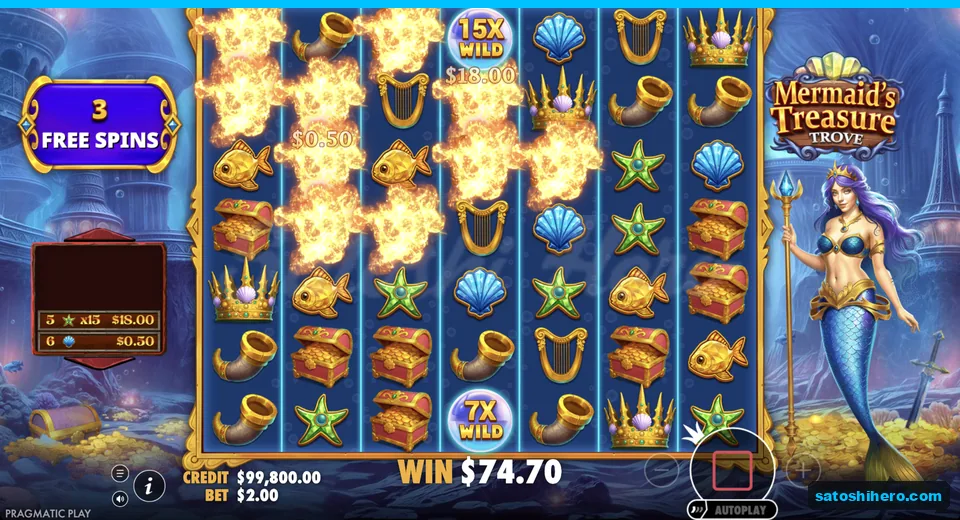
A starfish cluster covering the 15x wild paid $18. That hit explained the whole feature neatly. Symbols that pay little on their own can turn worthwhile when a fat wild sits inside the block.
Final payout
The round closed at $188.70, which equals 94x the bet. Against the $200 purchase price, that was $11.30 short. I call that ordinary, because the feature did its job but missed the one connection that mattered.
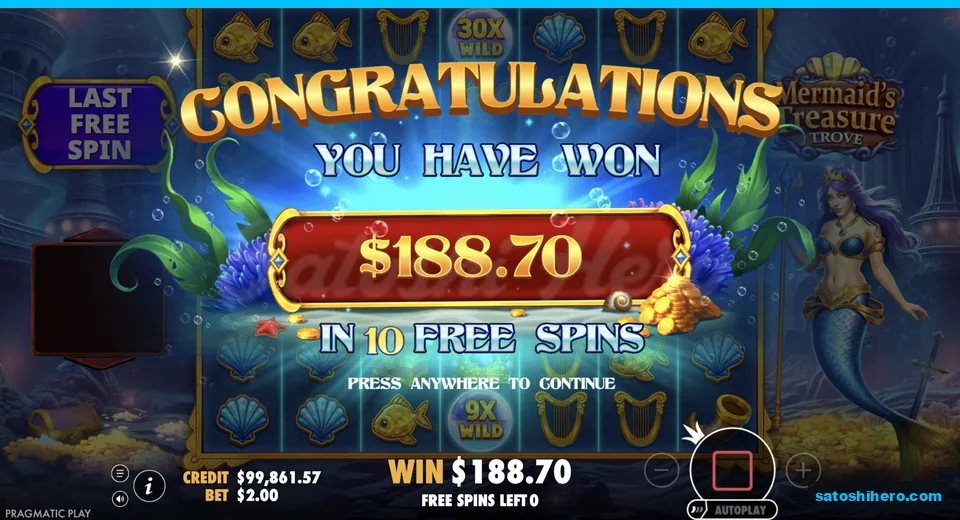
The 15x and 7x wilds never landed in the same paying block. That gap separated a decent return from the kind of hit people chase. Everything in this bonus revolves around getting multiple grown wilds covered by one cluster.
One bought round can’t tell you the whole story. It can show the texture, though, and this one showed the tension well. You can build promising wilds and still finish just under cost.
How It Played Over 500 Spins
The 500-spin test lost $301.20 at $2 per spin and did not trigger free spins naturally. That result felt grindy, and it taught the clearest lesson in the whole test: busy isn’t the same as profitable.
Base-game rhythm
I started on a fresh $100,000 balance, played 500 spins at $2 each, and finished with $99,698.80. The net loss was $301.20. That loss sat close to the simulator median, which made the dry spell feel normal rather than strange.
The base game paid constantly with small shell and starfish blocks. Many wins spawned little wilds that climbed to 2x or 3x, then disappeared when the tumble ended. You see action, but the returns often land below spin cost.
By spin 400, I was $452 down. The graph had barely lifted from a slow diagonal slide, and that can feel worse than a quiet slot because the board keeps teasing movement. I think that contrast defines the base game.
The mermaids trove demo session showed the base-game rhythm before any natural bonus arrived. If you compare pacing with Treasure Horse, this one feels more cluster-busy, while the pain comes from watching many small hits miss the cost.
Biggest base hit
Only five hits across the whole run paid more than 12x the bet. The best was $194.50, or 97x the bet, near spin 420. That one chain cut the loss almost in half in a few seconds.
That spike showed where the slot keeps its money. Most spins nibble, then one stronger chain can move the session sharply. You need those events, because small base wins rarely repair a long slide by themselves.
No free spins landed naturally in the full 500 spins. I don’t see that as a bug or complaint. Very-high volatility with a 10,000x ceiling can produce dull stretches, and my sample simply didn’t catch the scatter set.
RTP, Volatility & Our Test
Mermaid’s Treasure Trove has a 96.54% theoretical RTP, very-high volatility and a 10,000x bet cap, so short sessions can swing hard. You shouldn’t read that RTP as protection against a cold 500-spin run.
Simulator projection
Our simulator modelled 1,000 spins at a $2 bet using the published 96.54% return, very-high variance rating and 10,000x ceiling. The median outcome was a $203.20 loss. The 5th percentile landed $868.70 down, while the 95th percentile reached $1,360 up.
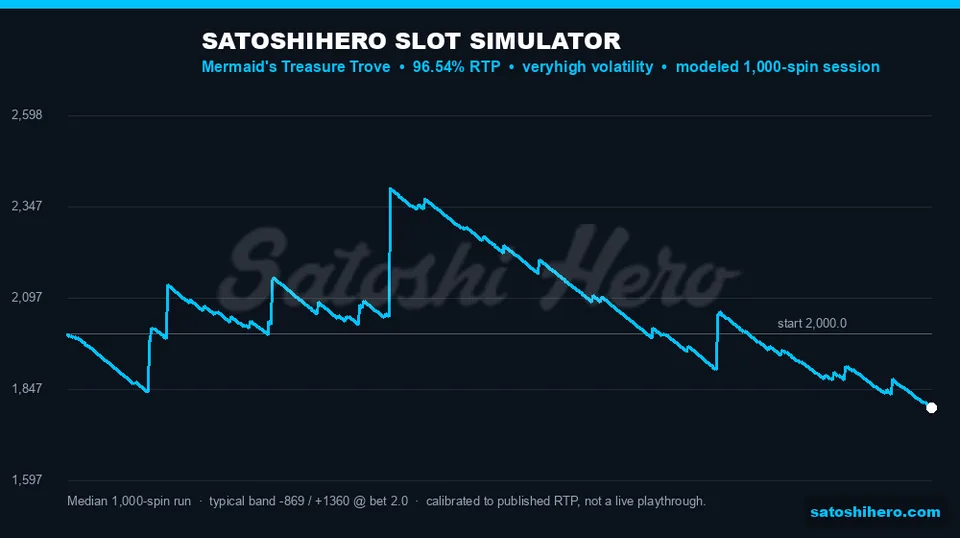
That spread matters more than the headline return when you choose a stake. You can land near the middle and still lose enough to feel the pressure. A better tail exists, but you need wild merges or strong free spins to reach it.

Caution: A 96.54% RTP is a theoretical figure. It doesn’t protect a 500-spin session from landing below expectation.
Our 500-spin session
My real 500-spin session at $2 lost $301.20. That landed close to the modelled median, and no natural free spins arrived. The result matched the very-high volatility profile better than it matched the cheerful theme.
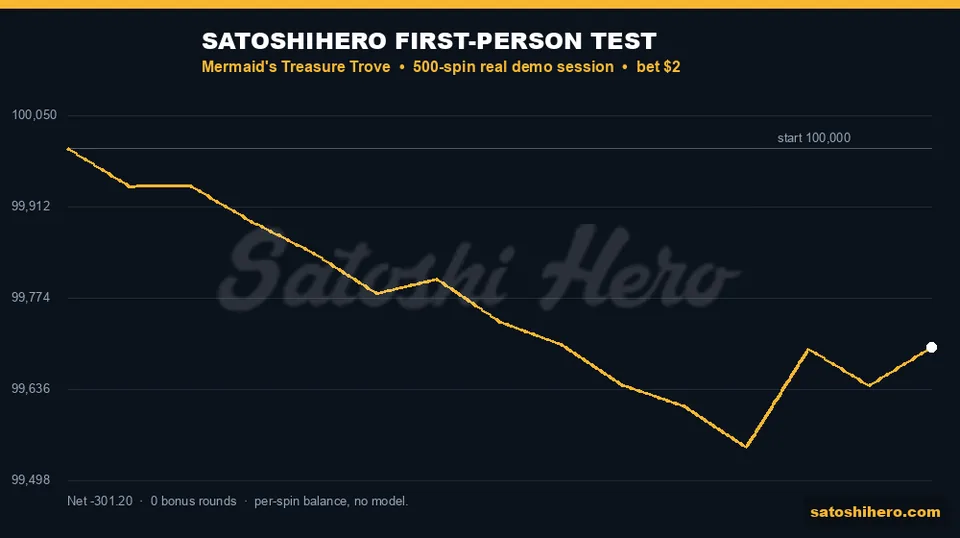
I think the max win looks attractive, but most gameplay waits for a wild-merge event or a strong free spins sequence. Small cluster wins keep the board alive, not your balance. You need to stake as if the bonus may stay away.
The theoretical RTP is the operator’s published return figure. One live session doesn’t prove or change that number. Bonus-buy RTP can sit slightly different from the base-game RTP by design.
Frequently Asked Questions About Mermaid’s Treasure Trove
How much does the bonus buy cost in Mermaid’s Treasure Trove?
The standard free spins buy costs 100x your total bet, so it cost $200 at my $2 stake. The super free spins cost 400x the bet, which was $800, and every multiplier wild starts at 10x instead of 1x.
How does the multiplier wild work in Mermaid’s Treasure Trove?
A winning block without a wild spawns one inside the area it covered. The wild starts at 1x, gains +1 when it helps pay, shuffles after each explosion, and can merge with other wilds while symbol multipliers up to 100x add on top.
What changes in the Mermaid’s Treasure Trove free spins?
Multiplier wilds persist for the whole round instead of clearing after one tumble chain. They keep moving, keep climbing, and can stack together on the grid, so you are chasing one cluster that covers multiple strong wilds.
How do you trigger free spins in Mermaid’s Treasure Trove?
Three, four, five, six or seven scatters award 10, 12, 14, 16 or 18 free spins. Extra scatters add one more spin during the round, and the ante bet gives a 3x better trigger chance while raising spin cost by half.
What did the 500-spin test return in Mermaid’s Treasure Trove?
My test lost $301.20 after 500 spins at $2 each. I started with $100,000, finished with $99,698.80, hit no natural free spins, and my biggest single hit was $194.50.
What did the bought bonus pay in Mermaid’s Treasure Trove?
The standard buy cost $200 and returned $188.70 across 10 spins, which was 94x the bet. The round built 15x and 7x wilds, but they never merged, leaving the result $11.30 below cost.
Final Thoughts
Mermaid’s Treasure Trove stands out because the cluster grid gives multiplier wilds room to grow, move and merge. Its main drawback is the very-high volatility, which can make the base game feel like a noisy balance slide.

My Verdict
Bonus hunters with patience get the most interesting play here, especially if they enjoy watching wilds build across a large board. Expect long dry stretches, small base wins, and sudden lifts when a wild finally catches the right cluster.
I like the persistence idea in free spins, and my bought round showed why it matters. I don’t like how many base-game wilds climbed briefly, then vanished before they could do real work. My 500-spin loss made the risk feel very real.
Mermaid’s Treasure Trove is a strong test for disciplined bankrolls, not a gentle casual spin. My notes and game details are checked regularly, so the figures here stay tied to the playable build.

Pros:
 Strong wild system: Growing wilds make clusters feel more meaningful.
- Clear grid layout: The 7×7 board helps you track tumbles and wild movement.
- High ceiling: The 10,000x cap gives bonus rounds real chase value.
- Useful demo feel: Free play shows the volatility before you risk larger buys.

Cons:
 Harsh variance: Cold runs can drain balance despite frequent small clusters.
- Costly buys: Standard and super purchases demand serious bankroll discipline.
- Brief base wilds: Base-game wilds often disappear before they merge.

Best For: High-volatility hunters, cluster-pay fans and bonus-buy testers get the most from this slot. You need to enjoy waiting for wilds to merge, because steady base-game profit isn’t the normal rhythm.

































































Bets
All Bets
Game
Player
Date
Wager
Mult.Multiplier
Prize
 Pelican's Bay: Rapid Link
 mdp0fxo
- 00:15:26
- 0×
- Royal Fruits 9: Hold 'n' Link
 Hidden
- 00:15:25
- 0×
- Royal Fruits 9: Hold 'n' Link
- josh1998
- 00:15:25
- 0×
- Galaxy Glitter
- mike_721
- 00:15:24
- 0.78×
- Purple Diamond
 cristianarroyo843
- 00:15:21
- 0×
- Pelican's Bay: Rapid Link
- mdp0fxo
- 00:15:21
- 0×
- Purple Diamond
- cristianarroyo843
- 00:15:18
- 0×
- Pompeii Gold: Rapid Link Bonus Buy
- Hidden
- 00:15:18
- 0×
- Pelican's Bay: Rapid Link
- mdp0fxo
- 00:15:15
- 0.29×
- Purple Diamond
- cristianarroyo843
- 00:15:14
- 0×