

Wild Wild Gold
By pressing play, you agree that you are above legal age in your jurisdiction and that your jurisdiction allows online gambling.


Wild Wild Gold: How to Play, Features and Real-Spin Results
Spin through a steampunk mining town in Wild Wild Gold, Popiplay’s five-reel, three-row slot with ten fixed paylines.
Wild Wild Gold is a very-high volatility slot with 95.65% RTP and 7,790x maximum win potential. Its sheriff-star Wild and Scatter unlocks ten free spins with persistent Expanding symbols. Sharp variance demands a solid bankroll, while cautious players could find the risk hard to stomach.
Key takeaways
- Best bonus: My test covered base spins only, so I can’t call any Bonus Buy level best.
- RTP / volatility: The slot combines a 95.65% RTP with very-high volatility.
- Max win: The official 7,790x cap feels relatively modest beside that risk rating.
- Risk note: My live session returned something often, while the simulator produced a much wider range.
- Bankroll note: Bonus prices from 110x to 520x need a separate budget from base spins.

Table of Contents
- How Wild Wild Gold Works
- Line wins and payouts
- Dual-purpose sheriff star
- Theme and First Impressions
- Scatter and Free Spins
- Base-Game Pace in Practice
- Hit rate and peak
- Practical bankroll implications
- Expanding Symbols
- Buy Bonus Options
- Gamble Round
- RTP, Volatility and Our Test
- Simulator projection
- Our 100-spin session
- Frequently Asked Questions About Wild Wild Gold
- Bottom Line
How Wild Wild Gold Works
Wild Wild Gold uses five reels, three rows and ten fixed paylines. Matching combinations pay from left to right, and only the highest win counts on each line. You should read every listed return as a multiple of your total stake, not a separate line stake.
The betting control runs from $0.10 to $20.00 per spin. My demo opened at $0.10 with a $1,000.00 play balance, equal to 10,000 default bets. The screen labels play money as FUN, but I express every amount in dollars and stake multiples here. You can use the same interface on desktop or mobile without learning a second layout.
Line wins and payouts
Premium symbols can pay from two matches, which creates more possible line combinations than the usual three-symbol minimum. That detail matters when you check a small return. Plain and simple, the paytable looks busy until you group symbols by matching count.
Five matching symbols pay:
- Gold nuggets: 500x.
- Pickaxe outlaw: 200x.
- Masked outlaw and gunslinger woman: 75x each.
- Robot horse and dynamite: 15x each.
- Revolver, wagon and barrel: 10x each.
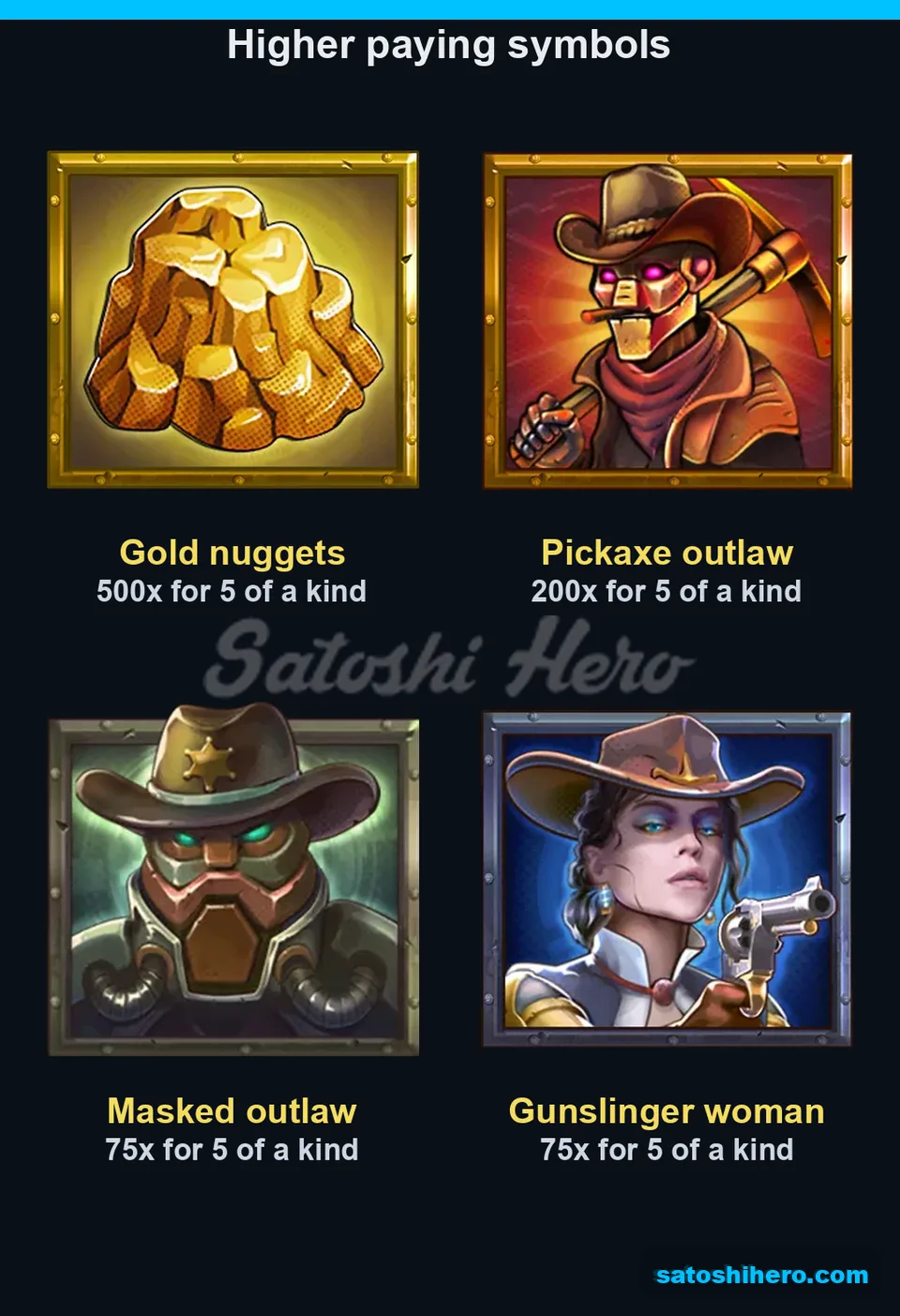
Four matching symbols pay:
- Gold nuggets: 100x.
- Pickaxe outlaw: 40x.
- Masked outlaw and gunslinger woman: 10x each.
- Robot horse and dynamite: 4x each.
- Revolver, wagon and barrel: 2x each.
Three matching symbols pay:
- Gold nuggets: 10x.
- Pickaxe outlaw: 4x.
- Masked outlaw and gunslinger woman: 3x each.
- Robot horse, dynamite, revolver, wagon and barrel: 0.5x each.
Two gold nuggets return 1x. Two pickaxe outlaws, masked outlaws or gunslinger women return 0.5x each. These two-symbol awards kept some of my paying spins alive, though they didn’t stop the balance from sliding.
Dual-purpose sheriff star
The sheriff star acts as both a substituting Wild and a Scatter. As a Wild, it replaces every other regular symbol. Two stars pay 1x, three pay 10x, four pay 100x and five pay 500x on a line.
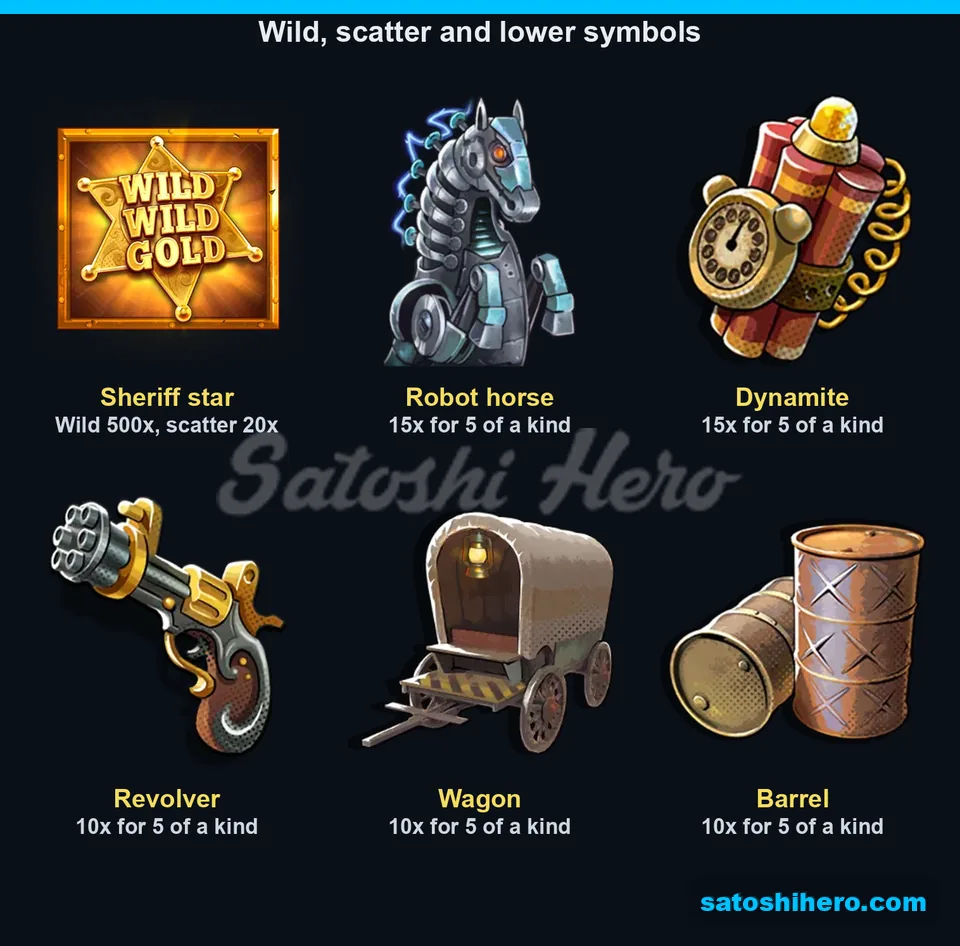
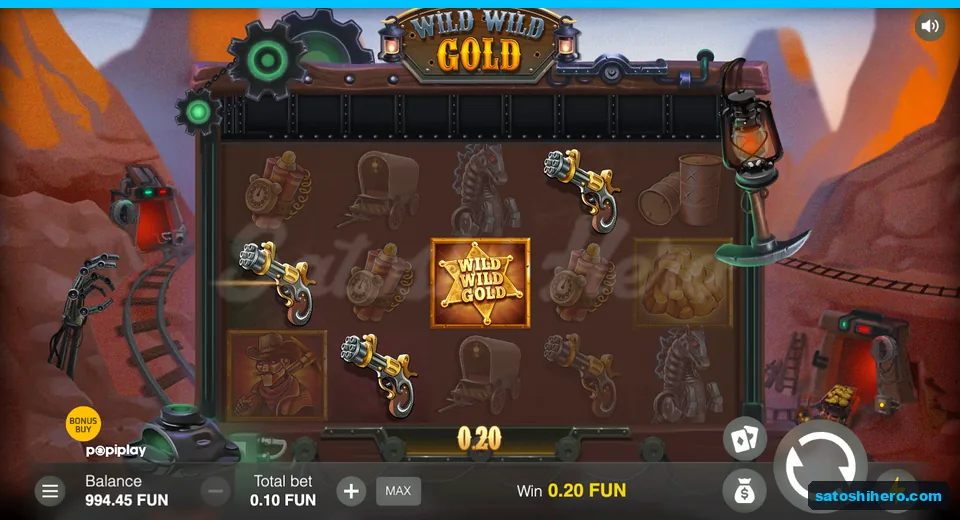
An extra spin after my counted test paid $0.20, or 2x my $0.10 stake, through revolvers. It doesn’t alter the recorded totals. That screen showed the Gamble controls, while paytable views covered the premium cast, sheriff star and lower symbols.

Data Point: The sheriff star has four jobs: substituting Wild, paying symbol, Scatter and free-spins trigger.
Don’t add several awards from the same active line. Check the highlighted line result because the game keeps only its highest completed combination.
Theme and First Impressions
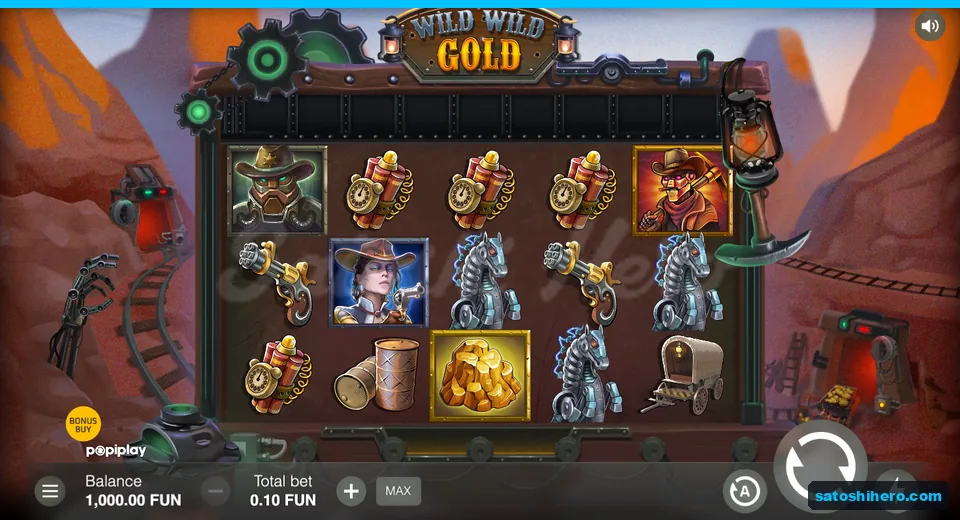
Familiar Western scenery fills the screen, but robotic characters give the setting a clear steampunk identity. The five-by-three board sits in a wooden mine-cart frame, with rails cutting through red canyon rock. You can grasp the mining theme before the first spin, and the clean symbol shapes remain easy to read.
The cast includes a masked outlaw, pickaxe outlaw, gunslinger woman and mechanical horse. Dynamite, a revolver, wagon, barrel and gold nuggets handle the frontier details. The Western setting won’t win originality awards, but the machinery gives it more personality than another plain saloon scene.
A full base-game image shows the board, wooden frame, Bonus Buy badge, $0.10 stake and $1,000.00 opening balance. The demo label changes only the display unit, so you can still compare each result through stake multiples. I found that approach clearer than treating the play balance as meaningful cash.
Wild West Gold offers a more conventional Western presentation if you prefer familiar gunslinger imagery over Popiplay’s robotic cast. Xperiment Gold provides another gold-focused Popiplay alternative, while Wild Witches shifts the provider’s style toward a darker magical setting. Wild Wild Steel is the closest named alternative for another mechanical frontier theme. Here, the mechanical horse and metal-faced outlaws create the real visual hook. That distinction helps you avoid confusing two similarly named games.

Fun Fact: The reel cabinet resembles a wooden mine cart, tying the interface directly to its gold-mining setting.
The steampunk treatment adds character without making you hunt for key symbols. I’d take readable icon design over more elaborate animation every time.
Scatter and Free Spins
Three or more sheriff-star Scatters anywhere award ten free spins. Three stars also pay 0.2x, four return 2x and five return 20x the stake. You don’t need them aligned on a payline, which makes the trigger rule easy to follow.
The round can retrigger after it begins. Each retrigger can select another Expanding symbol, but the expansion thresholds need their own explanation. In my 100-spin test, no free spins triggered, so I won’t pretend I observed a bonus payout.
One trigger-free sample can’t establish a hit rate. You could meet three stars quickly in another session, or wait longer than I did. No sugarcoating, missing the main feature made my run feel flat despite regular small returns.
The documented trigger rules and my observed play tell different parts of the story. Rules explain what can happen, while the counted spins show only what happened to me. You should keep that distinction in mind before judging the bonus from one short session.
Free spins provide the gateway to the persistent Expanding-symbol mechanic. Without a trigger, the base game stays simple and the slot’s main idea remains out of reach.
Base-Game Pace in Practice
Thirty-four of my 100 spins returned something, yet mostly small payouts left the balance lower. That pace felt busier than the final loss suggests. You see symbols connect fairly often, but frequent returns don’t mean the session is profitable.
My quiet sample doesn’t replace the official risk classification. It simply shows one narrow route through a game capable of much sharper movement. I liked the regular visual feedback, though the lack of one reversing hit made the run steadily frustrating.
Hit rate and peak
Exactly 34 spins produced a return, and 17 paid at least 1x the stake. My best result arrived on spin 79, paying $1.00 from a $0.10 wager, or 10x. You can see why the balance never recovered when the peak award stayed that small.
The balance peaked at $999.90 on spin 1. It reached its low point of $995.00 on spin 92, then closed slightly higher. Regular paying spins kept the movement contained, but none supplied enough force to reverse the gradual decline.
That pattern felt deceptively gentle. A line hit would interrupt the losing sequence, then the next few spins would remove the small return. I don’t consider that a fault, but it shows why raw hit counts can mislead you.
Practical bankroll implications
Frequent returns can create an active session while your balance still drifts downward. Turbo mode pushed my sample along quickly and made that loss less obvious in real time. You should set a spin limit or loss limit before speeding up play, not after a long sequence.

Suggestion: Track every result in stake multiples and choose your spin limit before enabling turbo. Small returns can hide a gradual loss.
My $0.10 test stayed within a tight dollar band, so the steady pace never became dramatic. Another session could move much more sharply, especially if feature access changes the pattern. You need a plan that can survive both quiet erosion and sudden variance.
The observed contrast matters most: this sample felt busy but ended 48.5x down. I’d rather track net movement than let a stream of tiny wins shape my judgment.
Expanding Symbols
Free spins select one regular symbol that can expand across every position on qualifying reels. High-value and medium-value symbols activate when at least two copies land on different reels. Low-value symbols need at least three copies across separate reels, so you must watch spread rather than adjacency.
Once qualified, the matching symbol covers every position on each involved reel. Those original copies don’t need to sit on neighboring reels for an expansion to form a win. I think that non-adjacent rule gives the feature more flexibility than its simple presentation suggests.
Retriggers can select further Expanding symbols, up to nine different choices during one bonus. Every selected symbol remains active until the free spins finish. You gain the most feature depth through persistence, because earlier selections stay available across later spins.
My live test never reached free spins, so I didn’t observe an expansion or a retrigger. These are documented mechanics, not claims about common payout sizes. You shouldn’t read the nine-symbol ceiling as a typical outcome, since my sample provides no basis for that conclusion.
A scattered premium pair can matter even when standard line positions look weak. Low symbols need a third copy on another reel before expansion activates.
Persistent accumulation supplies the main appeal, especially if retriggers add eligible symbols. I like the clear escalation, but base-only play offers no taste of it. Persistence matters most because each selected symbol stays usable for the remaining spins.
Buy Bonus Options
The Bonus Buy menu starts free spins with one to nine Expanding symbols already selected. A badge left of the reels opens the menu, letting you choose the starting count before paying. You get direct feature access, but each purchase concentrates substantial risk into one decision.
The documented prices are:
- One symbol: 110x the stake.
- Two symbols: 173x.
- Three symbols: 235x.
- Four symbols: 299x.
- Five symbols: 362x.
- Six symbols: 422x.
- Seven symbols: 478x.
- Eight symbols: 520x.
- Nine symbols: 485x.
Nine starting symbols cost 35x less than eight, making the price ladder unusual. Price alone doesn’t prove likely performance. I didn’t purchase any level, so I can’t rank the choices or attach real returns to them.
Even the cheapest entry consumes 110 ordinary stake units immediately. At my $0.10 test stake, that purchase costs $11.00 before the round starts. You should separate a buy budget from money reserved for base spins, because mixing both can hide total exposure.
A larger starting count sounds stronger, yet the menu price doesn’t guarantee a better final return. I find the inverted top prices interesting, not persuasive. Without tested outcomes or separate math figures, calling either choice superior would be guesswork.

Watch Out: One purchase can consume hundreds of stake units. Set a firm buy budget, and don’t assume a higher price guarantees a stronger return.
Judge each option by affordable risk, not the number of starting symbols alone. If a single buy would wreck your session budget, direct access isn’t worth the pressure.
Gamble Round
After a main-game win, Gamble lets you risk the entire return on one card guess. The completed payout becomes your stake for that round. You can guess the card’s colour to double it or name the exact suit for a 4x result.
A correct guess lets you collect the new amount or risk it again. A wrong choice ends the round and forfeits the gambled return. The rules are simple, but I think adding an all-or-nothing decision to this slot’s risk profile takes more restraint than it first appears.
Autoplay can display the option when you select “On any win.” The Gamble button appeared beside the spin control during my test, but I didn’t use it. You won’t find invented wins or losses here because I never placed a card guess.
Doubling a tiny payout can look harmless. An exact-suit attempt can seem even more tempting when the base hit barely covers prior spins. Yet the entire return remains at risk, and repeated guesses can erase a result you had already secured.
Decide before playing whether you’ll collect every win or expose selected returns. That rule prevents emotion from taking over after a pleasing hit. My preference is simple: in a risky game, I don’t need another variance layer attached to each payout.
RTP, Volatility and Our Test
The published theoretical return, risk level and win cap frame two very different test views. Our simulator produced a broad set of modeled outcomes, while my live sample moved inside a narrow band. You should use both as context, not as promises about your next session.
Theoretical RTP describes the game’s underlying return calculation, not a target for one short run. Neither my simulator path nor my live play came close to the top award.
Simulator projection
The SatoshiHero Slot Simulator modeled 1,000 spins at one stake unit per spin. It used the game’s math profile and top-win cap. The median run finished 109.9x down, and the central 90% range stretched from 439.6x down to 664.5x up.
A feature-sized result appeared about once per 54 modeled spins. A very large result appeared roughly once per 820 simulated spins. These frequencies describe model output, not a feature schedule or forecast, and you can’t use them as a countdown.
The projection’s blue line represents one modeled balance path across 1,000 spins. It helps illustrate how gains and losses can cluster along a single route. I find the full range more useful than that one line because it exposes how widely sessions can separate.
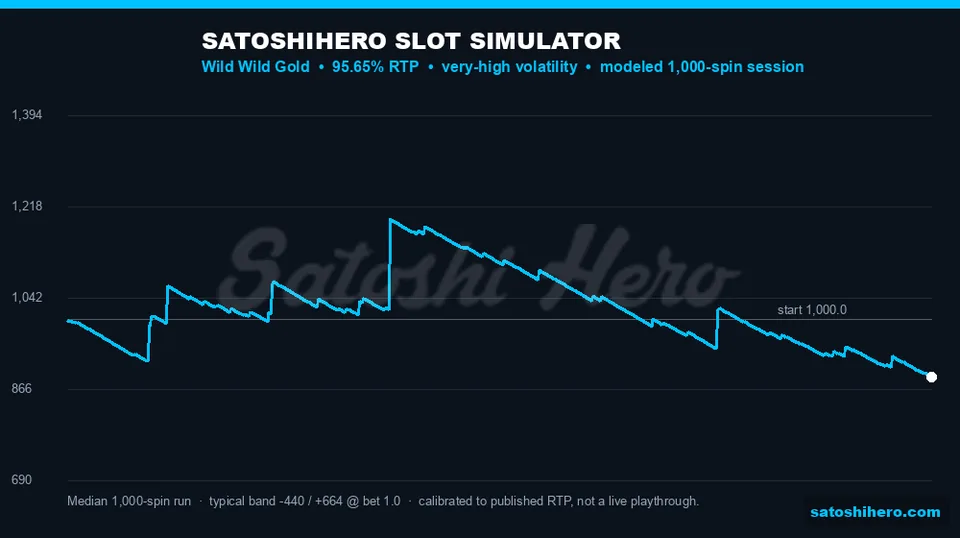
Here’s the deal: a median loss doesn’t predict your result. The broad central band shows why a session can finish far above or below its starting point. You shouldn’t infer that a bonus or large hit becomes due after any fixed number of spins.
Our 100-spin session
I started with $1,000.00 and finished at $995.15. The $4.85 net loss equaled 48.5x my $0.10 stake. My largest win paid 10x on spin 79, while 34 spins returned something and 17 covered at least the full wager.
No free spins triggered, I bought no bonus, and I didn’t use Gamble. The real-session graph’s gold line stayed within a tight range before ending lower. Compared with the simulator’s spread, my route looked quiet, but its lack of a meaningful recovery still mattered.
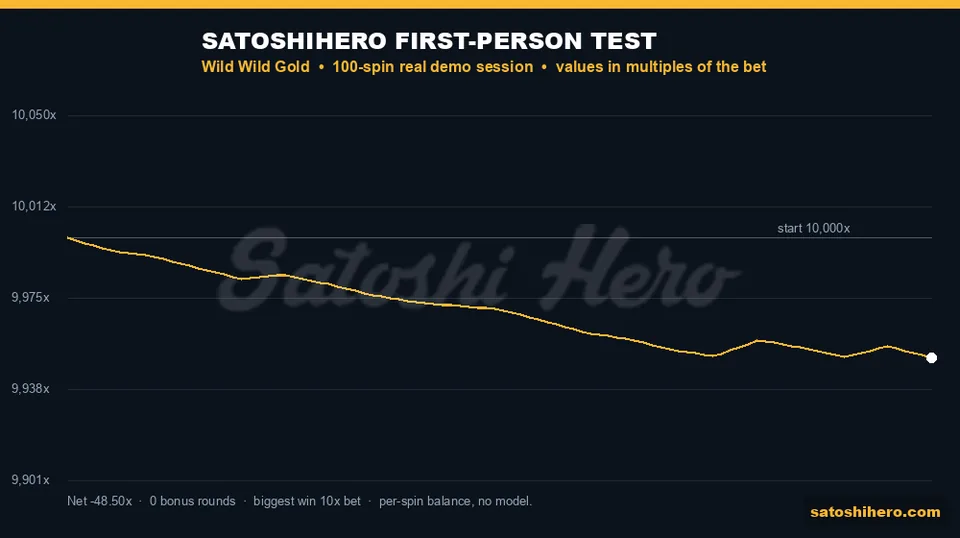
My counted test covered ordinary base spins only. It ran on turbo, which compressed the experience without changing the recorded results. You can play the Wild Wild Gold casino game in demo or real mode on SatoshiHero, though either format uses the same underlying mechanics.
The published RTP is Popiplay’s theoretical return figure, and one live session doesn’t change it. The simulator illustrates a possible distribution rather than recording live spins. Individual bonus modes can carry slightly different theoretical returns by design, so I won’t invent or rank figures that aren’t part of the documented rules.
Treat both test blocks as context for possible session behavior, never a promise of future results. In my view, the sharp modeled spread tells you more about risk than the calm shape of one short test.
Frequently Asked Questions About Wild Wild Gold
What is Wild Wild Gold?
Wild Wild Gold is Popiplay’s five-reel, three-row steampunk Western slot with ten fixed paylines. Its sheriff star acts as Wild and Scatter, while free spins use persistent Expanding symbols. The robotic outlaws and mine-cart frame separate it from a standard cowboy game.
How do free spins work in Wild Wild Gold?
Three or more sheriff-star Scatters start ten free spins. High-value and medium-value Expanding symbols activate from two copies on different reels, while low symbols need three. Retriggers can select more persistent symbols, up to nine during one round.
Can you buy the Wild Wild Gold bonus?
Yes. The menu starts free spins with one to nine Expanding symbols. Prices run from 110x for one through 520x for eight, while nine costs 485x. I didn’t buy a bonus during my 100-spin test.
How does the Wild Wild Gold Gamble round work?
A colour guess doubles the completed main-game win, while an exact-suit guess multiplies it by four. A wrong choice forfeits the gambled return. I saw the button during testing but didn’t use it.
What does the sheriff star do in Wild Wild Gold?
The sheriff star substitutes as the Wild and pays up to 500x for five on a line. It also acts as the Scatter, paying 0.2x, 2x or 20x for three, four or five. Three or more start free spins.
What did the Wild Wild Gold 1,000-spin simulator show?
The median modeled run ended 109.9x down after 1,000 spins. Its central 90% range stretched from 439.6x down to 664.5x up. That distribution can’t predict one individual session.
How did the Wild Wild Gold 100-spin test go?
I finished 48.5x my stake down. Thirty-four spins returned something, my best result paid 10x on spin 79, and free spins never triggered. This sample records one session rather than forecasting another.
What are the Wild Wild Gold RTP and maximum win?
Wild Wild Gold has a theoretical RTP of 95.65%, very-high volatility and a 7,790x maximum win. Those specifications describe the game’s published math profile, not a guaranteed session result.
Is Wild Wild Gold a Wild West game?
Yes. Red canyons, rails, gold mining tools and outlaw symbols establish the Western setting. Robotic characters, a mechanical horse and exposed machinery add its steampunk twist without changing the familiar frontier theme.
Bottom Line
Wild Wild Gold stands out through persistent Expanding symbols and an unusual nine-level Bonus Buy menu. Its main drawback is simple: the core feature stayed absent throughout my counted play, leaving mostly small line returns.

My Verdict
Bankroll-conscious variance hunters can appreciate the clear mechanics and direct bonus access. Expect base play to feel straightforward, with much of the attraction locked behind free spins that might not appear during a short run.
I like the readable symbols, two-symbol premium pays and clear separation between base play and the main feature. I don’t like how little excitement my 100 spins produced, since a 10x peak couldn’t reverse the steady loss.
Wild Wild Gold offers a distinctive robotic Western theme, but you need patience and firm limits. The guide is updated periodically when verified testing adds meaningful context.

Pros:
 Readable layout: Ten fixed lines make completed combinations easy to check.
- Persistent expansions: Selected bonus symbols remain active across later free spins.
- Flexible access: Nine purchase levels provide varied starting symbol counts.
- Useful premium pays: Four top symbols can return value from two matches.

Cons:
 Sharp variance: Short sessions can miss the main feature completely.
- Costly purchases: Even the cheapest bonus consumes 110 normal stakes.
- Extra gamble risk: Card guesses can erase a completed base-game return.

Best For: Patient high-risk players who track results in stake multiples and keep separate bonus budgets. Cautious players or anyone chasing steady feature access should treat the long gaps seriously.
Similar Games
































































Bets
All Bets
Game
Player
Date
Wager
Mult.Multiplier
Prize
 Mardi Gras Queen
 nina87
- 04:22:51
- 2×
- Big Banker Bonanza
- Hidden
- 04:22:50
- 0×
- Luck of Panda: Bonus Combo
 mdp0fxo
- 04:22:49
- 3.65×
- Mardi Gras Queen
- nina87
- 04:22:48
- 0.03×
- Mardi Gras Queen
- nina87
- 04:22:45
- 0×
- Phoenix HIT Hotfire Hold & Win Buy Bonus
 Hidden
- 04:22:44
- 0×
- Phoenix HIT Hotfire Hold & Win Buy Bonus
- Hidden
- 04:22:42
- 0×
- Bow of Artemis
 Hidden
- 04:22:42
- 0×
- Mardi Gras Queen
- nina87
- 04:22:42
- 0×
- Bow of Artemis
- Hidden
- 04:22:40
- 0×