

Retro Tokyo
By pressing play, you agree that you are above legal age in your jurisdiction and that your jurisdiction allows online gambling.


Neon Streets, Fixed Lines and a Lucky Cat
Spin across five fixed lines while neon Tokyo imagery frames every compact 3×3 result.
According to Onlyplay, Retro Tokyo slot is a medium volatility slot with 95.5% RTP and 3,015x maximum win potential. All five paylines stay active, while three arcade scatters open the bonus for line-slot fans seeking readable payouts. I tested 100 paid spins from a $10,000.00 demo balance and finished $39.00 down after a $27.00 best win, with no jackpot. The observed $1.00–$50.00 range, demo and real play are available here on SatoshiHero.
Key takeaways
- Best bonus: Three arcade scatters trigger 10 free spins because there’s no bonus buy. A random x2, x3 or x10 then multiplies the accumulated feature win.
- RTP / volatility: Retro Tokyo slot has a 95.5% RTP and medium volatility.
- Max win: The official maximum win reaches 3,015x the bet.
- Risk note: The simulator’s median 1,000-spin result finished $54.30 down at $1.00 per spin, but it can’t forecast your session.
- Bankroll note: The lowest observed stake was $1.00, so 100 paid spins put $100.00 into action before returns.
These points separate published math, modeled projections and my observed results. You can use them to judge the game before digging into each part.

Table of Contents
- Neon Theme and First Impressions
- Symbols and screen
- How Retro Tokyo Works
- Grid and win lines
- Wilds and scatters
- Symbol Values and Paytable
- Premium symbols
- Lower-value symbols
- Free Spins and Final Multiplier
- Trigger and rules
- Test result
- Full-Screen Jackpots
- Three fixed prizes
- What I observed
- RTP, Volatility and Test Data
- Simulator projection
- My 100-spin session
- How the Session Actually Felt
- Balance pattern
- Player fit
- Frequently Asked Questions About Retro Tokyo
- Bottom Line
Neon Theme and First Impressions
Neon city lights, a synthwave skyline and retro objects create a sharp Tokyo setting. A pink lucky cat watches beside the reels, while three jackpot plates sit near the compact board. You see hot pink, electric blue and purple without losing track of the symbols. I think the small grid saves the presentation from becoming a glowing mess.
The visible set includes a yellow sports car, red motorcycle, katana and retro television. A joystick, green phone, digital watch and game cartridge complete the regular symbols. Arcade cabinets carry the scatter label, so you can identify the feature trigger at a glance. The Tokyo retro style feels coherent rather than random.
Symbols and screen
The base screen also makes practical details easy to read. You can spot the joystick, katana and scatter beside the $10,000.00 demo balance and $1.00 starting bet. That clarity matters because the board resolves wins quickly. Bright colors never hide the result for long.
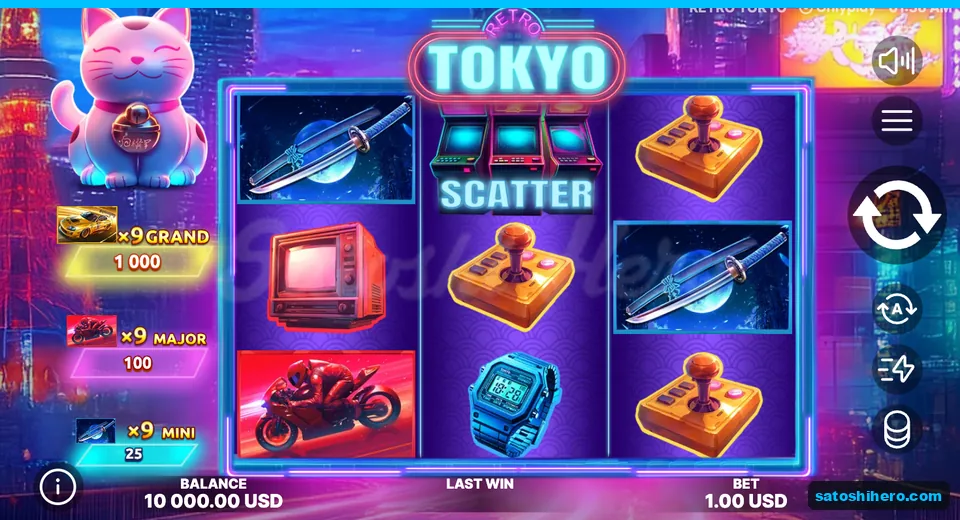
Plain and simple, the theme won’t win originality awards. Yet the lucky cat, arcade hardware and street-lit skyline belong together. Retro Pedro offers another nostalgic theme if old-school styling matters more to you than a specific city setting. I prefer this game’s tighter neon palette. Two more Onlyplay alternatives on SatoshiHero are Zombolics and Wolf Treasure.

Fun Fact: The symbol set mixes arcade hardware, old consumer electronics and stylized street imagery to reinforce the Tokyo retro mood.
You get a lively visual identity without a crowded play area. That restraint gives the Retro Tokyo slot a cleaner first impression than its loud colors suggest.
How Retro Tokyo Works
Retro Tokyo slot uses a 3×3 grid with five fixed paylines. Every line stays active on every paid spin, so you can’t reduce the count or change the pattern. You choose the stake, press spin and read the highlighted result. I like that direct setup because nothing distracts from the actual wager.
Grid and win lines
Three matching paying symbols must align across one of the five valid lines. The paytable expresses each reward as a multiple of your total bet. During my test, three retro televisions formed a diagonal and returned $2.00 from a $1.00 wager. That result confirmed the listed 2x value in live play.
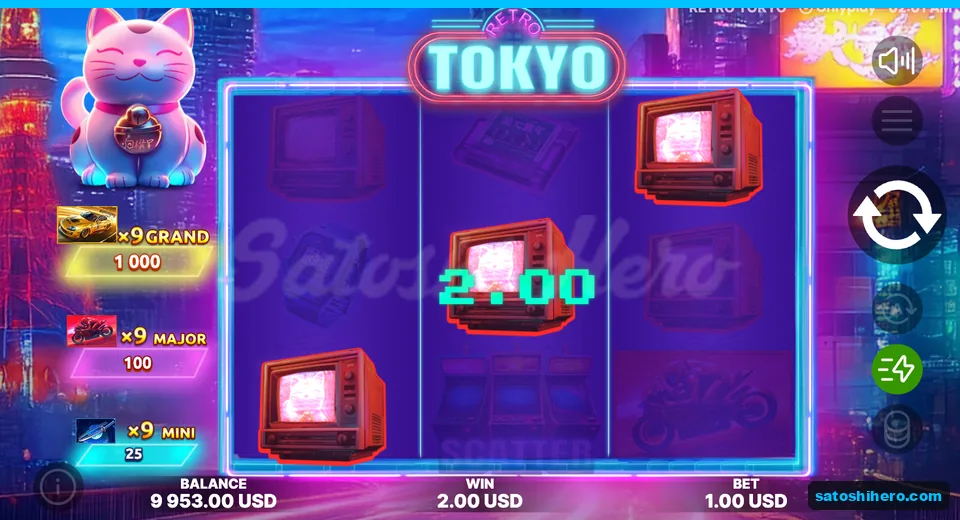
Diagonal wins deserve a second look on such a small board. You could scan only the rows and miss why the balance changed. Check the highlighted path after every return, especially when several symbols repeat. The line marker makes the final answer clear.
All five paths remain available at the $1.00 starting stake. Raising your wager changes the money attached to a multiplier, not the number of active lines. There isn’t a line-selection menu to manage before each spin. No sugarcoating, this structure favors speed over control.
Wilds and scatters
The game has no wild symbol. Arcade-cabinet scatters don’t pay as normal line symbols, and one or two cabinets return nothing by themselves. Three scatters anywhere on the grid open the free-spins round. You need that full trigger because near misses carry no consolation payout.
That lack of wilds keeps outcomes easy to audit. It also means regular wins rely on exact matching symbols across valid lines. I found the trade-off fair but basic: you gain clarity and lose substitution-driven combinations. The fixed lines and simple scatter rule let you read each result before the next spin.
Symbol Values and Paytable
The yellow sports car is the highest-paying regular symbol at 10x for three on a line. All listed rewards require three matching symbols across an active payline. You can learn the entire table quickly, though many hits barely cover the wager. I think that modest base-game profile puts too much pressure on the bonus and rare screens.
Premium symbols
At a $1.00 stake, the premium line returns are:
- Yellow sports car: 10x, equal to $10.00.
- Red motorcycle: 7x, equal to $7.00.
- Katana: 4x, equal to $4.00.
- Retro television: 2x, equal to $2.00.
The visible 10x, 7x, 4x and 2x labels make comparisons straightforward. You don’t need to convert line-specific stakes because every value uses the total wager. My diagonal television win matched the table exactly at $2.00. That concrete result made the paytable feel easier to trust and follow.
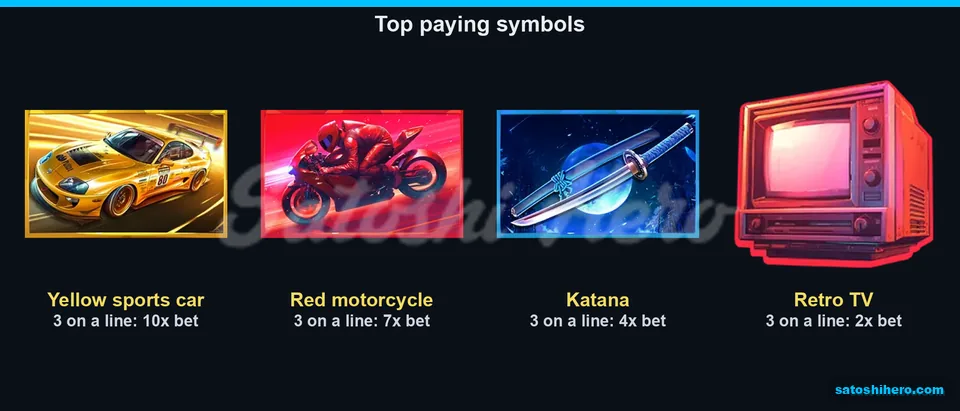
The sports car, motorcycle and katana also correspond to three full-screen jackpots. Their ordinary line values don’t change when fewer than nine matching symbols appear. You still receive the standard line return unless the complete screen meets a jackpot condition. I appreciate that clean separation between everyday pays and special prizes.
Lower-value symbols
The remaining three-symbol returns at $1.00 are:
- Joystick: 1x, equal to $1.00.
- Green phone: 1x, equal to $1.00.
- Digital watch: 0.5x, equal to $0.50.
- Game cartridge: 0.5x, equal to $0.50.
An arcade cabinet acts only as the free-spins trigger. It carries no standard line return, even when cabinets appear together below the required count. You should expect many paying spins to produce no profit because 0.5x and 1x outcomes merely soften the cost. My test contained plenty of $0.50 to $4.00 returns, which supports that practical reading.
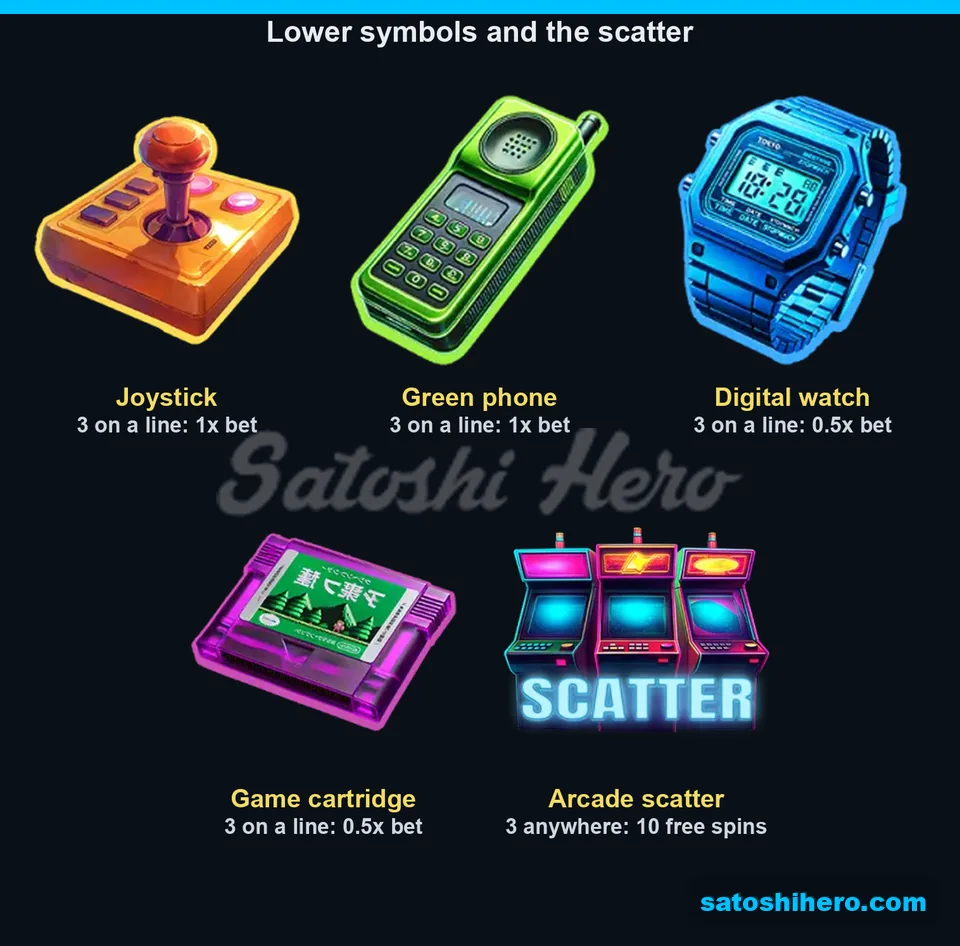
The free-spins multiplier and full-screen outcomes carry much of the upside. You shouldn’t treat every highlighted line as a meaningful recovery. The simple table is easy to learn, but ordinary line wins often remain modest.
Free Spins and Final Multiplier
Three arcade scatters award 10 automatic free spins, followed by one x2, x3 or x10 multiplier. The selected multiplier applies to the complete accumulated bonus win after the final spin. You can’t buy direct access, so paid play provides the only route. I like the clean format, although it offers no choices once triggered.
Trigger and rules
Scatters can land anywhere across the 3×3 grid. The three triggering cabinets don’t add a separate cash prize. All 10 free spins then run automatically while the game totals their returns. You watch the sequence rather than choosing options or paths.
After the tenth spin, the game draws one listed multiplier. It applies once to the entire accumulated amount, not separately during each free spin. The x10 possibility creates obvious tension, but you can’t assume any outcome before the draw. That final reveal supplies most of the feature’s personality.
Near misses have no direct value here. One or two scatters don’t pay, and a dry stretch doesn’t move you closer to three. I found this easy to understand but fairly unforgiving. You should set your paid-spin limit without relying on a trigger.
Test result
My feature started on paid spin 35. The 10 free spins built a $13.50 subtotal, then the draw selected x2. That produced a $27.00 return, equal to 27x my $1.00 bet. It became the largest result from all 100 paid spins.
The result briefly pushed my balance to about $10,008.00. You can see why the closing multiplier matters: the subtotal alone wouldn’t have created the same session high. Still, my single x2 draw says nothing about the relative chance of x2, x3 or x10. I won’t turn one observation into a probability claim.

Suggestion: Set a paid-spin limit before you start. The lowest observed stake was $1.00, and you can’t buy the feature after a dry stretch.
The final draw gives a simple bonus welcome suspense. My session received the lowest listed multiplier, yet the Retro Tokyo slot feature still delivered its best hit.
Full-Screen Jackpots
A jackpot requires one qualifying premium symbol to fill all nine grid positions. These prizes use fixed bet multiples rather than changing mystery values. You need a complete 3×3 screen, so eight matching symbols aren’t enough. I view them as rare upside, not a practical session target.
Three fixed prizes
The full-screen conditions and $1.00-stake equivalents are:
- Yellow sports car: Grand at 1,000x, equal to $1,000.00.
- Red motorcycle: Major at 100x, equal to $100.00.
- Katana: Mini at 25x, equal to $25.00.
Each prize requires nine copies of its matching symbol. A standard line of sports cars still pays its normal 10x amount without the full screen. You shouldn’t confuse several winning lines with the required jackpot pattern. The rule is strict but refreshingly easy to verify.
What I observed
No full-screen jackpot landed during my 100 paid spins. That absence doesn’t reveal the trigger rate, and it never means a prize has become due. You could play another spin without any increased entitlement to a matching screen. I wouldn’t chase one after a losing run.
The 1,000x Grand also differs from the overall 3,015x win cap. I can’t support guesses about how line pays, features or jackpots combine toward that ceiling. The supplied rules establish both figures without explaining a path between them. Treat them as separate limits unless the game displays a qualifying result.

Data Point: The 1,000x Grand isn’t the highest possible result. The overall win cap reaches 3,015x the bet.
Jackpot imagery adds tension to the compact screen. But you should build a bankroll around paid spins, not a rare full-screen rescue.
RTP, Volatility and Test Data
The math profile combines 95.5% RTP, medium volatility and a 3,015x maximum win. RTP describes the game’s theoretical return, not the result your balance must show. Medium volatility can mix routine small returns with less frequent larger hits. In my view, the label understates how quiet a short run can feel.
You should read the official profile beside modeled and observed evidence. Neither source predicts the next random result. The model maps a possible spread, while my session records one actual path. Keeping those evidence types apart prevents false expectations.
Simulator projection
The SatoshiHero Slot Simulator modeled 1,000 spins at $1.00 each. Inputs used the stated RTP, volatility and maximum win. Its median session ended $54.30 down, while the 5th percentile finished $223.50 down. The 95th percentile reached $150.40 up.
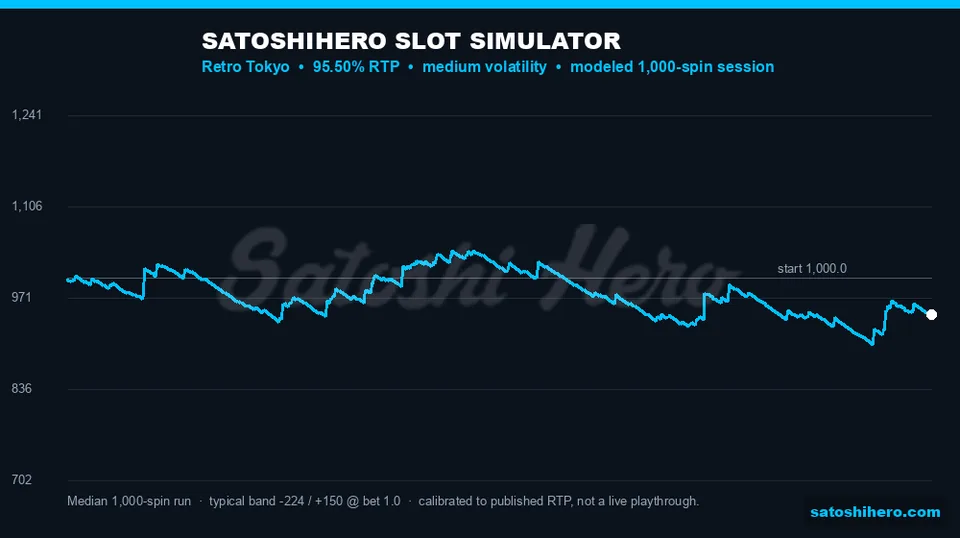
That band matters more than the median by itself. You could end above or below $54.30 down without contradicting the projection. A percentile isn’t a promised boundary, either. I think the wide spread gives a better warning than one neat average.
About 25% of modeled spins produced some return. The free-spins tier appeared roughly once every 51 spins, while a 100x-plus result appeared around once in 11,236 spins. Those frequencies describe the simulation, not the live random number generator. You can’t use them as a countdown.
A 25% return rate also doesn’t mean one profitable result every four spins. Some modeled returns can sit below the stake, just like the game’s 0.5x symbols. Clusters and dry patches can reshape a short balance path. The projection gives you context, not a schedule.
My 100-spin session
I lost $39.00 across 100 paid spins at $1.00 each. My balance started at $10,000.00 and ended at $9,961.00 after $100.00 of turnover. Only 16 spins paid anything, leaving 84 without a return. That hit pattern felt colder than the medium label might suggest.
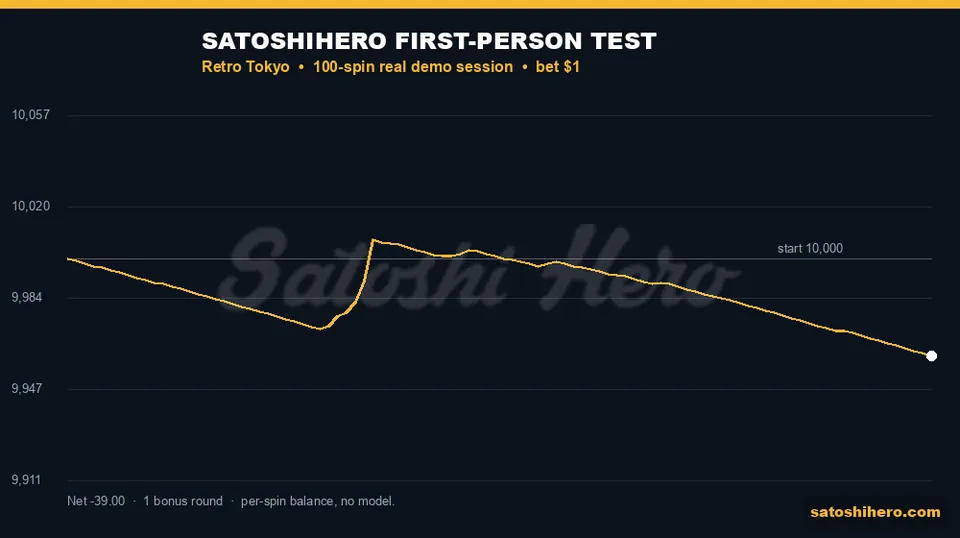
The largest win was $27.00 from free spins on spin 35. My strongest base-game results paid $7.00 on spin 31 and $8.00 on spin 33. Most other returns ranged from $0.50 to $4.00. You can see how the low symbols slowed losses without reversing them.
One bonus in 100 paid spins was less frequent than the model’s approximate once-every-51-spins tier. That difference doesn’t invalidate either record. A short sample can diverge sharply from a modeled average, especially with a single trigger. I wouldn’t use my test to forecast your feature count.

Watch Out: Neither the modeled feature frequency nor my live test works as a schedule. Don’t raise your wager because the scatters haven’t appeared.
The 95.5% figure is the operator’s published theoretical RTP, and one live session doesn’t alter it. Simulator frequencies remain estimates, while feature-specific returns can differ slightly from the base figure by design. You should judge the numbers by their stated scope. The evidence shows meaningful short-session variance despite the medium volatility rating.
How the Session Actually Felt
The test felt quiet because only 16 of 100 paid spins returned anything. Most wins ranged from 0.5x to 4x, so they often slowed the decline rather than reversing it. You got one sharp bonus-led lift inside a longer downward path. I found that rhythm flatter than many readers might expect from medium volatility.
Balance pattern
My balance declined steadily to about $9,971.00 by spin 30. Base-game wins of $7.00 and $8.00 then arrived on spins 31 and 33. The $27.00 feature on spin 35 pushed the total to roughly $10,008.00. That jump turned a dull opening into a brief profitable moment.
The mood changed immediately, but the profit didn’t hold. Small and empty spins gradually pulled the balance toward $9,961.00, which became the session low. You could mistake the temporary high for a turning point if you focused only on the feature. My ending shows why one decent bonus doesn’t secure a winning session.
Player fit
A $1.00 observed minimum puts $100.00 into action across 100 paid spins. Pick a spin limit you can accept without depending on free spins or jackpots to repair losses. You should also expect many returns to fall below or near the stake. That practical limit matters more than chasing the x10 multiplier draw.
Compact-line fans get fixed paylines, clear symbol values and a simple automatic feature. The Tokyo retro mood also gives visual appeal to readers who value styling beside straightforward mechanics. I think the format rewards patience more than constant interaction. It asks you to watch, not make bonus decisions.
Interactive-feature fans get less here. You can’t select paylines, use wild-led combinations or buy the bonus. Anyone seeking frequent choices could find the loop thin despite its polished theme. The x10 possibility adds tension, but one decent feature can disappear quickly during small or empty spins.
Frequently Asked Questions About Retro Tokyo
How many lines does Retro Tokyo slot have?
Retro Tokyo slot has five fixed paylines on a 3×3 grid. All five remain active, so you can’t choose a different line count before spinning.
How do free spins start in Retro Tokyo slot?
Three arcade scatters anywhere trigger 10 free spins. After the final spin, x2, x3 or x10 multiplies the full accumulated feature win.
What do the Retro Tokyo slot jackpots pay?
Nine sports cars award the 1,000x Grand, nine motorcycles award the 100x Major, and nine katanas award the 25x Mini. At $1.00, those values equal $1,000.00, $100.00 and $25.00.
Which symbol pays the most in Retro Tokyo slot?
The yellow sports car pays 10x for three on a valid line. A red motorcycle pays 7x, while a katana pays 4x.
What did the simulator project?
The 1,000-spin model at $1.00 produced a median finish of $54.30 down. Its 5th-to-95th-percentile span ran from $223.50 down to $150.40 up, illustrating outcomes rather than predicting your play.
How did the Retro Tokyo slot test go?
My 100-spin session finished $39.00 down from a $10,000.00 starting balance. Sixteen spins paid, the $27.00 feature was my largest win, and no jackpot landed.
What are the Retro Tokyo slot RTP and maximum win?
The RTP is 95.5%, volatility is medium and the maximum win is 3,015x the bet. These figures describe the math profile, not your guaranteed session result.
Bottom Line
Retro Tokyo stands out through its clean 3×3 layout, fixed lines and final bonus multiplier. Its main weakness is a base game where many wins merely return part of your stake. You get clarity and atmosphere, but not much interaction.

My Verdict
Simple-slot fans should try the demo before committing a larger spin budget. Expect readable outcomes, long quiet patches and occasional tension from scatters or full-screen symbols.
I like how my $2.00 diagonal television win matched the paytable without any guesswork. I also liked the $27.00 feature lift, though I don’t like how quickly small and empty spins erased it. My $39.00 loss exposed the downside clearly.
This Retro Tokyo slot guide is checked regularly for factual and testing clarity. You should still treat the 100-spin record as one session, not a forecast.

Pros:
 Readable grid: The compact board makes rows and diagonals easy to follow.
- Clear bonus: Ten automatic spins finish with one simple multiplier draw.
- Fixed jackpots: Each full-screen prize has a transparent bet-based value.
- Cohesive art: Neon colors and retro objects create a consistent setting.

Cons:
 Weak RTP: The 95.5% return trails stronger alternatives.
- Small common wins: Many paying combinations only soften the wager’s cost.
- Limited interaction: No wild, bonus buy or feature choices reduce variety.

Best For: Fixed-line fans who value a compact grid, direct paytable and neon arcade theme get the strongest match. You should accept quiet stretches and set a firm spin limit before relying on the bonus.
































































Bets
All Bets
Game
Player
Date
Wager
Mult.Multiplier
Prize
 Wild Buffalo Megaways: Hold N Link
 tomstacey1993
- 22:21:08
- 0.39×
- Galaxy Glitter
 nina87
- 22:21:04
- 0×
- Ultimate Fruits 5: Classic$$erieS
 Hidden
- 22:21:04
- 0×
- Rich Piggies: Bonus Combo
- mike_721
- 22:21:04
- 1×
- Wild Buffalo Megaways: Hold N Link
- tomstacey1993
- 22:21:04
- 0×
- Triple 5's: Megacharged
 oliveramuniz205
- 22:21:00
- 0×
- Super Hotfire Diamonds
 Hidden
- 22:20:59
- 0×
- Frontier Falcon: Hold 'N' Link
- josh1998
- 22:20:59
- 0×
- Luck of Panda: Bonus Combo
- Hidden
- 22:20:58
- 0×
- Wild Buffalo Megaways: Hold N Link
- tomstacey1993
- 22:20:58
- 0.19×