

Piggy Bonanza
By pressing play, you agree that you are above legal age in your jurisdiction and that your jurisdiction allows online gambling.


Sugar Rushes and Tumble Trouble
Piggy Bonanza throws Onlyplay’s pink mascot into a high-risk Pay Anywhere chase across a bright candy kingdom.
Piggy Bonanza is a high volatility slot from Onlyplay with 95.5% RTP and 6,853x max win potential. Its 6×5 grid pays for eight matching symbols anywhere, then tumbles can extend the spin. Candy-theme fans who accept sharp losses for risky bonus potential are the clearest audience, although the measured cap tempers that excitement.
Key takeaways
- Best bonus: Learn the tumbles through base play because I didn’t test the 200x Buy Free Spins option.
- RTP / volatility: The 95.5% theoretical return combines with high volatility, creating meaningful short-session risk.
- Max win: The prize ceiling reaches exactly 6,853x the selected bet.
- Risk note: Four heart candy box scatters open 10 free spins, where x2 to x100 cookie jars can add together.
- Bankroll note: My $1.00 test lost $75.10 across 100 spins, while one bonus purchase costs $200.00.
These points tell you where the real pressure sits before you spin. Plain and simple, the feature price demands more attention than the cheerful artwork suggests.

Table of Contents
- How Piggy Bonanza Works
- Regular symbol values
- Scatters and multipliers
- Theme and First Impressions
- Free Spins and Cookie Jars
- Trigger and retriggers
- Added multiplier values
- Winning Potential
- Pay Anywhere and Tumbles
- Eight-symbol win rule
- Chained tumble payouts
- Buy Free Spins
- How the 100-Spin Run Felt
- RTP, Volatility and Our Test
- The simulator projection
- Our 100-spin session
- Frequently Asked Questions
- Bottom Line
How Piggy Bonanza Works
Nine regular symbols pay when eight or more matching icons appear anywhere on the 6×5 grid. You count symbols across the whole screen because the game doesn’t use fixed paylines.
Each icon has three awards covering 8–9, 10–11, and 12 or more matching symbols. That structure makes the paytable easy to read once you stop looking for left-to-right patterns. The same grid, bet controls, and count-pays rules carry across mobile and desktop, so you don’t need to relearn the layout. I find that consistency useful, especially on a busy screen filled with similar pastel treats.
Regular symbol values
The listed values multiply your total bet, with larger matching counts unlocking the next award:
- Chocolate strawberry: 10x, 25x, and 50x.
- Berry cream cupcake: 2.5x, 10x, and 25x.
- Chocolate cake slice: 2x, 5x, and 15x.
- Ice pop: 1.5x, 2x, and 12x.
- Gingerbread man: 1x, 1.5x, and 10x.
- Blueberry lemon tart: 0.8x, 1.2x, and 8x.
- Chocolate shake: 0.5x, 1x, and 5x.
- Meringue stack: 0.4x, 0.9x, and 4x.
- Wrapped candy: 0.25x, 0.75x, and 2x.
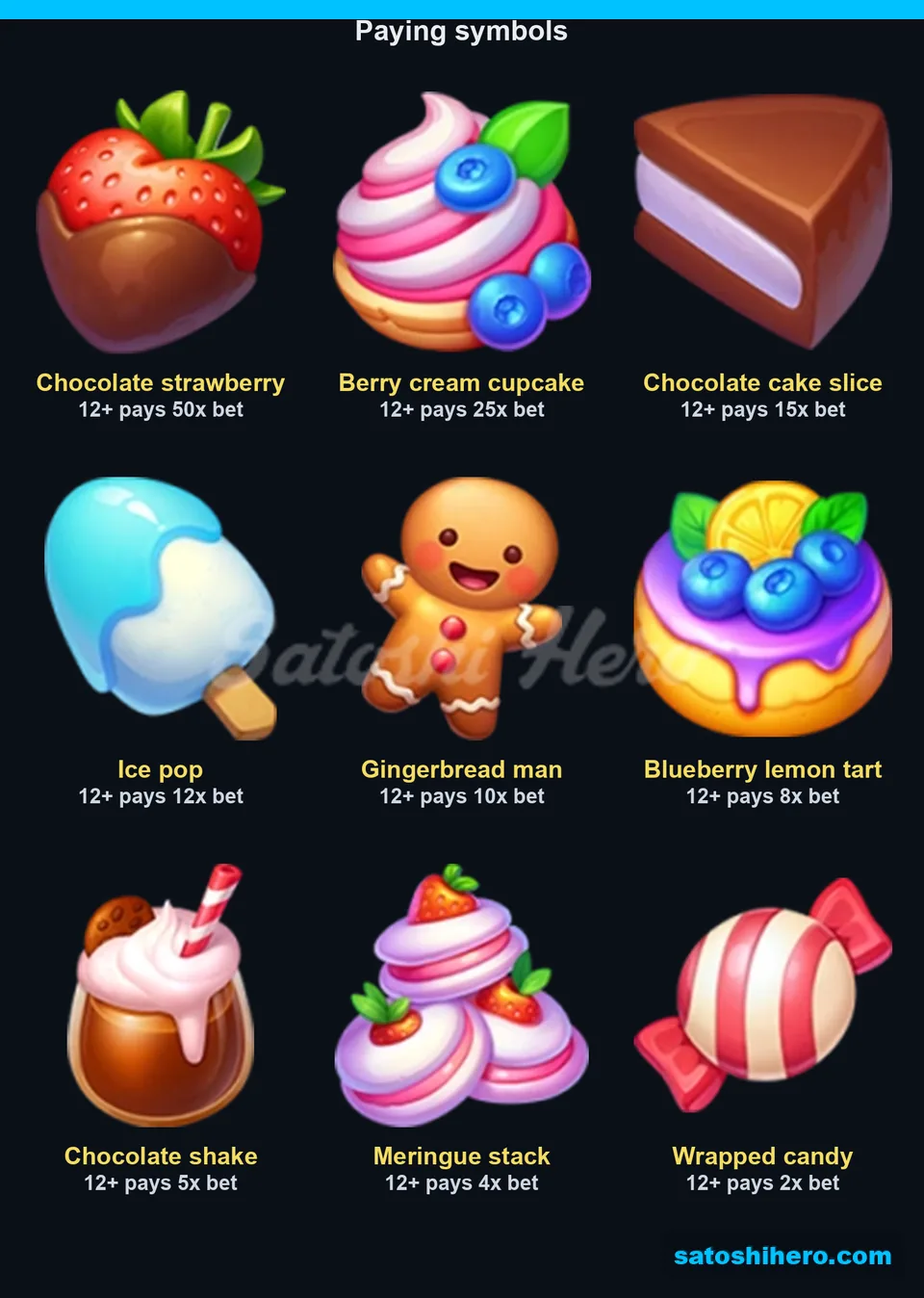
I checked those units against a live result. A $0.50 return on my $1.00 bet matched the chocolate shake’s 0.5x award for 8–9 symbols. That small hit also shows why you must compare each payout with the full stake, not merely celebrate a flashing counter. The lower symbols can qualify often enough to look active while returning less than the spin cost.
Scatters and multipliers
The heart candy box serves as the scatter and can appear in any grid position. Four boxes pay 3x, five pay 5x, while six or more pay 100x. No regular wild helps form base-game wins, which leaves symbol counts to do all the work. I think that stripped-back setup keeps the rules clean, though it also removes a familiar rescue symbol.

Cookie jars only enter during free spins and act as multipliers rather than normal paying icons. Their role matters later, but you won’t see them improving routine base-game combinations. When you inspect the grid, symbol quantity matters far more than placement.
That means an expensive icon can still miss while cheaper symbols qualify across distant spaces. You should compare the final count with its matching pay band before judging value. I prefer this direct check because the game never asks you to decode hidden routes.
Theme and First Impressions
A pink piggy bank mascot leads a bright candy-land scene beside the 6×5 grid. You get pastel castles, rolling green hills, cakes, ice pops, wrapped sweets, and a lollipop-shaped BUY control.
Successful symbols burst before fresh treats fall from above, so the art supports the tumble system instead of merely decorating it. I opened the Piggy Bonanza demo with a $10,000.00 balance and the default $1.00 stake. Bets ranged from $1.00 to $50.00, and the controls stayed clear despite the sugary background. You can follow the balance, stake, and changing grid without fighting visual clutter.
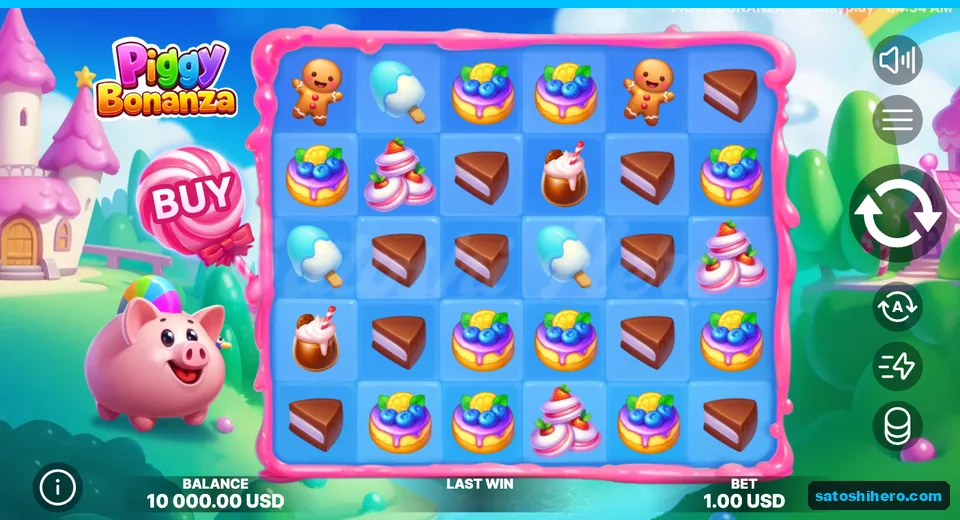
Onlyplay doesn’t chase subtlety in this candy-coated presentation. The mascot, oversized desserts, and rounded candy shapes push the theme hard, and originality isn’t its strongest quality. Still, crisp icon silhouettes make separate symbol types easy to recognize during quick cascades. That clarity matters because count-pays play asks you to scan every position rather than trace a single route.
Piggy Bonanza Valentine keeps the same piggy-bank appeal but shifts toward a romantic seasonal setting. Piggy Bonanza Halloween gives you a darker, spooky look when pastel scenery feels too sweet. Those alternatives make sense on theme alone, not because this test established any mechanical or statistical advantage. Other Onlyplay alternatives include Zombolics, Wolf Treasure, and Witch’s Secret.

Fun Fact: The piggy bank mascot blends a familiar savings symbol with sweets, turning stored value into a playful candy-world character.
The presentation works because you can read a crowded grid quickly. I wouldn’t call the theme daring, but you won’t struggle to understand what just paid.
Free Spins and Cookie Jars
Four heart candy box scatters anywhere trigger 10 free spins. During that round, three or more scatters add five extra spins, giving you another chance to use the feature-only jars.
Trigger and retriggers
No free spins appeared during my official 100-spin session. That absence matters because I can explain the rules, but I can’t claim the counted run established normal feature performance. You shouldn’t turn one miss into an estimated trigger rate, either. A short sample simply can’t support that conclusion.
I took several extra spins only to capture a settled frame after completing the count. Those spins triggered the round and moved my balance from $9,921.60 to $9,956.00. They don’t belong inside the 100-spin totals, and I don’t treat them as a formal bonus test. In my view, keeping that boundary clear matters more than presenting a flattering result.
The balance change confirms that the extra sequence ended positively, nothing more. You can’t infer jar frequency, average bonus value, or retrigger behavior from one unmeasured capture. I’d need a dedicated set of complete rounds before making any of those judgments.
Added multiplier values
Cookie jars appear only during free spins, each carrying a value from x2 to x100. When several jars land, their values add together before the combined total multiplies that round’s winnings. You need a qualifying win in the same round for that multiplier to matter.
This design creates the game’s strongest route toward a much larger return. Yet a high upper jar value doesn’t tell you how often jars or useful combinations appear. I like the additive rule because every landed jar contributes rather than replacing another one. You should still treat the possible total as upside, not an expected bonus result.

Data Point: Several cookie jars feed one combined multiplier, so their values add instead of competing or replacing one another.
On paper, the feature round carries real punch and attractive multiplier upside. My counted session offers no sound evidence about its typical payout, so you should keep expectations grounded.
Winning Potential
The maximum win reaches 6,853x the bet, and free-spin jar multipliers provide the main route toward stronger outcomes. You should read that ceiling as a hard limit, never a forecast for a set session.
My largest counted return was just $3.35 from a $1.00 stake. The next-best results reached $2.20 and $1.65, showing how far a short base-game run can sit below the headline potential. Six or more scatters can pay 100x, while added cookie jars can lift a qualifying free-spin round. Those mechanics explain the upside without proving that major returns happen often.
A 100-spin sample can’t measure the full payout range. It can only show what happened during those specific draws, and mine stayed firmly near the bottom. You might see a different pattern immediately, but no result becomes due because my test missed it. That distinction is basic, yet slot discussions often blur it.
No sugarcoating, 6,853x feels relatively measured beside the risk level and the 200x feature price. The cap remains meaningful, especially when several tumbles and multipliers combine, but it isn’t an extreme headline prize. I’d rather judge this release on its moving grid than pretend the ceiling alone makes it exceptional.
If you value tumbling action, the potential still has appeal. You won’t get evidence here that any stake size improves your chance of reaching the limit, so choose stakes by cost tolerance.
Pay Anywhere and Tumbles
A win needs at least eight identical symbols anywhere on the 6×5 grid, and those icons don’t need to touch. You don’t trace paylines or build adjacent clusters.
Eight-symbol win rule
Matching icons can occupy any positions across all 30 spaces. One symbol in a corner can count with another across the opposite side, provided the final total reaches eight. You should scan the whole screen and count one icon type at a time. I find that approach simpler than checking dozens of line patterns, though a packed grid can hide borderline counts.
Pay Anywhere differs from cluster systems because touching edges don’t matter. It also differs from line slots because symbols don’t need ordered reels or a leftmost starting point. Once you understand that distinction, near misses become easier to read. Seven scattered cakes still pay nothing, regardless of how attractive their arrangement looks.
Chained tumble payouts
A successful spin follows a fixed visual sequence:
- Winning symbols disappear from the grid.
- Remaining icons fall into the empty spaces.
- New symbols drop into open positions from above.
- Another qualifying count starts a fresh tumble.
- The sequence ends when no further win forms.
- The game returns the combined amount from the complete chain.
I captured a settled $0.80 cascade after the paid icons burst and replacements dropped. That frame showed the refreshed grid, not merely the first winning count. You can’t judge a paid spin from its opening match because later tumbles can add more value. In my opinion, this chaining rhythm gives the base game most of its energy.
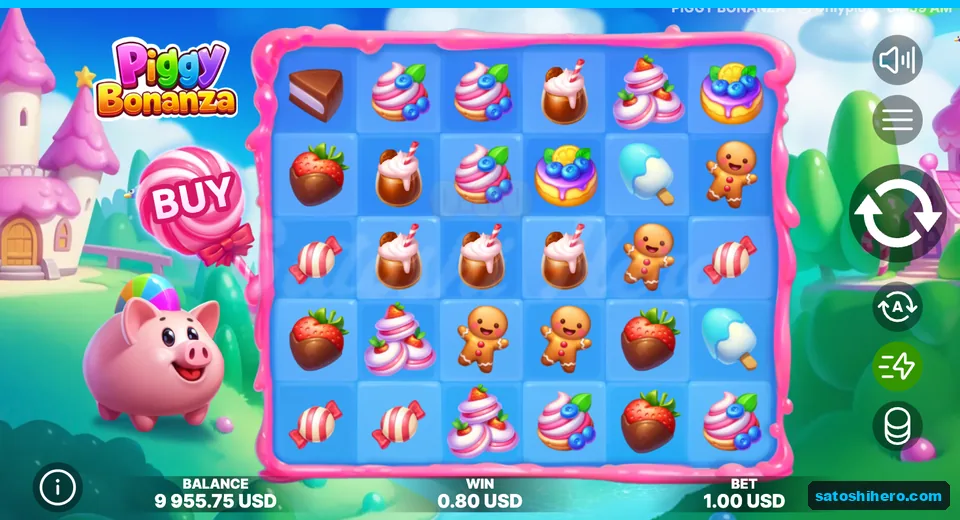
The tumble doesn’t require another wager while that chain remains active. You still need a fresh eight-symbol count after each refill, and the process stops immediately when the new grid misses. I like that clean reset because each paid spin has an obvious endpoint.

Suggestion: Watch the complete win counter rather than judging the first match, since one paid spin can contain several tumbles.
Wait until the final refreshed grid settles before recording the result. That habit prevents you from understating a chain or mistaking one tumble for several separate spins.
Buy Free Spins
The only documented Buy Free Spins option costs exactly 200x your selected bet. You open it through the lollipop-shaped BUY control on the grid’s left side.
At the $1.00 minimum stake, one purchase costs $200.00. Raising the bet to the $50.00 maximum pushes that price to $10,000.00. Those figures make the commitment easy to understand, but they don’t establish value. I didn’t purchase the feature, so my test provides no basis for ranking or recommending it.
Only one purchase option appears in the documented controls. That means there’s no sensible “best bonus” comparison to make, and I won’t invent an edge between buying and waiting. You can use Piggy Bonanza free play to learn symbol counting and tumble timing before considering any paid shortcut. Piggy Bonanza online offers the same core rules on SatoshiHero when you switch to real funds. Demo mode teaches the system without turning one click into a 200-spin outlay.

Watch Out: High volatility and a 200x price can drain funds quickly. At my $1.00 stake, one buy cost twice the full 100-spin base-game outlay.
Check the complete dollar price after every stake change. A small adjustment scales the feature cost by the same 200x factor, which makes casual increases surprisingly expensive. I think the bright lollipop control understates how serious that commitment is.
Demo play offers the sensible learning route, while the untested buy demands much greater risk. You should understand the base game first, then decide whether that single purchase fits your limit.
How the 100-Spin Run Felt
My 100-spin session felt attritional because small returns couldn’t stop a $75.10 decline. You saw the win counter often enough to stay engaged, but the balance told a harsher story.
I began with $10,000.00 and finished at $9,924.90 using a flat $1.00 stake. Exactly 30 of 100 spins paid something, yet the balance never climbed above its starting point. My best return reached $3.35 on spin 46, followed by $2.20 and $1.65. No free-spin round appeared inside the counted run.
The session avoided dramatic peaks and sudden crashes. Many small hits returned only part of the stake, letting the balance bleed between brief flashes. You could call the 30% paid-spin rate active, but activity didn’t equal profit. I found that pattern more wearing because frequent counters masked the loss.
A paid spin only tells you that some money came back. It doesn’t say whether the return covered the $1.00 cost, and most of mine didn’t. That distinction should shape how you read the game screen. Ten tiny payouts can look reassuring while still leaving a substantial deficit.
My run can’t predict yours or establish a stable hit rate. Random draws can produce earlier features, larger wins, or another deep loss. Still, this test shows how a busy session can finish badly. I think that experience explains the practical risk better than cheerful animations.
Judge payout size alongside frequency when you assess session value. If you only count how often the meter lights up, you’ll miss whether your bankroll actually recovers.
RTP, Volatility and Our Test
Piggy Bonanza combines a 95.5% theoretical RTP with high volatility, so short sessions can finish far from the published return. You need to keep the modeled projection separate from my live 100-spin record.
The simulator projection
The SatoshiHero Slot Simulator modeled 1,000 spins at a $1.00 stake. Its median session finished with a $63.30 loss. The 5th percentile reached a $321.70 loss, while the 95th percentile reached a $321.60 gain. That wide spread gives you a clearer picture of uncertainty than one central figure alone.
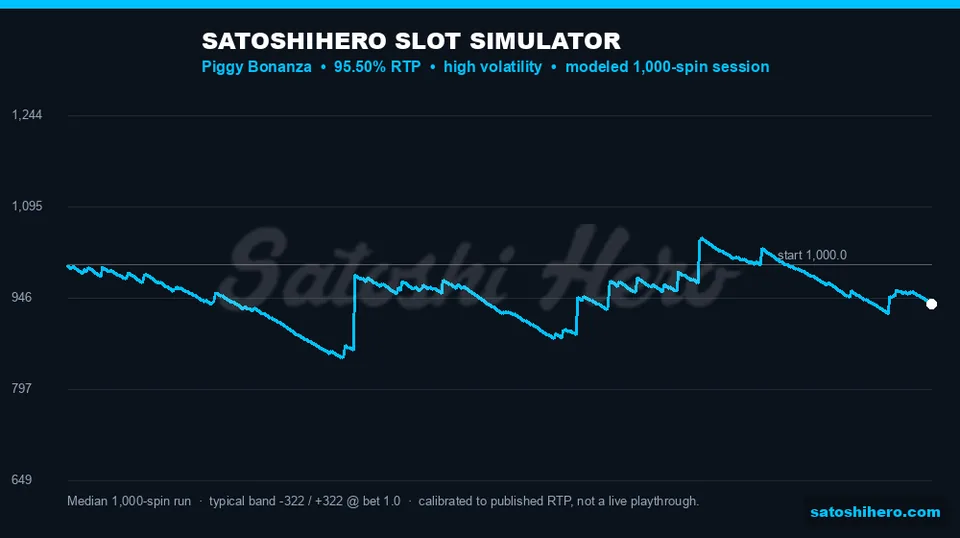
The model estimated a feature-tier event at roughly 1 in 46 spins and a big win at roughly 1 in 1,704 spins. These figures describe a simulated distribution, not a timetable. An event doesn’t become due after 45 misses, and your next spin gains no special entitlement. I like the range because it exposes both bad and good tails without pretending to call your result.
The near-balanced outer endpoints also deserve careful reading. They don’t make gains and losses equally likely in your session; they mark two modeled percentiles around many possible outcomes. You should focus on the width of that span, which signals how sharply results can separate.
Our 100-spin session
I played every counted spin at $1.00, starting with $10,000.00 and ending at $9,924.90. That left a $75.10 net loss, with $3.35 as my largest return and no free spins during the measured run. You can see that my loss sat near the simulator’s median direction, but the two datasets remain separate.
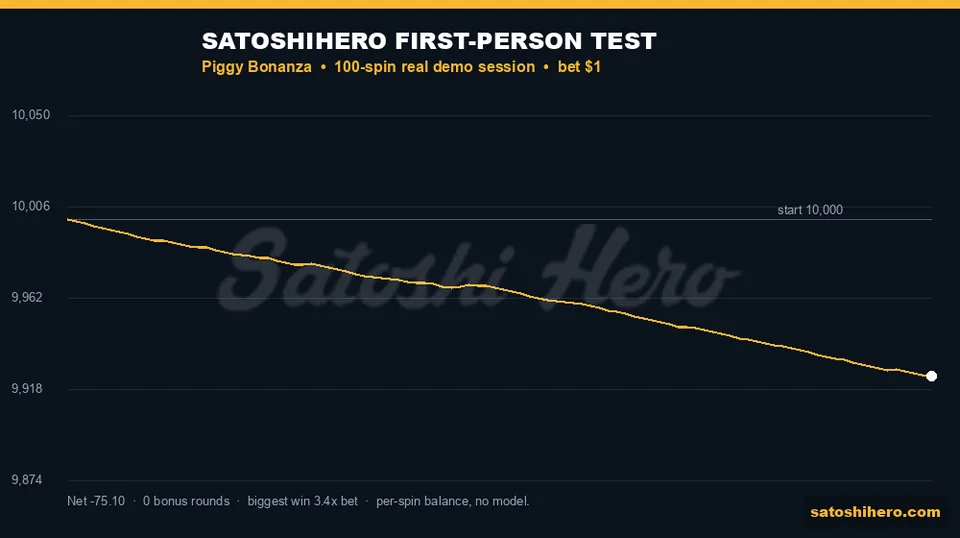
The presentation keeps modeled and observed evidence separate. I think that distinction is essential because combining them would create a false sample. You should use the projection to understand possible spread and the session to understand one actual experience.
The theoretical return is the operator’s published figure, and one live session doesn’t alter it. A simulator models a possible range rather than reproducing the game’s random draws. Individual bonus modes can use slightly different designed returns, so I won’t assign an unverified feature percentage.
Use both records as context, never as predictions for your play. Neither one tells you what your next spin or session must produce.
Frequently Asked Questions
How many scatters trigger free spins in Piggy Bonanza?
Four heart candy box scatters anywhere trigger 10 free spins. During the round, three or more scatters add five extra spins.
How does the Pay Anywhere mechanic work in Piggy Bonanza?
Eight or more identical symbols can appear anywhere on the 6×5 grid. Winners vanish, remaining icons fall, and replacements enter until no new qualifying count forms.
What does the Piggy Bonanza cookie jar multiplier do?
The cookie jar appears only during free spins and carries x2 to x100. Multiple jar values add before the combined multiplier applies to that round’s winnings.
What are the Piggy Bonanza RTP, volatility, and maximum win?
Piggy Bonanza has a 95.5% theoretical RTP, high volatility, and a 6,853x maximum win. Those figures don’t guarantee a particular result during your session.
What did the Piggy Bonanza 1,000-spin simulator show?
The modeled median was a $63.30 loss at $1.00 per spin. Its range ran from a $321.70 loss at the 5th percentile to a $321.60 gain at the 95th percentile.
How did the 100-spin Piggy Bonanza test end?
My balance fell from $10,000.00 to $9,924.90, producing a $75.10 loss. The largest return was $3.35, and no free spins triggered within the count.
Does Piggy Bonanza have a buy feature?
Yes, Buy Free Spins costs 200x the bet. I didn’t purchase it, so this guide doesn’t rank or recommend that option. You should treat the purchase as untested here.
Bottom Line
Piggy Bonanza stands out through simple count-pays rules, chained tumbles, and additive free-spin jars. Its main drawback is blunt: the prize cap feels measured beside the costly feature and severe short-run risk.

My Verdict
Tumble fans with firm limits can appreciate the clear grid and feature structure. Expect partial returns and dry bonus stretches rather than steady support.
I like how quickly the symbols burst and refill, because each paid spin stays easy to follow. I don’t like that 30 paid spins still left my test $75.10 down, while the counted run never reached free spins.
Piggy Bonanza works better as a movement-driven candy slot than a headline-prize chase. This guide is checked regularly, but learn its rhythm in free mode first.

Pros:
 Clear count pays: Any-position matching makes each grid easier to assess.
- Chained tumbles: Fresh symbols can extend one paid spin through several stages.
- Additive jars: Multiple multiplier values can strengthen the same free-spin round.
- Readable design: Distinct sweets help you count matches across a busy screen.

Cons:
 Severe session risk: My flat-stake run lost most of its total outlay.
- Expensive purchase: The only bonus buy costs 200x the selected bet.
- Measured ceiling: The top prize feels restrained beside the risk profile.

Best Fit: Count-pays fans who enjoy active tumbles and can tolerate long bonus gaps fit this game. You’ll need firm spending limits and patience with returns that often fail to cover the stake.
Similar Games


































































Bets
All Bets
Game
Player
Date
Wager
Mult.Multiplier
Prize
 Wild Cash x9990
 nymphetamine1231
- 06:20:33
- 0×
- Galaxy Glitter
 nina87
- 06:20:32
- 2.5×
- Elephant's Gold: Bonus Combo
- Hidden
- 06:20:32
- 0×
- Triple 5's: Megacharged
 Hidden
- 06:20:31
- 0×
- 5 Power Joker
 Gkc818
- 06:20:30
- 0×
- Wild Cash x9990
- nymphetamine1231
- 06:20:30
- 0×
- 5 Power Joker
- Gkc818
- 06:20:29
- 0×
- 5 Power Joker
- Gkc818
- 06:20:28
- 1.49×
- Triple 5's: Megacharged
- Hidden
- 06:20:28
- 0×
- Wild Cash x9990
- nymphetamine1231
- 06:20:28
- 0×