

Golden Kiwi
By pressing play, you agree that you are above legal age in your jurisdiction and that your jurisdiction allows online gambling.


Chasing Gold Through the Kiwi Jungle
Golden Kiwi slot put my $1.00 stake through a slow grind before a $64.00 Coin Game secured a $20.00 profit.
Onlyplay pairs a bright New Zealand wildlife theme with medium volatility, 95.5% RTP, and 2,507x maximum win potential. Its 5×3 grid uses 5 fixed paylines, while Extra, Multi, and Double shape the hold-and-respin bonus. Simple-line fans get readable features and manageable swings, but my result can’t predict what your session might return.
Key Takeaways
- Best bonus: My organic Coin Game paid $64.00 with Multi active at a $1.00 stake.
- RTP / volatility: You get 95.5% RTP with medium volatility, though dry spells still appeared.
- Max win: The 2,507x cap offers useful upside, but extreme-payout hunters can find it modest.
- Risk note: Only 15 of my 100 spins paid, so your balance can slide between hits.
- Bankroll note: My balance fell $27.00 below its starting point before recovering through one bonus.

Table of Contents
- How the Golden Kiwi slot Works
- Symbols and line wins
- Coin Game
- Tested bonus result
- Jackpots
- Prize tier conditions
- Extra, Multi and Double
- What changed in play
- Theme and First Impressions
- Free Spins
- Flaming Feature
- RTP, Volatility and Our Test
- Simulator Projection
- Our 100-Spin Session
- Frequently Asked Questions About Golden Kiwi
- Bottom Line
How the Golden Kiwi slot Works
The game uses a 5×3 grid with 5 fixed paylines, and matching symbols pay from left to right. Listed awards multiply your total bet, so a 25x line returned $25.00 at my $1.00 stake. You can play the free demo or real game on SatoshiHero, with the tested demo running from $1.00 up to $50.00. The browser display stayed sharp on desktop and mobile-sized screens.
The parrot leads the animals with 2x, 10x, and 40x awards for three, four, or five matches. Fur seals, tuataras, and penguins each pay 1x, 5x, and 25x. Ace, king, queen, and jack sit lower at 1x, 2x, and 10x. These symbol payouts aren’t spectacular, but you can read them without digging through a complex pay system.

Symbols and line wins
Kiwi Wild pays 3x, 15x, or 50x and replaces every symbol except coins. Spin 39 showed the math clearly: five matching animals paid $25.00 on one line, while another line added $2.00. The complete spin returned $27.00, exactly matching the displayed multipliers at my stake.
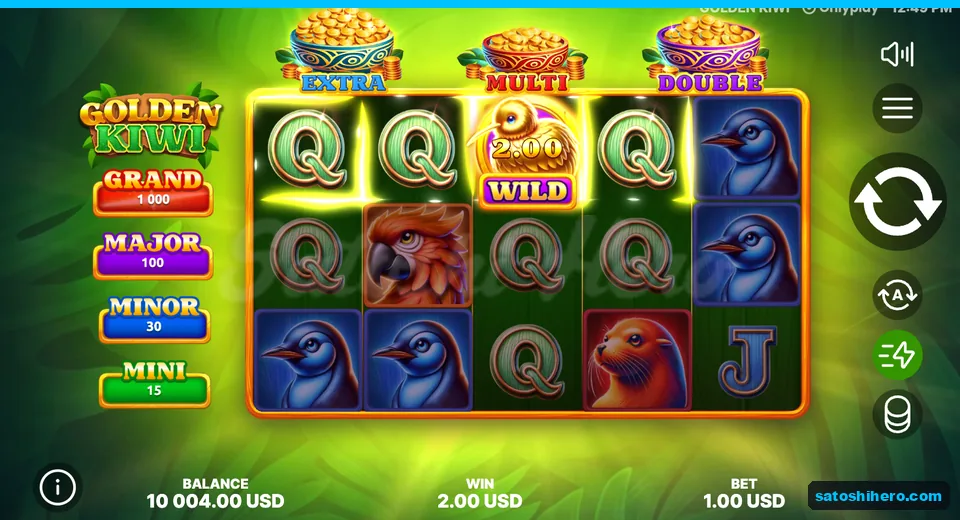
Cash coins can appear during base play and the Coin Game. Blue, red, and purple coins feed the Extra, Multi, and Double bowls, while labeled coins connect to four jackpots. You see each line and coin purpose quickly, which makes this compact layout unusually easy to follow.
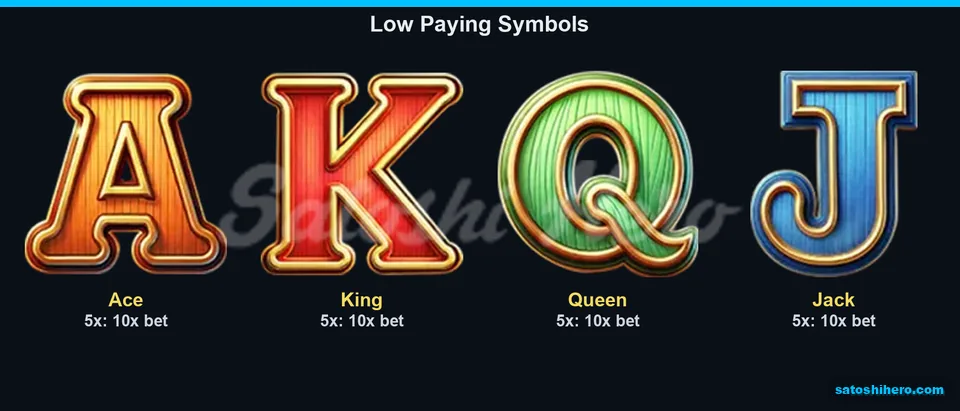
That simplicity also exposes weak spins immediately. There are no huge ways counts hiding how an award formed, so you can compare the paytable with the highlighted line in seconds.

Data Point: Five Kiwi Wilds pay 50x, making the wild the highest-paying regular symbol.
Coin Game
The Coin Game is the main bonus, and it produced my largest result. Blue coins activate Extra, red coins activate Multi, and purple coins activate Double. More than one modifier can run together, so you can enter with a layered setup rather than one isolated effect.
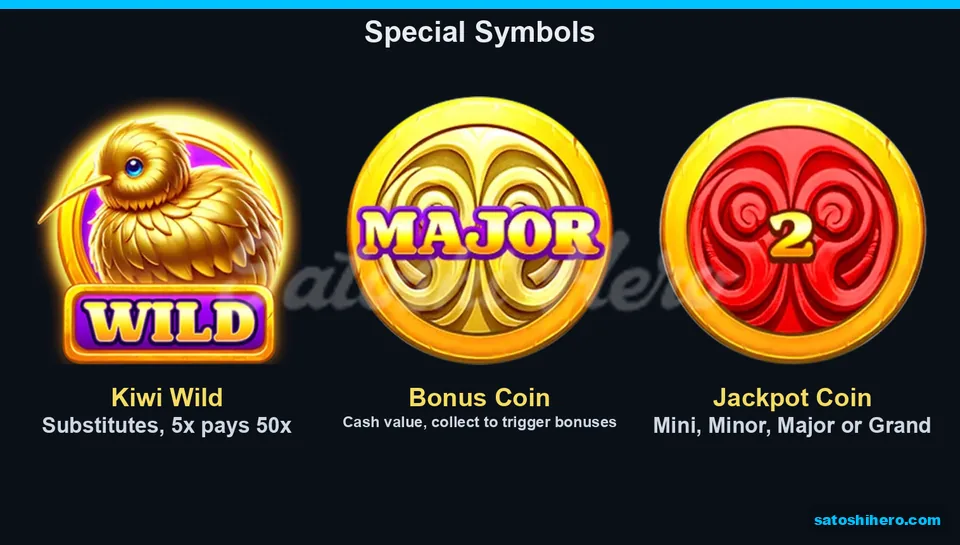
Coins lock on the 15-position grid, and the standard counter begins at three respins. Every new coin resets that counter to three. Play stops when the counter expires or all positions fill. I like this structure because you can see progress, although visible gaps don’t make another coin more likely.
Tested bonus result
My organic round began on spin 74 with Multi active. Values included $1.00, $2.00, $3.00, $5.00, and $8.00, alongside x3 and x4 multiplier markers. It returned $64.00 at a $1.00 stake and pushed my balance above its starting point. You should read that as one observed result, not a target payout.
The Golden Kiwi slot keeps held amounts visible, letting you judge what the round has already secured. Multiplier markers added tension in my feature, but they didn’t make later cells predictable. I watched the remaining counter, not the empty spaces, because only a fresh coin could extend play. That distinction keeps a promising board from becoming a false promise.
Mini, Minor, and Major coins can award their named jackpots inside the feature. Filling all 15 positions awards the Grand. Plain and simple, every outcome remains random, and an empty cell is never due to fill. Locked values show your live progress without making the final total certain.

Suggestion: Judge the round by locked value and remaining respins, not by assuming an empty position is due. Every result remains random.
Jackpots
All four jackpots can land only inside the Coin Game. At the tested $1.00 stake, the side panel showed Grand at 1,000x, Major at 100x, Minor at 30x, and Mini at 15x. You can see each target before the bonus starts, which gives the collection round a clear hierarchy.
Prize tier conditions
Mini, Minor, and Major can arrive on labeled coins. Grand uses a different condition and requires all 15 grid positions to fill. None appeared during my 100 spins, so I can’t attach a firsthand frequency or typical payout pattern to them. That absence matters because a short session tells you almost nothing about rare prize tiers.
These four goals sit apart from the game’s overall payout cap. I find the visible ladder useful, but jackpot labels can make a bonus look closer to completion than it really is. You know what each prize requires, yet you can’t know how often it might appear.
At a $1.00 stake, the displayed tiers also make their relative scale easy to compare. Mini starts at 15 times the bet, while Grand sits far above it at 1,000 times. That gap gives you several collection targets without pretending every labeled coin carries the same impact.
No jackpot in 100 spins isn’t evidence of a poor hit rate. It simply means my single Coin Game ended through ordinary collected values and multipliers. I wouldn’t build a stake plan around any tier, because the game supplies no schedule you can use. Treat each label as a possible result, not expected session income.
Extra, Multi and Double
Extra adds time, Multi can amplify collected values, and Double creates a second collection board. Extra starts the Coin Game with four respins instead of three. Multi gives each respin a chance to add a multiplier bonus symbol, while Double opens two boards when the feature begins.
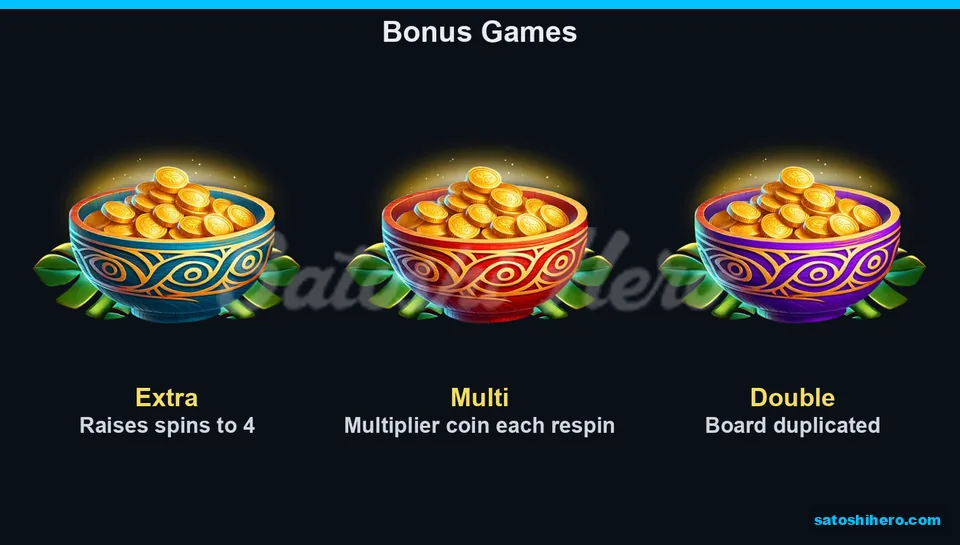
The modes can combine, which creates the bonus system’s deepest possible setup. Extra gives you another opening chance, Multi can improve collected value, and Double supplies more positions to fill. I wouldn’t rank one modifier as strongest without comparable tested rounds. Their value depends on the random coins and markers that follow.
What changed in play
Only Multi appeared in my Coin Game. That round started with three respins and returned $64.00 from a $1.00 stake. Extra and Double never activated, so their descriptions come from the documented rules rather than my play. You get meaningful variety from combined modifiers, but my test demonstrated only Multi in action.
The distinction between these effects matters when you read the board. Extra changes your starting allowance, Multi can place multiplier symbols, and Double changes the playable space itself. None guarantees a richer result, since useful coins still need to appear. I prefer that separation because each modifier changes the round in a visible way.
Combined activation would give you more moving parts, not a promised payout. My one Multi result can’t show how two or three modes interact across repeated features. The design has depth on paper, while the firsthand evidence remains narrow and easy to state.

Fun Fact: Double doesn’t merely double a final prize. It starts the Coin Game with two boards for you to fill.
Theme and First Impressions
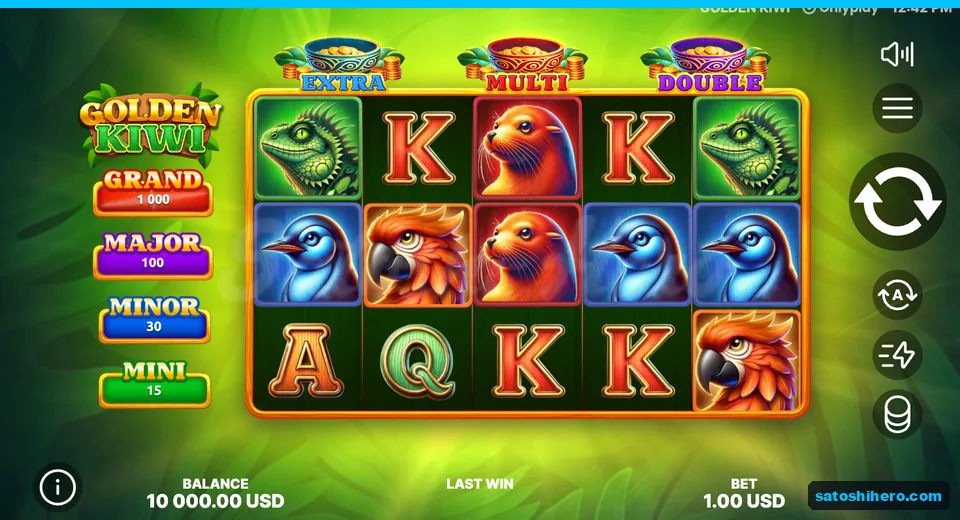
The game uses a bright New Zealand jungle built around a Golden Kiwi bird and a readable bonus display. Leafy greens frame a parrot, fur seal, tuatara, penguin, and the golden bird itself. That bird acts as Kiwi Wild, so the visual centerpiece also carries the best regular-symbol payout.
Three gold-filled bowls marked Extra, Multi, and Double sit above the reels. A jackpot panel stays on the left, keeping all four prize tiers visible. The wildlife setting won’t win originality awards, but these displays tell you how the feature system works before anything triggers. I value that clarity more than decorative animation.
Golden Octopus offers a similarly colorful animal theme with gold-heavy styling, making it a natural comparison if you like bright bonus displays. Wolf Treasure takes a more conventional wildlife route when you prefer familiar forest imagery. Zombolics shifts toward comic horror, Witch’s Secret uses a darker magical setting, and Wild West Girls changes the backdrop to a western theme. Neither comparison changes this game’s main strength: you can read its goals at a glance.
The layout remained clean on both full desktop and smaller mobile-sized views. You won’t confuse the bowls, jackpot targets, or main controls, and that practical design leaves a stronger impression than the familiar theme.
Gold accents connect the bird, bowls, coins, and jackpot panel without making the reels muddy. Animal faces remain distinct against the leafy background, so you can separate premium symbols quickly. The Golden Kiwi slot looks cheerful rather than dramatic, and I think that tone matches its uncomplicated five-line format.
Free Spins
Three scatter symbols award 25 free spins. That award comes from the documented rules, because I didn’t trigger the feature during my 100-spin session. You should treat it as an available bonus, not something every short run must include.
The missing trigger prevents me from judging its average payout, pace, or entertainment value. I also won’t invent retriggers, altered reels, or multipliers that the supplied rules don’t support. No sugarcoating, a rule-sheet description can’t replace hands-on evidence.
That limitation matters because 25 awarded spins reveal nothing about what happens during them. The count sounds generous, yet payout quality depends on rules and results I didn’t observe. You should separate the confirmed trigger from any assumptions about feature strength. I would need an actual round before comparing it with the Coin Game.
You can confirm that 25 spins sit behind three scatters, but nothing from my play supports a stronger claim. Only an observed trigger could justify a firsthand assessment of how this mode actually feels.
For a short session, its absence also changes the rhythm. My test relied on line wins and one hold-and-respin bonus rather than a long sequence of free rounds. If you value frequent feature variety, that quiet spell can feel more restrictive than the medium label suggests.
Flaming Feature
The Flaming Feature can activate randomly during base play and force one of two events. It either guarantees three scatters or supplies enough wilds to activate an extra reel carrying bonus features. That gives the random trigger real mechanical weight rather than adding empty animation.
It didn’t activate during my 100 spins, so I have no firsthand payout result or frequency estimate. You can’t plan around it, and you shouldn’t treat a quiet stretch as evidence that activation is close. Random timing makes that assumption meaningless.
The two possible outcomes serve different immediate purposes. Three forced scatters connect directly to the 25-spin feature, while enough wilds open an extra reel carrying bonus features. You can understand both routes from the rules, but you can’t infer which route appears more often. I found no test evidence for ranking them.
I like that both outcomes connect to actual features, though the lack of a test trigger limits any firm judgment. You know the Flaming Feature can force a scatter or wild-based event, but this session provides no payout evidence.
That makes the mechanic attractive but hard to assess from one run. It has more substance than a cosmetic surprise, yet my balance graph contains no Flaming Feature jump to examine. You should regard it as extra upside rather than part of a dependable session pattern.
RTP, Volatility and Our Test
The official figures are 95.5% RTP, medium volatility, and a 2,507x maximum win. RTP describes theoretical return rather than a promise for your balance. Medium volatility still gave me only 15 paying spins from 100, while the cap can feel restrained if you chase extreme payouts.
Official rules define the game, my play records one real session, and the simulator maps possible swing patterns. Keeping those evidence types separate matters. Otherwise, one profitable run can look far more predictive than it really is.

Watch Out: Medium volatility didn’t prevent a 27-stake drawdown in my test. Pick a stake that leaves room for dry stretches instead of relying on a feature to recover your balance.
Simulator Projection
The 1,000-spin model produced a median loss of $49.80 at a flat $1.00 stake. It used the stated RTP, volatility level, and payout cap as inputs. The fifth percentile finished $216.20 down, while the ninety-fifth percentile ended $139.90 up. That broad range matters more than the middle result when you size your bankroll.
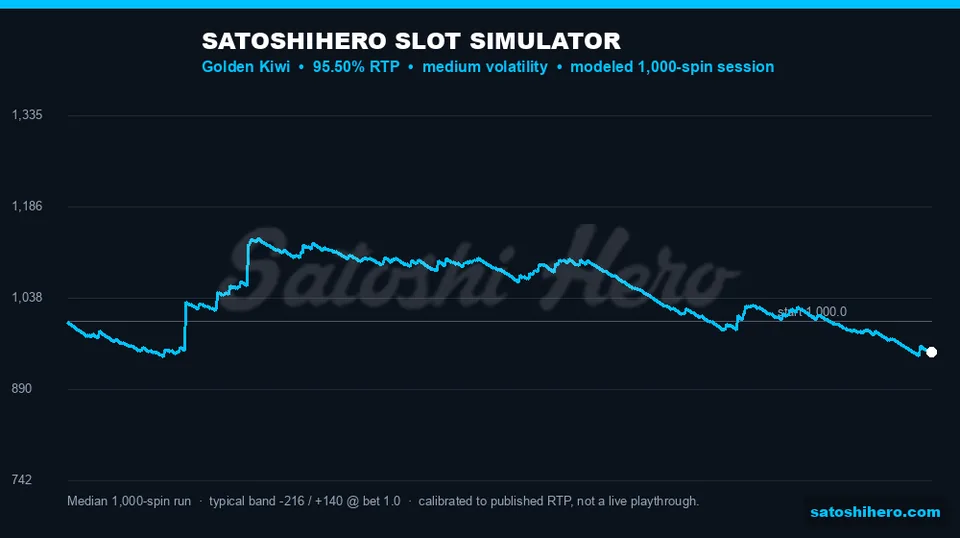
About 25% of modeled spins returned something. Feature-tier wins appeared roughly once per 50 modeled spins, while the big-win marker appeared about once per 12,500. Those rates describe a simulation, not the game’s random draw engine. You can’t turn them into a countdown for your next feature.
For the Golden Kiwi slot, that modeled hit share also contrasts with my live test. The model returned something on roughly one quarter of spins, while I recorded 15 paying results from 100. Neither figure overrides the other. One comes from a projection, and the other captures a single random session.
I find the spread more useful than the median because it exposes how different equal-length sessions can look. A $1.00 stake still produced modeled outcomes separated by $356.10 from one edge to the other. The model helps you picture risk, but it can’t tell you where your run might finish.
Our 100-Spin Session
My firsthand test finished $20.00 ahead after 100 spins at $1.00 each. I started with $10,000.00 and ended at $10,020.00. Only 15 spins paid, so most clicks removed the stake without a return. The final profit hides how weak the run looked before one bonus changed it.
My balance reached a low of $9,973.00 and a high of $10,042.00. Spin 39 delivered the biggest base-game result at $27.00, built from $25.00 and $2.00 line wins. Other payouts ranged from $1.00 through $6.00. You could feel the slow drip because small returns rarely repaired several losing spins.
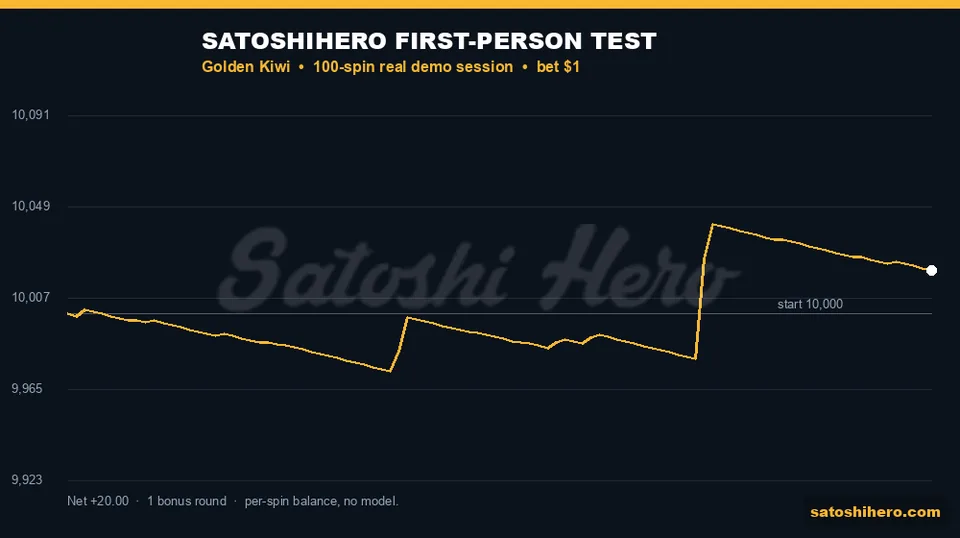
The decisive Coin Game began on spin 74 and paid $64.00 with Multi active. Without that result, I would’ve finished well behind. No free spins, Flaming Feature, or jackpot appeared, so the profitable ending depended heavily on one organic bonus. You shouldn’t read a narrow gain as proof of gentle variance.
The operator-published 95.5% figure remains the theoretical return, and one 100-spin test doesn’t alter it. Simulator figures are modeled projections rather than real draws, while individual bonus modes can sit slightly above or below the base configuration by design.
Frequently Asked Questions About Golden Kiwi
What is the Coin Game in the Golden Kiwi slot?
It is the main hold-and-respin bonus. Blue, red, and purple coins activate Extra, Multi, and Double, then landed coins lock while every new coin resets the counter to three respins. My Multi round began on spin 74 and paid $64.00 at a $1.00 stake. You can follow locked value, but you can’t predict the next coin.
How many paylines does the Golden Kiwi slot have?
It has 5 fixed paylines across a 5×3 grid. Matching symbols pay from left to right, and Kiwi Wild replaces every symbol except coins. I find five lines easier to track than large ways systems because you can see exactly where each award formed.
What do Extra, Multi and Double do in the Golden Kiwi slot?
Extra starts the Coin Game with four respins, Multi can add a multiplier bonus symbol on each respin, and Double starts two boards. Multiple modifiers can operate together. My only triggered round used Multi, so I didn’t observe Extra or Double firsthand.
What are the Golden Kiwi slot RTP, volatility and maximum win?
The game has 95.5% RTP, medium volatility, and a 2,507x maximum win. These values describe its math profile, not a guaranteed result for your session. The cap offers solid room above ordinary line wins, though extreme-payout hunters could want more.
How did the Golden Kiwi slot perform over 100 spins?
I started at $10,000.00 and finished at $10,020.00, giving me a $20.00 profit. Fifteen spins paid, and the $64.00 Coin Game was my largest result. That outcome records one session and can’t predict your next 100 spins.
What does the 1,000-spin Golden Kiwi slot simulation show?
The model produced a $49.80 median loss at a $1.00 stake. Its range ran from $216.20 down at the fifth percentile to $139.90 up at the ninety-fifth, with about 25% of spins returning something. It illustrates possible swings rather than forecasting real draws.
How many free spins can you win in the Golden Kiwi slot?
Three scatters award 25 free spins. I didn’t trigger them during my 100-spin test, so that number comes from the documented rule. You shouldn’t assume the feature must appear inside any fixed session length.
Bottom Line
Golden Kiwi stands out through a clear Coin Game, combinable modifiers, and an uncluttered five-line layout. Its main drawback is dependence on a bonus that might not arrive before repeated losing spins wear down your balance.

My Verdict
Straightforward slot fans should try the demo if readable paylines and hold-and-respin play matter more than giant payout ceilings. Expect scattered small wins, visible dry stretches, and occasional features that can decide the whole session.
I like how the Multi round made every locked coin and marker easy to follow. I don’t like that only 15 spins paid, while free spins, jackpots, and the Flaming Feature stayed absent. One $64.00 bonus carried too much of my $20.00 profit for me to call the run steady.
The Golden Kiwi slot facts and test notes are checked regularly, so you can assess the game using clear rules and firsthand context.

Pros:
 Readable lines: Five fixed paylines make every base-game award easy to trace.
- Layered bonus: Extra, Multi, and Double can combine inside one Coin Game.
- Clear progress: Locked coins show your collected value throughout each respin round.
- Responsive display: Desktop and mobile-sized views keep controls and feature goals legible.

Cons:
 Low hit count: Only 15 of 100 tested spins returned any value.
- Feature dependence: One $64.00 Coin Game determined the profitable session result.
- Modest ceiling: The payout cap could disappoint dedicated extreme-win hunters.

Best For: Simple-payline fans and patient hold-and-respin players get the clearest value here. The medium math profile still needs enough bankroll room for dry stretches, especially when the main bonus arrives late or not at all.

































































Bets
All Bets
Game
Player
Date
Wager
Mult.Multiplier
Prize
 Ultimate Fruits 5: Classic$$erieS
 Hidden
- 22:18:26
- 0×
- 3 Inferno Wolves
 Hidden
- 22:18:26
- 0×
- Rich Piggies: Bonus Combo
 mike_721
- 22:18:25
- 0×
- Frontier Falcon: Hold 'N' Link
- josh1998
- 22:18:23
- 0.39×
- 3 Inferno Wolves
- Hidden
- 22:18:21
- 0×
- 3 Inferno Wolves
- Hidden
- 22:18:18
- 0.07×
- Frontier Falcon: Hold 'N' Link
- josh1998
- 22:18:18
- 0.19×
- Luck of Panda: Bonus Combo
- Hidden
- 22:18:17
- 0×
- Ultimate Fruits 5: Classic$$erieS
- Hidden
- 22:18:15
- 0×
- 3 Inferno Wolves
- Hidden
- 22:18:12
- 0.19×