

5 Sevens Dice
By pressing play, you agree that you are above legal age in your jurisdiction and that your jurisdiction allows online gambling.


Five Lines, Flaming Stars and Classic Fruit
5 Sevens Dice slot is a stripped-back Novomatic fruit machine with five fixed lines, a scatter payout and no wild, free spins or bonus buy.
This 5×3 slot has 95.66% theoretical RTP and an official 1,000x maximum win. My 100 spins at $1 returned $67 from $100 wagered, leaving a $33 loss, while my largest hit paid $14. The stake assigned $0.20 to every active line, and that refreshingly clear format could feel bare to feature hunters.
Key Takeaways
- Best play: Every spin uses the base game because no free spins, bonus buy or line selector appears.
- RTP: The theoretical return is exactly 95.66%.
- Max win: The official prize ceiling is 1,000x the stake.
- Risk note: Only 12 tested spins paid, while my longest dry spell lasted 20 spins.
- Bankroll note: My $100 wager returned $67, but that single result doesn’t set your expected return.

Table of Contents
- How the 5 Sevens Dice slot Works
- Theme and First Impressions
- Symbol Values and Paytable
- What Happened Across 100 Spins
- Star Scatter and Line Rules
- Stakes, Controls and Quick Spin
- RTP, Volatility and Our Test
- Simulator Projection
- Our 100-Spin Session
- Is 5 Sevens Dice Right for You?
- Frequently Asked Questions About 5 Sevens Dice
- Final Thoughts
How the 5 Sevens Dice slot Works
Wins use five fixed paylines across five reels and three rows, except when star scatters pay anywhere. Three patterns run straight across the rows, while two bend through different reel positions. This is a true payline game, not a cluster, ways or pay-anywhere format. I like how you can trace every route from the numbered badges.
Regular fruit and seven symbols must connect on adjacent reels from left to right. The machine pays only the highest qualifying combination on each line, and every line stays active. You can’t reduce the count, so changing your stake adjusts the amount placed across all five patterns. That setup feels refreshingly direct when you want rules without hidden layers.
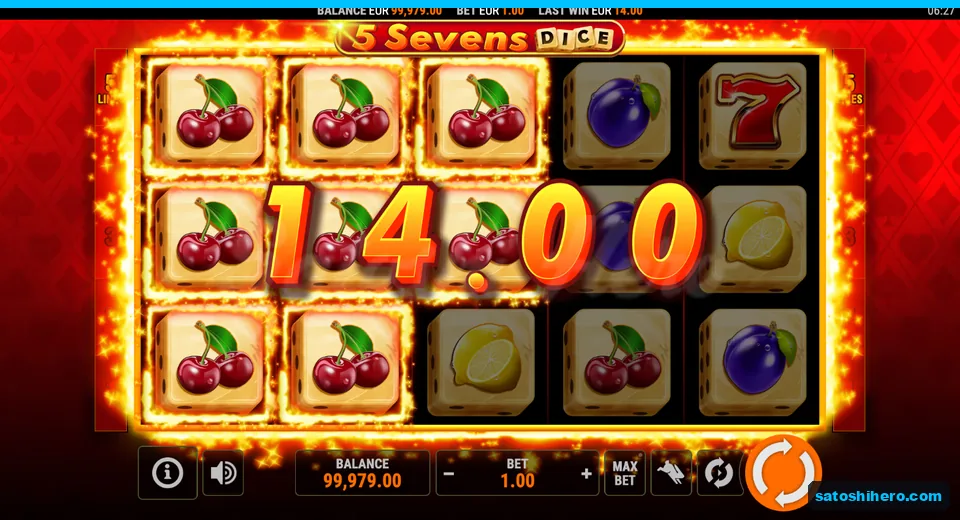
My clearest example arrived on spin 72, when cherries crossed the first three reels. The Last Win box showed $14, and a flame effect marked the result. You could see which fixed paths contributed without opening the information panel. I think that visual clarity matters more here because there isn’t a wild to complicate the pattern.
The information area has one paytable page and another page covering rules and winlines. Browser play works on mobile and desktop, with the same compact board and controls. You can follow qualifying combinations easily on either screen, though smaller displays demand closer attention to bent lines. The simple layout keeps every result readable.

Pro Tip: All five lines remain active. Lowering your total stake reduces the amount assigned across every line instead of deselecting individual patterns.
Theme and First Impressions
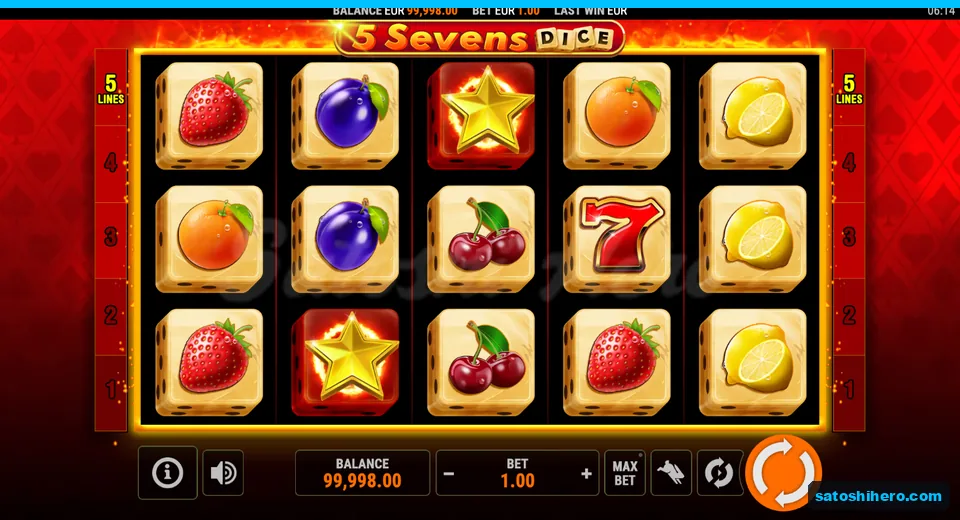
The game presents a traditional fruit machine through a light dice-and-card treatment. Every fruit rests on a cream die with pips around its edges. A red die holds the star scatter inside a flaming ring, making that symbol easy for you to spot. I think the dice idea adds just enough character without hiding the familiar fruit setup.
A gold frame surrounds the reels against a red background patterned with card suits. Above them, a flaming gold banner carries the name. Red “5 LINES” badges numbered one through five run down both sides. You can read the board quickly because each decorative choice reinforces the boundaries rather than crowding them.
The settled screen shows cherries, lemons, oranges, plums, grapes, strawberries and a red seven. It also shows the $1 stake beside the balance and spin controls. Since my test didn’t track broader sound or animation behaviour, I won’t dress the presentation up beyond what I saw. The theme won’t win originality awards, but its restraint works.
Readers wanting seven imagery inside a visibly feature-led setting could prefer 5 Sevens Hold & Win Christmas. 5 Super Clover provides another classic Novomatic alternative with a distinct identity. That alternative puts more emphasis on its themed feature identity, while this game stays with a plain five-line fruit layout. You shouldn’t assume shared mathematics or mechanics from the names. I find the simpler board easier to scan, though it offers less spectacle.

Did You Know? Every fruit appears on a cream die, while the star uses a contrasting red die and flaming ring.
Symbol Values and Paytable
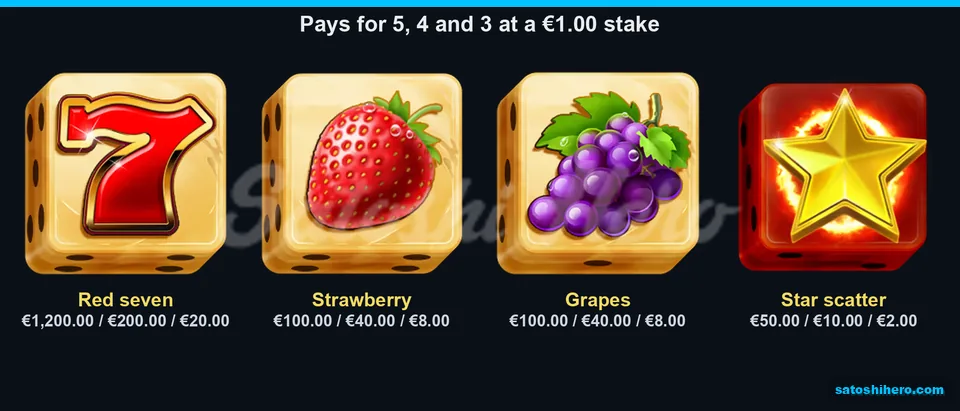
The red seven is the highest-paying regular symbol on my tested $1 paytable. That stake divided into $0.20 on each of five fixed lines. Five red sevens showed $1,200, four showed $200 and three showed $20. You should treat these as displayed symbol payouts, not a replacement for the stated game cap.
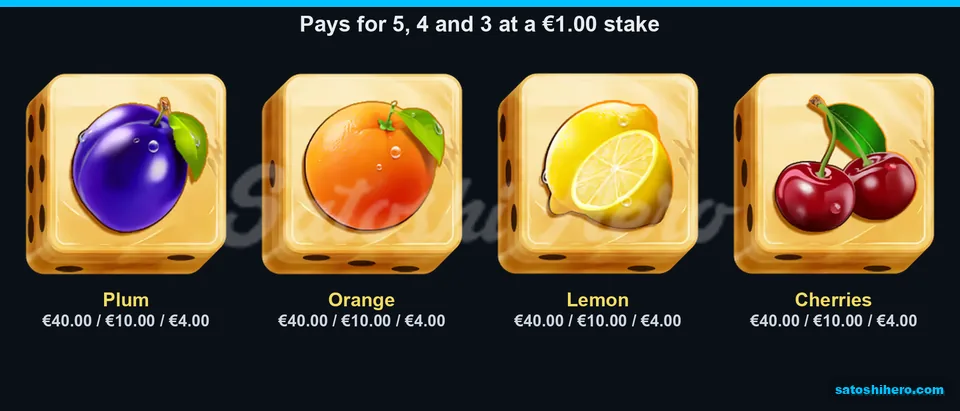
Strawberries and grapes each showed $100 for five, $40 for four and $8 for three. Plums, oranges, lemons and cherries each showed $40, $10 and $4 for the same match lengths. Most symbols start paying from three matches, so you can learn the compact hierarchy quickly. I like that the table avoids dozens of near-identical values.
The top group places the red seven above strawberries and grapes. Its larger five-symbol figure makes the hierarchy obvious at a glance. You still need adjacent matches from the first reel when these symbols form a line prize. I think the clear grouping helps you check a result before the win display settles.
The lower group covers plums, oranges, lemons and cherries. Cherries also pay $1 for two matching symbols on a qualifying line, making them the lone two-reel payer. My four lemons across the middle line paid $10 on spin 13, exactly matching the displayed figure. That observed result gave me a useful check on how the $1 paytable applied.

Quick Fact: Cherries are the only regular symbol capable of paying from two matching reels.
What Happened Across 100 Spins
My 100-spin session lost $33 after I wagered $100 at $1 per spin. I began with $100,000 and finished at $99,967, meaning the wins returned $67. Only 12 spins paid, although every winning spin returned more than my $1 stake. Your run can take a completely different path, but mine felt streakier than the plain design suggested.
The paying results broke down into four $2 hits, one $3 hit and two $4 hits. Three more paid $8, one paid $10, and the largest returned $14. This distribution kept most rewards modest, which I found less satisfying than the clean win presentation. You can still see how several small results built the final return.
Session balance path
My first win came on spin 8 after seven blanks. Spin 13 then produced four middle-row lemons for $10, lifting the balance to $99,999. It also reached $99,999 after spin 1, but never returned to the $100,000 start once play began. I felt the early lemon line offered false comfort before the longer losing stretches appeared.
The toughest run covered spins 52 through 71, making 20 consecutive spins without a win. Spin 72 ended it with my $14 cherry result across the first three reels. You shouldn’t mistake that recovery for a trend because each later result remained independent. In my view, this drought matters more to bankroll planning than the uncomplicated artwork.
My balance reached its low of $99,965 after spin 94. An $8 win on spin 95 raised it to $99,972, then the final five spins paid nothing. That finish left the session $33 down despite twelve above-stake wins. Simple mechanics clearly don’t guarantee smooth or low-risk play for you.
Star Scatter and Line Rules
The star is a direct-paying scatter, not a free-spins trigger. It is the only special symbol listed in the information panel, and it pays from any screen positions. At my $1 stake, five stars showed $50, four showed $10 and three showed $2. You remain inside the base game whenever this prize lands, which I find simple but rather limited.
Regular symbols follow another rule. They need adjacent matching symbols from left to right on one of the five fixed lines. The game can add a scatter award to qualifying line wins from the same spin. You can therefore receive both prize types together without entering another mode.
How prizes combine
The rules page confirms that only the highest win counts on each selected line and per scatter combination. “Selected” doesn’t mean you can switch lines off because all five remain permanently active. I think that wording deserves care, especially if you expect adjustable classic-slot paylines. The visible badges help you follow each route once you understand the fixed setup.
No wild, free-spins mode or bonus buy appears in the tested panel. The star also doesn’t unlock a pick game, respin or separate screen. Its “scatter” name only describes where it can pay. You might find that purity appealing, but I missed having a second gameplay phase.
A rule also states that a malfunction voids plays and pays. That condition sits beside the line and scatter instructions rather than changing normal play. For you, the practical point remains straightforward: stars pay anywhere, while fruit and sevens obey fixed paths. The symbol adds one direct payout route without shifting the base-game focus.
Stakes, Controls and Quick Spin
You can change the total stake and spin speed, but all five lines remain active. My $1 total wager assigned $0.20 to each line, and the minus or plus buttons adjusted that combined amount. They never changed the payline count. I prefer this setup because you can’t accidentally play fewer patterns than intended.
The control bar contains information and sound buttons beside the balance display. It also carries the bet box, minus and plus controls, Max Bet, a rabbit toggle and the round spin button. You can identify each function without searching through several menus. The layout feels practical, even if it lacks advanced session controls.
I switched on the rabbit quick-spin option before completing the remaining spins. It shortened the wait between outcomes but didn’t alter the odds, paytable or return figure. Max Bet likewise doesn’t improve your chance of winning. I think speed controls are useful only when you stay aware of how fast the stake leaves your balance.
Bankroll and access

Caution: Quick spin compresses the session and can consume a fixed bankroll faster. It doesn’t change the game’s mathematical return.
My 20-spin drought would have cost $20 at the tested setting. Choose a total stake that leaves room for a similar sequence without forcing you to chase the balance. You control exposure through wager size, not through line selection. That distinction matters because faster play can hide how quickly repeated $1 spins accumulate.
You can play 5 Sevens Dice online through the demo or real-play version on SatoshiHero. Searching for 5 Sevens Dice online free or 5 Sevens Dice free points to the same useful goal: learning the controls before staking money. Browser access covers desktop and mobile without requiring a dedicated app. Faster spins raise your wagering pace in clock time, never your winning chances.
RTP, Volatility and Our Test
According to Novomatic, the game carries a 95.66% theoretical RTP and an official maximum win of 1,000x the stake. Those figures describe the published mathematics and prize ceiling, not what you should expect from 100 spins. My short result differed sharply from the headline return, which is normal for a single observed path. I don’t think either figure should be read as a session target.
Simulator Projection
The illustrative 1,000-spin model produced a median loss of $79.90 at $1 per spin. Its fifth-percentile outcome lost $313.90, while the ninety-fifth-percentile outcome gained $339.10. About 18% of modeled spins paid something. You can see substantial uncertainty between those outer results, and I find that spread more useful than the median alone.
A result worth at least 100x appeared roughly once per 1,603 modeled spins. That frequency isn’t a countdown, schedule or promise for your play. The SatoshiHero Slot Simulator can’t reproduce Novomatic’s random number generator or forecast another session. It only illustrates how different modeled paths can separate even under the same input assumptions.
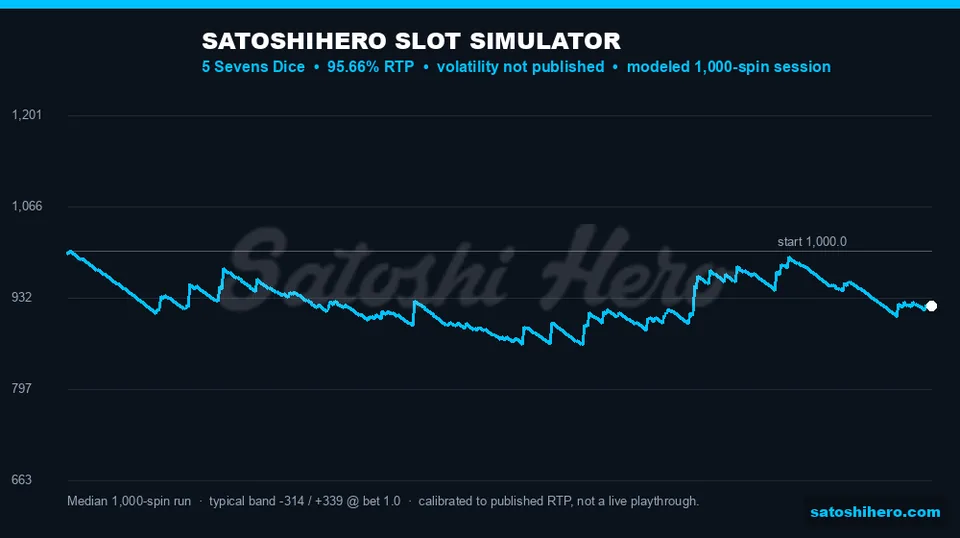
The median outcome also doesn’t mean most sessions must finish near that exact loss. It marks the middle modeled result after sorting the runs. You could finish outside the stated range because a model doesn’t define every possible game outcome. In my opinion, the honest takeaway is uncertainty, not likely profit or loss.
Paying-spin frequency also counts any positive award, not only results above the stake. A sequence can contain several paying spins and still lose money overall if their combined value stays too small. You should read the 18% figure as model output rather than a hit-rate promise. I find that distinction essential when small fruit prizes dominate the visible table.
Our 100-Spin Session
My live test finished $33 down after 100 spins. Twelve spins paid, the wins returned $67, and my largest result reached $14. That ending sits within the model’s broad spread, but it doesn’t validate the simulation. You should view it as one real balance path rather than a prediction.
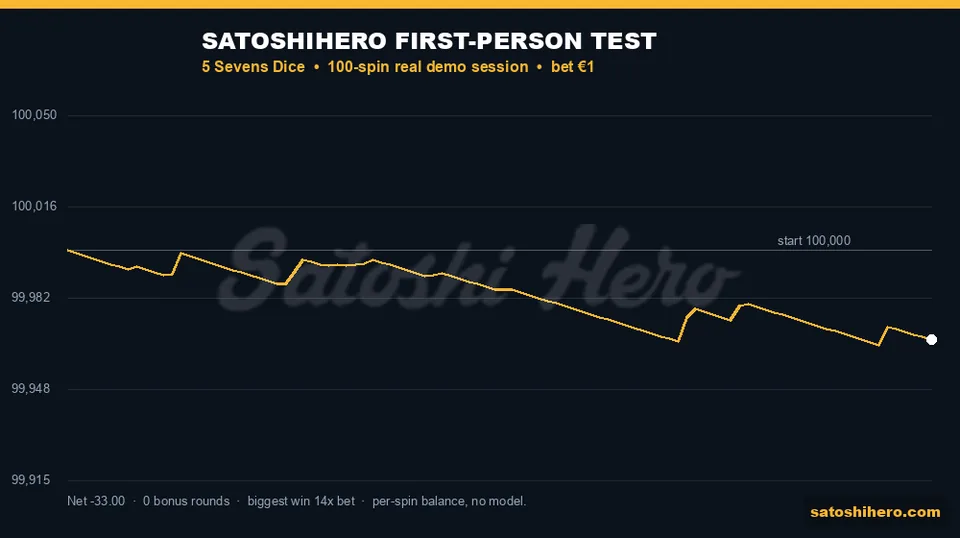
The observed session also included a 20-spin dry spell. Its 12% paying-spin share doesn’t replace the model’s roughly 18% frequency. I think keeping live evidence and modeled evidence separate prevents false confidence. Another 100-spin sample could form a sharply different balance curve.
My result also shows why return and win count answer different questions. Twelve paid spins sounded active enough on paper, yet their $67 combined value couldn’t cover $100 wagered. You need the prize sizes as well as the count to understand the finish. I consider the balance path more informative than quoting either measure alone.
The 95.66% figure is the operator’s published theoretical RTP, and one 100-spin session has no bearing on it. The simulator is an illustrative model, not the game’s random number generator. No separate bonus-mode RTP applies because the tested panel lists no free-spins mode or bonus buy.
Is 5 Sevens Dice Right for You?
The 5 Sevens Dice slot fits a taste for simple fixed-line fruit games over layered feature formats. Familiar symbols, red sevens and five visible paths keep every spin easy to read. You can learn the paytable quickly through demo play, then choose a pace that feels manageable. I think its clarity is the strongest reason to try it.
Feature hunters get far less here. There are no wild combinations, free spins, bonus buys, jackpots or hold-and-win rounds in the tested rules. The official 1,000x cap also feels modest beside many feature-heavy releases. That missing feature depth makes every ordinary payline result carry more of the experience.
My $33 loss and 20-spin drought show why clean presentation shouldn’t imply low-risk play. Those observations can’t establish your future result, yet they demonstrate one uncomfortable route through a $100 session. I would lower the stake before speeding up, particularly if a 20-spin blank run would strain your budget. Direct rules don’t protect a balance from random swings.
Ultra Hotfire offers another direction if you want fire-and-fruit styling around a different slot identity. Don’t assume that visual overlap means matching RTP, mechanics or risk behaviour. I find 5 Sevens Dice easier to explain after one spin, but its lack of bonus depth divides opinion. You get clear rules and fast play, while giving up feature variety.
Frequently Asked Questions About 5 Sevens Dice
What is the RTP of 5 Sevens Dice slot?
The 5 Sevens Dice slot has a theoretical RTP of 95.66% and an official 1,000x maximum win. These values don’t promise a particular session result.
How many lines does 5 Sevens Dice slot have?
It uses five fixed lines across five reels and three rows. At my $1 total stake, each line received $0.20, and numbered badges marked all five paths on both reel sides.
What does the red seven pay in 5 Sevens Dice slot?
The tested $1 paytable showed $1,200 for five red sevens, $200 for four and $20 for three. Those are displayed symbol prizes, while 1,000x remains the official maximum-win specification.
Does 5 Sevens Dice slot have a wild, free spins or a bonus buy?
No. The tested panel lists none of those features, and the star scatter is the only special symbol. It pays directly from any positions without starting another mode.
Which symbol pays for two of a kind in 5 Sevens Dice?
Cherries are the only regular symbol paying from two matches. The tested paytable showed a $1 line prize at the $1 total stake.
What did the 5 Sevens Dice slot 1,000-spin simulation show?
The model returned a $79.90 median loss, a $313.90 fifth-percentile loss and a $339.10 ninety-fifth-percentile gain. Roughly 18% of modeled spins paid, while a 100x-or-higher result appeared about once per 1,603 spins.
How did the 100-spin 5 Sevens Dice slot test finish?
My balance fell from $100,000 to $99,967 after I wagered $100. Twelve spins paid, my largest win reached $14, and the longest dry stretch covered 20 spins.
How do you play the 5 Sevens Dice slot?
Set your total stake and spin all five fixed lines. Ordinary symbols need adjacent left-to-right matches, while three or more star scatters can pay from any screen positions.
Final Thoughts
5 Sevens Dice keeps classic fruit play unusually clear through five permanent lines and one direct-paying scatter. Its main drawback is equally plain: the game offers no bonus round to break up base play.

My Verdict
Pick it when you value readable wins, quick spins and an uncluttered paytable. Expect a lean session where ordinary line hits carry everything, and set your wager for possible dry stretches.
I like how my $10 lemon hit matched the table and how the $14 cherry result was easy to trace. I don’t like that a 20-spin drought had no feature anticipation to soften it.
Controls and paytable details for the 5 Sevens Dice slot are checked regularly. The test evidence still represents one session, so your result can differ sharply.

Pros:
 Clear paylines: Five visible patterns make each qualifying win easy to trace.
- Simple paytable: Compact symbol groups reduce the time needed to learn prizes.
- Direct scatter: Stars can pay anywhere without requiring a line connection.
- Flexible pace: Quick spin lets you shorten waits without changing the mathematics.

Cons:
 No bonus rounds: Base-game spins provide the entire experience.
- Modest cap: The 1,000x ceiling trails many feature-heavy alternatives.
- Streaky test: My session included 20 consecutive losing spins.

Best For: Classic fruit-slot fans who prefer fixed paylines, direct prizes and minimal rules get the clearest value. Bonus hunters and players seeking layered features should look elsewhere.



































































Bets
All Bets
Game
Player
Date
Wager
Mult.Multiplier
Prize
 Fruit Cash: Hold 'N' Link NG
 Hidden
- 22:16:38
- 0.6×
- Galaxy Glitter
 josh1998
- 22:16:36
- 1.39×
- Merry Cash Splash: Hold 'N' Link
- mike_721
- 22:16:33
- 0×
- Mr. Crystalman: Hold 'N' Link
 mdp0fxo
- 22:16:31
- 0×
- Royal Fruits 9: Hold 'n' Link
- Hidden
- 22:16:30
- 0×
- Luck of Panda: Bonus Combo
- nina87
- 22:16:30
- 0×
- Rat King
 Hidden
- 22:16:28
- 0×
- Rat King
- Hidden
- 22:16:26
- 0×
- Triple 5's: Megacharged
- oliveramuniz205
- 22:16:26
- 0×
- Rat King
- Hidden
- 22:16:25
- 0×