

San Chong Baozha Blue: Bonus Combo
By pressing play, you agree that you are above legal age in your jurisdiction and that your jurisdiction allows online gambling.

San Chong Baozha Blue: Bonus Combo
RTP96.08%
VolatilityLow–medium
Max winx5,000
Lines50
Hit rate35.23%
ThemeAsia
ReleasedSep 2024
Live game stats
Real RTP89.43%
Spins5,026
Players8
Biggest win$67.8

Fireworks Above the Blue Festival Reels
Netgame sends coloured rockets toward three fireworks that can alter a Hold ’N’ Link round. San Chong Baozha Blue: Bonus Combo is a traditional 5×3 slot with 50 fixed lines and 96.06% RTP. Its layered modifiers target fixed-line fans who accept quiet base play while chasing a more involved coin feature.
I played 100 spins at a $4.00 stake from a $1,000.00 play-money balance. The session lost 74.2x the bet, peaked at 3.75x, and triggered no bonus. You can try the free demo or real play directly on SatoshiHero.
Key takeaways
- Best bonus: No bonus buy appeared, and no feature activated across 100 counted spins.
- RTP / volatility: The theoretical RTP is 96.06%, while the counted test showed sharp short-session swings.
- Largest observed win: My best result reached 3.75x, which describes this session rather than any payout ceiling.
- Risk note: I finished 74.2x down, and most paying spins returned less than my stake.
- Bankroll note: A 250x starting balance still declined steadily, so you shouldn’t expect fast firework activation.

Table of Contents
- How San Chong Baozha Blue: Bonus Combo Works
- Lines and payouts
- Wilds and coins
- Theme and First Impressions
- Festival presentation
- First screen impression
- Bonus Combo Feature
- Rocket trigger rules
- What testing showed
- Hold ’N’ Link
- Respins and resets
- Coins and jackpots
- RTP and Real-World Results
- Simulator projection
- Our 100-spin session
- Ultra Games
- Rising coin values
- Evidence boundary
- Extra Games
- Four-respin setup
- Session evidence
- Double Up Games
- Side-by-side rounds
- No guaranteed double
- Combined Bonuses and Mega Bonus
- Two-effect combinations
- All three effects
- Frequently Asked Questions About San Chong Baozha Blue: Bonus Combo
- Final Word
How San Chong Baozha Blue: Bonus Combo Works
San Chong Baozha Blue: Bonus Combo uses a 5×3 grid and 50 fixed win lines. It isn’t a cluster, scatter-pay, or ways-to-win slot, so you must read wins across set paths. I find that structure clear, although small symbol values can make active spins feel unrewarding.
Lines and payouts
Matching symbols pay from left to right across adjacent reels, with only the highest win paid on each line. Five ladies return 4x, while five lotuses pay 2x. The blue scroll and red lantern each return 1.5x, and the green gourd pays 1x. You can identify the strongest symbol quickly, but even that 4x top line value looks restrained.
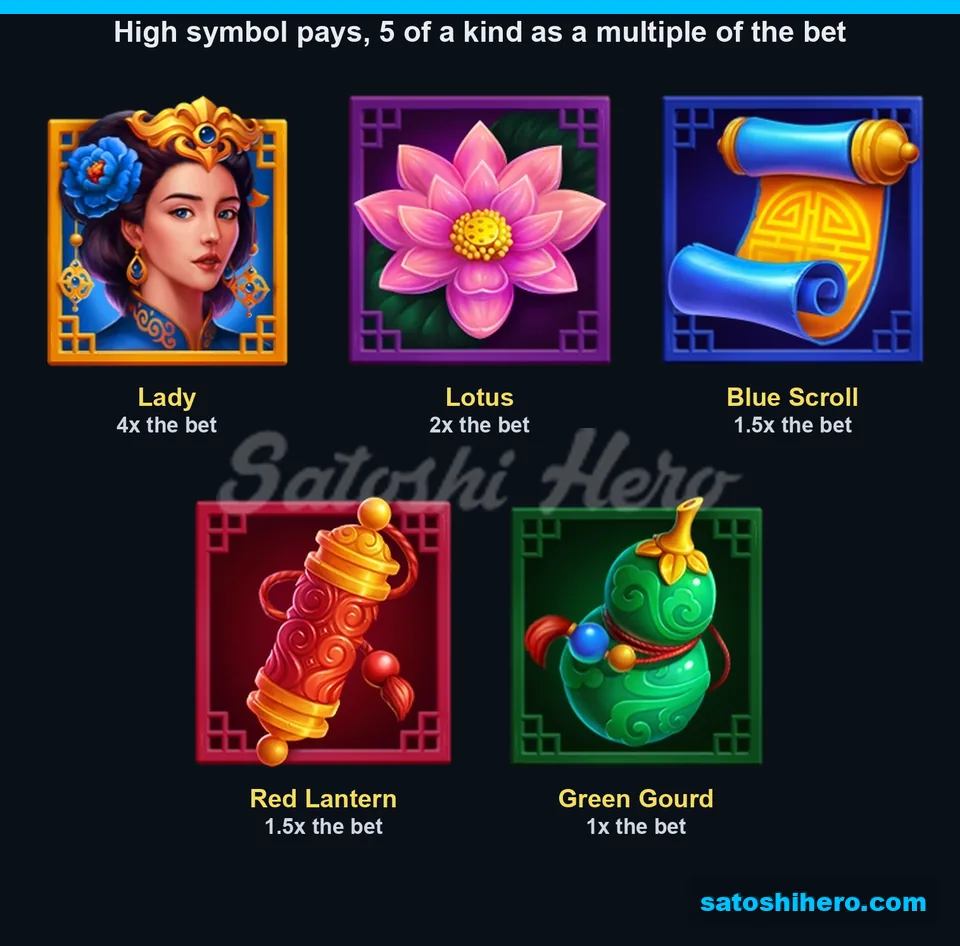
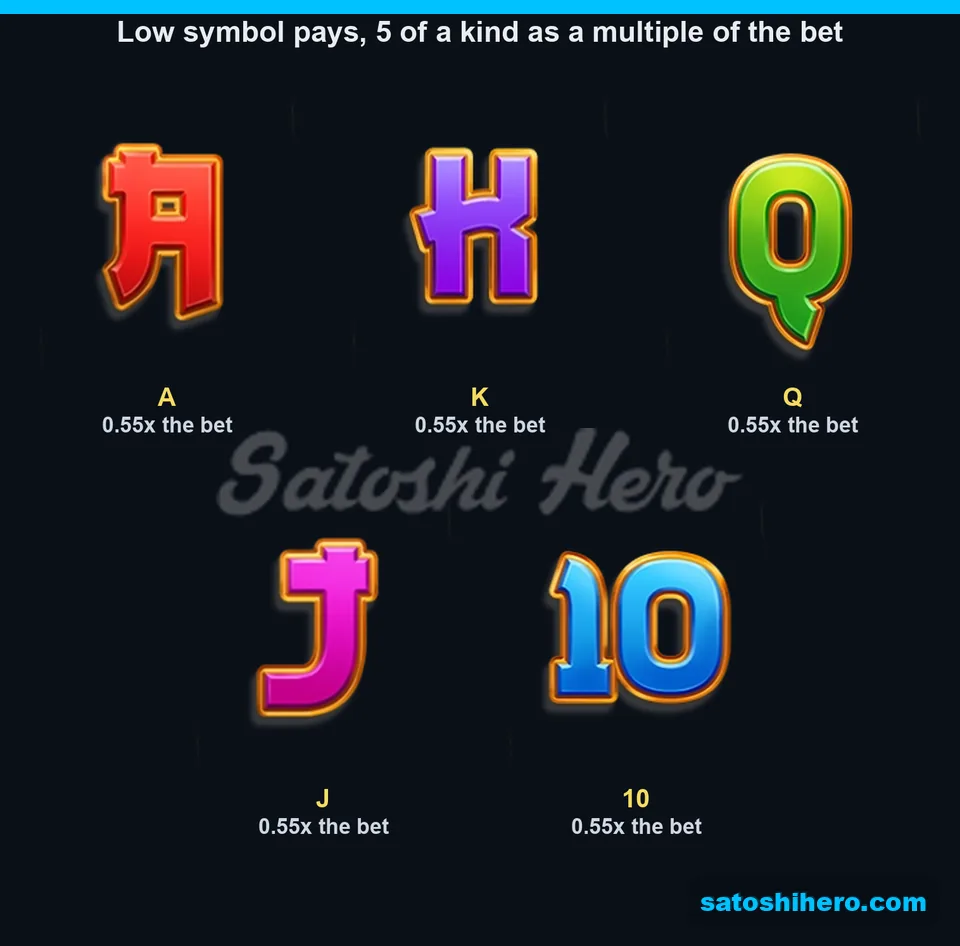
Five matching A, K, Q, J, or 10 symbols return 0.55x each. Four ladies pay 1x, three return 0.15x, and two give 0.05x. Each card rank pays 0.15x for four and 0.05x for three. You can therefore hear a win sound while still losing money on that spin.
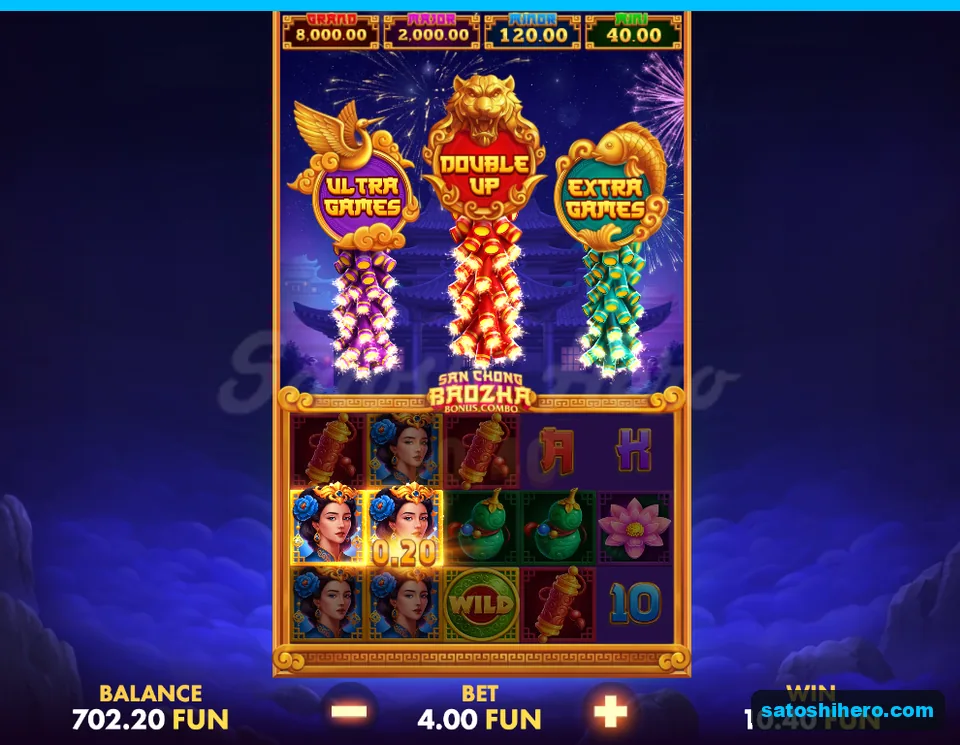
My captured base-game example placed two ladies and a wild across the left reels. Several fixed lines combined for a $10.40 return, equal to 2.6x my $4.00 stake. The smallest wins I logged reached just 0.05x. On one hand, frequent line checks create visible activity; the trade-off is that many returns barely slow a falling balance.
Wilds and coins
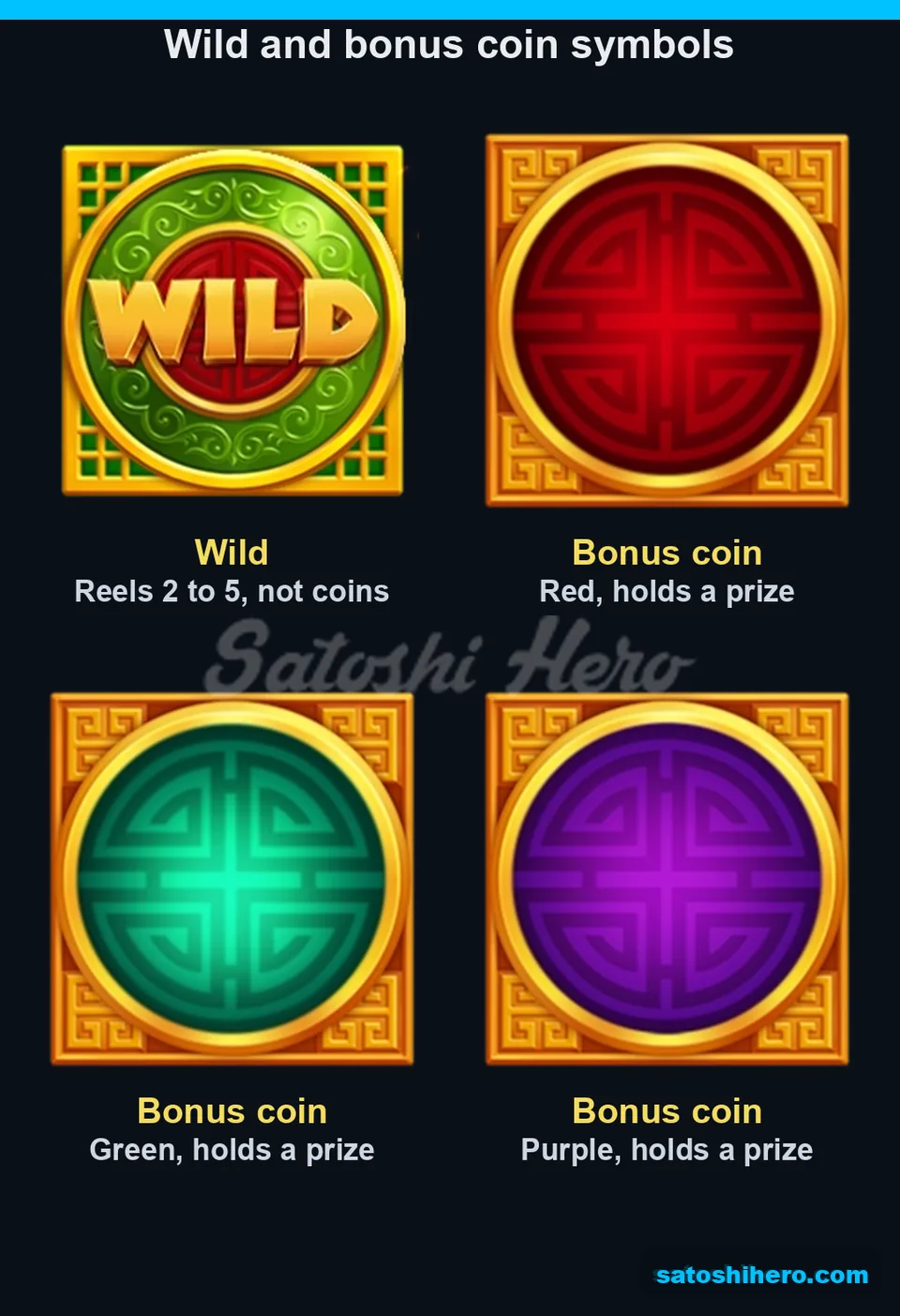
The wild appears only on reels two through five and substitutes for normal paying symbols. It can’t replace rockets or coins, which keeps the base pays separate from feature collection. Red, green, and purple coins belong to the bonus system rather than standard line combinations. You should watch their colour first, since it links each feature symbol to the matching firework above.
Supported mobile and desktop browsers can run the game through SatoshiHero without changing its core layout. I prefer the wide view, though the rules stay clear on either screen. Fixed paylines determine every ordinary base-game win, regardless of your device.

Metric: All 50 fixed lines pay from left to right, so this isn’t a pay-anywhere or ways-to-win game.
Theme and First Impressions
The slot frames three modifiers through a Chinese festival setting before you spin. A temple and dark sky establish the scene, while colour-coded fireworks explain each feature family. You can grasp that system immediately, and I’d take its clarity over a busier design.
Festival presentation
Three hanging firework strings sit above the reels. Purple marks Ultra Games with a crane, red identifies Double Up with a tiger, and green signals Extra Games with a koi. The lady in blue, lotus, scroll, lantern, and gourd carry the same festival style into the paytable. You don’t need to reopen the rules whenever a coloured rocket or coin appears.
Gold trim and saturated symbols stand out against the night background. The familiar temple imagery won’t win originality awards, but your eyes can connect each rocket with its same-coloured firework.
First screen impression
All three fireworks remain visible above the 5×3 board from the opening screen. My settled setup showed a $4.00 play-money stake and $1,000.00 balance, equal to 250 bets. You can understand the three modifier families before any feature starts, which is unusually helpful. I still wanted more base-game drama once the reels began repeating low returns.
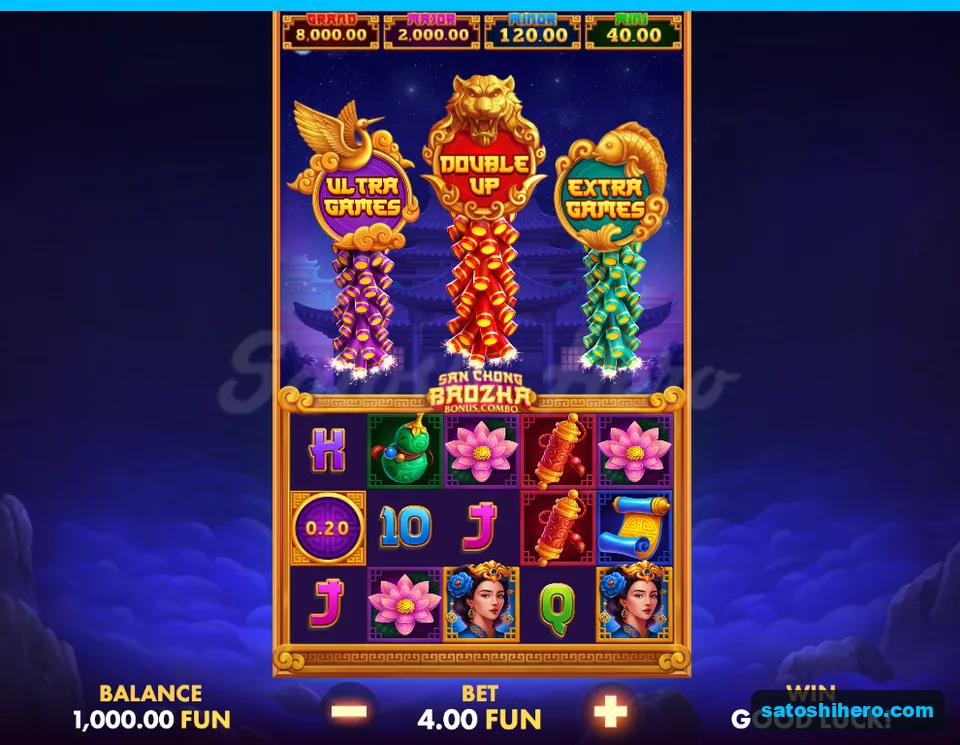
The screen communicates mechanics better than it builds atmosphere. You’ll likely remember the three animals more than the conventional card ranks. Practical clarity remains the design’s strongest quality.

Footnote: The crane, tiger, and koi give each coloured firework a separate festival identity beyond simple colour coding.
Bonus Combo Feature
Rockets can launch in the base game, fly toward matching fireworks, and potentially activate Hold ’N’ Link modifiers. Every launched rocket becomes a prize coin, but a launch doesn’t guarantee feature entry. You should treat each spin as a fresh chance rather than stored progress. I found that distinction important because the animation can otherwise imply momentum that the rules don’t provide.
Rocket trigger rules
Red, green, and purple rockets correspond with the three fireworks above the reels. A launched rocket travels to its matching colour and gets a chance to switch on that effect. Rockets from earlier spins don’t accumulate toward later activation, so separate launches never build a hidden meter. If you see several across different spins, you still haven’t moved closer to a guaranteed round.
Several fireworks can activate together, giving the system more depth than one fixed format. Yet previous misses never become progress, so you should judge each rocket on its own spin.
What testing showed
None of my 100 counted spins activated a bonus. I observed the base game directly, while every later feature description comes from the documented rules. That evidence boundary matters because I can’t honestly judge the bonus pace or payout quality from live play. The feature architecture sounds appealing, but my session never let me experience its headline idea.
Players familiar with San Chong Baozha Red: Bonus Combo will recognise the family name and firework-led presentation. I won’t claim differences that my test didn’t establish. You can expect related visuals, not a proven comparison of returns or triggers.
Other feature-led alternatives on SatoshiHero include Rich Piggies: Bonus Combo, Hot to Burn – 7 Deadly Free Spins, and Big Bass Boxing Bonus Round, although their themes and bonus structures differ from this firework-led Hold ’N’ Link format.
Hold ’N’ Link
Every activated firework leads into Hold ’N’ Link with locked coins and a resetting respin counter. The active colour determines whether the round changes coin values, respin quantity, playing area, or several elements together. You gain both value and more feature life whenever a new coin lands. I like that simple foundation, although I couldn’t test its rhythm during the counted session.
Respins and resets
All visible coins stay locked for the entire feature. The round starts with three or four respins, depending on the active modifier. Each newly landed coin restores the counter to its applicable starting number, and the round ends once that counter reaches zero. You therefore receive another complete set of chances after every successful coin landing.
One new coin adds its value while extending the round. You should watch the counter after each landing, and I find that reset easy to follow.
Coins and jackpots
Standard coins can show 0.5x, 1x, 1.5x, 2x, 2.5x, 3x, 4x, 5x, 6x, 8x, or 10x. Higher values include 15x, 20x, 25x, 30x, 40x, 50x, and 100x. A coin can carry a Mini, Minor, Major, or Grand jackpot label instead. My play produced no live coin collection to assess these values.
At my $4.00 test stake, the marquee showed Mini at $40.00, Minor at $120.00, Major at $2,000.00, and Grand at $8,000.00. Those amounts equal 10x, 30x, 500x, and 2,000x the bet. Filling all 15 positions awards the Grand. You should read them as documented feature values.

Recommendation: A new coin adds value and restores the full respin counter, so track extra feature life alongside its printed amount.
RTP and Real-World Results
The theoretical RTP is 96.06%, while the model and my live test show how far short sessions can move around it. Neither predicts what you’ll get next. I consider the counted play useful because it records the sub-stake returns behind the loss.
Simulator projection
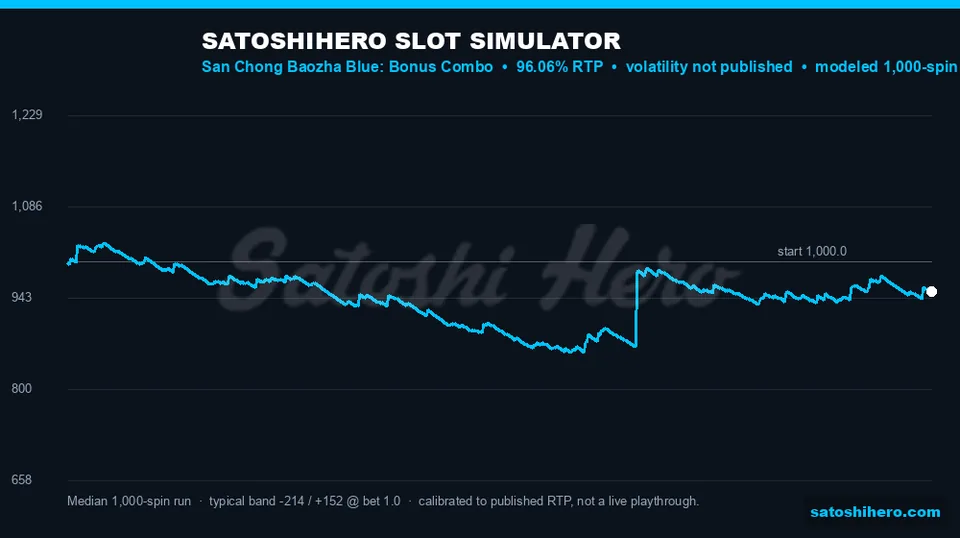
The SatoshiHero Slot Simulator modelled 1,000 spins at one bet unit. Its median result ended 46.2x down, while the middle 90% stretched from 214.1x down to 152.2x up. Roughly one modelled spin in four produced some payout. That broad spread shows why a central estimate can’t describe every bankroll path you might see.
A feature-sized result appeared about once per 50 modelled spins, while a very large result appeared about once per 13,889. These frequencies summarise many possible runs rather than schedule your next event. You shouldn’t interpret them as proof that a feature becomes due after 50 misses. In my view, the enormous gap between ordinary and rare outcomes deserves more attention than the median alone.
The simulator graph represents one possible route inside that wider range. Your results can finish far from the centre, which is the projection’s main lesson.
Our 100-spin session
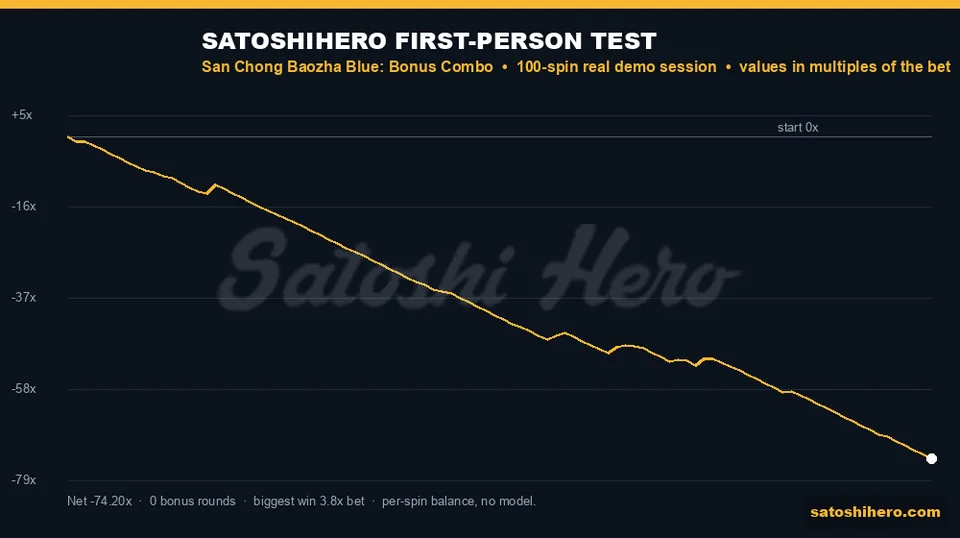
I ran 100 autoplay spins at $4.00 each, starting with $1,000.00 and ending at $703.20. The net loss reached $296.80, equal to 74.2x my bet. Twenty-six spins paid something, yet most returns came in below the $4.00 stake. You can see why payout frequency alone gave a misleading impression of activity.
My largest win reached 3.75x on spin 64. Spin 17 returned 3.65x, while spins 57 and 74 each produced 3.5x. No bonus activated anywhere in the counted run. I found the steady fall punishing because none of those modest peaks created a meaningful recovery.
The ending result fell below the simulator’s central outcome. My balance slid toward $703.20 without one dramatic collapse. You should compare every return with your stake instead of counting pay events alone.
I took a few extra manual spins afterward to capture the 2.6x base-win image. Those spins don’t appear in any counted total, keeping my test internally consistent.

Caveat: My 250x starting balance lost 74.2x in 100 spins without reaching a feature. Choose a stake that leaves room for a long bonus drought.
The 96.06% theoretical return comes from the operator’s published figure, while one 100-spin test neither measures nor changes it. Modelled frequencies stay separate from observed triggers, and no event becomes due after losses. The simulator supplies context, while my log records only what happened.
Ultra Games
Ultra Games uses three respins and can raise landed coin values after each respin. The purple crane firework identifies it. You get changing values on the existing layout rather than another grid. I find that idea interesting, but my test supplied no live evidence about its effect.
Rising coin values
After a respin, landed coin values can increase at random. An increase isn’t guaranteed, and the rules don’t establish a fixed size or pattern. You should therefore view every adjustment as a possible enhancement, not an automatic step upward. The mechanic changes coins already present instead of adding new symbols by itself.
Three respins apply when Ultra acts alone, and new coins reset that counter. Rising values can help early locks, but you still need fresh coins to prolong the round. I wouldn’t estimate its value without a triggered example.
Evidence boundary
Ultra Games didn’t activate during my 100 counted spins. I can explain its documented behaviour, but I can’t describe its speed, payout quality, or actual adjustment frequency. You deserve that distinction because rules and live experience aren’t interchangeable. Dynamic values sound engaging, though I had no direct example to judge.
Extra Games
Extra Games raises both the initial counter and every reset from three respins to four. The green koi firework marks this modifier. You receive four further chances whenever a new coin lands, but coin values and grid count stay unchanged. I like the clean rule change, though one extra chance doesn’t prove superior value by itself.
Four-respin setup
The round begins with four respins instead of three. Every new coin returns the counter to four, giving you another full sequence after a successful landing. Repeated resets can extend the feature, but you should remember that extra chances don’t guarantee another coin.
This modifier changes only the counter. It doesn’t raise values, create a second grid, or improve jackpots. I wouldn’t rank it above other colours because its effect depends on later outcomes.
Session evidence
Extra Games never activated during the counted test. My 100 spins therefore provide no direct evidence about its duration or coin total. You can understand the four-respin advantage, but you can’t infer an expected payout from it. The setup looks useful, although my play never reached it.
Double Up Games
Double Up Games runs two Hold ’N’ Link grids side by side instead of doubling each prize. The red tiger firework identifies this modifier. You track separate collections and counters, then receive values from both sides. I appreciate the larger area, but the name can overstate what it guarantees.
Side-by-side rounds
Two independent Hold ’N’ Link rounds play simultaneously. Each side receives three respins when Double Up acts without Extra Games. New coins affect the applicable round, and both grids continue until their counters expire. You should follow each side separately rather than assume one shared collection.
Once both rounds finish, the game awards their collected coin values. A second board creates more positions, not automatic multiplication. Either grid can remain sparse, so I’d need a live trigger before judging the format.
No guaranteed double
“Double Up” refers to two active grids only. It doesn’t guarantee doubled coin values or a final return twice as large. You should resist reading the feature name as a payout promise. That clarification matters more than promotional language around the expanded layout.
The modifier didn’t activate during my counted session. Without an observed round, I won’t rank its value. Two grids could look lively, though my base-game test never reached one. The mechanic doubles playing area, not each reward.
Combined Bonuses and Mega Bonus
Lighting multiple fireworks combines their rule changes within one Hold ’N’ Link feature. The modes stack value changes, respins, and grids rather than adding an unrelated game. You can identify each piece through colour, which I find logically designed.
Two-effect combinations
Ultra Extra Games combines possible random coin increases with four respins. Ultra Double Up Games applies possible rising values across two side-by-side grids with three respins. Double Up Extra Games uses two grids and four respins. Each title states which mechanics it joins, making the structure easier to decode than the long names suggest.
Purple changes coin values, green changes the counter, and red changes the number of grids. You can see each change without memorising a new rule set. I consider that modular design the slot’s smartest idea.
All three effects
The Mega Bonus combines possible rising coin values, four respins, and two simultaneous grids. Multiple matching fireworks need to activate together for a combined mode to start. No such event occurred during my 100 spins, so I can’t support claims about its practical frequency or payout quality. You should treat it as documented potential rather than an observed highlight.
A larger mechanic set doesn’t prove better value. More grids and respins increase activity, but no feature-specific return data establishes the strongest combination. The modes simply stack familiar rules.
Frequently Asked Questions About San Chong Baozha Blue: Bonus Combo
How many win lines does San Chong Baozha Blue: Bonus Combo have?
San Chong Baozha Blue: Bonus Combo has 50 fixed win lines on a 5×3 grid. Wins form from left to right across adjacent reels, and only the highest win on each line pays.
What do the symbols pay in San Chong Baozha Blue: Bonus Combo?
Five ladies pay 4x, lotuses 2x, blue scrolls 1.5x, red lanterns 1.5x, and green gourds 1x. Five A, K, Q, J, or 10 symbols each return 0.55x the bet.
What is the Bonus Combo feature in San Chong Baozha Blue: Bonus Combo?
Rockets launch during base play and travel to matching coloured fireworks, where each gets a chance to activate its modifier. Every rocket becomes a prize coin, while rockets from earlier spins don’t accumulate toward later features.
How does the Hold ’N’ Link bonus work?
Coins remain locked while the round uses three or four respins. Every new coin resets the applicable counter, and filling all 15 positions awards the Grand jackpot.
Which changes come from Ultra, Extra, and Double Up Games?
Ultra can raise landed coin values, Extra sets the respin counter to four, and Double Up runs two grids side by side. The Mega Bonus combines all three rule changes.
What jackpots appear in San Chong Baozha Blue: Bonus Combo?
The feature includes Mini, Minor, Major, and Grand jackpots. At my $4.00 test stake, they showed $40.00, $120.00, $2,000.00, and $8,000.00, equal to 10x, 30x, 500x, and 2,000x; filling all 15 positions awards Grand.
What did the San Chong Baozha Blue: Bonus Combo simulator show?
The modelled median 1,000-spin result ended 46.2x down. Its middle 90% ranged from 214.1x down to 152.2x up, and both figures describe simulated outcomes rather than live play.
How did the 100-spin San Chong Baozha Blue: Bonus Combo test go?
I lost 74.2x the bet across 100 spins, with 26 paying results and a 3.75x largest win. No bonus activated during the counted session.
What is the RTP of San Chong Baozha Blue: Bonus Combo?
San Chong Baozha Blue: Bonus Combo has a theoretical RTP of 96.06%. That figure doesn’t predict the result of a 100-spin session.
Final Word
San Chong Baozha Blue: Bonus Combo stands out through three colour-coded Hold ’N’ Link modifiers. Its drawback is access: my counted session never activated the headline feature.

My Verdict
Fixed-line fans can appreciate the clear modifier logic. Expect modest base returns, and don’t assume your short session will reveal the fireworks.
I like how the colours explain combinations before they start. I don’t like how 26 paying spins still led to a 74.2x loss. My 3.75x best hit never threatened a recovery.
San Chong Baozha Blue: Bonus Combo deserves attention for coherent bonus design, not my uneventful base session. This guide is updated periodically.

Pros:
 Clear colours: Each firework shows which Hold ’N’ Link rule can change.
- Flexible structure: Multiple fireworks combine familiar effects without confusing side games.
- Transparent lines: Fifty set paths make ordinary wins easy to verify.
- Visible jackpots: Bet-based amounts show each feature jackpot’s scale immediately.

Cons:
 Weak base play: Most paying spins returned less than my stake.
- No tested bonus: One hundred spins never activated the headline mechanic.
- Misleading activity: Twenty-six payouts still ended with a steep net loss.

Best For: Traditional line-slot fans who value clear rules and layered modifiers get the strongest match. If you manage feature droughts patiently, you’ll understand the appeal, while quick-action seekers could find the base game flat.































































Bets
All Bets
Game
Player
Date
Wager
Mult.Multiplier
Prize
 Mardi Gras Queen
 nina87
- 04:20:57
- 0×
- Bunny's Bounty: Hold`n`Link
 whodey39311
- 04:20:56
- 0×
- Power Diamonds King Size: Hold ‘N’ Link
 chorus106
- 04:20:56
- 0×
- Power Diamonds King Size: Hold ‘N’ Link
- chorus106
- 04:20:54
- 0.99×
- Mardi Gras Queen
- nina87
- 04:20:54
- 0×
- Bow of Artemis
 Hidden
- 04:20:53
- 0×
- Power Diamonds King Size: Hold ‘N’ Link
- chorus106
- 04:20:53
- 0.49×
- Bow of Artemis
- Hidden
- 04:20:51
- 0×
- Three Piglets
- josh1998
- 04:20:51
- 0×
- Phoenix HIT Hotfire Hold & Win Buy Bonus
 Hidden
- 04:20:49
- 0×