

Rubber Duck: Hold 'N' Link
By pressing play, you agree that you are above legal age in your jurisdiction and that your jurisdiction allows online gambling.

Rubber Duck: Hold 'N' Link
RTP96.26%
VolatilityMedium
Max winx3,500
Lines50
Hit rate36.24%
ReleasedSep 2024
Live game stats
Real RTP61.86%
Spins1,087
Players1
Biggest win$251

Chasing Ducks and Cash Spheres by the Shore
Chase multiplying Wilds and sticky Cash Spheres across a bright, beachside reel set. Rubber Duck: Hold ‘N’ Link slot is a Netgame beach game with 96.1% theoretical RTP, 50 fixed paylines, and two organic features. Fans of free spins, locked-symbol respins, and simple lines get plenty, though many base payouts are small.
My 100 spins ended 32x down despite two free-spin rounds near 20x. The five-reel, three-row SatoshiHero demo opened with $1,000.00 at $3.75 per spin. You can play demo or real here, but neither feature has a buy option.
Key Takeaways
- Best bonus: Free spins delivered my two strongest results, while Hold ‘N’ Link never triggered.
- RTP / risk: The 96.1% theoretical RTP sits beside wide short-session balance swings.
- Feature access: Both bonuses trigger through normal spins because there is no feature buy.
- Risk note: Thirty-eight paying spins couldn’t stop my balance falling 32x the stake.
- Bankroll note: Many small returns can create activity without protecting your starting balance.

Table of Contents
- Rubber Duck: Hold ‘N’ Link slot Theme & First Impressions
- How the 100 Spins Played
- How Rubber Duck: Hold ‘N’ Link slot Works
- Forming Regular Wins
- Trigger Symbol Rules
- Symbols and Payouts
- Premium Symbol Values
- Royals and Wilds
- Free Spins
- Multiplying Wild Wins
- Tested Round Results
- Hold ‘N’ Link
- Sticky Sphere Respins
- Cash Sphere Values
- Jackpot Prizes
- Fixed Jackpot Spheres
- Filling the Board
- RTP, Risk and Test Results
- Simulator Projection Results
- Our 100-Spin Session
- Frequently Asked Questions
- Final Word
Rubber Duck: Hold ‘N’ Link slot Theme & First Impressions
The slot presents a bright, readable beach scene, though its rubber-duck idea isn’t especially original. Palm trees frame the reels beside a wooden boat and red crab, while blue sky keeps the board airy. You can spot the jackpot display above the five-reel layout without losing sight of active symbols. In my view, clarity matters more than novelty here.
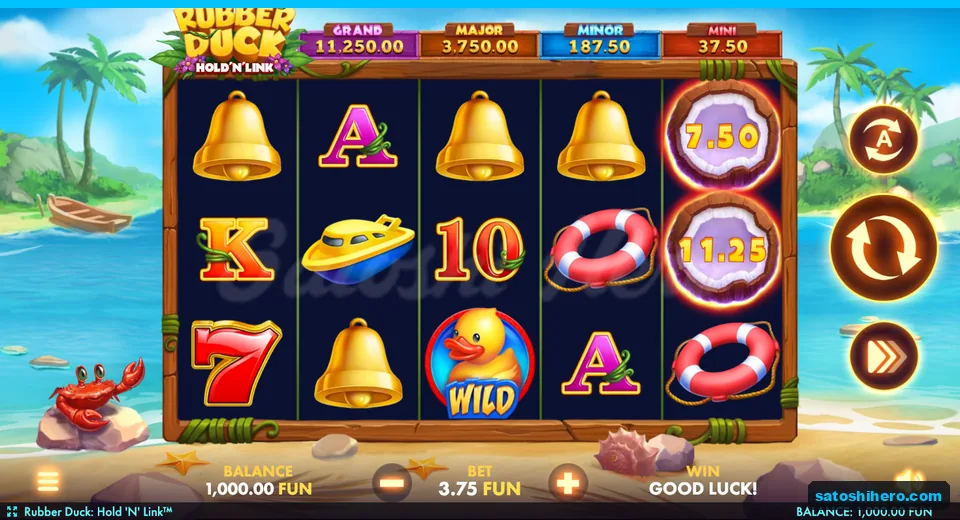
Free spins switch the sky to a pink sunset, so you instantly know when the feature starts. Bright icons separate cleanly from the background, helping you track paylines, Bonus Ducks, and Cash Spheres. If you dislike cluttered slot art, you’ll appreciate how little competes with the reels. The trade-off is a setting that feels familiar after only a few spins.
Tiki Island: Hold ‘N’ Link offers another tropical setting built around the same broad feature style. Pick between them by visual taste rather than assuming one has stronger mathematics or easier triggers. Rubber ducks give this game a sillier mood, while its beach props keep everything light. You still get a clear view when several special symbols appear together.

Metric: The background changes from bright daylight to a pink sunset when free spins begin.
On one hand, the art won’t win originality awards. On the other, you can read every state quickly on large or compact screens. That simple direction keeps normal spins and bonuses easy to follow.
How the 100 Spins Played
My 100-spin session lost $120.00 at a $3.75 stake, equal to 32x the bet. I started with $1,000.00 and finished at $880.00 despite 38 paying spins. You might find that hit count encouraging, but most returns covered only a fraction of one stake.
The largest base-game spin I logged paid about 5.1x. Free spins arrived organically near spins 33 and 57, creating the only meaningful balance recoveries. Those rounds paid roughly 20.1x and 20x, stopping the loss from becoming much deeper. Hold ‘N’ Link never appeared during the counted play.

Caveat: This session produced 38 paying spins but still ended 32x lower because most base-game wins were small.
The rhythm felt busy because modest line hits appeared regularly. Yet you shouldn’t mistake frequent flashes for stable returns. Each low payout softened one spin without repairing surrounding misses. Payout size mattered far more than payout frequency.
I took one extra photo spin after completing the count. It produced the base-game line-win image, but I excluded it from every session figure. You can trust the stated result as exactly 100 spins, not 101.
Rubber Duck: Hold ‘N’ Link slot gave me two strong moments inside an otherwise grinding session. You may find the action steady when paylines connect often. Still, a falling balance can hide behind small celebrations. Judge short play by net movement, not win animations.
How Rubber Duck: Hold ‘N’ Link slot Works
Rubber Duck: Hold ‘N’ Link slot uses five reels, three rows, and 50 fixed paylines. Regular combinations form from left to right, and only the best qualifying combination on each line pays. You read those wins along marked paths rather than by counting adjacent symbols anywhere. The Bonus Duck and Cash Spheres follow separate rules.
Three or more Bonus Ducks award six free spins, while six Cash Spheres activate Hold ‘N’ Link. A Wild duck replaces ordinary paying symbols except Bonus Ducks and Cash Spheres. It can land only on reels two through five. You should count trigger symbols across the full screen instead of tracing them along one payline.
The control rail gives you spin, autoplay, and fast play without a feature-buy button. Desktop and mobile layouts keep those controls accessible. I found the interface direct, although fast play can hide small balance drops. Both bonuses must arrive through ordinary play.
Forming Regular Wins
Regular wins begin on reel one and continue across matching positions on fixed paths. My photographed bell result paid $3.60 from a $3.75 spin, with a Wild on reel three completing highlighted combinations. You can see why a visible win doesn’t always return the full stake. Only the strongest qualifying combination on each line contributes.
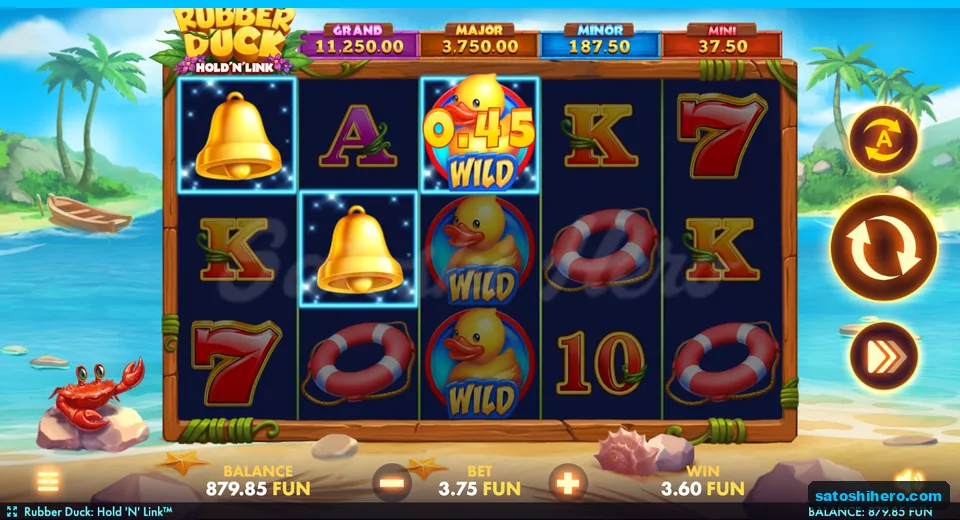
The Wild helps complete ordinary symbols when it occupies the needed payline position. It doesn’t replace a Bonus Duck or Cash Sphere, so it can’t manufacture either feature trigger. To be fair, that restriction keeps the three symbol systems easy to understand. You trace lines for regular icons, count Bonus Ducks anywhere, and count Cash Spheres separately.
Trigger Symbol Rules
Bonus Ducks pay according to their total number anywhere on the screen. Cash Spheres instead count toward the six-symbol respin trigger, then carry collected values inside that feature. You don’t need either symbol to appear from the leftmost reel. This separation prevents feature symbols from behaving like ordinary line icons.
Rubber Duck: Hold ‘N’ Link slot keeps its core logic conventional despite running two bonuses. Read each symbol by its own rule and you won’t confuse a line hit with a feature count.
Symbols and Payouts
The Bonus Duck offers the standout 100x five-symbol award, while regular combinations pay much less. Every value below uses a multiple of your bet, making the paytable useful at any stake. You should notice how quickly ordinary three-symbol returns shrink beside the top duck award. That imbalance explains why many visible hits barely offset one spin.
Premium Symbol Values
- Bonus Duck: Five pay 100x, four pay 15x, and three pay 2x.
- Red Seven: Five pay 3x, four pay 1x, three pay 0.2x, and two pay 0.04x.
- Speedboat: Five pay 2x, four pay 0.6x, and three pay 0.12x.
- Lifebuoy: Five pay 2x, four pay 0.6x, and three pay 0.12x.
- Golden Bell: Five pay 2x, four pay 0.6x, and three pay 0.12x.
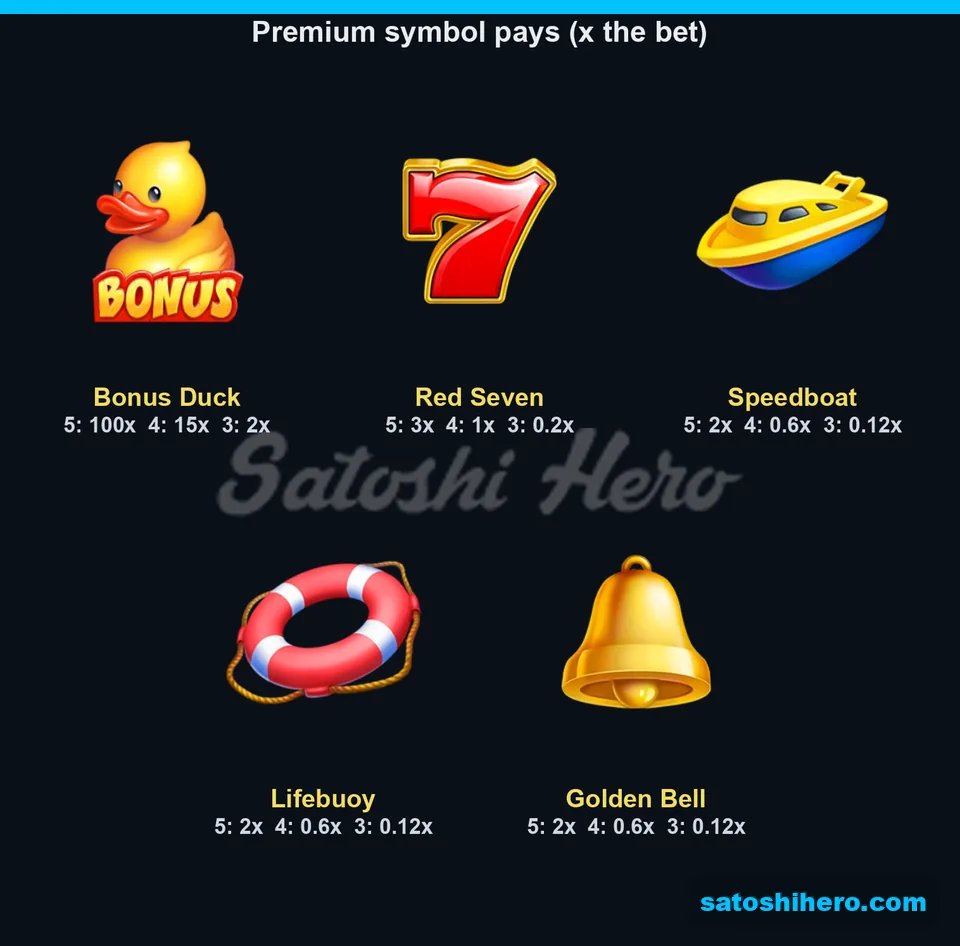
The three beach premiums share identical values, so you can remember them together. Red Sevens pay slightly more, but even five return only 3x before lines combine. Bonus Ducks stand apart because their total count pays anywhere. The gap makes ordinary premiums feel less exciting than their artwork suggests.
Royals and Wilds
- Ace: Five pay 1.2x, four pay 0.4x, and three pay 0.08x.
- King: Five pay 1x, four pay 0.2x, and three pay 0.08x.
- Queen: Five pay 1x, four pay 0.2x, and three pay 0.08x.
- Jack: Five pay 1x, four pay 0.2x, and three pay 0.08x.
- Ten: Five pay 1x, four pay 0.2x, and three pay 0.08x.
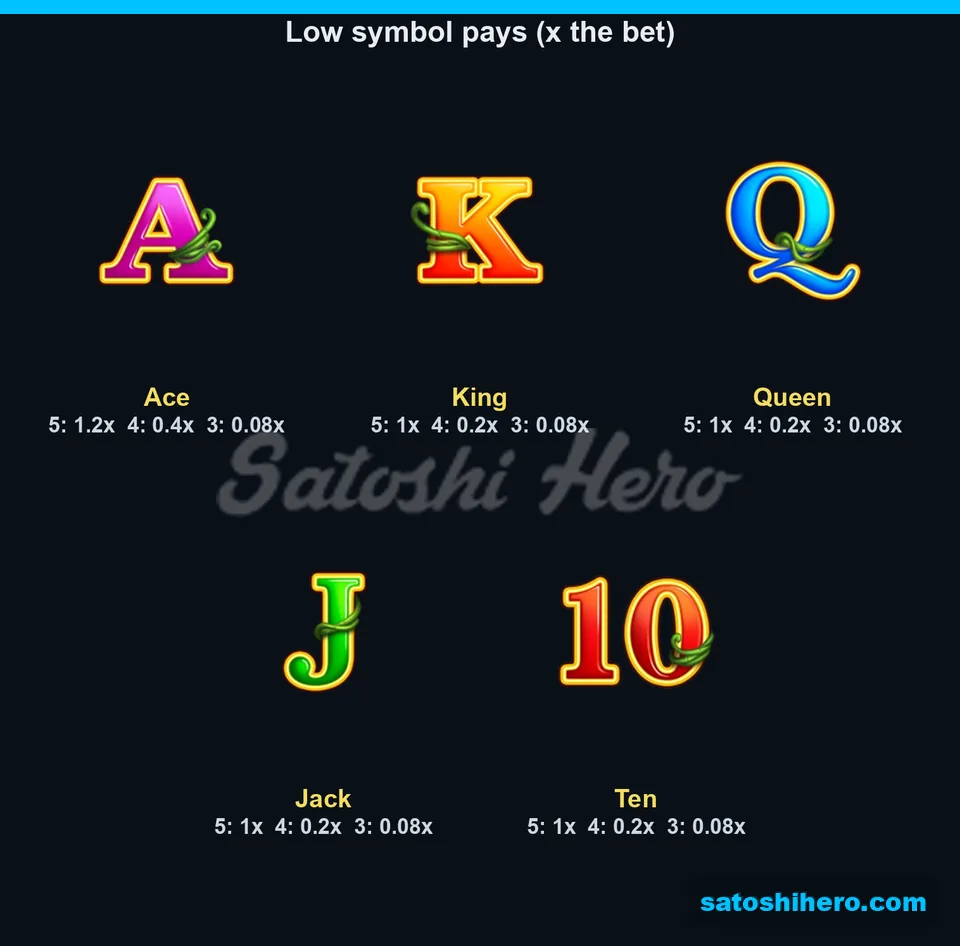
Royals fill the lowest tier, explaining many fractional returns. The Wild substitutes for these icons and beach premiums, but never Bonus Ducks or Cash Spheres. You may complete several lines with one well-placed Wild. Still, combined lines won’t always cover your stake.
Rubber Duck: Hold ‘N’ Link slot concentrates its clearest symbol value in the count-anywhere Bonus Duck. You get an easy paytable, but the regular symbols often need several concurrent lines to feel meaningful.
Free Spins
Three or more Bonus Ducks award six free spins, and both rounds I triggered paid about 20x. Every Wild upgrades into a 2x Wild during the feature, creating the main route to stronger line wins. You still need that Wild to contribute to a winning payline. A multiplier elsewhere on the board doesn’t affect unrelated combinations.
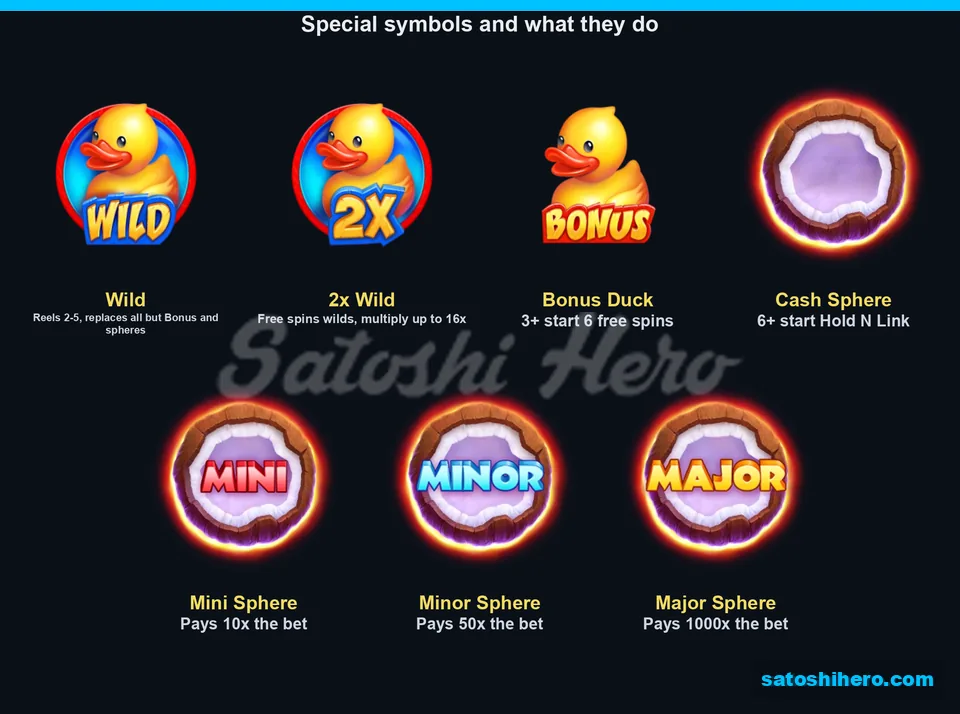
The feature uses a different reel set and turns the sky pink. Three Bonus Ducks inside the round add three spins, giving you extra chances at upgraded Wilds. The switch makes the bonus state unmistakable. Six starting spins feel brief unless a retrigger arrives.
Multiplying Wild Wins
One upgraded Wild doubles the affected line award. Two or more 2x Wilds compound when they help the same payline, rather than adding their values together. The combined multiplier can reach 16x, but that ceiling applies to the contributing Wilds on one line. You shouldn’t multiply every visible line simply because several Wilds appear.
The strongest setup needs matching symbols plus several upgraded Wilds along one path. On one hand, that creates a readable target. The trade-off is that scattered Wilds may enhance separate lines only modestly. A lone 2x Wild can still leave its result below your stake.

Recommendation: The strongest line potential comes from several 2x Wilds sharing one payline. One upgraded Wild only doubles the win it completes.
Tested Round Results
My first organic round returned $75.30 from a $3.75 stake, approximately 20.1x. The second paid $75.00, exactly 20x, after arriving near spin 57. Both ranked as my largest results within the counted session. Neither managed to erase the steady base-game losses around it.
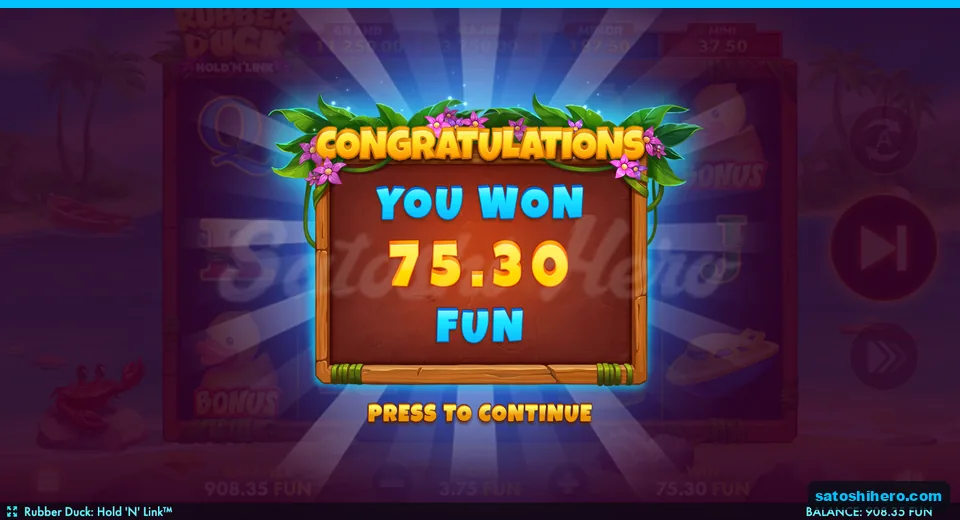
Rubber Duck: Hold ‘N’ Link slot offers no bonus buy, so I reached both rounds through Bonus Ducks during normal play. Their nearly identical totals made the experience feel consistent, but two outcomes can’t define a normal feature return. You could see a weaker round without useful Wild placement or a stronger one with compounded multipliers. My test proves only what happened in those two triggers.
Free spins supplied all meaningful upside during my play. The feature has clear multiplier logic, yet its short starting length keeps expectations grounded. You get genuine recovery potential from grouped 2x Wilds, not an automatic rescue from the trigger itself.
Hold ‘N’ Link
Six or more Cash Spheres trigger a sticky-symbol round with three respins. Those spheres can appear during base play or free spins, then lock into their positions when the feature begins. Only Cash Spheres can land during the round. You follow the counter and empty positions rather than fixed paylines.
Each regular sphere carries 1x, 2x, 3x, 4x, 5x, 10x, 15x, 20x, 50x, or 100x. A new sphere resets the counter to three without adding three spins. Empty respins reduce it by one. The sequence ends at zero or with a full board.
Sticky Sphere Respins
Triggering spheres stay fixed while vacant cells spin again. Suppose the counter falls to one and a new sphere lands: it returns to three, rather than rising to four. You can track progress through the 15 positions and the visible counter. This loop feels simple, although repeated empty respins can end it quickly.
Every additional sphere improves the collected total and extends the chance of finding another. Filling all 15 positions ends the round through completion instead of exhaustion. Wild Buffalo: Hold ‘n’ Link gives locked-symbol respin fans a different visual setting with a comparable broad loop, while The Big Game Hold ‘n’ Link provides another theme built around that feature style. Choose its atmosphere only if you prefer that theme, not because of an assumed trigger advantage.
Cash Sphere Values
Regular numbered spheres contribute their displayed multiples to the final total. Labelled jackpot spheres use fixed awards, while every occupied cell advances board completion. You should separate a sphere’s value from its role in keeping respins alive. One symbol can help both under different rules.
I didn’t trigger Hold ‘N’ Link during my 100 spins, so I won’t pretend to have observed a payout. That absence also made the session rely heavily on two free-spin rounds. Rubber Duck: Hold ‘N’ Link slot may show Cash Spheres without reaching the required six together. New spheres extend the bonus once active, while empty respins push it toward an ending.
Jackpot Prizes
Four fixed awards sit inside the Hold ‘N’ Link structure: Mini pays 10x, Minor pays 50x, Major pays 1,000x, and Grand pays 3,000x. Mini, Minor, and Major come from their labelled spheres. The Grand follows a different condition because you must fill all 15 positions. You don’t need 15 jackpot-labelled spheres.
Fixed Jackpot Spheres
- Mini sphere: Pays 10x the bet when collected.
- Minor sphere: Pays 50x the bet when collected.
- Major sphere: Pays 1,000x the bet when collected.
Each labelled sphere gives its fixed multiple as part of the final feature total. Regular numbered spheres can land beside them and add their own values. You should read a jackpot label as an immediate collected prize, not as a requirement to finish the board. That approach makes the three fixed spheres straightforward.
Filling the Board
The Grand requires a sphere in every one of the 15 positions before respins expire. Any mixture of regular and jackpot-labelled spheres can complete that board. You only need full occupancy, so ordinary 1x or 2x spheres still count toward the condition. This distinction prevents the common mistake of waiting for 15 special labels.

Footnote: Any combination of sphere types can fill all 15 positions and award the 3,000x Grand.
No jackpot appeared because Hold ‘N’ Link never triggered. To be fair, the conditions remain easy to follow without seeing them resolve. You collect Mini, Minor, or Major through the matching sphere, while Grand needs every cell. That split keeps the prize structure simple.
RTP, Risk and Test Results
The 96.1% theoretical return doesn’t prevent wide short-session swings. My live result and the simulator both show losses can persist despite feature activity and frequent small payouts. You should use these figures to understand possible balance movement, not to predict a coming spin. Risk matters more here than any unsupported volatility label.
Simulator Projection Results
The SatoshiHero Slot Simulator modelled 1,000 spins at one bet unit. Its median path finished about 64x down, while the fifth-to-ninety-fifth-percentile band ranged from roughly 313x down to 310x up. A feature appeared approximately once every 46 spins. Wins of at least 100x appeared around once every 1,658 spins.
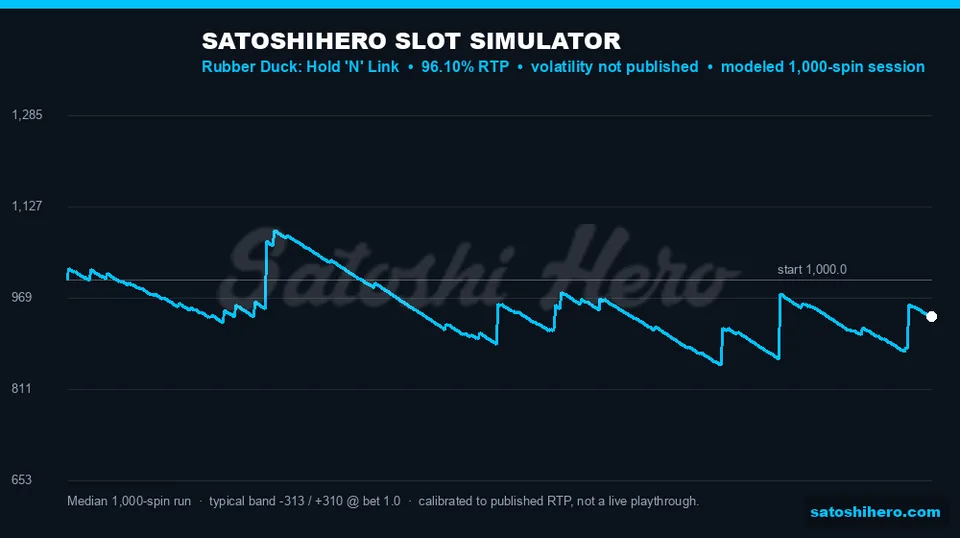
That broad range matters more than the single median result. You can see how similar starting conditions may produce sharply different balance paths. The model can’t forecast a specific Cash Sphere board, your next feature, or a live outcome. It only illustrates the shape and spread of risk under its assumptions.
Our 100-Spin Session
- Starting balance: $1,000.00
- Stake: $3.75
- Ending balance: $880.00
- Net result: $120.00 lost, or 32x the stake
- Paying spins: 38 from 100
- Free-spin triggers: Two
- Free-spin payouts: About 20.1x and 20x
- Largest base spin: About 5.1x
- Hold ‘N’ Link triggers: Zero
My balance graph showed two clear upward bumps around the free-spin triggers. Outside those moments, small regular returns couldn’t cover continued $3.75 spins. You might focus on 38 paying results, yet the $120.00 loss reveals their limited weight. The line still trended downward after both feature recoveries.
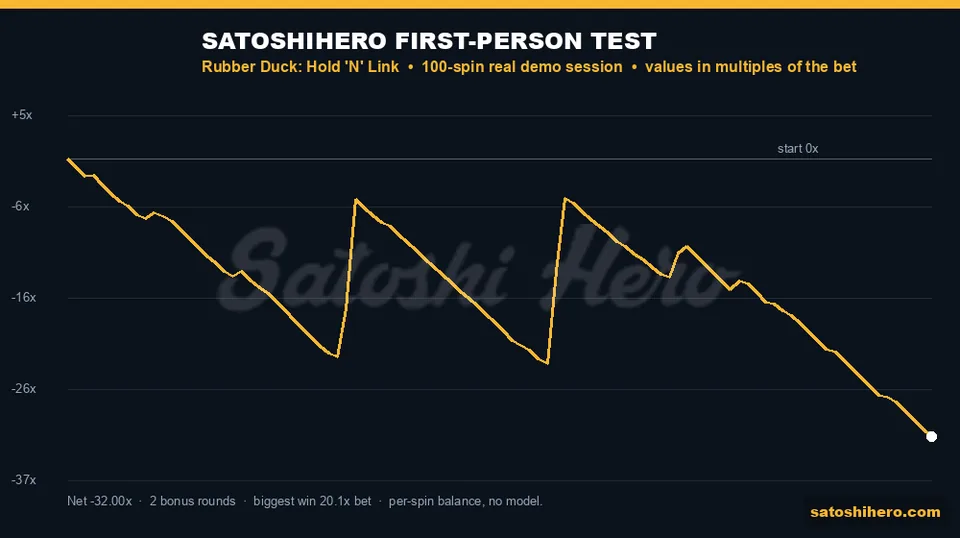
Rubber Duck: Hold ‘N’ Link slot produced activity without balance stability in my test. I wouldn’t call 100 spins enough to define future play, but it does expose the danger of judging value by hit count. The simulator widens that lesson by showing both substantial losses and gains across modelled paths. Your result can land anywhere within or beyond one sample band.
The operator’s theoretical return expresses expected mathematical return under the stated rules, while one 100-spin session doesn’t change it. The simulator illustrates risk rather than predicting live outcomes, and feature behaviour can differ from base play by design.
Frequently Asked Questions
How do you trigger free spins in Rubber Duck: Hold ‘N’ Link slot?
Three or more Bonus Ducks in the base game award six free spins. Every Wild becomes a 2x Wild, while three Bonus Ducks during the feature add three more spins.
How does the Hold ‘N’ Link bonus work?
Six or more Cash Spheres trigger three sticky respins. Each new sphere resets the counter to three, and all collected values pay when respins expire or the 15-position board fills.
What jackpots does Rubber Duck: Hold ‘N’ Link slot have?
Mini pays 10x, Minor pays 50x, Major pays 1,000x, and Grand pays 3,000x. Filling all 15 positions with any sphere mixture awards the Grand.
How do line wins work in Rubber Duck: Hold ‘N’ Link slot?
Regular combinations pay from left to right across 50 fixed paylines. Only the best combination on each line pays, while Bonus Ducks use their total count anywhere.
What did the 100-spin Rubber Duck: Hold ‘N’ Link slot test return?
My balance fell from $1,000.00 to $880.00 at $3.75 per spin, a 32x loss. Two free-spin rounds each returned about 20x and supplied the strongest results.
What is the RTP of Rubber Duck: Hold ‘N’ Link slot?
The game’s stated theoretical return is 96.1%. This percentage doesn’t promise the same return during one session.
What does the 1,000-spin simulator show for Rubber Duck: Hold ‘N’ Link slot?
The median modelled result ended about 64x down, within a range from roughly 313x down to 310x up. Features appeared approximately once every 46 spins, but the model doesn’t predict your next session.
Final Word
Rubber Duck: Hold ‘N’ Link combines clear paylines with two simple organic features. Multiplying Wilds created my best moments, but small base wins failed to protect the balance. Cheerful art makes that uneven rhythm more pleasant, not less costly.

My Verdict
Try the demo if you value simple lines, organic bonuses, and visible feature states. Expect modest base returns, then judge the game by net balance rather than animations.
I liked both free-spin recoveries near 20x. I didn’t like that 38 paying spins still left me $120.00 down, while respins never appeared. That mix felt active but unforgiving.
The Rubber Duck: Hold ‘N’ Link slot gives you readable mechanics and multiplier potential without a feature buy. Its clean design works, though small payouts demand disciplined staking. Tested details are checked regularly.

Pros:
 Clear paylines: Fifty fixed lines make every regular combination easy to trace.
- Useful Wild upgrade: Free spins turn each Wild into a 2x multiplier.
- Distinct features: Bonus Ducks and Cash Spheres create separate, readable trigger paths.
- Strong presentation: The sunset switch makes bonus play instantly recognisable.

Cons:
 Small base payouts: Many wins returned only a fraction of my stake.
- No feature buy: You can’t access either bonus directly.
- Elusive respins: Hold ‘N’ Link didn’t trigger during my counted session.

Best For: Patient bonus chasers who enjoy fixed paylines, multiplying Wilds, and sticky respins have the clearest reason to play. You need comfort with frequent small returns and features that may stay absent across a short session.

































































Bets
All Bets
Game
Player
Date
Wager
Mult.Multiplier
Prize
 Egypt Fortunes: Bingo Bounty
 mdp0fxo
- 10:46:42
- 0×
- Egypt Fortunes: Bingo Bounty
- mdp0fxo
- 10:46:39
- 0×
- Galaxy Glitter
 blazecraft
- 10:46:38
- 0×
- Grand Koala: Hold ‘N’ Link
 mike_721
- 10:46:37
- 0×
- Egypt Fortunes: Bingo Bounty
- mdp0fxo
- 10:46:36
- 0×
- Luck of Panda: Bonus Combo
 Hidden
- 10:46:34
- 17×
- Mr. Crystalman: Hold 'N' Link
 Hidden
- 10:46:33
- 3.5×
- Egypt Fortunes: Bingo Bounty
- mdp0fxo
- 10:46:33
- 0×
- Mr. Crystalman: Hold 'N' Link
- Hidden
- 10:46:32
- 0×
- Almighty Diamonds: Hold 'N' Link
- novaone948
- 10:46:31
- 0×