

Splendour Forest
By pressing play, you agree that you are above legal age in your jurisdiction and that your jurisdiction allows online gambling.

Splendour Forest
RTP95.09%
VolatilityHigh
Max winx6,426.5
Lines10
Hit rate30.59%
ThemeFantasy

Splendour Forest slot Guide: Free Spins, Expanding Symbols and Our 100-Spin Test
Enter the Splendour Forest slot for high-volatility play across 10 fixed paylines, framed by Max Win Gaming’s enchanted woodland.
Splendour Forest is a high volatility slot from Max Win Gaming with 95.09% RTP and 6,426x max win potential. Its 5×3 grid combines line wins, a golden tree Wild, 10 Free Spins, and expanding Golden Symbols. Patient players with enough funds for long dry spells will understand its uneven rhythm best.
Splendour Forest slot at a Glance
The Splendour Forest slot is a 5×3 Max Win Gaming title built around 10 fixed paylines. You get a familiar line format, yet the math profile demands far more patience than the simple board suggests.
- Provider: Max Win Gaming, shortened to Max Win
- Game type: Slot
- Layout: 5 reels and 3 rows
- Win system: 10 fixed paylines paying from the leftmost reel
- RTP: 95.09%
- Volatility: high
- Maximum win: 6,426x the bet
My demo opened with a $5,000 balance and a $1 total stake, with every amount shown in US dollars. I used 100 autoplay spins in turbo mode and finished at $4,937. My $63 loss came with a $5 best win and no Free Spins trigger.
No bonus buy appeared during my test, so regular spins provided the only path into the feature. That matters when you plan a session because you can’t pay for immediate access after a dry start. Free demo and real play sit directly on SatoshiHero, and you can use either mode with the same straightforward layout.
The specifications receive routine checks, while the live details come from the exact run described here. This guide keeps official rules, simulator projections, and events I witnessed clearly separated. You should treat the clean setup as an easy entry point, not as a sign of gentle risk.
Key Takeaways
- Best play: No bonus buy appeared, so use regular spins and leave room for a long dry spell.
- RTP / volatility: The theoretical RTP is 95.09%, and the volatility is high.
- Max win: The official maximum win reaches 6,426x the bet.
- Risk note: My 100-spin test lost $63 and never triggered Free Spins.
- Bankroll note: A $1 total stake puts $0.10 on each line, so reduce the total bet when needed.

Table of Contents
- Splendour Forest slot at a Glance
- Theme and First Impressions
- How Splendour Forest Works
- High-Value Symbol Payouts
- Wild Symbol Behavior
- Understanding the 10 Fixed Paylines
- Reading Line Wins
- Calculating Each Payout
- Free Spins and Multiple Retriggers
- Triggering the Feature
- Retrigger Rules
- Expanding Golden Symbols
- Golden Tile Expansion
- Extra Pick Markers
- What Happened Over 100 Spins
- Balance and Best Win
- Hit Pattern Observed
- RTP, Volatility and Our Test
- Simulator Projection Results
- Our 100-Spin Session
- Frequently Asked Questions About the Splendour Forest slot
- The Takeaway
Theme and First Impressions
The Splendour Forest slot uses an enchanted woodland framed by silver vines, glowing trees, flowers, and soft green light. The fantasy art stays bright without hiding the line structure.
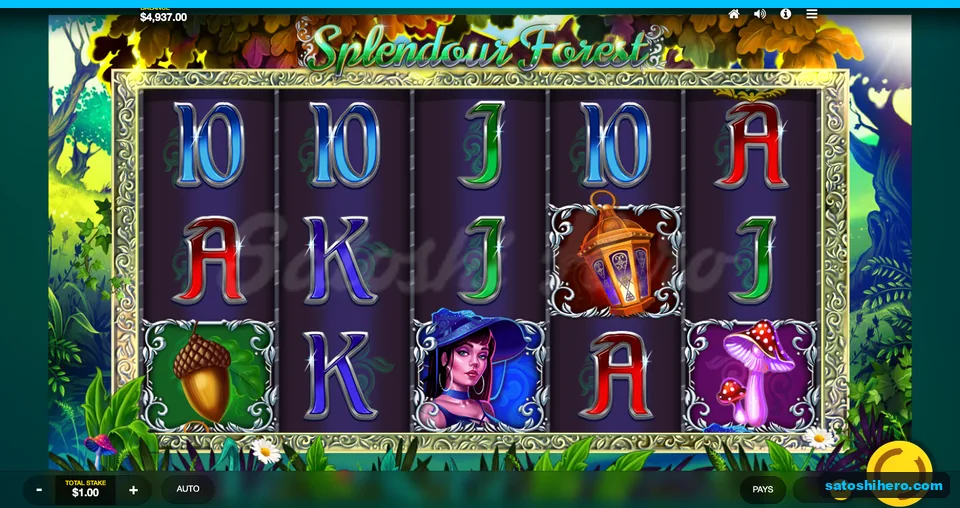
A witch in a blue hat leads the premium symbols. An orange lantern, purple mushroom, and acorn on a green tile complete that group. Silver-edged A, K, Q, J, and 10 symbols look flatter and simpler, so you can separate them from the illustrated premiums at a glance.
The base-game image shows my $1 stake and final $4,937 balance around the complete board. That context connects the polished presentation with my colder test result. The silver frame keeps your eyes on the reels while the background supplies depth.
The golden tree acts as the Wild and Free Spins trigger, though its full rules matter more in the feature sections. Its warm color contrasts sharply with the green setting, making it easy for you to spot on reels 1, 3, and 5.
This enchanted-forest concept won’t win originality awards, but its lighting creates a cohesive storybook look. Forest Dreams offers richer woodland fantasy atmosphere, while Forest Fortune leans toward straightforward line-slot appeal. I prefer this game’s restrained lighting because it supports the mechanics. For another Max Win Gaming title, Wild Donuts offers a different theme.
You’ll recognize premium symbols through detailed character art and bright colored tiles, while the lower ranks use plain silver borders. The visual design feels coherent, even if its core theme remains familiar.
How Splendour Forest Works
Wins form from the leftmost reel across 10 fixed paylines, with your total stake divided evenly between them. At my $1 total stake, each line carried $0.10. The game applies paytable multipliers to that line stake, not directly to the full amount.
That distinction drives every displayed prize. If you read a symbol value as though the whole $1 sits on one line, the paytable looks ten times richer than the real payout. Mechanically speaking, the fixed split makes the result easy to audit once you know where to look.
The full board remained clear in the tested presentation, and the controls left enough room to follow symbols without changing the underlying rules. You should still open the paytable before raising your stake because every line value rises with the total bet.
High-Value Symbol Payouts
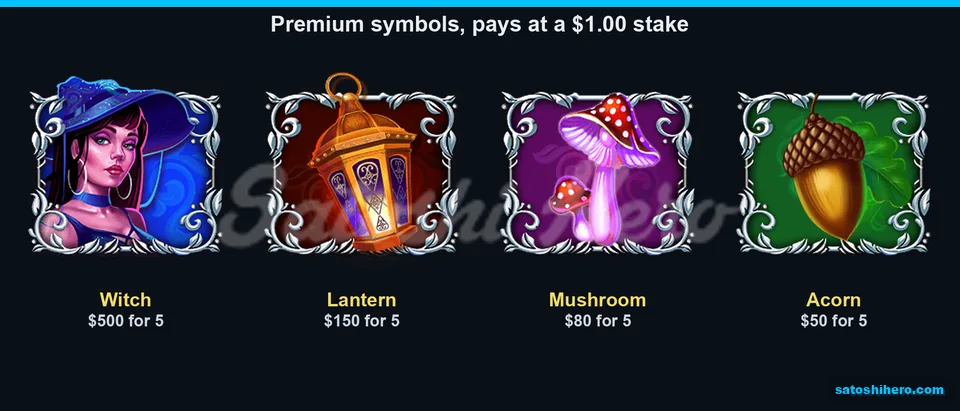
At the tested $1 total stake, the witch paid $1 for two, $10 for three, $80 for four, and $500 for five. The lantern paid $0.50, $5, $30, and $150 for two through five.
The mushroom returned $0.50, $4, $15, and $80 across the same counts. The acorn paid $0.50, $3, $10, and $50. These dollar values make the premium hierarchy much easier to compare than bare multiplier labels.
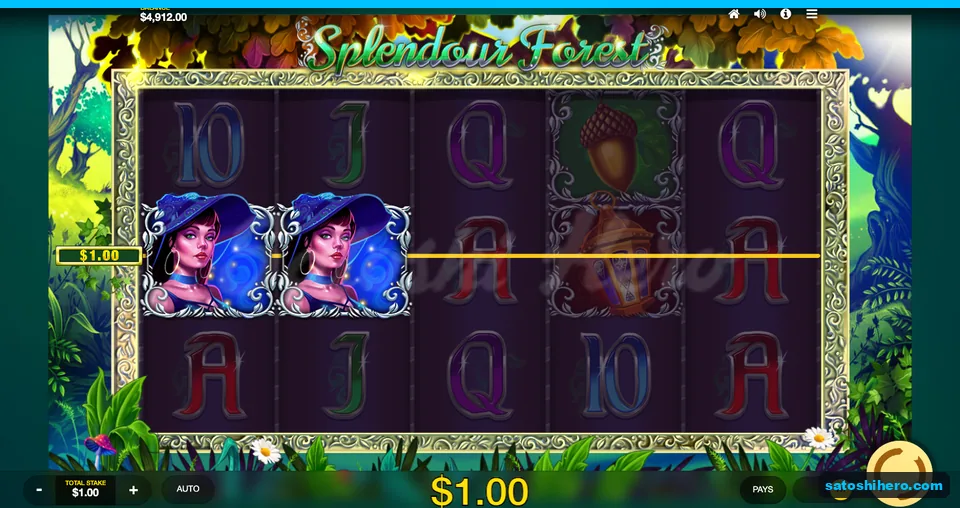
I saw two witches connect on a middle line during my run, producing the expected $1 win. That base-game line result gave me a useful live check against the symbol pay values. It wasn’t exciting, but it confirmed how the line calculation appears during normal play.
Wild Symbol Behavior
The golden tree substitutes for every other symbol. Three trees on reels 1, 3, and 5 also start the Free Spins, even when they don’t follow a payline.
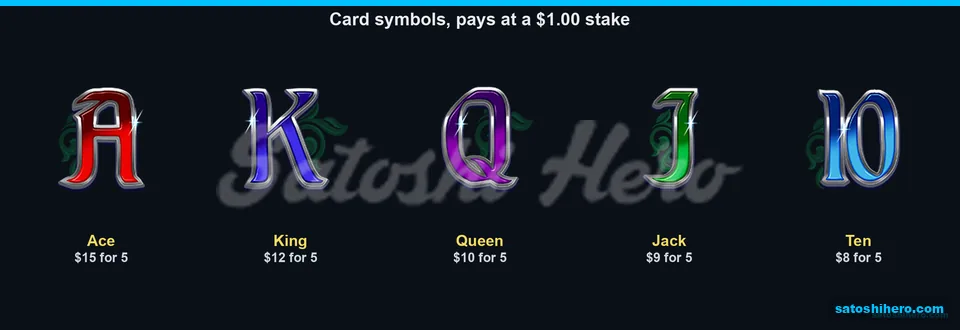
Low symbols begin paying from three matches. Five A symbols pay $15, five K symbols pay $12, five Q symbols pay $10, five J symbols pay $9, and five 10 symbols pay $8. You can use those five-symbol values to judge whether a full low-rank line meaningfully covers your total stake.

Key Number: At a $1 total stake, every payline carries $0.10, so read displayed symbol prizes against the line stake.
Understanding that line stake stops the paytable from looking more generous than it really is.
Understanding the 10 Fixed Paylines
This is a traditional 10-line slot, not a cluster, pay-anywhere, or Megaways game. Every winning combination starts on the leftmost reel and continues along one of the fixed paths.
Reading Line Wins
A valid line may bend between rows, but it can’t skip the required reel sequence. You can follow each highlighted route after a win, which makes the payout easier to verify than a large variable-ways total.
Wins landing on different paylines add together. If several qualifying combinations share one line, only the largest one pays. That rule prevents overlapping symbol groups on a single path from creating separate prizes.
At a $1 total stake, each of the 10 lines carries $0.10. The arrangement stays predictable because your stake always spreads across all fixed routes. I like that transparency, although ten active paths can make very small returns feel more common than meaningful wins.
Calculating Each Payout
The game multiplies the paytable value by the $0.10 line stake in this example. You shouldn’t multiply that same displayed value by the full $1 total stake. Check the highlighted path, identify its symbol count, and then compare the payout amount with one line’s value.

Smart Move: Check both the total stake and line stake before judging a symbol prize, since the multiplier applies to one-tenth of the total bet.
Max Megaways takes the opposite structural route with variable ways to win. This game gives you predictable line paths instead, so you can trace exactly where each result formed. Neither system is inherently better, but I find fixed lines easier when I want to verify a small payout without decoding a changing reel layout.
Once you understand the line split, you can audit each result quickly. The fixed-line format stays easy to follow because its paths and stake division never shift.
Free Spins and Multiple Retriggers
The Splendour Forest slot needs three golden trees on reels 1, 3, and 5 to trigger 10 Free Spins, regardless of paylines. The same tree works as a Wild during normal play, giving one symbol two connected jobs.
Triggering the Feature
The three required trees don’t need to form a standard winning line. Their reel positions alone activate the round, which keeps the trigger rule simple enough for you to check instantly.
Free Spins didn’t trigger during my 100-spin session. I’m reporting the rules shown inside the game rather than claiming a bonus result I never saw. That limit matters because I can explain how entry works, but I can’t attach a live payout or personal hit pattern to it.
No bonus buy appeared in the demo, so I couldn’t purchase direct access. Regular spins remained my only route, and 100 attempts weren’t enough. If you’re budgeting a run, you may need to allow for a dry spell without assuming the feature can rescue the balance.
Retrigger Rules
Extra spins can land while the feature remains active. The introduction screens call this system Multiple Retriggers, but they don’t turn that phrase into a promised count or schedule.
I won’t assign a frequency, average feature value, or expected number of extra spins without witnessing them. That restraint gives you a cleaner line between written rules and my actual session. The feature could extend, yet my test supplied no evidence about how often that happens.
The Wild and Golden symbols image shows the tree as both substitute and three-symbol trigger. You should look for it specifically on reels 1, 3, and 5 rather than waiting for a normal payline. The trigger rule stays simple, but my test showed that reaching it can take patience.

Expanding Golden Symbols
Golden Symbols expand during Free Spins and can connect with other Golden Symbols along a line for additional prizes. Up to five Expanding Symbols can appear on the board during this feature.
Golden Tile Expansion
The game’s Expanding Tiles information pages display golden versions of the witch, lantern, mushroom, acorn, and card ranks. Covered positions change into these Golden Symbols as part of the bonus sequence. Their shared gold treatment links the transformed tiles visually, helping you track potential connections across a line.
My live test never reached Free Spins, so I learned these rules from those in-game information pages. I didn’t witness an expansion, receive an expanding payout, or measure how often the mechanic activates. You should treat the five-symbol limit as a documented capacity, not a normal outcome for every round.
The engineering here ties visual state to payout logic in a clear way. A covered tile becomes readable as a Golden Symbol, then its line connection can create an extra prize. I like that sequence because each stage has a visible purpose rather than adding unexplained animation.
Extra Pick Markers
Some covered tiles may show “+1 Pick” before changing into Golden Symbols. That marker belongs to the documented feature sequence, not to an event from my 100 spins.

Lore: The golden tree and Golden Symbols perform different jobs. The tree acts as the Wild and trigger, while transformed Golden Symbols drive expansion during Free Spins.
Refer back to the shared Wild and Golden symbols image when comparing their designs. You should watch the covered positions once the feature begins, and you shouldn’t confuse them with the tree trigger. Their similar color links the bonus theme, but their mechanical roles remain separate.
This expanding system supplies the game’s main bonus potential. Still, my session provided no live example, so any exact payout claim would go beyond the evidence.
What Happened Over 100 Spins
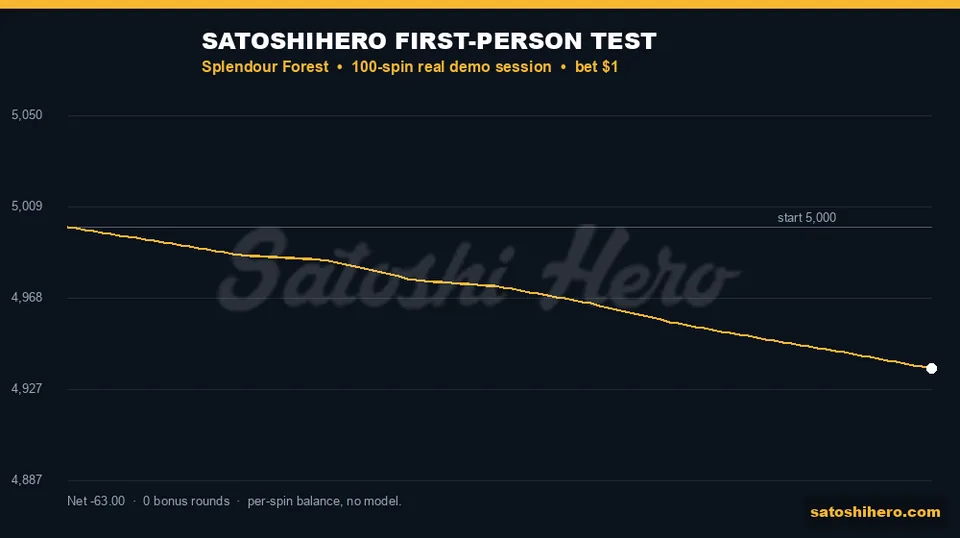
My 100-spin test finished $63 down, with no Free Spins and a $5 best win. I ran autoplay in turbo mode at $1 per spin, starting with $5,000 and finishing at $4,937.
Balance and Best Win
The balance never moved above its starting point after the first spin. Its lowest reading arrived at the end, so the run closed without a late recovery. That downward shape felt steady rather than dramatic because no single loss created most of the damage.
A $5 top result returned five times my stake, but it couldn’t alter the broader direction. I saw the two-witch line pay $1, and many other hits landed near that size. You should read the $63 loss as one short session, not as a promised cost for every 100 spins.
The polished presentation made the run easy to follow, yet the outcome stayed cold. I don’t mind a quiet spell in a high-risk slot, but a best hit of $5 left little tension across the full test.
Hit Pattern Observed
Around 31 of my 100 spins returned something. Most paying results gave back only $0.50 or $1, meaning they still lost money against the $1 stake or merely returned it.
That distinction matters whenever you assess activity. A paying spin can flash and show a prize while leaving your balance lower overall. You should separate hit count from profitable results because the first number can make a session sound healthier than it felt.
Free Spins never triggered, and I didn’t purchase a feature. The 31% observed hit count sounds active, but repeated sub-stake returns made the run feel much colder. From a design perspective, those small hits soften individual spins without stopping cumulative losses.
My experience had plenty of visible payouts but almost no upward momentum. Frequent small returns did little to prevent the balance from drifting downward.
RTP, Volatility and Our Test
Splendour Forest combines 95.09% RTP, high volatility, and a 6,426x maximum win. That uneven profile can produce extended runs of small or losing spins, while the top prize remains a rare ceiling rather than a likely session result.
The 6,426x cap feels respectable, but relatively modest beside the high volatility and lean return. You’re accepting meaningful short-run swings without an unusually vast top-end target. I’d approach that trade-off with smaller stakes rather than chasing recovery after a weak opening.
Simulator Projection Results
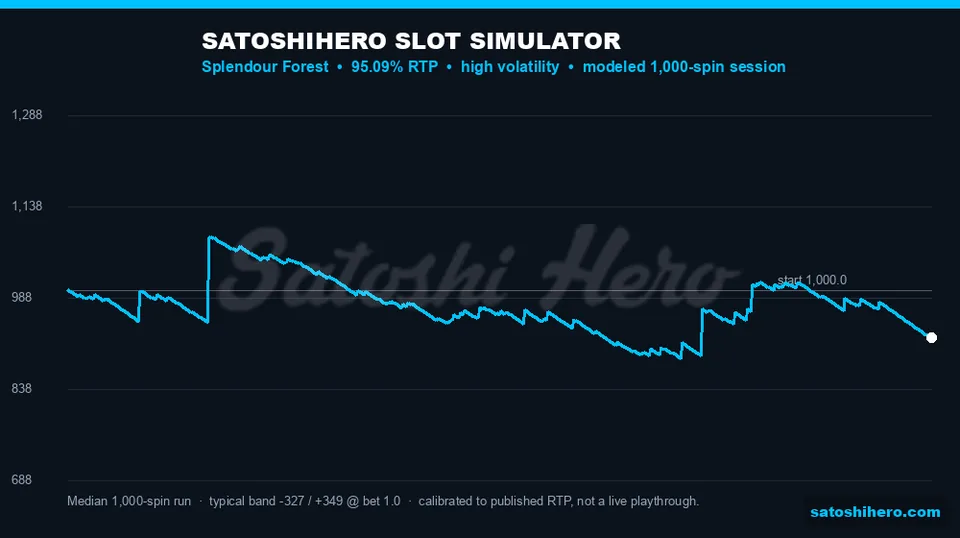
The SatoshiHero Slot Simulator modelled 1,000 spins at a $1 stake. Its median result ended $77.60 down, while the 5th percentile finished $327.30 down and the 95th percentile ended $348.90 up.
About 18% of simulated spins paid. The model placed a feature round at roughly once per 46 spins and a big win near once per 1,783 spins. These figures describe assumptions and outcome distributions, not countdowns for your next feature or large prize.
The projection image makes that spread easier to read because the median sits between two sharply different edges. You can use the range to understand uncertainty, but you can’t turn either endpoint into a session forecast. Mechanically speaking, the broad band fits a game where infrequent stronger events drive much of the upside.
Our 100-Spin Session
My live run lost $63 after only 100 spins, compared with the model’s $77.60 median loss over 1,000. That doesn’t make the short session unusually good or bad because the spin counts differ greatly. My $5 top win and absent feature simply show one plausible dry outcome.
The real-session balance image tracks the slide from $5,000 to $4,937 without a major recovery. One hundred spins can’t validate theoretical RTP or establish the true feature frequency. You should use my result as first-hand context, not as a prediction for your own play.

Red Flag: High volatility can create long runs of small or losing spins. Set a loss limit first and choose a stake that can last beyond 100 spins.
The 95.09% theoretical RTP is the operator-published return, and one live session doesn’t alter it. Simulator ranges model possible outcomes rather than predict the next run. Feature configurations can differ slightly by design if separate bonus-mode returns appear.
Both the model and my live session support cautious stake sizing. Neither can tell you what your next result will be.
Frequently Asked Questions About the Splendour Forest slot
What grid and paylines does the Splendour Forest slot use?
The Splendour Forest slot uses a 5×3 grid with 10 fixed paylines. Wins start on the leftmost reel, and only the largest qualifying combination pays on any single line.
How do Free Spins start in the Splendour Forest slot?
Three golden tree symbols on reels 1, 3, and 5 trigger 10 Free Spins regardless of paylines. The tree also acts as a Wild, and extra spins can land during the feature.
What are the Expanding Symbols in the Splendour Forest slot?
Golden Symbols expand during Free Spins and connect with other Golden Symbols along a line for extra prizes. Up to five Expanding Symbols can appear on the board.
What does the top symbol pay?
At the tested $1 total stake, the witch pays $1 for two, $10 for three, $80 for four, and $500 for five. The lantern ranks next and pays $150 for five.
What did the Splendour Forest slot simulator show?
The modelled 1,000-spin session at a $1 stake had a median result of $77.60 down. Its range ran from $327.30 down at the 5th percentile to $348.90 up at the 95th percentile, modelling possibilities rather than predicting one session.
How did the 100-spin test go?
My balance fell from $5,000 to $4,937, creating a $63 loss. My best spin paid $5, and Free Spins didn’t trigger.
What are the Splendour Forest slot RTP and maximum win?
The Splendour Forest slot has 95.09% RTP, high volatility, and a maximum win of 6,426x the bet.
The Takeaway
Splendour Forest connects a readable fixed-line base game with a promising Golden Symbol feature. Its biggest drawback is the demanding combination of lean return, high variance, and no bonus buy in my test.

My Call
Choose this game when you value traceable paylines and can tolerate long quiet stretches. Expect small returns to appear more often than truly profitable hits, with Free Spins carrying much of the mechanical interest.
I like the clear line logic and the way the tree connects base play with the bonus. I don’t like that my 100 spins lost $63 without showing the main feature, while my best result reached only $5.
The Splendour Forest slot keeps its rules easy to audit, and this guide is updated periodically as test details change.

Pros:
 Clear paylines: Fixed paths let you verify wins without decoding variable ways.
- Connected design: The golden tree links Wild substitutions directly with bonus entry.
- Readable symbols: Premium artwork separates cleanly from lower card ranks.
- Bonus depth: Expanding Golden Symbols add a second layer to Free Spins.

Cons:
 Lean return: The math leaves little margin beside a volatile session profile.
- Cold test: My run lost $63 without reaching Free Spins.
- No direct entry: The tested demo offered no bonus buy for immediate access.

Best For: Patient fixed-line fans who track line stakes and accept uneven outcomes. The woodland setting rewards visual-theme interest, while cautious bankroll managers can better absorb its dry spells.



























































Bets
All Bets
Game
Player
Date
Wager
Mult.Multiplier
Prize
 Rich Piggies: Bonus Combo
 Hidden
- 22:22:48
- 0×
- Galaxy Glitter
- nina87
- 22:22:47
- 0×
- Luck of Panda: Bonus Combo
- mike_721
- 22:22:45
- 0×
- Rich Piggies: Bonus Combo
- Hidden
- 22:22:45
- 0×
- Royal Fruits 9: Hold 'n' Link
- josh1998
- 22:22:44
- 0×
- Rich Piggies: Bonus Combo
- Hidden
- 22:22:42
- 5.5×
- Rich Piggies: Bonus Combo
- Hidden
- 22:22:39
- 0×
- Galaxy Glitter
- nina87
- 22:22:37
- 0×
- Rich Piggies: Bonus Combo
- Hidden
- 22:22:36
- 0×
- Halloween Harvest: Rapid Link
 mdp0fxo
- 22:22:36
- 0×