

Wild Wild Bet
By pressing play, you agree that you are above legal age in your jurisdiction and that your jurisdiction allows online gambling.

Wild Wild Bet
RTP95.16%
VolatilityHigh
Max winx3,500
Lines5
Hit rate35.8%
ThemeWild West
ReleasedDec 2023

Poker Hands and Powder Smoke at the Saloon Table
Wild Wild Bet deals poker hands across a Wild West card table instead of matching ordinary slot symbols. This high volatility card game from Mascot Gaming uses a 5×3 grid and 5 fixed paylines, with 95.16% RTP and 3,500x maximum win potential. Poker-hand fans who accept sharp swings, small returns, and uncertain bonus access will understand its appeal.
My 100-spin test produced frequent but mainly small payouts, while Free Deals never triggered. You can play the Wild Wild Bet casino game in demo or real mode on SatoshiHero.
Key takeaways
- Best bonus: Free Deals apply a x3 multiplier, but you need at least three Jokers and can’t buy entry.
- RTP / volatility: The math combines 95.16% RTP with high volatility, creating a demanding short-session profile.
- Max win: The top prize reaches exactly 3,500x the bet, which feels restrained for this risk level.
- Risk note: Many recorded wins returned less than the stake, so a paying deal still created a net loss.
- Bankroll note: A conservative stake makes sense because my balance never climbed above its starting point.
No Wild Wild Bet strategy changes the random card outcomes. Your meaningful choices involve stake size, session limits, and whether you expose an earned win to Gamble.

Table of Contents
- How Wild Wild Bet Works
- Five winning lines
- Joker wild card
- Theme and First Impressions
- Free Deals
- My test boundary
- Practical Poker-Slot Strategy
- Gamble Feature
- How the 100 Spins Played
- Observed hand mix
- RTP, Volatility and Test Results
- Simulator projection
- Our 100-spin session
- Bankroll and Bet Sizing
- Frequently Asked Questions About Wild Wild Bet
- Wrap-Up
How Wild Wild Bet Works
Wild Wild Bet pays for poker hands formed across five fixed lines on a 5×3 card grid. You get the top, middle, and bottom rows, plus two diagonals running between opposite corners. Every position contains a playing card, but three of a kind is the lowest qualifying hand.
Only the strongest completed hand on each line pays. Aces, kings, queens, jacks, and numbered cards have no standalone values, which makes this setup quite different from a normal symbol matcher. You need to read the whole line as a poker hand, not celebrate one attractive card.
The complete paytable uses total-bet multiples:
- Three of a kind: 0.4x.
- Straight: 1x.
- Flush: 3x.
- Full house: 7x.
- Four of a kind: 10x.
- Straight flush: 30x.
- Royal flush: 150x.
- Five of a kind: 300x.
- Natural royal flush: 1,000x.
- Five Jokers: 2,000x.
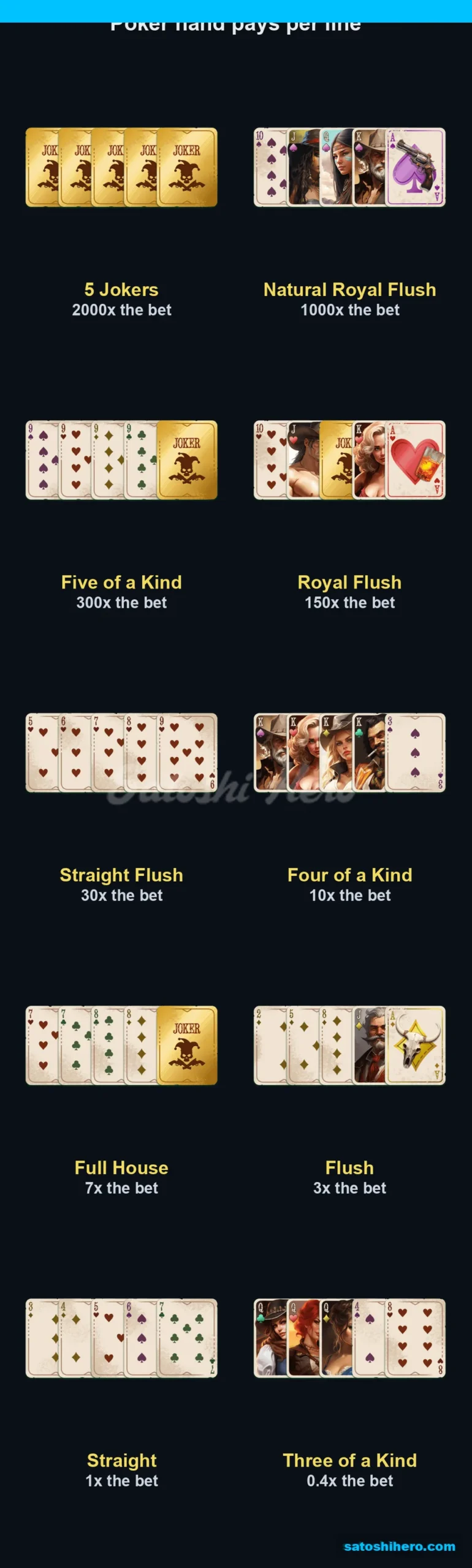
I checked the smaller values against my own deals. At a $0.40 stake, one straight returned $0.40 and one full house returned $2.80. Those exact payouts matched 1x and 7x the total bet, so the table was easy to verify during play.
Multiple lines can qualify in one deal, though each line awards only its highest hand. Honestly, that rule keeps busy screens readable.
Five winning lines
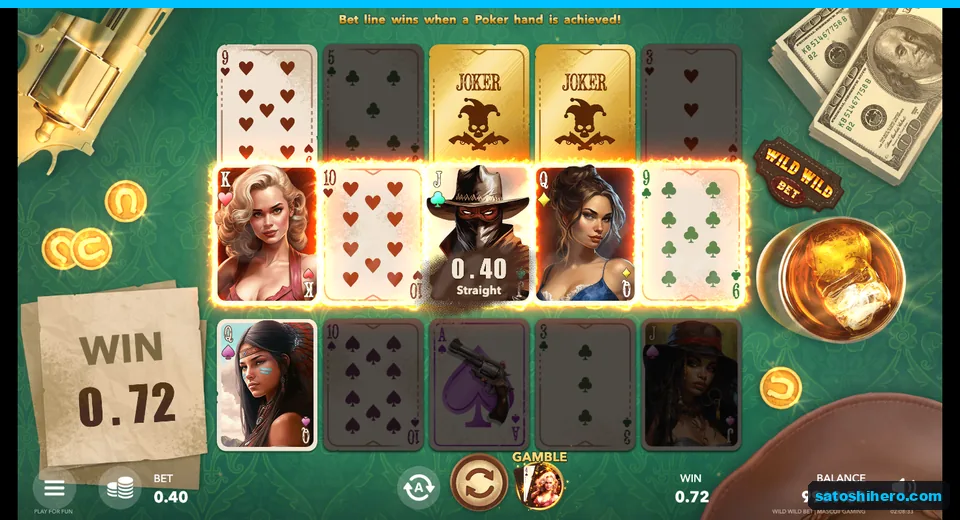
Three horizontal paths and two diagonals decide whether each hand qualifies. Cards don’t need to show five matching faces because poker rankings control the return. A nine-through-king sequence can pay as a straight even though every card looks different.
The glowing nine-to-king straight came from later image-capture deals. It isn’t part of my counted 100 paid spins, but it clearly shows how the middle line gets evaluated. You can follow the highlighted path and see why sequence matters more than matching artwork.
Place this image beside the list so you can compare all ten qualifying hands. I like how the paytable removes guesswork, though the 0.4x minimum return can make a visible win feel hollow.
Joker wild card
The gold Joker substitutes for another card when completing a hand, including five of a kind or a royal flush. It also serves as the Free Deals trigger when at least three appear anywhere. Those jobs overlap visually, yet they produce different outcomes.
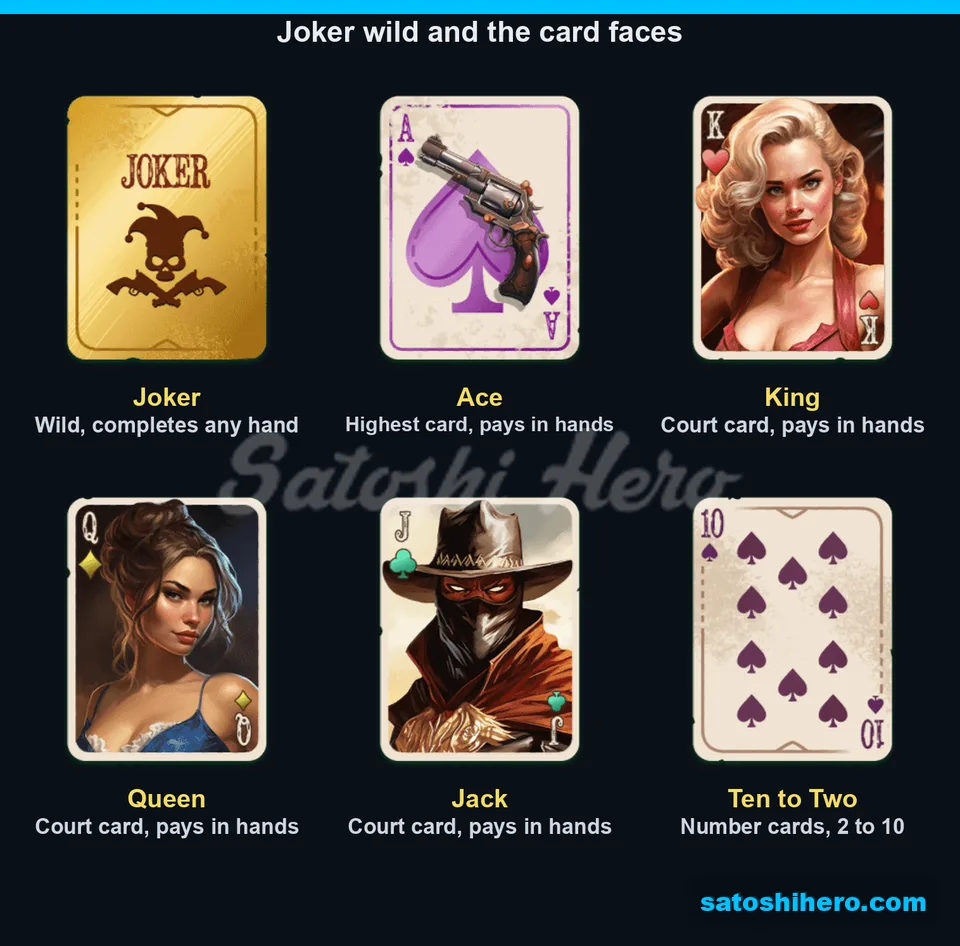
Ordinary cards matter only inside complete hands, while the Joker can repair a missing rank or suit. You should watch all five paths before judging the deal.

Stat Check: Five fixed lines determine wins, but each line gets evaluated as a poker hand rather than identical symbols.
The practical takeaway is simple: track each line path and completed rank, not individual card values.
Theme and First Impressions
The game uses a clear Wild West poker-table design that explains its card mechanic immediately. Green felt frames the grid, while a gold revolver, stacks of dollar bills, and a whiskey glass fill the table edges. You can grasp the saloon setting before the first deal finishes.
Court cards become a compact Western cast. The jack appears as a masked rider, while illustrated women represent the queen and king ranks. That unusual choice gives the deck personality, even if the theme won’t win originality awards.
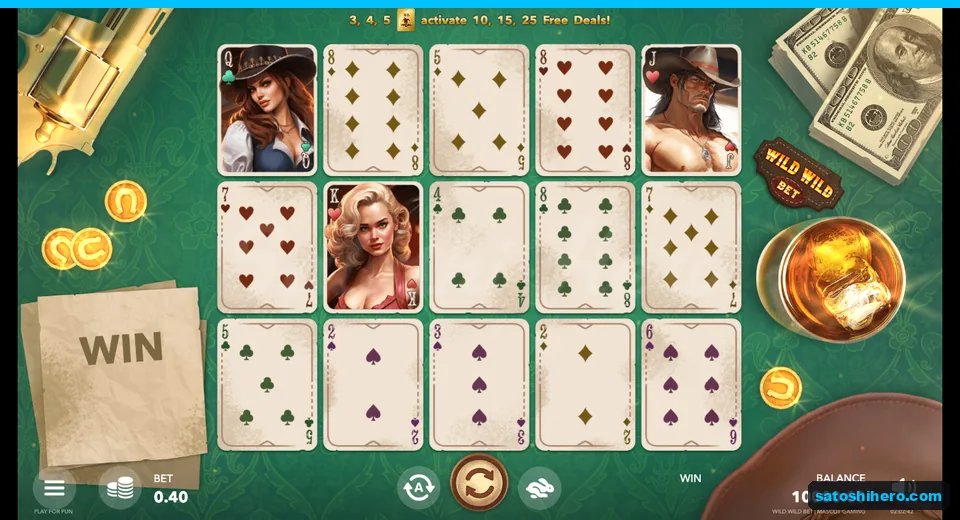
The untouched screen shows the 5×3 layout, $0.40 bet, $10,000.00 play-money balance, and the banner for three to five Joker triggers. I found the table props more useful than decorative because they make the screen feel like a card game. You won’t mistake it for a standard fruit machine.

Fun Detail: Western saloons often used poker imagery as shorthand for risk and rivalry, making this card-table setting a natural thematic match.
Mascot keeps the presentation familiar but coherent. You can understand what each deal represents without studying a long rules screen, and that clarity is the design’s strongest quality.
Free Deals
According to Mascot Gaming’s game rules, three, four, or five Jokers anywhere award 10, 15, or 25 Free Deals. The round runs automatically at the triggering stake, and every winning hand receives a x3 multiplier. Extra Jokers during the feature can add more deals.
The trigger levels are straightforward:
- Three Jokers: 10 Free Deals.
- Four Jokers: 15 Free Deals.
- Five Jokers: 25 Free Deals.
My test boundary
I didn’t trigger the round during my 100 paid spins, despite seeing Jokers in many hands. That evidence boundary matters: I can explain the documented rules, but I can’t claim a firsthand bonus return. Let me be real, the missing feature left the session feeling thin.
There is no bonus buy, so you can’t skip directly into the round. Every Free Deals entry depends on at least three Jokers appearing naturally. You also can’t treat a long dry spell as progress toward a trigger because each deal remains random.
The x3 multiplier applies to every win during the round, not only the strongest hand shown across the grid. Still, I had no chance to test that uplift.
Jokers perform two jobs here. One can complete a base-game poker hand, while three or more anywhere can open the feature. You should separate those roles when reading a deal because a helpful wild doesn’t mean bonus access.
No session length guarantees Free Deals. You must trigger them organically, and my full test showed how easily that headline feature can remain out of reach.
Practical Poker-Slot Strategy
No Wild Wild Bet strategy can alter the dealt cards, fixed lines, or random outcomes. The poker theme offers no hold, discard, draw, or hand-selection decisions. You control exposure, not the result placed on the grid.
Read every return as a multiple of your total stake. A common three-of-a-kind hand pays 0.4x, which means you lose 0.6x after counting the original bet. In my test, that gap made the payout count look much kinder than the balance graph.
Choose your stake and stopping point before starting. You shouldn’t increase the bet to recover losses or chase Free Deals after a long non-triggering run. Honestly, those reactions only enlarge your risk while leaving the card probabilities unchanged.

Player Hint: Track net returns rather than paying spins, because a sub-1x hand still leaves you down on that deal.
The optional Gamble decision creates the only post-win choice. Collecting preserves your return, while risking it can double or erase the amount. If you plan to use Gamble, decide your limit before emotion takes over after a frustrating stretch.
A simple session record also helps. Note your starting balance, stake, and net result rather than counting flashing win messages. You can then see whether small hands actually cover their cost.
Disciplined staking provides the only practical edge available here. It won’t improve the dealt hands, but it can stop one rough run from consuming more of your bankroll than intended.
Gamble Feature
Gamble lets you risk an earned win by predicting the highest card. A correct guess doubles the amount, a wrong guess loses everything, and a tied card leaves the win unchanged. You choose whether extra variance belongs in your session.
The three outcomes are clear:
- A correct guess doubles the win.
- A wrong guess loses the whole win.
- A tied card leaves the amount unchanged.
I deliberately skipped Gamble throughout my test. No result from that feature enters the session totals, and I won’t suggest an observed success rate without evidence. Frankly, the base game’s swings already gave me enough variance.
Gamble isn’t a dependable way to improve theoretical return. Collecting protects the payout already earned, while opening the feature puts that entire amount at risk. You should weigh that trade before clicking, not after seeing a tempting card screen.
Small 0.4x hands create a psychological trap because doubling them can look harmless. Yet losing one removes even the partial return that softened the original stake. The same decision becomes much heavier after a full house or larger combination.
Set your risk tolerance before play and stay consistent. Collecting remains the lower-risk option after every win, which makes it the sensible default when bankroll control matters.
How the 100 Spins Played
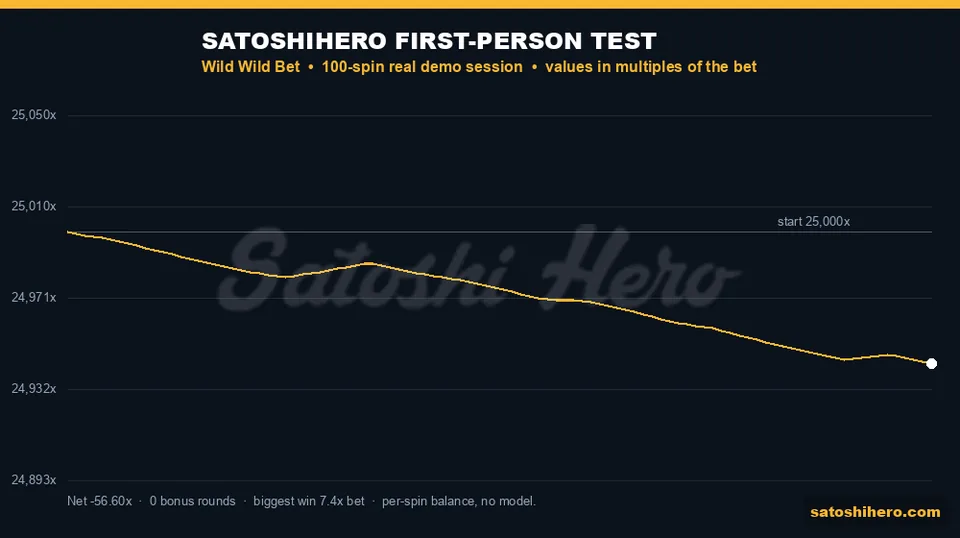
My 100-spin session lost 56.6x the bet despite producing payouts on 33 deals. I used quick-spin mode at the default $0.40 stake, starting with $10,000.00 and finishing at $9,977.36. You shouldn’t confuse frequent payout messages with profitable play.
Most paying deals produced low-value three-of-a-kind hands. Those returned $0.16, or 0.4x the bet, so each still left a net loss of $0.24. This one surprised me because the screen often celebrated while the balance kept sliding.
Observed hand mix
I logged these qualifying hands:
- 26 three-of-a-kind lines.
- 9 straights.
- 3 full houses.
- 1 flush.
Those counts exceed the 33 paying spins because one deal can produce several winning lines. You can see a full house on one path and three of a kind on another, with both contributing to the same spin return.
My largest result arrived on spin 94. A full house plus three of a kind returned $2.96, equal to 7.4x the bet. It followed the lowest balance point of $9,976.80 on spin 93, but that rebound still didn’t restore the starting position.
Jokers appeared regularly without reaching the three-card feature threshold. I never entered Free Deals, and the balance never rose above $10,000.00. The run felt harsher than 33 paying spins suggest because most successful hands returned less than their cost.
Exactly 100 paid spins form the counted session. I played a few extra deals afterward to capture a clean straight image, but none enters these statistics. You should judge the result from the fixed test window, not the later screenshot work.
Small poker hands softened parts of the decline, yet they never reversed its direction. The useful lesson is to follow net movement rather than the number of wins displayed.
RTP, Volatility and Test Results
Wild Wild Bet has 95.16% RTP, high volatility, and a 3,500x maximum win. The return is theoretical, while the volatility signals broad short-session swings. You can play many deals without seeing a feature or large payout.
The 3,500x cap feels modest beside that risk rating. You can still face sharp losses while waiting for results far below the ceiling, which weakens the reward side of the trade. I prefer high-variance games to offer a more ambitious top target.
Simulator projection
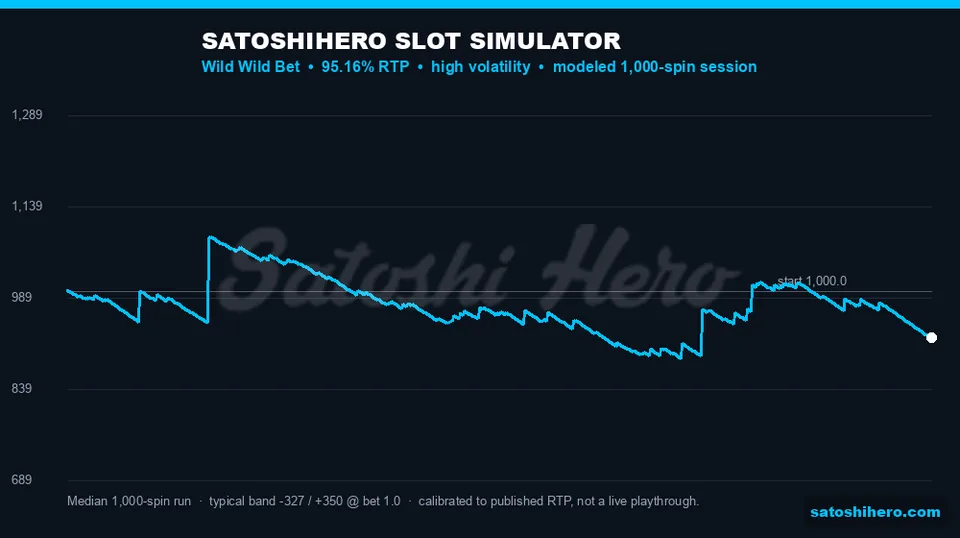
The SatoshiHero Slot Simulator modeled 1,000 spins at one bet unit using the game math. This projection stays separate from my live play because modeled ranges describe repeated runs, not one actual balance path. You should read the figures as distribution markers.
The projection returned these results:
- Median outcome: 76.9x the bet down.
- Central 90% range: 326.8x down to 349.9x up.
- Feature-sized win frequency: approximately once per 46 simulated spins.
- Very large win frequency: approximately once per 1,779 simulated spins.
That central range stretches from a heavy loss to a substantial gain. Honestly, the spread tells you more about risk than the median alone. A single neat average can’t capture how differently two sessions can finish.
The modeled frequencies aren’t countdowns, promises, or predictions. A feature-sized result can appear early, late, or not at all inside your chosen window. Likewise, a prior dry run doesn’t move the next spin closer to a large win.
Use the chart to see the possible spread rather than expecting a smooth return path. The wide band reinforces why you need a stake that survives poor sequences without forcing larger bets.
Our 100-spin session
My live test produced a mostly downward path interrupted by small poker-hand wins. These figures cover the counted quick-spin session only:
- Starting balance: $10,000.00.
- Ending balance: $9,977.36.
- Net result: $22.64 lost.
- Bet-unit result: 56.6x the $0.40 bet down.
- Paying spins: 33 out of 100.
- Highest balance: never above $10,000.00.
- Lowest balance: $9,976.80 on spin 93.
- Largest spin: 7.4x the bet on spin 94.
- Free Deals triggered: zero.
The graph shows a steady decline with brief upward steps. Later screenshot-capture deals don’t belong to these figures, and I kept Gamble out. You can read the net loss as plain base-game play.

Beware: High volatility can create sharp swings, and neither modeled frequency nor a previous dry run makes a bonus or large win due.
According to Mascot Gaming, the published theoretical RTP represents the game’s theoretical return, while one live session can’t confirm or disprove it. A feature can use slightly different return behavior by design, but that doesn’t establish a separate Free Deals figure here.
Keep theoretical math, simulator projections, and observed results separate. That distinction gives you a cleaner picture of risk than blending all three into one promise.
Bankroll and Bet Sizing
Choose a small stake that can withstand a high-variance session without pushing you to chase losses. The betting range runs from $0.10 to $25.00, so you can scale exposure widely. Your chosen amount changes bankroll duration, not the cards dealt.
My default $0.40 stake still produced a 56.6-unit loss across only 100 paid spins. The $10,000.00 demo balance represented 25,000 default stakes, which is far deeper than most real-play budgets. You shouldn’t let that oversized play-money cushion encourage an unrealistic real stake.
Plan in bet units rather than focusing only on dollar totals. A bankroll covering more spins gives you room for empty deals and sub-1x wins, though it can’t guarantee Free Deals. I think this approach makes the risk easier to compare across stake sizes.
Set a firm session limit before starting. Don’t wait indefinitely for three Jokers, and don’t raise the stake because a trigger feels overdue. You control how much money and time enters the session.
A low stake can stretch the same bankroll across more deals, but it doesn’t improve the expected return. At the top of the range, identical card sequences create much larger dollar swings. That simple relationship matters more than any betting pattern.
Practical sizing should match the loss you can accept within your preset session. Stake size controls how long your bankroll can absorb swings, but it never changes the hand you receive.
Frequently Asked Questions About Wild Wild Bet
What is Wild Wild Bet?
Wild Wild Bet is a Wild West poker game from Mascot Gaming with a 5×3 grid and 5 fixed paylines. A line pays when it forms three of a kind or a stronger poker hand.
How do wins work in Wild Wild Bet?
Only the highest qualifying poker hand on each line pays. Returns range from 0.4x for three of a kind to 2,000x for five Jokers.
What does the Joker do in Wild Wild Bet?
The gold Joker substitutes for another card to complete a poker hand. Three, four, or five Jokers anywhere also trigger 10, 15, or 25 Free Deals.
How do Free Deals work in Wild Wild Bet?
Free Deals run automatically at the triggering stake and apply a x3 multiplier to every win. Extra Jokers can extend the round, but I didn’t trigger the feature during my counted test.
What did the Wild Wild Bet 100-spin test show?
My balance fell from $10,000.00 to $9,977.36 at a $0.40 stake, producing a 56.6x loss. I recorded 33 paying spins, while the largest deal returned 7.4x.
Which outcomes appeared in the simulator?
The median modeled 1,000-spin session lost 76.9x the bet. The central 90% ranged from 326.8x down to 349.9x up, but those figures don’t predict your session.
What are the Wild Wild Bet RTP, volatility, and maximum win?
The game has 95.16% RTP, high volatility, and a 3,500x maximum win. These figures describe the published math rather than a guaranteed short-session result.
Does Wild Wild Bet have a bonus buy?
No, you can reach Free Deals only by landing at least three Jokers. That restriction means you can’t purchase direct feature access.
What is a wild in slot machines?
A wild substitutes for other symbols when completing qualifying combinations. Here, the Joker wild completes poker hands and also contributes toward the Free Deals trigger.
Wrap-Up
Wild Wild Bet stands out by replacing routine symbol matches with readable poker-hand lines. Its clear saloon presentation works well, but uncertain feature access and many sub-stake payouts can make sessions feel punishing. SatoshiHero’s guides to Wild Spirit, Wild Yield, Wild Woof, Wild Wild Riches, and Wild Wild Pearls provide related comparisons of wild-symbol themes and feature structures.

My Verdict
Poker fans who enjoy line reading and can tolerate sharp swings should try the demo first. Expect frequent small hand payouts, with no promise that Free Deals will appear inside a short session.
I like how every card and table prop supports the core poker idea. I don’t like that my 33 paying spins still ended $22.64 down, while the main feature stayed completely absent.
This Wild Wild Bet guide keeps official rules, modeled projections, and my paid-spin results distinct. Its testing notes are checked regularly, giving you a realistic basis for judging the format.

Pros:
 Distinct poker payouts: Hand rankings create more thought than ordinary matching symbols.
- Clear line paths: Five simple routes make every completed hand easy to check.
- Useful wild: Jokers complete hands while also building toward Free Deals.
- Triple feature wins: Every Free Deals payout receives the x3 multiplier.

Cons:
 Sub-stake hits: Three of a kind pays only 0.4x, despite showing a win.
- Uncertain bonus access: No bonus buy means Jokers control every feature entry.
- Restrained ceiling: The top prize feels modest beside the demanding risk profile.

Best For: Poker-slot fans who value clear hand rankings, simple lines, and an old-saloon setting get the strongest match. Careful bankroll managers can handle the variance better than anyone chasing quick feature access.

























































Bets
All Bets
Game
Player
Date
Wager
Mult.Multiplier
Prize
 Mayan Fortunes
 Hidden
- 16:19:13
- 0.19×
- Royal Fruits 9: Hold 'n' Link
- josh1998
- 16:19:12
- 0×
- Galaxy Glitter
- nina87
- 16:19:11
- 0×
- Mighty Stars
 Hidden
- 16:19:10
- 0×
- Money Hive: Hold'n'Link
 Hidden
- 16:19:10
- 0×
- Mayan Fortunes
- Hidden
- 16:19:08
- 0×
- Money Hive: Hold'n'Link
- Hidden
- 16:19:07
- 0×
- Royal Fruits 9: Hold 'n' Link
- josh1998
- 16:19:05
- 0×
- Galaxy Glitter
- mdp0fxo
- 16:19:04
- 2.8×
- Red Hot 100
 mbongigycolombe
- 16:19:04
- 2.2×