

Wizards Want War
By pressing play, you agree that you are above legal age in your jurisdiction and that your jurisdiction allows online gambling.


Fire and Ice on the Wizard Battlefield
Wizards Want War is a high-volatility Habanero Systems slot where the duel feature does most of the heavy lifting.
Wizards Want War is a Habanero Systems slot with a duelling-wizards theme, high volatility, 98.11% RTP and 400x max win potential. The game uses 5 reels, 3 rows and 25 fixed paylines, with a real 100-spin demo test and a 1,000-spin simulator model behind this guide. Duels created most meaningful wins in my test, and the 400x cap feels modest for the risk, though the RTP looks unusually strong.
Key takeaways
- Best bonus: There’s no bonus buy, so you chase base-game duels and naturally triggered free games.
- RTP / volatility: Wizards Want War has 98.11% RTP with high volatility.
- Max win: The maximum win is 400x the bet.
- Risk note: My 100-spin run had long flat stretches and relied on duel spikes.
- Bankroll note: Use a smaller stake than on calmer slots because meaningful returns clustered.

Table of Contents
- Theme & First Impressions
- How Wizards Want War Works
- Reels and lines
- Bet setup
- Symbols, Wilds & Payouts
- High symbols
- Wild and triggers
- Duels and Crystal Counters
- Duel trigger
- Counter progress
- Free Games Feature
- Trigger symbols
- Wizard choice
- Progressive Jackpot
- Random trigger
- Test result
- RTP, Volatility & Our Test
- Simulator projection
- Our 100-spin session
- How It Played in Practice
- Session rhythm
- Bankroll feel
- Who This Slot Suits
- Best fit
- Skip if
- Frequently Asked Questions About Wizards Want War
- Final Take
Theme & First Impressions
The theme lands quickly because the two wizards and their red-blue sides make every duel easy to read. You don’t need to hunt for the story, since the screen splits into fire on the left and cold magic on the right.
The reels sit inside a dark gothic frame, with a white-bearded wizard facing a dark-haired rival when a duel starts. An orange crystal tracks the White Wizard, while a blue crystal tracks the Dark Wizard. You can follow that state fast, which matters when spins move quickly.
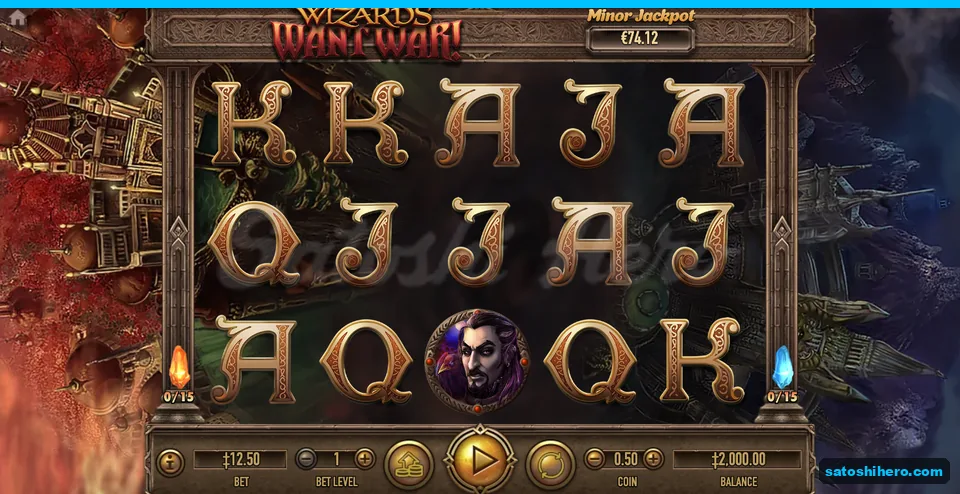

Discovery: The split red-and-blue screen mirrors the fire-versus-ice duel setup, so the battle stays readable even during quick spins.
Minor and Grand jackpot meters rotate above the reels, adding motion without crowding the 5-reel, 3-row board. Wicked Witch has a darker witchcraft pull, but this game leans harder into direct magical conflict. I like that choice, even if the theme won’t win originality awards.
If you enjoy clear visual signals, the counters help you stay oriented. The guide is checked regularly so the mechanics and test notes stay useful. Next, the fixed-line setup explains why those visual cues matter.
How Wizards Want War Works
Wizards Want War uses a classic fixed-line setup with 5 reels, 3 rows and 25 fixed paylines. It isn’t a cluster slot, a Megaways game or a pay-anywhere setup, so you should read wins from the paytable rather than guessing from symbol groups.
Reels and lines
Wins pay from the leftmost reel to the right. Only the longest win on each line counts, while wins on separate lines add together. That makes the game easy to understand, though it also means scattered screen patterns can mislead you.
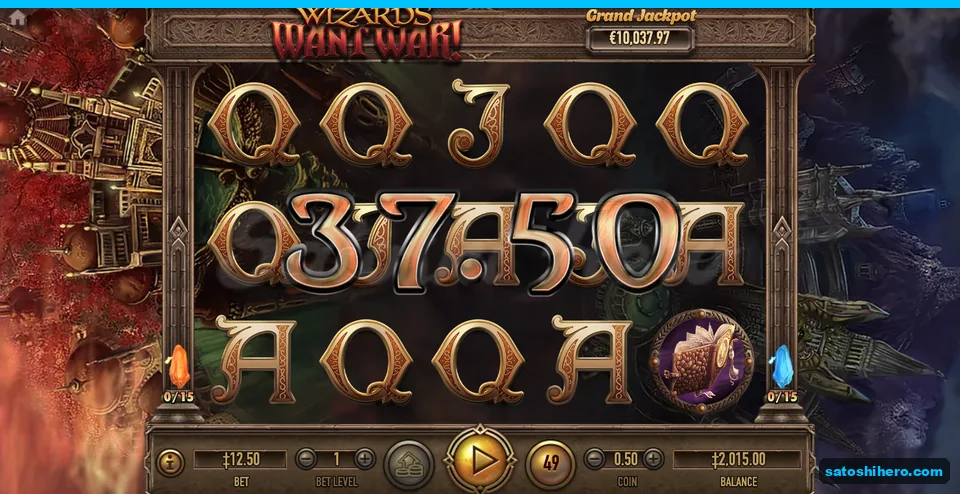
The same fixed-line controls and paytable logic apply on mobile and desktop at SatoshiHero, where demo and real play are available. You still need to check the line logic because the board can look busier than it is. I’d rather have this clarity than a vague “ways” format.
Bet setup
Bets come from 25 lines, a coin value and a bet level. My default test stake was $12.50, built from 25 lines, a $0.50 value setting and bet level 1. Check your coin value before spinning, because the total stake changes fast.
Crystal-counter progress saves by bet configuration, which means your coin and bet level matter. If you keep changing that setup, you may split the progress you wanted to track. The structure rewards steady testing more than casual button tapping.

Tactic: Because counters save by coin and bet level, don’t keep changing stake configuration if you’re specifically tracking crystal progress.
Symbols, Wilds & Payouts
The Wild is the highest-paying symbol, while the two free-games symbols trigger the feature and carry no line pay. I checked the paytable at the $12.50 stake, and my logged wins landed on multiples of $2.50, matching the table.
High symbols
Every figure below uses total-bet multiples. The White Wizard pays 14x for five, 4.8x for four and 1.2x for three. The Dark Wizard pays 12x, 3.2x and 0.8x, so the two lead symbols carry real weight.
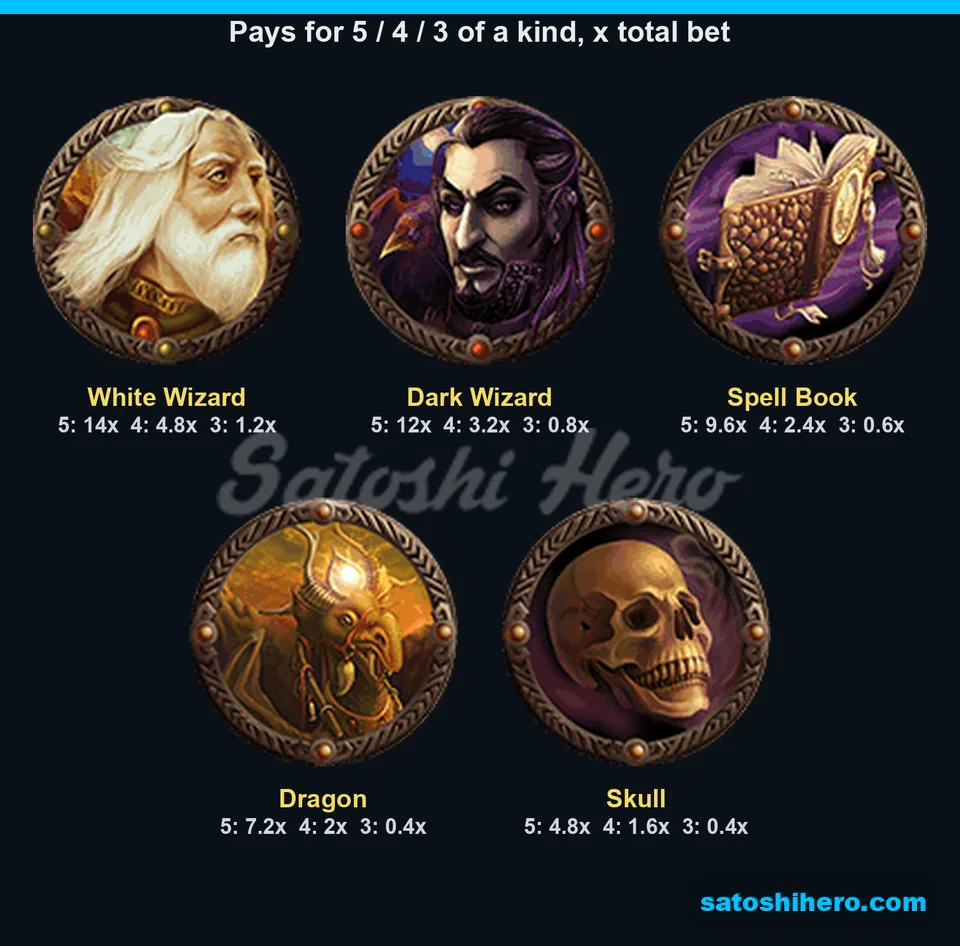
The Spell Book pays 9.6x, 2.4x and 0.6x. The Dragon pays 7.2x, 2x and 0.4x, while the Skull pays 4.8x, 1.6x and 0.4x. You feel the gap between premium and low symbols during flat stretches.
Low letters pay less, but they still matter across 25 lines:
- A: 4x, 0.4x and 0.2x.
- K: 3.2x, 0.4x and 0.2x.
- Q: 2.4x, 0.4x and 0.2x.
- J: 2x, 0.4x and 0.2x.
Wild and triggers
The gold plaque Wild pays 16x for five of a kind. It replaces every symbol except the Green Potion and Bird-Skull Staff, which makes it valuable without taking over the trigger path.
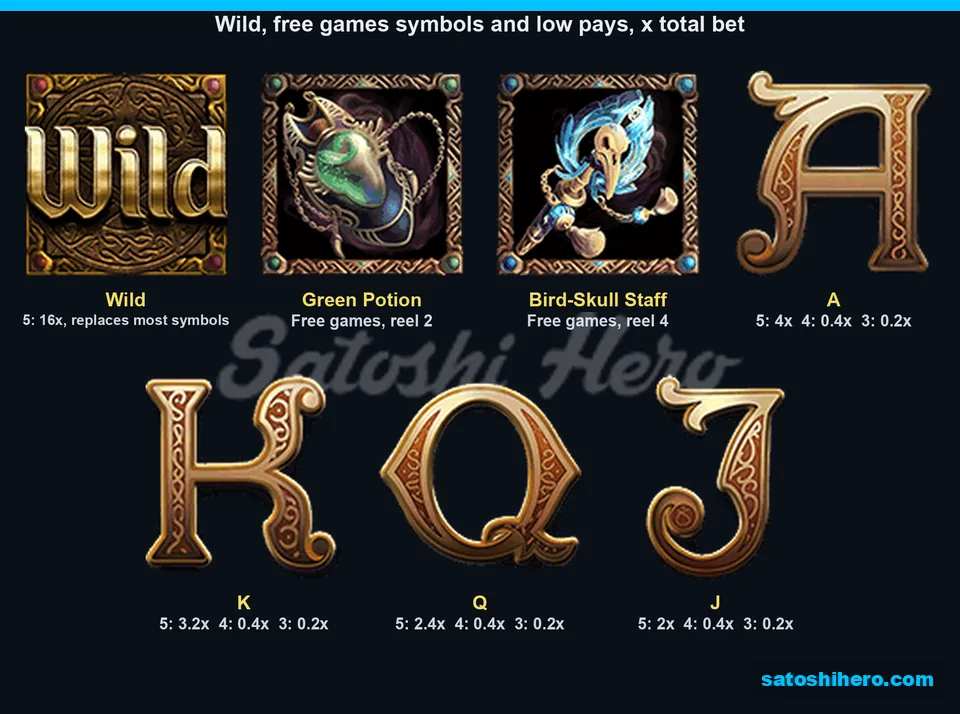

Factoid: The Wild pays 16x for five and substitutes for everything except the two free-games symbols.
The Green Potion lands on reel 2, and the Bird-Skull Staff lands on reel 4. They have no line pay, so you’re watching them for feature access only. I like that split, because it keeps the bonus trigger clean and easy to spot.
Duels and Crystal Counters
Duels drive the game because they can add Wild combinations and apply 3x or 2x multipliers. A duel starts when the White Wizard lands on reel 1 and the Dark Wizard lands on reel 5 in the same spin.
Duel trigger
Once the duel starts, a wheel appears with five possible Wild combinations. The wheel picks exactly one, then the base-game fight begins. The first wizard to land three strikes wins the duel.
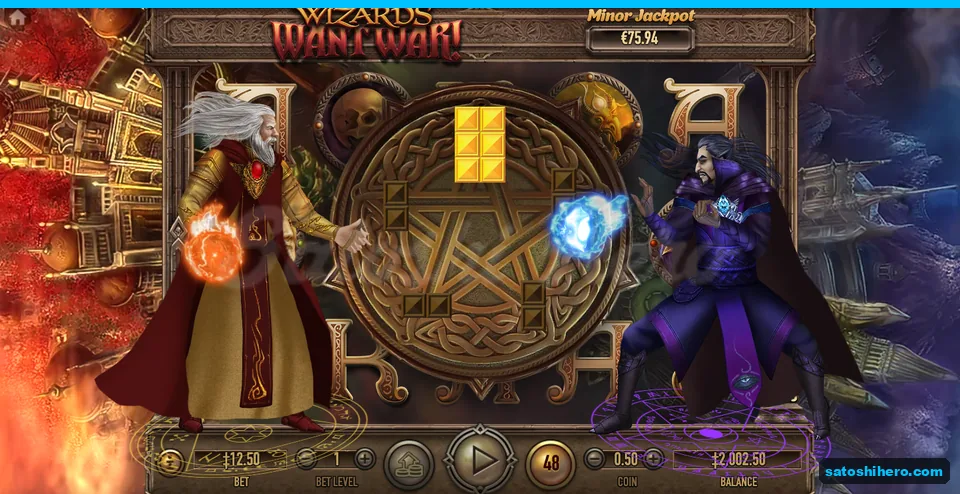
When the duel ends, the chosen Wild combination drops onto the reels at a random position. A White Wizard win multiplies all wins by 3, while a Dark Wizard win multiplies them by 2. Return to the Feature has a stronger feature-first identity, but this slot gets a similar “one event can flip the run” feeling from duels.
My test made that point early. I caught duels on spins 3, 7, 59, 70 and 73, and those spins paid $285.00, $95.00, $75.00, $270.00 and $35.00. Those results made duels the biggest mover in the 100-spin run.
Counter progress
Each duel win also fills that wizard’s crystal counter. The orange counter tracks White Wizard wins, while the blue counter tracks Dark Wizard wins. Each counter runs up to 15, so you can see progress build over time.
When a wizard reaches 15 duel wins, the next spin awards a Wild combination and applies that wizard’s multiplier. If a normal duel also happens on that spin, the two multipliers multiply together before the counter resets. You should avoid constant stake-configuration changes if you’re watching that counter climb.
Free Games Feature
Free games trigger when the Green Potion lands on reel 2 and the Bird-Skull Staff lands on reel 4 together. The feature awards 10 free games, and there’s no bonus-buy route.
Trigger symbols
The Potion and Staff have reel-specific roles, so you’re watching reels 2 and 4. The same pair can trigger from the base game or inside the feature. I saw the trigger once around spin 33, which made the screen shift into wizard choice mode.

Proceed Carefully: There’s no bonus buy, and one observed trigger in 100 spins shouldn’t count as proof of frequent free games.
That trigger felt exciting because the base game had already shown strong duel spikes. Still, the demo session expired as I moved on, so I didn’t play that round out. I won’t attach a payout to a feature I didn’t finish.
Wizard choice
Before the free games start, you choose either the Potion or the Staff. The Potion picks the White Wizard, while the Staff picks the Dark Wizard. That choice sets your wizard for the full round.

A duel can happen during free games, and the chosen wizard wins any duel with one strike. The feature also counts the longest winning combination left to right or right to left, whichever is higher, for each line. Free games use the lines and bet from the triggering spin, so your entry stake still matters.
Progressive Jackpot
The progressive jackpot can trigger randomly at the end of any game and adds to other wins. It didn’t land during my 100-spin session, so this section stays short and factual.
Random trigger
The jackpot sits outside normal line wins. If it hits at the end of a game, the amount adds to other wins from that game. Autoplay stops if the jackpot lands, which gives the event its own pause.
You should treat this jackpot as extra variance, not a plan. The game gives no reason from my test to build stake choices around it. I like the added ceiling, but I wouldn’t chase it.
Discovery: The jackpot can be added on top of other wins, but my test didn’t produce a jackpot hit, so don’t overstate its practical impact.
Test result
The jackpot never appeared across my logged spins. That isn’t surprising, because random progressive events can sit quiet through a short sample. The useful point is simple: duels shaped my run, not the jackpot.
RTP, Volatility & Our Test
The math profile is generous on paper but swingy in practice: 98.11% RTP, high volatility and a 400x maximum win. That 400x cap feels modest for this volatility level, so the risk comes more from uneven pacing than huge headline potential.
Many spins missed or paid below stake during my test. Only eight logged paying spins returned at least the $12.50 stake. At least five of those eight came with duels, which tells you where the real movement happened.
Simulator projection
The SatoshiHero Slot Simulator used 98.11% RTP, high volatility and a 400x top win across 1,000 spins. Every figure sat in multiples of the bet, so the output focused on session shape rather than dollar stake. The median session ended about 44.6x down.
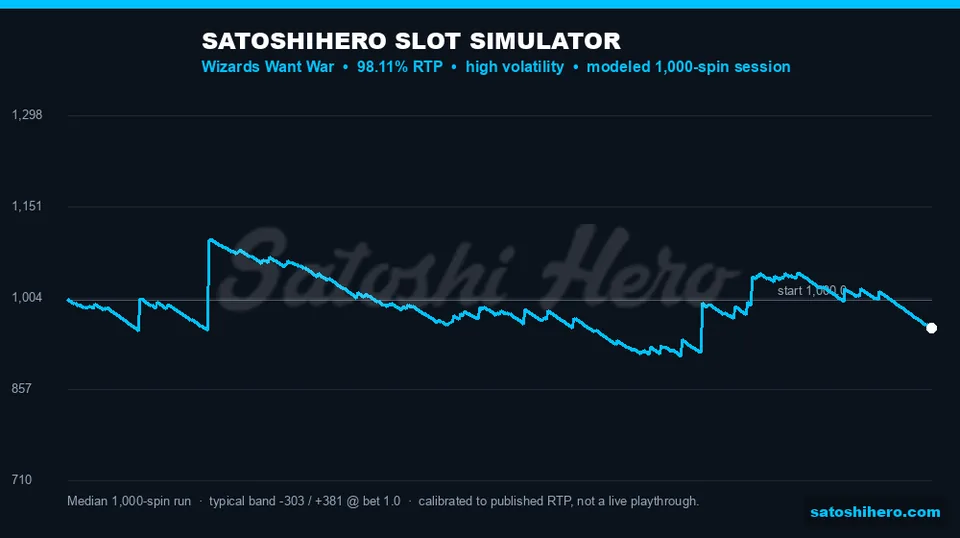
The 5th percentile landed 303.3x down, while the 95th percentile reached 381.3x up. That spread fits what I felt in play: the game can look flat, then suddenly lurch. The model lands a win on about 18 spins in 100.
Feature triggers appeared about one spin in 44 in the model. The top end appeared about one spin in 1,664, which lines up with a capped but jumpy game. It doesn’t know the real random number generator, and it shouldn’t shape your next-spin expectations.
Our 100-spin session
I played 100 spins on the play-money demo at a stake of $12.50, starting from $2,000.00. The demo session kept expiring after about a minute, so I chained fresh sessions into one running balance. That gave me one continuous 100-spin line.
I finished at $2,420.00, which was 33.6x the bet up. My best logged result was $730.00 on spin 91, or 58.4x the bet. The next biggest hits were $285.00 on spin 3 and $270.00 on spin 70.
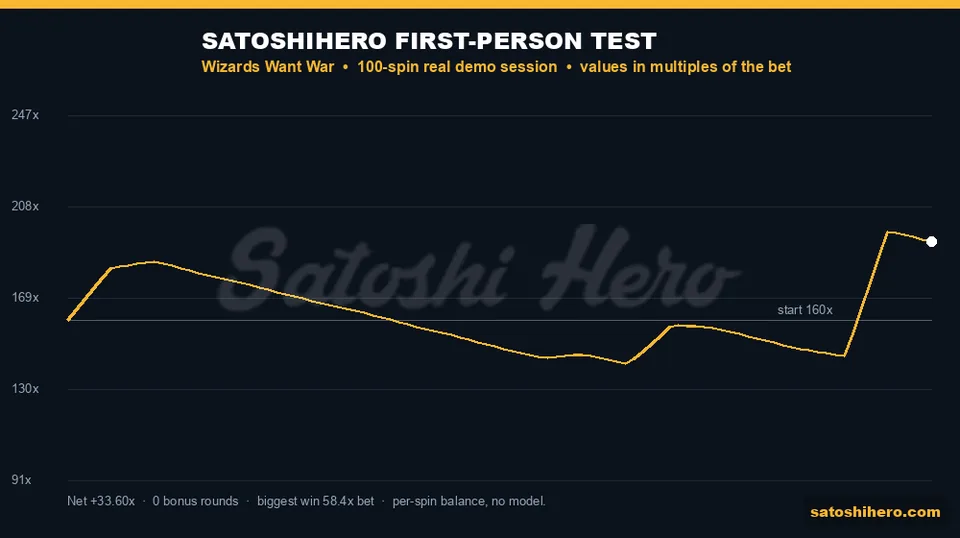
The balance slid to about $1,762.50 by spin 65. It still sat at only $1,805.00 on spin 90 before that $730.00 hit pulled the run above the start. The Dead Escape gives a similar dark, tense mood, though this game’s volatility felt more tied to duel timing.
Of the 99 spins I logged, 35 paid something. Only eight paid at least the $12.50 stake, and at least five of those came with a duel. The free games triggered once but didn’t finish because the demo expired.
Theoretical RTP is the operator’s published return figure, while a single live or demo session has no bearing on that return. The simulator is a model based on the supplied RTP, volatility and max-win cap, not the real RNG. Feature and jackpot outcomes from one session remain anecdotal.
How It Played in Practice
The 100-spin run finished up, but it still felt volatile because one late 58.4x result rescued the balance. This section comes from my first-person test, not generic slot talk.
Session rhythm
An early duel hit gave the balance a useful cushion. After that, the middle of the run bled down through small returns and dead spins. You could feel the game waiting for another event rather than feeding steady line wins.
Spin 91 changed the shape of the session. The $730.00 result did most of the late recovery, while earlier duel hits kept the run alive. I like that drama, but it can feel rough if you enter with a tiny bankroll.
Proceed Carefully: Even a winning 100-spin sample needed one late 58.4x result to look strong, so don’t judge the slot from a short cold stretch.
Bankroll feel
You can be ahead after 100 spins, but the route can still feel uncomfortable. My balance dropped below the starting point before the late hit, and the smaller pays didn’t do enough on their own. That rhythm makes stake sizing more important than usual.
If you play this game, avoid judging it from one cold stretch. The duel feature can swing the mood fast, but it doesn’t smooth every gap. I’d use a smaller stake here than on a calmer fixed-line slot.
Who This Slot Suits
This slot fits fixed-payline fans who like persistent counters and base-game events that can change a session fast. You should skip it if you need a bonus buy, a huge top prize or smooth short-session pacing.
Best fit
Fixed-line players get a clear structure here. You know the board, the line count and the left-to-right pay logic from the start. The game doesn’t hide behind unclear win systems.
Persistent-progress fans also get something to watch. The crystal counters give you a reason to track wizard wins, and duels can turn ordinary spins into bigger moments. High-RTP hunters may like the math, though they still need patience for the high volatility.
Skip if
Bonus-buy fans won’t find a shortcut. The free games only come from landing the Potion and Staff together, so you can’t pay your way straight into the feature. That may frustrate you if you want instant bonus access.
Max-win chasers may also feel boxed in by the 400x ceiling. Waltz Beauty makes more sense if you want a lighter mood instead of a combative magic setup. My practical take is simple: play this for duels and counters, not a massive top-end chase.
Frequently Asked Questions About Wizards Want War
What is the RTP and volatility of Wizards Want War?
Wizards Want War has a 98.11% RTP and high volatility. That matched my 100-spin feel, with many small returns, a few duel spins over 20x and a balance that swung hard.
How many paylines does Wizards Want War have?
The game has 25 fixed paylines on 5 reels and 3 rows. Wins pay from the left, only the longest win on each line counts, and wins on different lines add together.
How does a duel work in Wizards Want War?
A duel starts when the White Wizard lands on reel 1 and the Dark Wizard lands on reel 5. A wheel picks one of five Wild combinations, then the first base-game wizard to three strikes wins. The White Wizard applies 3x to all wins, while the Dark Wizard applies 2x.
What do the crystal counters do?
The orange crystal counts White Wizard duel wins, and the blue crystal counts Dark Wizard duel wins. Each counter climbs to 15, then the next spin awards a Wild combination and that wizard’s multiplier. If a duel also happens on that spin, the effects multiply together before reset.
How do you trigger the free games in Wizards Want War?
Land the Green Potion on reel 2 and the Bird-Skull Staff on reel 4 together to award 10 free games. You choose Potion or Staff first, which picks your wizard for the round. I saw the trigger once in 100 spins.
What does the Wild do in Wizards Want War?
The Wild is a gold plaque that pays 16x the total bet for five of a kind. It replaces every symbol except the Green Potion and Bird-Skull Staff.
What is the maximum win in Wizards Want War?
The maximum win is 400x the bet. My best logged 100-spin result was 58.4x the bet, so the cap sat far above my test peak.
Is there a bonus buy in Wizards Want War?
No, there’s no bonus buy. Free games only come from landing the Potion and Staff together, and a random progressive jackpot can appear at the end of any game.
What did the 1000 spin simulator show for Wizards Want War?
The model used 98.11% RTP, high volatility and a 400x cap. The median 1,000-spin session ended about 44.6x down, with a 5th to 95th percentile band from 303.3x down to 381.3x up. It triggered the feature about one spin in 44.
How did my 100-spin Wizards Want War session go?
I started with $2,000.00 at a $12.50 stake and finished at $2,420.00, which was 33.6x the bet up. A $730.00 win on spin 91 did most of the work. Duels caused at least five of my eight stake-beating returns.
Final Take
Wizards Want War stands out because the duel feature gives a fixed-line slot real mid-spin drama. The drawback is just as clear: the 400x cap feels modest beside the high-volatility pacing.

My Read
Play this when you want a duel-led slot with clear rules, visible counters and a strong RTP figure. Expect uneven stretches, because my test needed duel spikes and one late 58.4x hit to shine. Don’t treat the free games trigger as routine after one short sample.
I like how the duel wheel can turn a plain spin into a real moment. I don’t like how much the session leaned on a few hits, especially when only eight logged pays beat the stake. The unfinished free-games round also left that feature less proven in my test.
Wizards Want War is checked regularly so the guide stays aligned with the tested mechanics and play notes. If you try it, track your stake setup and treat the crystal counters as part of the rhythm.

Pros:
 Strong RTP: The 98.11% figure gives the math profile real appeal.
- Clear duels: The red-blue wizard setup makes feature action easy to follow.
- Persistent counters: Crystal progress adds purpose to repeated base-game spins.
- Simple lines: Fixed paylines keep wins readable and paytable-led.

Cons:
 Modest cap: The 400x ceiling limits top-end excitement.
- No bonus buy: Free games require the Potion and Staff trigger.
- Swingy pacing: Short sessions can feel flat without duel spikes.

Best For: Fixed-payline players, counter trackers and high-RTP hunters get the most from this game. You’ll enjoy it more if you can handle dry patches and wait for duel-driven swings. Skip it if you want instant bonus access or a giant max-win target.

































































Bets
All Bets
Game
Player
Date
Wager
Mult.Multiplier
Prize
 Galaxy Glitter
 mike_721
- 04:19:13
- 0×
- Mayan Fortunes
- nina87
- 04:19:13
- 0×
- Joker's Jewels
 tonex25
- 04:19:08
- 9.99×
- Royal Fruits 9: Hold 'n' Link
 mdp0fxo
- 04:19:06
- 2×
- Joker's Jewels
- tonex25
- 04:19:04
- 0×
- Galaxy Glitter
- mike_721
- 04:19:04
- 0×
- Joker's Jewels
- tonex25
- 04:19:01
- 0×
- Luck of Panda: Bonus Combo
- josh1998
- 04:19:00
- 2.05×
- Royal Fruits 9: Hold 'n' Link
- mdp0fxo
- 04:18:59
- 0×
- Joker's Jewels
- tonex25
- 04:18:57
- 0×