

Mighty Mammoth
By pressing play, you agree that you are above legal age in your jurisdiction and that your jurisdiction allows online gambling.

Mighty Mammoth
RTP94.19%
VolatilityHigh
Max winx10,000
Hit rate34.36%
ThemeAncient civilizations
ReleasedNov 2023

Mammoth Multipliers Crack the Ice
Stacked Mammoths merge across three middle reels, multiplying their ways values as the frozen board erupts.
Mighty Mammoth is a high volatility Ice Age slot from Gaming Corps with 96.2% RTP and 10,000x maximum win potential. Its five reels form a 3-4-4-4-3 layout with 576 fixed ways and progressive Free Spins. Patient multiplier hunters who can accept long dry spells will understand its demanding pace.
Key takeaways
- Best bonus: Progressive Free Spins remove weaker Mammoth values, yet reaching the round doesn’t guarantee a worthwhile return.
- RTP / volatility: The theoretical RTP is 96.2%, and the volatility level is high.
- Max win: The maximum win is exactly 10,000x the bet.
- Risk note: A 100x result appeared roughly once per 1,724 simulated spins, illustrating rarity rather than predicting outcomes.
- Bankroll note: My 100 paid spins at $1.00 lost $60.40, so your budget must absorb dry periods without chasing.

Table of Contents
- Frozen Ice Age Theme
- RTP, Volatility and Test Results
- Simulator projection
- Our 100-spin session
- How Mighty Mammoth Works
- Symbol values
- Wild and Scatter
- Mighty Mammoth Feature
- Scatter Re-Spin
- Progressive Free Spins
- Stronger stack pool
- What the 100 Spins Felt Like
- Bankroll Fit and Player Profile
- Frequently Asked Questions
- Wrap-Up
Frozen Ice Age Theme
Cracked blue ice, snowy peaks, and a golden woolly mammoth establish a clear but familiar prehistoric setting. Ice frames the five uneven reels, while animal portraits and carved card symbols stay easy to separate. You won’t need to study the screen for long before its visual hierarchy makes sense.
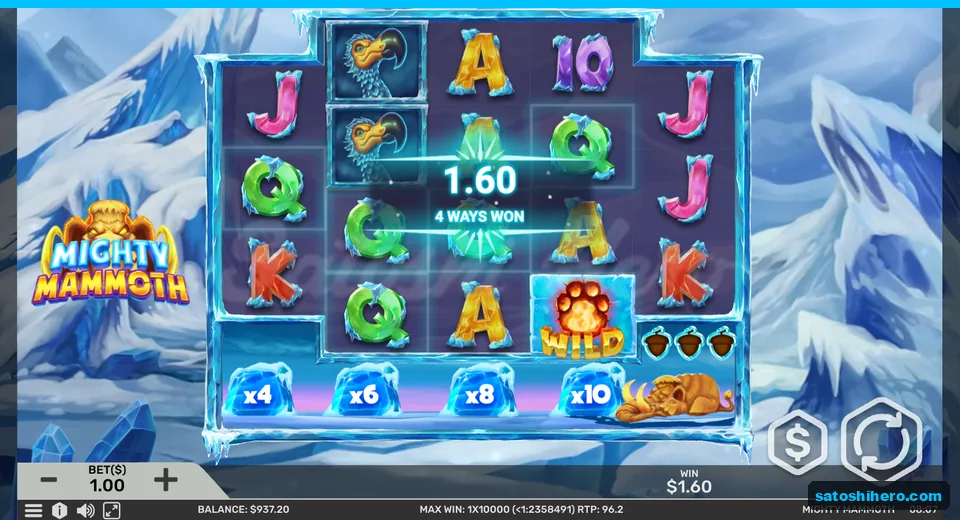
Four stone slabs below the reels show x4, x6, x8, and x10 values. Three golden acorns fill in the corner whenever Scatters land, giving you a simple progress display. A visible counter announces results such as “4 ways won,” which helped me follow small combinations without opening the information panel.
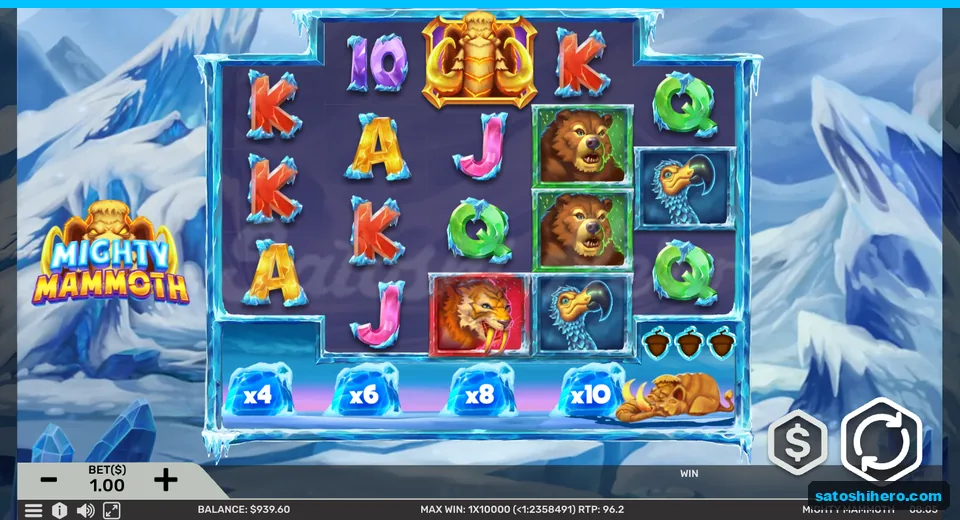
The setting won’t win originality awards, and I found the multiplier apparatus more interesting than the scenery. Still, the cold blue frame keeps your attention on the middle reels, where the important stacked Mammoths can appear. That practical clarity matters when several symbols, ways, and multipliers resolve together.
Players drawn to prehistoric imagery may recognise the broad style of Mammoth Gold Megaways. This game takes a cleaner route, using a fixed 576-ways board instead of a variable Megaways format. You always know the board size here, although that predictability doesn’t make the outcomes gentler. Other alternatives include Mighty Kong, Mighty Munching Melons, and Mighty Stars.

Fun Detail: Neighbouring stacks merge into one wider woolly mammoth, making the headline animal part of the reel presentation rather than a standard portrait.
Honestly, the presentation works best as a clean frame for the feature, not as your main reason to play.
RTP, Volatility and Test Results
The risk profile matters more than the headline prize during ordinary play. Sharp balance swings can arrive quickly, and my live test showed how repeated full-stake losses and undersized returns can drain your funds. You should read the top prize as the far edge of a wide outcome range, not a realistic session target.
Simulator projection
The SatoshiHero Slot Simulator models possible outcomes; it doesn’t record live spins. At a $1.00 stake, the modeled 1,000-spin median finished $68.00 down. The fifth-to-95th-percentile band stretched from $328.10 down to $334.50 up, showing how far your result could sit from that central figure.
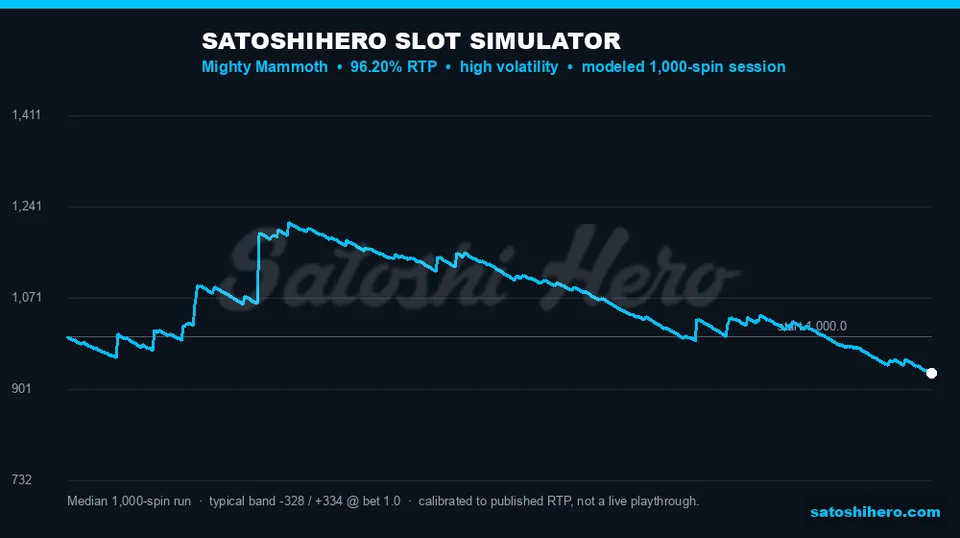
Approximately 18% of simulated spins returned something, while a feature-tier result appeared roughly once every 45 spins. A 100x-or-higher hit appeared about once per 1,724 spins. Those intervals describe the model’s full run, so you can’t use them as a countdown to your next feature or larger hit.
The broad percentile band tells you more than one modeled finish. It includes deep losses and meaningful gains around the same inputs, which captures the uncertainty better than the median alone. In my view, that spread gives you the most useful warning about short-session expectations.
Our 100-spin session
My 100 paid spins lost $60.40. I started with $1,000.00, staked $1.00 each time, and finished with $939.60. Twenty-eight spins paid something, including the bonus trigger, but most of the session consisted of full $1.00 losses interrupted by small returns.
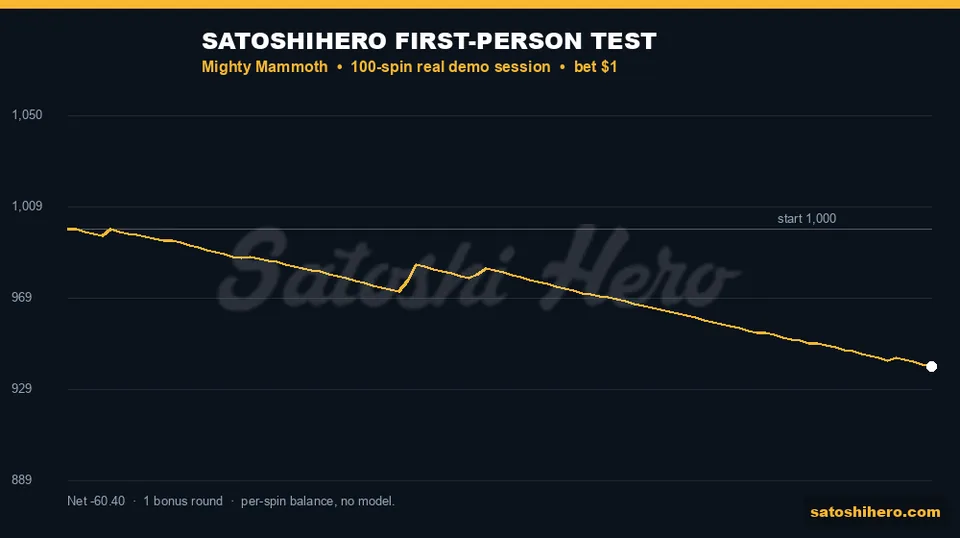
Free Spins triggered once on spin 40 and returned $13.30 across 12 free spins. The round contained a $12.00 result, which became my best single outcome during the entire test. That $13.30 return lifted the balance briefly, yet the following spins resumed the downward drift.
My largest base-game result paid $6.00 on spin 48. Smaller paying outcomes commonly sat between $0.10 and $2.40, so many didn’t recover the $1.00 paid stake. You could see frequent animations in parts of this sample while the balance still declined underneath them.
I took a few extra spins afterward to capture a settled screenshot, but I excluded them from every total reported here. That separation keeps the 100-spin result clean and prevents presentation work from changing the test. You should judge the sample as one observed run, not a typical-loss forecast.

Beware: Full-stake losses and small returns can consume your budget quickly. Set your limit before spinning, and never raise the stake to recover a loss.
The theoretical return is the operator-published figure, while one 100-spin session has no bearing on that calculation. Modeled projections remain separate from live random outcomes, and this guide doesn’t claim feature-specific return figures without verified values.
How Mighty Mammoth Works
Wins use 576 fixed ways across five reels, not paylines. Reel heights of 3-4-4-4-3 create that total by multiplying the available positions. You can ignore line maps because each valid combination follows the same adjacent-reel rule.
Matching symbols pay from left to right, beginning on reel 1 and continuing across neighbouring reels. Only the highest win pays on each way. This structure feels straightforward once you understand that repeated symbol positions can create several winning routes across the same spin.
At my $1.00 stake, the panel’s cash values matched the bet multiples directly. You can scale those multiples to your stake without treating them as fixed cash awards.
The reel layout and controls remained readable on both mobile and desktop displays. I liked that the uneven rows stayed clear, so you can track the middle-reel stacks without wrestling with a crowded interface.
Symbol values
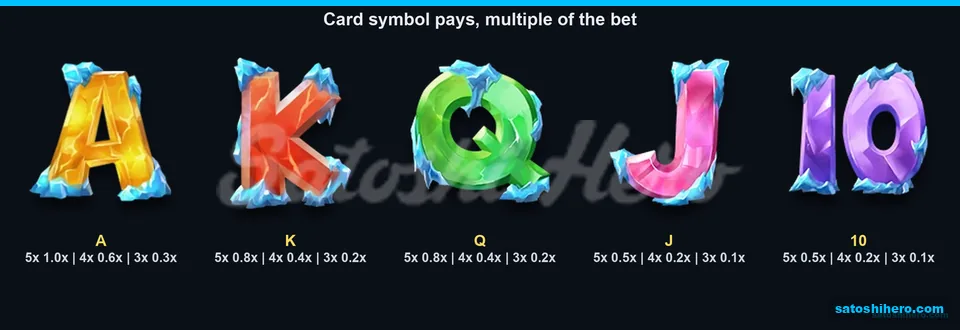
The Mammoth is the only regular symbol that pays with two matches. Every other listed symbol needs at least three adjacent reels from the left. These groups let you compare their relative strength quickly:
Premium symbols
- Mammoth: 5x for five, 2x for four, 1x for three, and 0.30x for two.
- Sabre-tooth cat: 3x for five, 1.50x for four, and 0.70x for three.
- Bear: 2.50x for five, 1.20x for four, and 0.60x for three.
- Dodo: 2x for five, 1x for four, and 0.50x for three.

Card symbols
- A: 1x for five, 0.60x for four, and 0.30x for three.
- K and Q: 0.80x for five, 0.40x for four, and 0.20x for three.
- J and 10: 0.50x for five, 0.20x for four, and 0.10x for three.
Most base pays are restrained, which matched the modest returns I saw in practice. Even premium combinations can fall below your stake when they connect across fewer reels or ways. The Mammoth’s two-symbol payment helps create activity, but you shouldn’t mistake activity for profit.
Wild and Scatter
The paw-print Wild appears only on reels 2, 3, 4, and 5. It substitutes for every regular symbol but never replaces the Scatter. Because it can’t land on the first reel, you still need a natural starting symbol before it can extend your combination.
Golden-acorn Scatters appear only on reels 2, 3, and 4. Those restricted middle positions feed both the one-shot re-spin and the full Free Spins trigger. In my test, three acorns landed together on spin 40, so the bonus started directly without the extra chance.

Stat Check: The 3-4-4-4-3 reel heights create exactly 576 fixed ways to win. This isn’t a 576-payline system.
A settled $1.60 result showed “4 ways won” with a Wild on the right side, making the rule visible in play. The fixed board keeps the base logic simple, letting you focus on stacks and Scatter collection.
Mighty Mammoth Feature
Stacked Mammoths can appear during base play or Free Spins, then multiply across adjacent middle reels. One to three stacks may occupy reels 2, 3, and 4. Each carries x4, x6, x8, or x10, setting how many ways the Mammoth wins on.

Two stacks on neighbouring reels merge visually into one wider animal. Their values multiply instead of adding, so x4 beside x10 becomes x40. If stacks fill all three middle reels, their combined ways value can reach x1000, although that feature value doesn’t equal the final payout or override the game’s overall ceiling.
This multiplying-stack system is easily the game’s strongest idea. You can read the ingredients immediately, then watch their value accelerate when adjacent reels cooperate. The visual merger also gives the mechanic more impact than a small multiplier label tucked beside an ordinary symbol.
My 100-spin test didn’t produce a huge merged-Mammoth result. I saw the mechanism in action, but nothing approached the largest theoretical combination or transformed the session. That matters because you shouldn’t treat the x1000 stack as a common event merely because the interface displays its components clearly.
In live play, several conditions must align: the right reels need stacks, those stacks must touch, and useful ways still need to resolve. Honestly, that dependence creates anticipation without making larger combinations feel routine.
The feature creates transparent potential because you can see exactly which values combine. Its best outcomes still require several specific stacks to line up together, and that rarity defines the excitement.
Scatter Re-Spin
Two Scatters award one free re-spin, giving you a single extra chance to land the third. Acorns appear only on reels 2, 3, and 4, so the two triggering symbols remain collected and held in their middle positions. If another Scatter lands during that re-spin, Free Spins can begin.
Three Scatters on the original paid spin trigger the bonus directly and bypass this detour. That direct route occurred in my test on spin 40. I didn’t need the re-spin then, though its presence makes any two-Scatter stop more tense than an ordinary near miss.

Player Hint: Treat two Scatters as a one-shot bonus opportunity, not a signal. Keep your stake unchanged instead of raising it to chase the missing acorn.
The held symbols make the goal easy to follow, but they don’t make the third Scatter more likely. You receive one chance rather than a nearly completed bonus. I like the added suspense, though you can still leave that free attempt empty-handed.
The re-spin adds a useful second route into Free Spins without changing the underlying uncertainty. You get extra tension at no added stake, but never a reason to chase afterward.
Progressive Free Spins
Three Scatters award 12 Free Spins and start a progressive round that removes weaker Mammoth values. The stack feature stays active throughout, while x4 remains disabled from the beginning. You initially see only x6, x8, and x10 values on qualifying stacks.
Every Scatter collected during the round advances the acorn meter. Collecting three adds six spins and removes x6 from the available stack values. Gathering another three adds three spins, removes x8, and prevents any further Scatters from appearing.
Stronger stack pool
That progression concentrates the stack feature around stronger values. Mammoths can still multiply across reels 2, 3, and 4, so adjacent x10 stacks become the clearest late-stage target. I like this structure because upgrades change the feature pool instead of merely adding spins to an unchanged round.
My bonus began on paid spin 40 with three Scatters and 12 free spins. It returned $13.30 total, including one $12.00 result that supplied nearly all its value. The $13.30 return lifted my balance briefly, but it couldn’t reverse the session’s broader decline.
This one surprised me because the progressive rules sound more forceful than my result felt. Removing weaker values creates satisfying momentum if you collect enough acorns, yet the starting round can finish before either upgrade arrives. You still need strong stacks and useful adjacent positions for the feature to change your session.
The $13.30 return also shows why a bonus trigger isn’t the same as a profitable session. At a $1.00 stake, that feature recovered only part of the money already lost. You may enjoy the round’s improved Mammoth pool while still ending with a modest payout.
During my sample, the largest bonus spin paid $12.00, leaving $1.30 across the other outcomes. That lopsided distribution showed how one stack alignment can dominate the feature total.
Free Spins form the game’s most developed feature because the rules create a clear path toward stronger stacks. Reaching the round alone isn’t enough, and my modest total proved how much the remaining symbol alignment still matters.
What the 100 Spins Felt Like
The sample felt attritional rather than action-heavy. Most paid spins lost $1.00, while many wins returned too little. You could watch symbols celebrate while your balance lost ground.
Small payments commonly ranged from $0.10 to $2.40. Those results softened individual losses but rarely shifted the overall direction, especially after several empty spins. I found that rhythm more draining than dramatic because the game often acknowledged a win without restoring the spin cost.
The Free Spins trigger on spin 40 created the session’s main interruption. Its $13.30 total produced a temporary lift, led by the $12.00 bonus spin. Once the round ended, the balance resumed drifting downward, and no later base-game result generated similar momentum.
My largest base return reached $6.00 on spin 48, far below the amount exposed across dozens of paid spins. You need to separate pleasing animations from their effect on your balance.
Twenty-eight paying spins didn’t mean twenty-eight profitable spins. That count included every return, even the smallest partial recovery and the Free Spins trigger. Honestly, the distinction explains the session better than the raw hit count because most paid outcomes couldn’t cover $1.00.
One test can’t define every future session. It shows a plausible dry run where one bonus and several small pays fail to stop sustained erosion.
Small returns reduced a few losses but rarely changed the downward path. By the final counted spin, patience mattered far more than the number of result animations.
Bankroll Fit and Player Profile
Patient high-risk players who accept sharp balance movement can appreciate the wait for stacked multipliers. The game fits less comfortably when you expect regular returns above your stake. You need enough discipline to keep one stake through losing runs rather than treating every near miss as a prompt.
My $1.00 test lost $60.40 across 100 paid spins. That figure records one session, not a forecast for your next 100 spins. It still demonstrates why a stake that looks small in isolation can create meaningful exposure when repeated through a cold run.
Choose an amount that leaves room for a substantial number of spins inside your fixed budget. No session length can guarantee a feature, a merged stack, or a profitable finish. If losing several full stakes would tempt you to increase the bet, this volatility profile deserves extra caution.
Players seeking frequent stake-covering returns may find the base game frustrating. Sudden drops also make it uncomfortable when you prefer a smoother balance path. I wouldn’t treat a Scatter re-spin as a reason to continue past a limit because that one-shot chance doesn’t improve later spins.
You can try demo or real-play mode on SatoshiHero. Demo play explains the uneven board, held Scatters, and stack multiplication. Real play still needs a fixed budget and stopping point.
Mighty Mammoth rewards attention to a compact feature set, not attempts to predict when it activates. A sensible fixed stake matters more than trying to time the next bonus.
Frequently Asked Questions
How does the Mighty Mammoth feature work?
One to three Mammoth stacks can land on reels 2, 3, and 4 during the base game or Free Spins. Each carries x4, x6, x8, or x10 ways, and adjacent values multiply, so x4 beside x10 becomes x40. Three touching stacks can reach a combined x1000 ways value.
How do you trigger Free Spins in Mighty Mammoth?
Three Scatters on reels 2, 3, and 4 award 12 Free Spins. Collecting three more adds six spins and removes x6, while another three adds three spins and removes x8. The x4 value stays disabled throughout the round.
What does the Mighty Mammoth re-spin do?
Two Scatters become held and award one free re-spin. A third Scatter landing during that single chance can trigger Free Spins, while three Scatters on the original spin start the round directly.
Where can the Mighty Mammoth Wild land?
The paw-print Wild appears only on reels 2, 3, 4, and 5. It substitutes for every regular symbol but can’t replace the golden-acorn Scatter.
What did the Mighty Mammoth simulator show?
The modeled median finished $68.00 down at a $1.00 stake. Its percentile band ran from $328.10 down to $334.50 up, about 18% of spins paid, and a 100x result appeared roughly once per 1,724 spins. These outputs don’t predict live results.
How did 100 Mighty Mammoth spins go?
I began with $1,000.00 and finished with $939.60 after 100 paid spins at $1.00, losing $60.40. One Free Spins round paid $13.30, while my largest base-game result paid $6.00.
What are Mighty Mammoth’s RTP and maximum win?
Its theoretical RTP is 96.2%, its volatility is high, and the maximum win is 10,000x the bet. None of those figures guarantees a particular result within one session.
Wrap-Up
Mighty Mammoth stands out through readable adjacent-stack multiplication and a Free Spins round that removes weaker values. Its main drawback is the punishing gap between visible activity and returns that actually cover your stake.

My Verdict
Patient multiplier hunters may enjoy watching the middle reels build toward stronger combinations. Expect dry spells, small partial returns, and occasional feature tension rather than steady balance support.
I like how quickly the stack rules make sense, and the progressive bonus gives every collected acorn a purpose. I don’t like how my only bonus returned $13.30 while the full test still lost $60.40.
Mighty Mammoth remains a focused but demanding choice, and its test details are checked regularly.

Pros:
 Clear stack logic: Adjacent values multiply visibly, making complex combinations easy to follow.
- Progressive bonus: Collected Scatters remove weaker values and sharpen later stack potential.
- Readable board: Uneven reel heights remain clear across the frozen interface.
- Useful re-spin: Two Scatters create one extra bonus chance without another paid stake.

Cons:
 Severe dry spells: Full-stake losses can reduce your balance quickly.
- Weak partial returns: Many paying spins may still return less than your stake.
- Bonus uncertainty: Reaching Free Spins doesn’t ensure a meaningful payout.

Best For: Patient bankroll managers who value one transparent multiplier mechanic over a crowded feature list. You must accept sharp swings, modest bonus outcomes, and long waits without chasing losses.


































































Bets
All Bets
Game
Player
Date
Wager
Mult.Multiplier
Prize
 Royal Fruits 9: Hold 'n' Link
 Hidden
- 00:20:00
- 0×
- Royal Fruits 9: Hold 'n' Link
- Hidden
- 00:19:59
- 0×
- Elephant's Gold: Bonus Combo
 Hidden
- 00:19:57
- 0×
- Galaxy Glitter
- nina87
- 00:19:56
- 0×
- Mr. Crystalman: Hold 'N' Link
 Hidden
- 00:19:56
- 0×
- Royal Fruits 9: Hold 'n' Link
- Hidden
- 00:19:56
- 0×
- Royal Fruits 9: Hold 'n' Link
- Hidden
- 00:19:55
- 0×
- Royal Fruits 9: Hold 'n' Link
- Hidden
- 00:19:53
- 0×
- Royal Fruits 9: Hold 'n' Link
- Hidden
- 00:19:52
- 0×
- Galaxy Glitter
- josh1998
- 00:19:49
- 0×