

Super Heated Sevens
By pressing play, you agree that you are above legal age in your jurisdiction and that your jurisdiction allows online gambling.


Fruit Wins Get a Glossy Heatwave
I found Super Heated Sevens to be a polished 5×3 fruit slot built around 20 fixed paylines, not free spins or elaborate bonus rounds.
Super Heated Sevens is a low volatility GameArt slot with 96.65% RTP and 1,500x maximum-win potential. Its frequent, generally modest line wins share the stage with a paying scatter star and optional red-or-black gamble. My $500.00 balance ended at $484.85 after 100 spins at $1.00, with a $24.25 best hit.
Key takeaways
- Best play: Base spins are the whole game, and collecting wins carries less immediate risk than gambling them.
- RTP / volatility: The theoretical RTP is 96.65%, and the volatility level is low.
- Max win: The maximum win is capped at 1,500x the bet.
- Risk note: The optional red-or-black gamble doubles a correct pick but removes the risked win after a wrong choice.
- Bankroll note: My $1.00-per-spin test lost $15.15 across 100 spins, so you still need a firm budget.

Table of Contents
- How Super Heated Sevens Works
- Reel and line setup
- Symbol values by tier
- The Wild Seven
- Theme and First Impressions
- Visual style and mood
- Interface at first load
- The Gamble Feature
- Risk and round limits
- Settings and autoplay
- The Scatter Star
- Payout Ceiling and Win Scale
- Bankroll Pace in Practice
- Observed balance pattern
- RTP, Volatility and Our Test
- The simulator projection
- Our 100-spin session
- Frequently Asked Questions
- Closing Thoughts
How Super Heated Sevens Works
Super Heated Sevens uses five reels, three rows, and 20 fixed paylines. Regular wins need matching symbols on those lines, rather than clusters, pay-anywhere groups, or changing ways to win. You can read each result without decoding a complex system. I think that clarity is the game’s strongest mechanical quality.
Reel and line setup
Every standard spin evaluates the same 20 lines across the 5×3 grid. The selected coin value applies to each line, so the total bet equals that value multiplied by 20. During my test, a $0.05 denomination produced a $1.00 total stake. You should check both figures before pressing spin because the smaller number isn’t your complete cost.
All displayed symbol awards use the total bet as their base. That choice makes the paytable easier to read once you know your actual stake. The controls and reels also remained straightforward across desktop and mobile play. You won’t need to relearn the layout when moving between screens, which feels refreshingly practical.
Symbol values by tier
The golden bell leads the regular paytable, while the fruits sit in clear value groups. You can scan these awards quickly because each figure represents a multiple of the total bet:
- Golden bell: 75x for five, 10x for four, 3x for three, and 0.25x for two.
- Four-leaf clover: 15x for five, 5x for four, and 2x for three.
- Grapes and watermelon: 10x for five, 4x for four, and 1x for three.
- Plum, lemon, orange, and cherries: 5x for five, 2x for four, and 0.4x for three.
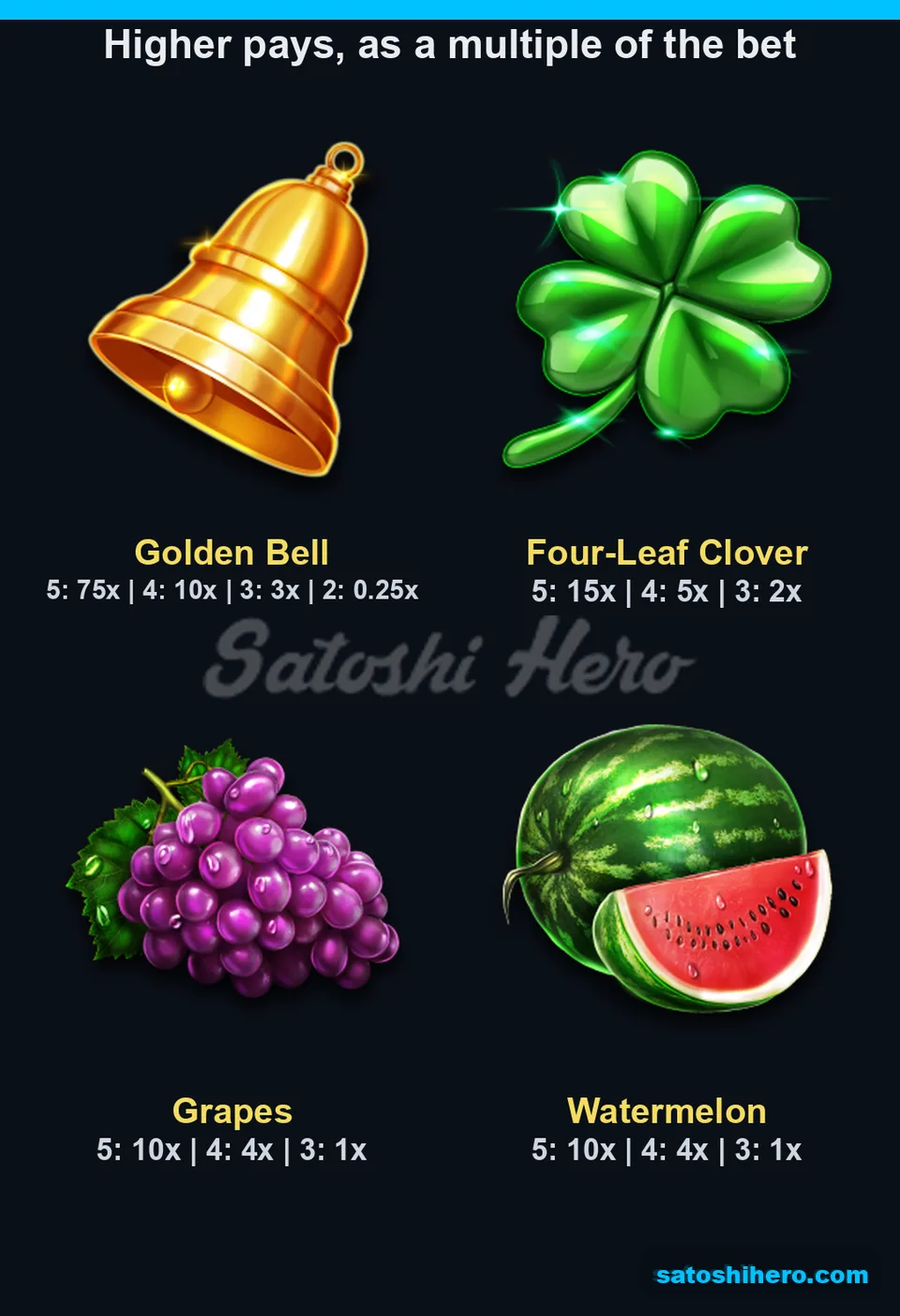
The purple star creates the only exception to those fixed-line rules because it pays anywhere on the reels. At a $1.00 total bet, the money values shown in my tested paytable matched the listed multiples directly. That direct relationship made checking my modest fruit wins simple, and you can verify yours just as quickly.
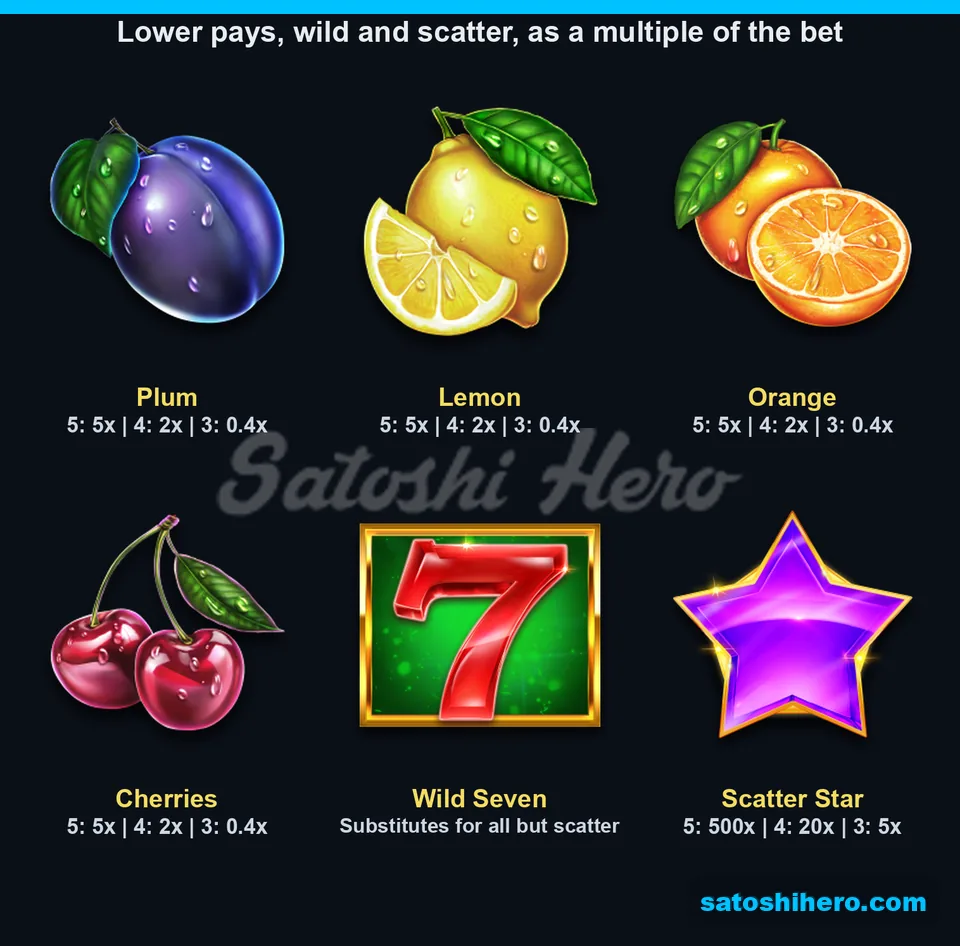

Fast Fact: At a $1.00 total bet, the displayed dollar awards correspond directly to the listed bet multiples.
The Wild Seven
The red seven substitutes for every paying symbol except the purple scatter star. It completes fixed-payline combinations but carries no independent paytable award. You can spot it by its green-and-gold frame, which stands apart from the fruit symbols. I like that the artwork makes its role obvious without crowding the reels.
My clearest example came on an extra spin after the counted session. A full-height wild stack landed beside stacked cherries and helped complete several lines for a combined $2.00 win. I captured that frame separately, so it didn’t change the recorded $484.85 finish. You should treat it as practical evidence of wild substitution, not another result inside the 100-spin totals.
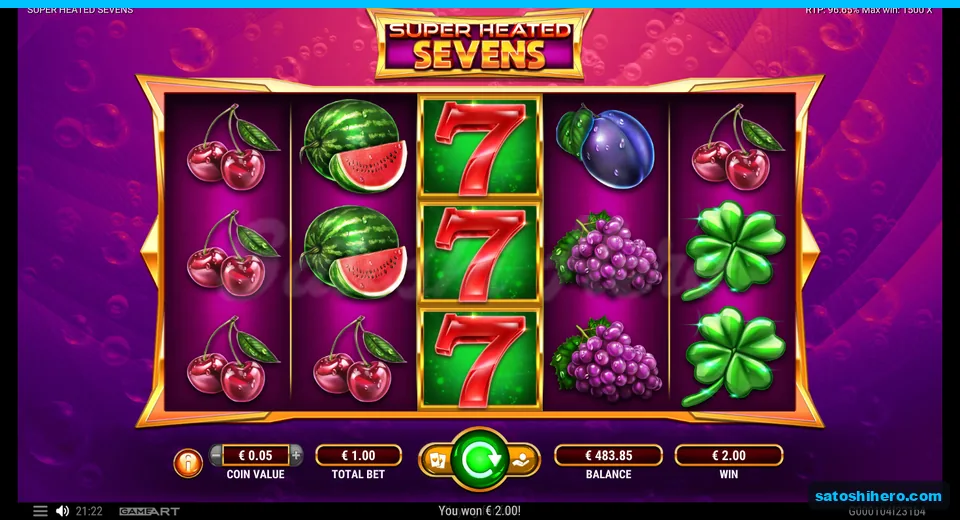
What shouldn’t you expect from that full reel? The wild doesn’t pay by itself, unlock a mode, or replace the scatter. It simply improves ordinary line combinations when the surrounding symbols cooperate. In my view, stacked wilds add useful visual tension, though they don’t transform the basic fruit-slot structure.
The $2.00 example shows how several small line awards can combine. You still need valid paths around the stack, so its practical role stays focused on ordinary fruit wins.
Theme and First Impressions
The game places familiar fruit-machine symbols inside a glossy pink-and-purple setting, rather than copying a deliberately retro cabinet. Gold-framed reels sit over drifting soap bubbles, while bright highlights give every icon a polished finish. You’ll recognize the visual language immediately, yet the candy-like backdrop softens the usual hot-slot look. I find it cheerful, if hardly original.
Visual style and mood
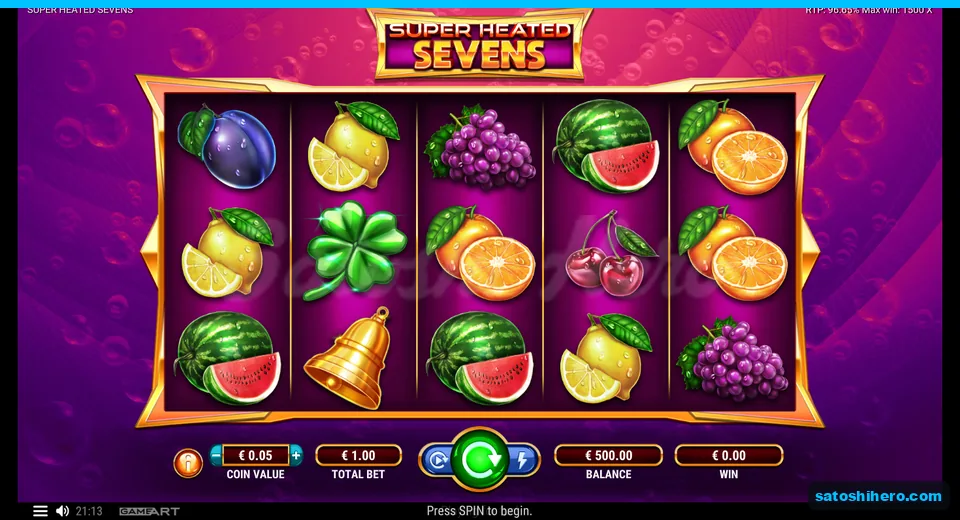
The visible set includes a golden bell, four-leaf clover, grapes, watermelon, plum, lemon, orange, and cherries. A red seven handles wild duties, while a purple star serves as the scatter. These chunky symbols remain easy to separate when turbo autoplay moves quickly. You won’t confuse the specials with the ordinary fruits, which matters more than decorative depth here.
The theme won’t win originality awards, although its clean execution gives the old formula some gloss. Xtreme Hot offers a more traditional hot-fruit presentation, while this game leans harder into pink, purple, and floating bubbles. I prefer the clearer contrast here because you can follow fast spins without visual strain. Its sugary finish may still feel too soft if you favor classic cabinet styling.
Xtreme Summer Hot provides another bright GameArt fruit theme, while Xmas Express and Wolf Hunt move into more distinct seasonal and animal imagery.
Interface at first load
The opening screen placed coin value, total bet, and balance clearly around the reels. My display showed a $0.05 denomination, a $1.00 total bet, and a $500.00 starting balance. Before you spin, look at the total bet first because it reflects all 20 active lines. The coin value alone can make your actual wager seem smaller than it is.
The main controls use familiar positions, with no dense menu blocking key information. You can confirm your stake and start autoplay quickly. I wouldn’t call the design adventurous, but it supports confident decisions.
The free demo and real-play version are available here on SatoshiHero. Trying the layout first lets you see how line costs and the total bet connect before risking money. You should still set a session limit because a simple interface can make repeated spins feel effortless. The presentation succeeds by keeping attention on the reels and wager display.
The Gamble Feature
The gamble offers a red-or-black card choice after eligible wins. A correct pick doubles the amount, while a wrong pick removes everything placed into that round. You can continue for up to five consecutive gamble rounds after successful choices. I consider it a sharp contrast with the otherwise steady base game.
Risk and round limits
A face-down card appears and asks you to choose red or black. Neither color gains an advantage from previous cards, so streaks can’t guide the next pick. The accumulated amount can’t pass the 1,500x maximum-win cap. Once you reach that limit, further gamble rounds stop until you reload the game and collect the winnings.
No betting pattern removes this double-or-lose risk. You might double several times, but every new choice exposes the whole accumulated amount again. The five-round limit controls the sequence length without making any individual pick safer. In my opinion, that escalating exposure can turn a calm session harsh very quickly.

Alert: Low slot volatility doesn’t make the gamble low risk. One wrong color choice removes the complete win placed into that round.
Settings and autoplay
You can enable or disable the gamble option in the settings menu. It didn’t appear during turbo autoplay, so I never used it during my 100-spin test. Skipping it kept my recorded finish tied entirely to base-spin results. That makes the session easier to interpret because no card choice altered the balance path.
Decide your approach before the reels start, rather than after an exciting hit. Collecting every win keeps the base game’s measured pace intact, while gambling changes that pace through optional risk. You won’t improve the underlying return by choosing a favorite color. The feature adds a quick decision, but I think restraint fits this slot better.

Tip: Choose your gamble policy before playing. Collect every win or risk only a fixed amount instead of deciding impulsively after a larger hit.
The Scatter Star
The purple star pays anywhere on the reels and doesn’t need to follow a fixed payline. Three scatters pay 5x the total bet, four pay 20x, and five pay 500x. You receive the scatter payout as the complete result, not as entry into another screen. I appreciate the clear rule, though bonus hunters may find it underwhelming.
This symbol doesn’t award free spins, open a pick game, or start a separate bonus round. Stars appeared during my test, but none launched anything beyond their direct scatter function. You shouldn’t wait for a second stage after the reels settle. The absence of a trigger keeps every spin self-contained and easy to audit.
Five stars represent the largest individual award shown on the paytable. That 500x scatter result remains separate from the broader game cap, which can include combined line wins or successful gambles. You can therefore see a meaningful scatter without reaching the full payout ceiling. The distinction matters because one symbol award and the maximum possible result aren’t interchangeable.

Trivia: Five scatter stars pay 500x the total bet, but they don’t launch free spins or another bonus. The scatter payment is the entire result.
For me, the star works more like a premium pay-anywhere symbol than a conventional bonus trigger. Its direct payout can add excitement without pausing the base game. You still need three or more visible stars before it pays, and fewer stars do nothing. That simple rule suits the slot’s stripped-back approach, even if it limits surprise.
Payout Ceiling and Win Scale
The official maximum win is 1,500x the bet, a relatively modest ceiling beside feature-heavy alternatives. That cap covers the overall outcome, while five scatter stars carry a separate 500x paytable award. Several line wins or successful gamble rounds can contribute toward the broader limit. You should judge the scale by that distinction, not assume one symbol pays the cap.
My observed results sat far below either headline figure. The extra wild-and-cherry frame paid $2.00, while my largest logged test win reached $24.25. Those amounts better reflect what happened in one short run, not what your next session must produce. I liked the readable scale, but jackpot hunters may find its upper limit too restrained.
The ceiling makes sense for a low-volatility game built around ordinary line hits. There isn’t a free-spins multiplier ladder, expanding bonus grid, or bonus buy pushing the top end higher. Instead, the design keeps returning you to the same 20 lines after each result. You can focus on stake control rather than funding expensive feature entries.
Could the cap produce a large result at a bigger stake? Yes, but raising your wager also magnifies every loss. My test never approached the cap, so I wouldn’t plan around chasing it.
Clarity is the real appeal of this payout scale. You can see how fruit combinations, scatter awards, and optional gamble decisions feed the final amount. Players chasing huge bonus spectacles may feel boxed in by 1,500x. Transparency-focused players get a cleaner, calmer proposition.
Bankroll Pace in Practice
My balance moved through many small or losing outcomes before a late $24.25 win recovered part of the drawdown. The run still finished $15.15 below its starting point, despite the lower-risk profile. You can encounter a sustained dip without seeing dramatic swings on every spin. I found the pace calm, but the cumulative cost remained noticeable.
Observed balance pattern
These recorded checkpoints show how the session developed:
- After spin 25: $476.00.
- After spin 47: $486.50.
- After spin 61: $480.60.
- Near spin 95: Approximately $460.60.
- After spin 100: $484.85.
Turbo autoplay moved quickly through the test and made gradual balance shifts easier to see. My detailed per-spin log begins at spin 70, so the earlier graph connects recorded checkpoints rather than showing every intermediate result. You should read that first segment as an outline, not a complete spin-by-spin trace. I prefer stating that limit plainly because false precision would misrepresent the session.
From spin 70 onward, I recorded six payouts across 31 spins. They were $4.00, $0.80, $3.60, $5.60, $24.25, and $5.00. The $24.25 hit on spin 96 lifted my balance from $459.60 to $483.85. That recovery helped, yet it didn’t erase the earlier decline.
Low volatility generally points toward a steadier payout profile, not guaranteed profit. This run consumed more than 15 one-dollar stakes across 100 spins after all returns. You need enough balance for your intended spin count, especially when autoplay compresses many decisions into minutes. In my view, the calm animation can disguise how quickly total wagers accumulate.
Stake sizing can’t change the RNG, improve RTP, or predict when a win appears. It only controls how much money each uncertain result moves through your balance. If you plan 100 spins, compare that full exposure with your session budget before starting. Sensible sizing matters even when the pace feels gentle.
RTP, Volatility and Our Test
The theoretical RTP is 96.65%, volatility is low, and my test finished away from that headline return. Short play can land above or below a modeled expectation because individual results vary. You should use the figures as context, not as a promise for your balance. I find the combined live and simulated view more useful than either figure alone.
The simulator projection
The SatoshiHero Slot Simulator modeled 1,000 spins at a flat $1.00 stake using the published game inputs. Its median session ended $35.70 down, while the middle 90% ranged from $135.60 down to $74.80 up. The model paid something on roughly 34% of spins. Those results show a broad spread even under a low-volatility setting.
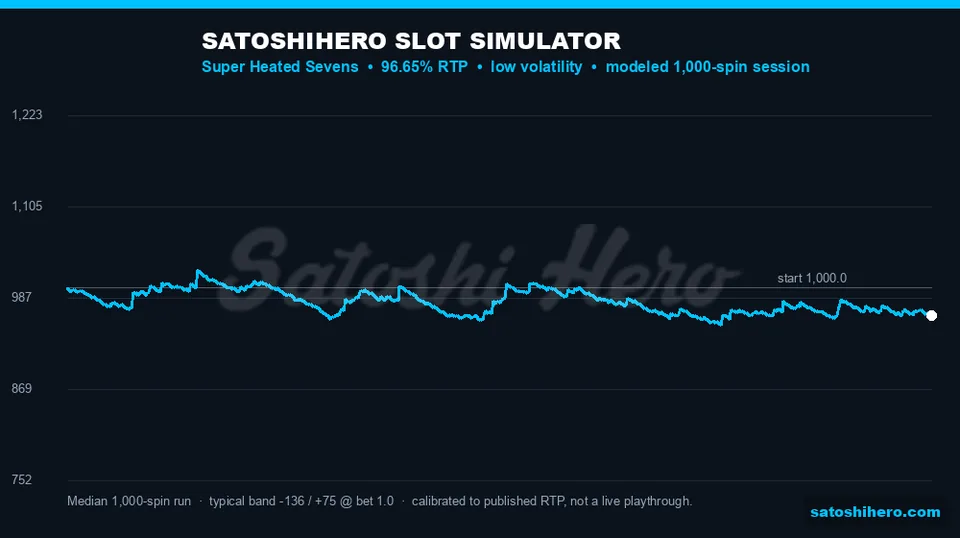
A feature-sized return comparable with a bonus win appeared about once per 121 spins in the model. That label describes payout size only because the actual game has no bonus round. A 100x-plus win appeared around once per 500,000 modeled spins. I wouldn’t interpret either frequency as a countdown toward your next hit.
The simulator illustrates a possible distribution and can’t predict the live RNG. You can use its range to understand variance, but not to forecast where one session ends. Its wide middle band shows why a calm slot may still generate a meaningful loss or gain. The projection feels valuable precisely because it doesn’t pretend that low volatility removes uncertainty.
Our 100-spin session
My $500.00 starting balance became $484.85 after 100 turbo-autoplay spins at $1.00 each. That equals a $15.15 net loss, and the final spin also lost. Six logged payouts from spins 70 through 100 returned $4.00, $0.80, $3.60, $5.60, $24.25, and $5.00. You can see how one larger result dominated that late section.
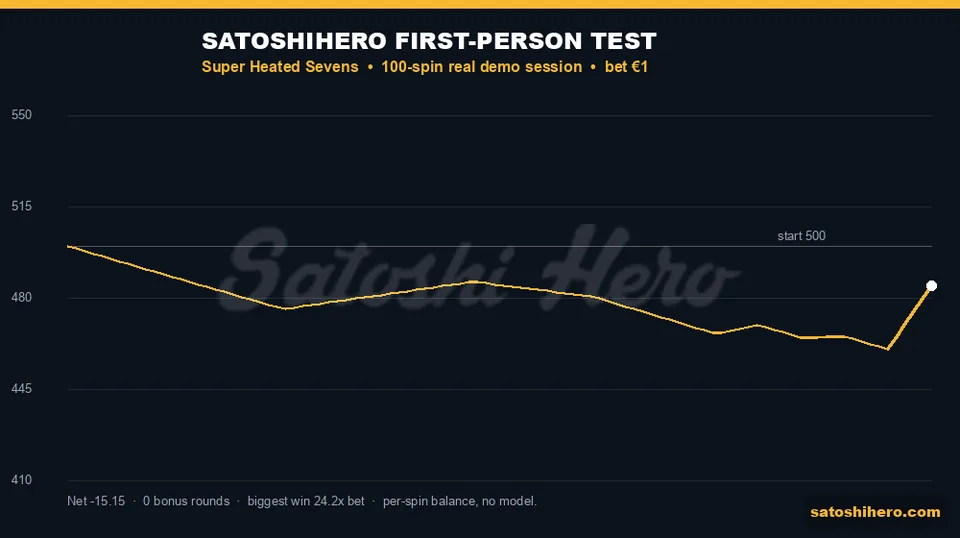
The $24.25 win arrived on spin 96 and lifted my balance from $459.60 to $483.85. I didn’t record the symbols behind it, so I won’t assign a combination after the fact. No bonus round existed to trigger during the run. For me, the late recovery softened the loss without turning the test profitable.
This record captures one genuine session rather than a typical promised outcome. Your sequence can differ from mine from the first spin onward. The six late payouts also don’t reveal every earlier result because my detailed log began at spin 70. That limitation doesn’t change the verified starting balance, ending balance, or net loss.
The theoretical figure comes from the operator’s published return. One live session can’t confirm, disprove, or alter it, while the simulator only illustrates a possible spread from those inputs. There are no separate bonus-mode returns because the game has no bonus buy or bonus round.
Frequently Asked Questions
Does Super Heated Sevens have free spins or a bonus buy?
No. The game has no free spins, bonus round, or bonus buy. Three, four, or five scatter stars pay 5x, 20x, or 500x, while the gamble remains the only optional extra.
What does the wild do in Super Heated Sevens?
The red seven replaces every paying symbol except the scatter and has no independent award. On my extra spin, a full wild reel helped stacked cherries create a $2.00 win outside the counted test.
How does the Super Heated Sevens gamble feature work?
You choose red or black after an eligible win. A correct choice doubles the amount, a wrong one loses it, and you can continue for five rounds. The cap restricts the total, settings can disable gambling, and autoplay doesn’t offer it.
Which symbols pay the most in Super Heated Sevens?
Five golden bells pay 75x, five clovers pay 15x, and five grapes or watermelons pay 10x. Five scatter stars pay 500x anywhere on the reels.
What did the Super Heated Sevens 1,000-spin simulator show?
The median modeled session lost $35.70. The middle 90% ranged from a $135.60 loss to a $74.80 gain, illustrating possible variance rather than predicting your next result.
How did the 100-spin Super Heated Sevens test go?
I started with $500.00 and finished at $484.85, losing $15.15 at $1.00 per spin. My largest logged win reached $24.25, and no bonus round existed to trigger.
What are the Super Heated Sevens RTP, volatility, and maximum win?
The slot has a 96.65% theoretical RTP, low volatility, and a 1,500x maximum win. Its 5×3 grid uses 20 fixed paylines.
Closing Thoughts
Super Heated Sevens stands out through clear fixed lines, readable symbols, and a glossy twist on familiar fruit imagery. Its biggest drawback is the thin feature set, especially if you expect free spins or a bonus buy.

My Verdict
Choose it when you want a calm, transparent base game with no feature cost to calculate. Expect small line results to carry the session, while the optional gamble can sharply increase risk.
I like how easily I could track the wager and understand each pay. I don’t like the lack of a true bonus mode, and my late $24.25 recovery still left the 100-spin test down $15.15.
Super Heated Sevens keeps its promises modest and its rules visible. Its figures and mechanics are checked regularly, so you can assess the game using verified details and firsthand results.

Pros:
 Clear fixed lines: Twenty fixed paylines make standard wins easy to follow.
- Readable paytable: Grouped fruit values help you verify results quickly.
- Steady pacing: Lower variance keeps most balance moves relatively measured.
- Useful wild stacks: Full-height sevens can strengthen several fruit lines together.

Cons:
 No free spins: Every result stays inside the base game.
- Limited ceiling: The 1,500x cap may disappoint jackpot-focused players.
- Harsh gamble: One wrong color choice removes the entire risked win.

Best For: Traditional fruit-slot fans and careful bankroll managers get the clearest value here. The simple line system rewards attention to total stake, while bonus hunters may prefer something deeper.

































































Bets
All Bets
Game
Player
Date
Wager
Mult.Multiplier
Prize
 Halloween Harvest: Rapid Link
 Hidden
- 00:20:22
- 0×
- Halloween Harvest: Rapid Link
- Hidden
- 00:20:21
- 0×
- Halloween Harvest: Rapid Link
- Hidden
- 00:20:20
- 0×
- Royal Fruits 9: Hold 'n' Link
 mdp0fxo
- 00:20:19
- 0×
- Halloween Harvest: Rapid Link
- Hidden
- 00:20:19
- 0×
- Aztec Magic Deluxe
 RicoSoul
- 00:20:19
- 0×
- Halloween Harvest: Rapid Link
- Hidden
- 00:20:19
- 1.99×
- Royal Fruits 9: Hold 'n' Link
- mike_721
- 00:20:18
- 0×
- Halloween Harvest: Rapid Link
- Hidden
- 00:20:17
- 0×
- Halloween Harvest: Rapid Link
- Hidden
- 00:20:16
- 0×