

Santa's Factory
By pressing play, you agree that you are above legal age in your jurisdiction and that your jurisdiction allows online gambling.


Building Bigger Clusters in Santa’s Workshop
Santa’s Factory slot turns each paid spin into a hunt for connected clusters and feature-charging cascades.
Santa’s Factory is a high volatility Christmas slot from GameArt, played on a 7×7 grid with 96.32% RTP and 6,404x maximum win potential. Clusters, cascades, and queued grid modifiers replace paylines and free spins. It targets patient readers who accept uneven results while chasing longer cascade sequences.
Key takeaways
- Best bonus: Base play is the only tested route because I didn’t use the Buy Bonus.
- RTP / volatility: The mathematical profile creates uneven short sessions, so you need room for dry stretches.
- Max win: The prize ceiling reaches exactly 6,404x your total bet, which feels modest for this risk level.
- Risk note: Five-symbol clusters start wins, while cascades charge Santa’s Box without any free-spins round.
- Bankroll note: Choose a stake that supports a sustained run, and don’t react to one isolated loss.
You can read these points as the practical core: the meter matters more than a single symbol drop. I find the cascade engine engaging, though you shouldn’t mistake constant meter movement for steady returns.

Table of Contents
- How Santa’s Factory slot Works
- Cluster payouts
- Cascade engine
- Santa’s Factory slot Santa’s Box Features
- Meter and queue
- Four queued effects
- Santa Bonus and Splitting Wilds
- Full-meter trigger
- Splitting Wilds
- Buy Bonus Options
- Theme and First Impressions
- A 100-Spin Session
- RTP, Volatility and Test Results
- Simulator projection
- My 100-spin session
- Frequently Asked Questions About Santa’s Factory
- Closing Thoughts
How Santa’s Factory slot Works
You win by forming clusters of five or more matching symbols on the 7×7 grid. Each successful group disappears, then fresh symbols fall into the spaces and can extend that paid spin.
Matching symbols must touch horizontally or vertically. Diagonal contact alone doesn’t qualify, even when two symbols look close on the large board. Santa’s Factory slot has no fixed paylines, scatter symbol, or free-spins round. You should scan connected edges rather than trace paths from left to right.
GameArt built the title as a cluster-pays slot, and that choice gives each drop a clear purpose. I like how you can follow the board without calculating ways or checking line markers.
Cluster payouts
Every payout uses your total bet as its multiplier base. The compact paytable below shows each symbol’s return for clusters of five and at least fifteen:
- Snowman: 1x for five, rising to 60x for fifteen or more.
- Gingerbread man: 0.6x for five, rising to 20x for fifteen or more.
- Elf: 0.4x for five, rising to 10x for fifteen or more.
- Reindeer: 0.28x for five, rising to 6x for fifteen or more.
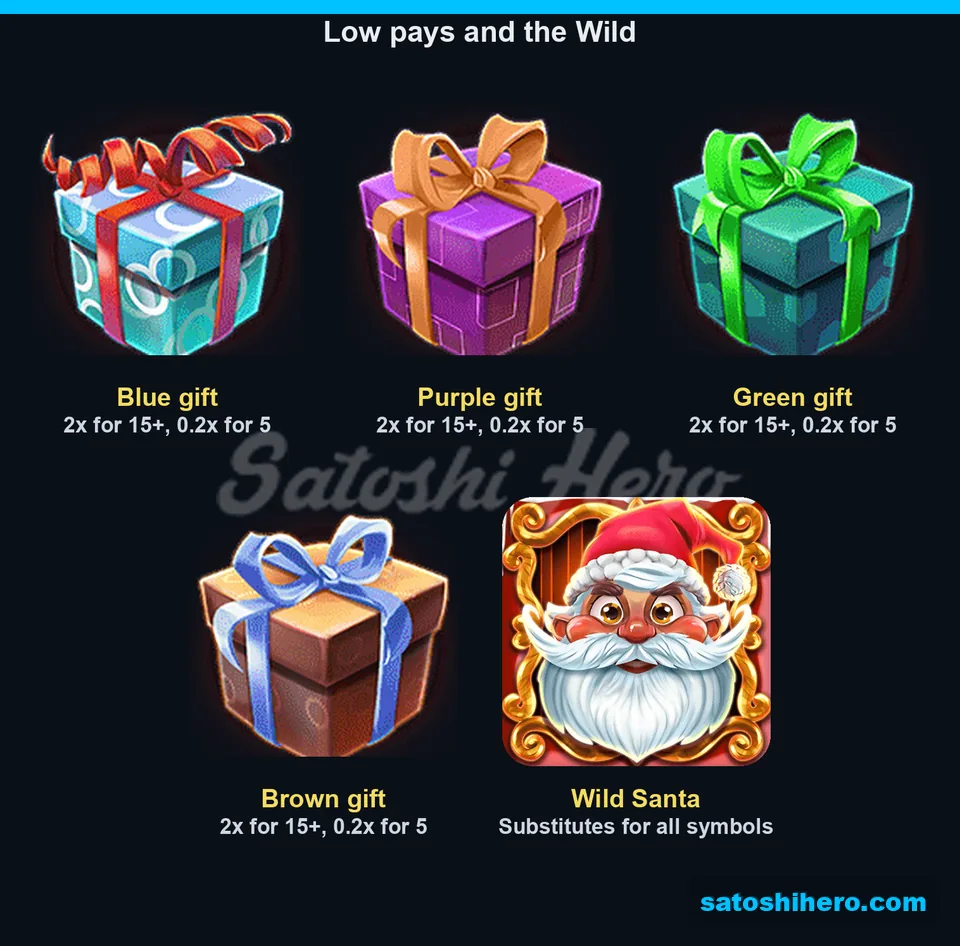
- Blue, purple, green, and brown gifts: 0.2x for five, rising to 2x for fifteen or more.
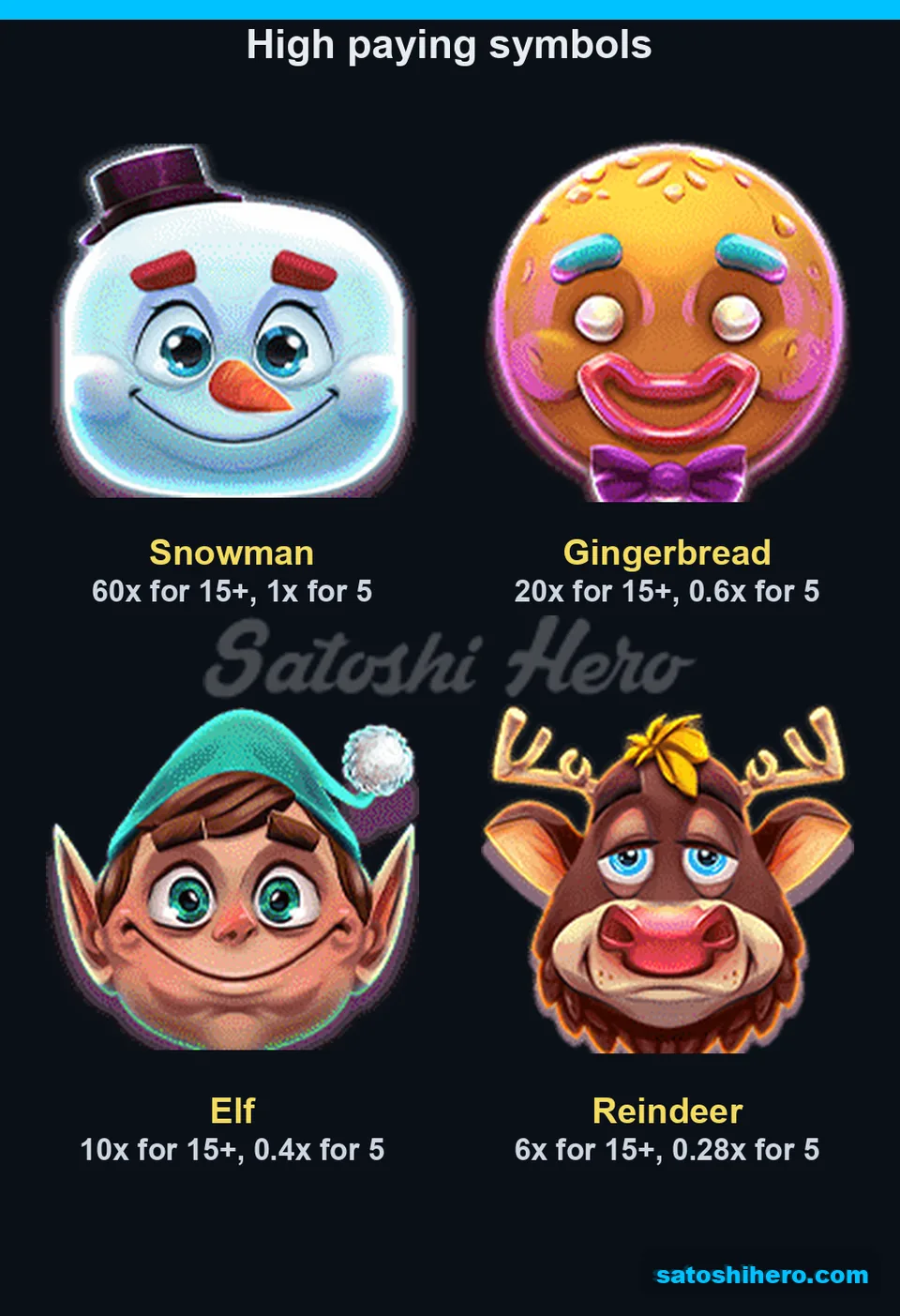
The snowman clearly carries the most weight, while the four wrapped gifts share identical values. Wild Santa substitutes for every standard symbol. You might find the low gifts unexciting alone, but their supporting mechanics make them useful during longer chains.
Cascade engine
Winning symbols vanish, and replacements drop into their former spaces. One paid spin can produce several linked wins, with every successful cascade charging Santa’s Box.
Three supporting mechanics can reshape a weak board. Four identical symbols arranged as a square merge into one 2×2 Super Sized Symbol, and any win containing it receives a 2x multiplier. When a paid spin opens without a win, Random Gifts can place up to eight Wilds. Gift Return highlights one low-paying gift each spin, and a highlighted winner leaves two 1×1 Wilds behind.
My $38.04 standout came from a long chain rather than one dramatic initial cluster. That result made the drop sequence much more exciting than the first connection.
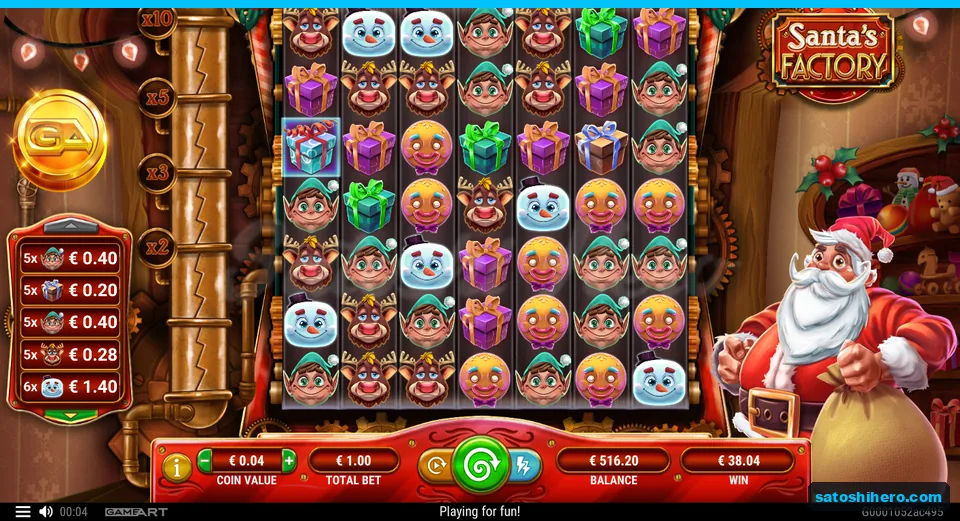
Small early clusters still matter because each removal changes the board above them. A low gift win can open a path for stronger characters, then Gift Return can leave useful Wilds behind. You won’t know the round’s real value until the grid settles and the queue finishes. I consider that delayed resolution the slot’s strongest mechanical hook.

Tip: Treat the first cluster as the start, not the finish. The strongest rounds need repeated cascades that keep charging the meter.
The practical takeaway is simple: watch the spaces created after every win, because extended cascades create most of the game’s momentum.
Santa’s Factory slot Santa’s Box Features
Santa’s Box converts consecutive cascade wins into queued grid modifiers. Rather than presenting four detached bonuses, Santa’s Factory slot connects them through one visible copper tube beside the board.
You can follow its colored segments without opening another screen. Each filled segment adds the matching effect to a queue, and those effects activate after ordinary cascades stop. I think this visible progress gives quiet rounds a useful objective, even though a partly filled meter doesn’t promise a payout.
Meter and queue
Consecutive wins fill colored sections within the tube. Once regular cascades end, queued effects alter the grid and can form another cluster. A new win restarts cascades, charges more effects, and keeps the same paid round alive.
The meter resets only when the round ends without another winning combination. Introduction screens indicate that one round can activate up to four different Santa’s Box features. You should treat that limit as feature capacity, not an expected outcome on every productive chain.
This system creates a satisfying loop because grid changes can feed the device that caused them. In my view, the queue feels more coherent than a collection of unrelated random modifiers.
Four queued effects
The queue draws from these four effects:
- Explosion: Changes up to eight symbols into Wilds and removes adjacent symbols.
- Slice and Dice: Adds a central Wild, then fills two diagonals with one selected symbol without replacing Wilds.
- Destruction: Removes all four low-paying gift symbols from the grid.
- Swap Shop: Changes every instance of one selected low-paying gift into another symbol.
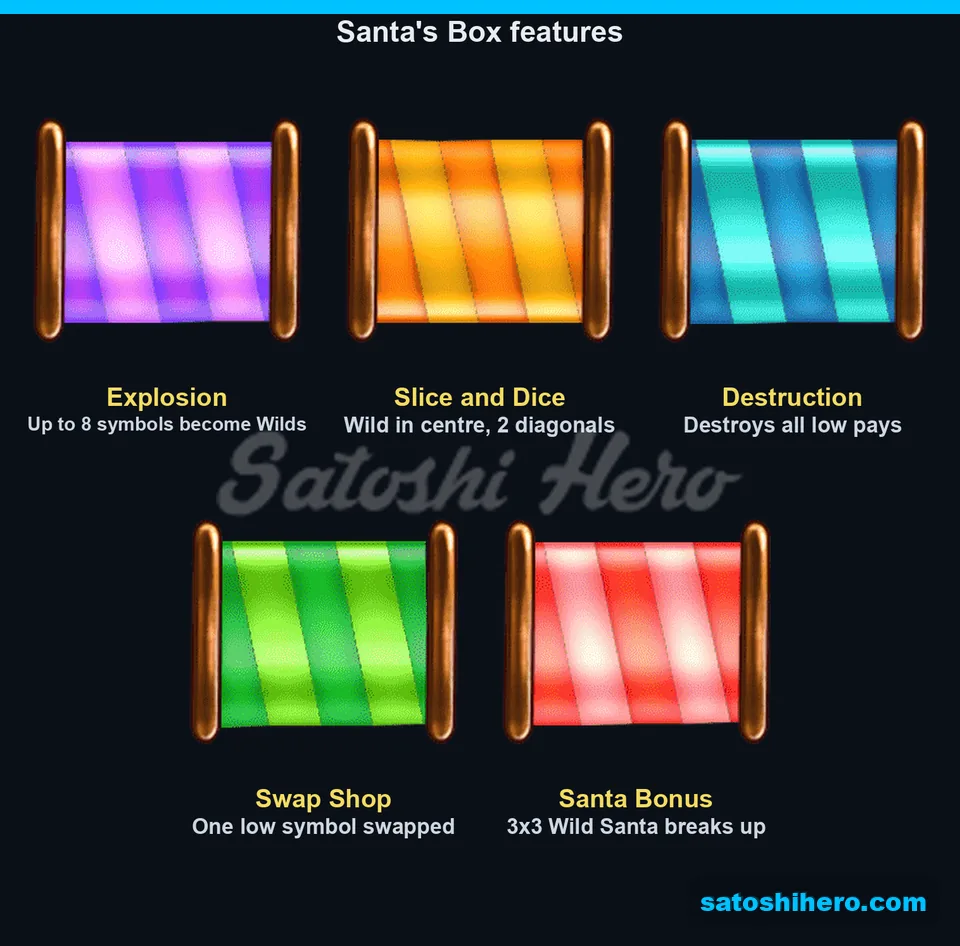
The tube also displays x2, x3, x5, and x10 Total Win Multiplier levels. The number of triggered features determines the multiplier applied to the round total, but you shouldn’t expect a particular level before the queue resolves. I like the potential interaction between Destruction and later drops, although random selection limits your control.

Fast Fact: Santa’s Box charges from wins inside the active cascade sequence. It doesn’t rely on scatters or a free-spins trigger.
A successful queue effectively gives the same paid spin another chance to continue. Your best approach is to follow the whole sequence before judging what the opening cluster achieved.
Santa Bonus and Splitting Wilds
Filling the complete meter queues a multi-stage Wild transformation called the Santa Bonus. It remains inside the cascade round, so you don’t enter free spins or a separate bonus game.
The full-meter trigger differs from an ordinary colored segment. Only a completely filled Santa’s Box adds this event to the queue. You shouldn’t read the trigger as guaranteed profit because the resulting symbols still need useful connections.
Full-meter trigger
A 3×3 Wild Santa lands at a random grid position once the queued event begins. Its size creates many possible contact points, yet placement still shapes how much help it provides. I find that uncertainty more interesting than a fixed central block, though an awkward position can feel less productive.
Fresh symbols enter as the transformation advances. That detail matters because every stage gets a changed board rather than rechecking the same settled layout.
Splitting Wilds
After cascades from the 3×3 Wild stop, Santa divides into two 2×2 Wilds. When that phase finishes, the feature splits him again into nine 1×1 Wilds. New symbols drop before each next stage, giving those smaller blocks fresh cluster opportunities.
The progressive split spreads Wild coverage across more positions. You gain additional contact points, but you still need connected standard symbols to produce qualifying clusters. The mechanic is elaborate without changing the game’s core rule.

Trivia: The oversized Santa doesn’t vanish at once. He breaks into smaller Wilds across two further workshop-style phases.
I didn’t log this event as a separate free-spins result because no such mode exists. You should see the extra drops as the meter’s deepest extension, not an independent game with a promised return.
Buy Bonus Options
The Buy Bonus button can purchase up to five randomly triggered Santa’s Box features, but I didn’t use it during my test. That means base play remains the only evidence-backed route in this guide.
A purchase doesn’t guarantee the Santa Bonus, a particular multiplier, a profit, or access to the prize ceiling. Random feature selection also leaves you with little control once the bought sequence starts. I don’t think an untested purchase deserves a ranking or preferred level.
This distinction matters when you compare normal meter building with immediate feature access. Base spins let you watch clusters charge the queue naturally, while the button jumps to random effects without making their outcome predictable. You might value the shorter route, but you shouldn’t confuse speed with better value.
I also avoided inventing purchase prices or separate return figures. Santa’s Factory slot already has enough moving parts without unsupported estimates muddying the choice.
If you explore the button, set a separate spending limit before opening it. The practical takeaway is firm: don’t treat random bought features as a reliable shortcut to a positive session.
You can also compare a purchase against the number of ordinary spins it replaces within your budget. I prefer that concrete check to chasing a chosen effect, since the random queue doesn’t let you select one. If the cost would consume too much of your planned session, base play leaves more room to observe normal variance.
Theme and First Impressions
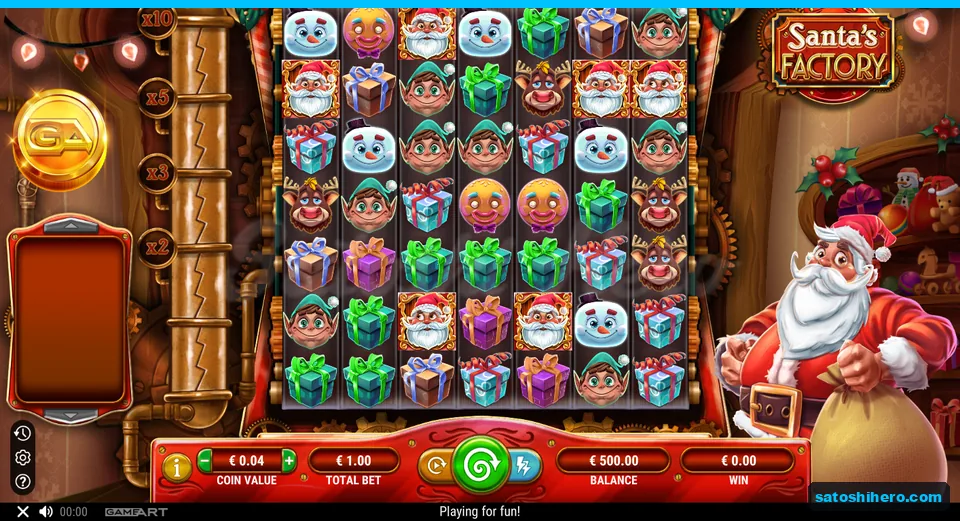
The Christmas workshop looks familiar, but its visible machinery makes feature progress easy to understand. Santa sits beside the 7×7 grid, while shelves packed with toys fill the background.
Elves, snowmen, gingerbread men, reindeer, and wrapped gifts keep the board tied to the setting. The copper tube works especially well because it looks like factory equipment while showing useful progress. You can read connected groups despite the busy board, and you can track the meter without leaving the main screen.
The workshop theme won’t win originality awards, but the visible tube and toy-filled presentation make each feature step easy to follow. I prefer that functional design to decorations that obscure symbols or hide what charged a feature.
The opening setup showed a $500.00 demo balance, a $1.00 total bet, and a $0.04 denomination. Its displayed stake range ran from $0.25 to $10,000.00 per spin. Those limits span very different budgets, so you should choose a stake from your own loss limit rather than the screen’s upper reach.
Xmas Express offers another festive setting if you want to compare holiday visuals, while this workshop emphasizes machinery beside the grid. Xtreme Summer Hot offers a seasonal contrast, while Xtreme Hot strips away the workshop story for a more traditional fruit-slot look.
Both demo and real play are available here on SatoshiHero. The presentation works most clearly when you watch the tube fill beside the settled board, not when you focus only on Santa’s artwork.
A 100-Spin Session
My 100 paid spins depended on a few extended cascade rounds rather than frequent medium-sized wins. Paid spin 26 produced the standout $38.04 result, equal to 38.04x my $1.00 stake.
The next notable wins reached $25.68 and $5.40. Only a handful of other rounds exceeded $2.00, which made those larger chains carry much of the session. I liked having the meter as an objective during quiet spells, but the result still relied on occasional long cascade chains.
Seven wins reached the displayed balance several seconds after the symbols stopped moving. I logged each delayed payment against the paid spin that generated it, so later balance changes didn’t distort my records. You should also wait for every cascade and queued effect to settle before recording a result.
No free-spins round occurred because Santa’s Factory slot doesn’t include one. That absence isn’t a missed trigger; the meter and queue provide the game’s feature structure instead. In my opinion, this keeps play focused, though fans of a separate spin bundle might miss that familiar change of pace.
The sample also doesn’t establish what your next 100 spins might do. Wolf Hunt gives animal-theme fans a different visual direction, but any comparison should still respect each game’s own risk profile and mechanics.
One or two productive cascade sequences can shape a short session. Your practical takeaway is to judge the completed round, including delayed payments, rather than the first settled grid.
RTP, Volatility and Test Results
The mathematical profile combines a 96.32% theoretical RTP, high volatility, and a 6,404x maximum win. You can face uneven losing stretches despite that published return, while the prize cap feels modest beside the risk.
Official specifications, simulator projections, and my observed play answer different questions. The first defines the game, the model maps possible session spreads, and my log records one real path. I think keeping those categories separate gives you a more honest picture than blending them into one claim.
Simulator projection
The SatoshiHero Slot Simulator used these settings:
- $1.00 stake.
- 1,000 spins per modeled session.
- The published mathematical profile.
- The official prize ceiling.
Its median modeled finish ended $61.00 down. The 5th-to-95th-percentile band stretched from $323.70 down to $348.30 up, showing a broad range around the same settings. About 18% of spins paid something within the model.
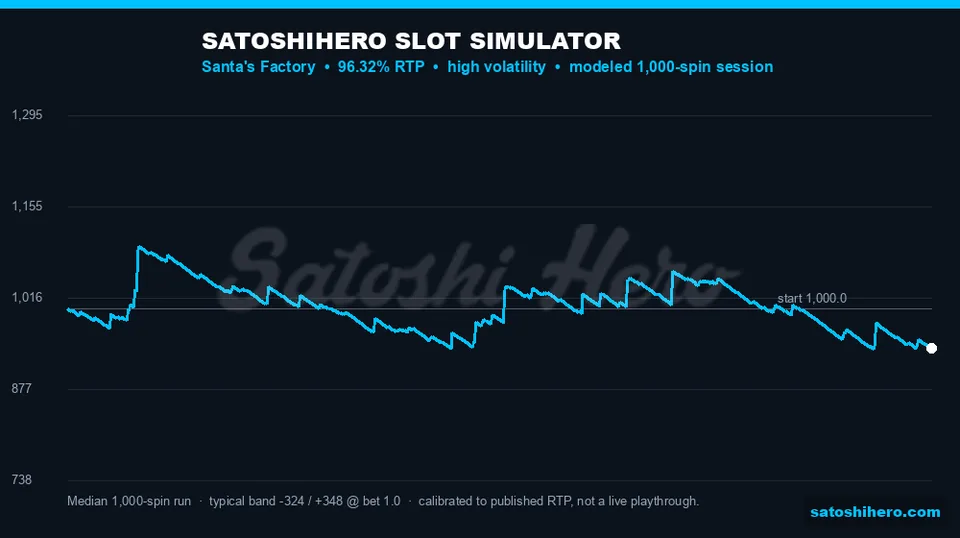
A feature-level hit appeared roughly once every 46 spins, while a result of at least 100x appeared about once every 1,527 spins. These frequencies describe the modeled distribution, not a countdown. You shouldn’t expect a feature merely because 45 spins passed without one.
I find the wide band more informative than the median alone. It shows how sharply two equal-length sessions can diverge, so your stake needs enough breathing room for the lower side of that spread.
The modeled feature interval also needs careful reading. An average gap can include features arriving close together, followed by a much longer quiet period. You gain no stored entitlement when a feature misses its rough frequency. In my opinion, the percentile band gives you a better risk picture than any single hit-rate estimate.
My 100-spin session
My observed figures were:
- Starting balance: $500.00.
- Stake: $1.00.
- Paid spins: 100.
- Total staked: $100.00.
- Final balance: $491.80.
- Net result: $8.20 loss.
- Total wins paid: $91.80.
- Paying spins: 30.
- Largest logged win: $38.04, equal to 38.04x the stake.
That sample produced a 91.8% session return. It doesn’t replace or alter the theoretical figure, and your run can follow a very different path. Thirty paying spins also shouldn’t be compared directly with the modeled hit rate as though both samples measure the same future result.
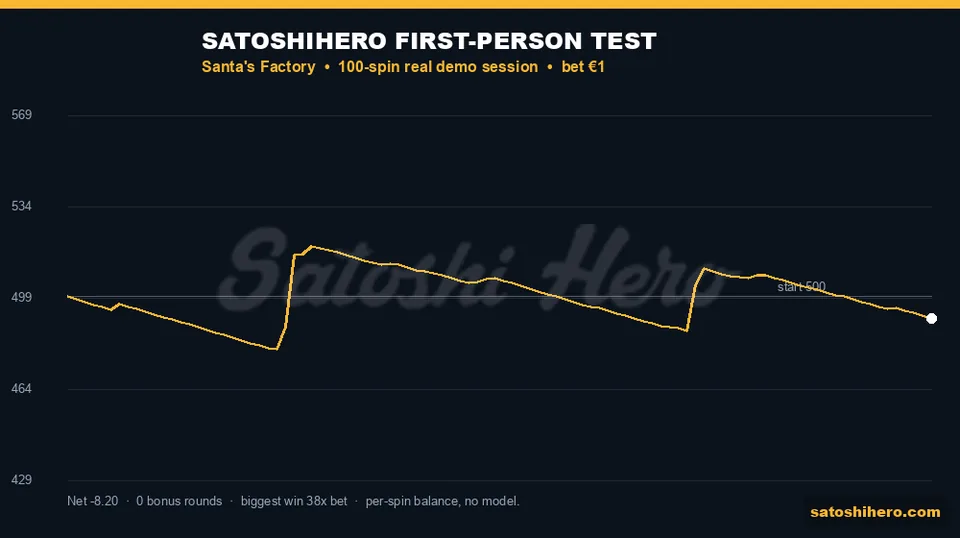
My largest win supplied more than a third of the $91.80 paid total. The $25.68 result also carried considerable weight, leaving the smaller rounds unable to describe the session alone. You can see why one extra long cascade might have changed the final balance sharply. I view the $8.20 loss as mild, but not especially representative.

Alert: High volatility means another 100-spin run could look very different. Set your stake first, and don’t raise it to chase a recovery.
The operator’s published theoretical return describes the game mathematics, while one live session has no bearing on that figure. Bonus configurations can differ slightly by design; official details, simulator modeling, and my observations remain separate evidence classes.
Game details and testing notes undergo routine checks. The modest test loss represents one possible path, not the result you should expect.
Frequently Asked Questions About Santa’s Factory
How does Santa’s Factory slot work?
Santa’s Factory slot uses a 7×7 cluster-pays grid. Five or more matching symbols must touch horizontally or vertically, while diagonal contact alone doesn’t count. Winners disappear, replacements drop, and every successful cascade charges Santa’s Box for possible queued modifiers.
What does the Santa Bonus do in Santa’s Factory slot?
A completely filled meter queues the Santa Bonus. It places a 3×3 Wild Santa, then splits him into two 2×2 Wilds after cascades stop. The final stage creates nine 1×1 Wilds, with fresh symbols entering before each phase.
Which mathematical specifications define Santa’s Factory slot?
Santa’s Factory slot has 96.32% RTP, high volatility, and a 6,404x maximum win. It follows a cluster-pays format, and those figures describe its mathematical design rather than guaranteeing what you receive during one session.
What are the best-paying symbols in Santa’s Factory slot?
The snowman pays 60x for a cluster of at least fifteen. At that size, the gingerbread man pays 20x, the elf 10x, the reindeer 6x, and each gift 2x. Wild Santa substitutes for all standard symbols.
What did the 1,000-spin Santa’s Factory slot simulator show?
The modeled median ended $61.00 down, with a band from $323.70 down to $348.30 up between the stated percentiles. Its approximate hit rate reached 18%. This distribution illustrates possible outcomes and doesn’t predict your session.
What happened during my 100-spin Santa’s Factory slot test?
I started with $500.00 and finished with $491.80 after staking $1.00 across 100 paid spins. My net loss was $8.20, with 30 paying spins and a $38.04 largest win. Those figures cover one first-person session only.
Closing Thoughts
Santa’s Factory stands out through a meter that turns ordinary cascades into visible feature progress. Its connected queue feels purposeful, but the prize cap seems restrained against the uneven risk you accept.

My Verdict
Patient cluster fans should try the demo before risking real funds. Expect quiet stretches, occasional long chains, and random modifiers that don’t promise a recovery.
I like the readable 7×7 board, delayed feature queue, and the way my $38.04 win grew across several drops. I don’t like how heavily my short test leaned on two larger results, especially without a separate free-spins mode.
This Santa’s Factory slot guide is checked regularly, with first-person observations kept distinct from modeled outcomes. You should use the evidence to set expectations, then choose a stake that protects your limit.

Pros:
 Clear clusters: Connected groups remain readable across the large grid.
- Visible progress: The copper tube shows how cascades build queued effects.
- Layered Wilds: Santa’s multi-stage split creates several fresh cluster chances.
- Useful demo: You can learn the queue before using real funds.

Cons:
 Uneven returns: Short sessions can depend heavily on a few cascade chains.
- Modest ceiling: The top prize feels restrained beside the risk profile.
- No free spins: Feature fans don’t get a separate spin bundle.

Best For: Patient cluster players who enjoy tracking a visible meter and letting multi-stage rounds finish. You need comfort with uneven results, firm stake control, and no expectation of free spins.


































































Bets
All Bets
Game
Player
Date
Wager
Mult.Multiplier
Prize
 Galaxy Glitter
 nina87
- 12:02:03
- 0.46×
- Luck of Panda: Bonus Combo
- Hidden
- 12:02:03
- 0×
- Big Banker Bonanza
 maya_81
- 12:02:03
- 0×
- Pelican's Bay: Rapid Link
 blazecraft
- 12:02:01
- 0.19×
- Luck of Tiger: Bonus Combo
- Hidden
- 12:02:00
- 0×
- Frontier Falcon: Hold 'N' Link
- josh1998
- 12:01:59
- 0.14×
- Piggy Bonanza Halloween
 flaviocas82
- 12:01:57
- 1×
- Galaxy Glitter
 Hidden
- 12:01:56
- 0×
- Piggy Bonanza Halloween
- flaviocas82
- 12:01:54
- 0×
- Galaxy Glitter
 Hidden
- 12:01:54
- 0×