

Lady Luck
By pressing play, you agree that you are above legal age in your jurisdiction and that your jurisdiction allows online gambling.


Reading the Fortune in Lady Luck’s Parlour
Spin through Lady Luck’s bright fortune-teller parlour, where approachable play meets a fairly modest prize ceiling.
Lady Luck is a traditional GameArt slot with low-medium volatility, 95.93% RTP, and 1,453x maximum win potential. Its 5×3 layout has 20 fixed paylines and one simple free-games feature, giving you familiar line play without complex feature chains.
Key Takeaways
- Best bonus: Land at least three crystal-ball scatters for 15 free games with 3x wins; there’s no bonus buy.
- RTP / volatility: The theoretical RTP is 95.93%, paired with low-medium volatility.
- Max win: The prize ceiling reaches 1,453x the bet.
- Risk note: The optional red-or-black gamble can erase a win and allows five consecutive attempts.
- Bankroll note: My 100-spin run lost 59.8x the stake, never led, and triggered no free games.

Table of Contents
- How Lady Luck Works
- Line-win rules
- Special-symbol roles
- Free Spins
- Trigger and multiplier
- What testing showed
- What the Base Game Felt Like
- Hit frequency
- Biggest observed win
- Theme and First Impressions
- Gamble Feature
- Double-or-nothing rules
- Testing decision
- Paytable and Prize Ceiling
- Charm and card pays
- Wild and scatter pays
- RTP, Volatility and Our Test
- Simulator projection
- Our 100-spin session
- Frequently Asked Questions About Lady Luck
- Closing Thoughts
How Lady Luck Works
Lady Luck uses a traditional 5×3 layout with 20 fixed paylines. Qualifying combinations begin on reel 1, then continue across consecutive reels from left to right. You get only the highest qualifying combination on each active line. When several lines hit together, their separate values combine into one displayed result.
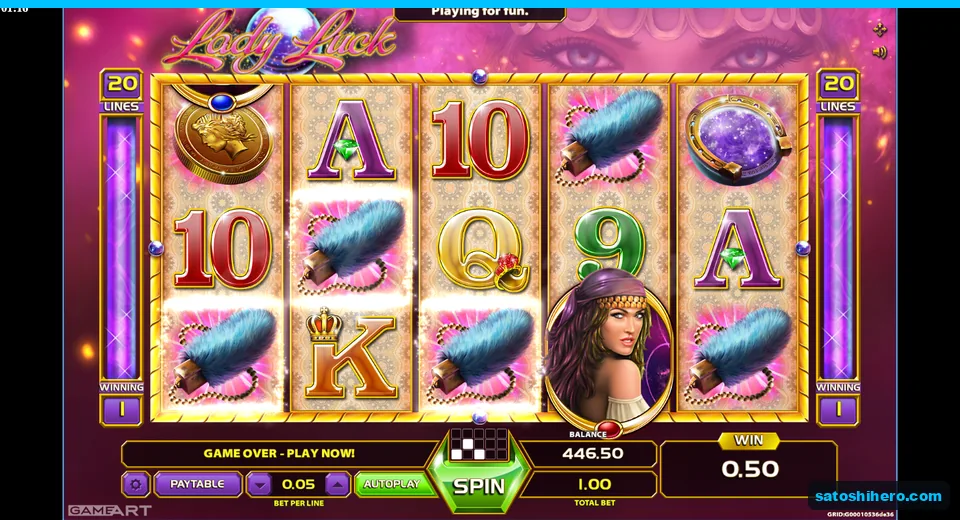
The crystal-ball scatter breaks that line rule because it pays from any positions. Rewards appear as multiples of the total bet, rather than dollar figures. My default $1.00 total stake divided into $0.05 across each of the 20 lines. I found that setup clear, though the fixed line count leaves little room to personalise play.
One settled gallery spin returned $0.50 from a $1.00 stake. I played it after the logged session, so it isn’t part of my tracked sample. The interface adapts across desktop and mobile layouts. You can try play money or real play here on SatoshiHero.
Line-win rules
Suppose matching ladybugs appear on reels 1, 2, and 3 along an active line. That sequence qualifies because every symbol connects without a gap. If reel 2 misses, another ladybug on reel 4 can’t repair the broken path. Consecutive reels matter more than the total matching symbols you can see.

Several highlighted lines can qualify during the same spin, and their values add together. You should follow each path from the first reel before checking the total. I find the clear highlights easier to read than many feature-heavy systems.
Special-symbol roles
The fortune-teller wild replaces every symbol except the crystal-ball scatter. Whenever it substitutes, it doubles the relevant line win, not every payment from that spin. The scatter pays from any reel positions and can combine with ordinary line rewards. You’ll notice both symbols quickly because their larger artwork stands apart from the charm icons.

Tip: A substituting wild doubles only the line win it joins; it doesn’t double every payout on that spin.
The conventional mechanics help newcomers, but you must follow connected positions rather than count matching pictures.
Free Spins
Three, four, or five crystal-ball scatters anywhere award 15 free games. Every winning combination during the feature gets a 3x multiplier, while another qualifying scatter combination can retrigger it. Your triggering stake and active line count remain unchanged. I like the clean rules, but one bonus leaves little variety when the trigger refuses to appear.

Free games form the slot’s only bonus, and you can’t buy entry. Two scatters still produce a normal 2x payment, yet they don’t start the feature. During my 100 spins, pairs appeared on spins 20, 78, 79, and 90. Each paid $2.00 from my $1.00 stake, but none added the third scatter I needed.
Trigger and multiplier
Scatter positions don’t need to follow a payline or begin on reel 1. Any three or more across the grid can start the 15-game round. The fixed initial award doesn’t limit retriggers, since another qualifying set can add a fresh feature. You should expect the same stake and 20 active lines throughout those games.
A 3x multiplier applies to every feature win. I didn’t trigger it, so I can’t judge its observed payout quality. You get simple rules here, not layered modifiers.
What testing showed
Four two-scatter results created visible near misses, but they never made a trigger more likely. Each spin remains independent, so the previous pair doesn’t place the feature closer. You shouldn’t increase your stake because several crystal balls nearly aligned. That chase would raise exposure without changing the next random outcome.
Missing the feature left my balance dependent on base-game returns. The $2.00 scatter payments helped briefly, yet they couldn’t reverse the slide. I found the repeated pairs teasing because the third symbol never arrived.

Fast Fact: Two crystal-ball scatters pay 2x the bet, but they don’t launch the 15 free games.
The feature is easy to understand, though you might not see it during brief play. My four pairs show why a paying scatter result and a bonus trigger aren’t the same event.
What the Base Game Felt Like
The base game produced regular paying spins, but many returns were too small to slow my balance decline. Thirty-three of 100 spins paid something, while only 15 returned at least my $1.00 stake. My balance never moved above its $500.00 starting point, and no free games appeared. You’ll feel activity here, yet that activity can hide a steady net loss.
A paying spin doesn’t always make money. If you stake $1.00 and receive $0.50, the game records a hit while your balance falls by $0.50. I found the session busy enough by raw hit count, but not rewarding enough to stop its downward drift. That difference matters more than celebratory animations or the number of highlighted lines.
Hit frequency
The 33 paying spins created a busy rhythm, but 18 returned less than the stake. You should watch balance changes instead of treating every payment as progress. In my experience, net movement gives a more honest picture than hit frequency.
Small returns can extend play by returning part of your stake. They don’t protect your bankroll when their values repeatedly trail the wager. I’d still prefer fewer meaningful hits over many tiny returns.
Biggest observed win
My largest result arrived on spin 38 and paid $8.00 from the $1.00 stake. Four ladybugs first formed a 3.75x line combination. A substituting wild doubled that line to 7.5x, while another 0.5x line raised the full result to 8x. You can see three mechanics working together in that one outcome.
That result demonstrates why separate paylines and wild substitution need careful reading. The wild doubled only its joined ladybug line, then the game added the second qualifying line. You shouldn’t treat my 8x hit as typical or predictive. I liked its transparent calculation, but it remained too small to repair the earlier losses.

Trivia: A spin can count as a win while returning less than your stake, so hit frequency doesn’t measure profitability.
Frequent small hits kept the reels moving without protecting my bankroll. The session’s best result offered a neat mechanical example, not a turning point.
Theme and First Impressions
The game uses a bright pink-and-violet fortune-teller parlour filled with familiar symbols of good luck. A crystal ball sits above the logo, while the fortune teller watches beside the fifth reel’s wild frame. You’ll see a golden coin, four-leaf clover, horseshoe, ladybug, and rabbit’s foot. Ace through nine provide the more conventional lower-value symbols.
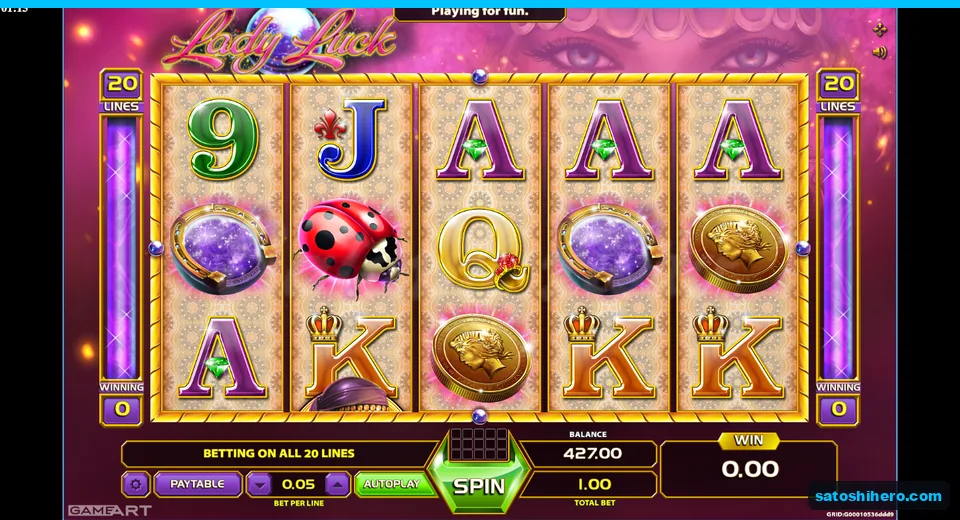
Its luck be a lady concept won’t win originality awards, but the colour coding makes the reels easy to scan. The demo presents play-money figures without a currency sign, so I report observed results in dollars and paytable rewards as bet multiples. You can separate the bright charms from the card ranks at a glance. I value that clarity more than the rather predictable theme.
Dragon Lady also builds its presentation around a title character, while this game uses a fortune teller surrounded by lucky charms. That visual contrast gives you a useful thematic choice without implying different mathematics. The parlour feels softer and more playful than a dramatic character portrait. In my opinion, the smaller visual stakes match the restrained prize profile. Xtreme Summer Hot and Xtreme Hot provide fruit-machine alternatives from GameArt, while Xmas Express shifts toward a festive railway setting.
The phrase Lady Luck casino can suggest a venue rather than this GameArt title. Here, the name means the fortune-themed slot on this page. Lady Luck slots can describe unrelated games, so use the pink parlour and crystal-ball bonus as identifiers.
Familiar artwork supports quick reading, and its clean presentation keeps your attention on paylines.
Gamble Feature
After a win, the optional gamble feature lets you risk that return on a red-or-black choice. A correct colour doubles the amount, while a wrong choice reduces the gambled win to $0. You can gamble again after success, with the sequence stopping after five attempts. I consider that limit sensible, though one mistake can still erase a useful payment.
Players can enable or disable the option in the settings menu. I kept it switched off so an accidental click couldn’t alter my tracked balance. That choice preserved a clean record of ordinary reel outcomes rather than creating results from side decisions. You might prefer the extra tension, but it doesn’t improve the underlying mathematical return.
Double-or-nothing rules
Imagine winning $2.00 and choosing red. A correct pick raises the held amount to $4.00, then another correct choice can double it again. Each success increases both the possible reward and the full amount exposed to the next guess. You lose the gambled sum after one incorrect colour, regardless of earlier successful choices.
The decision is pure chance rather than a skill test. Repeated attempts concentrate risk into one binary result. You should compare the confirmed amount with what you’re comfortable losing. I don’t think a small win improves merely because a risk button appears.
Testing decision
Disabling it tied every balance change to a reel result and protected my 100-spin record. You can do the same when measuring base play. My decision changed risk handling, not random outcomes.

Alert: Even with low-medium volatility, gambling creates immediate all-or-nothing risk and can turn a recorded win into $0.
Preserving confirmed wins mattered more to me than chasing a larger short-term result. You should treat each gamble as a separate risk decision after the reels stop.
Paytable and Prize Ceiling
The fortune-teller wild offers the largest individual symbol payout, while the official maximum win reaches 1,453x the bet. All figures below use a $1.00 total stake, making each multiplier equal to its dollar return. You can compare the symbol groups quickly, although the gap between ordinary charms and special icons is steep. I think the full prize ceiling feels modest beside more aggressive slots.
Charm and card pays
The golden coin and four-leaf clover lead the regular symbol hierarchy. Their two-symbol payments also make them unusual among the higher charms. Here are the rewards you can form on connected paylines:
- Golden coin: 0.1x for two, 1.25x for three, 5x for four, and 37.5x for five.
- Four-leaf clover: 0.1x for two, 1.25x for three, 5x for four, and 37.5x for five.
- Horseshoe: 0.75x for three, 5x for four, and 20x for five.
- Ladybug: 0.5x for three, 3.75x for four, and 12.5x for five.
- Rabbit’s foot: 0.5x for three, 2.5x for four, and 12.5x for five.
Card symbols sit lower in the hierarchy:
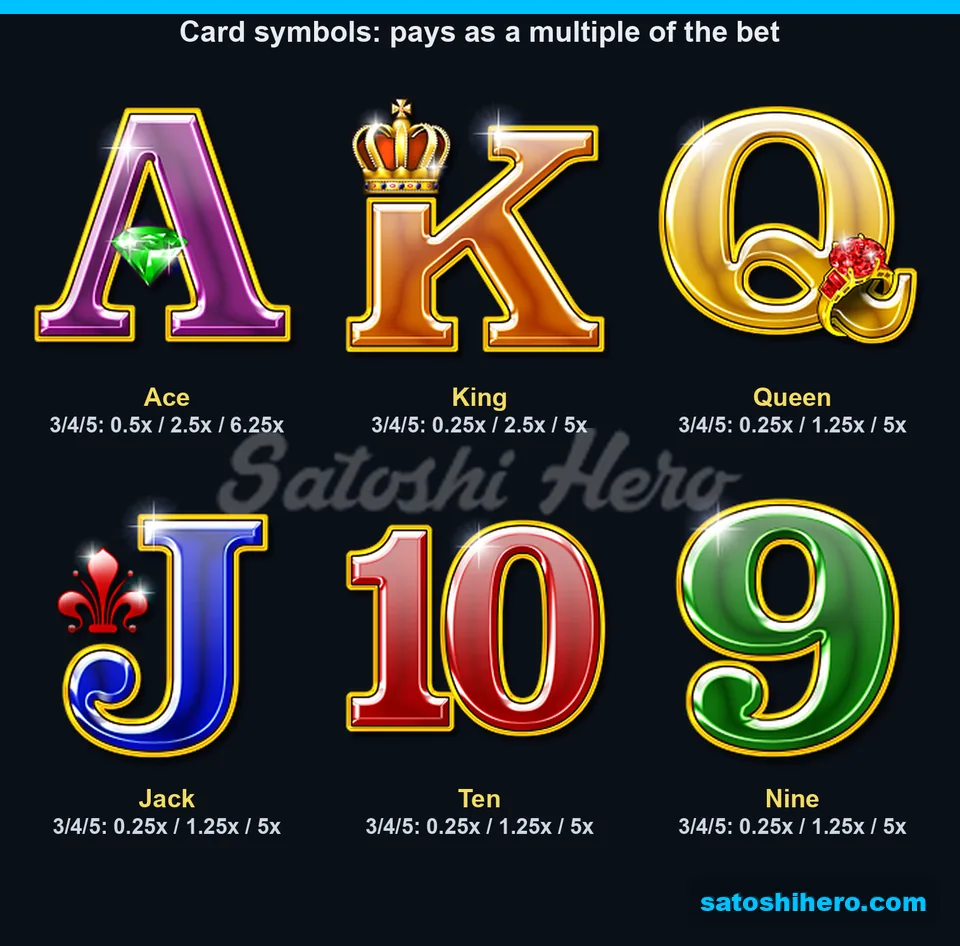
- Ace: 0.5x, 2.5x, and 6.25x for three, four, and five.
- King: 0.25x, 2.5x, and 5x for three, four, and five.
- Queen, jack, and ten: 0.25x, 1.25x, and 5x for three, four, and five.
- Nine: 0.1x for two, then 0.25x, 1.25x, and 5x for three through five.
Two golden coins, clovers, or nines can pay before most combinations begin. You should check those exceptions before assuming every line needs three matching symbols. I found the hierarchy logical once I separated charms from cards.
Wild and scatter pays
The fortune-teller wild replaces all symbols except the scatter and doubles any line it completes. It pays 0.5x for two, 10x for three, 100x for four, and 450x for five. You’ll get the clearest value when wilds strengthen an existing line.
Crystal-ball scatters pay from any positions at 2x, 5x, 20x, or 400x for two through five. Their rewards add to line wins, so you should inspect both result types. My four scatter pairs each matched the listed 2x payment.
Neither five wilds nor five scatters alone reaches the 1,453x ceiling. Combined outcomes can exceed either award. I like the transparent totals, though the upper cap lacks blockbuster scale.
RTP, Volatility and Our Test
Lady Luck has a 95.93% theoretical RTP, low-medium volatility, and a 1,453x maximum win. That profile usually produces smaller, more regular returns than highly volatile play, but losing stretches remain possible. Your balance doesn’t have to stay near its opening level. I found the modest headline risk far less comforting after watching many small hits fail to cover their stakes.
Projection and observed play answer different questions. The simulator describes modeled sessions, while my log records one actual run. You shouldn’t treat either as a forecast for your next result.
Simulator projection
The SatoshiHero Slot Simulator modeled 1,000 spins at a $1.00 stake. Its typical finish landed about $45.30 down, equivalent to 45.3x the bet. The fifth-to-95th-percentile range stretched from roughly $172.00 down to $96.80 up. You can see how widely sessions sharing the same settings can finish.
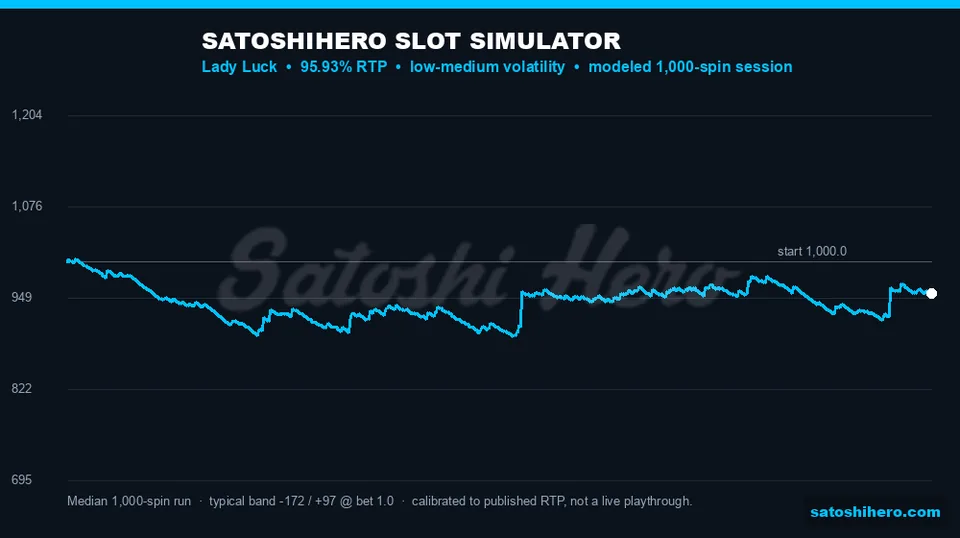
About three spins in ten returned something in the model. A feature-sized result appeared roughly once every 69 simulated spins, while a top-range result appeared around once every 90,909. Those frequencies describe a large modeled distribution, not a countdown. I think the wide result band matters more than the tidy average because it shows the range you could experience.
No modeled frequency makes an event due after a dry spell. You shouldn’t infer that 68 misses force a feature on spin 69. Each figure describes session shape rather than a particular reel stop.
Our 100-spin session
I played 100 spins at the default $1.00 stake and logged the balance after each one. My starting $500.00 fell to $440.20, leaving me $59.80 down, or 59.8x the stake. The gold balance line drifted downward and never rose above its opening point. You can read that as one real example of short-session variance, not a promised pattern.
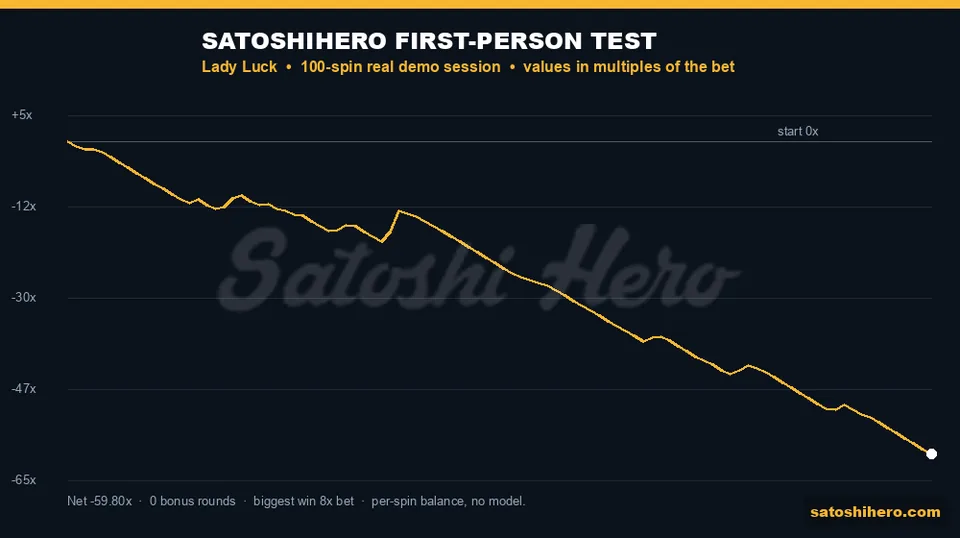
- Starting balance: $500.00
- Stake: $1.00 per spin
- Ending balance: $440.20
- Net result: $59.80 down
- Paying spins: 33
- Returns of at least 1x: 15
- Largest win: $8.00
- Two-scatter payouts: Four
- Free-games triggers: None
The live loss exceeded the model’s typical loss, but that comparison gives context rather than proof. My four scatter pairs paid $2.00 each, and spin 38 supplied the $8.00 high point. I found the gap between 33 hits and 15 full-stake returns revealing.
Theoretical RTP is the operator’s published return figure, while one live session doesn’t alter it. Simulator figures are modeled projections rather than observed outcomes, and feature-level returns can differ slightly from the base game by design. I won’t invent a separate free-games RTP when my feature never triggered.
My real test shows what short-session variance can look like, not what your balance must do. You should use the figures as context and set a limit before spinning.
Frequently Asked Questions About Lady Luck
How does Lady Luck play?
Lady Luck uses a 5×3 grid with 20 fixed paylines. Wins begin on reel 1 and continue across consecutive reels from left to right, with only the highest combination paid per line. Separate line awards combine, while crystal-ball scatters pay from any positions.
What are the RTP and volatility of Lady Luck?
The slot has 95.93% theoretical RTP, low-medium volatility, and a 1,453x maximum win. That profile leans toward smaller, steadier returns than aggressive high-volatility play, but it doesn’t guarantee a smooth balance.
How do you trigger the free spins in Lady Luck?
Land three, four, or five crystal-ball scatters anywhere to receive 15 free games. Every feature win gets a 3x multiplier, qualifying scatters can retrigger, and the original stake remains active. I didn’t trigger the feature during my 100 spins.
What does the wild do in Lady Luck?
The fortune-teller wild substitutes for every symbol except the scatter. It doubles a line win when substituting and pays $450.00 for five wilds on one line at a $1.00 stake.
Which results did the 1,000-spin simulator project?
The model’s typical session finished 45.3x down, with a range from roughly 172x down to 96.8x up. Around three spins in ten returned something. These projections don’t predict the next result.
How did my 100-spin Lady Luck session go?
I started with $500.00 and finished at $440.20 after staking $1.00 each spin, a $59.80 loss. Thirty-three spins paid, my largest win reached $8.00, and no free games triggered.
Is there a bonus buy in Lady Luck?
No. The only bonus is the 15 free games awarded by at least three crystal-ball scatters, so you must trigger it through ordinary play.
Does Lady Luck have a gamble feature?
Yes. After a win, you can choose red or black for a chance to double it, repeating up to five times. One wrong choice loses the gambled amount, and I disabled the setting during my logged test.
Are Lady Luck spins based on skill or chance?
Spin outcomes depend on chance. Your stake choice and decision to gamble affect risk management, but neither changes random reel results or turns the game into a skill contest.
Closing Thoughts
Lady Luck offers readable fixed lines, a doubling wild, and simple 3x free games. Its modest ceiling and single bonus limit excitement. You get an old-school experience rather than a feature-packed spectacle.

My Verdict
Choose this game when clear paylines and frequent small returns matter more than complicated modifiers. Expect plenty of partial payments, and don’t assume the main feature must appear during a short session.
I like how the wild, multiple lines, and scatter totals remain easy to verify. I don’t like that my 33 paying spins still ended $59.80 down, while four scatter pairs never became a bonus. The test felt active without ever feeling generous.
Lady Luck stays simple enough to learn quickly, and this guide is updated periodically.

Pros:
 Clear paylines: Highlighted paths make each connected win easy to verify.
- Useful wild: Substitution doubles the joined line and can strengthen ordinary combinations.
- Simple bonus: Fifteen free games apply a clear 3x multiplier to every win.
- Readable design: Distinct charms and card ranks stay easy to separate.

Cons:
 Modest ceiling: The 1,453x cap trails more aggressive slot prizes.
- Single bonus: Missing the scatter trigger leaves only base play and gambling.
- Weak test return: Frequent small hits didn’t prevent my balance declining steadily.

Best For: You’ll appreciate the clear rules if fixed paylines and measured pacing matter to you. Bonus hunters seeking layered mechanics or huge prizes could find it restrained.



































































Bets
All Bets
Game
Player
Date
Wager
Mult.Multiplier
Prize
 Desert Riches: Hold 'N' Link
 Hidden
- 02:20:18
- 50.5×
- Elephant's Gold: Bonus Combo
- nina87
- 02:20:16
- 0×
- Golden Tree
 mdp0fxo
- 02:20:16
- 0×
- Golden Tree
 mbongigycolombe
- 02:20:16
- 1.19×
- Elephant's Gold: Bonus Combo
 tess1973
- 02:20:15
- 0.39×
- Desert Riches: Hold 'N' Link
- Hidden
- 02:20:15
- 0.2×
- Almighty Diamonds: Hold 'N' Link
- Hidden
- 02:20:14
- 4×
- Desert Riches: Hold 'N' Link
- Hidden
- 02:20:12
- 0×
- Elephant's Gold: Bonus Combo
- nina87
- 02:20:09
- 0.6×
- Desert Riches: Hold 'N' Link
- Hidden
- 02:20:09
- 0.4×