

Buffaloes Duel
By pressing play, you agree that you are above legal age in your jurisdiction and that your jurisdiction allows online gambling.

Buffaloes Duel
RTP96%
VolatilityVery high
Max winx2,321
Hit rate21.57%
ThemeWild West
ReleasedJun 2022

Mirrored Buffaloes Clash Across the Savanna
The Buffaloes Duel slot turns every spin into a mirrored showdown, pairing stacked Buffalo Wilds with whole-spin multipliers reaching x10. This GameArt wildlife slot combines very-high volatility, a 96% RTP, 2,321x maximum win, 5×4 grid, and 50 fixed paylines. Regular wins run left to right, while Eagle Scatters pay anywhere, making it better for patient fans of unusual mechanics.
Key Takeaways
I lost $16.84 across 100 paid $1.00 spins, with a $47.04 best hit and no free games. The SatoshiHero demo opened at $500.00 and showed $0.02 per line, though those were test settings rather than universal limits. I saw no Gamble option, and the mirrored design made disciplined staking essential.
- Best bonus: The base game supplied my main action, while paired Buffalo Wilds can create whole-spin Clash multipliers.
- RTP / volatility: The mathematical profile allows sharp short-session movement, as my uneven results showed.
- Max win: The fixed payout ceiling feels restrained beside the game’s risk level.
- Risk note: Six Eagle Scatters start free games, but none appeared during my 100 paid spins.
- Bankroll note: My balance fell from $500.00 to $483.16, so choose stakes that leave room for losing stretches.

Table of Contents
- How Buffaloes Duel Works
- Grid and win rules
- Symbols and pay values
- Mirrored Reels
- Opposite reel motion
- Paired symbol behavior
- Theme and First Impressions
- Clash Multiplier
- How multipliers step up
- Impact in my test
- Free Games
- Scatter trigger thresholds
- Result from my session
- What the 2,321x Cap Means
- RTP, Volatility and Our Test
- What the simulator projects
- Our 100-spin session
- Bankroll Lessons From 100 Spins
- What losses looked like
- Practical stake control
- Frequently Asked Questions
- Closing Thoughts
How Buffaloes Duel Works
According to GameArt, the game uses a 5×4 grid, 50 fixed paylines, and left-to-right line evaluation. You need matching regular symbols on adjacent reels, beginning with reel one. Its rules feel conventional until the paired reels begin moving in opposite directions.
Grid and win rules
Each payline checks consecutive reels from the left and counts only its highest winning combination. Eagle Scatters provide the sole exception because they pay across any visible positions. You can read the fixed lines easily, although the reflected symbol layout initially makes the board look busier.
My demo started with a $1.00 total stake, displayed as $0.02 across each line. Those figures describe my setup, not the complete betting limits. During one base hit, lit Jack combinations returned $0.68 and showed how several modest fixed-line wins can combine.
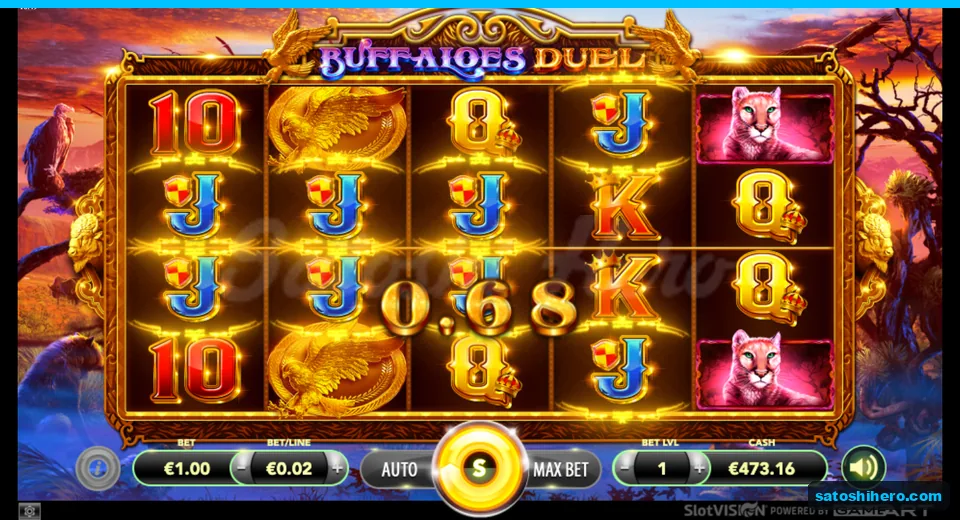
The same controls and rules remain easy to follow across supported screen sizes. You should still check the total stake before spinning, since the per-line display can draw your eye first. In my view, the interface explains fixed paylines better than many more decorative wildlife games.
Symbols and pay values
The paytable has nine regular symbols, a Buffalo Wild, and an Eagle Scatter coin. At my tested $1.00 stake, the Wolf paid $4.00, $0.80, or $0.12 for five, four, or three. Cougar returns were $2.00, $0.60, and $0.10, while Stag and Hare each showed $1.00, $0.30, and $0.08.
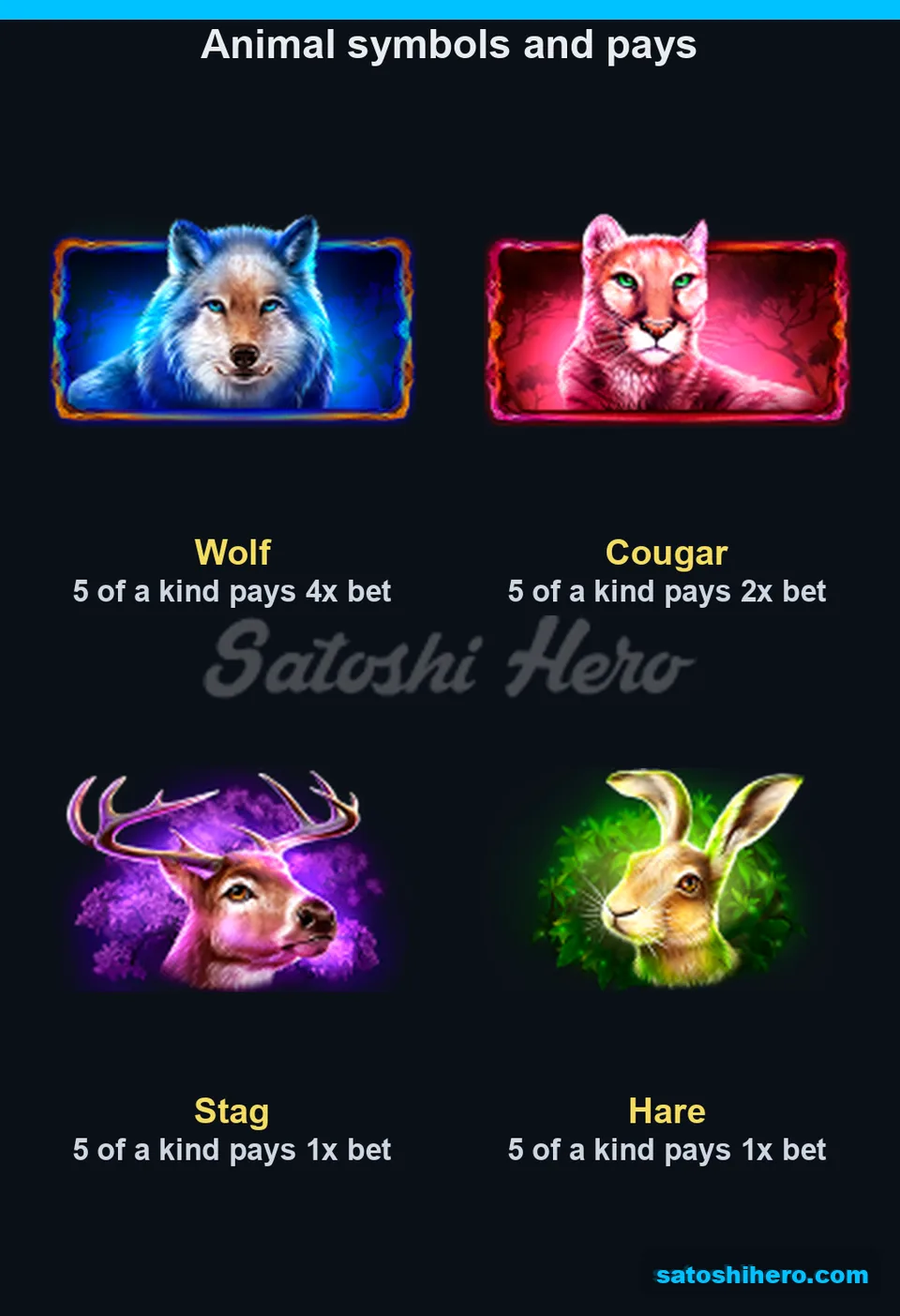
Ace and King paid $0.60, $0.20, and $0.06. Queen, Jack, and Ten paid $0.30, $0.10, and $0.04. Since I used a $1.00 stake, those amounts also read directly as bet multiples: five Wolves equal 4x, Cougar 2x, and Stag or Hare 1x.
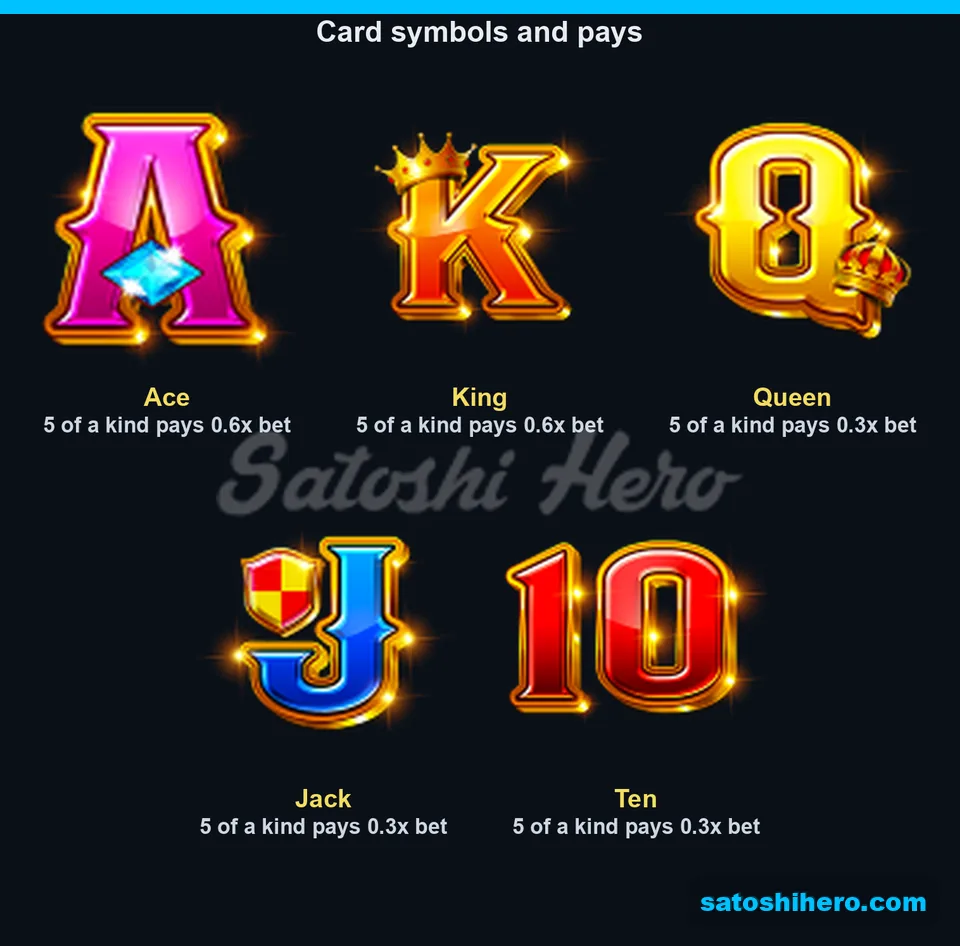
Five matching card symbols return either 0.6x or 0.3x before any multiplier. The Buffalo Wild replaces every symbol except the Scatter. Six, eight, or ten Eagle Scatter coins pay $5.00, $10.00, or $50.00 at the tested setting.
Readers who prefer changing win ways could favour Witch’s Candy Quest Megaways, while this game keeps outcomes tied to defined lines. Fixed-line alternatives from GameArt include Xtreme Summer Hot and Xtreme Hot, while Xmas Express offers another themed comparison. You’ll notice that low regular-symbol values make Wild placement and multipliers carry much of the excitement.

Tip: Read each paytable amount as a total-bet multiple when playing at $1.00. That makes the Wolf’s $4.00 five-symbol return easy to recognise as 4x.
Mirrored Reels
Every column contains two connected reels holding identical symbols in reverse order, and they spin in opposite directions. You see a horizontal reflection across the completed board, yet all 50 paylines still follow their usual paths. This is the slot’s smartest idea, and you can learn its visual logic quickly.
Opposite reel motion
Each column splits into an upper reel and lower reel, with two visible spaces on each. The upper reel’s top symbol matches the lower reel’s bottom symbol. Meanwhile, the two positions meeting at the centre also match one another.
Opposing motion creates the illusion of two linked strips folding around the middle. You can’t influence either half, so timing the spin button changes nothing. Once you watch several stops, the reflected pairs become much easier to spot.
Paired symbol behavior
Wilds and Scatters can appear as same-column pairs because both halves reverse the same strip. A pair doesn’t automatically create a line win, which prevents the mechanic from feeling overly generous. You still need a valid combination across adjacent reels.
Paired Wilds matter most when they meet centrally and form a Clash. In the Buffaloes Duel slot, mirrored Scatters matter because each pair pushes the board closer to the six-symbol bonus threshold. I found those double appearances visually exciting, even when they produced no useful payout.

Fast Fact: One column can display two matching Wilds or Eagle Scatter coins. Those pairs can support Clash multipliers or move the board two steps toward free games.
The reflected engine gives the game a clear mechanical identity. You’ll understand results faster once you separate visual symmetry from actual win evaluation.
Theme and First Impressions
The sunset savanna looks familiar, but bold colour and the mirrored board stop it feeling completely generic. You see an orange-and-violet sky behind a gold frame, with eagle ornaments perched on both upper corners. The Buffaloes Duel slot won’t win awards for originality, though its presentation has real clarity and strong contrast.
Wolf, Cougar, Stag, and Hare portraits sit on glowing coloured tiles. Shiny gold-and-red card symbols create enough contrast for you to scan smaller wins without squinting. Wolf Hunt could appeal more if wildlife imagery alone drives your choice, but this layout has a more distinctive visual hook.
Along the bottom, the interface shows the bet, bet per line, cash balance, Auto, Max Bet, and a round gold spin button. My settled screen displayed a $1.00 stake and $483.16 balance. Paired Eagle Scatters on reels one and three also made the horizontal reflection obvious.
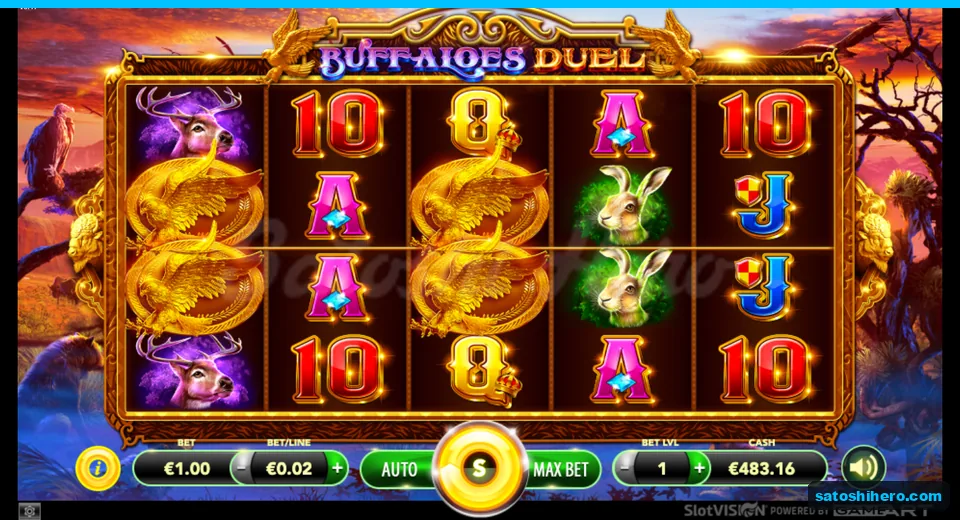

Trivia: Eagle ornaments and sunset colours extend the savanna setting beyond the symbols into the reel frame. That small touch gives the board a stronger sense of place.
The clean controls leave room for the unusual reel behavior. You can follow each mirrored stop without fighting needless animation or visual clutter.
Clash Multiplier
A Clash forms when mirrored Buffalo Wilds meet across a column’s centre, multiplying every win from that spin. It supplies the main high-impact feature because ordinary symbol values remain fairly low. You should watch the middle positions first when both Buffalo Wilds appear.
How multipliers step up
The qualifying Wild occupies the bottom of the upper reel and the top of the lower reel. One Clash applies x2, two apply x4, three apply x6, four apply x8, and five apply x10. With no Clash, wins remain at x1.
That multiplier covers every qualifying win, not just one payline. Several Clash columns can therefore lift multiple small combinations at once. I like this whole-spin treatment because you never need to guess which line receives the boost.
The mirrored setup makes each central Wild pair easy to identify. Still, you shouldn’t mistake a visible Clash opportunity for a promise of a large result. A multiplier needs underlying wins before it has anything useful to increase.
Impact in my test
My largest return arrived on spin 27, when stacked Buffalo Wilds on reel one helped produce $47.04. The balance jumped from $487.76 to $533.80, making that hit the session’s defining moment. My record doesn’t verify a specific Clash multiplier, so I won’t attach one afterward.
Paired or stacked Wilds carried far more practical weight than regular low-paying symbols. You might find that exciting, but meaningful hits remained uneven throughout my test. The Clash mechanic creates the tension, while its irregular timing keeps the game firmly unpredictable.
Free Games
Six, eight, or ten Eagle Scatters award 10, 15, or 25 free games. The round uses different reel strips, allows unlimited retriggers, and pays the qualifying Scatter award as well. You get clear thresholds, but my paid session never reached one.
Scatter trigger thresholds
Six Eagle Scatters unlock 10 free games, eight unlock 15, and ten unlock 25. Only the highest Scatter award counts on a single spin. You can also retrigger the round without a stated limit once play moves onto its separate strips.
The Scatter coin pays independently of paylines. At my $1.00 test stake, six paid $5.00, eight paid $10.00, and ten paid $50.00. Those returns correspond to 5x, 10x, and 50x before the free-game action begins.
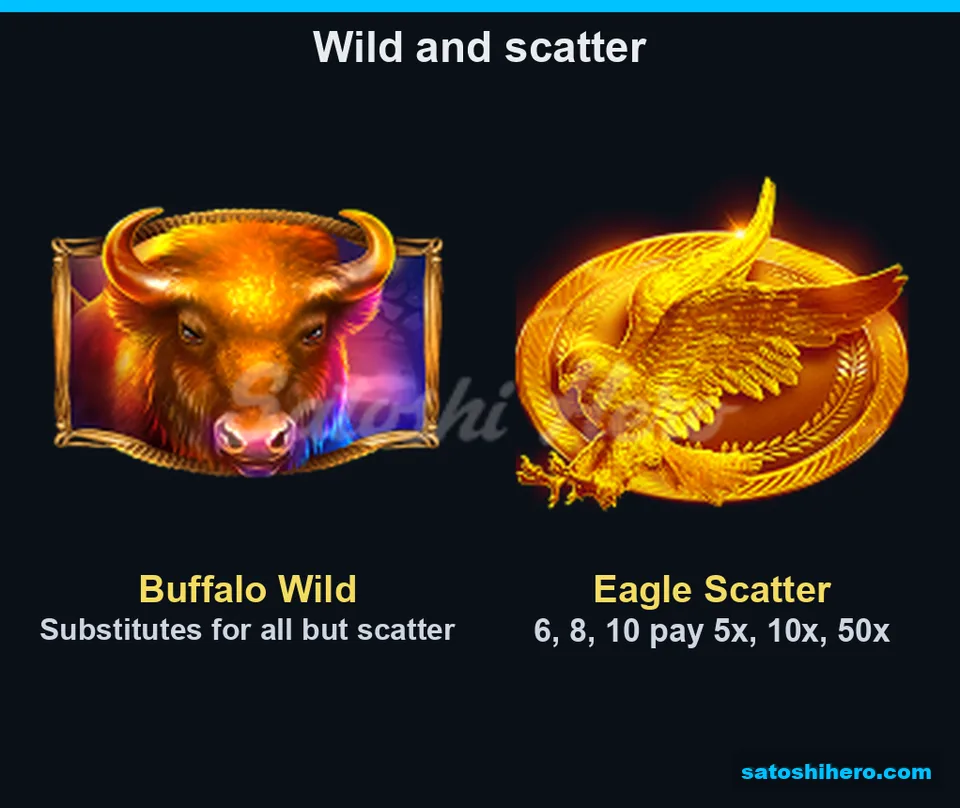
Mirroring explains why Eagle Scatters often arrive in visible pairs. However, two or four symbols still fall short of the minimum. You should count the full board instead of treating every mirrored pair as a near-certain trigger.
Result from my session
I saw no free games during the 100 counted paid spins. Mirrored Scatter pairs appeared several times, including one photographed board with four coins. That stop looked promising, yet it remained two symbols below entry.
The same image showed a Buffalo Wild, which can replace regular symbols but never the Scatter. I don’t think one missed bonus proves the feature is unusually difficult. A 100-spin sample simply can’t settle that question for you.
The rules are appealing because retriggers have no set cap. Even so, the Buffaloes Duel slot gave me no first-hand bonus result to assess beyond its clear entry requirements.
What the 2,321x Cap Means
The payout ceiling offers comparatively restrained upside for such an uneven game. Sharp balance swings can still occur, although the top prize stays below the five-figure multiples found in some high-risk slots. In my opinion, the feature design carries more appeal than the raw prize limit.
For the Buffaloes Duel slot, any buffaloes duel score for risk against reward should weigh theoretical return, irregular hits, and the fixed ceiling together. Assigning a simple numerical rating would hide that trade-off. You could love the mirrored Wild setup while still finding the available upside underwhelming.
Ask what matters more during your sessions: unusual reel behavior or enormous headline prizes? If you value the latter above mechanical character, this cap could feel restrictive. Players drawn to whole-spin Clash multipliers could accept the compromise more readily.
The limit doesn’t change because my short test ended down. You should treat it as a boundary, not an expected target, and judge the entertainment inside that boundary.
RTP, Volatility and Our Test
The mathematical profile combines the stated theoretical return with severe short-session variance, so possible results spread widely. I compared our simulator’s distribution with my logged session without treating either result as a forecast. You should read both as evidence of uncertainty, not a repeatable pattern.
What the simulator projects
The SatoshiHero Slot Simulator modelled 1,000 spins at $1.00 using the published profile. Its median result finished approximately $106.60 down. The middle 90% of modelled sessions ranged from $437.50 down to $670.70 up, a strikingly broad span.
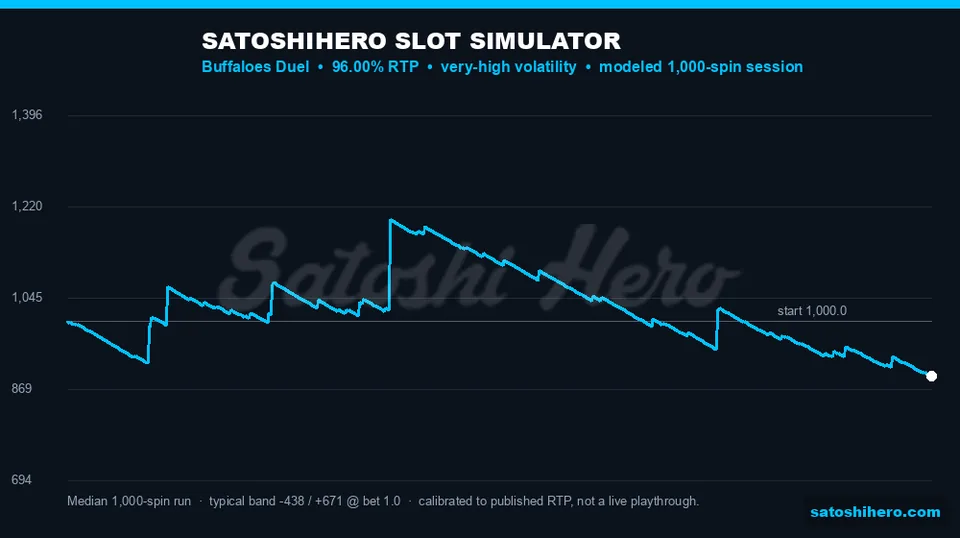
About 14% of simulated spins returned something. A feature-sized result appeared roughly once per 54 spins, while a very large win appeared about once per 814 spins. You can’t use those averages to time either event in live play.
The graph’s median line slopes into a loss, yet the surrounding range stretches far above and below it. That picture matters more than any single projected endpoint. I think it captures the game’s risk more honestly than a tidy average ever could.
Our 100-spin session
I played 100 paid spins at $1.00 from a fresh $500.00 demo balance. My finish was $483.16, leaving me $16.84 down. Of 22 paying spins, 11 returned less than the original stake, so a visible win often still reduced the running balance.
Spin 27 produced my best hit at $47.04 and caused the graph’s sharpest rise. My second-best return was $10.40 on spin 9, followed later by three wins between $3.00 and $5.00. After the big hit, losing spins and small returns gradually removed the temporary gain.
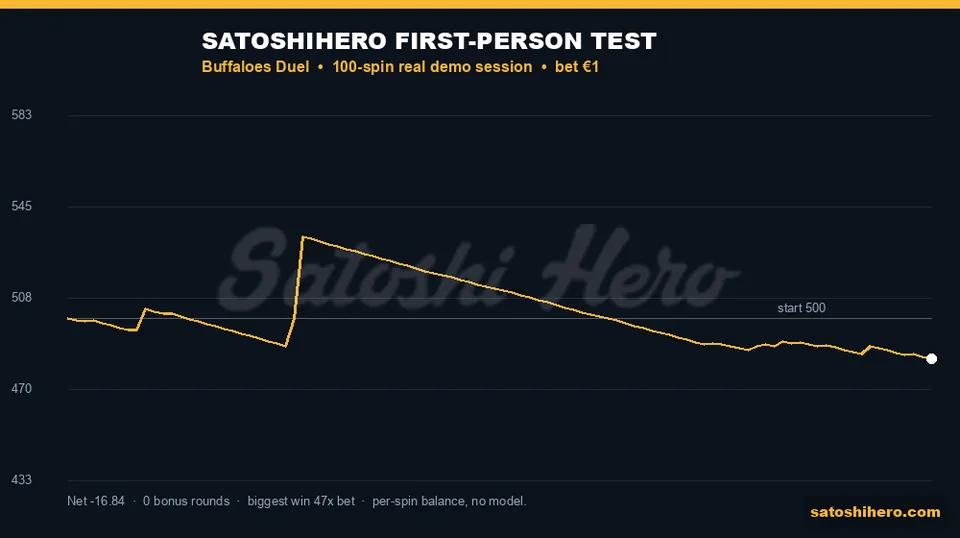
No free games appeared during the counted session. I excluded extra screenshot spins from every calculation, keeping the sample consistent. That clean boundary matters because unlogged extras would distort the observed return and weaken any practical comparison.
The theoretical RTP is SatoshiHero’s published return figure, and one live session neither changes nor validates it. Our simulation illustrates mathematical spread rather than future play. Feature-specific returns can differ slightly from the base mode by design when separate figures apply.
Together, both result sets show uncertainty rather than a reliable session pattern. You can prepare for swings, but you can’t know their direction beforehand.
Bankroll Lessons From 100 Spins
My test leaned heavily on one $47.04 hit and still ended $16.84 down. That pattern shows why stake control matters, even though no budget choice alters the odds. You need room for losses that arrive after an exciting jump.
What losses looked like
Half my paying spins returned less than the $1.00 stake. Those animations marked wins, but each still left the balance lower than before the spin. You shouldn’t confuse frequent visual feedback with meaningful bankroll recovery.
Small returns and blank spins slowly erased the gain created on spin 27. One strong hit shaped most of my session without rescuing the final total. I found that arc harsher than the bright interface initially suggested.
Patient play handles this rhythm better than a demand for steady feedback. If you dislike long stretches without useful progress, the mirrored spectacle might not compensate.
Practical stake control
Buffaloes duel players could enjoy the paired-symbol suspense or dislike how quickly smaller returns disappear. Choose a stake that leaves room for a long gap between meaningful hits. You should also set a session budget and loss limit before the first spin.
Neither control changes symbol frequency or improves your mathematical chance. My $500.00 opening balance was a controlled demo setup, not a suggested deposit or bankroll. Trying the SatoshiHero demo first lets you learn the mirrored layout without using a real balance.

Alert: The theoretical return can’t prevent substantial short-session losses. Don’t chase free games, and never raise your stake because earlier mirrored Scatters appeared or because you want to recover losses.
Previous Scatter pairs don’t make another pair more likely. You’ll protect your limits best by treating every spin as independent and stopping when your preset boundary arrives.
Frequently Asked Questions
How do the mirrored reels work in the Buffaloes Duel slot?
Every column contains two reels with two visible positions. Both hold the same symbols in reverse order and spin oppositely. Matching outer and central positions make the board look reflected across its middle.
What is a Clash in the Buffaloes Duel slot?
A Clash is a mirrored Buffalo Wild pair meeting across a column’s centre. One through five Clashes apply x2, x4, x6, x8, or x10 respectively. The resulting multiplier affects every qualifying win on that spin.
How do you trigger free games in the Buffaloes Duel slot?
Landing six, eight, or ten Eagle Scatters can award 10, 15, or 25 free games. The feature uses different reel strips and permits unlimited retriggers. I didn’t trigger it during my 100-spin test.
What does the top symbol pay in the Buffaloes Duel slot?
At my tested $1.00 total stake, five Wolves paid $4.00, four paid $0.80, and three paid $0.12. The Buffalo Wild substitutes for every symbol except the Scatter.
What did the Buffaloes Duel slot return over 100 spins?
I began with $500.00 and finished with $483.16 after 100 paid $1.00 spins, a $16.84 loss. Twenty-two spins paid something. My best result was $47.04 on spin 27.
What does the Buffaloes Duel slot simulator show?
Across 1,000 modelled $1.00 spins, the median result ended about $106.60 down. The middle 90% ranged from $437.50 down to $670.70 up. This spread illustrates variance and doesn’t predict your session.
What are the Buffaloes Duel slot RTP, volatility and maximum win?
The official specifications list 96% RTP, very-high volatility, and a 2,321x maximum win. Regular wins use 50 fixed paylines across the mirrored 5×4 board.
Closing Thoughts
Buffaloes Duel stands out through reflected reels and whole-spin Clash multipliers rather than an original wildlife theme. Its main drawback is the restrained payout ceiling beside an aggressive risk profile. You get mechanical character, but not steady reassurance.

My Verdict
Try the demo if paired symbols and multiplier hunting sound engaging, then keep any real stake conservative. Typical sessions can hinge on one strong Wild result while many smaller wins fail to cover their spins.
I liked how the stacked Buffalo Wilds transformed spin 27 and lifted my balance above its starting point. I didn’t like watching that gain drain away, and missing free games left the feature set only partly experienced.
The Buffaloes Duel slot offers a clever reflected board with genuinely uneven outcomes. This guide is checked regularly so you can assess its mechanics and my documented test with clear context.

Pros:
 Distinctive reels: Mirrored strips create recognisable pairs and make central Wilds easy to spot.
- Whole-spin boost: Clash multipliers can strengthen every qualifying win on the same spin.
- Clear rules: Fixed paylines and visible thresholds make outcomes straightforward to check.
- Flexible demo: Free play lets you learn the reflection before risking a balance.

Cons:
 Uneven returns: Half my paying spins returned less than the tested stake.
- Restrained ceiling: The top payout feels modest beside the severe balance swings.
- Elusive bonus: My paid-spin sample never reached the six-Scatter trigger.

Best For: Patient mechanics fans who enjoy tracking mirrored symbols and waiting for stacked Wild impact. You’ll need firm limits, comfort with dry spells, and little dependence on frequent bonus rounds.
































































Bets
All Bets
Game
Player
Date
Wager
Mult.Multiplier
Prize
 Royal Fruits 9: Hold 'n' Link
 lakidd1987
- 00:16:14
- 0×
- Book Of Nile: Magic Choice
 Hidden
- 00:16:12
- 0×
- Royal Fruits 9: Hold 'n' Link
 mike_721
- 00:16:12
- 5×
- Big Banker Bonanza
- josh1998
- 00:16:10
- 1×
- Royal Fruits 9: Hold 'n' Link
- lakidd1987
- 00:16:10
- 0×
- Book Of Nile: Magic Choice
- Hidden
- 00:16:09
- 0.5×
- Galaxy Glitter
- Hidden
- 00:16:08
- 0×
- Royal Fruits 9: Hold 'n' Link
- mdp0fxo
- 00:16:08
- 0×
- 4 Lucky Nuggets
 whodey39311
- 00:16:07
- 0×
- Royal Fruits 9: Hold 'n' Link
- lakidd1987
- 00:16:06
- 0×