

40 Lucky Sevens
By pressing play, you agree that you are above legal age in your jurisdiction and that your jurisdiction allows online gambling.

40 Lucky Sevens
RTP96.12%
VolatilityLow
Max winx2,700
Lines40
Hit rate23.93%
ThemeFruits
ReleasedJun 2023
Live game stats
Real RTP84.81%
Spins247
Players1
Biggest win$52

Forty Lines, Red Sevens, and a Clover Surprise
Spin 40 Lucky Sevens and you get a simple GameArt fruit slot built around fixed lines, expanding wilds, scatters, and clovers. 40 Lucky Sevens is a low volatility slot with 96.12% RTP and 2,700x maximum win potential. Its 5×4 grid has 40 paylines, while my 100 paid spins ended $3.60 ahead after a 20x clover hit.
Key takeaways
The plain rules favour readers who value frequent smaller outcomes over free spins or a bonus buy. I tested $0.80 spins from a $500 balance with turbo enabled, although stakes run from $0.40 to $200.00. You can play 40 Lucky Sevens online free or with a real stake at SatoshiHero.
- Best bonus: There’s no free-spins round or bonus buy; expanding wilds drive the main action.
- RTP / volatility: The theoretical return is 96.12%, paired with low volatility.
- Max win: The payout ceiling is 2,700x the total stake.
- Risk note: The Gamble can double or quadruple a payout, but one wrong pick loses it.
- Bankroll note: My balance fell $12.80 before recovering, with one 13-spin dry run.

Table of Contents
- How 40 Lucky Sevens Works
- Grid and line rules
- Stake and payout basis
- Theme and First Impressions
- Symbols and Pay Values
- Higher-paying symbols
- Lower-paying fruit
- Scatter and Clover Pays
- Dollar scatter values
- Three-clover payout
- Expanding Wild Reels
- Wild reel limits
- Full-reel expansion
- Observed No-Cost Respins
- What I observed
- How spins were counted
- Gamble Feature and Risk
- Double or quadruple
- Why I disabled it
- RTP, Volatility and Our Test
- Simulator projection
- Our 100-spin session
- Frequently Asked Questions About 40 Lucky Sevens
- Closing Thoughts
How 40 Lucky Sevens Works
40 Lucky Sevens uses five reels, four rows, and 40 fixed paylines rather than a ways-to-win system. You need regular combinations to start on reel 1 and continue across adjacent reels from left to right. Only the best-paying combination on each active line counts, so you can check the result without untangling overlapping awards.
Grid and line rules
Dollar scatters break the standard line rule because they pay anywhere on the grid. Every other paying combination follows one of the 40 preset paths. You can trace those paths from the first reel, while the two visible “40” badges keep the line count clear.
All paytable amounts scale with your selected total stake. That approach makes a completed spin easy to audit once you understand the line pattern. In my experience, the format feels old-fashioned but refreshingly transparent.
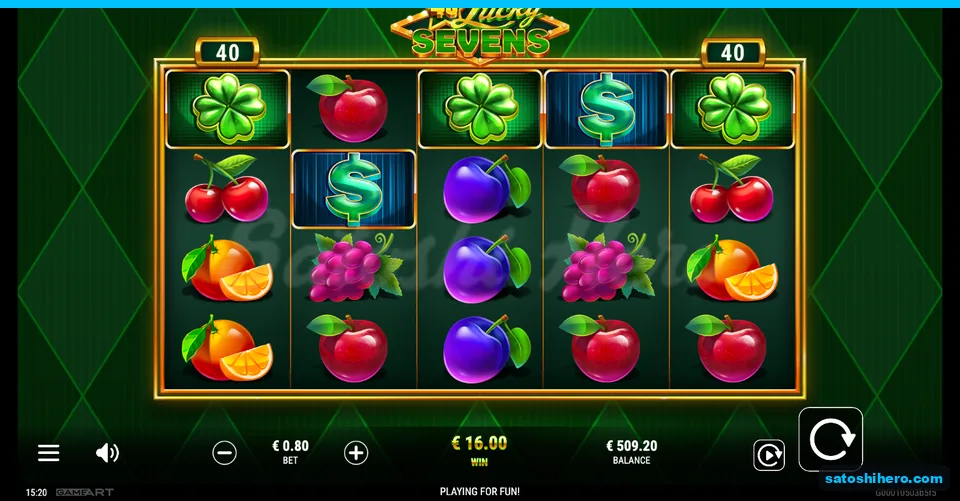
My $16 clover result looked different from a normal line hit because clovers occupy reels 1, 3, and 5. Seeing all three on the same grid confirmed the listed 20x award at my chosen stake. You don’t need to count ways or clusters after the reels stop.
Stake and payout basis
I used a $0.80 total stake, which divided into $0.02 on each fixed payline. If you change the total, every displayed symbol award changes in the same proportion. The 40 Lucky Sevens free mode keeps the same 5×4 interface across supported desktop and mobile screens, so you can read lines consistently.

Fast Fact: At my $0.80 total stake, each of the 40 fixed paylines carried $0.02.
Once you grasp that fixed-line basis, you can verify each displayed payout much faster.
Theme and First Impressions
The slot uses a deliberately traditional fruit-machine style, with green and gold shaping almost every screen. You see a dark green diamond-pattern backdrop, a gold reel frame, and a green marquee logo edged with lit bulbs. Glossy fruit sits beside stars, clovers, dollar symbols, and oversized red sevens.
The idle display showed my fresh $500 balance, $0.80 stake, full 5×4 grid, and line count before I spun. Badges above reels 1 and 5 repeat the number 40, making the payline setup hard to miss. You’ll know where the important information sits within seconds.
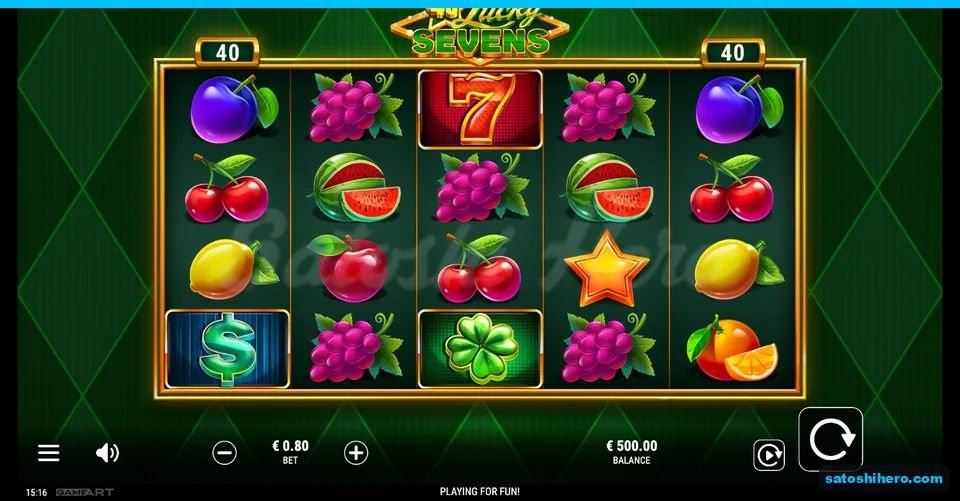
I found the presentation clean, readable, and slightly plain. It won’t satisfy you if you expect cinematic scenes or elaborate character animation. The classic look won’t win originality awards, yet the restrained motion keeps every outcome easy to follow.
5 Lucky Sevens offers familiar lucky-seven and fruit-machine imagery when you want another straightforward take on that style. 40 Super Heated Sevens places the “40” identity and sevens theme front and centre for a similarly focused visual choice. Neither comparison changes this game’s strongest design quality: clarity beats spectacle here. O’Really Lucky provides another luck-themed alternative with a distinct visual identity. Lucky Reefs shifts the lucky-symbol theme into an underwater setting.

Trivia: Fruit machines traditionally use cherries, lemons, and other produce because early mechanical games replaced card suits with simple, readable icons.
If you value function over flash, this design keeps the important details firmly in view.
Symbols and Pay Values
The paytable combines a valuable dollar scatter, a strong star, a reel-restricted clover, and two fruit groups. You should read every figure as a multiple of your total stake, not as a separate currency unit. I checked that interpretation against the actual payouts in my spin log.
Higher-paying symbols
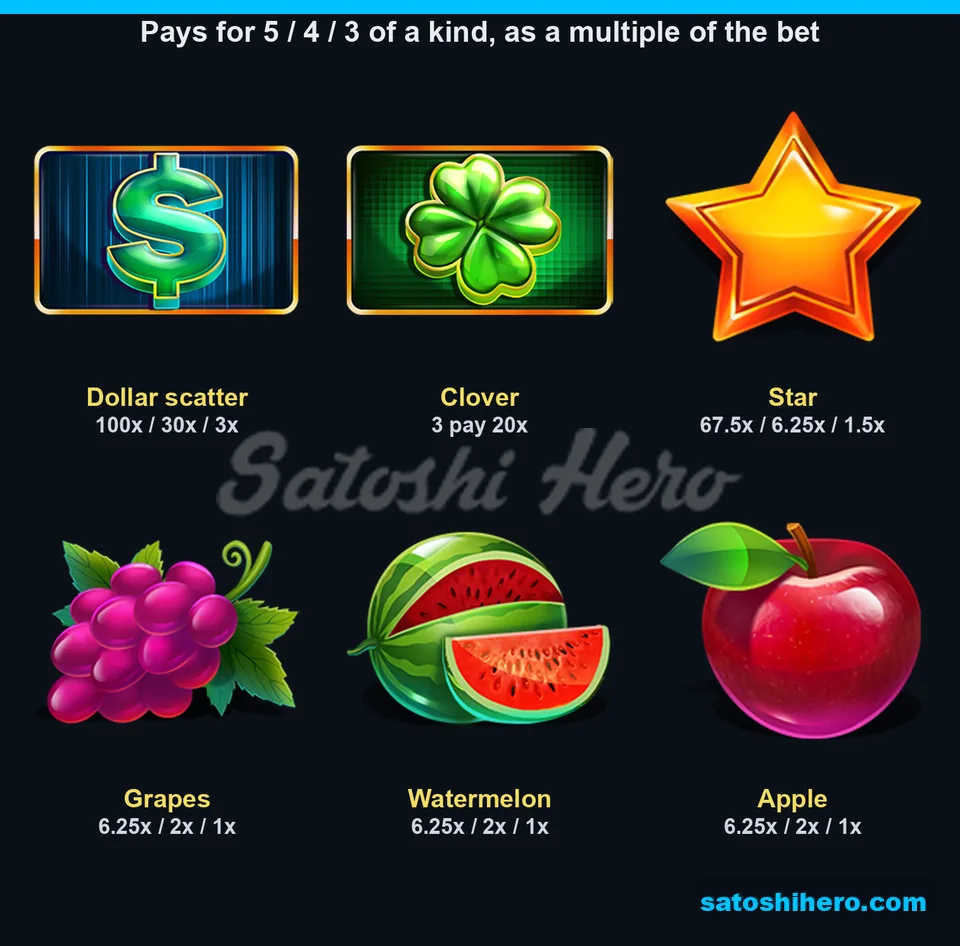
The dollar scatter pays 100x, 30x, or 3x for five, four, or three symbols. Stars pay 67.5x, 6.25x, 1.5x, or 0.25x for five down to two matches. The star is unusually flexible because you can receive its smallest listed award from only two matching symbols.
Clovers pay 20x when all three permitted positions land. Grapes, watermelons, and apples each pay 6.25x, 2x, or 1x for five, four, or three symbols. Those mid-tier fruits can build ordinary line returns, but they don’t rival a complete scatter set.
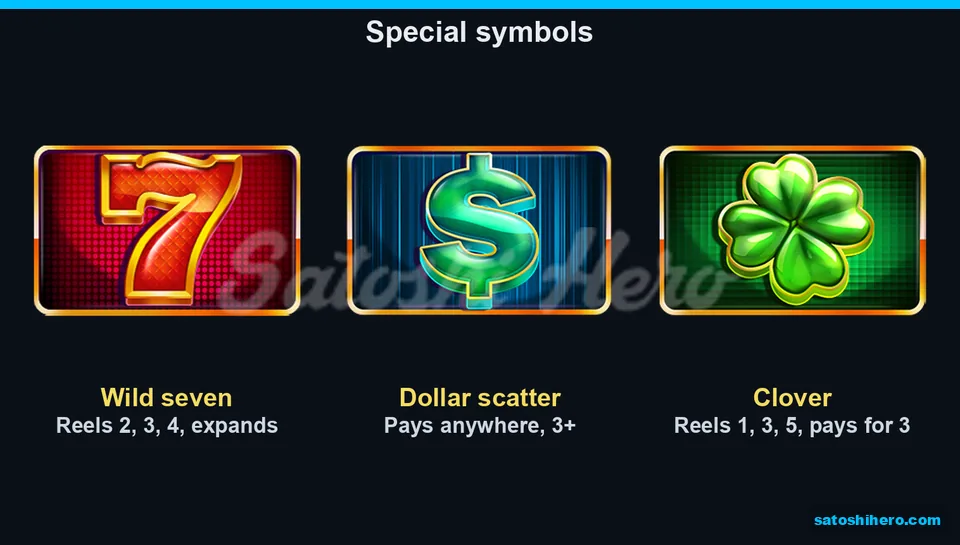
The red seven serves as the wild on reels 2, 3, and 4. It replaces every symbol except the dollar scatter, which lets it complete several ordinary lines at once. You’ll get the most value from reading it as a connector rather than a prize with its own listed pay.
Lower-paying fruit
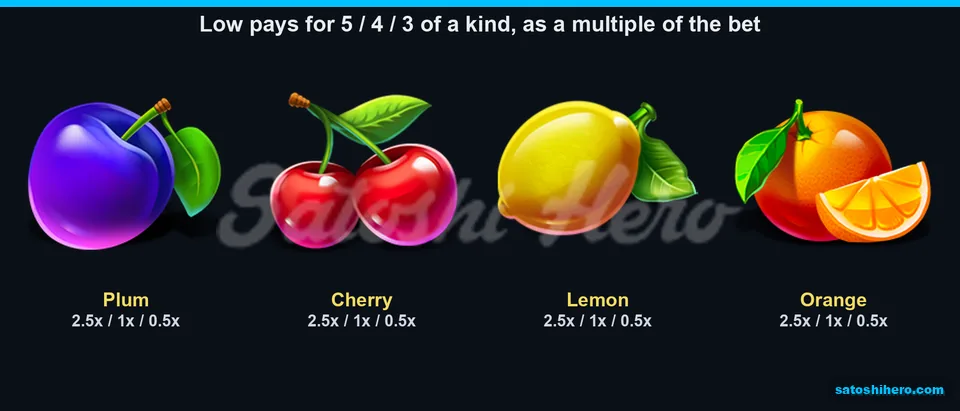
Plums, cherries, lemons, and oranges each pay 2.5x, 1x, or 0.5x for five, four, or three matches. My smallest logged returns were $0.40, exactly 0.5x my $0.80 stake. That real result gave me a useful check against the paytable.
Three clovers later paid me $16, confirming their 20x listing. You might find the many small fruit wins modest, and I’d agree. Stars, clovers, and scatters provide the meaningful jumps, while ordinary produce keeps the base game moving.
Scatter and Clover Pays
Dollar scatters pay anywhere, while clovers pay only when they fill reels 1, 3, and 5. You don’t enter a bonus round after either result. Both symbols award their value directly to the balance, which makes the outcome immediate and easy to understand.
Dollar scatter values
Three dollar symbols can return 3x your total stake from any positions. Four increase that award to 30x, while five can pay 100x. The red-seven wild can’t replace a dollar scatter, so you need the actual symbols to secure these payouts.
A scatter result doesn’t start free spins. That limitation may disappoint you if you expect a layered bonus from a high-paying special symbol. I prefer the honest simplicity here, though the feature list undeniably feels narrow.
Three-clover payout
Clovers appear only on the first, third, and fifth reels. Landing all three can award 20x the total stake. In my test, that exact pattern paid $16 from a $0.80 spin and became my largest result.
You see the money added without moving into another mode. The clover gave my session its best moment, but it still felt like a direct symbol hit rather than a full feature. That distinction helps you set the right expectations before playing.
Expanding Wild Reels
The red-seven wild appears only on reels 2, 3, and 4, where it can expand across an entire reel. You should watch those middle columns because one full stack can connect several fixed lines simultaneously. It substitutes for every symbol except the dollar scatter.
Wild reel limits
The information panel states the reel restriction, substitution rule, and expansion. Sevens can’t land on reels 1 or 5, so they always support combinations anchored by another symbol on reel 1. You may see several winning paths form around one expanded centre reel.
That structure gives the wild a clear job without making every appearance dramatic. In my view, the three-reel limit keeps the mechanic easy to read. A full wild reel helps, but it can’t guarantee a large payout.
Full-reel expansion
During my test, activated sevens filled reels from top to bottom. One sequence covered reels 3 and 4 with red sevens and returned $10.40, my second-largest recorded outcome. The balance shown after that result stood at $502.
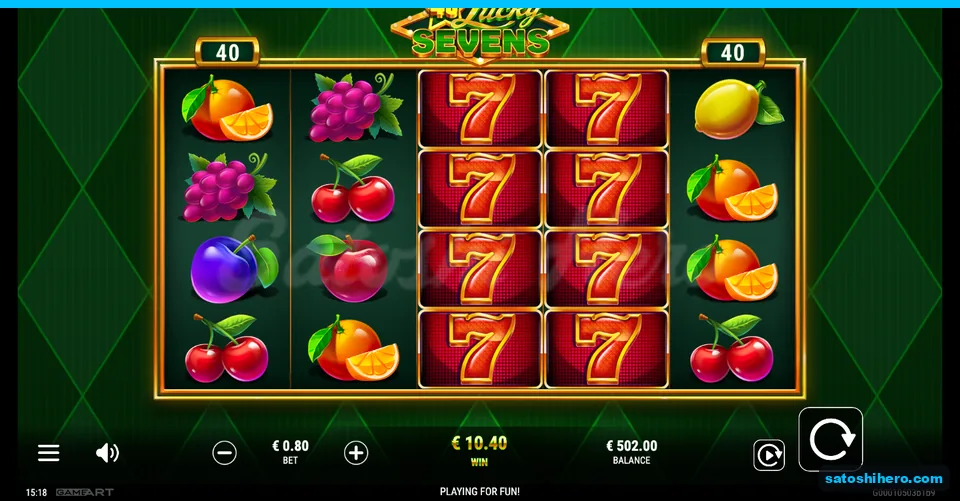
Some following button presses kept those expanded reels visible and charged no new $0.80 stake. I treat that as observed no-cost respin behaviour because the information panel didn’t describe a respin rule. You shouldn’t assume every wild expansion creates one, but you can check your balance when the next press begins.

Tip: Watch your balance when an expanded reel stays visible. Some following presses in my test didn’t deduct another $0.80 stake.
The expansion creates the slot’s most engaging screen, even when its payout remains modest.
Observed No-Cost Respins
Ten of my 110 button presses took no new stake, so I counted 100 paid spins rather than 110. You can identify the same observed no-cost respin behaviour by checking whether your balance falls when the next reel motion starts. This distinction matters because the published information panel explains wild expansion but doesn’t describe respins.
What I observed
Some presses after an expanding-wild result kept full wild reels in place. Those presses didn’t remove the standard $0.80 amount from my balance. I saw the behaviour often enough to track it, but I won’t present my observation as a documented trigger rule.
You should separate what appears on screen from what the help pages promise. That caution keeps a useful firsthand detail from becoming an unsupported claim. I found the balance movement more reliable than the spin button count for identifying each no-cost press.
How spins were counted
I treated the ten no-cost presses as following respins rather than separate paid attempts. My session therefore covered 100 paid spins across 110 button presses. Any return from a respin stayed grouped with the paid spin that began its sequence.
That method stopped me from overstating both total stake and hit count. It also explains why I logged 25 paying outcomes across 100 paid spins, despite pressing the button more often. When you compare my figures, use paid spins as the denominator.
Gamble Feature and Risk
The Gamble adds an all-or-nothing choice after a win, despite the base game’s calm payout pattern. You can pick red or black to double the amount, or choose a suit to multiply it by four. One wrong choice forfeits the whole sum you placed at risk.
Double or quadruple
A correct result can be gambled again, up to five consecutive times. Any resulting amount remains subject to the game’s overall payout ceiling. You may build a small win quickly, but each extra decision creates another chance of losing everything from that sequence.
That trade-off feels much sharper than the ordinary fruit action. I don’t consider it a gentle extension of the base game, even though the controls look simple. The feature rewards risk tolerance, not slot-reading skill.
Why I disabled it
The setting had Gamble enabled by default when I opened the game. I switched it off before my first counted spin and never used it. None of my reported balances, hits, or notable payouts came from risking a previous award.
Turning it off made the underlying slot results easier for me to track. You also avoid adding sudden binary risk to an otherwise steady session. Leaving it available makes sense only if you’re comfortable losing a complete win for a chance to multiply it.

Alert: Low slot volatility doesn’t make the Gamble low risk. One incorrect selection loses the entire amount at stake.
My practical choice remains simple: disable it when you want the calmest version of the game.
RTP, Volatility and Our Test
The mathematical profile combines 96.12% theoretical RTP, low volatility, and a 2,700x maximum-win ceiling. You can expect the intended distribution to favour more frequent returns, although many may stay small. Low volatility doesn’t promise that your short session will remain near its opening balance.
The cap offers substantial upside beside routine fruit wins, but our simulator places the very top end far outside ordinary session expectations. You shouldn’t treat that rare possibility as a bankroll plan. I found the live balance comparatively contained, yet it still moved through a meaningful drawdown.
Simulator projection
The SatoshiHero Slot Simulator modelled 1,000 spins at $0.80 using the stated profile. Its median finish landed about $32.80 down, equal to 41 stakes. The middle 90% band stretched from roughly $112.20 down to $55.10 up, showing why one headline average can’t describe every path.
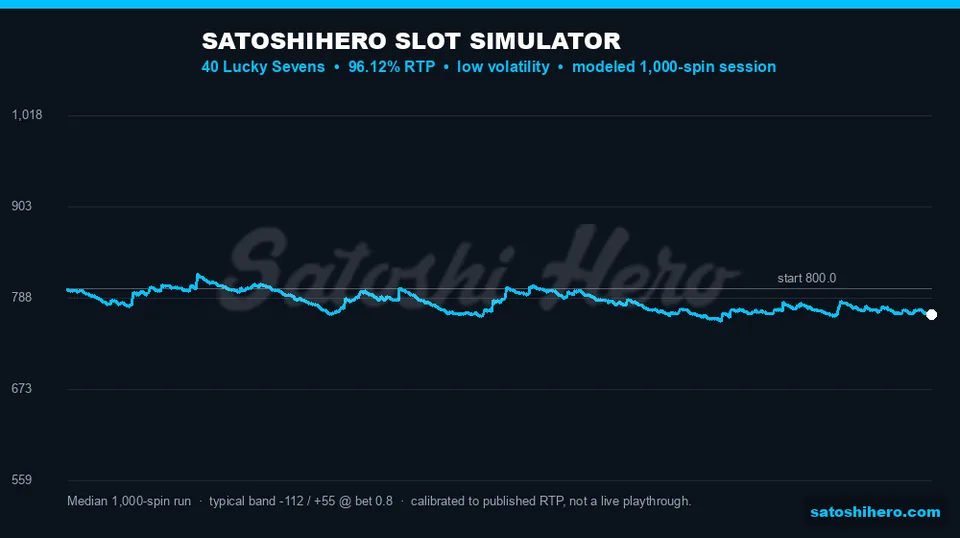
About 34% of modelled spins returned something. A modelled big-win tier appeared roughly once per 123 spins, while the estimated top-end event appeared around once per 500,000 spins. You can’t turn either frequency into a countdown for live play.
The simulation illustrates a distribution of possible outcomes. It neither inspects the game’s random number generator nor predicts your next session. In my opinion, the broad loss-to-profit band says more about practical uncertainty than the median alone.
Our 100-spin session
I began with $500 and finished with $503.60, producing a $3.60 gain worth 4.5 stakes. Twenty-five of 100 paid spins returned something after I grouped following no-cost respins with their initiating spins. You should read that positive finish as one observed route, not an expected result.
My lowest balance reached $487.20 after spin 48, a $12.80 drawdown from the start. The session then climbed to a $511.20 peak after spin 89. A 13-spin dry run showed that a gentle mathematical label can still contain uncomfortable short stretches.
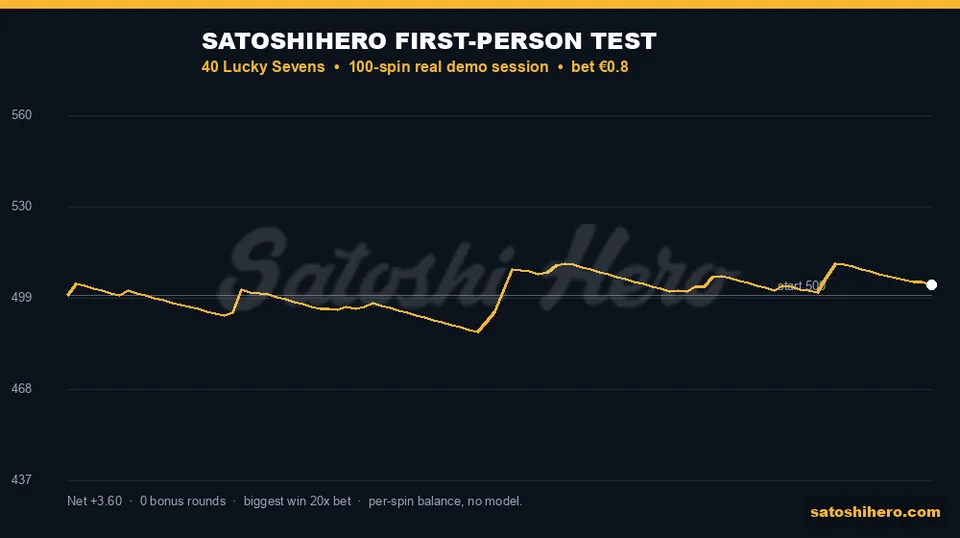
The largest payout was $16 from three clovers on spin 51. Other notable outcomes included $10.40 on spin 20, $8.40 on spin 49, and $6.40 on spin 88. You’ll notice that even the best live hit stayed far below the theoretical ceiling.
All returns came from line wins, scatter payouts, clovers, and expanding sevens. No free-spins mode or buyable bonus altered the results. I liked the steady recovery after the low point, but the final profit doesn’t promise your balance will follow it.
Theoretical RTP is the operator-published return, and one live session doesn’t alter it. No separate free-spins or bonus-buy return applies because neither mode exists, and I haven’t inferred hidden values from observed respins. The session simply showed a steady profile alongside a real drawdown and losing stretch.
Frequently Asked Questions About 40 Lucky Sevens
What are the RTP and maximum win in 40 Lucky Sevens?
The slot uses 96.12% theoretical RTP, low volatility, and a 2,700x maximum win. My balance stayed within a fairly contained range, although it still dropped $12.80 before recovering. A short profitable test doesn’t change the underlying mathematical return.
How many paylines and reels does 40 Lucky Sevens have?
It has five reels, four rows, and 40 fixed paylines. Regular wins start on reel 1 and continue left to right across adjacent reels, with only the highest award on each line counting. My $0.80 total stake worked out to $0.02 per line.
How does the wild seven work in 40 Lucky Sevens?
The red seven appears on reels 2, 3, and 4 only. It replaces every symbol except the dollar scatter and can expand over its full reel. Some following presses charged no new stake in my test, though I treat that behaviour as an observation rather than a documented rule.
How do the scatter and clover pay?
Three, four, or five dollar scatters can pay 3x, 30x, or 100x anywhere on the grid. Three clovers on reels 1, 3, and 5 can pay 20x. I received $16 from that clover pattern at a $0.80 stake.
Does 40 Lucky Sevens have free spins or a bonus buy?
No, it has neither a free-spins round nor a bonus buy. Its documented action centres on expanding wilds, scatter and clover payouts, and the Gamble. The no-cost presses I observed weren’t a separate free-spins mode.
What is the Gamble feature in 40 Lucky Sevens?
Red or black can double a win, while a correct suit can quadruple it. You may gamble successful results up to five times, but one wrong selection loses the full amount. I disabled the option before the counted test began.
What did the 1,000-spin simulator show?
The model produced an approximate median loss of $32.80. Its modelled fifth-to-95th-percentile range ran from about $112.20 down to $55.10 up. This output shows possible variance rather than forecasting any live session.
How did the 100-spin 40 Lucky Sevens test finish?
My balance rose from $500 to $503.60, with 25 paying outcomes across 100 paid spins. The largest hit was a $16 three-clover payout. A 13-spin dry run balanced that positive finish with a clear example of short-term risk.
Closing Thoughts
40 Lucky Sevens stands out through readable fixed lines, useful expanding wilds, and an unusually clear test trail. Its main drawback is a narrow feature set with no free-spins round or bonus buy. You get an accessible fruit slot, not a cinematic event game.

My Verdict
Straightforward slot fans can expect frequent modest activity and occasional stronger symbol hits. Keep the Gamble disabled if you want the base game’s steadier character without an abrupt all-or-nothing choice.
I like how easily I could trace the $16 clover hit and the $10.40 expanded-wild result. I don’t like the lack of a larger bonus mode, though the observed no-cost respins added some useful texture. My ending profit felt pleasant, not predictive.
This 40 Lucky Sevens guide is updated periodically so its mechanics and test presentation remain useful. The direct rules make it easy to learn, while the live drawdown shows why you still need a firm spending limit.

Pros:
 Clear paylines: Fixed left-to-right rules make every completed spin easy to verify.
- Steady profile: Frequent smaller outcomes can keep ordinary sessions active.
- Useful wilds: Expanded middle reels can connect several paylines on one result.
- Readable design: Clean symbols and line badges reduce visual confusion.

Cons:
 No free spins: The feature set lacks a separate bonus round.
- Modest test peak: My largest payout reached only 20x the stake.
- Risky Gamble: One incorrect pick removes the whole amount being gambled.

Best For: Traditional fruit-slot fans and careful bankroll managers get the clearest value here. The low-volatility profile and simple line rules favour steady play, while bonus hunters may find the format too restrained.

































































Bets
All Bets
Game
Player
Date
Wager
Mult.Multiplier
Prize
 Royal Fruits 9: Hold 'n' Link
 mdp0fxo
- 00:16:20
- 0×
- Royal Fruits 9: Hold 'n' Link
 lakidd1987
- 00:16:20
- 0×
- 3 Witches: Bonus Combo
 bjgrandy149
- 00:16:20
- 0×
- Book Of Nile: Magic Choice
- Hidden
- 00:16:18
- 0×
- 3 Witches: Bonus Combo
- bjgrandy149
- 00:16:18
- 0×
- Royal Fruits 9: Hold 'n' Link
 mike_721
- 00:16:17
- 2×
- Royal Fruits 9: Hold 'n' Link
- lakidd1987
- 00:16:17
- 0×
- 4 Lucky Nuggets
 whodey39311
- 00:16:16
- 0.66×
- Crazy Balls
- thomas032172
- 00:16:15
- 0.28×
- 4 Lucky Nuggets
- whodey39311
- 00:16:15
- 0×