

Piggy Bank: 3 Pots Bonanza
By pressing play, you agree that you are above legal age in your jurisdiction and that your jurisdiction allows online gambling.


Three Glowing Pigs and One Tough Coin Chase
Piggy Bank: 3 Pots Bonanza turns Evoplay’s coloured Bonus coins and three glowing pigs into a Gold-coin collection chase.
Piggy Bank: 3 Pots Bonanza is a traditional 5×3 slot with 20 fixed paylines, 96.01% theoretical RTP, and 6,414x maximum win potential. Its Gold-coin feature and pig boosters target collect-and-reset fans, although my 100 spins lost 58.5x the bet without triggering it. If you searched for “piggy bank 3 pots bonanza free,” you can learn through SatoshiHero’s demo before considering real play.
Key takeaways
- Best bonus: Normal spins provide my only firsthand evidence because I bought no feature. One random booster costs 35x the bet, making it the cheapest entry rather than proven value.
- RTP / volatility: The theoretical RTP is exactly 96.01%, while the recorded results show how sharply your short session can diverge.
- Max win: The ceiling is exactly 6,414x the bet. Reaching it ends the round immediately and cancels unresolved features.
- Risk note: Only 16 of my 100 spins paid, no Bonus Game started, and the balance dropped 58.5x the bet.
- Bankroll note: Purchases cost 35x, 44x, or 66x your bet, so size your stake for the complete upfront charge.
The booster system gives a familiar farmyard treasure idea some useful identity. Yet my dry run offered no practical evidence of its feature potential, so you should separate documented rules from observed play.

Table of Contents
- How Piggy Bank: 3 Pots Bonanza Works
- Lines and symbol values
- Wild crown rules
- Bonus Coins and Trigger Rules
- Coin colours and values
- Landing versus triggering
- Farmyard Theme and First Impressions
- Farmyard treasure look
- Clarity at a glance
- Three Pig Boosters
- Individual booster effects
- Combined booster potential
- Inside the Bonus Game
- Starting the feature
- Resets and collection
- Jackpot Values and Grand Conditions
- Four prize levels
- Filling every position
- Bonus Buy Costs and Choices
- Three purchase levels
- Evidence and bankroll
- RTP, Session Swings and Our Test
- Simulator projection
- Our 100-spin session
- Frequently Asked Questions
- Closing Thoughts
How Piggy Bank: 3 Pots Bonanza Works
Piggy Bank: 3 Pots Bonanza uses a 5×3 grid and 20 fixed paylines. Wins run from left to right, beginning on reel 1, and only the highest combination counts on each line.
Lines and symbol values
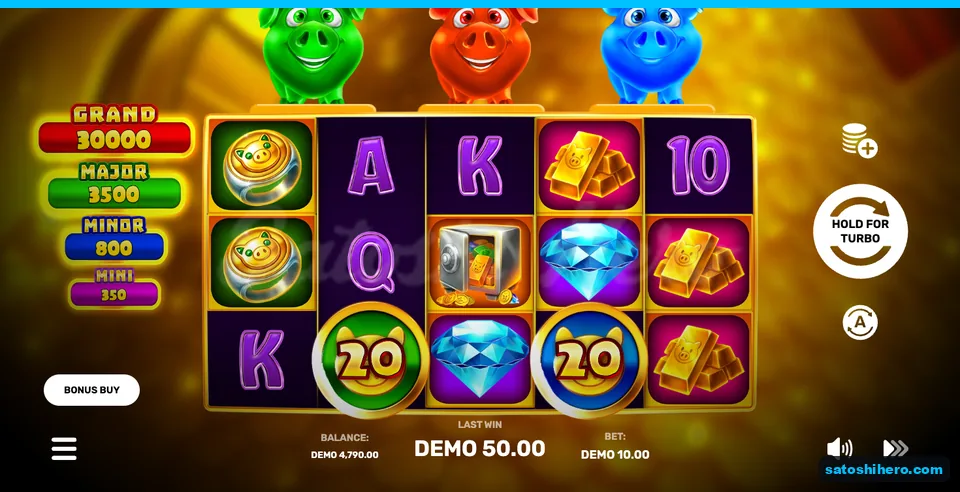
Every paytable figure uses your total bet, not a smaller line stake. I confirmed that scale when three safes on one line returned 3x my total bet. That direct check matters because the listed multipliers otherwise look unusually generous for ordinary symbols.

- Safe: 100x for five, 20x for four, 3x for three, and 0.5x for two.
- Diamond: 30x for five, 15x for four, and 2x for three.
- Red money bag: 20x, 10x, and 2x for five, four, and three.
- Gold bars: 15x, 7x, and 1x for five, four, and three.
- Pig ring: 10x, 5x, and 1x for five, four, and three.
- A and K: 5x, 1.5x, and 0.5x for five, four, and three.
- Q, J, and 10: 3x, 1x, and 0.5x for five, four, and three.
The safe leads the regular symbols by a wide margin. You can use these values to compare routine line returns against the larger-looking coin amounts, which remain inactive during base play.

Wild crown rules
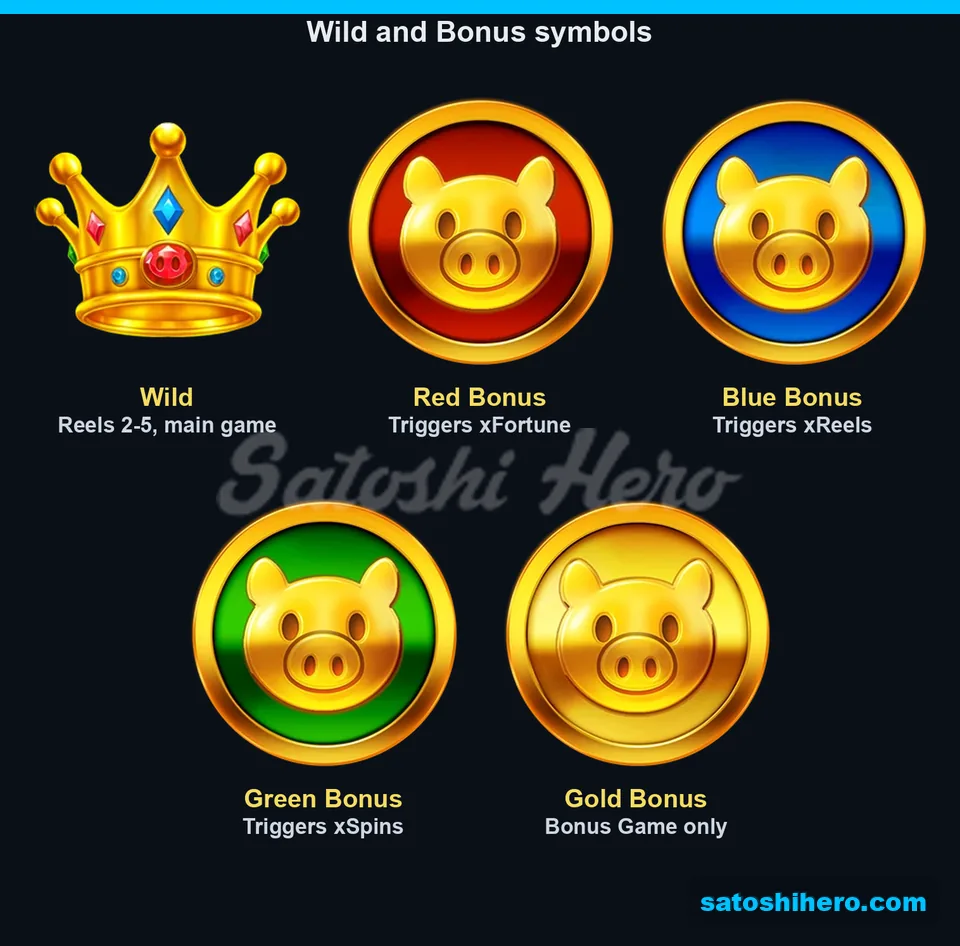
The crown Wild appears on reels 2 through 5 during the main game. It replaces any of the ten regular symbols, but it can’t stand in for a Bonus coin. There is no separate scatter, which keeps the screen easy to read.
Controls remain clear on smaller and larger screens, so you won’t need a separate layout lesson when switching devices. I like that simplicity, though a Wild still needs a qualifying left-to-right line before it helps you win.

Fast Fact: The paytable uses multiples of the total bet. My tested line of three safes confirmed that scale with a 3x return.
Bonus Coins and Trigger Rules
Red, Blue, and Green coins can lead into the Bonus Game, while Gold coins appear only inside it. You can see valuable amounts in base play, but those labels don’t pay unless the feature begins.
Coin colours and values
Each colour can display 1x, 2x, 3x, 5x, 10x, 12x, or 15x your total bet. A coin can instead carry the Mini, Minor, or Major jackpot label. Red, Blue, and Green stay on the main reels, whereas Gold belongs to the special feature reels.
This separation is easy to misunderstand on a first spin. In my view, bright multipliers look like instant prizes, so you should treat every visible coin as a possible feature component instead.
Landing versus triggering
Landing one or more coloured coins creates a chance to start the feature, not guaranteed entry. During my run, one Green and one Blue coin appeared together with 2x on each. Neither amount paid, and the Bonus Game didn’t start.
When a trigger occurs, its coin colours decide which pig boosters activate. That rule comes from the documented mechanics; my example only confirms that visible coins can fail to trigger. You can therefore land several appealing symbols without collecting their values or entering a bonus round.

Trivia: Bonus-coin amounts stay dormant during base play. They become collectible only after the Bonus Game begins, which makes colour more important than surface value.
Farmyard Theme and First Impressions
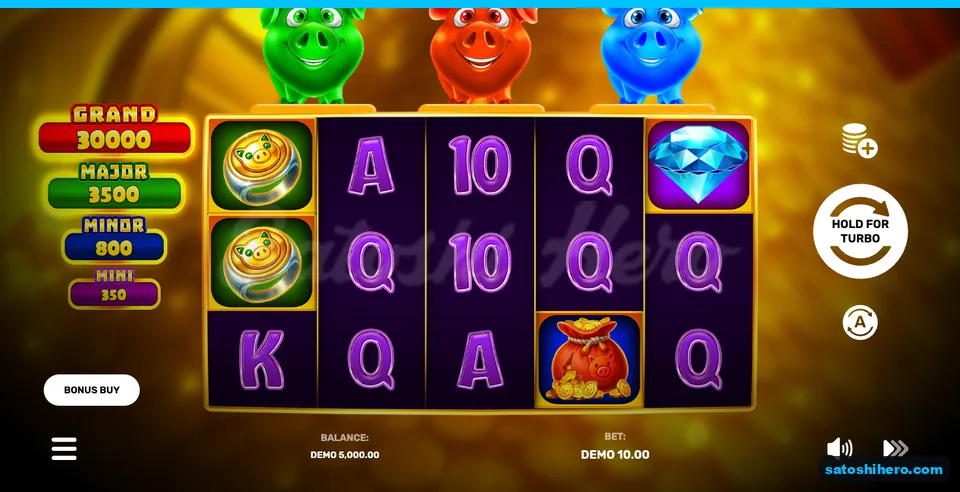
Three glowing pigs connect the farmyard treasure theme directly to the booster system. You see Green, Red, and Blue pigs above the reels, with each colour tied to a different enhancement.
Farmyard treasure look
A four-level jackpot ladder runs down the left side beside the Bonus Buy control. Mini, Minor, Major, and Grand labels remain visible while you spin, so the prize structure never hides behind a menu. The colour links also help you match landed coins with the relevant pig quickly.
Piggy Bank: 3 Pots Bonanza won’t win originality awards for putting farm animals beside treasure. Still, I think the colour-coded pigs earn their space because they explain mechanics rather than adding empty decoration.
Clarity at a glance
The 5×3 board uses large symbols, bright coins, and a separate jackpot panel. Its demo begins with a balance equal to 500x the selected bet, but the display omits a currency symbol. I report my results as bet multiples for that reason.
You can understand the core screen without digging through decorative clutter. The Bonus Buy control also stays distinct from the spin controls, which reduces accidental confusion. Clarity beats novelty here, and that choice serves you well during faster play.
Three Pig Boosters
xSpins changes the initial counter, xFortune can raise eligible coin values, and xReels creates a second bonus field. You can activate one, two, or all three, but none guarantees a stronger result.
Individual booster effects
The Green pig supplies xSpins, raising the initial feature counter from three spins to four. Red supplies xFortune, which can increase one to four random non-jackpot coins during each round. Possible increases are 0.5x, 1x, 2x, 3x, 5x, or 10x the bet.
Blue supplies xReels and adds another bonus field at the start. Extra space creates more collection positions, though it doesn’t promise that Gold coins fill them. I find the three roles nicely distinct, so you can understand each benefit without decoding overlapping rules.
Combined booster potential
With xReels, the lower field first copies coin positions from the matching places above. Both fields then spin independently, and the game combines their final prizes. Pairing that structure with xSpins or xFortune expands the feature in different directions.
No booster round started in my 100-spin test, so these effects come from the rules rather than observed outcomes. You shouldn’t rank combinations by imagined strength after reading one dry session. The sensible takeaway is simple: check the active colours because each pig changes a different part of play.

Tip: Check the active pig colours before the feature starts. xSpins changes the counter, xFortune changes eligible values, and xReels changes the field count.
Inside the Bonus Game
The Bonus Game converts triggering coloured coins into locked Gold coins, then runs a resetting spin counter. You collect coin values here instead of building wins across fixed paylines.
Starting the feature
Every Red, Blue, and Green coin on the triggering spin turns Gold while keeping its displayed value. Special reels then replace regular symbols with Gold coins and empty spaces. The feature keeps the selected bet from the triggering spin, and converted coins begin in their matching positions.
This collect-and-reset structure will feel familiar if you already play bonanza slots. Piggy Bank: 3 Pots Bonanza separates itself through colour-selected boosters, although my test never reached this stage. You should view the description as a rules explanation, not a claim about feature frequency.
Resets and collection
The round begins with three spins unless xSpins raises the opening count to four. Every newly landed Gold coin locks and resets the remaining spins to three. Play ends when the counter reaches zero or all 15 positions fill.
At the finish, the game adds every collected coin value and pays the combined amount at the triggering bet. A reset extends your collection chance, but it can’t promise another Gold coin. I like the clean objective, yet the mechanic needs continued landings rather than line combinations to build momentum.
Jackpot Values and Grand Conditions
Four fixed jackpot levels sit above the ordinary coin amounts, while the Grand requires a completely filled field. You need to distinguish that 15-position condition from the slot’s overall payout ceiling.
Four prize levels
- Mini: 35x the bet.
- Minor: 80x the bet.
- Major: 350x the bet.
- Grand: 3,000x the bet.
Individual Gold coins can carry Mini, Minor, or Major labels. Collecting one awards its attached jackpot with the other feature values. I prefer this visible method because you know which special prize entered the field before final collection.
Filling every position
Filling all 15 positions awards the Grand. With xReels active, each field can fill separately, creating a chance for two Grand awards. Neither a jackpot nor a completed field appeared during my recorded play.
The 3,000x Grand remains separate from the 6,414x game-wide cap. If total winnings reach that cap, the round ends immediately and unresolved feature parts disappear. You should track the distinction because a full-field prize isn’t the same as the maximum possible payout.
Bonus Buy Costs and Choices
Three purchase levels begin the Bonus Game immediately with one, two, or all three boosters. You pay 35x, 44x, or 66x your selected bet before learning the feature result.
Three purchase levels
One random booster costs 35x the bet, and two random boosters cost 44x. Activating all three costs 66x, while “random” means the first two tiers don’t let you choose exact pigs. The lowest price only offers the cheapest entry, not demonstrated value.
I didn’t purchase any feature during my test, so I can’t rank these options honestly. You shouldn’t read the smaller upfront cost as evidence of a better return. Each tier changes booster access, while its outcome remains unknown when you commit the stake.
Evidence and bankroll
Think of each multiplier as a complete stack of betting units. The top tier removes 66 betting units before its first feature outcome appears. Lower your base stake until that whole cost fits your planned spend, rather than anchoring on the possible ceiling.
SatoshiHero lets you use demo or real mode. Temple of Dead Bonus Buy also offers direct paid feature entry, while Gold of Sirens Bonus Buy gives another example of bypassing natural triggering. Those comparisons concern access structure only, not superior returns or value. You can also compare the purchase menus in Bandit Bust Bonus Buy, Budai Reels Bonus Buy, and Camino de Chili Bonus Buy.

Alert: Buying all three boosters costs 66x your selected bet in one action. Keep the complete purchase affordable, and don’t treat the maximum payout as likely.
RTP, Session Swings and Our Test
The model produced a wide range of possible results, while my recorded 100 spins finished 58.5x the bet lower. You should use both views for context, never as a forecast of your next session.
Simulator projection
The SatoshiHero Slot Simulator covered 1,000 spins at a $10.00 stake. Its inputs included the game’s theoretical return and maximum-win ceiling, while its outputs described a broad distribution rather than scheduled events.
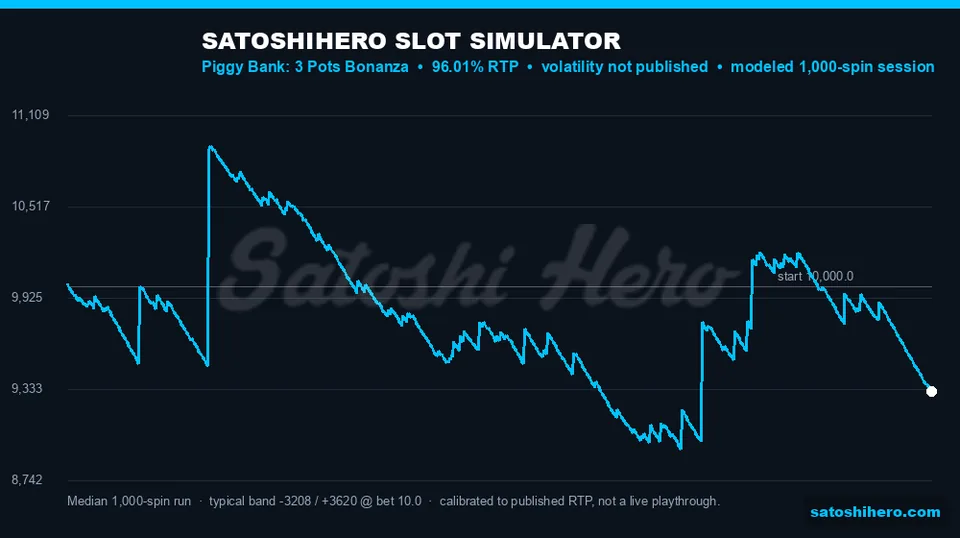
- Median ending result: about 68.6x the bet down.
- Typical band: from 320.8x down to 362.0x up.
- Modeled feature tier: about once every 45 spins.
- Paying spins: about 18%.
- Very large modeled win: about once every 1,757 spins.
These frequencies belong to the model and can’t tell you what the random number generator does next. Your result can also finish outside the typical band. I find the 682.8x span more informative than the median because it exposes how little one central figure says about session swings.
Our 100-spin session
I lost 58.5x the bet over 100 spins at $10.00 per spin. My balance began at 500x the bet and ended near 441x, after only 16 spins returned anything. The largest hit paid 9.5x on spin 11, and no natural Bonus Game trigger arrived.

After that best hit, small returns interrupted a long dry stretch without reversing the slide. My balance reached its lowest point on the final spin. The base game felt dry in this run, though 100 spins can’t measure the value of a feature I never entered.
The demo closed with an internal error after spins 33 and 54. I opened a fresh session each time, played only the remaining spins, and carried the net result forward. My final chart therefore stitches three sessions into one 100-spin record, which you should treat as firsthand evidence rather than an expected pattern.
According to Evoplay, the theoretical return is the operator’s published figure, and one live session can’t confirm, disprove, or alter it. Our simulator doesn’t predict future spins, while feature modes can use their own designed returns. I won’t invent per-purchase figures that weren’t provided.
The practical message is blunt: short play can lose steadily without showing the headline feature. The model gives you broader swing context, while my test shows how uneventful a small sample can feel.
Frequently Asked Questions
How do Bonus coins work in Piggy Bank: 3 Pots Bonanza?
Red, Blue, and Green coins appear in the main game and can trigger the feature. Gold coins appear only inside it. Each can carry 1x, 2x, 3x, 5x, 10x, 12x, or 15x the bet, plus Mini, Minor, or Major labels. You collect those values only during the Bonus Game.
What do the three pig boosters do in Piggy Bank: 3 Pots Bonanza?
xSpins raises the starting counter from three spins to four. xFortune can add 0.5x to 10x the bet to one through four eligible coins per round, while xReels adds a second field. No booster round triggered during my test, so you should treat these as documented effects.
How does the Bonus Game work in Piggy Bank: 3 Pots Bonanza?
The feature starts with three spins and locked Gold coins converted from the triggering colours. Each new Gold coin resets the counter to three, and filling all 15 positions ends collection. xSpins changes only the initial counter to four. When play stops, you receive the combined coin values at the triggering bet.
Which jackpots appear in Piggy Bank: 3 Pots Bonanza?
Mini pays 35x, Minor pays 80x, Major pays 350x, and Grand pays 3,000x the bet. Filling all 15 positions awards the Grand. If xReels creates a second field, each field can qualify separately, so you have a chance to collect two Grand prizes.
Can I buy the Bonus Game in Piggy Bank: 3 Pots Bonanza?
Yes. One random booster costs 35x the bet, two random boosters cost 44x, and all three cost 66x. I bought none during my short test, so I can’t give any option a value ranking. You should judge each tier by its full upfront cost.
How many paylines does Piggy Bank: 3 Pots Bonanza have?
The 5×3 grid uses 20 fixed paylines. A winning combination must begin on reel 1 and continue from left to right. Only the highest-paying combination counts on each line. Wild crowns on reels 2 through 5 can replace regular symbols, but they can’t replace Bonus coins.
What is the top-paying regular symbol in Piggy Bank: 3 Pots Bonanza?
The safe leads regular symbols, paying 100x the bet for five, 20x for four, and 3x for three. Five diamonds return 30x, while five red money bags return 20x. I also observed three safes pay exactly 3x my total bet.
What did the 1,000-spin simulator show for Piggy Bank: 3 Pots Bonanza?
Its median session finished about 68.6x the bet down, with a typical range from 320.8x down to 362.0x up. About 18% of modeled spins paid, and a feature tier appeared about once every 45 spins. Those outputs can’t forecast what you will see next.
What happened during the 100-spin Piggy Bank: 3 Pots Bonanza test?
I lost 58.5x the bet, recorded 16 paying spins, and saw no Bonus Game trigger. My largest return was 9.5x on spin 11. Two internal errors forced me to continue in fresh sessions, so I carried each net result forward and combined the three segments.
What is the maximum win in Piggy Bank: 3 Pots Bonanza?
The maximum win is 6,414x the bet. Reaching that ceiling ends the round immediately, and any unresolved feature elements disappear. This cap differs from the 3,000x Grand jackpot, so you shouldn’t treat the Grand label as the game’s complete payout limit.
Closing Thoughts
Piggy Bank: 3 Pots Bonanza gives its familiar coin collection format a clearer identity through three colour-linked boosters. Its drawback is clear: my base-game sample stayed dry and never opened the feature.

My Verdict
Collect-and-reset fans should learn the pig colours in demo mode before risking a paid feature. Expect line wins to carry play until a coin trigger, but don’t assume a short session reaches one.
I like how each pig changes a separate part of the Bonus Game. I dislike how little the base game showed, where a 9.5x hit couldn’t stop a 58.5x decline.
Piggy Bank: 3 Pots Bonanza offers readable play and a feature unseen in my test. Its rules are checked regularly so you can compare them before playing.

Pros:
 Clear booster roles: Colour coding shows which feature element each pig changes.
- Transparent line pays: Total-bet multipliers make ordinary symbol returns easy to compare.
- Flexible feature access: Three buy tiers provide different levels of booster access.
- Useful demo mode: You can learn triggers and controls without using real funds.

Cons:
 Dry tested base game: Only 16 of 100 spins returned anything.
- Unseen core feature: My test never demonstrated the Bonus Game in action.
- Expensive full access: All three boosters cost 66x the selected bet upfront.

Best For: Coin-collection fans who enjoy reset counters and layered booster combinations should understand the format quickly. Careful bankroll planners can use the demo first, while anyone needing frequent feature action could find the dry spells frustrating.


































































Bets
All Bets
Game
Player
Date
Wager
Mult.Multiplier
Prize
 Luck of Panda: Bonus Combo
 mike_721
- 09:06:21
- 0×
- Luck of Panda: Bonus Combo
 Hidden
- 09:06:21
- 0×
- Mardi Gras Queen
- josh1998
- 09:06:19
- 0×
- Piggy Bankroll: The Big Stash
 davidm5
- 09:06:19
- 0×
- Piggy Bankroll: The Big Stash
- davidm5
- 09:06:18
- 0×
- Luck of Panda: Bonus Combo
- Hidden
- 09:06:18
- 0×
- Luck of Panda: Bonus Combo
- mike_721
- 09:06:18
- 0×
- Piggy Bankroll: The Big Stash
- davidm5
- 09:06:17
- 0×
- Piggy Bankroll: The Big Stash
- davidm5
- 09:06:16
- 0×
- Piggy Bankroll: The Big Stash
- davidm5
- 09:06:15
- 0×