


Neon Sparks Across the MegaClusters Grid
Cyberslot MegaClusters turns a neon gem board into a high-risk cluster-pays slot with sharp reactions and roaming wild tension.
Cyberslot MegaClusters is a very-high volatility slot from Big Time Gaming with 96.36% RTP and 31,364x max win potential. It uses an expanding MegaClusters gem board instead of paylines, and my 100-spin test finished $3.45 ahead without triggering free spins. Technical cluster fans get the best match here, especially if they can handle long dry spells.
Key takeaways
- RTP / volatility: Cyberslot MegaClusters has 96.36% RTP, very-high volatility and 31,364x max win potential.
- Best play: The Cyberslot MegaClusters slot has no fixed paylines; wins need 5 or more matching gems touching horizontally or vertically.
- Best bonus: Base-game spinning was the only tested route, because the Feature Drop button stayed unused.
- Risk note: Free spins need 12 or more reactions on one base spin, not scatter symbols.
- Bankroll note: My test ended $3.45 ahead, but the simulator showed a wide swing range.

Table of Contents
- Theme & first impressions
- How Cyberslot MegaClusters works
- Cluster pay rules
- Gem value ladder
- Megaclusters and reactions
- Splits and drops
- Reaction timing
- Roaming Wild multiplier
- Multiplier timing
- Movement rules
- Free spins trigger and upgrades
- Trigger condition
- Wild upgrades
- Feature Drop, stakes and test setup
- Test conditions
- Feature buy note
- 100-spin session results
- Balance movement
- Biggest win
- RTP, volatility and simulator results
- Simulator projection
- Our 100-spin session
- Frequently Asked Questions About Cyberslot MegaClusters
- Where I Land
Theme & first impressions
Cyberslot MegaClusters looks more like a neon arcade puzzle board than a classic slot. You get glowing gem reactions, chrome framing and a synthwave grid, not reel stops or line wins.
The opening board starts as a 3×3 gem display with one position already split into nine smaller symbols. That detail matters because you can see the MegaClusters idea before any win lands. The board stays readable even when symbols split, drop and crowd the screen. I like that clarity, because busy cluster slots can turn into visual noise fast.
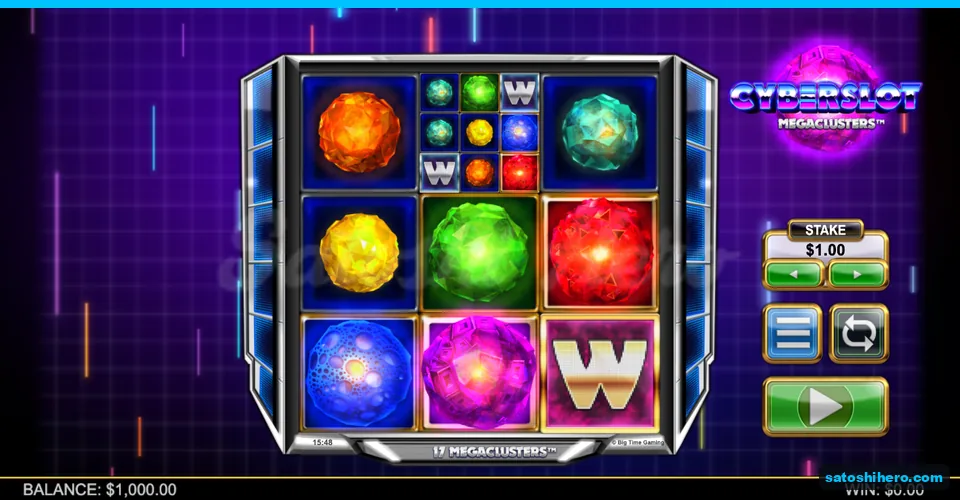
The neon arcade theme won’t win originality awards, but the execution looks sharp and easy to follow. You may prefer Wild Flower if softer, brighter and nature-led visuals fit your mood better than chrome, grids and glowing gems. This game aims for machine-room energy instead, and it commits to that look.

Background: The synthwave arcade look makes the game feel closer to a puzzle cabinet than a reel slot. That mood matches the way the board splits and rebuilds after wins.
A useful way to judge the theme is speed. You can understand the whole screen in a second, even when the smaller gems start filling the middle. That helps because the game asks you to track reactions, not paylines. I found the chrome frame plain, but the gem contrast does real work.
Practically speaking, you should expect a technical gem board rather than a familiar row-spin rhythm. If you want reels and paylines, this won’t feel familiar.
How Cyberslot MegaClusters works
Cyberslot MegaClusters pays through touching gem clusters, not paylines, so you should read the board by connected colors. You don’t need to count lines, because matching symbols only need to touch horizontally or vertically.
Cluster pay rules
Wins need 5 or more matching symbols of any size. Only the highest win pays for each winning cluster, then the game adds every winning cluster on the board together. I read the values at a $1.00 stake, so the dollar amounts map cleanly to bet multiples. Desktop and mobile play use the same board logic, which keeps the learning curve simple.

Snapshot: Cyberslot MegaClusters pays by touching clusters of 5 or more matching symbols. You don’t need to count paylines, because this game doesn’t use them.
That rule changes how you watch each spin. You look for color groups, wild contact and new spaces after a split. The bottom line is simple: bigger connected groups matter more than symbol positions.
Gem value ladder
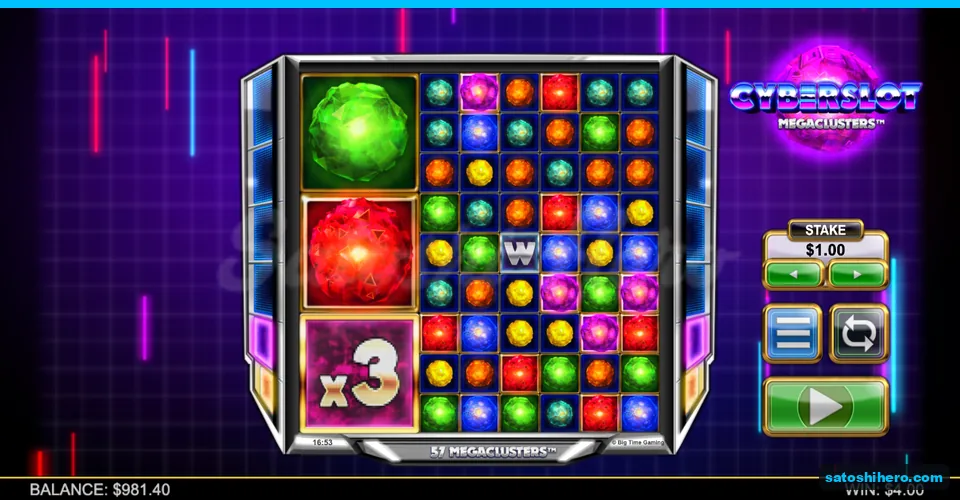
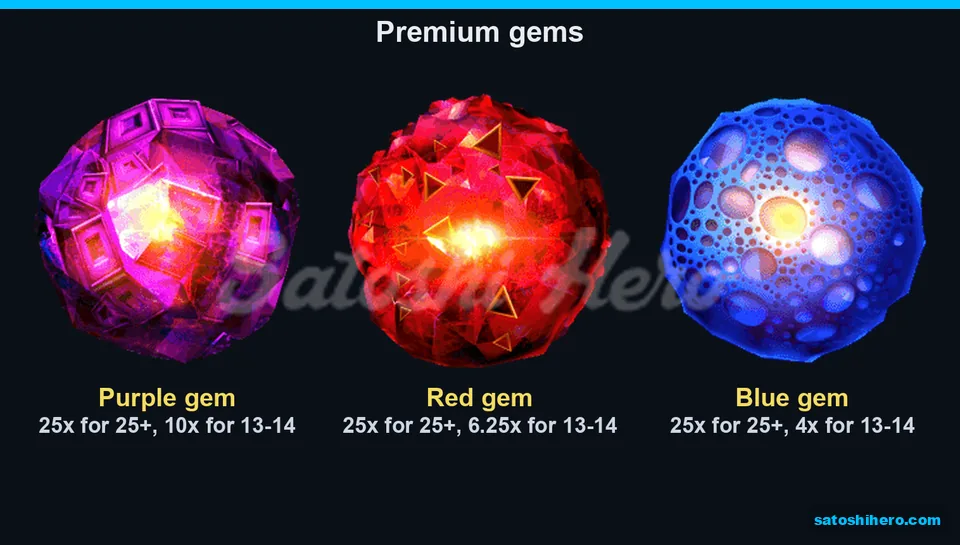
The premium gems carry the strongest visible pay values. Purple pays $25.00 for 25 symbols, $10.00 for 13 to 14, $2.50 for 9 to 10 and $0.40 for 5. Red pays $25.00 for 25, $6.25 for 13 to 14 and $0.30 for 5. Blue pays $25.00 for 25, $4.00 for 13 to 14 and $0.30 for 5.
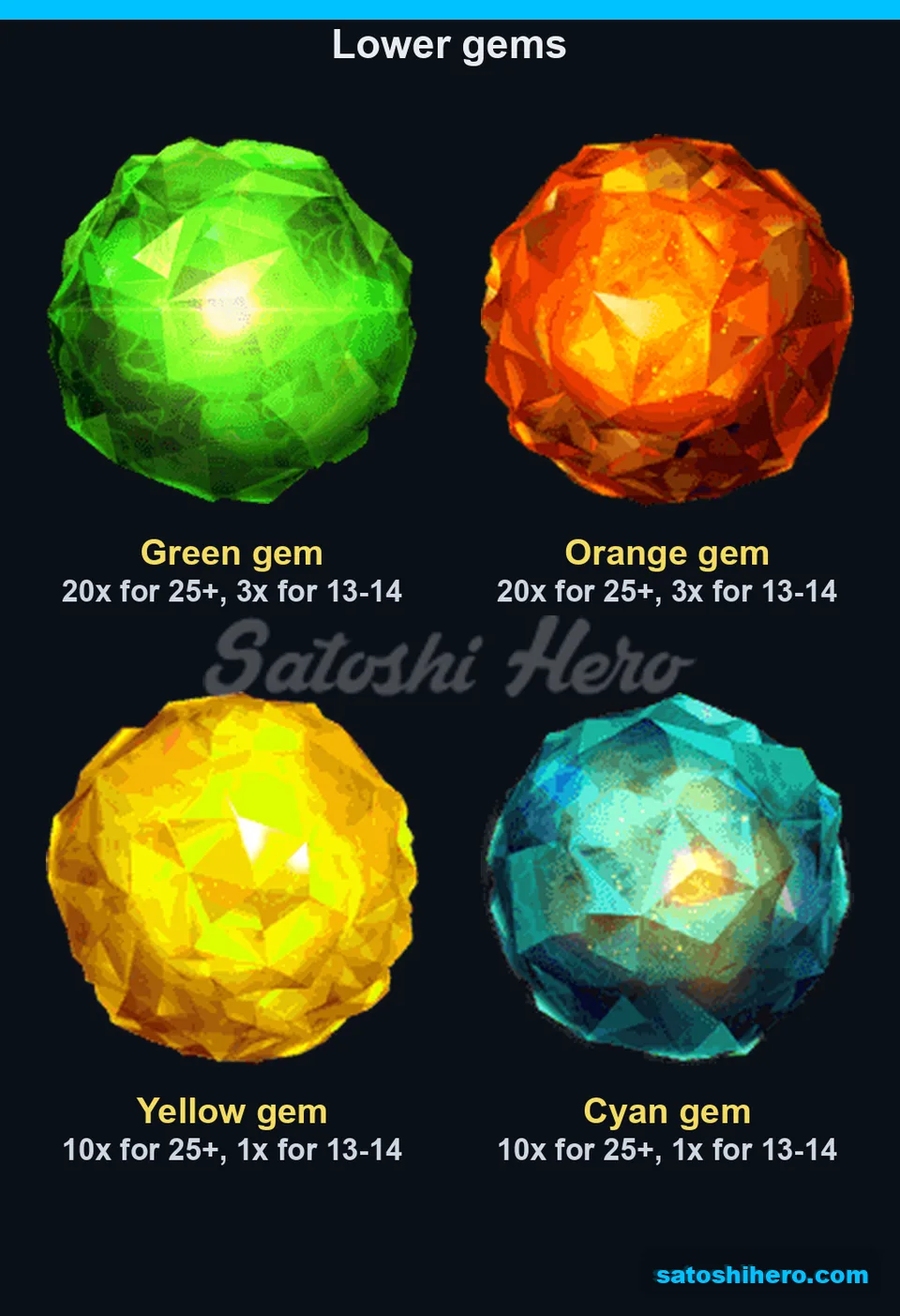
Lower gems still matter because repeated small hits can keep a spin alive. Green and orange pay $20.00 for 25 symbols, $3.00 for 13 to 14 and $0.20 for 5. Yellow and cyan pay $10.00 for 25, $1.00 for 13 to 14 and $0.15 for 5.
The regular Wild appears as a silver W in a metal frame. It substitutes for every symbol except Roaming Wilds, but only for adjacent symbols. It doesn’t pay as a cluster by itself, so you need it to connect real gem groups. That limit feels fair, because universal wild contact would make the board too loose.
You also need to treat the paytable as a ceiling map, not a target list. A 25-symbol premium cluster looks huge on paper, but most of my live clusters stayed much smaller. The lower gems paid often enough to matter, though they rarely changed the session alone. You’ll care more about how they combine with wild contact and follow-up drops.
Megaclusters and reactions
The MegaClusters engine makes winning symbols split into smaller symbols, creating more spaces for reactions and bigger board states. You’re watching the board rebuild itself after wins, not waiting for a line hit.
Splits and drops
Each base spin starts on a 3×3 board. Every spin includes one random position with nine smaller symbols instead of one large gem. When a win lands, each winning symbol becomes nine smaller symbols in the base game. Free spins use four smaller symbols instead, which changes how the board fills.
If the new smaller symbols win, same-size symbols above fall down. New symbols then drop from the top, and reactions continue until no fresh win appears. What matters here is pace: one simple hit can open extra positions, but many spins still end before the board builds into anything serious.
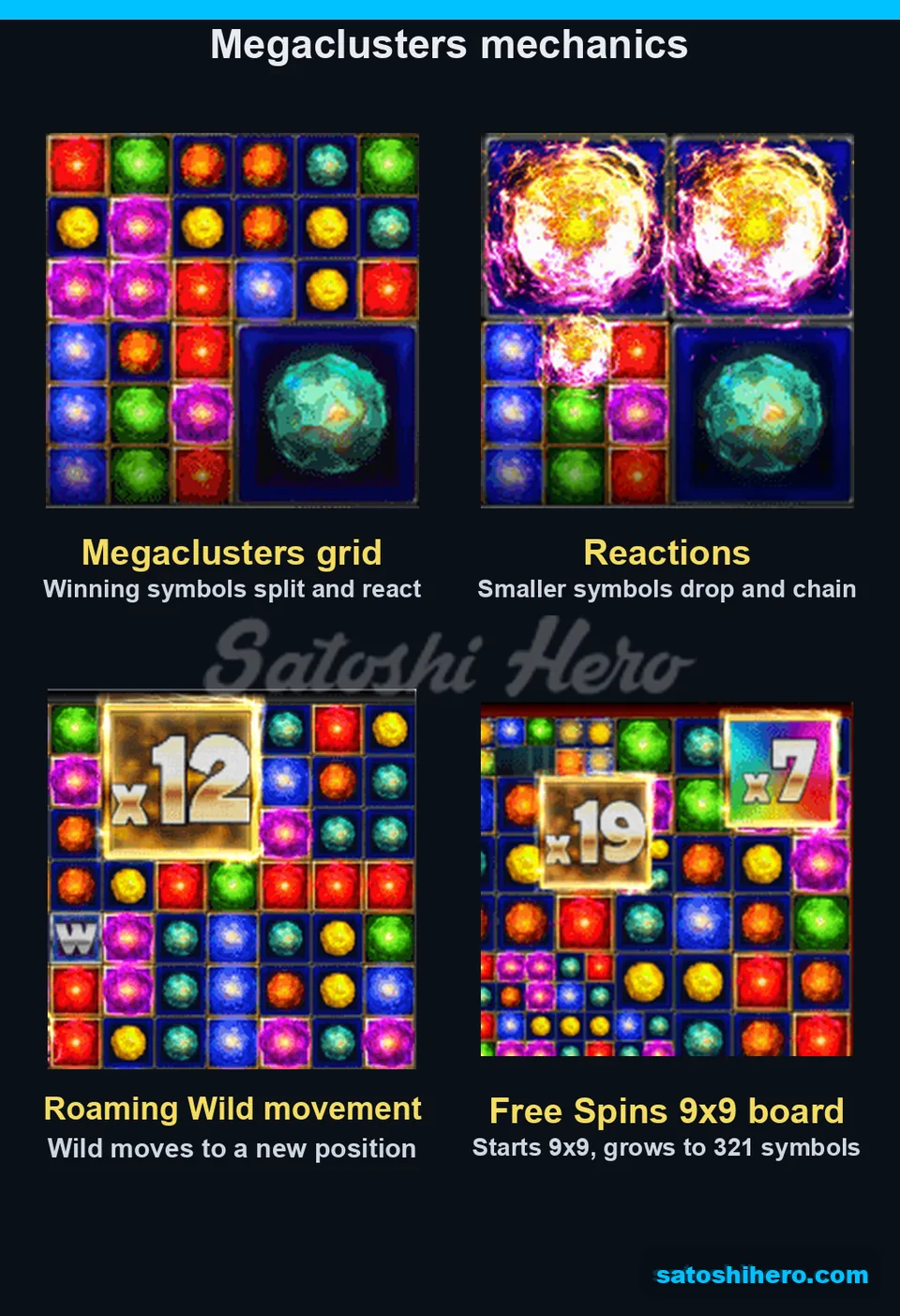
Background: The board expands because winning gems break into smaller symbols. That creates more positions for later reactions and explains the game’s puzzle-like rhythm.
Reaction timing
Reactions start only after every win on the board has paid. That keeps the sequence clear, because you can separate the payout from the next drop. The board can hold up to 321 symbols in free spins, so the screen can move from calm to crowded quickly.
The strange part is how a spin can feel busy without paying much. A few splits can fill the board with motion, then stop at a small result. That isn’t bad design; it’s the math showing through the mechanic. You should enjoy the process of watching reactions, because the payout screen won’t always justify the drama.
I like the mechanic because it gives every small win a second job. It pays first, then it may create room for another chain. Still, many spins fade after one or two reactions, and that’s where the very-high volatility shows its teeth. You’re watching for repeat reactions, not a line hit.
Roaming Wild multiplier
The Roaming Wild is the main tension feature because it substitutes, moves after wins and can grow its multiplier before wins pay. You can’t steer it, so the excitement comes from where it lands next.
Multiplier timing
The Golden Roaming Wild stays present on every spin and substitutes for every symbol. Its multiplier starts at x1, then rises by 1 when it joins a win on the first reaction. It also rises by 1 on every second reaction after that. The increase happens before the win pays, which can make one connection matter more than it first appears.

The multiplier resets at the end of the spin unless free spins trigger. That reset can feel harsh when the wild reaches a promising number late in the base game. I don’t mind the rule, though, because it makes the bonus trigger carry more weight.
Movement rules
After each win, the Roaming Wild moves to one of the 9 base-game positions. In free spins, it can move to one of 81 positions. The spot it leaves gets refilled with smaller symbols, so its movement can create fresh cluster paths. You get tension from the jump, but you don’t get control.
The wild creates good drama, but it can also tease movement without making a useful connection. Players who enjoy wild-led tension may also appreciate Wild Portals, because both games put wild behavior near the center of the spin. Here, the moving wild feels more technical and less cinematic. Watch the wild, but don’t assume it can rescue every quiet board.
Free spins trigger and upgrades
Free spins trigger from 12 or more reactions on one base-game spin, not from scatter symbols. That means the bonus depends on sustained chain reactions, so you need patience and sensible stake sizing.
Trigger condition
A qualifying base spin awards 6 free spins. The round starts on a 9×9 board, and the stake that triggered it applies to every free spin. The total pays at the end. I didn’t trigger free spins during my 100-spin test, which tells you plenty about the swing profile.
The trigger condition feels more interesting than a scatter count because it grows from the core mechanic. You need the board to keep splitting, falling and reconnecting. That sounds exciting, but you shouldn’t treat it as something nearby on every session.

Pointer: Free spins need 12 or more reactions rather than scatters. Keep your stake sized for missed triggers and quiet stretches.
The free-spin rules also make the base game easier to read. Every reaction matters because the count, not a separate scatter symbol, decides whether the bonus opens. During my test, several spins looked lively early and still died well short of 12 reactions. That made the trigger feel earned, but also remote.
Wild upgrades
The Golden Roaming Wild multiplier carries over from the triggering spin. Every multiple of 10 on that multiplier can add 2 more free spins. The first retrigger adds a Rainbow Roaming Wild with its own x1 multiplier, and it stays for the rest of the round.
I didn’t see the Rainbow Roaming Wild or any retrigger in live play. That absence matters, because a feature can look strong on paper while staying out of reach in a short test. The rules are exciting, but my session never reached the bonus.
Feature Drop, stakes and test setup
The test used base-game spins at $1.00, while the Feature Drop button stayed untouched because this was a lite session. This section gives practical test context, not a feature-buy push.
Test conditions
Demo stakes ran from $0.20 to $20.00. I started at a $1.00 stake with a $1,000.00 balance and used 100 autoplay spins. After opening the game from a SatoshiHero account, a Cyberslot MegaClusters login leads into demo or real play before you set your stake.
Those conditions gave me a clean view of base-game behavior. A $1.00 stake made the paytable easy to read, because each dollar value also showed the stake multiple. You can choose a lower stake if you want more spins from the same balance.
Feature buy note
The Feature Drop button exists for buying the feature, but I didn’t use it. With very-high volatility, I’d treat any direct feature entry as higher-risk by nature. I won’t estimate feature-buy value without testing that route.
The Feature Drop note deserves caution because the button can change your spending rhythm. A buy option shortens the wait, but it also concentrates risk into fewer decisions. Since I didn’t press it, I’m only judging normal spins here. That honesty matters more than guessing a value I didn’t test.
That restraint matters. The base-game sample already showed how quickly the board can go quiet, even when the final result looked calm. If you use Feature Drop, treat it as a separate risk decision rather than an upgrade to normal spinning.
100-spin session results
The 100-spin test finished $3.45 ahead, but that flat result doesn’t make this a low-risk slot. My session stayed calmer than the math profile, while the bonus stayed completely out of sight.
Balance movement
I played 100 autoplay spins at $1.00 from a $1,000.00 demo balance. The final balance reached $1,003.45, so I finished $3.45 up. My lowest point was $980.35 around spin 25, then the session climbed to $1,015.25 around spin 82. About a third of my spins paid something.
Most wins came from small 5 to 8 gem chains worth a few cents to a couple of dollars. The Golden Roaming Wild helped keep the balance level when it connected nearby colors. You shouldn’t read that as comfort, because small wins can disguise how hard the bonus can be to reach.

Heads Up: My test ended slightly ahead, but the official volatility is still very-high. A 31,364x max win profile can create long dry spells and sharp balance swings.
Biggest win
My biggest single win was $21.60 on spin 40. That equals 21.6x the $1.00 stake, which is useful but nowhere near the game’s ceiling. Free spins didn’t trigger, and I didn’t see the Rainbow Roaming Wild or any retrigger.
The result felt playable because the balance never collapsed. I still wouldn’t call it gentle, because 100 spins barely scratches a 31,364x max-win game. The better lesson is bankroll control: a calm test can still belong to a very-high volatility slot.
RTP, volatility and simulator results
According to Big Time Gaming, Cyberslot MegaClusters has 96.36% theoretical RTP, very-high volatility and 31,364x max win potential. The math profile points toward wide swings, not steady grind results.
Simulator projection
Data from the SatoshiHero Slot Simulator modelled 1,000 spins at a $1.00 stake. It used 96.36% RTP, very-high volatility and a 31,364x max win as assumptions. The median session finished $103.30 down, while the typical band ran from $435.40 down to $676.80 up. About 14% of spins paid.
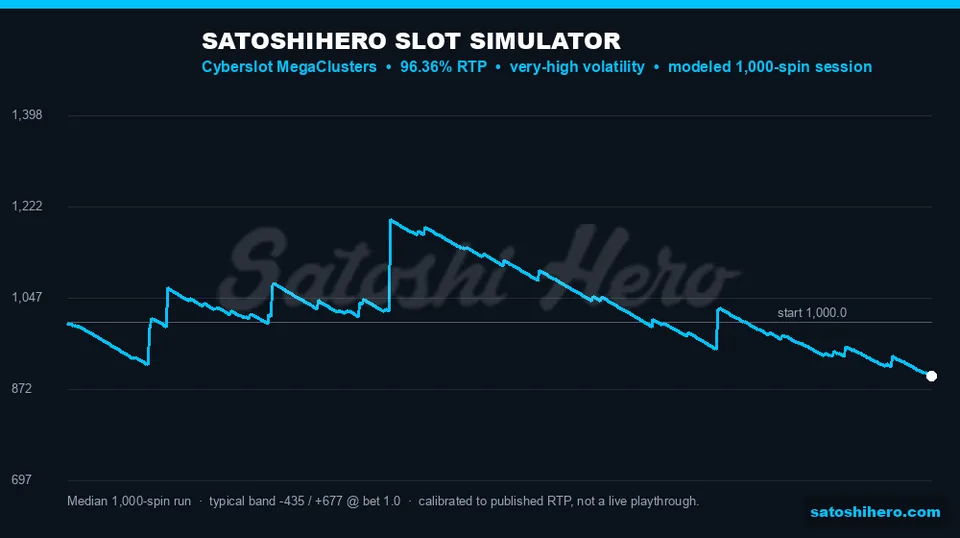
The feature tier appeared roughly once in 54 spins. A 100x or larger win appeared roughly once in 810 spins. That projection isn’t a promise, but it shows the shape of the risk. Players comparing high-upside, swingy sessions can use Millionaire Mystery Box as another risk-profile reference, not a safer alternative.
I’d separate two ideas when reading the simulator. The hit rate tells you how often any spin may return money, while the 100x frequency tells you how rarely a strong result may appear. Those are very different player experiences. My flat finish sat between those extremes, which is exactly why one session can mislead you.
Our 100-spin session
My live-style demo test finished $3.45 up, with a 21.6x biggest win. Free spins didn’t trigger, so the session showed base-game stability more than bonus potential. The simulator looked much rougher because it stretched across more spins and allowed more room for sharp jumps.
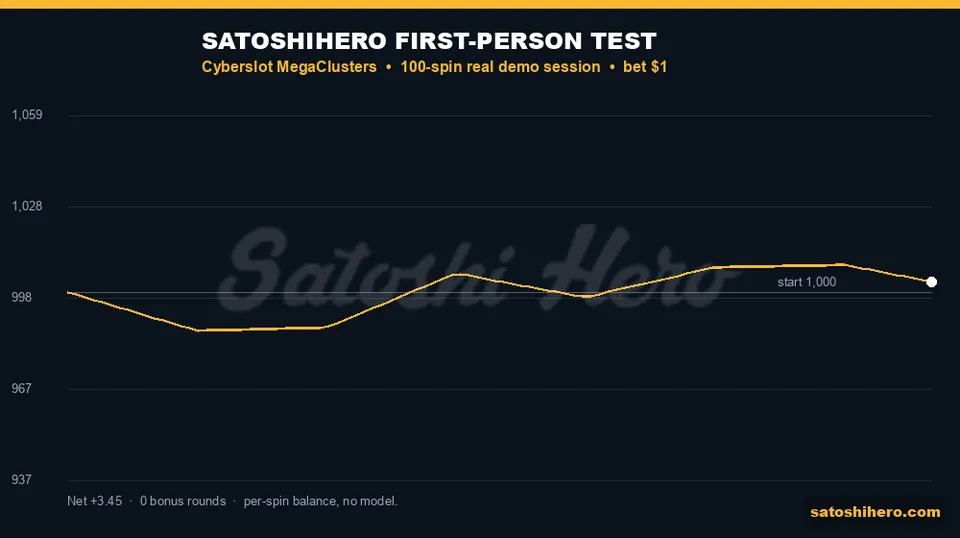
The practical read is simple. You can have a flat 100-spin run, but the official profile still pushes toward larger gaps between meaningful hits. The 96.36% RTP is the operator-published theoretical return. A single 100-spin live or demo session doesn’t change that theoretical figure, feature-buy or bonus-specific returns can sit slightly differently from base play by design, and the simulator uses official specs as assumptions but can’t know or predict the operator’s random numbers.
Frequently Asked Questions About Cyberslot MegaClusters
How do wins work in Cyberslot MegaClusters?
You need 5 or more matching symbols of any size touching horizontally or vertically. Only the highest win pays per winning cluster, all clusters on the board get added together, and 25 purple, red or blue symbols pay 25x.
What happens when a symbol wins in Cyberslot MegaClusters?
Each winning symbol becomes nine smaller symbols in the base game and four smaller symbols in free spins. Symbols above fall down, new ones drop in, and reactions continue until no win remains.
How do the free spins trigger in Cyberslot MegaClusters?
Free spins trigger when 12 or more reactions happen on one base-game spin. That awards 6 free spins on a 9×9 starting board, the Roaming Wild multiplier carries over, and every multiple of 10 on the Golden Roaming Wild multiplier adds 2 free spins.
What does the Roaming Wild do in Cyberslot MegaClusters?
It substitutes for every symbol and carries a multiplier that starts at x1. The multiplier rises when it joins a win on the first reaction and every second reaction after that, then it moves to a new position after each win.
What are the RTP, volatility and maximum win in Cyberslot MegaClusters?
Cyberslot MegaClusters has 96.36% RTP, very-high volatility and 31,364x max win potential.
What did the 1,000-spin simulator show?
At a $1.00 stake, the modelled median session ended $103.30 down, with a typical band from $435.40 down to $676.80 up. About 14% of spins paid, and a 100x win or better came roughly once in 810 spins.
How did the 100-spin test go?
The 100-spin autoplay test at $1.00 started from $1,000.00 and finished at $1,003.45. The lowest point was $980.35, the highest was $1,015.25, the biggest win was $21.60, and free spins didn’t trigger.
Where I Land
Cyberslot MegaClusters stands out because its gem board makes every win feel mechanical and visible. The drawback is just as clear: very-high volatility can leave you waiting for the board to build.

My Take
Technical slot fans should try the demo before raising stakes, because the rhythm feels different from reels. Expect small cluster hits, teasing wild movement and long waits for the feature. I like the structure, but I wouldn’t use oversized bets here.
I like how the Golden Roaming Wild gave my session shape, especially when it kept the balance near level. I don’t like how distant the free spins felt across 100 spins. The best hit was only $21.60, so my test showed control rather than fireworks.
Cyberslot MegaClusters is updated periodically when tested details change. My verdict stays practical: play it for the mechanic, not because one flat session suggests soft volatility.

Pros:
 Clear cluster rules: Touching colors make wins easy to read during fast reactions.
- Strong wild tension: The Roaming Wild keeps quiet boards worth watching.
- Useful RTP: 96.36% gives the math profile a fair starting point.
- Flexible stakes: The $0.20 to $20.00 range supports cautious testing.

Cons:
 Harsh volatility: very-high swings can drain short sessions quickly.
- Distant bonus: Free spins need 12 reactions, not a simple scatter hit.
- Feature untested: I can’t judge Feature Drop value from this base-game sample.

Best For: Patient cluster-slot players get the most from this game when they enjoy technical boards, moving wilds and volatility planning. If you prefer smooth reel spins or frequent bonus rounds, this one may feel too stop-start. Start low, learn the reaction rhythm, then decide whether the risk fits your bankroll.


































































Bets
All Bets
Game
Player
Date
Wager
Mult.Multiplier
Prize
 Galaxy Glitter
 nina87
- 20:17:30
- 0×
- Elephant's Gold: Bonus Combo
 mdp0fxo
- 20:17:29
- 0.8×
- 3 Witches: Bonus Combo
 Hidden
- 20:17:27
- 0×
- Galaxy Glitter
- josh1998
- 20:17:27
- 0×
- Galaxy Glitter
- Hidden
- 20:17:27
- 0×
- Big Banker Bonanza
- Hidden
- 20:17:25
- 0×
- 3 Witches: Bonus Combo
- Hidden
- 20:17:25
- 0×
- 3 Witches: Bonus Combo
- Hidden
- 20:17:24
- 0×
- Galaxy Glitter
- Hidden
- 20:17:24
- 1×
- 3 Witches: Bonus Combo
- Hidden
- 20:17:23
- 0×