

Miles Bellhouse and the Gears of time
By pressing play, you agree that you are above legal age in your jurisdiction and that your jurisdiction allows online gambling.

Miles Bellhouse and the Gears of time
RTP96.68%
VolatilityMedium
Max winx1,084
Hit rate19.89%
ThemeFantasy

Chasing Time Through Copper Gears
I tested Miles Bellhouse and the Gears of time as a steampunk cluster-pays slot where marked grid spots matter more than paylines.
Miles Bellhouse and the Gears of time is a medium volatility slot from Betsoft with 96.68% RTP and 1,084x max win potential. The game uses a 5×5 grid where clusters of 3 or more matching symbols pay, the Wild orb substitutes, and Free Spins unlock after all 5 marked positions get covered. Aimed at patient cluster fans who like active cascades, feature choices, and measured risk.
Key takeaways
- Best bonus: Free Spins give you the main choice, with Past, Present, or Future picked before the round starts.
- RTP / volatility: The slot runs at 96.68% RTP with medium volatility, so you get activity without huge chaos.
- Max win: The top payout caps at 1,084x, which feels modest beside some modern cluster slots.
- Risk note: My 100-spin test lost $17.64 at $0.30 per spin, with no Free Spins trigger.
- Bankroll note: Small cluster wins can keep you watching while the balance still slides.

Table of Contents
- Theme & First Impressions
- Symbols and Payouts
- High symbol pays
- Gear and wild pays
- How Miles Bellhouse and the Gears of time Works
- Grid and clusters
- Cascades and wins
- Clusters of Time
- Marked grid spots
- Covered positions
- Time Traveling Events
- Past and Present
- Future respin
- Free Spins
- Three time streams
- No bonus buy
- How the 100 Spins Played
- Session result
- Best hit
- RTP, Volatility & Our Test
- Simulator projection
- Our 100-spin session
- Frequently Asked Questions About Miles Bellhouse and the Gears of time
- Closing Thoughts
Theme & First Impressions
Miles Bellhouse and the Gears of time presents a glossy steampunk time-travel workshop with a copper-framed 5×5 grid. You see copper pipes, a brick wall, a green portal, Miles on the right, and a small robot beside the machine. Betsoft’s shiny 3D style gives the whole scene a toy-like finish, which you may either love or find a little polished.
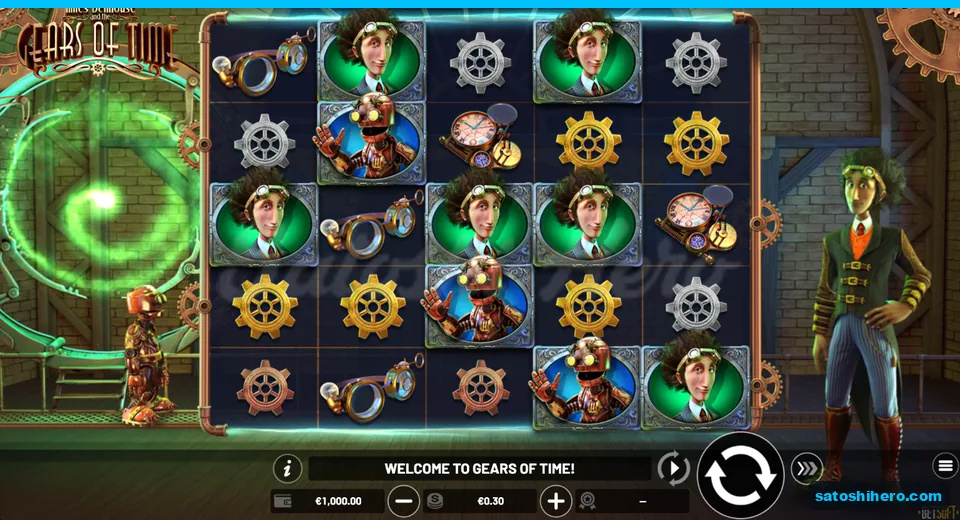
The symbols fit the setting cleanly. You get brass gears, a clock device, goggles, the robot, and Miles himself as the top character portrait. If you play Miles Bellhouse and the Gears of time for the theme, the appeal is mostly in the workshop atmosphere and time-machine details. The theme won’t stun steampunk fans, but the portal and copper workshop add more personality than a plain gear grid.

Fast Fact: The game looks like a line slot at first glance, but it pays by clusters on a 5×5 grid.
You’ll notice the layout reads well because the grid stays compact. On desktop or mobile, the 5×5 board keeps clusters, marks, and cascades easy to follow. That matters because you need to see which wins touch the marked positions. I like that the design supports the mechanic instead of fighting it.
Symbols and Payouts
Every symbol pays from clusters of 3 up to 25, with Miles as the highest symbol. I checked the in-game paytable at my $0.30 stake and matched it against a logged $0.18 win from three gold gears. That confirmed the lower pay scale in live play, not just in the paytable. You’ll get the clearest feel by reading values as bet multiples.
High symbol pays
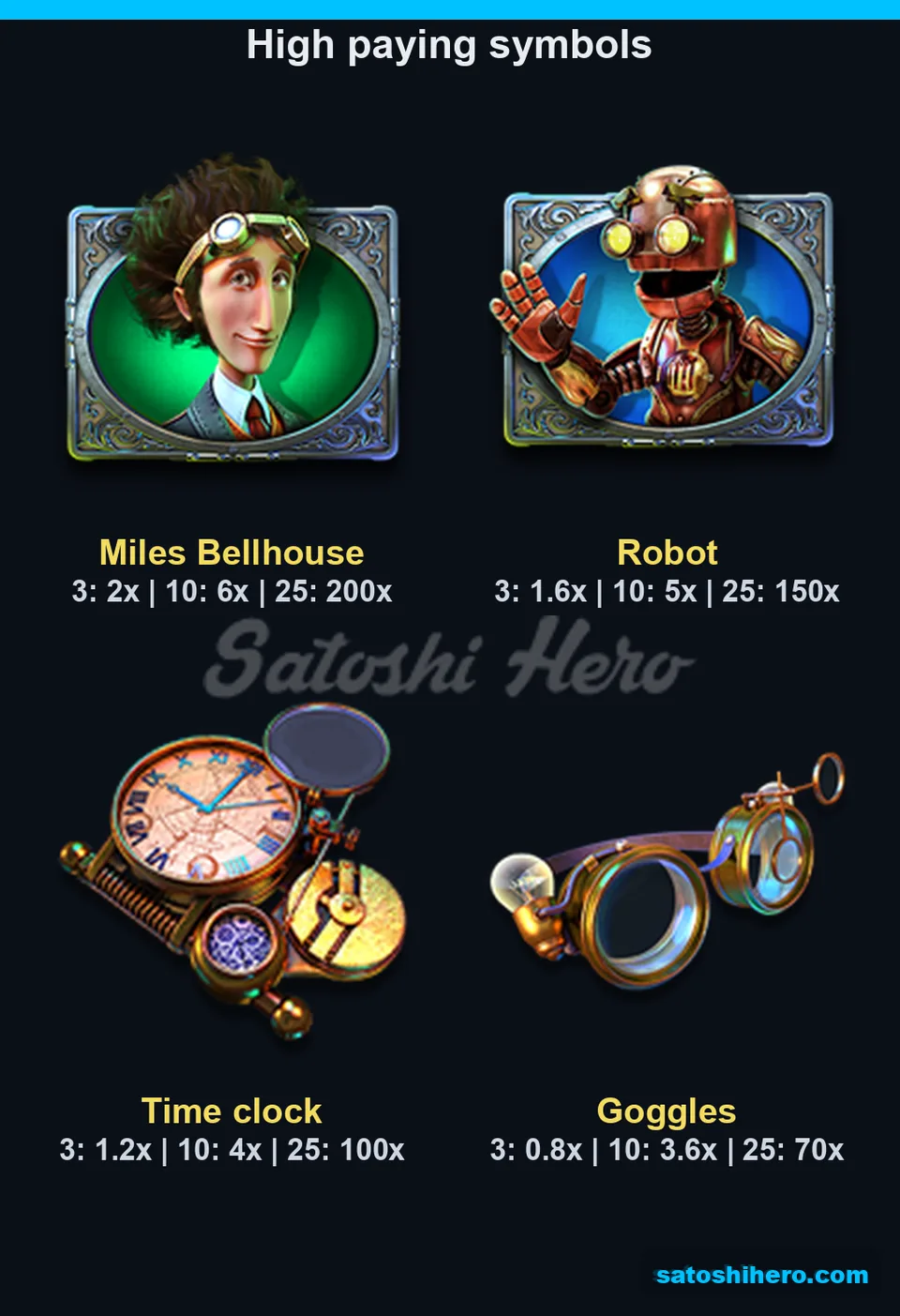
The premium symbols are simple to read, which helps when the grid starts cascading. Miles Bellhouse pays 2x for 3 symbols, 6x for 10, and 200x for a full 25-symbol cluster. The Robot pays 1.6x, 5x, and 150x across those same sizes. The Golden Owl of Athena also uses readable adventure-style premiums, but this game leans harder on mechanical clarity.
- Miles Bellhouse: 2x for 3, 6x for 10, 200x for 25.
- Robot: 1.6x for 3, 5x for 10, 150x for 25.
- Time clock: 1.2x for 3, 4x for 10, 100x for 25.
- Goggles: 0.8x for 3, 3.6x for 10, 70x for 25.
You won’t need to memorize every number. Still, knowing that Miles and the Robot sit above gears helps you judge a cascade quickly.
Gear and wild pays
The gears carry most of the small base-game wins. In my test, that $0.18 gold-gear cluster showed how modest a three-symbol hit can feel. You see activity, but you don’t always see balance movement. That’s the honest trade-off in this paytable.
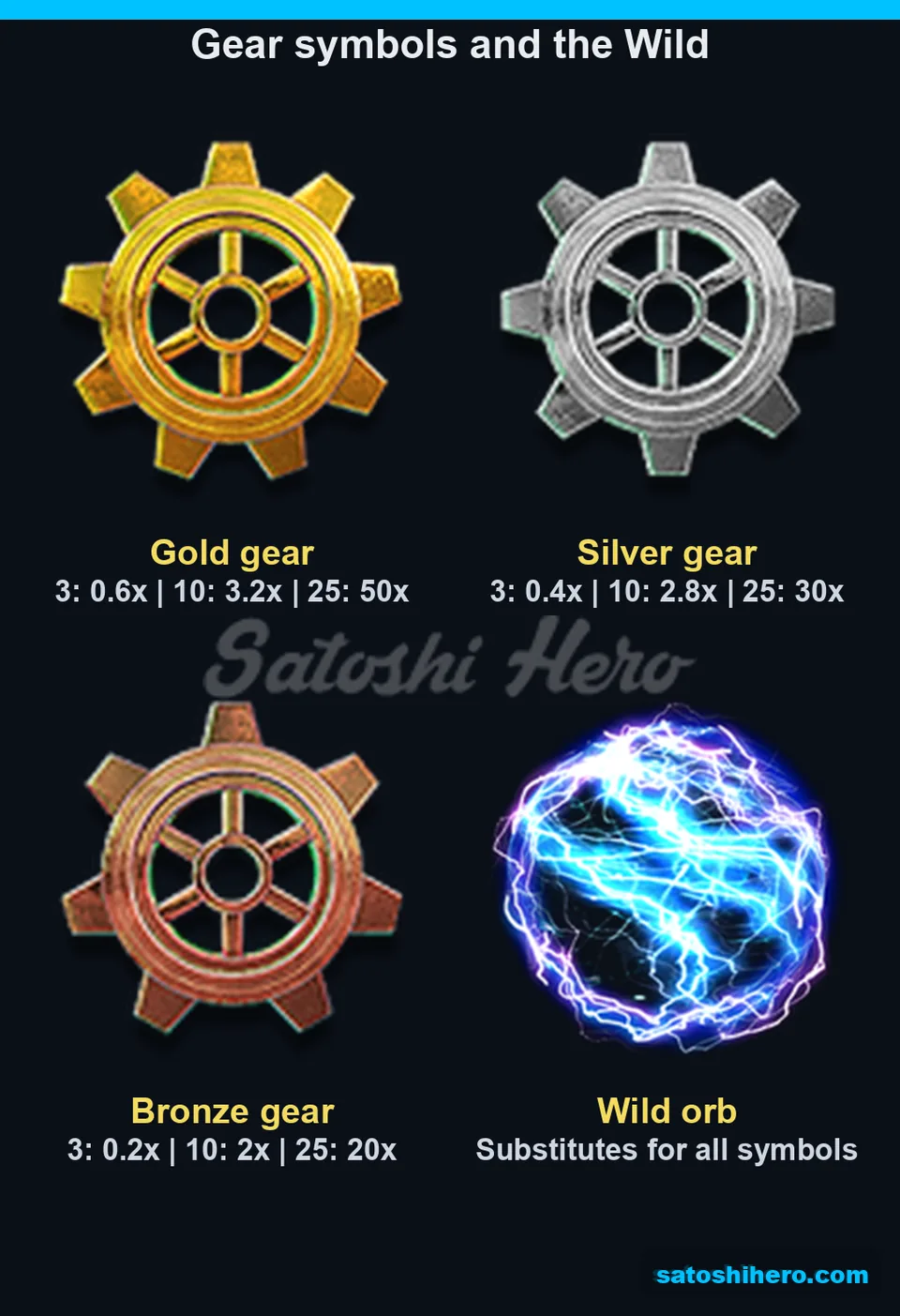
- Gold gear: 0.6x for 3, 3.2x for 10, 50x for 25.
- Silver gear: 0.4x for 3, 2.8x for 10, 30x for 25.
- Bronze gear: 0.2x for 3, 2x for 10, 20x for 25.
- Wild orb: substitutes for every paying symbol.
- Wild orb: doesn’t pay by itself.
- Wild orb: only helps complete clusters.
The Wild orb looks like a ball of lightning, and it does useful work without becoming a payout symbol. I like that restraint because it keeps the paytable clean. You still need real symbols around it to make the cluster matter.
How Miles Bellhouse and the Gears of time Works
The game works through cluster pays, cascades, and marked positions on a 5×5 grid. It doesn’t use fixed paylines, so you shouldn’t look for left-to-right line hits. When you play Miles Bellhouse and the Gears of time online, the first thing to understand is that the grid does more work than a normal line-slot reel set. That makes the slot feel more tactical than it really is.
Grid and clusters
Clusters of 3 or more matching symbols pay anywhere on the grid. Separate clusters can pay separately when they don’t touch each other. The game counts the highest win per cluster, so you don’t stack every smaller size inside one group. You’ll notice that rule keeps the math readable.
This matters because several small wins can appear on one spin. A gold-gear cluster might pay, while another group pays somewhere else. That doesn’t mean you found a pattern. It just means the board created several separate clusters.
Cascades and wins
Winning symbols leave the grid after they pay, then new symbols fall into the empty spaces. Cascades can create extra small wins, and they also matter for marked positions later. In my base-game notes, the $0.18 gold-gear win showed how a tiny result can still keep the screen moving. I found the motion engaging, even when the return stayed small.
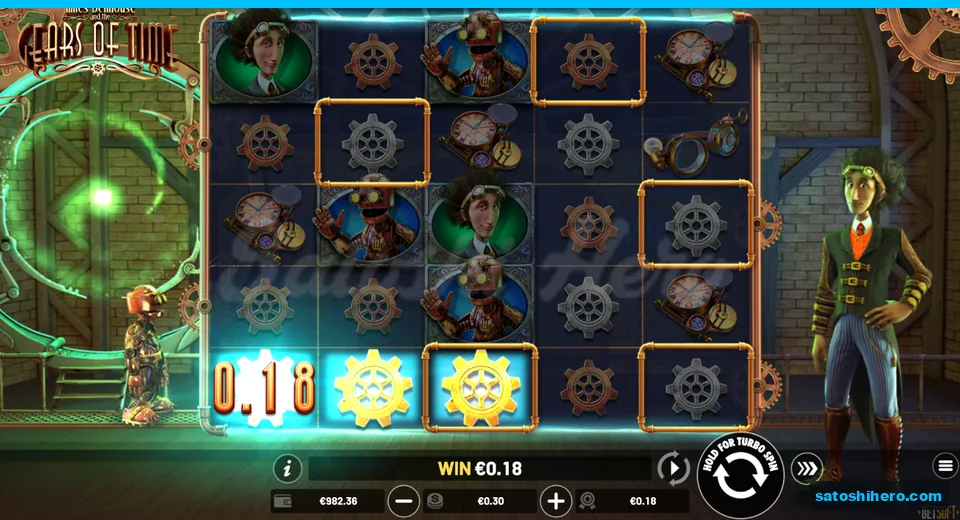

Tip: Don’t judge a spin only by the first cluster. Cascades can cover extra marked positions after the first win lands.
The best approach is simple. Watch the whole cascade cycle before you decide how the spin felt. If you jump straight to the payout number, you may miss why a weak-looking hit still pushed the mechanic forward.
Clusters of Time
Clusters of Time marks 5 random grid positions before each spin, then rewards winning clusters that cover those marked spots. This is the core named mechanic, and it gives small wins more purpose. You can’t choose the marked positions, so don’t treat it like a beatable puzzle. I like the idea, but you still need random clusters to cooperate.
Marked grid spots
Before each spin, the game quietly marks 5 positions on the 5×5 grid. The player doesn’t pick those positions, and the marks can sit anywhere. You’ll see why that matters once cascades start checking the grid. A win in the wrong place pays, but it doesn’t help the feature path.
This mechanic gives you something extra to watch. Instead of only asking, “Did I win?” you also ask, “Did that win land over a mark?” That’s a smart way to add tension to small clusters. Still, the system remains random from the player side.
Covered positions
At the end of each cascade, any marked position covered by a winning cluster counts as covered. More covered positions can improve the chance of a Time Traveling event. Covering all 5 positions triggers the Free Spins round. You may find that simple rule easier to follow than a dense bonus meter.
Small base-game wins can matter beyond the payout. A few cents may not excite you, but a covered mark can keep the spin interesting. That said, patience and stake sizing matter more than prediction here. You can’t aim symbols, so you shouldn’t chase one marked square.
Time Traveling Events
Time Traveling Events can trigger after marked positions get covered, and each event changes the spin in a different way. I didn’t see one of these events during my 100-spin test. The descriptions here come from the game’s own explanation, not from a triggered event in my session. That absence made the base game feel quieter than the feature list suggests.
Past and Present
Past replays the last spin, then adds 5 extra re-cascades of non-matching symbols at the end. The idea is simple: the game gives the old result another chance to improve before the payout gets totalled. You might like Past if you prefer extra board movement over a single multiplier moment. It sounds controlled, but the outcome still depends on the symbols that fall.
Present applies a random 2x to 20x multiplier to all wins from the initial spin. The game adds that multiplied total once every cascade settles. I’d expect Present to feel punchier than Past when a decent cluster chain appears. Yet a multiplier needs a useful win underneath it.
Future respin
Future picks a random symbol on the grid and guarantees a Free Respin. It drops 10 or more identical symbols from the time stream, which makes it the most cluster-focused event. You can see why that matters on a 5×5 board. Ten matching symbols can reshape the grid fast.

Trivia: The Future event is the most cluster-focused of the three because it forces 10 or more matching symbols onto the grid.
I wish this event had appeared in my test because it sounds like the most visual one. The slot’s whole appeal sits in cluster formation, so a symbol flood fits the design well. Still, I won’t pretend I saw it happen. You should treat it as a possible highlight, not a regular promise.
Free Spins
Free Spins trigger when winning clusters cover all 5 marked positions, then you choose Past, Present, or Future before the round starts. The game has no bonus buy, so you must reach the feature through covered marked positions. Free Spins didn’t trigger in my 100-spin session. That made the base game feel grindier than the medium-volatility label might suggest.
Three time streams
The three choices set different bonus moods. Past awards 12 free spins, and each spin gets an extra re-cascade at the end. Present gives 10 free spins, with every winning spin receiving a random 2x to 20x multiplier. Future offers 6 free spins, and each spin places 10 or more of a random symbol onto the grid.
Past feels like the steadier option because it gives you the most spins. Present suits multiplier swings when you want sharper peaks. Future leans into concentrated clusters, which may appeal if you enjoy symbol floods. I’d probably choose Future first because it matches the game’s core mechanic best.
No bonus buy
There’s no bonus buy, so you can’t skip the base game. You need the marked-position system to deliver the Free Spins trigger naturally. April Fury And The Chamber Of Scarabs also builds anticipation around adventure-style features, but this slot makes the chase more grid-focused. If you enjoy watching small steps build toward a bonus, this structure can work.
I don’t mind the missing buy option because it keeps the session grounded. Still, bonus fans may feel impatient during flat stretches. My session never reached the choice screen, and that shaped my view of the game. You may enjoy the chase more if you value base-game cascades.
How the 100 Spins Played
My 100-spin session was a quiet grind: $30.00 staked at $0.30 per spin ended with the balance at $982.36. I started from a fresh $1,000.00 demo balance and finished $17.64 down. The balance slid slowly and never moved above the starting point. You might find that boring, but it matched the slot’s controlled feel.
Session result
I logged 24 paying spins from 100 total spins. Most wins were small cluster hits of a few cents, often with one or two cascades. The grid kept moving, but the returns didn’t build much pressure. That’s the part you should understand before raising your stake.
- Spins played: 100.
- Stake: $0.30 per spin.
- Starting balance: $1,000.00.
- Finish balance: $982.36.
- Net result: $17.64 down.
- Paying spins: 24.
- Free Spins: none.
Anyone looking for a Miles Bellhouse and the Gears of time strategy should start with the reality that the base game can be quiet. Stake sizing matters more than chasing one specific symbol. Paco and the Popping Peppers has livelier, quirkier energy, while this steampunk cluster slot feels calmer and more mechanical. I prefer the clarity here, but I missed bigger spikes.
Best hit
My best result came on spin 88. A cascade chain returned $1.92 from a $0.30 spin, which equals 6.4x the bet. That stayed modest for a session high, and it tells you plenty about my run. The game looked busy without giving me a memorable payout.

Alert: A medium-volatility slot can still produce a flat 100-spin run. My test had 24 paying spins but no bonus and no recovery above the starting balance.
The balance bottomed out near $981 before finishing slightly above that low point. I didn’t get a dramatic comeback, and I didn’t hit the Free Spins round. If you enjoy steady visual action, the session had enough movement. If you need frequent bonus drama, this test felt thin.
RTP, Volatility & Our Test
The slot’s math profile is 96.68% RTP, medium volatility, and a 1,084x max win, which matched the steady but unspectacular feel of my test. The maximum win feels modest compared with some modern cluster slots. Still, it fits the medium-volatility framing better than a huge long-shot cap would. You get a game that looks active, not one built around rare monster wins.
My 100 spins were not wild, but they weren’t especially rewarding either. Small clusters and cascades created activity without producing Free Spins. Legend of the Nile may appeal if you want adventure pacing with more classic decision expectations, while this game puts more attention on grid coverage. I found the math feel honest, even if the session lacked excitement.
Simulator projection
Our simulator modelled 1,000 spins at the $0.30 stake using the stated math profile and win cap as inputs. The typical session ended $11.90 down. The 5th to 95th percentile band ran from $63.80 down to $51.80 up. About one spin in four paid something, which lines up closely with my 24 paying spins.
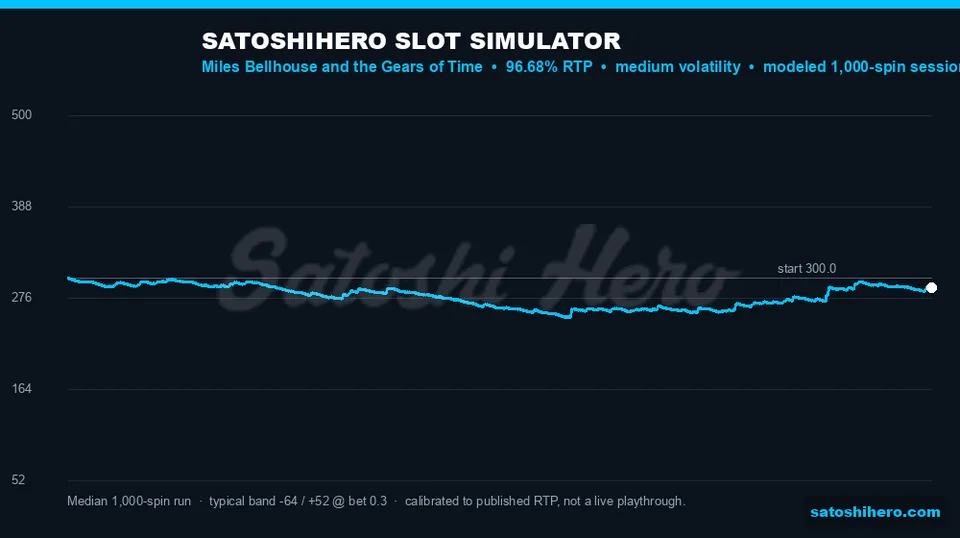
A feature-sized win appeared roughly once every 49 spins in the model. A top-end result appeared about once in 13,158 spins. That doesn’t predict your next session or the live random draw. It only gives you a range of possible outcomes from the same math inputs.
Our 100-spin session
My live session started at $1,000.00 and finished at $982.36. I lost $17.64, logged 24 paying spins, and never triggered Free Spins. The best hit was $1.92, or 6.4x, from spin 88. That result felt quiet, but not out of character.
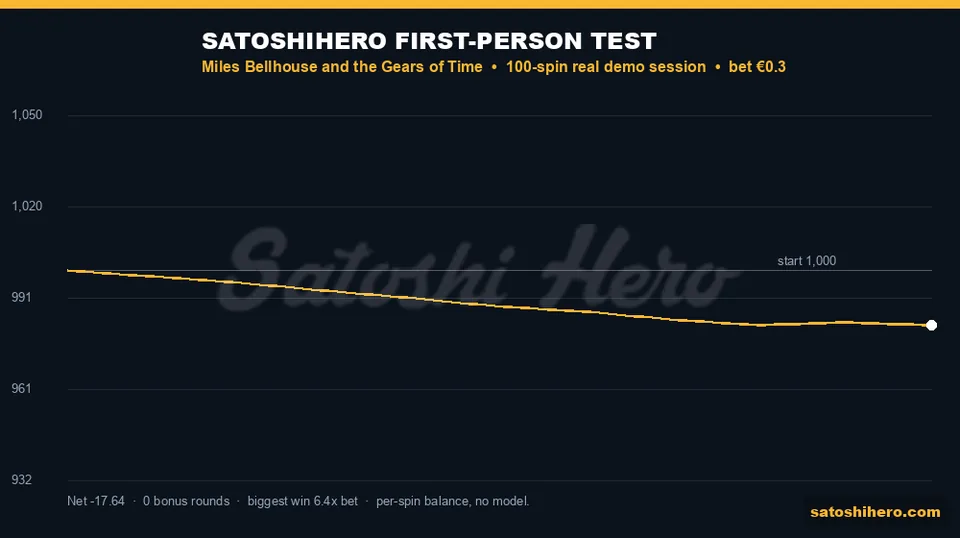
The useful lesson is simple. You may see plenty of motion without many strong balance boosts. I wouldn’t raise stakes quickly after a few tiny cascades. The slot can keep your attention while still eating into the balance.
The theoretical RTP is the operator-published return figure. A single 100-spin live session doesn’t change or prove that return. The simulator is a model using RTP, volatility, and max-win cap as inputs, while bonus and event returns can sit slightly differently by design inside the same overall slot math.
Frequently Asked Questions About Miles Bellhouse and the Gears of time
How do the Clusters of Time work in Miles Bellhouse and the Gears of time?
The game marks 5 random positions on the 5×5 grid before every spin. At the end of each cascade, any marked position covered by a winning cluster counts as covered. More covered positions can raise the chance of a Time Traveling event, and covering all 5 starts Free Spins.
What do the Past, Present, and Future events do?
Past replays the last spin and adds 5 extra re-cascades of non-matching symbols before the payout gets totalled. Present applies a random 2x to 20x multiplier to wins from the initial spin. Future guarantees a Free Respin where 10 or more of one chosen symbol drop onto the grid.
How do I choose a Free Spins mode in Miles Bellhouse and the Gears of time?
The choice appears after winning clusters cover all 5 marked positions. Past gives 12 spins with an extra re-cascade on each spin. Present gives 10 spins with a 2x to 20x multiplier on every win, while Future gives 6 spins with 10 or more of a random symbol added each spin.
What does the Wild orb do?
The Wild orb substitutes for every other paying symbol. It helps build clusters and can turn near-misses into paying groups. It never pays on its own, so you still need other symbols around it.
What are the RTP, volatility, and max win in Miles Bellhouse and the Gears of time?
Miles Bellhouse and the Gears of time has 96.68% RTP, medium volatility, and a 1,084x max win. It uses a 5×5 grid with cluster pays instead of fixed paylines. Clusters of 3 or more matching symbols create wins.
How did my 100 live spins go in Miles Bellhouse and the Gears of time?
I started with $1,000.00 and finished at $982.36, so I ended $17.64 down. The session had 24 paying spins, no Free Spins trigger, and a best hit of $1.92. That best result came from a $0.30 spin.
How do you play Miles Bellhouse and the Gears of time?
You set a stake, spin the 5×5 grid, and look for clusters of 3 or more matching symbols. Winning symbols disappear, new symbols cascade in, and marked positions can lead to events or Free Spins. The game plays more like a cluster slot than a payline slot.
Can you play Miles Bellhouse and the Gears of time with bitcoin on SatoshiHero?
You can try the game on SatoshiHero in demo or real mode, including crypto play where available. The online Miles Bellhouse and the Gears of time experience stays the same either way. The main choice comes from stake size and feature selection, not the payment method.
Closing Thoughts
Miles Bellhouse and the Gears of time stands out through its marked-position cluster system and three-choice Free Spins setup. Its main drawback is the modest ceiling and the chance of a flat base-game run. You’ll get clear mechanics, but you may not get fast drama.

My Verdict
Patient cluster-slot fans should try this one at low stakes first. Expect a tidy 5×5 grid, small cascades, and a bonus chase that may take patience. I’d treat it as a measured session game, not a quick-hit thrill slot.
I like the way small clusters can matter beyond their payout, especially when they cover marked positions. I don’t like that my 100 spins never reached Free Spins or a Time Traveling event. The strongest part is the structure, while the weakest part is the quiet stretch between highlights.
Miles Bellhouse and the Gears of time earns a careful recommendation from me because the design feels coherent and easy to read. My notes are checked regularly, so test details can stay aligned with displayed game behaviour. Keep your stake sensible, and don’t mistake movement for momentum.

Pros:
 Clear grid: The 5×5 layout makes clusters and marks easy to follow.
- Useful wild: The Wild orb helps clusters without confusing the paytable.
- Choice bonus: Free Spins let you pick Past, Present, or Future.
- Measured math: Medium volatility keeps the game calmer than high-risk cluster slots.

Cons:
 Modest cap: The 1,084x ceiling limits dream-win appeal.
- Quiet base game: My test produced small wins and no bonus round.
- No bonus buy: You must wait for marked positions to trigger Free Spins.

Best For: Patient cluster fans get the clearest value from the steampunk visuals and bonus chase with choices. The best match is a steady bankroll manager who watches cascades closely and doesn’t need huge win caps. If you want wild swings every few spins, this one may feel too restrained.
































































Bets
All Bets
Game
Player
Date
Wager
Mult.Multiplier
Prize
 3 Witches: Bonus Combo
 bjgrandy149
- 00:19:14
- 0×
- Halloween Harvest: Rapid Link
 Hidden
- 00:19:14
- 7.39×
- Luck of Panda: Bonus Combo
 Hidden
- 00:19:13
- 0×
- 3 Witches: Bonus Combo
- bjgrandy149
- 00:19:12
- 0.4×
- Halloween Harvest: Rapid Link
- Hidden
- 00:19:10
- 0.39×
- 3 Witches: Bonus Combo
- bjgrandy149
- 00:19:09
- 0×
- 4 Lucky Nuggets
 whodey39311
- 00:19:08
- 0×
- Royal Fruits 9: Hold 'n' Link
- nina87
- 00:19:07
- 0×
- 4 Lucky Nuggets
- whodey39311
- 00:19:07
- 0×
- 4 Lucky Nuggets
- whodey39311
- 00:19:06
- 0×