

Piggy Bank
By pressing play, you agree that you are above legal age in your jurisdiction and that your jurisdiction allows online gambling.

Piggy Bank
RTP92%
VolatilityHigh
Max winx4,000
Lines10
ThemeLuxury life
Live game stats
Real RTP65.50%
Spins372
Players2
Biggest win$3.72

Cracking the Vault With Piggy Bank
Piggy Bank slot is a high-volatility Belatra game built around cartoon bank robbers, bidirectional line wins and a multi-stage bonus.
Piggy Bank is a high-volatility slot from Belatra with a 92% RTP and 4,000x maximum win. Its 5×3 grid has nine fixed paylines, wins can run either way, and patient line-slot fans get the clearest appeal. I tested 100 turbo spins at $90 each with risk games disabled; you get simple rules, but you shouldn’t expect frequent feature action.
Piggy Bank slot at a glance
Piggy Bank slot uses a traditional 5×3 layout with nine fixed paylines. Belatra evaluates combinations from both edges, giving you more ways to read familiar line patterns without changing the basic format. According to Belatra, three or more Piggy Bank Bonus symbols open the main feature, while no bonus buy skips you straight there.
| Detail | Specification |
|---|---|
| Game type | Slot |
| Grid | 5×3 |
| Paylines | Nine fixed lines |
| Win direction | Left to right and right to left |
| Bonus access | Three or more Piggy Bank Bonus symbols |
| Bonus buy | None |
| Line stake | $1 to $500 |
| Speed | Normal or turbo |
| Risk game | Dealer, Red-or-Black or off |
| Play options | Demo and real play on SatoshiHero |
Displayed paytable amounts change with your selected line stake. My recorded session used nine $10 line stakes, creating a $90 total wager, and every balance figure came from play money. You should compare line-based awards with that $10 line stake, not the full amount placed on one spin.
The 4,000x cap feels fairly modest beside the high volatility and 92% RTP. Optional Dealer and Red-or-Black games can follow wins, though I kept both off throughout my count. You can disable them too, which removes another layer of risk. The core format looks simple, but its underlying risk is severe.
Key takeaways
- Best play: Regular spins provide the only route into the Piggy Banks Bonus because there is no bonus buy.
- RTP / volatility: The 92% theoretical return and high volatility can move your balance sharply.
- Max win: The maximum win reaches 4,000x the bet.
- Risk note: Dealer and Red-or-Black gambling can follow wins, but you can disable both; my test kept them off.
- Bankroll note: My 100-spin session lost 70.33 stakes and never recovered its starting balance.
These points capture the game without disguising its hard math. If you prefer frequent bonus access, the regular-spin-only route can test your patience. I find the simple line system approachable, yet you need firm limits before using it.

Table of Contents
- Piggy Bank slot at a glance
- Theme and first impressions
- How Piggy Bank Works
- Line wins both ways
- Symbols and wilds
- RTP, volatility and our test
- Simulator projection
- Our 100-spin session
- Piggy Banks Bonus
- Pick-and-break rounds
- Brick continuation
- Safes Bonus
- Free Games
- Moving Wild reel
- How the 100 spins felt
- Dry spells and returns
- Bankroll implications
- Frequently asked questions
- Summing It Up
Theme and first impressions
The game turns a playful savings mascot into a complete cartoon robbery. A brick wall, bullet holes and steel vault door frame the reels, while a trench-coated pig gangster stands nearby with sunglasses and a gun. You can read the crime story before your first spin, and that clarity helps the older presentation feel coherent.
Symbols extend the same idea through every value tier. The Piggy Bank Boss sits inside a porthole frame, while Wanted Jimmy appears on a wanted poster. Keys, safes, hammers, robbers, coins, trucks, cash and bonus symbols complete the gang’s toolkit. Premium portraits look distinct from the simpler objects, so you won’t spend long separating larger line awards from lower ones.
The piggy-bank crime idea won’t win originality awards, but the vault setting makes the board easy to scan. Unlike a piggy bank for kids or a piggy bank for adults, this familiar object anchors a brisk bank-heist joke.
Piggy Bank Bills shares the cash imagery, while this title frames every object as part of one robbery. I prefer that stronger visual story. Wild Piggy Bank and You Can Piggy Bank On It provide two more savings-themed comparisons.
Screenshot slot: Base game and theme. The resting board shows the 5×3 layout, pig gangster, symbol set, $90 stake and $100,000 balance.
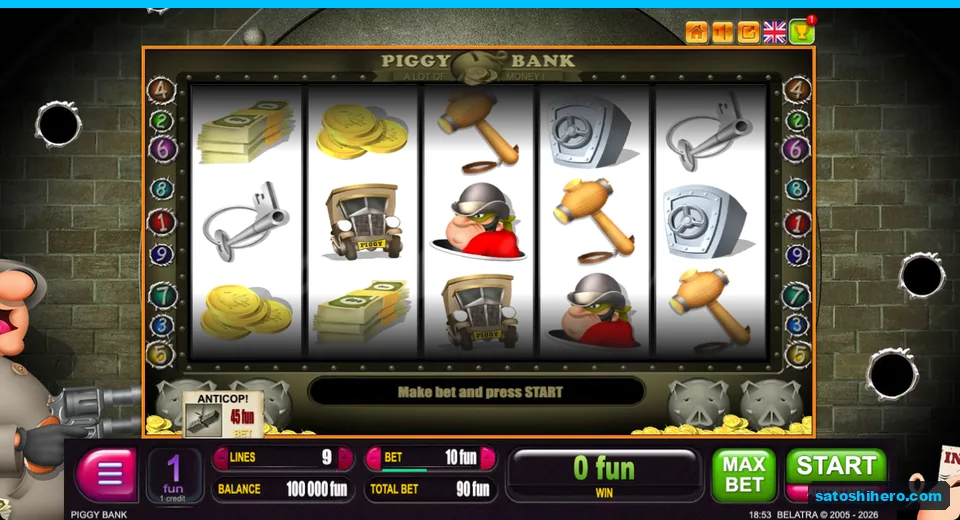

Notable Detail: A familiar savings-bank pig becomes the center of a complete robbery scene, rather than a conventional money-box design.
Turbo mode cuts the time between outcomes, yet the board remains readable. I consider that clarity one of the game’s better qualities.
How Piggy Bank Works
Wins follow fixed lines and can form from either edge of the reels. The game pays only the highest qualifying combination on each winning line, so you don’t receive duplicate awards for reading one pattern twice. You should first check the active line, then identify which direction creates its strongest result.
Paytable figures reflect your chosen line stake, not the complete spin wager. With nine lines, that distinction can make a displayed symbol award look larger than its balance effect.
Line wins both ways
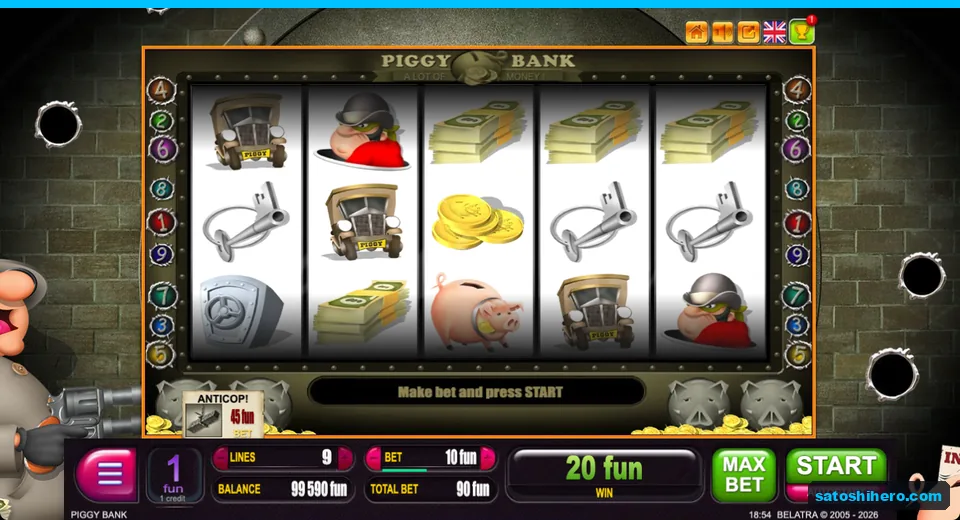
Spin 9 gave me the clearest proof of right-to-left evaluation. Three Cash symbols sat across reels three, four and five on the top row, returning $20. That result matched the listed 2x award against my $10 line stake, even though the full spin cost $90.
The game didn’t also pay a second left-to-right version of that combination. It selected the highest result on the qualifying line, which keeps the two-way rule from doubling one pattern. You gain directional flexibility, not two payments for identical symbols.
Screenshot slot: Right to left line win. The image shows three Cash stacks, the $20 result and $99,590 balance. You can trace the symbols from the right edge.
Symbols and wilds
These are the listed line-stake multiples for five, four and three matching symbols:
- Piggy Bank Boss: 10,000x, 1,000x and 100x.
- Wanted Jimmy: 2,500x, 500x and 100x.
- Key: 200x, 100x and 20x.
- Safe: 100x, 40x and 20x.
- Hammer: 100x, 20x and 10x.
- Robber: 30x, 15x and 5x.
- Coins: 20x, 5x and 3x.
- Truck: 15x, 4x and 3x.
- Cash: 5x, 3x and 2x.
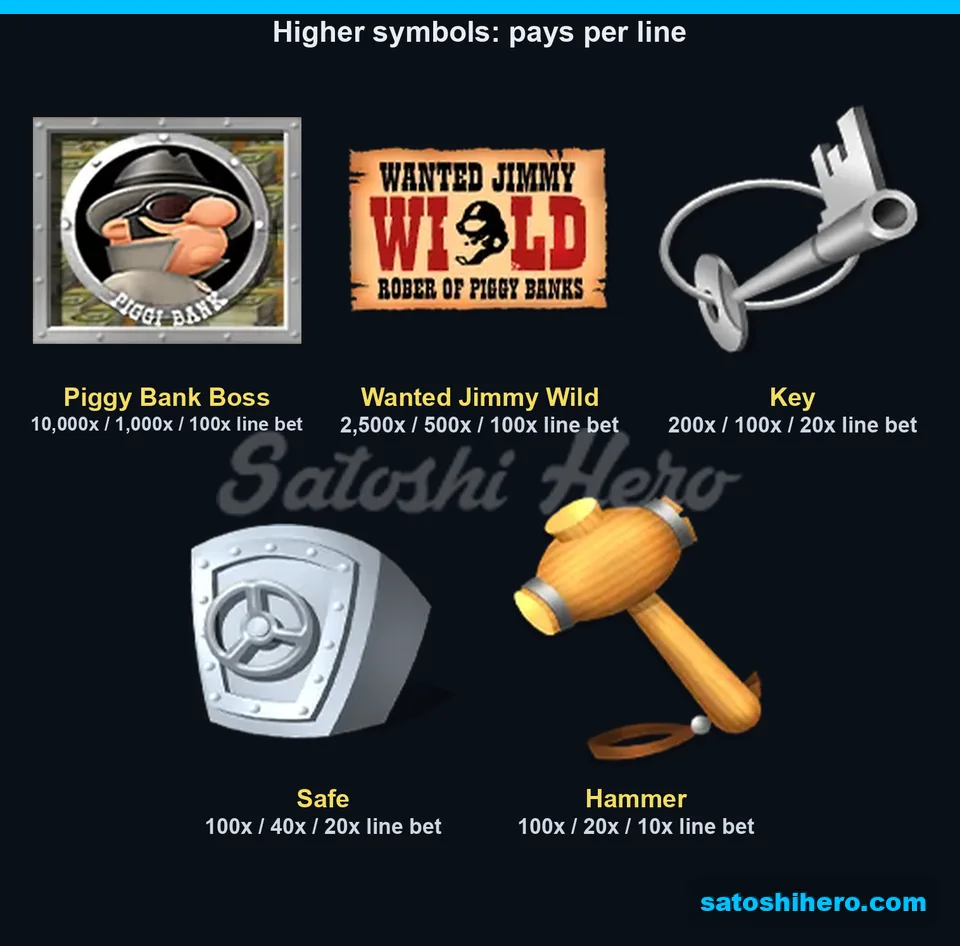
Wanted Jimmy acts as the Wild for the Robber, Safe, Hammer, Key, Coins, Truck and Cash. It doesn’t replace the Boss or Piggy Bank Bonus symbol. Five posters carry their own 2,500x line-stake award.
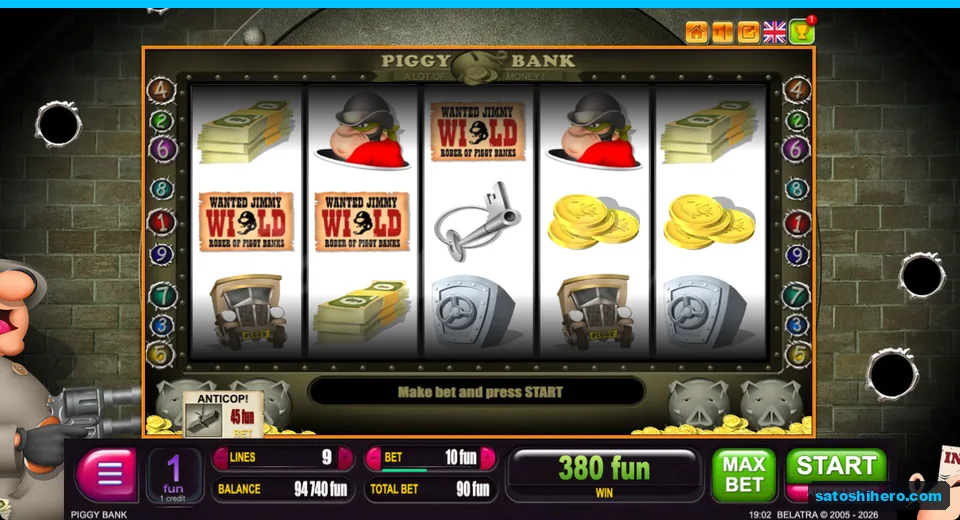
My largest observed result came on spin 81, when three Wanted Jimmy posters returned $380. That equaled 4.22x my $90 stake and moved my balance from $94,450 to $94,740. The amount barely changed the wider decline.
The Piggy Bank Bonus symbol has no regular line award. At least three start the pick feature, making those symbols valuable only as a trigger. After any ordinary win, you can choose Dealer or Red-or-Black risk play, or turn it off. I disabled that setting before spin one, so no gamble affected my recorded totals.

Screenshot slots: Base game line win, Symbol pay values, and Low symbols and bonus symbol. Use spin 81 for the $380 result, then show the premium values, lower symbols and three-symbol trigger.

Highlight: Winning combinations can run in either direction, but the game pays only the highest combination on each winning line.
Check your line stake before matching a paytable number against the full wager. That small habit prevents the most common misunderstanding in this otherwise straightforward format.
RTP, volatility and our test
The mathematical profile creates wide balance swings, and my counted play showed how small returns can hide a steep loss. Piggy Bank slot combines high volatility with a 92% theoretical RTP, so you shouldn’t treat an active-looking hit count as healthy balance performance. I consider the risk profile unforgiving even before feature access enters the picture.
Specifications describe the math, our simulator estimates distributions, and my test records one sequence. Keep them separate because none can predict your next spin.
Simulator projection
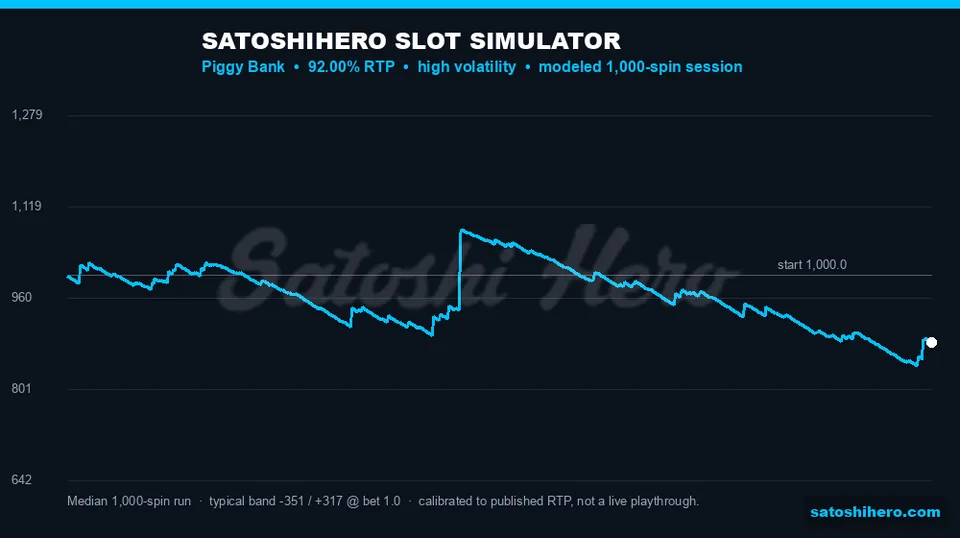
The SatoshiHero Slot Simulator modeled 1,000 spins at $1. Its median result finished 117.3x down, while the middle 90% band stretched from 351.2x down to 317.0x up. That range exposes the variance.
About 18% of simulated spins returned something. A feature-tier result appeared roughly once per 49 modeled spins, while an outcome of at least 100x appeared around once per 1,727 spins. The gap between those frequencies is revealing.
Every modeled session operates independently. These frequencies aren’t promises, stored progress or countdowns, so several empty rounds don’t make the next one more likely. You should read them as distribution estimates, not a schedule for feature timing.
Screenshot slot: Simulator projection, 1000 spins. The blue graph illustrates how differently equal-length modeled sessions can end.
Our 100-spin session
I finished 100 spins at $93,670, losing $6,330 from my $100,000 start. Each turbo spin cost $90, so the decline equaled 70.33 stakes. Of 29 paying spins, 19 returned less than the wager.
Nine results landed between 1x and 3x, and only one exceeded 3x. My best was the $380 return on spin 81, equal to 4.22x. The Piggy Banks Bonus, Safes Bonus and Free Games never appeared, which left the base game carrying the entire session.
All 29 wins returned $2,670 against $9,000 placed. That gap explains why visible wins never restored my balance, despite breaking several losing runs. I found the rhythm harsher than the pay count suggests because most celebrations still represented net losses on their spins.
Screenshot slot: Real 100-spin session balance. The gold graph marks spin 81 and the final session low without suggesting a recovery.
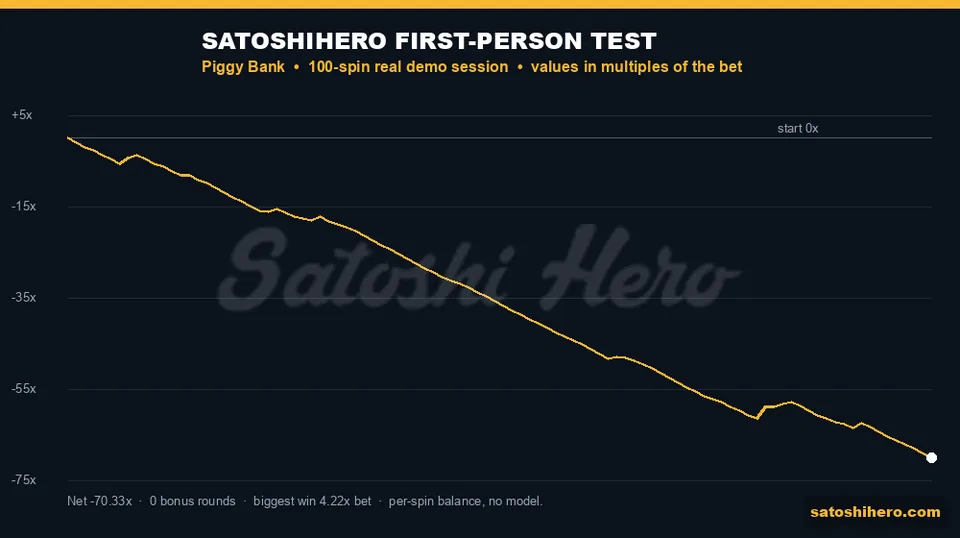

Risk Note: High volatility, the 92% theoretical RTP and no triggered bonus left my test 70.33 stakes down. Set a session budget and loss limit first, and don’t raise stakes to chase earlier losses.
The theoretical return is the operator-published figure, and one live session neither changes nor verifies it. Simulator outputs remain projections rather than observed feature odds, while separate play modes can carry slightly different theoretical values by design. Short results can sit far from the theoretical figure.
Piggy Banks Bonus
Three or more Piggy Bank Bonus symbols start a pick feature with prizes, Free Games and Safes Bonus access. Regular spins provide the only route. I didn’t trigger it, so you should read these as documented mechanics.
Pick-and-break rounds
You select one bank, and the Robber reveals a direct prize, 10 to 25 Free Games, or a Safes Bonus key. A real pig can smash two extra banks and collect both contents.
A Policeman ends the sequence. Choice adds theater, but no visible clue makes it a skill decision. I like how one pick can redirect the feature.
At my $90 stake, the combined Piggy Banks and Safes prize range runs from $2,250 to $27,000, or 25x to 300x. Treat that range as a limit, not an average.
Brick continuation
A main-game total wager of at least $45 grants one Anticop brick. If a Policeman arrives, that brick can continue the feature once. It changes continuation eligibility rather than increasing individual prizes, so a qualifying stake doesn’t make the banks themselves more valuable.
Check the Anticop indicator if continuation matters to you. My $90 setup qualified, but the missing trigger meant I never used the brick.

Expert Advice: Check whether your selected total stake qualifies for the Anticop brick before play. It affects one continuation opportunity, not the size of individual prizes.
The bonus combines cash awards, free spins and safe access within one sequence. Even so, you must reach it through regular spins, which makes patience and a fixed budget more important than pick preference.
Safes Bonus
A key from the Piggy Banks Bonus starts this short selection round. You choose one safe, it opens, and its displayed amount ends the feature. There are no extra stages or separate reel triggers, so the mechanic gives you one quick reveal before play moves onward.
Safe selection isn’t a skill test. Nothing visible identifies a larger result, so don’t invent patterns from prior choices. Judge spending by your overall balance.
The Safes Bonus didn’t appear during my 100 spins because the main pick feature never started. I can’t support an average payout, a preferred safe or a personal result from that round. You get more value from understanding the entry path than guessing which door seems luckier.
This simplicity is both its strength and weakness. I like the pace, though one selection feels thin. The feature ends before the game returns or Free Games begin.
Free Games
Free Games arrive through the Piggy Banks or Safes Bonus rather than an independent reel trigger. They run automatically with the same line stake and active lines as the triggering play. You can’t alter that setup during the sequence under the documented rules, so confirm your wager before entering either bonus path.
The counted session never reached Free Games, so I won’t attach a personal return or trigger rate. You should separate that absence from the simulator’s broader feature-tier estimate.
Moving Wild reel
One complete reel becomes Wild during every Free Game. The first round assigns a random reel, then the Wild position moves one place right on each following spin. After reaching the rightmost reel, it reverses and travels left, repeating that back-and-forth motion through the remaining games.
For example, a start on reel two can reach reels three, four and five before reversing toward reel one. That route doesn’t guarantee a payout. I like its easy-to-follow rhythm.
The locked lines keep the feature tied to the base game. The moving Wild changes which reel supports combinations, but matching symbols still matter.
Free Games offer the clearest structural change in the slot, but access first depends on the multi-stage bonus path. If you value frequent free-spin entries, that extra gate could feel frustrating.
How the 100 spins felt
The session felt much harsher than 29 paying spins suggests because most returns failed to cover my $90 stake. Piggy Bank slot showed frequent enough flashes to interrupt silence, yet the balance kept sliding. You should watch net movement, not the number of win animations, because those two measures told very different stories here.
Dry spells and returns
Nineteen paying spins returned less than one stake. Nine landed between 1x and 3x, while only the $380 result crossed 3x. All wins produced $2,670 against $9,000 wagered.
My longest losing run covered spins 33 through 44. The next lasted eight spins, from 67 through 74. Turbo mode made those gaps pass dangerously fast.
Smaller wins broke droughts without repairing their cost. Spin 29 returned $230, while spins 7, 24, 64, 83 and 92 each returned $200. None covered three wagers.
Bankroll implications
My highest post-spin balance was $99,910 after spin one. It never recovered the $100,000 start, then reached its lowest point at the final $93,670 balance. That one-way session path made a preset loss limit more useful than waiting for an unavailable bonus.
Future sequences can differ, and this test can’t forecast yours. I don’t like how productive sub-stake results can feel, so measure each session against total spending.
Choose a fixed amount before starting and stop when it expires, even if no bonus has appeared. Chasing the missing feature only extends exposure; it doesn’t move you closer to a trigger.
Frequently asked questions
What are the RTP, volatility, maximum win and paylines of Piggy Bank slot?
Piggy Bank slot has a 92% theoretical RTP, high volatility and a 4,000x maximum win. Its 5×3 grid uses nine fixed paylines. My $90 setup placed $10 on each line.
Do Piggy Bank slot wins pay in both directions?
Yes. Wins run left to right and right to left, while only the highest combination on each qualifying line pays. On spin 9, three Cash symbols across the top row returned $20 from right to left. You don’t receive two awards for the same line pattern.
How does the Piggy Banks Bonus work?
Three symbols start it. You pick for a prize, 10 to 25 Free Games, a Safes Bonus key or a pig that breaks two banks. A Policeman ends the round, while a brick from a $45 wager can continue it once. I didn’t trigger it.
What happens in Piggy Bank slot Free Games?
The sequence follows either bonus and keeps the triggering line setup. One reel becomes fully Wild, moves right each game, then reverses at the last reel. You can track its journey left.
What does Wanted Jimmy substitute for in Piggy Bank slot?
Wanted Jimmy replaces the Robber, Safe, Hammer, Key, Coins, Truck and Cash. It doesn’t replace the Boss or bonus symbol. Five Wanted Jimmy posters pay 2,500x the line stake on their own, while three helped create my $380 best observed result.
How did the 100-spin Piggy Bank slot test go?
I moved from $100,000 to $93,670, losing $6,330 or 70.33 stakes. Twenty-nine spins returned something, my best result reached $380 or 4.22x, and no bonus feature appeared. You would’ve seen activity, but not enough value to halt the decline.
What did the simulator show for Piggy Bank slot?
The median projection ended 117.3x down across 1,000 spins. Its middle 90% range ran from 351.2x down to 317.0x up, and about 18% returned something. A 100x result appeared around once per 1,727 modeled spins, while every run remains independent.
Can you buy the bonus in Piggy Bank slot?
No. Piggy Bank slot has no bonus buy, so at least three bonus symbols must appear during regular spins. You can’t pay for immediate entry, and a long wait doesn’t improve the next spin’s trigger chance.
Summing It Up
Piggy Bank turns a savings mascot into a bank-heist slot with unusual two-way line evaluation. Base-game droughts can dominate before you reach its linked features.

My Call
Patient fixed-line fans can appreciate the direct rules, readable symbols and layered pick feature. Expect uneven balance movement, many sub-stake returns and no shortcut into the bonus, so bring a strict spending limit.
I like the bidirectional wins and how spin 9 proved the rule with a $20 result. I don’t like that 29 paying spins still left me 70.33 stakes down, while none of the three feature stages appeared.
This Piggy Bank slot guide is updated periodically. Treat my session as one observed sequence, not a forecast for your play.

Pros:
 Two-Way Wins: Both directions create more readable line combinations without adding complex mechanics.
- Clear Wild Rules: Wanted Jimmy substitutes across seven regular symbol types.
- Linked Features: Picks can lead into safes or moving-Wild Free Games.
- Risk Control: You can disable both optional post-win gamble modes.

Cons:
 Low Return: The 92% theoretical figure puts sustained pressure on your balance.
- No Bonus Buy: Regular spins provide the only path into every feature.
- Weak Test Outcome: My session lost 70.33 stakes without triggering any bonus.

Best For: Patient fixed-line enthusiasts who enjoy retro visuals, pick features and visible volatility get the clearest match. You need comfort with long waits, many sub-stake returns and firm session limits.












Other Belatra Games





















































Bets
All Bets
Game
Player
Date
Wager
Mult.Multiplier
Prize
 Luck of Panda: Bonus Combo
 nina87
- 18:19:57
- 0×
- Galaxy Glitter
- mike_721
- 18:19:56
- 0.46×
- Wild Buffalo Megaways: Hold N Link
 mdp0fxo
- 18:19:55
- 4.4×
- Royal Fruits 9: Hold 'n' Link
- josh1998
- 18:19:54
- 0×
- Luck of Panda: Bonus Combo
- nina87
- 18:19:54
- 0×
- Luck of Panda: Bonus Combo
- nina87
- 18:19:51
- 0.8×
- Galaxy Glitter
- mike_721
- 18:19:49
- 0×
- Luck of Panda: Bonus Combo
- nina87
- 18:19:48
- 0×
- Royal Fruits 9: Hold 'n' Link
- josh1998
- 18:19:47
- 0×
- Luck of Panda: Bonus Combo
- nina87
- 18:19:45
- 0×