

Robbed Bank
By pressing play, you agree that you are above legal age in your jurisdiction and that your jurisdiction allows online gambling.


Cracking the Comic Vault in Robbed Bank
Crack the vault in the Robbed Bank slot, where quick cascades and Wild transformations drive a light-hearted heist. According to Barbara Bang, Robbed Bank is a high volatility game with 96% RTP and 9,999x maximum win potential. Its 5×4 grid offers 1,024 ways to win, aimed at patient players who accept uneven, feature-led play.
My 100-spin test lost 20.2x the stake, peaked at a 16.2x return, and never triggered Hold and Spin. You can expect restrained base payouts, so this guide separates my observed results from rule-based feature details.
Key takeaways
- Best bonus: Hold and Spin has no bonus-buy shortcut; you need three Bonus diamonds in the main game.
- RTP / volatility: The theoretical RTP is 96%, and the volatility rating is high.
- Max win: The maximum win is capped at 9,999x the bet.
- Risk note: Break the Bank triggered three times, returning 5.8x, 7.4x, and 4.8x.
- Bankroll note: Conservative staking matters because my balance never moved above its start and finished 20.2x down.

Table of Contents
- How the Robbed Bank slot Works
- Winning combinations
- Symbols and values
- Theme and First Impressions
- Vault presentation
- Reels and readability
- Break the Bank
- Wild transformations
- Tested results
- How the Session Played
- Balance turning points
- What wins felt like
- Hold and Spin Bonus
- Trigger and re-spins
- Grid progression
- Diamond Values and Helper Symbols
- Diamond multipliers
- Bottom-row helpers
- RTP, Volatility and the Robbed Bank slot Test
- Simulator projection
- Our 100-spin session
- Frequently Asked Questions About Robbed Bank
- Summing It Up
How the Robbed Bank slot Works
The Robbed Bank slot uses a 5×4 layout with 1,024 ways to win, not fixed paylines. Three, four, or five matching symbols must appear on adjacent reels, starting from the leftmost reel. Only the highest win on each route pays, while separate routes combine.
Winning symbols dissolve, then fresh symbols fall into their spaces. That cascade can produce several consecutive returns from one paid spin, although extra drops don’t guarantee a profit. You should read 1,024 as possible symbol routes rather than lines drawn across the grid.
The reels and controls worked cleanly on desktop and mobile. I found the layout easy to follow with fast play active.
Winning combinations
Adjacent-reel matching makes the system simpler than the large ways figure suggests. You need the same symbol across consecutive reels from the left, but its row position can change. When several routes qualify, the game adds their values before showing the total.
A separate manual spin settled at a $1.60 win. I captured that frame after the recorded 100-spin dataset, so it isn’t part of the totals. You can see a finished cascade there, but it isn’t another logged result.
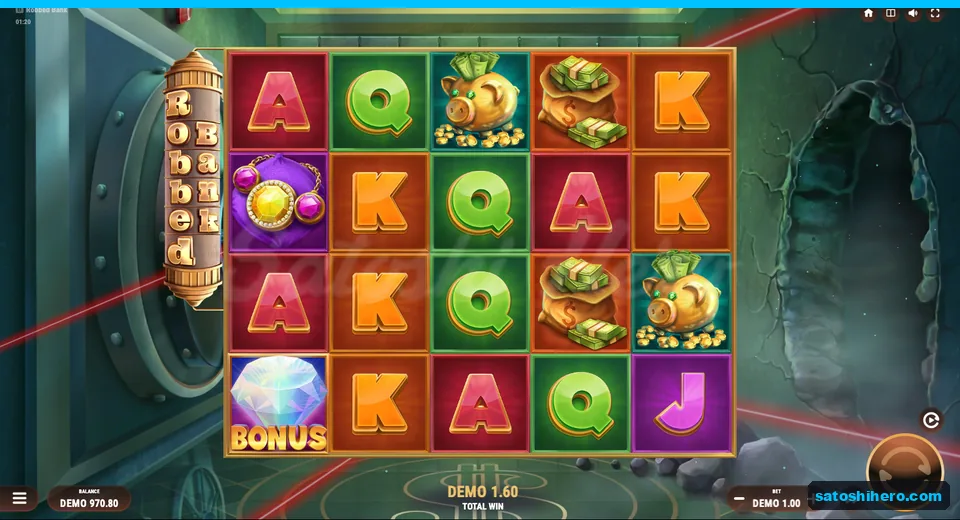
Cascades extend a paid spin only when the replacement symbols form another valid route. In my view, this mechanism keeps modest wins visually lively, yet it doesn’t hide their limited value.
Symbols and values
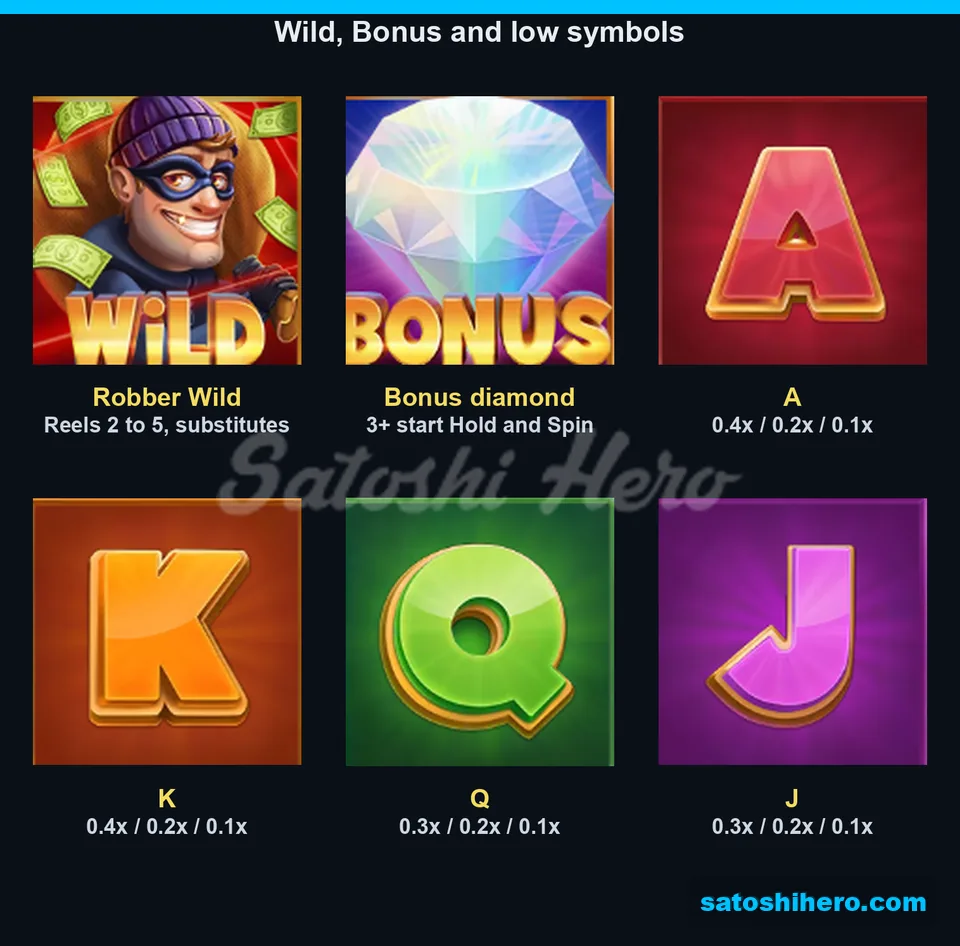
Every paytable value uses the total bet as its base. The money bag pays 1x, 1.5x, or 2x for three, four, or five matches. The jewel pouch pays 0.8x, 1x, or 1.5x, while the gold watch pays 0.6x, 0.8x, or 1x.

The golden piggy bank returns 0.4x, 0.6x, or 0.8x. A and K each pay 0.1x, 0.2x, or 0.4x, while Q and J pay 0.1x, 0.2x, or 0.3x. My smallest logged return was $0.10 from three matching low symbols at a $1.00 stake.
The Robber Wild appears only in the main game on reels two through five. It replaces every regular symbol but can’t substitute for the Bonus diamond. Three Bonus diamonds anywhere on the reels activate Hold and Spin.
Piggy Bank Bills also uses playful cash imagery, though its golden pig theme feels softer than this vault-heist setting. Regular values feel modest, placing the emphasis on cascades and features.

Highlight: The 1,024 figure describes ways to win, not fixed paylines. Matching symbols must connect across adjacent reels from the left.
Theme and First Impressions
A colourful arcade-style bank heist defines the visual identity, not a dark or realistic crime story. The reels sit before an open steel-vault door, crossed laser beams, and a grinning masked burglar swinging from a rope. Money bags, jewel pouches, watches, piggy banks, and bold card letters fill the board.
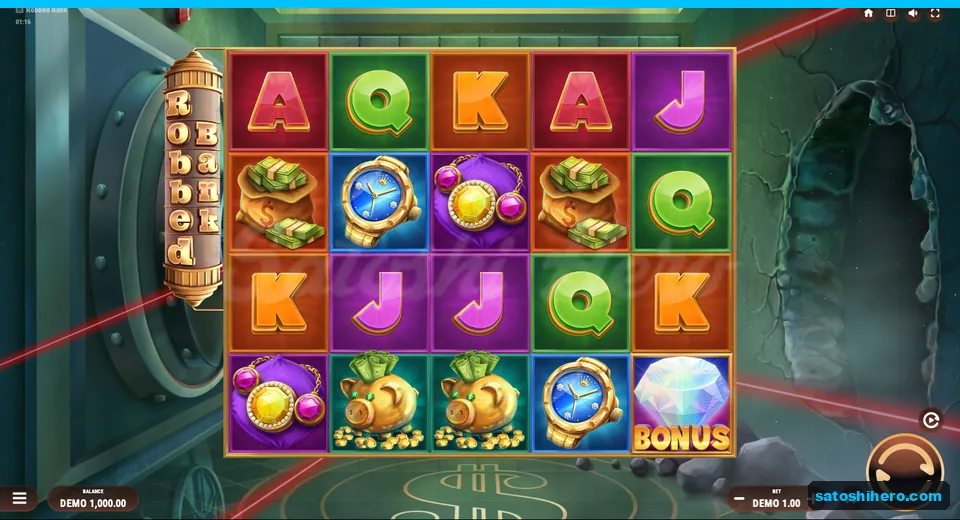
The scene looks like a bank robbed inside a Saturday cartoon. That familiar premise won’t win points for originality, but the vault and burglar communicate it instantly. You know what the game wants to be before your first spin.
Vault presentation
The open vault, red lasers, and animated burglar establish the setting without a long intro sequence. Fast play and dissolving symbols support the lively comic tone, so the presentation rarely slows you down. I like that visual movement follows the game rhythm rather than interrupting it.
Empty the Bank takes a similarly direct vault-heist route, while Wild Wild Bank pushes the bank-and-outlaw idea into a more exaggerated style. This game sits between them, using clean arcade comedy instead of dense cartoon detail. You can distinguish all three by tone rather than by title alone.

Notable Detail: The open vault, crossed lasers, and rope-swinging burglar turn the robbery into visual comedy instead of a realistic crime scene.
Reels and readability
Premium objects use distinct shapes, and the card letters have strong colour separation. The Robber Wild and large Bonus diamond also stand apart during quick drops. You won’t need to pause each cascade just to identify what landed.
Bold colours remain readable with fast play switched on. I found the large white diamond especially clear against the darker vault background, which reduces confusion around near-triggers. If you prefer quick sessions, you can still follow the board without sacrificing basic clarity.
The theme succeeds because it never gets in the way of the result. In my opinion, that practical readability matters more than visual novelty.
Break the Bank
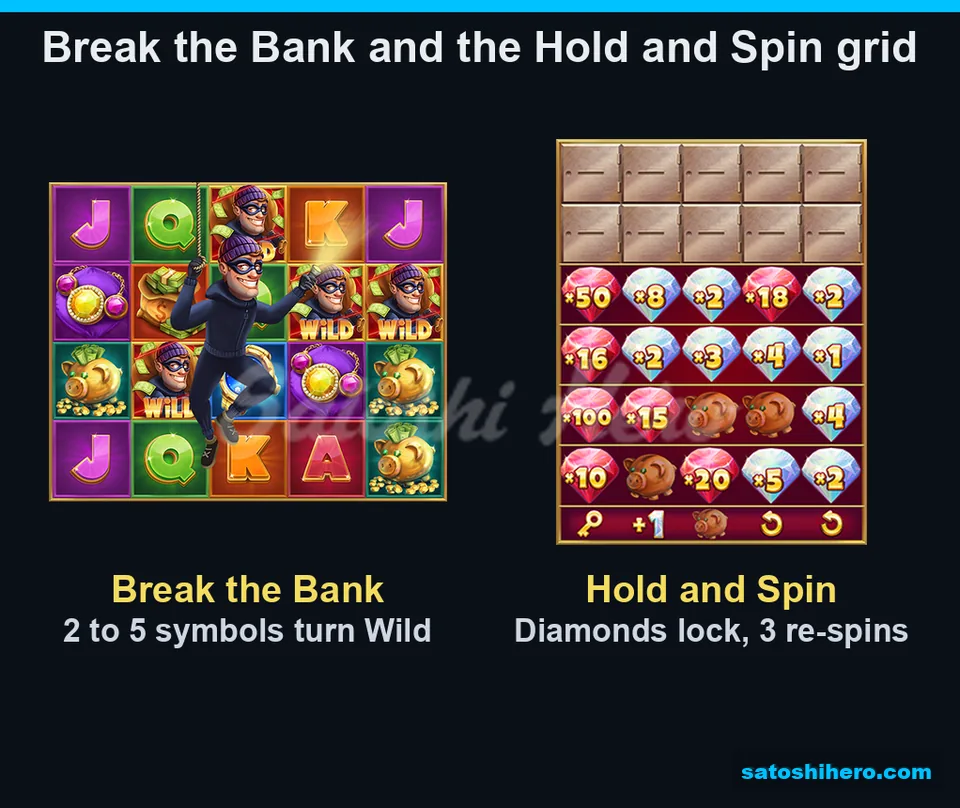
Break the Bank can activate during any main-game spin and convert two to five existing symbols into extra Wilds. It can’t select Bonus diamonds or Wilds already on the board. Those transformations can connect symbols across adjacent reels or strengthen the next cascade.
No fixed schedule controls the activation from a player’s perspective. You might see it several times or miss it for long stretches. I found the visible board changes more engaging than ordinary cascades.
Wild transformations
Any eligible regular symbol can change, with two to five conversions during the active spin. The best positions bridge matching symbols across several consecutive reels, where each Wild can support more routes. A scattered conversion can still pay, but it has less connecting power.
The added Wilds last only for that active spin. They don’t remain on the grid or build toward a persistent meter. You should treat each activation as a fresh recovery chance, not progress toward an assured payout.
This mechanic can rescue an otherwise weak board, yet it doesn’t guarantee a large return. I think its temporary nature keeps the feature clear and stops the base game becoming cluttered.
Tested results
I saw three activations during 100 recorded spins. Spin 35 returned 5.8x, spin 71 produced 7.4x, and spin 90 paid 4.8x. Every activation cleared the 1x stake, but none matched my session-high 16.2x return.
The feature became the most visible recurring mechanic in my run. Its wins felt like useful recoveries rather than balance-changing hits, especially after the early decline. You might value that interruption during a cold stretch, but it won’t erase earlier losses reliably.
Three observations don’t predict your trigger rate. If your run behaves differently, that isn’t evidence of a changed mechanic. My honest take is that Break the Bank added needed energy, but its tested payouts remained measured.
How the Session Played
My 100-spin test ended at $979.80 from a $1,000.00 balance, a loss equal to 20.2x the stake. I used 100 autoplay spins, fast play, and a $1.00 stake from a fresh demo balance. The session showed how frequent small returns can coexist with a steady decline.
The bet menu spans $0.10 to $500.00 across 21 steps. Autoplay offers 25, 50, 75, 100, 200, 500, 750, or unlimited spins, with optional stops for a loss limit, selected win, or bonus trigger. There is no bonus buy or ante bet.
You can test the game in demo mode or play for real on SatoshiHero. I prefer testing the pace first because the upper stake range can magnify a rough sequence quickly.
Balance turning points
My balance fell to $974.40 by spin 34. Break the Bank returned 5.8x on spin 35 and began a limited recovery. The largest hit arrived on spin 44 at 16.2x, lifting the balance to $995.00 without crossing its opening level.
The next-best results were 7.4x on spin 71 and 5.8x on spin 35. Later play mixed small losses with minor returns, and the balance settled at $979.80. I never reached a point where the session moved into profit.
That path mattered more than the final number alone. You could see the 16.2x hit repair much of the early damage, but it lacked enough force to reset the run.
What wins felt like
Thirty-one spins returned something, although most wins stayed below 2x the bet. No Hold and Spin Bonus appeared during the recorded session. The separate $1.60 manual-spin screenshot only illustrates a settled win and doesn’t alter those figures.
Small payouts gave the reels movement without protecting the balance. If you judge only the paying-spin count, you can overestimate the session. The repeated sub-2x results felt underpowered beside this risk profile.
You should track balance direction rather than celebrate every cascade. Frequent small returns didn’t prevent my total from declining.

Expert Advice: Set your stake for a run of quiet spins rather than one spin. My 16.2x hit recovered much of the early decline but didn’t lift the balance above its start.
Hold and Spin Bonus
Land at least three Bonus diamonds anywhere in the main game to trigger Hold and Spin. There is no bonus-buy shortcut. The round starts on a 5×4 bonus grid, with two locked rows above and a helper row below.
Triggering diamonds carry into the feature with random values. The bonus didn’t activate during my 100 recorded spins, so the mechanics below come from the rules rather than an event I played. I found the absence meaningful because this is the game’s deepest feature.
Trigger and re-spins
The bonus begins with three re-spins, and only bonus symbols can land. Each new diamond locks into place and resets the counter to three. The round ends when the counter reaches zero, while re-spins run automatically at the triggering stake.
Your payout equals the bet multiplied by the accumulated total above the grid. That structure makes every locked diamond relevant, but it doesn’t promise that the grid fills. You need to separate the displayed multiplier total from a standalone dollar prize.
No trigger in 100 spins doesn’t make the next spin more likely to produce one. I think the natural-entry requirement adds genuine tension, though it can leave a short session feeling incomplete.
Grid progression
Two upper rows begin locked above the active middle grid. Keys unlock upper cells, starting with the lowest available locked cell, while the helper row affects the reels above it. More unlocked space can create further landing opportunities before the counter expires.
You can complete an entire session without seeing this progression. My run did, despite 31 paying spins and three Break the Bank activations. If the bonus is your main reason for playing, you should budget for the possibility of missing it altogether.

Risk Note: High volatility and a natural-trigger-only bonus can produce sessions with no Hold and Spin round. Don’t increase your stake simply because the feature hasn’t appeared.
Diamond Values and Helper Symbols
White diamonds build the basic bonus total, while red diamonds carry the largest individual values. White diamonds show x1, x2, x3, x4, x5, or x8. Red diamonds show x10, x12, x14, x16, x18, x20, x50, or x100.
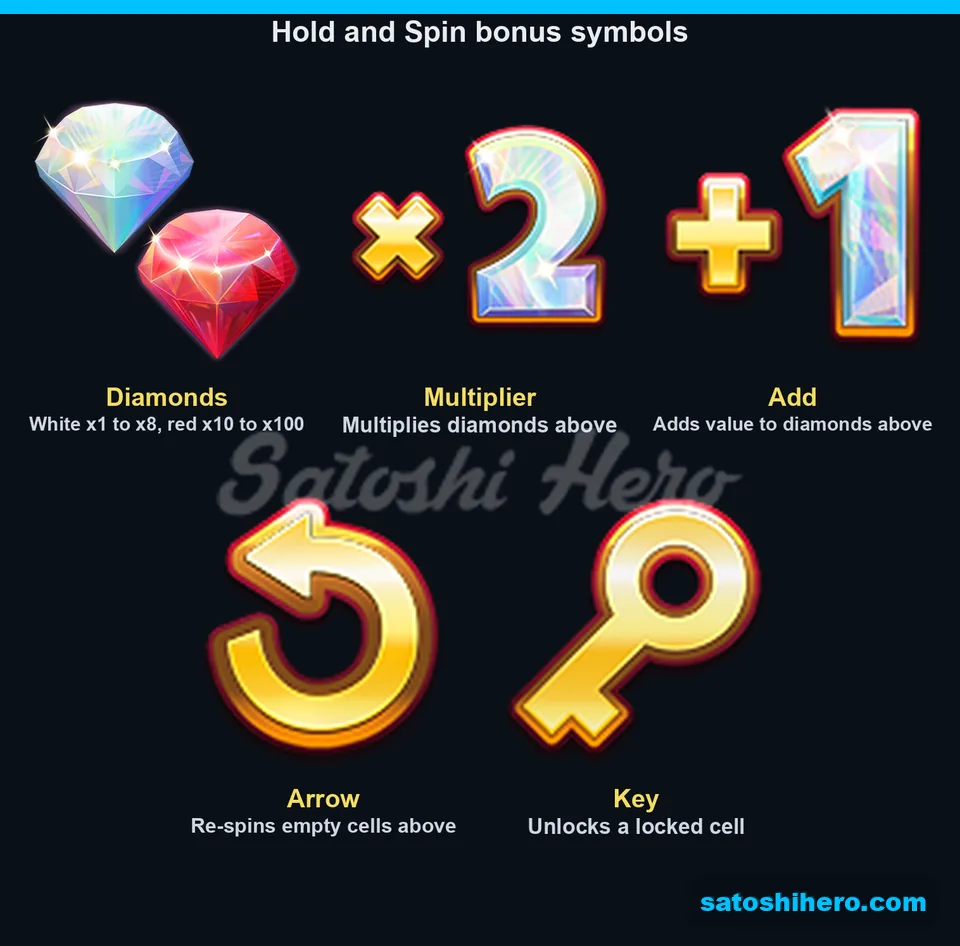
Every landed diamond remains frozen until the bonus ends. I didn’t observe these symbols in action because Hold and Spin never triggered during my recorded run. You should treat the following behaviour as documented mechanics, not my played result.
Diamond multipliers
Several white diamonds can build the accumulated total through volume. A single red diamond can have a much larger immediate effect, especially at x50 or x100. Neither colour comes with a known appearance rate in the information available here.
Each multiplier contributes to the feature total above the grid. It isn’t a separate cash award at the moment it lands. You can judge the round by the combined bar, not by mentally cashing each symbol early.
I like the clear colour hierarchy because it makes the strongest values obvious. Still, the gap between x1 and x100 means the eventual result can depend heavily on which diamonds appear.
Bottom-row helpers
A Multiplier affects diamond values on the reel above once per spin. Add applies its displayed value to every diamond above, while Arrow re-spins empty cells on that reel. A Key unlocks an upper cell, beginning with the lowest locked position.
Multiplier and Add become strongest beneath a populated reel. Arrow creates another filling chance, while Key expands the landing area. You should judge each helper by the board above it rather than its name alone.
A Key can look less exciting than a direct value boost, but extra space can matter across later re-spins. In my view, this interaction gives the bonus more depth than a basic lock-and-respin round. Your best-looking helper can change as the grid develops.
RTP, Volatility and the Robbed Bank slot Test
The 96% theoretical return doesn’t predict an individual session, while high volatility can push short runs far above or below it. The 9,999x maximum is a cap, not an expected target or a clue about hit frequency. Many sub-2x returns in my test showed why you shouldn’t confuse headline potential with normal play.
A staking system can’t change the underlying mathematics. You can only control exposure by choosing a bet that leaves enough room for quiet stretches. I consider that especially important here because the main bonus has no purchase shortcut.
Simulator projection
The SatoshiHero Slot Simulator modelled 1,000 spins at my live bet. Its median session ended 73.3x the bet down, while the central 90% range ran from 331.4x down to 337.7x up. About 18% of modelled spins returned something.
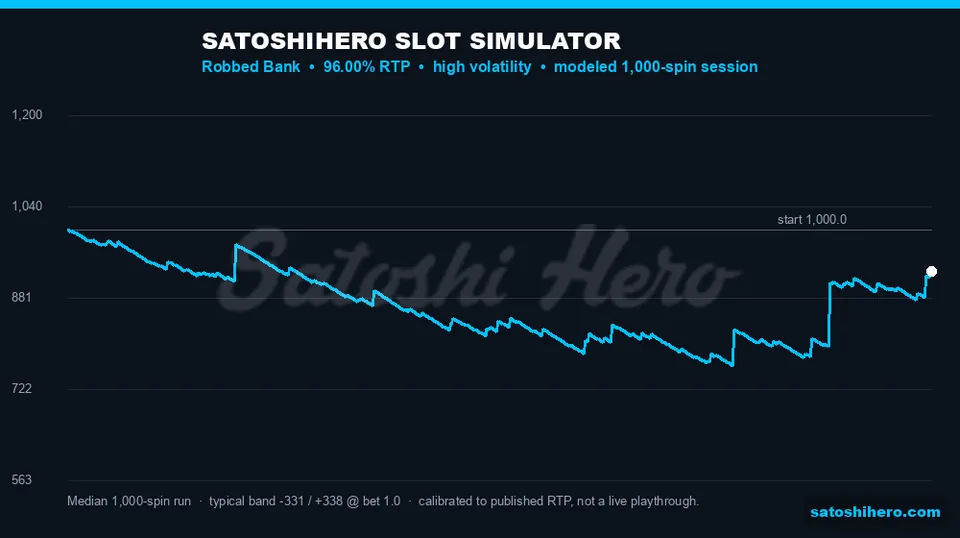
A feature-sized result appeared roughly once per 46 modelled spins. A very large result appeared roughly once per 1,585 modelled spins. Those frequencies describe the projection’s distribution, not a countdown for your next game.
The wide range captures the core risk better than the median alone. You could finish far above the middle outcome, yet a severe downswing also sits inside the modelled spread. I wouldn’t use the projection to predict a specific session.
Our 100-spin session
I played 100 spins at $1.00 each, starting with $1,000.00 and finishing at $979.80. That produced a net loss of 20.2x the stake. Thirty-one spins paid, and the largest return reached 16.2x on spin 44.
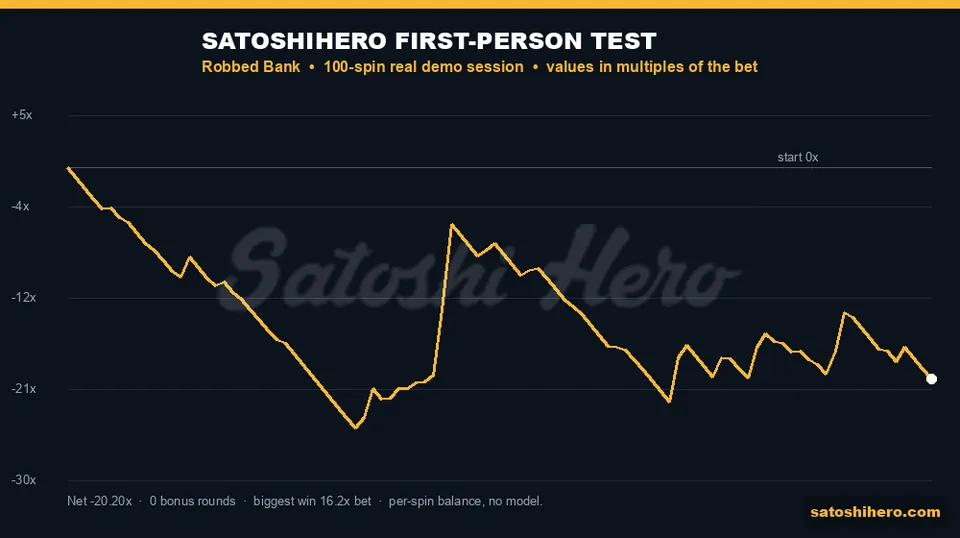
Hold and Spin never triggered, while the balance stayed below its opening point throughout. My live paying-spin share exceeded the modelled 18%, but most returns remained below 2x. That contrast shows why hit count alone can’t describe result quality.
You should choose a stake that leaves space for missed bonuses and quiet sequences. I found the tested run active enough to watch, yet its small wins rarely changed the overall direction.
The published RTP is the operator’s theoretical figure, and one live session can’t confirm, disprove, or alter it. The simulator projection differs from my recorded result, while mode-specific returns can differ slightly by design.
Frequently Asked Questions About Robbed Bank
What kind of game is the Robbed Bank slot?
The Robbed Bank slot is a Barbara Bang bank-heist game with a 5×4 layout and 1,024 ways. It includes cascades, a Robber Wild, Break the Bank, and Hold and Spin, but no bonus buy.
How does Break the Bank work in the Robbed Bank slot?
Break the Bank can activate on any main-game spin and change two to five eligible symbols into Wilds. It excludes Bonus diamonds and existing Wilds, and it triggered three times in my test.
How do you trigger Hold and Spin in the Robbed Bank slot?
Land at least three Bonus diamonds anywhere in the main game. You begin with three re-spins, and each new diamond resets that counter, although the feature didn’t trigger in my test.
What do bonus diamonds pay in the Robbed Bank slot?
White diamonds carry x1 to x8, while red diamonds carry x10 to x100. Multiplier and Add helpers can increase values on the reels positioned above them.
Which regular symbols pay most in the Robbed Bank slot?
Five matching money bags pay 2x, jewel pouches pay 1.5x, watches pay 1x, and piggy banks pay 0.8x. A and K pay 0.4x, while Q and J pay 0.3x.
What are the RTP and maximum win of the Robbed Bank slot?
The Robbed Bank slot has a 96% theoretical RTP and a maximum win capped at 9,999x the bet. Neither figure predicts what you can receive in one session.
How volatile is the Robbed Bank slot?
The game has high volatility. My 100-spin test recorded 31 paying spins, a 16.2x largest return, and a finishing balance 20.2x the stake below its start.
What did the 1,000-spin simulator show?
The median modelled session ended 73.3x down, with the central 90% range spanning 331.4x down to 337.7x up. This projection isn’t a forecast for your next session.
What happened in your 100-spin test?
My balance fell from $1,000.00 to $979.80, and it never exceeded its starting point. The largest return was 16.2x, while Hold and Spin didn’t trigger.
Summing It Up
Robbed Bank combines readable cascades, visible Wild transformations, and an ambitious natural-trigger bonus. Its strongest draw is feature variety, while restrained ordinary payouts make the risk feel sharp.

My Call
Patient high-volatility players can appreciate the changing board and natural bonus chase. Expect uneven results, modest base returns, and no guarantee that Hold and Spin appears during a short run.
I liked how Break the Bank interrupted dry stretches three times, yet its 4.8x to 7.4x returns never transformed my balance. I didn’t like that a 16.2x session-high hit still left the run below its opening point.
The Robbed Bank slot guide is updated periodically to keep its practical details useful.

Pros:
 Clear ways system: Adjacent-reel matches remain easy to follow during quick cascades.
- Visible feature action: Wild transformations make Break the Bank immediately understandable.
- Deep bonus structure: Diamonds, helpers, and unlockable cells create layered bonus decisions.
- Strong visual clarity: Distinct symbols stay readable when fast play accelerates the reels.

Cons:
 Restrained base values: Most tested returns stayed below 2x the stake.
- No bonus shortcut: You can’t buy direct access to Hold and Spin.
- Sharp session swings: A solid 16.2x hit couldn’t restore the opening balance.

Best For: You need patience, conservative staking, and comfort with high risk. You get a colourful heist, quick cascades, and a natural bonus chase that demands restraint.
Similar Games



































































Bets
All Bets
Game
Player
Date
Wager
Mult.Multiplier
Prize
 Piggy Bonanza Halloween
 flaviocas82
- 12:01:57
- 1×
- Galaxy Glitter
 Hidden
- 12:01:56
- 0×
- Piggy Bonanza Halloween
- flaviocas82
- 12:01:54
- 0×
- Galaxy Glitter
 Hidden
- 12:01:54
- 0×
- Luck of Tiger: Bonus Combo
 Hidden
- 12:01:50
- 0×
- Caribbean Escape: Rapid Link
- mdp0fxo
- 12:01:50
- 0×
- Galaxy Glitter
- Hidden
- 12:01:48
- 0×
- Galaxy Glitter
 nina87
- 12:01:46
- 0×
- Piggy Bonanza Halloween
- flaviocas82
- 12:01:46
- 0×
- Luck of Panda: Bonus Combo
- Hidden
- 12:01:45
- 0×