

LooneyPop
By pressing play, you agree that you are above legal age in your jurisdiction and that your jurisdiction allows online gambling.

LooneyPop
RTP96%
VolatilityHigh
Max winx50,000
Ways118,098
Hit rate21.5%
ThemeFantasy
ReleasedFeb 2023

Mad Science Goes Off the Rails in LooneyPop
LooneyPop turns every winning cluster into a growing mad-science experiment, and I tested 100 spins at $1 to see how that idea performs. LooneyPop is a high volatility AvatarUX slot with 96% RTP and 50,000x max win potential. Its 5-reel by 3-row grid starts with 486 variable ways, while PopWins can expand it toward 118,098 ways. Volatile reel-growth fans who can accept long losing stretches have the clearest reason to play.
Key takeaways
- Best play: Base or demo play is the soundest start because I tested neither buy, and natural free spins never triggered.
- Best bonus: Boom Bonus costs 125 bets, while Maxi Boomy costs four times more for twice the starting spins.
- RTP / volatility: The core math combines 96% RTP with high volatility.
- Max win: The 50,000x cap ends the round and pays the accumulated amount.
- Risk note: My $100 test lost $39.10 despite 24 paying spins, while smaller stakes leave more room for an 11-spin drought.

Table of Contents
- How LooneyPop Works
- High-paying symbols
- Medium and low pays
- PopWins
- ZapReel
- Reward interactions
- Theme and First Impressions
- Bonus Buy Options
- Free Spins
- Retained growth
- Wacky Gamble Wheel
- RTP, Volatility and Our Test
- Simulator projection
- Our 100-spin session
- Frequently Asked Questions About LooneyPop
- The Takeaway
How LooneyPop Works
Wins require at least three matching symbols on adjacent reels, starting from the leftmost reel. They can occupy different rows, so you should trace reel positions rather than search for straight lines. A one-reel gap breaks the combination. This variable-ways structure has no fixed paylines, which makes the expanding board easier to understand than its huge top count suggests.
The resting board uses five reels and three rows, creating 486 ways. PopWins raises individual reel heights as winning symbols disappear and receive replacements. That growth can push the counter as high as 118,098 ways. You can play through a mobile or desktop browser at SatoshiHero, with the same core layout adapting to either screen.
Mechanically speaking, the rule is simple: follow matching symbols across neighbouring reels, then watch which columns grow. You can recognise a valid win even when the matching icons sit at opposite vertical positions. I like that clarity because the game adds complexity through expansion, not through hidden line patterns.

Key Number: Matching symbols can sit on different rows and still win when they occupy adjacent reels from left to right.
High-paying symbols
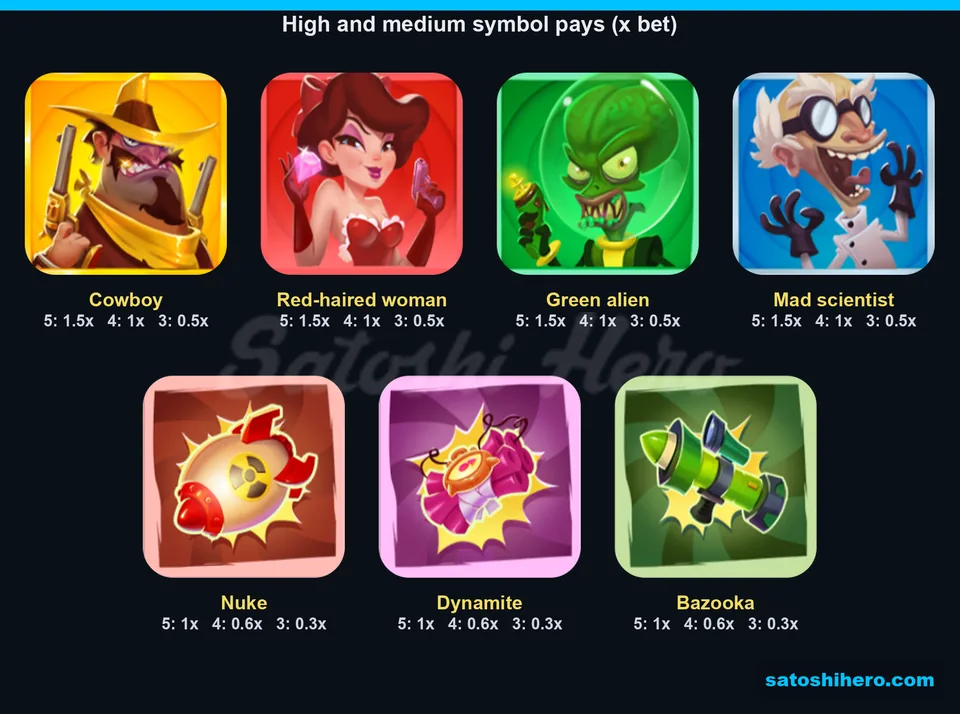
Four cartoon characters lead the paytable: the cowboy, red-haired woman, green alien, and mad scientist. Each character pays 0.5x for three matches, 1x for four, and 1.5x for five. Those values are restrained, so you need reel growth or ZapReel support before a sequence feels substantial.
Medium and low pays
The nuke, dynamite, and bazooka each pay 0.3x, 0.6x, or 1x for three, four, or five matches. My smallest observed return was $0.30 at a $1 stake, matching the 0.3x medium-symbol value exactly. That small result showed how easily a paying spin can still leave the balance moving backward.
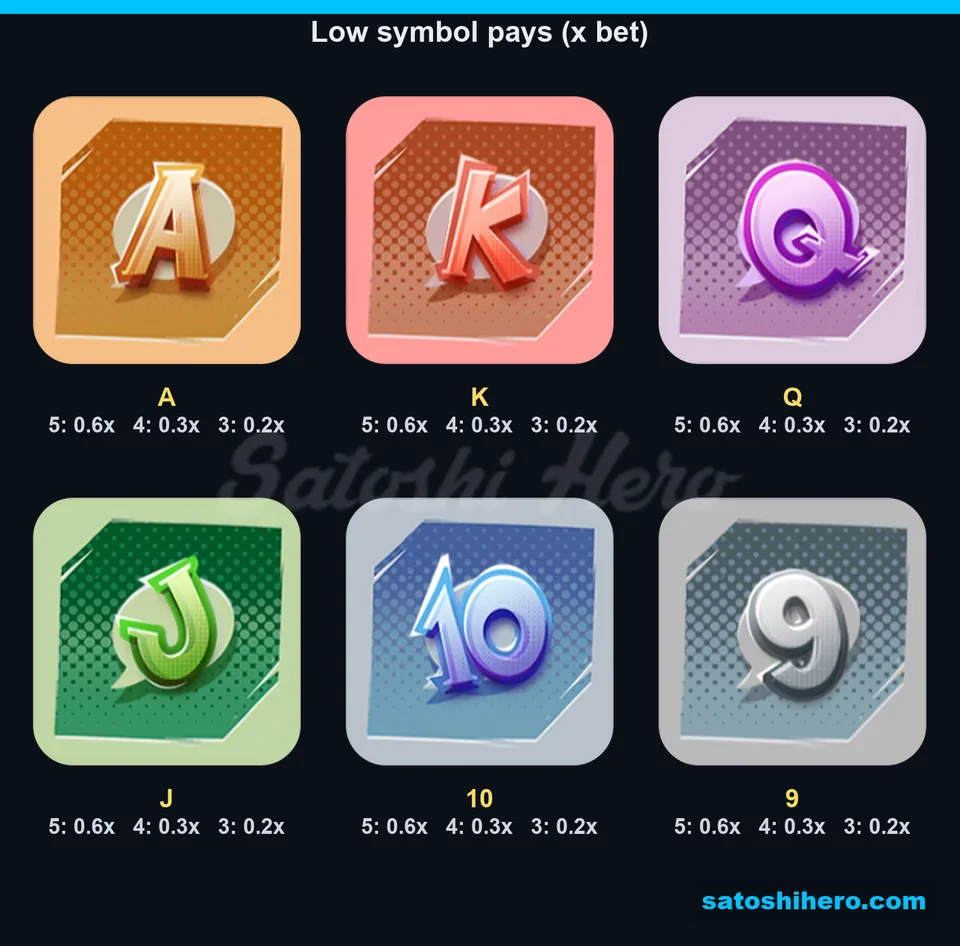
A, K, Q, J, 10, and 9 pay 0.2x for three, 0.3x for four, and 0.6x for five. The paytable contains no wild or scatter, and I saw neither during play. In my view, the familiar symbols feel plain, but their low values give expanding chains a clear job. The rules stay readable, while meaningful returns depend heavily on growth.
PopWins
PopWins drives the whole slot and does more than a standard tumble. Every winning symbol pops, receives two replacements, and makes its reel taller. Fresh wins repeat that process, then the game pays the accumulated chain total when no new combination forms. You need to follow reel height and the changing ways counter together because each pop reshapes the next chance.
I saw the counter begin at 486 ways, then reach 3,000 and 6,000 on expanded boards. Base-game reels stop growing at six symbols, while free-spin reels can reach nine. The counter rises unevenly because only affected reels expand. That individual growth feels more engaging than a uniform cascade.
One extra manual spin produced a $7.40 return at a $1 stake on a 6,000-ways board. I took it after the logged test for a visual example, so it doesn’t belong in the official 100-spin totals. The sequence looked busier than the payout felt, which captures the mechanic honestly: more ways increase possibility, not guaranteed value.
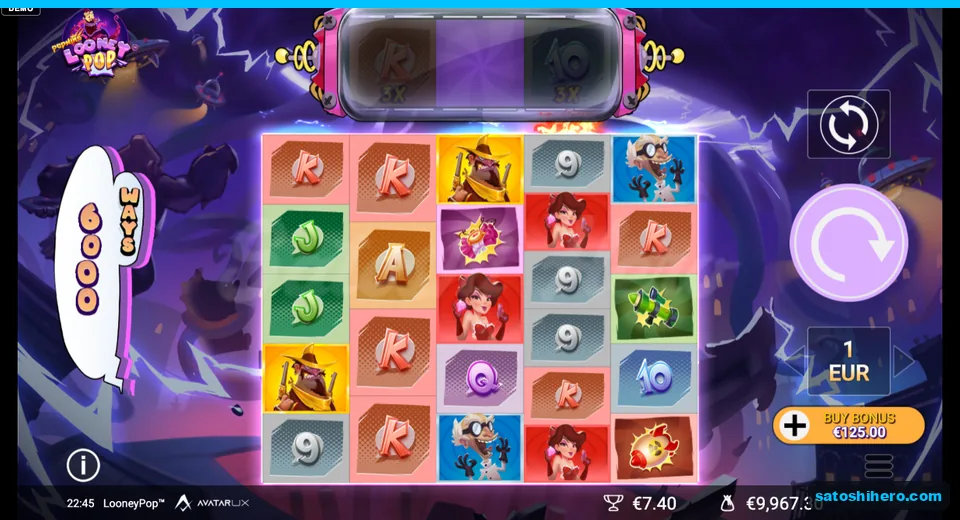

Smart Move: Watch reel heights and the ways counter throughout each chain. A pop can improve the next winning chance even when the opening layout looks weak.
Many regular combinations still pay modest amounts, making chain length more important than visual size alone. You can see a board balloon without receiving a standout total. I found the process satisfying because every replacement has an obvious cause and effect. PopWins supplies the momentum, while longer chains give that momentum financial weight.
ZapReel
ZapReel refreshes above the board on every spin and shows up to three reward cells. Each cell affects the reel directly below it, so you should inspect the tube before judging the symbols. During a chain, you can track the same reward across later wins on that reel. That persistence gives this feature most of the slot’s personality.
Reward interactions
Base-game cells can hold an x2 or x3 multiplier, split a symbol into five copies, expand a winning symbol across its reel, or sync two neighbouring reels. Multiple multipliers multiply together instead of adding. A multiplier affects the first qualifying win and later wins on its reel during the same PopWins chain. I think that connection between position and persistence shows clever engineering.
Hot To Burn Multiplier offers a more direct multiplier-led structure. Here, reel-specific multipliers stay tied to one growing chain, so their value depends on both position and follow-up wins. You need more attention, but the reward feels better integrated with the board. That practical difference makes this game less immediate and more mechanical.
Free spins strengthen every part of the tube. ZapReel always holds three rewards, multipliers reach x2, x3, x5, or x10, and split can create ten copies. Sync can connect three neighbouring columns. Two-direction sync appears only in extended free spins or after the matching gamble-wheel result.

Lore: The glass ZapReel resembles laboratory equipment, which makes every reward look like another unstable experiment above the board.
I didn’t reach the enhanced version during my test, so according to AvatarUX, those details come from the in-game rules. Even without that round, the tube made routine spins easier to read because each reward pointed at one reel. The standard paytable feels conservative, but ZapReel creates clear routes toward stronger chains. Its changing cells make every expanded sequence more interesting.
Theme and First Impressions
The game builds its visual identity around a purple laboratory, crackling lightning, glass equipment, and a tentacled mascot. At rest, you see a 5-reel by 3-row grid, a 486-ways counter, character symbols, and the reward tube above. My screen also showed a visible x2 ZapReel cell. Once wins begin, you watch the board stretch upward like an experiment escaping control.
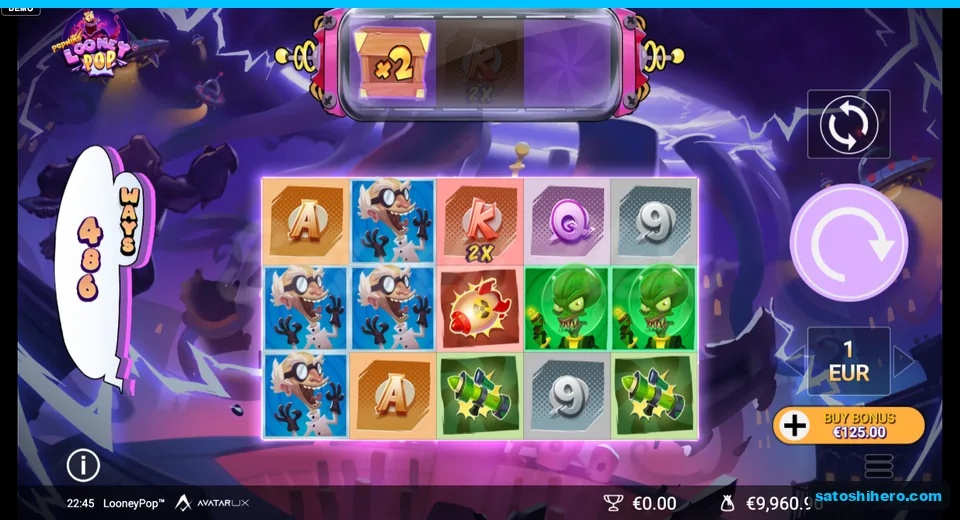
The cast includes a cowboy, a red-haired woman, a domed green alien, and a wild-haired scientist. Nukes, dynamite, bazookas, and card ranks support them. You can identify each pay group quickly because the premium characters use larger faces and stronger colours. I found the hierarchy clear, even when several replacement symbols arrived together.
Journey to the West makes more sense when you prefer fantasy adventure and a mythic atmosphere. This laboratory takes the opposite route with slapstick danger, glowing machinery, and cartoon chaos. The comparison comes down to mood rather than game access. I prefer the lab’s visual link to the mechanics because the growing board resembles a failed experiment.
The mad-science concept won’t win originality awards. Still, the mascot, glass tube, and animated reel growth create a cohesive result. ZapReel looks like active equipment rather than a detached bonus panel. The art works best when the board expands and the laboratory effects animate together.
Bonus Buy Options
Boom Bonus is the more approachable purchase because it costs 125 bets, while Maxi Boomy Bonus costs 500 bets. I bought neither option, so I can’t call either one better value. At my $1 stake, the displayed prices were $125 and $500. You should compare that full cost with the number of ordinary spins your bankroll could fund.
Boom Bonus starts the entry free-spin mode with six spins. Maxi Boomy starts the extended mode with twelve, giving twice as many starting spins for four times the price. Cash cost scales across the $0.10–$200 betting range. Before confirming, you can multiply the selected stake by 125 or 500 to understand the commitment.
Starting spins don’t reveal likely returns, and a larger purchase doesn’t remove variance. From a bankroll perspective, the price jump is hard to justify without first learning how the base game behaves. My natural session never reached free spins, but that absence doesn’t prove a buy would perform well or poorly. It only shows why the shortcut can look tempting.

Red Flag: High volatility and upfront costs of 125x or 500x can drain your bankroll quickly. Buying a feature never guarantees profit or a meaningful return.
I prefer demo play first because it exposes cold stretches without demanding a large upfront stake. You can test your comfort with reel growth before risking 125 normal bets at once. Either buy remains a high-cost route into stronger mechanics, not a solution to weak results.
Free Spins
Free spins trigger when the base-game reels grow to six symbols tall. The round starts with six spins and reels already six symbols high, then growth can continue toward nine. My logged 100 spins never reached this feature, so I rely on the in-game rules here. You should treat the description as documented mechanics rather than a result I experienced.
Retained growth
Reel-unlock progress doesn’t reset completely after each free spin. Instead, it falls only to the shortest current reel height. You can judge retained growth by watching that shortest reel, since it establishes the floor for the following spin. This design gives each expansion more lasting importance than base-game growth.
ZapReel also remains full with three active rewards. Multipliers can reach x10, split can create ten matching symbols, and sync can join three reels. Those stronger tools connect logically with the taller grid. Mechanically speaking, persistent height and fuller rewards should create richer chains, although they still can’t promise a strong return.
Hot to Burn – 7 Deadly Free Spins foregrounds its free-spin structure more directly. LooneyPop makes you earn the trigger through reel growth, then adds enhanced ZapReel rewards and a pre-feature gamble choice. That route creates more anticipation, but it also means you can play a long stretch without seeing the main bonus. I found that drawback significant after the trigger stayed absent throughout my session.
You need patience because normal reel growth must align before the round opens. The feature has stronger tools than the base game, yet access can remain scarce over a short session. Its persistent progress is smart design, but the test left that design unproven in live play.
Wacky Gamble Wheel
The Wacky Gamble Wheel lets you risk the entire free-spin feature for more spins before it starts. A loss returns you to the base game with no free spins, so you must accept losing the whole trigger before choosing it. You can decline and keep the starting allocation. I think that guaranteed six-spin round deserves more respect after a difficult natural trigger.
The normal path starts with six spins. One successful gamble raises the allocation to nine, while a second raises it to twelve. Golden fields can raise the first gamble as high as twelve spins and the second as high as eighteen. These outcomes change quantity, but they don’t turn the wheel into a skill test.
My session never opened the wheel because free spins didn’t trigger. I can’t judge its live pacing, wheel balance, or emotional pull from firsthand play. The rules still make the trade-off plain: extra spins require risking every guaranteed spin already earned. No timing pattern or button press can make that random result predictable.
Experienced players sometimes chase the larger allocation because eighteen spins sounds far stronger than six. Yet spin count alone can’t show the final return, especially in a high-risk game. For me, risking a hard-earned natural trigger makes little sense unless losing every free spin feels acceptable. Keeping the guaranteed feature is the cautious choice, while the wheel demands a very high risk tolerance.
RTP, Volatility and Our Test
The slot uses a 96% theoretical RTP, high volatility, and a 50,000x maximum win. Reaching that cap ends the round and pays the accumulated amount. These figures define the game math, while my simulation and live test illustrate short-session variance. You shouldn’t treat either result set as a prediction because your outcome can fall well outside the middle range.
Simulator projection
The SatoshiHero Slot Simulator modelled 1,000 spins at a $1 stake. Its median finish was $57.90 down, while 90% of runs landed from $316.30 down to $312.80 up. About 18% of spins paid, with a feature-sized result appearing around once per 45 spins. A very large win appeared around once per 1,745 spins.
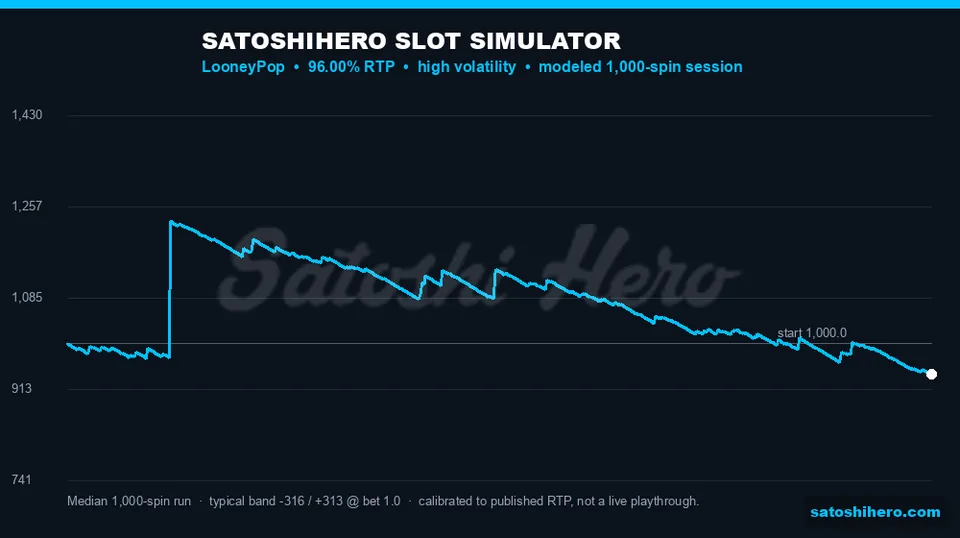
Those frequencies describe the model, not a countdown. You can go longer than 45 spins without a feature-sized result, or see one sooner. The wide projected band matters more than the median because it shows how far sessions can separate. I find that spread a more honest warning than a single average figure.
The model used a 1,000-spin horizon, $1 stake, the stated return, and the high-volatility band. It can’t predict the next spin or your finishing balance. Instead, it demonstrates why identical starting stakes can lead to sharply different results. That range fits a game where small regular pays compete with rare, stronger chains.
Our 100-spin session
I started with $10,000.00 and finished at $9,960.90 after 100 autoplay spins at $1. Total stakes reached $100.00, while returns reached $60.90, leaving a $39.10 loss. Only 24 spins paid. You can see from those figures that a decent hit rate doesn’t ensure bankroll stability when many wins remain below the stake.
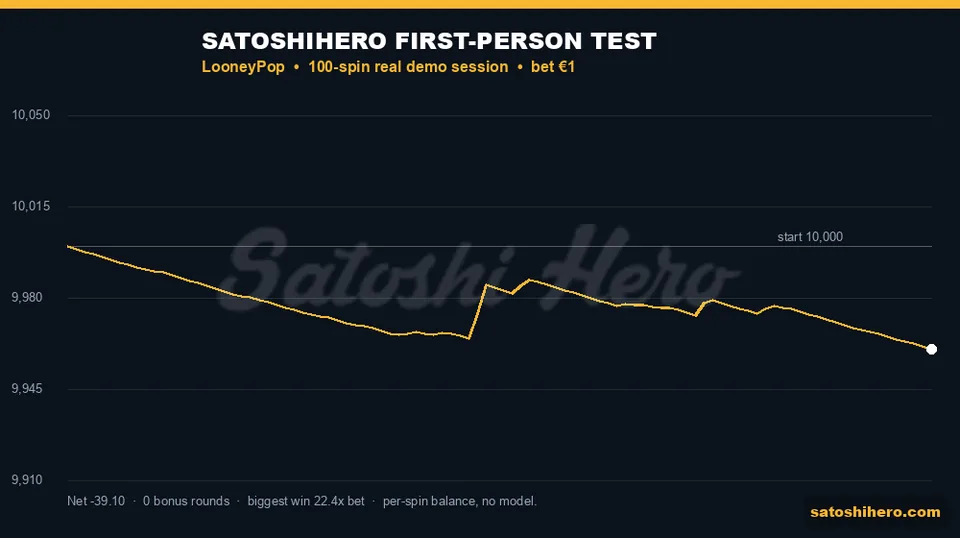
My first return arrived on spin 9 and paid $0.50. The longest losing stretch lasted 11 spins, which made the early balance path feel colder than the final 24% observed hit rate suggests. My best hit landed on spin 48 for $22.40, equal to 22.4x. It lifted the balance to $9,985.70, still about $14 below the starting point.
The next-best returns were $7.20 on spin 53 and $7.80 on spin 74. After those moments, my balance kept declining and reached its session low on the final spin. Neither free spins nor the gamble wheel appeared. I also excluded the later $7.40 screenshot spin, keeping the logged totals clean.
That balance path moved from $10,000.00 to $9,960.90 without any bonus interruption. One 22.4x result recovered a useful chunk, but it couldn’t reverse the accumulated losses. In my opinion, this is the clearest evidence of the risk profile: one respectable hit still left a sizeable deficit. Smaller stakes would give you more attempts to absorb a similar cold run.
The 96% figure is the operator-published theoretical return, and one 100-spin session can’t prove or disprove it. The simulator models that return and volatility band rather than forecasting future play. Feature-mode or bonus-buy returns can differ slightly from the base configuration by design. Routine verification keeps the specifications accurate, while the session supports the risk classification without redefining the underlying math.
Frequently Asked Questions About LooneyPop
How does PopWins work in LooneyPop?
Winning symbols pop, receive two replacements, and make their reels taller. Chains continue while new wins appear, with reel limits of six rows in the base game and nine during free spins. The expanded board can reach 118,098 variable ways.
How do you trigger free spins in LooneyPop?
Grow the base-game reels to six symbols tall to start six free spins. Optional wheel gambles can raise that total to nine or twelve, but a loss removes the whole feature. I didn’t trigger free spins during my 100-spin test.
What does the LooneyPop ZapReel do?
ZapReel applies reel-specific multipliers, split symbols, expanding symbols, or synced reels from cells above the grid. It always holds three rewards during free spins, where multipliers can reach x10. Each reward affects the reel directly beneath it.
Can you buy LooneyPop free spins?
Yes, Boom Bonus costs 125 bets for six spins, while Maxi Boomy Bonus costs 500 bets for twelve. At my $1 stake, those prices were $125 and $500, and I purchased neither option.
What does the LooneyPop 1,000-spin simulator show?
The model produced a $57.90 median loss and a 90% range from $316.30 down to $312.80 up. Roughly 18% of spins paid, with a feature-sized result around once per 45 spins. It doesn’t predict future spins.
How did the LooneyPop 100-spin test go?
I lost $39.10 after staking $100 across 100 spins, with 24 paying results and no free-spin trigger. My largest hit paid $22.40 on spin 48, equal to 22.4x the stake.
What are LooneyPop’s RTP and maximum win?
The theoretical return is 96%, the volatility is high, and the maximum win is 50,000x. A round ends and pays the accumulated total when that cap is reached.
The Takeaway
LooneyPop stands out because PopWins and ZapReel connect reel growth, position, and persistent rewards cleanly. Its main drawback is simple: restrained symbol values and scarce bonus access can make a short session expensive.

My Call
Try the free demo before committing meaningful stakes, then keep your bets small enough to survive long dry patches. Expect board growth, modest routine pays, and no assurance that free spins appear within your session.
I like how each pop changes reel height and creates a visible path toward more ways. I don’t like that my 22.4x best hit still left me well behind, while neither bonus option received a real purchase test.
LooneyPop rewards attention over blind spinning, and this guide is updated periodically as mechanics and test evidence change.

Pros:
 Connected mechanics: PopWins growth gives every ZapReel reward a clear positional purpose.
- Readable wins: Adjacent-reel matching stays easy to trace as the board expands.
- Strong visual logic: Laboratory equipment supports the unstable reel-growth idea.
- Large ceiling: The cap leaves considerable room for rare extended chains.

Cons:
 Cold stretches: Eleven losing spins showed how quickly momentum can disappear.
- Restrained regular pays: Small symbol values make many visible wins feel weak.
- Costly buys: The cheaper option still consumes 125 normal stakes upfront.

Best For: Patient high-variance fans who enjoy tracking reel heights, changing ways, and reward positions get the clearest appeal. Cautious players should favour the demo and smaller stakes, especially when bonus access matters.
































































Bets
All Bets
Game
Player
Date
Wager
Mult.Multiplier
Prize
 Mardi Gras Queen
 Hidden
- 16:19:52
- 0×
- Joker's Mega Multipliers
 Hidden
- 16:19:51
- 0×
- Joker's Mega Multipliers
- Hidden
- 16:19:50
- 0.34×
- Luck of Panda: Bonus Combo
- josh1998
- 16:19:50
- 0×
- Merry Cash Splash: Hold 'N' Link
- mike_721
- 16:19:50
- 0.09×
- Joker's Mega Multipliers
- Hidden
- 16:19:48
- 0×
- Joker's Mega Multipliers
- Hidden
- 16:19:47
- 0×
- Elephant's Gold: Buy Bonus Combo
 mdp0fxo
- 16:19:46
- 0.39×
- Joker's Mega Multipliers
- Hidden
- 16:19:45
- 0×
- Triple 5's: Megacharged
 Hidden
- 16:19:45
- 0×