

Chicken Drop
By pressing play, you agree that you are above legal age in your jurisdiction and that your jurisdiction allows online gambling.


Cracking the Farmyard for Bigger Egg Spins
Chicken Drop slot looks like a cheerful farmyard game, but the 96.5% RTP and 5,000x max win sit behind sharper math. Chicken Drop is a very-high volatility slot from Pragmatic Play with 96.5% RTP and 5,000x max win potential. It uses a 7×7 cluster-pays grid with 5+ connected-symbol wins. It targets patient risk hunters who prefer tumbles, egg upgrades and bonus swings over steady medium wins.
I tested the SatoshiHero demo at $2 per spin; stakes run from $0.20 to $100, and the buy cost $200.
Key takeaways
- Best play: Base-game spins give you more time with tumbles and egg build-up, while the buy asks you to accept heavy variance fast.
- Best bonus: The buy costs 100x the bet, and my $200 test buy returned only $31. This was an in-game feature purchase, not a casino bonus or promotion.
- RTP / volatility: Base RTP is 96.5%, buy RTP is 96.53%, volatility is very-high and the max win is 5,000x.
- Risk note: Long quiet stretches can hit before a useful egg, free-spin round or 100x-plus spike arrives.
- Bankroll note: My 500-spin test finished about $299 down despite one organic 143x bonus hit.

Table of Contents
- Theme & first impressions
- Cluster wins and symbol values
- Cluster requirements
- Pay table notes
- Tumbles between wins
- Chain reaction wins
- Base-game value
- Egg Drop feature
- Size upgrades
- Multiplier upgrades
- Free spins round
- Trigger symbols
- Locked upgrades
- Chicken Drop slot bonus buy test
- Buy price
- Test result
- RTP, volatility & our test
- Simulator projection
- Our 500-spin session
- Bankroll fit and play style
- Frequently Asked Questions About Chicken Drop
- Final Thoughts
Theme & first impressions
Chicken Drop looks light, bright and easy to read, but it plays like a tougher high-risk cluster game. You get a sunny farm backdrop, a wide-eyed rooster on the right, and a wooden crate frame around the 7×7 board.
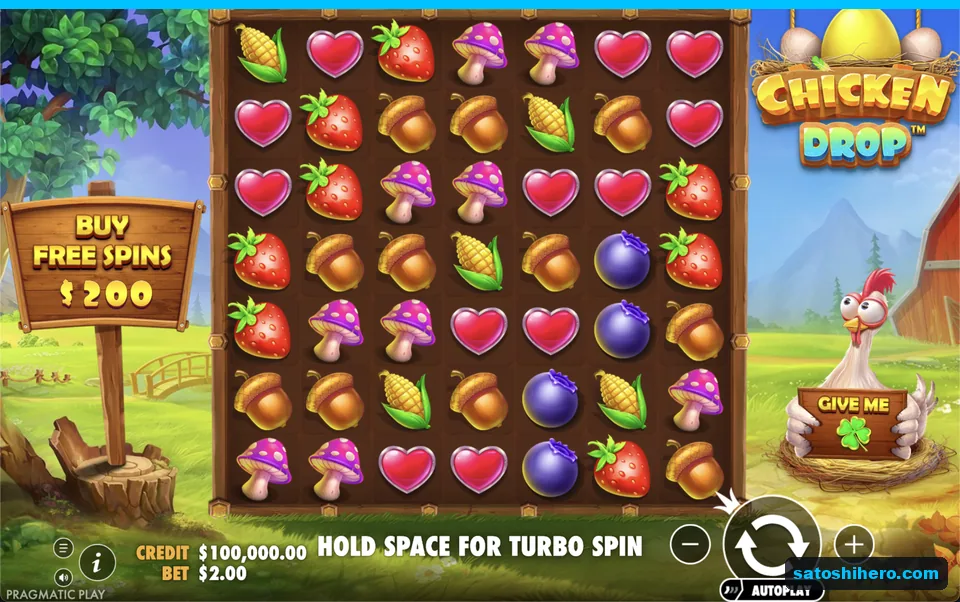
Fruit and veg symbols fill the grid: strawberries, blueberries, corn, acorns, toadstools and card-style shapes. You don’t line up reels here. Symbols pay wherever they connect, which makes the layout clearer than a fixed-line slot once you see a few tumbles.
I think the theme won’t win originality awards, but the clean art helps when the math starts biting. Chicken Chase has the same light farmyard pull with a different pace, while The Great Chicken Escape leans harder into comic chicken energy.

Did You Know? The cute rooster and sunny farm art clash with the very-high volatility underneath. I like that contrast because it keeps the game readable without making it feel soft.
The testing notes and guide details go through the same QA check used for SatoshiHero slot guides, so the tone stays grounded in actual play. You can enjoy the cartoon shell, but you shouldn’t mistake it for a gentle session.
Cluster wins and symbol values
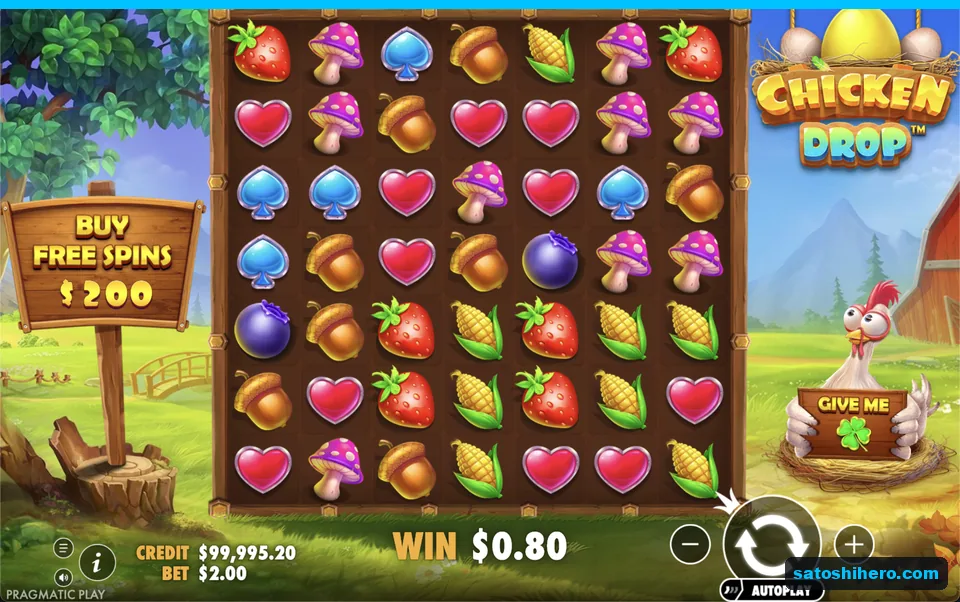
Chicken Drop slot pays through 5+ connected matching symbols on a 7×7 grid, not through fixed paylines. You need matching symbols linked horizontally or vertically, and bigger clusters pay more than small ones.
Cluster requirements
Board shape matters more than left-to-right placement. A five-symbol group can sit almost anywhere, as long as the pieces touch up, down or across. That makes the Chicken Drop slot feel closer to a puzzle board than a reel game.
You may see a line-count field in some game data, but I wouldn’t call this a payline slot. My test showed connected-symbol wins throughout, and that distinction matters when you judge how often a spin can recover.

Quick Fact: Despite the API line-count field, Chicken Drop should be explained as a cluster-pays game because wins form from 5+ connected symbols. That single detail changes how you read the whole board.
Pay table notes
At the $2 stake, strawberry pays $2 for 5 symbols and climbs to $2,000 for 37 or more. Blueberry pays $1.50 up to $1,000, while corn pays $1 up to $500.
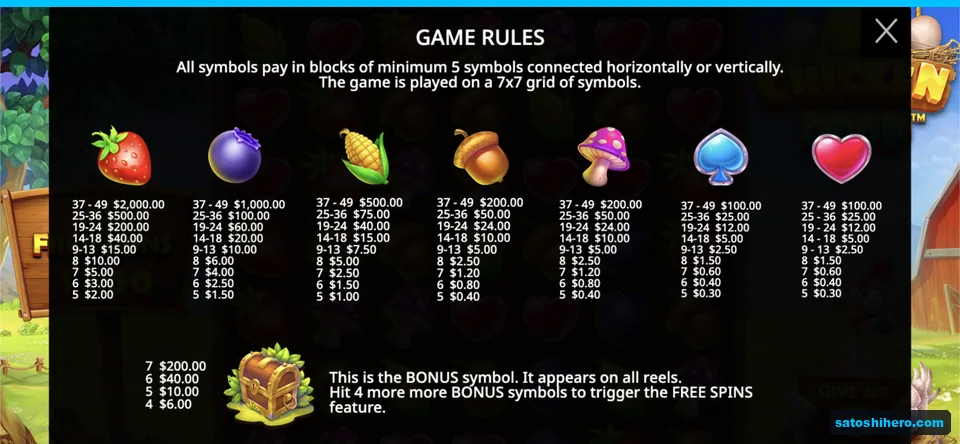
Lower symbols still matter during tumbles. Acorn and red toadstool run from $0.40 up to $200, and the blue spade plus pink heart run from $0.30 up to $100. Those small hits kept my base-game balance alive, even when the screen looked cold.
The treasure chest is the bonus symbol and pays its own prize. Four chests pay $6, and seven pay $200 at the same stake, while 4, 5 or 6 chests can start the free spins round. I like that the chest can help even before it opens the feature.
Tumbles between wins
Every winning cluster tumbles away, so one paid spin can create several chained wins. You see winning symbols pop off, higher symbols drop into the gaps, and fresh symbols fall from the top.
Chain reaction wins
If the refill creates another cluster, it pays and tumbles again. The game doesn’t set a fixed tumble limit, so the chain only stops when a drop adds no new connected group. That gives each spin a little suspense after the first hit.
I noticed that most base-game value came from these small chains rather than single big screens. You shouldn’t expect fireworks every time, but a plain-looking $2 spin can claw back a few dollars when tumbles line up.
The catch is that many chains stop after one or two refills. That can make the base game feel busy without moving the balance much. I don’t mind that pace, but you need to judge the spin by the final banked total, not the amount of board movement.
Base-game value
The tumble rhythm also makes the game work neatly on desktop and mobile. You watch the same vertical drop, the board stays readable, and the important upgrade symbols don’t get lost in the motion.
Dino Drop gives a useful comparison if you like drop-style motion more than fixed-line timing. This game feels harsher, though, because the best moments usually need egg help or a free spins round. You get activity, but you don’t get comfort.
Egg Drop feature
The Egg Drop feature gives the game its identity because it turns upgrade symbols into a large symbol block with a multiplier. Two symbols drive it, and you want them to build together rather than land in isolation.
Size upgrades
The golden watering can grows the next egg from 2×2 to 3×3, 4×4, 5×5 and finally 6×6. After the paid spin’s tumbles stop, a giant egg drops onto the grid and cracks into one random paying symbol.

That block can instantly create a large same-symbol cluster. In my play, a larger egg changed the feel of dead spins because one sudden block could pull the board into shape. Still, size without a useful symbol can feel flatter than the animation suggests.

Pro Tip: The egg is strongest when size and multiplier upgrades build together. A big egg without much multiplier can still feel underwhelming, so don’t judge the feature by size alone.
Multiplier upgrades
The green clover raises the next egg’s multiplier from 2x up to 11x. When that multiplier attaches to a large block, you finally see why the slot can swing hard despite many quiet turns.
If more upgrade symbols land after the egg, another egg can drop. I like that loop because it gives the base game a clear hook, but you still need the board to cooperate. The feature has personality, yet it doesn’t remove the grind.
Free spins round
Free spins matter because every bonus spin guarantees an egg drop after tumbles end. That rule changes the whole rhythm, since size and multiplier upgrades lock in for the full round instead of resetting.
Trigger symbols
Land 4, 5 or 6 treasure chests to receive 10, 15 or 20 free spins. During my session, the organic bonus arrived after a stretch of small tumble wins, so it felt like the first real chance to reset the run.
Three or more chests inside the round can add 5 extra spins with no cap. Special reels also keep chests and upgrades more active. I felt the bonus had far more life than the base game, which is exactly what this design needs.
Locked upgrades
Locked upgrades make the round feel progressive. Each watering can can make future eggs larger, and each clover can push the multiplier higher, so later spins can carry more pressure than the first few.
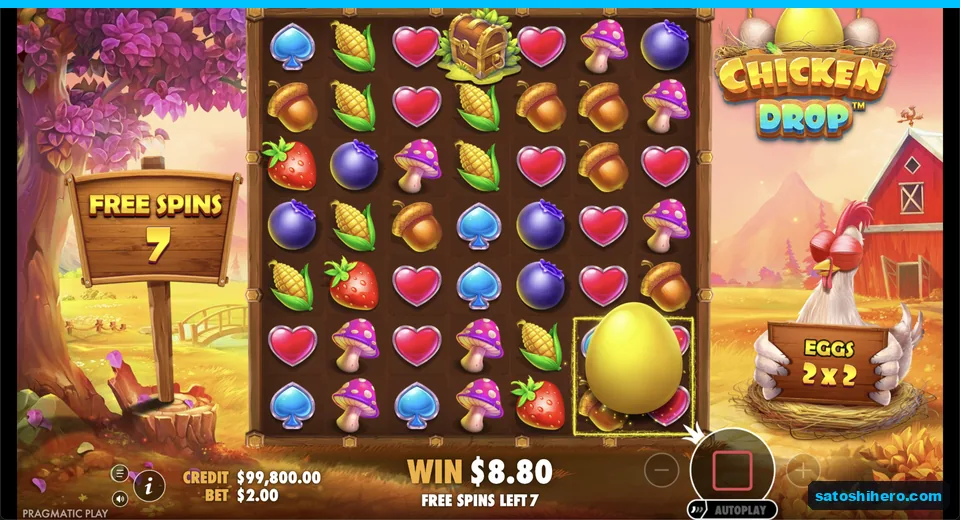
I paid close attention to the moments after each tumble, because that is where the egg arrives and either rescues the spin or lands flat. You can feel the bonus building when upgrades stack early. If they arrive late, the round can still finish ordinary.
My organic free spins round paid $286.90 at a $2 stake. That was about 143x and became the biggest win in my 500-spin test. The hit pulled my balance near even, but it didn’t erase the very-high volatility once the grind returned.
Chicken Drop slot bonus buy test
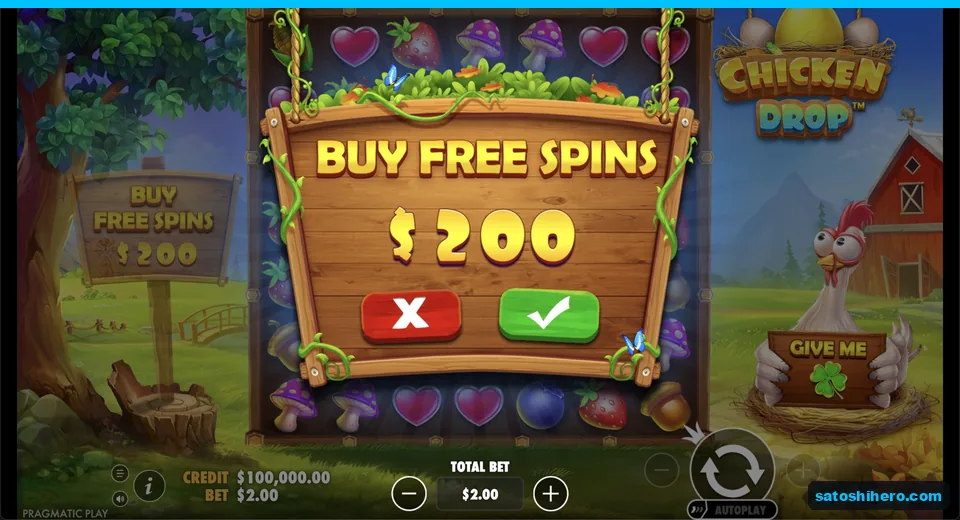
The Chicken Drop slot bonus buy is fast and convenient, but my test showed it can lose hard. The Buy Free Spins button sits on the left rail and sends you straight into the round for 100x the bet. This is an in-game feature purchase, not a casino bonus or promotional offer, so wagering requirements and bonus T&Cs don’t apply to that test.
Buy price
At my $2 stake, the buy cost $200. It can award 4, 5 or 6 chests at random, so the starting free-spin count can vary. The buy RTP is 96.53%, only a touch above the 96.5% base game.
That tiny RTP difference doesn’t protect one bonus. I wouldn’t treat the buy as a smarter route, just a faster one. You skip the base-game build-up, but you also compress the pain into one expensive click.

Caution: A 96.53% buy RTP doesn’t protect a single bonus. The tested $200 buy returned only $31, which is a brutal miss.
Test result
My clean-balance buy returned $31 from $200. That result felt poor because the round had the structure I wanted, yet the eggs never built into a strong enough paying block.
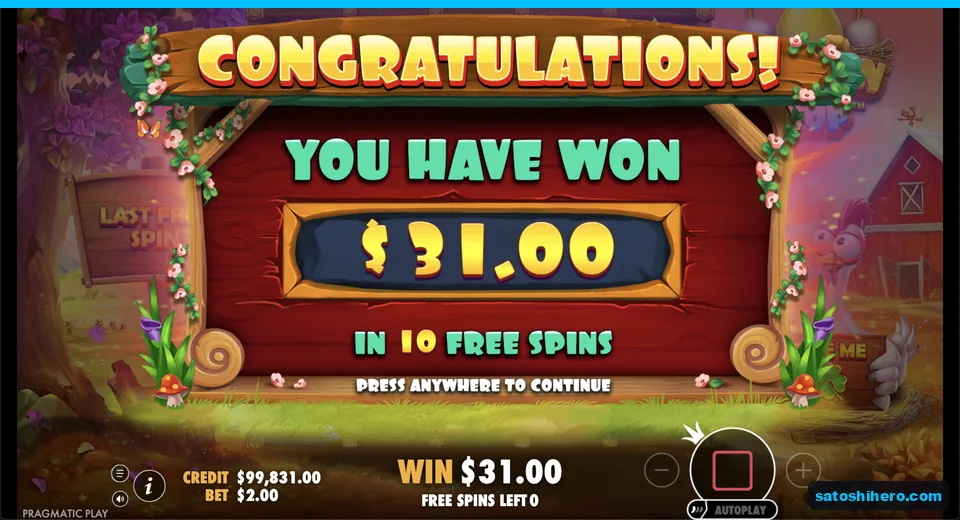
Base-game play gives you more spin volume and more chances to see the egg system wake up. Bonus-buy fans get speed and intensity, but they also need to accept dead rounds without chasing. I prefer the base route here unless your bankroll can absorb sharp hits.
You should also remember that the buy can start with different chest counts. I felt that extra uncertainty made the $200 price tougher to swallow after the weak return.
RTP, volatility & our test
Chicken Drop slot has 96.5% RTP, very-high volatility and a 5,000x max win, so session swings can get wide. The 5,000x cap matters because the game still plays aggressively, and a round ends once a feature reaches that ceiling.
The cap feels a little modest for this level of risk. I don’t mind tough volatility when the ceiling is huge, but here the game asks for patience while holding the top prize at 5,000x. You can still spike, yet the test showed plenty of small tumbles and balance bleed.
Simulator projection
The SatoshiHero Slot Simulator ran 1,000 spins at the $2 stake using the published 96.5% RTP, very-high volatility and 5,000x cap. The median session landed about $268 down, with a p5 to p95 band from roughly $915 down to $1,361 up.
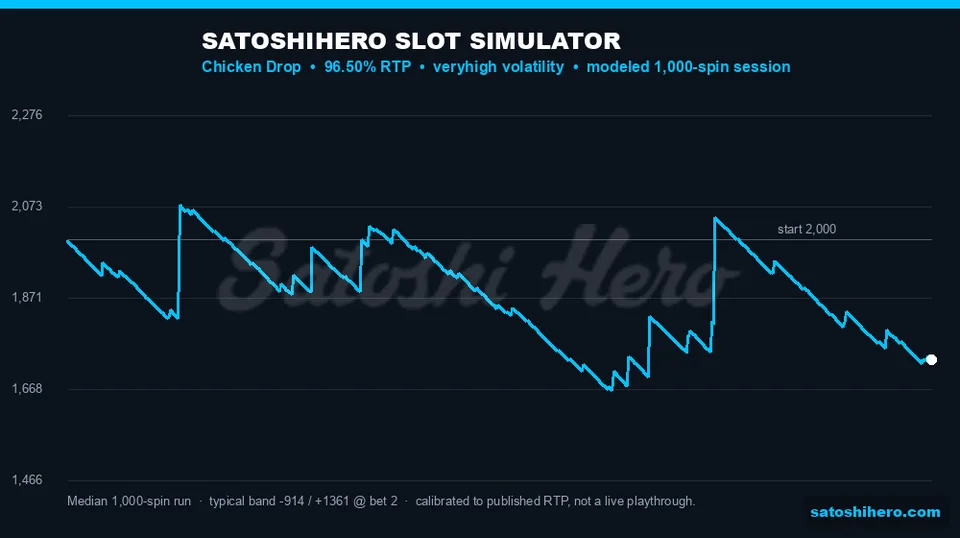
The model also showed a feature about once in 55 spins. A 100x or larger win appeared about once in 796 spins. That spread explains why you can feel busy on the board while the bankroll still drifts south.
I use the simulator as a variance map, not a prediction. It can’t tell you your next result, and it doesn’t soften a bad short sample. The numbers help set expectations before you press spin or buy the bonus.
What stood out to me was the gap between the median loss and the upper band. That spread tells you why one player can feel punished while another sees a sharp rebound in the same spin count. The game doesn’t need many big wins to change a session, but waiting for them can feel slow.
Our 500-spin session
My live run started on a fresh $100,000 demo balance and used 500 spins at $2 on Turbo. The balance bled slowly on small tumbles, then slid to around $99,660 by the middle of the run.
One organic free spins round changed the mood. It built its egg multiplier as it went and paid $286.90, my best hit at about 143x the stake. That pulled the balance near even, but the recovery didn’t last.
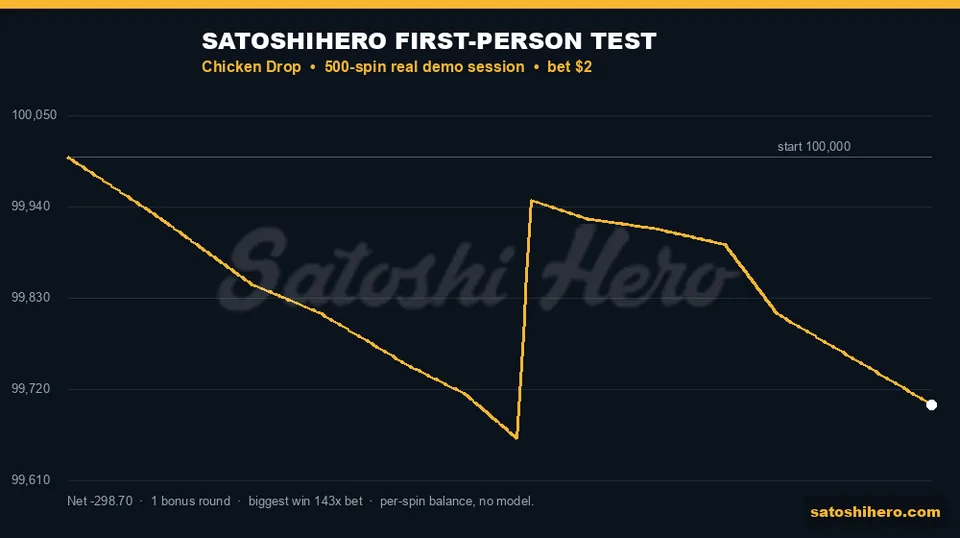
The grind resumed after the bonus, and I finished at $99,701.30. That left me about $299 down from the starting point. I also ran the separate $200 bonus buy, and that returned $31.
Very-high volatility can turn a mathematically fair-looking session into a sharp short-sample loss. You need room for dry stretches before the egg system matters.
Theoretical RTP is the operator-published return figure, and one 500-spin session doesn’t change or prove it. Bonus-buy RTP can differ slightly from base-game RTP by design, while the simulator and my live test show variance rather than your next result.
Bankroll fit and play style
Chicken Drop fits patient cluster fans who like tumbling wins and risky egg-driven bonus swings. It doesn’t fit anyone chasing steady medium wins, calm bankroll movement or a buy that smooths results.
At $2 per spin, my 500-spin test put $1,000 of total spin volume through the game. It still finished about $299 down despite one strong organic bonus. If you want a longer session, lowering the stake makes more sense than hoping the next egg saves you.
Wild Hop & Drop is worth comparing if you like drop-style momentum but want a different volatility feel. This slot felt more patient than exciting during long base-game spells, yet the egg feature gave it enough character to avoid feeling generic.
The strongest hit in my 500-spin test came from organic free spins, not the paid buy. That result shaped my preference for playing the base game first.
You should also think about the 5,000x ceiling before raising your stake. I feel the cap is fine for casual play, but ambitious max-win hunters may want more upside for this much variance. The game rewards patience, not panic.
Frequently Asked Questions About Chicken Drop
How do wins work in Chicken Drop slot?
Chicken Drop slot uses a 7×7 cluster grid with no lines to follow. You need at least 5 matching symbols connected horizontally or vertically, and every winning cluster tumbles away. That means one spin can chain several wins before it stops.
What do the eggs, watering can and clover do in Chicken Drop slot?
The golden watering can grows the next egg from 2×2 up to 6×6. The green clover raises the next egg multiplier from 2x up to 11x. When tumbles end, the egg cracks into one random paying symbol block at the built size and multiplier.
How are Chicken Drop free spins triggered?
You trigger free spins with 4, 5 or 6 treasure chests, which give 10, 15 or 20 spins. Every bonus spin guarantees an egg drop, and size plus multiplier upgrades stay locked for the round. Three or more chests can retrigger 5 extra spins with no cap.
Can you buy the Chicken Drop slot bonus, and is it worth it?
Yes, the Buy Free Spins button starts the round for 100x the bet. At $2, that means a $200 buy. The buy RTP is 96.53%, but my test returned $31 from $200, so I see it as high variance rather than a shortcut. This is an in-game feature purchase, not a casino bonus or promotional offer, so wagering requirements and bonus T&Cs don’t apply.
What did the SatoshiHero simulator show for Chicken Drop slot?
The simulator modelled 1,000 spins at $2. It showed a median near $268 down, a p5 to p95 band from about $915 down to $1,361 up, a feature about once in 55 spins and a 100x-plus win about once in 796 spins. It maps variance, not a single-session forecast.
What happened in your real 500-spin Chicken Drop test?
I started with a $100,000 demo balance and played 500 spins at $2. The run drifted down on small tumbles before one organic free spins round paid $286.90, about 143x. I finished at $99,701.30, roughly $299 down, and the separate $200 buy returned only $31.
What are the Chicken Drop slot RTP and maximum win?
Chicken Drop slot has 96.5% base RTP and 96.53% buy RTP. Volatility is very-high, and the maximum win is 5,000x the bet. A round ends when a feature reaches that cap.
What is Chicken Drop slot?
Chicken Drop slot is a Pragmatic Play 7×7 cluster-pays slot with a farmyard theme. It combines tumbling wins, egg drops, size upgrades, multipliers and free spins. I see it as a high-risk slot for feature chasers rather than steady-win grinders.
Final Thoughts
Chicken Drop stands out because the egg system gives a familiar farmyard slot a sharper identity. Its main drawback is the mismatch between very-high volatility and a 5,000x cap, which may feel tight if you chase giant ceilings.

My Verdict
Patient cluster fans should start with base-game spins and treat the buy with care. Expect stretches of small tumbles, then sudden egg-led spikes that may or may not repair the session. I like the feature design, but I wouldn’t raise stakes quickly here.
I like how the organic bonus built pressure during my 500-spin run. I don’t like how the $200 buy returned only $31, because that result shows how quickly convenience can turn ugly. The game feels honest about its risk once you play enough spins.
This Chicken Drop slot guide is updated periodically as our testing notes and SatoshiHero slot QA checks evolve. The core advice stays simple: respect the volatility, watch the egg upgrades, and don’t treat the buy as protection.

Pros:
 Clear cluster system: Connected wins are easy to read across the 7×7 grid.
- Strong egg identity: Size and multiplier upgrades give every feature real personality.
- Useful test data: The 500-spin session shows the risk in plain dollars.
- Flexible stakes: The $0.20 to $100 range supports cautious or bold play.

Cons:
 Harsh variance: Quiet spells can drain balance before one useful bonus appears.
- Modest ceiling: The 5,000x cap feels tight for very-high volatility.
- Punishing buy: My $200 buy returned $31, so speed carried real cost.

Best For: Patient cluster fans, tumble lovers and bonus hunters get the strongest match here. You need a calm bankroll style, because the best egg moments can sit behind long dry patches. If you want steady medium wins, this farmyard can feel rough fast.

































































Bets
All Bets
Game
Player
Date
Wager
Mult.Multiplier
Prize
 Halloween Harvest: Rapid Link
 Hidden
- 00:17:12
- 0×
- 3 Witches: Bonus Combo
 bjgrandy149
- 00:17:12
- 0.5×
- Luck of Panda: Bonus Combo
 Hidden
- 00:17:12
- 0×
- Halloween Harvest: Rapid Link
- Hidden
- 00:17:11
- 0×
- Halloween Harvest: Rapid Link
- Hidden
- 00:17:11
- 0.49×
- 3 Witches: Bonus Combo
- bjgrandy149
- 00:17:09
- 0×
- Big Banker Bonanza
- josh1998
- 00:17:09
- 0×
- Halloween Harvest: Rapid Link
- Hidden
- 00:17:08
- 0×
- 4 Lucky Nuggets
 whodey39311
- 00:17:07
- 1.66×
- 4 Lucky Nuggets
- whodey39311
- 00:17:06
- 0×