

Lord of the Keys
By pressing play, you agree that you are above legal age in your jurisdiction and that your jurisdiction allows online gambling.


Unlocking Egypt’s Expanding Treasure Chambers
Lord of the Keys slot turns a compact Egyptian reel set into expanding Respins and four-grid Free Spins.
According to Platipus, Lord of the Keys is a medium-volatility slot with a 95.1% RTP and 2,718x maximum win. It uses a 3×3 grid with 27 fixed ways, while its main features expand play across larger or additional grids. Coin-feature fans get moderate risk and clear mechanics, but the RTP remains a noticeable drawback.
Key takeaways
- Best bonus: Respins triggered twice and delivered my 55x top win; I received no bonus-buy option to test.
- RTP / volatility: The official profile combines a 95.1% theoretical return with medium volatility.
- Max win: The game-wide maximum win is exactly 2,718x the bet.
- Risk note: The modeled median lost 54 stakes, while my test finished ahead after one strong feature hit.
- Bankroll note: My 13-spin longest line-win drought makes autoplay loss limits useful during extended play.
Official specifications, modeled projections and my firsthand results describe different evidence. You should keep those categories separate when judging the game.

Table of Contents
- Lord of the Keys slot theme and first impressions
- How Lord of the Keys slot works
- Reading the 27 ways
- Starting each feature
- Symbols and base payouts
- High-value symbols
- Gem symbols
- Special symbols and feature triggers
- Wild and Scatter
- Coins and Keys
- Respins and expanding grids
- Grid growth thresholds
- My two triggers
- Jackpots and the maximum win
- Four jackpot levels
- Reaching the ceiling
- Free Spins across four grids
- Unlocking additional grids
- Building reel three
- RTP, volatility and test results
- Simulator projection
- My 100-spin session
- Frequently Asked Questions About Lord of the Keys
- Bottom Line
Lord of the Keys slot theme and first impressions
Golden pillars, torches and cat statues frame a compact Egyptian temple. A small stone frame holds the 3×3 arrangement, while four jackpot plaques pull your attention left. I think this restrained layout beats a crowded design.
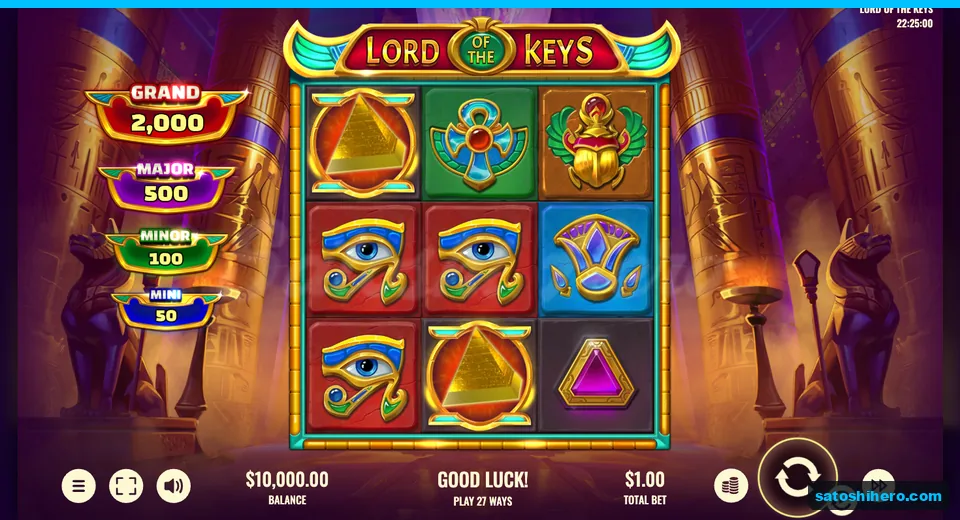
You’ll first notice how little space the base reels occupy. That size makes every symbol easy to read, especially during quick autoplay spins. The plaques also signal the coin feature’s importance without explaining its rules. No sugarcoating, the theme won’t win originality awards, and its artwork doesn’t change the mathematics.
Lord of the Sun offers brighter Egyptian imagery, while this game favors a cleaner, more functional temple setting.

Data Point: The base game starts on a 3×3 grid, while the Respins grid can grow as large as 9×9.
The modest presentation hides the real visual trick. Respins enlarge the frame, while Free Spins spread play across four panels. I like that clear, functional contrast.
How Lord of the Keys slot works
Lord of the Keys slot pays on 27 fixed ways across three reels and three rows, not 27 paylines. Matching symbols must land on adjacent reels, and each qualifying route starts on the leftmost reel. The slot adds awards from separate successful ways into one result. You can read each route independently before checking the combined payout.
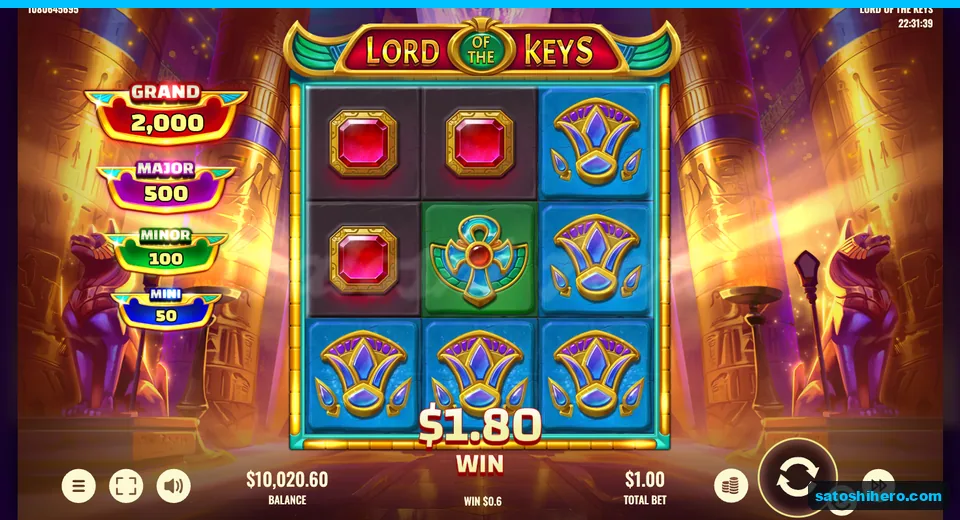
Listed three-symbol awards use tenths of the total bet. At my $1 stake, three ankhs paid $0.70, while one route of three lotus symbols paid $0.60. My captured result on spin 75 returned $1.80 after the game combined its winning ways. I find this system simple once you stop looking for drawn lines.
Reading the 27 ways
Repeated symbols can create several routes through the same three reels. Suppose one matching symbol lands on reel one, two land on reel two and two land on reel three. Those positions can form several left-to-right combinations, and the slot totals every valid route. You should focus on matching reel groups, not fixed line shapes.
Ways of the Gauls provides broader ways-based presentation, while this game favors compact clarity over spectacle.
Starting each feature
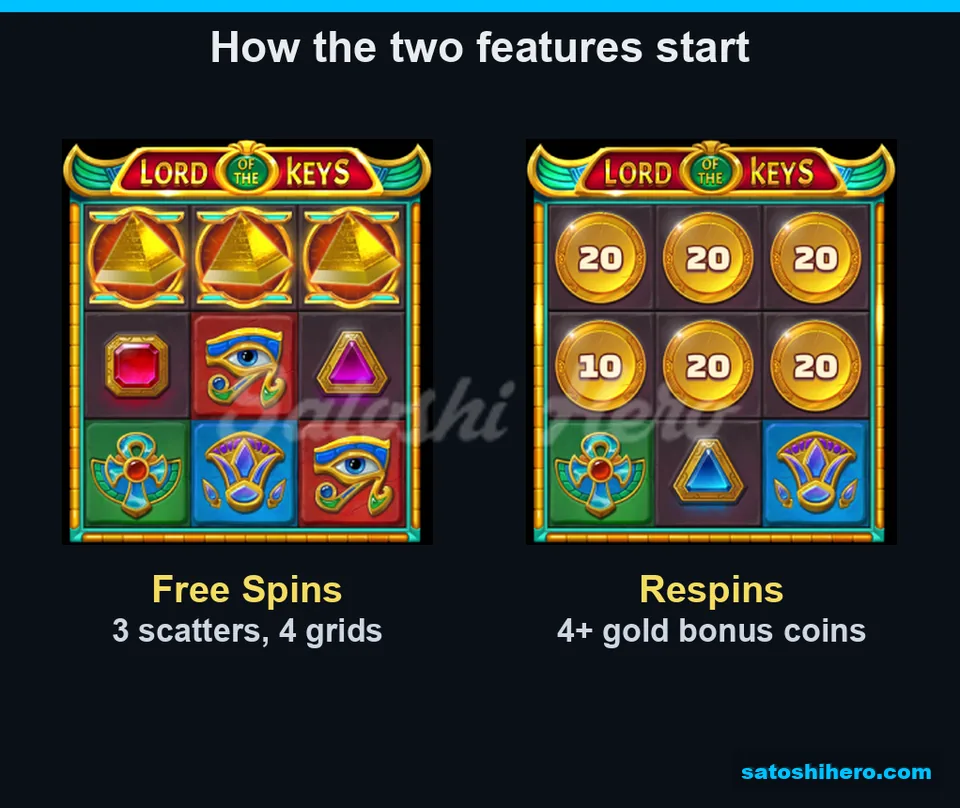
Three golden pyramid Scatters anywhere activate 12 Free Spins. Four or more Gold Bonus coins in one spin start the Respins. These triggers don’t overlap with ordinary symbol routes, so you can identify them quickly. Understanding that split makes each feature sequence easier to follow.
Autoplay lets you choose a play count, single-win limit and loss limit. The starting limits sat below the thresholds I needed, so I raised them before my 100-spin test. You should inspect all three settings before pressing start, especially when using a larger session budget. The controls work well, but the low defaults caught me off guard.

Suggestion: Check the autoplay single-win and loss limits before a longer session because the starting limits could be lower than you intend.
The SatoshiHero demo opened with a $10,000 balance and $1 stake. You can try the demo or play for real there, and Free Spins keep the triggering stake. Fixed ways explain base wins, while special symbols open the larger mechanics.
Symbols and base payouts
Regular awards stay modest, with the scarab paying the highest three-symbol value at 1x the bet. Several ways can combine, so one value doesn’t cap the spin. You should read the paytable as route values. I found it clear but rarely powerful.
High-value symbols
- Scarab: 1x the bet for three, equal to $1 at my test stake.
- Eye of Horus: 0.7x the bet for three, equal to $0.70.
- Ankh: 0.7x the bet for three, matching my logged $0.70 hit.
- Lotus: 0.6x the bet for three, matching my logged $0.60 route.
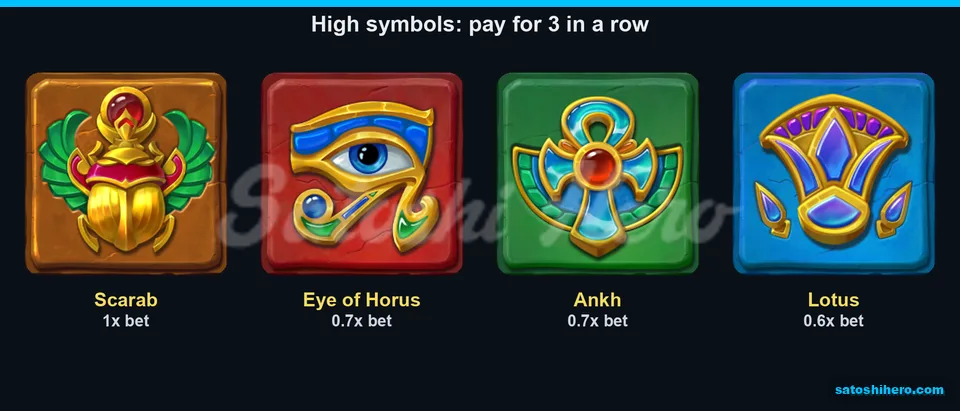
Even the scarab returns only the stake on one route, so stronger results need overlapping ways. My leading $8.40 base spin showed how combinations can exceed one listed award.
Gem symbols
- Red gem: 0.2x the bet for three.
- Green gem: 0.2x the bet for three.
- Purple triangle: 0.1x the bet for three.
- Blue triangle: 0.1x the bet for three.
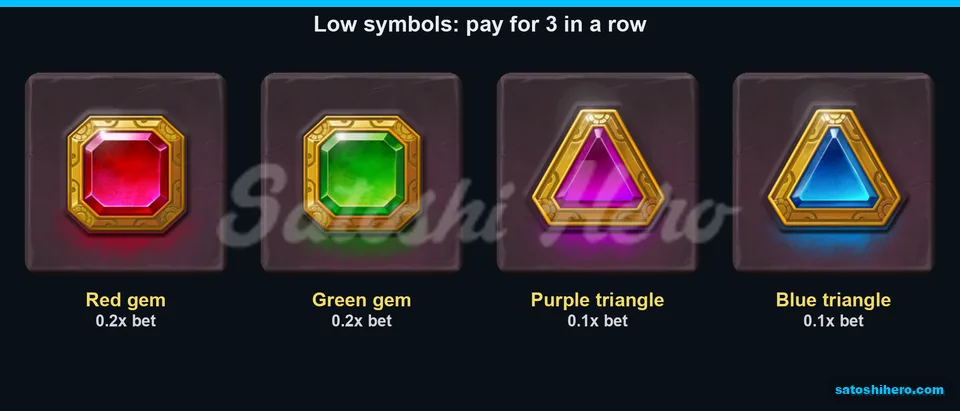
At a $1 stake, one low-tier route produces $0.10 or $0.20. You can combine several routes, but these symbols mainly soften a spin’s cost. In my view, features create the memorable moments.
Wizard of the Wild offers richer magical character symbols, while this paytable stays plain and reserves its larger potential for features.
Special symbols and feature triggers
The Wild builds combinations, while Scatters, Bonus coins and Keys control features. Each symbol has a narrow job. You should distinguish substitution from progression, and I like that clean separation.
Wild and Scatter
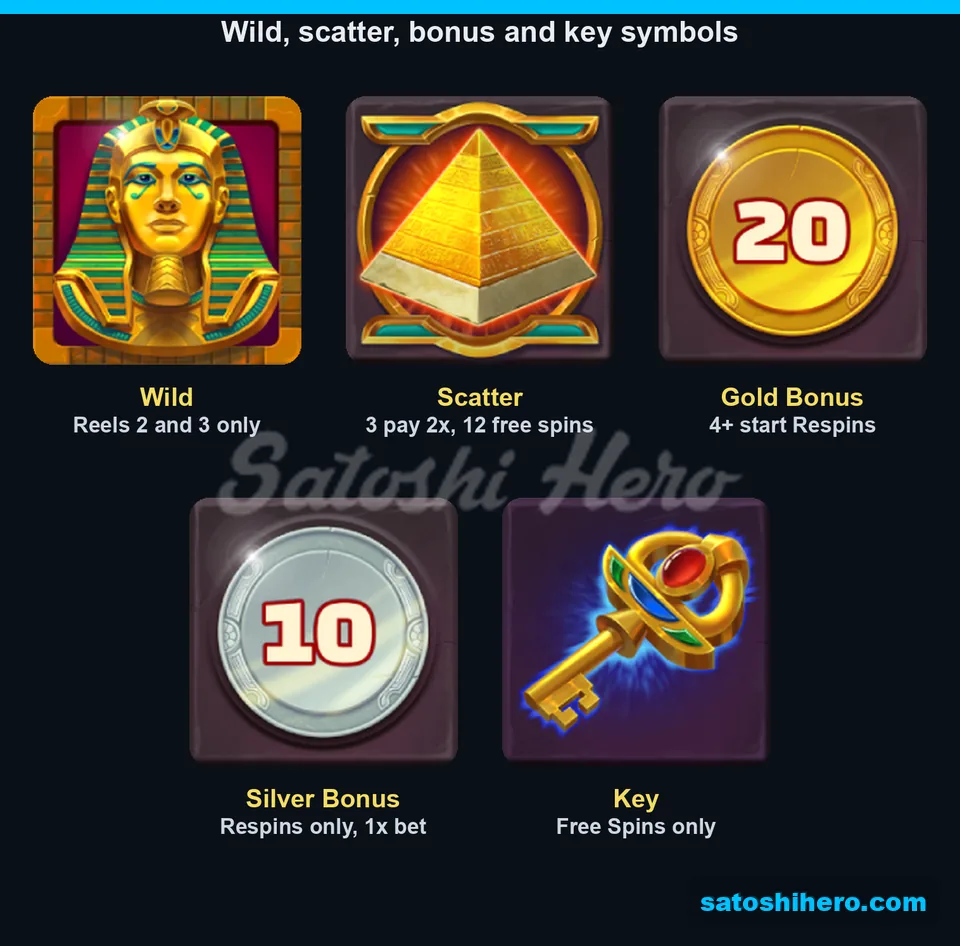
The golden pharaoh Wild appears only on reels two and three. It replaces regular symbols but can’t replace the Scatter, Bonus coins or Key. Its reel restriction matters because every paying route starts on reel one. You still need a natural matching symbol in the first position before the Wild can finish a combination.
Golden pyramid Scatters can appear anywhere. Three Scatters pay 2x the bet and activate 12 Free Spins. You should count Scatters separately from fixed-way matches because they don’t follow the same left-to-right rule. I found the distinction clear on the small grid, although the trigger never appeared in my counted test.
Coins and Keys
Gold Bonus coins can land anywhere with values of 1x, 2x, 3x, 4x, 5x, 10x, 15x or 20x the bet. Silver Bonus coins appear only during Respins and carry a 1x value. Those coins are mechanic symbols, not currency labels. Their held values combine when the feature ends.
Keys appear only during Free Spins. They unlock extra grids and improve the reel-three setup instead of paying as ordinary cash symbols. You’ll see their effect through reduced counters and added Wilds, not an immediate listed award. That delayed role makes sense, but it demands more attention than the simple coin collection.

Fun Fact: The Key acts as an Egyptian-themed progression symbol, opening additional Free Spins grids instead of awarding an ordinary base-game payout.
Gold coins open Respins, Scatters open Free Spins and Keys advance that bonus. You won’t confuse the mechanics once each symbol has one purpose. I consider that division a strong design choice.
Respins and expanding grids
Respins activated twice during my counted session, paying 55x first and 12x afterward. The opening result supplied my biggest win and changed the entire session. Four or more Gold Bonus coins start the feature with three Respins. You immediately see why this mechanic carries more weight than the base paytable.
Triggering coins stay locked with their displayed values, while every empty position spins independently. Each new Gold or Silver coin locks and resets the counter to three. The feature ends when the counter reaches zero or every active position fills. All held values combine into one payment, and a full grid awards the Grand Jackpot.
Grid growth thresholds
- One Silver coin: The grid expands to 5×5.
- Five Silver coins in total: The grid expands to 7×7.
- Ten Silver coins in total: The grid expands to 9×9.
Counter resets can extend the round without guaranteeing another expansion. A new Gold coin buys more attempts, yet only Silver totals open larger grids. You should watch the Silver tally and remaining-respin counter as separate measures. I think this dual progression adds tension without making the sequence hard to follow.
A larger board creates more positions and more room for new coins. Bigger doesn’t mean easier, so you shouldn’t treat expansion as a major-payout promise.
My two triggers
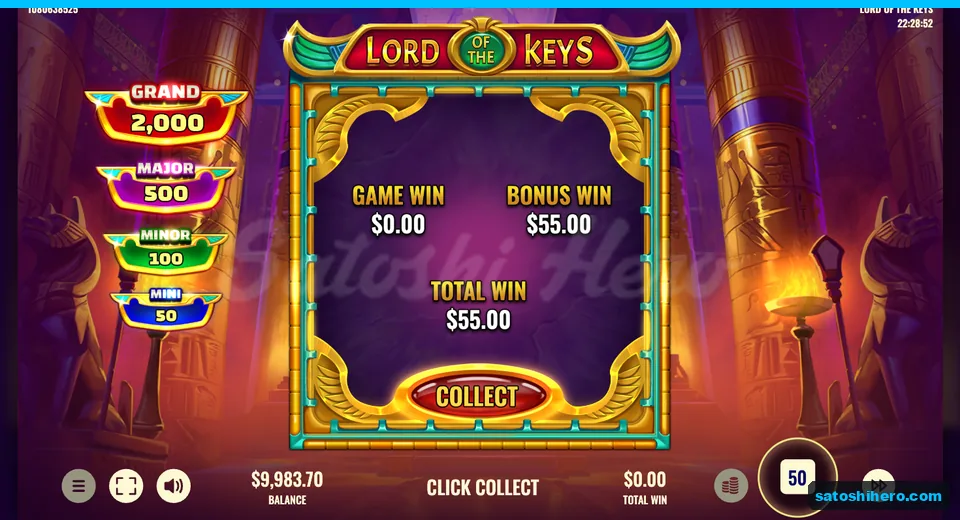
My first trigger arrived on spin 25 after the balance fell to $9,984.70. The grid reached 5×5, and I counted 20 collected prizes before the round ended. Its $55 payment lifted my balance to $10,038.70. That recovery felt substantial because the base wins had offered nothing close.
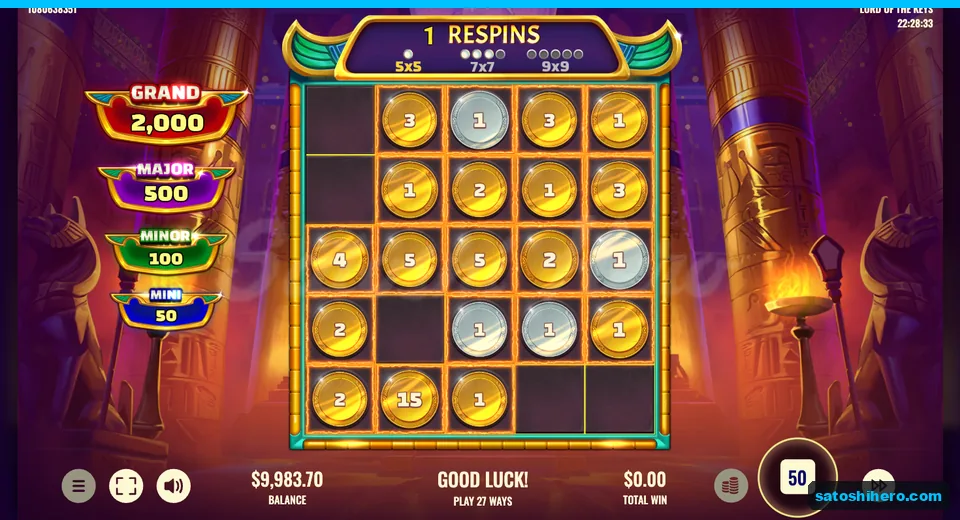
The second trigger landed on spin 79 and returned $12. Neither outcome defines a typical result, even within the same session. I liked the first round because its locked coins and expanding board built visible momentum. The smaller second payment exposed the mechanic’s variability just as clearly.

Watch Out: A new coin resets the counter, but that reset doesn’t promise continued grid growth or a large payment.
You should budget around uncertain feature value. My two outcomes differed by $43 under identical rules, proving that every trigger carries different value.
Jackpots and the maximum win
The jackpot plaques show stake-based feature prizes, while the game-wide ceiling covers the whole slot. You shouldn’t substitute one for another. I think the interface could explain that distinction better.
Four jackpot levels
At my $1 stake, the plaques displayed these amounts:
- Mini: $50
- Minor: $100
- Major: $500
- Grand: $2,000
A Gold Bonus coin can carry a jackpot label instead of its normal cash value. These plaque amounts belong to my $1 stake context. You should check the stake before reading displayed prizes.
Reaching the ceiling
Filling every active position during Respins awards the Grand Jackpot. That full-grid condition remains separate from the overall 2,718x ceiling. You can win a displayed jackpot within the coin feature without redefining the broader cap. No sugarcoating, the ceiling feels respectable for this risk level but restrained beside feature-heavy slots with enormous limits.
The Grand plaque showed $2,000 at my stake, while the overall cap limits total game potential. You should assess each separately.
I never filled the board or collected a jackpot label. Displayed prizes aren’t observed wins, and the plaques aren’t interchangeable with the game-wide ceiling.
Free Spins across four grids
Three Scatters anywhere award 12 Free Spins at the triggering stake. The feature uses four separate 3×3 grids, each evaluated through 27 fixed ways. Two grids start active, while two remain locked behind Key counters. You get more active routes as the round develops.
Every Key on an active grid reduces the counters attached to locked grids. Once a counter reaches zero, that grid stays open for the rest of the feature. Each new opening also adds extra Wilds to reel three across all active grids. I find this progression more ambitious than the Respins, though I didn’t trigger it live.
Unlocking additional grids
Opening another grid adds both winning routes and reel-three Wild support. That combination matters because more grids create extra evaluations, while Wilds help complete left-to-right matches. You should track both locked counters rather than watching only one panel. The mechanic rewards Key collection through lasting upgrades instead of one-off cash awards.
Each board retains the familiar 3×3 shape, keeping four panels understandable. The feature can’t retrigger. I’d prefer that option, but the upgrades already add several progression layers.
Building reel three
After all four grids open, further Keys feed a collection target. Completing it turns reel three fully Wild across every active grid. You’ll still need matching starts on reels one and two.
Free Spins never activated during my 100 counted spins. This description comes from the rules, and I captured no live frame from the feature. You shouldn’t read it as a claimed firsthand result. That evidence limit makes Respins the only bonus I can judge from actual play.
The four-grid design looks more elaborate, but an untriggered feature can’t earn the same confidence as tested play. I only proved how the Respins behaved.
RTP, volatility and test results
The mathematical profile allows sharp short-session movement despite its medium classification. My balance fell to $9,984.70 before the strongest hit, and the longest line-win drought lasted 13 spins. You shouldn’t expect smooth returns. I found the swings manageable, but one feature controlled the outcome.
The maximum-win input bounds the model without predicting any spin. Its purpose is context, not a promise, and short runs can finish outside the median.
Simulator projection
The SatoshiHero Slot Simulator modeled 1,000 spins at a $1 stake. Its median session finished $54 down, while the middle 90% ranged from $222.40 down to $147.90 up. About 25% of spins returned something. You can use that spread to understand risk, not forecast your next balance.
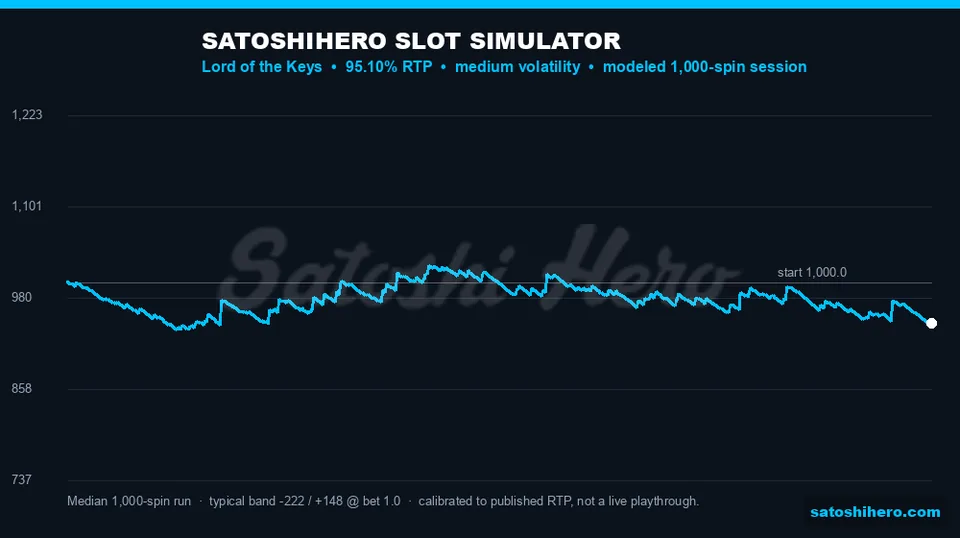
A feature-sized hit appeared roughly once per 50 modeled spins. A 100x-or-better result appeared about once per 14,706 spins. Those frequencies summarize many modeled outcomes and don’t create a countdown. In my opinion, the rare 100x projection makes the restrained maximum feel less important during ordinary sessions.
The central 90% spans a $370.30 gap, so the classification doesn’t mean predictable play. Your result can depend heavily on feature timing.
My 100-spin session
I started with $10,000 and played 100 autoplay spins at $1 each. Total wagering reached $100, while returns reached $112.70. My ending balance was $10,012.70, leaving a $12.70 profit. You should view that finish as one path through the modeled range.
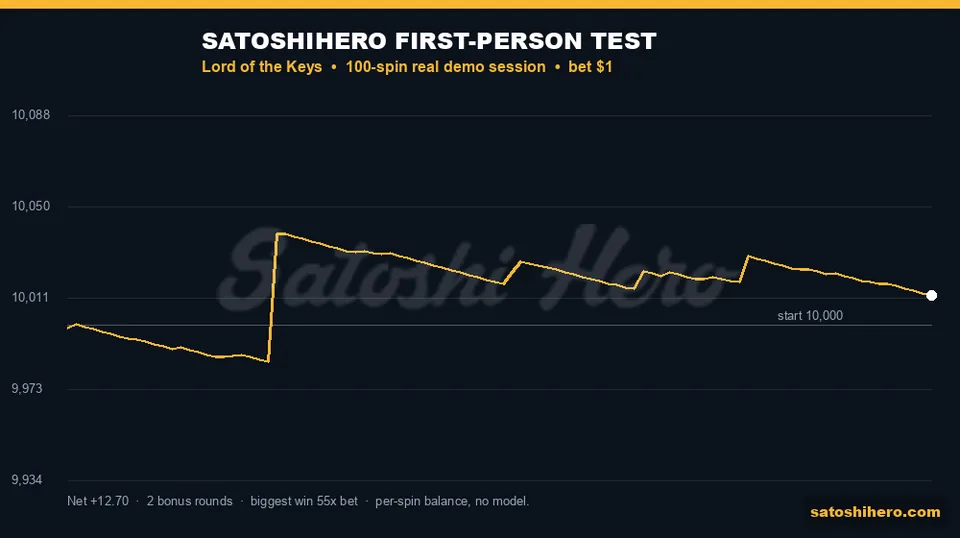
I logged 27 line-winning spins and a 13-spin longest drought. Respins triggered on spins 25 and 79, while Free Spins never appeared. The first feature paid $55, and the second returned $12. My leading base results were $8.40 on spin 67, $6 on spin 52 and $5.60 on spin 53.
One 55x result drove most of the profit. You shouldn’t treat my finish as an expected outcome. I value the test because it exposes dependence on feature timing.
Platipus’s theoretical return figure describes the game mathematics, while one live session doesn’t alter that design. The simulator and my balance graph serve different purposes, and bonus modes can use slightly different returns by design. The model supplies wider risk context, while my session shows one genuine route through that range.
You should separate base routes, feature triggers and test evidence. I think that distinction matters more than one headline number.
Frequently Asked Questions About Lord of the Keys
How does Lord of the Keys slot pay?
Lord of the Keys slot pays on 27 fixed ways across a 3×3 grid. Matching symbols must land on adjacent reels from the leftmost reel, and separate winning ways combine. Three-symbol values range from 0.1x for blue and purple triangles to 1x for the scarab.
How do Respins work in Lord of the Keys slot?
Four or more Gold Bonus coins start three Respins. Coins remain held, while every new Gold or Silver coin resets the counter to three. Silver totals expand the grid at one, five and ten coins, and filling the active grid awards the Grand Jackpot.
What happens during Free Spins in Lord of the Keys slot?
Three Scatters award 12 Free Spins at the triggering stake. Four 3×3 grids form the feature, with Keys unlocking panels and adding reel-three Wilds. It can’t retrigger, and it didn’t activate during my counted session.
What does the Wild do in Lord of the Keys slot?
The golden pharaoh Wild appears only on reels two and three. It replaces regular symbols but can’t replace Scatters, Bonus coins or Keys. You still need a matching regular symbol on reel one to begin the route.
What are the RTP, volatility and maximum win?
Lord of the Keys slot has a 95.1% RTP, medium volatility and a maximum win of exactly 2,718x the bet. These specifications don’t guarantee a particular result in your session.
What did the Lord of the Keys slot simulator show?
The modeled 1,000-spin session produced a $54 median loss. Its middle 90% ran from $222.40 down to $147.90 up, with an approximate 25% return frequency. A modeled 100x result appeared once per 14,706 spins, but that output doesn’t predict your next session.
How did the Lord of the Keys slot 100-spin test finish?
My $1-per-spin test ended with a $12.70 profit after $100 in total wagers. Respins triggered twice, and the first feature produced my largest win at $55, equal to 55x the stake.
Which regular symbol pays the most in Lord of the Keys slot?
The scarab pays the most at 1x the bet for three. The Eye of Horus and ankh pay 0.7x each, while the lotus pays 0.6x. Several winning ways can combine into a larger spin total.
What do the jackpot plaques show?
At my tested $1 stake, the plaques showed Mini $50, Minor $100, Major $500 and Grand $2,000. Gold coins can carry jackpot labels, and filling every active Respins position awards the Grand.
Bottom Line
Lord of the Keys stands out by turning a tiny base grid into two ambitious expansion features. Its clear fixed-way rules and strong Respins sequence impressed me, but the low return figure and modest base awards cut into the appeal. You’ll need patience when features stay away.

My Verdict
Coin-collection fans and measured bankroll managers should consider it for the expanding Respins, not steady base-game wins. Expect simple spins between occasional feature swings, and don’t treat my profitable test as a baseline.
I liked how the first Respins round grew to 5×5 and paid $55 after my balance reached its low point. I didn’t like that the second trigger managed only $12, while Free Spins never gave me live evidence. That contrast made the session exciting but heavily dependent on one result.
The Lord of the Keys slot guide is checked regularly so its mechanics and testing context stay useful.

Pros:
 Expanding Respins: Silver coins can grow the board from 3×3 to 9×9.
- Clear mechanics: Distinct symbols keep fixed-way wins and feature progress easy to follow.
- Visible session impact: My first Respins round recovered the early balance decline.
- Layered Free Spins: Keys can add grids and improve reel-three Wild coverage.

Cons:
 Weak base values: Regular symbols need combined ways to produce meaningful returns.
- Feature dependence: One 55x Respins result drove most of my profitable finish.
- Untested Free Spins: The bonus never triggered during my counted session.

Best For: Egyptian-theme fans who enjoy coin collection, persistent upgrades and moderate session swings get the clearest value here. You should accept modest base awards and manage autoplay limits while waiting for feature activity.





























































Bets
All Bets
Game
Player
Date
Wager
Mult.Multiplier
Prize
 Luck of Panda: Bonus Combo
 mdp0fxo
- 15:46:33
- 0×
- Luck of Panda: Bonus Combo
 Hidden
- 15:46:31
- 0×
- Galaxy Glitter
- maya_81
- 15:46:30
- 0×
- Galaxy Glitter
 novaone948
- 15:46:30
- 0×
- Luck of Panda: Bonus Combo
- mdp0fxo
- 15:46:30
- 0×
- Galaxy Glitter
 Hidden
- 15:46:28
- 0×
- Luck of Panda: Bonus Combo
- mdp0fxo
- 15:46:27
- 0×
- The Fortune Eye: Hold & Win
 staten1971
- 15:46:26
- 0×
- Elephant's Gold: Bonus Combo
- nina87
- 15:46:25
- 0×
- Grand Koala: Hold ‘N’ Link
- mike_721
- 15:46:25
- 0×