

Techno Tumble
By pressing play, you agree that you are above legal age in your jurisdiction and that your jurisdiction allows online gambling.


Neon Balls, Physics Drops and Sharp Swings
Techno Tumble drops glossy balls into a pinball chamber instead of spinning reels, and Habanero Systems makes every win wait for physics. Techno Tumble is a very-high volatility slot from Habanero Systems with 98.05% RTP and 1,593x max win potential.
Key takeaways
It lists 25 lines, but the tested win mechanic pays touching groups after the balls settle. The demo on SatoshiHero started at $2,000 with a $12.50 default stake, and my 100 spins ended 50.6x down despite one free-games hit. That matters because the screen can look busy even when the balance barely moves, so the useful read comes from settled clusters, multiplier steps and the final payout card rather than motion alone.
- Best play: No bonus buy or ante bet appeared in the demo, so you rely on regular spins and Scatter-triggered free games.
- RTP / volatility: The slot carries 98.05% RTP with very-high volatility, so the number looks generous while the ride stays rough.
- Max win: The top prize sits at 1,593x the bet, which feels modest beside the swing level.
- Risk note: My 100-spin test ended 50.6x down, even after one free-games trigger paid about 6.2x.
- Bankroll note: Smaller stakes give you more time, since our simulator showed about 14% paying spins.

Table of Contents
- First look at the neon playfield
- Visual style
- Sound and pace
- Tumble Games and the multiplier
- Settled-ball wins
- Multiplier resets
- How Techno Tumble Works
- Paying balls
- Wilds and Scatters
- Badge payouts
- Badge symbols
- Doubling extras
- Free Games
- Trigger rules
- Test result
- Progressive Jackpot
- Random jackpot
- Demo meters
- RTP, volatility and our test
- Simulator projection
- Our 100-spin session
- How the session actually played
- Session rhythm
- Bankroll feel
- Frequently Asked Questions About Techno Tumble
- Final Take
First look at the neon playfield
The playfield is a neon pinball chamber, not a reel grid. You watch colored balls drop, bounce, stack and settle around a central launcher before the game checks the result. That gives Techno Tumble more toy-box energy than most abstract neon slots, even if the theme itself won’t win originality awards. The useful visual cue is the final pile, because the most dramatic bounce can still become nothing if the colors finish separated.
Visual style
Glossy blue, orange and magenta balls fill a dark cyberpunk chamber. A multiplier panel sits in the top right, while a jackpot meter glows in the top left. You can read the main action quickly because the launcher, ball groups and multiplier stay central.
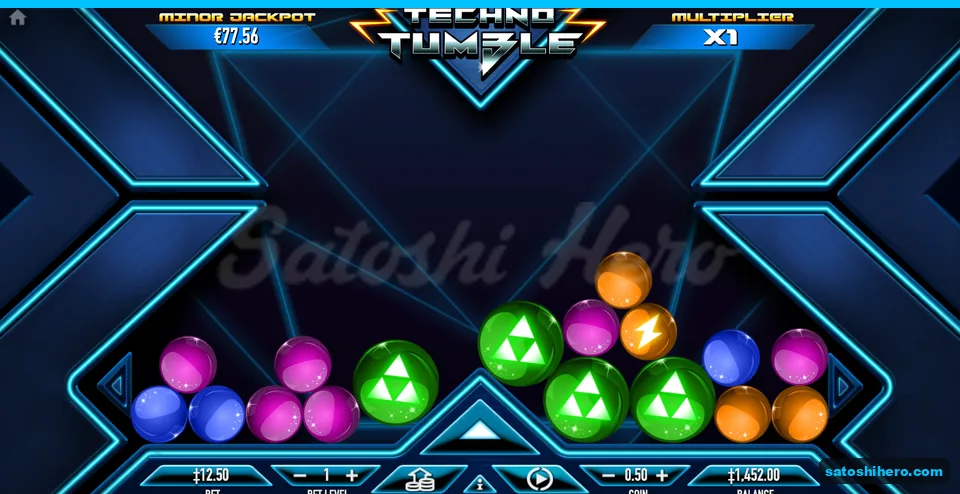
During free games, the screen shifts into magenta. That color change helps you feel the mode switch, which matters because the core board shape stays familiar. If you prefer fantasy framing over abstract electronics, Wicked Witch offers a clearer story world, while this game leans into motion and machinery.

Discovery: The balls must settle before the game reads wins, which is why the rhythm feels different from reels stopping.
Sound and pace
The soundtrack uses pulsing electronic tones that match the cyberpunk backdrop. What stands out is the pause before each payout, because you wait for the final ball position rather than a reel stop. You get a small burst of suspense on nearly every spin.
I like that delay more than I expected. You see why a near cluster misses, and you can spot the pieces that might connect next time. The theme works because movement does the heavy lifting.
Tumble Games and the multiplier
Wins come from settled touching groups, not normal paylines. The game can drop up to 45 balls in a round, then it waits until every ball stops under the physics engine. Groups of matching balls that touch each other pay from the table. That final-read rule is the core mechanic, so a spin isn’t really decided when the last ball enters the chamber.
Settled-ball wins
The specification lists 25 lines, but that isn’t the useful way to read the board. You don’t track left-to-right patterns here. You watch final positions, then matching groups of five or more balls create wins. The clearest mistake is treating the chamber like a fixed grid, because contact matters more than where a symbol first appeared.
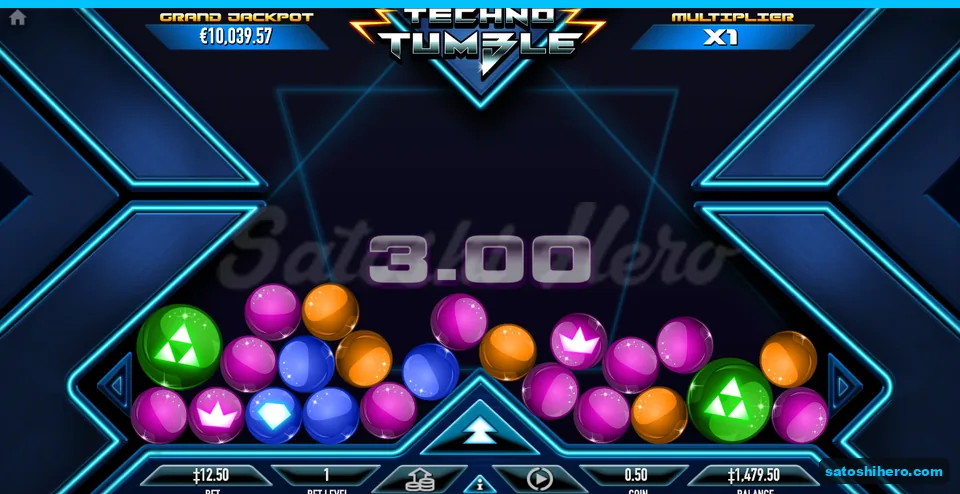
Winning balls disappear after a pay. New balls tumble into the chamber, and the game checks again. Return to the Feature also builds sessions around its feature structure, but this game makes the core engine feel unusual before any bonus appears.

Factoid: The round only pays after the balls stop moving, so the win comes from the final settled layout.
Multiplier resets
Each winning tumble raises the multiplier by +1. The multiplier starts at X1 on every new spin, so short base-game chains rarely feel explosive. You need repeated tumbles inside one round to make it bite. That reset keeps the base game readable, but it also means one isolated cluster usually needs size, badges or Wild help to feel meaningful.
Wins from different groups add together before the round ends. The chamber layout reads clearly on desktop and mobile because ball groups, launcher and multiplier stay visually central. My take: the mechanic feels fresh, but you need patience when the board refuses to connect.
How Techno Tumble Works
Blue balls matter most for larger group pays, while Wilds and Scatters control the bigger moments. The Techno Tumble slot keeps the symbol set small, so you can learn the board faster than a busy reel game. You still need to watch the final cluster shape carefully.
Paying balls
There are three standard paying balls. Blue pays the most, orange sits in the middle, and magenta pays the least. Eleven or more matching balls keep adding the 10-ball pay, so 11 blue balls pay 36x.
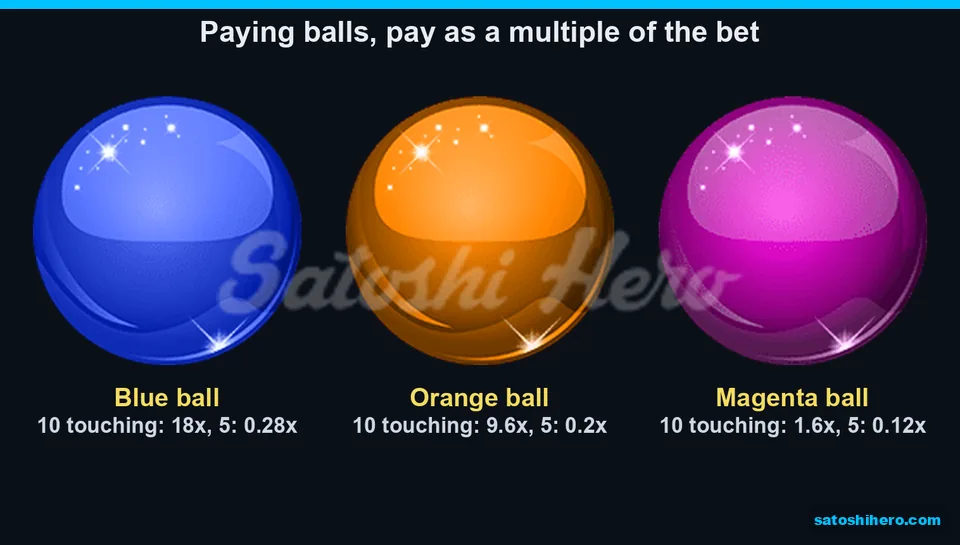
- Blue balls: 10 touching pays 18x, 9 pays 9.6x, 8 pays 6x, 7 pays 2.4x, 6 pays 0.8x and 5 pays 0.28x.
- Orange balls: 10 touching pays 9.6x, 9 pays 4x, 8 pays 2.8x, 7 pays 1.2x, 6 pays 0.48x and 5 pays 0.2x.
- Magenta balls: 10 touching pays 1.6x, 9 pays 1x, 8 pays 0.6x, 7 pays 0.4x, 6 pays 0.24x and 5 pays 0.12x.
Those values explain why blue clusters catch your eye. A big magenta group can still help, but it doesn’t move the balance like a strong blue group. Wizards Want War gives a more traditional fantasy layout, so it may feel easier if you dislike physics-based reading.
Wilds and Scatters
The red star Wild substitutes for every ball except the green Scatter. It doesn’t pay alone, which keeps it from acting like a cash symbol. The surprise here is that one Wild can sit in several winning groups at once.
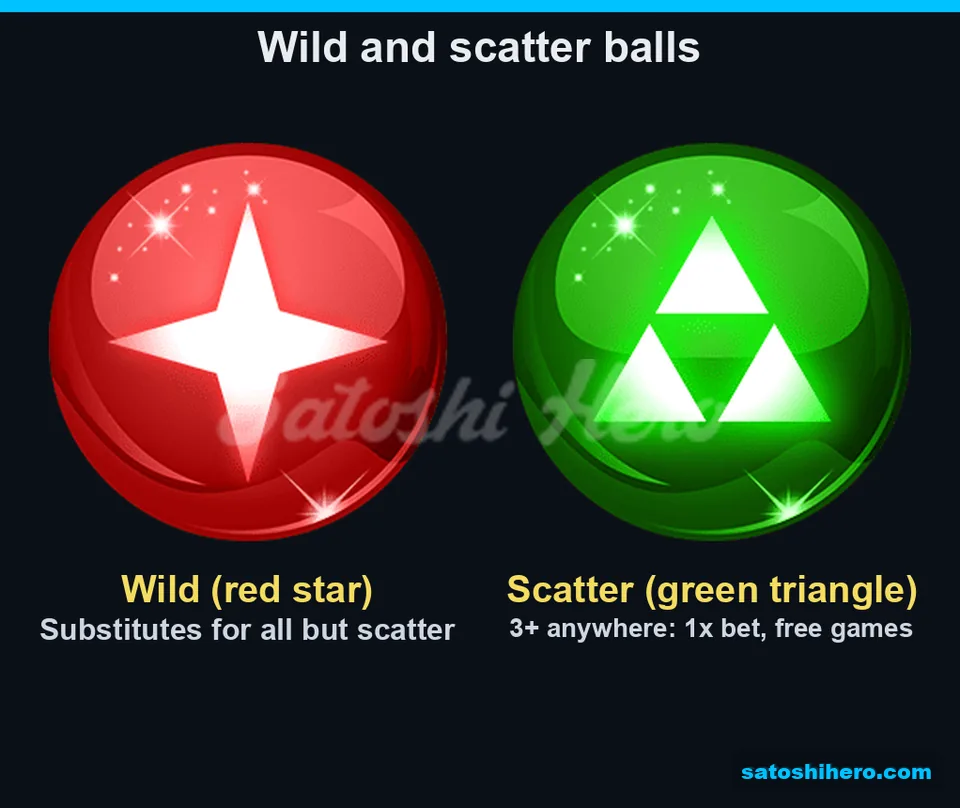
The green triangle Scatter pays 1x the bet for three or more anywhere. It pays on top of other wins and starts the free games. You don’t need a line or a side of the chamber, just enough Scatters anywhere on the board.
Badge payouts
Badges add extra value only when they sit inside a paying cluster. Blue, orange and magenta balls can carry badges, but a lonely badge doesn’t help you. That makes them more like boosters than separate winning symbols.
Badge symbols
The badge types are easy to spot once you know them. Blue can carry a diamond, orange can carry a lightning bolt and magenta can carry a crown. You’ll see them appear often enough to notice, but the game only cares when they join a winning group.
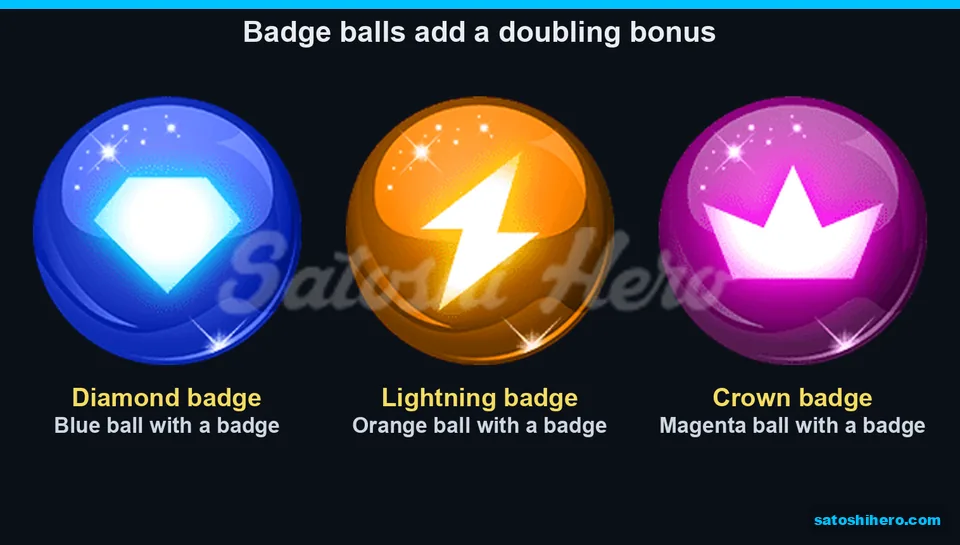
I like this layer because it gives ordinary clusters a second outcome. A small group can feel less dull if a badge lands inside it. The downside is clear too: a chamber full of badges can still miss if the colors don’t connect.

Tactic: Badge value depends on being inside a paying group, so a screen full of badges isn’t automatically a big win.
Doubling extras
The first badge in a winning group pays 0.12x the bet. Each extra badge doubles the previous badge payout, so two badges pay 0.24x and three pay 0.48x. Ten badges pay 61.44x, which makes rare packed clusters far more interesting.
You shouldn’t chase badges as if they guarantee a strong round. They need the cluster first, then the doubling kicks in. That tension fits the game well because the board always asks one question: did the final settled shape help you?
Free Games
Three Scatters anywhere trigger 8 free games, and each extra Scatter adds 4 more. I landed 4 Scatters and received 12 free games, which gave me the main bonus once during my test. The feature plays at the same bet as the triggering spin.
Trigger rules
Free games can’t retrigger. The multiplier keeps running through tumbles, which gives the round its best chance to build. If the feature ends without a payout, an Extra Chance free game appears and raises the multiplier by +1 until something pays.
That rule sounds kinder than it felt in my first run. It helps avoid a dead feature, but it doesn’t turn every bonus into a saver. The Dead Escape creates bonus tension through darker cinematic staging, while this feature makes you stare at tumbling physics and hope the board links.

Proceed Carefully: This is a very-high volatility game, and even a triggered feature can pay small. The tested 12 free games returned about 6.2x.
Test result
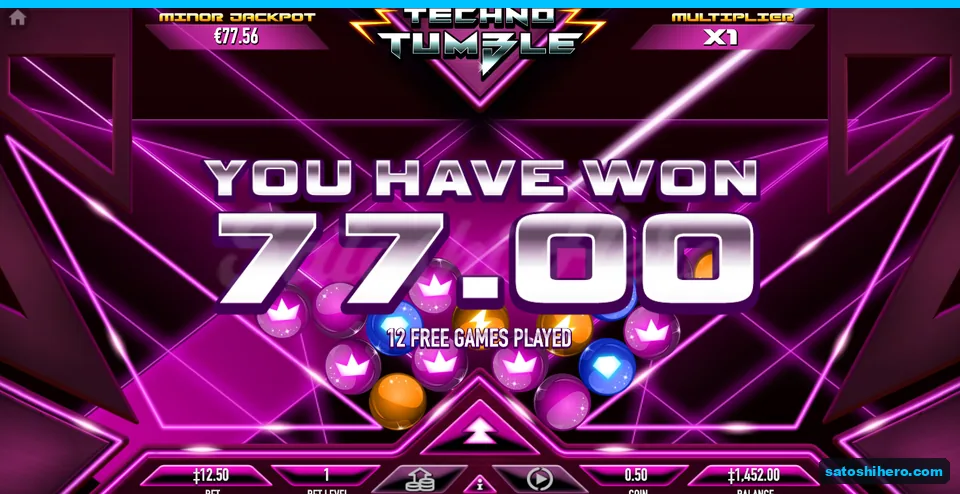
In my session, I had to tap the central launcher once to begin the free games. After that, the 12 games played themselves, and a result card closed the feature. The whole round felt clean and quick, not overloaded with buttons.
The result card showed $77.00 from a $12.50 stake. That lands around 6.2x the bet, which softened the loss but didn’t rescue the session. I’d call the feature useful, not generous, based on that first hit.
Progressive Jackpot
The jackpot can drop at the end of a game, but my test didn’t show it paying. A jackpot win can add to any other win, so it sits above the normal cluster and tumble engine. You see two meters on the screen, which makes the prize feel present without taking over the board.
Random jackpot
The game treats the progressive as a random end-of-game event. I didn’t see a paid jackpot during my spins, so I won’t pretend to know its practical frequency. That restraint matters because visible meters can make a feature feel closer than it really is.
You should view the jackpot as background upside. The main session still comes from clusters, tumbling wins, badges and free games. If the random prize appears, great; if not, the slot still needs regular wins to carry your balance.
Demo meters
The demo meters looked display-only during my test. That doesn’t prove how real-money meters behave, and I don’t want to blur the two modes. What you can safely take from the demo is visual placement, not trigger rate.
I like that the meters stay tucked away in the corners. They add a little glow without distracting you from the chamber. The jackpot gives the game an extra hook, but it shouldn’t shape your stake plan.
RTP, volatility and our test
The math looks generous on RTP but rough in short-session volatility. Techno Tumble combines a strong headline return with a swing profile that punished my short test. The max win feels capped lower than I expected for this risk level, so bankroll control matters more than hype. The key lesson is not that the return figure is weak, but that the path toward it can still feel harsh when the board misses clusters for several paid spins in a row.
Simulator projection
Our simulator modelled 1000 spins at a bet of $1. It used the game’s RTP, volatility profile and prize cap to sketch possible session shapes. The result doesn’t predict your next spin, but it helps you understand how wide the ride can feel.
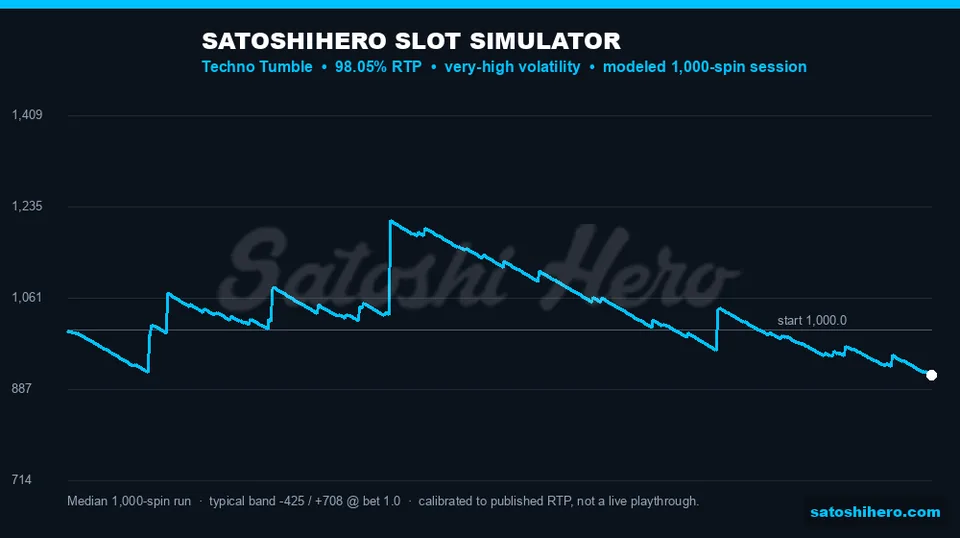
- Median session: 86.7x the bet down.
- 5th to 95th percentile band: 425x down to 707.8x up.
- Paying spins: about 14%.
- Top-tier feature: roughly once in 53 spins.
- 100x or larger win: roughly once in 788 spins.
Those figures explain why ten quiet spins mean very little. You can hit small pays, watch them vanish into the stake cost, then wait a long time for something that changes the graph. Waltz Beauty gives a different rhythm if you want a less mechanical feel after this chamber’s stop-start pace.
Our 100-spin session
I played 100 spins at $12.50 per spin. My balance started at $2,000.00 and finished at $1,367.00, leaving me 50.6x the bet down. The biggest single-spin win reached $155.50, or 12.4x.
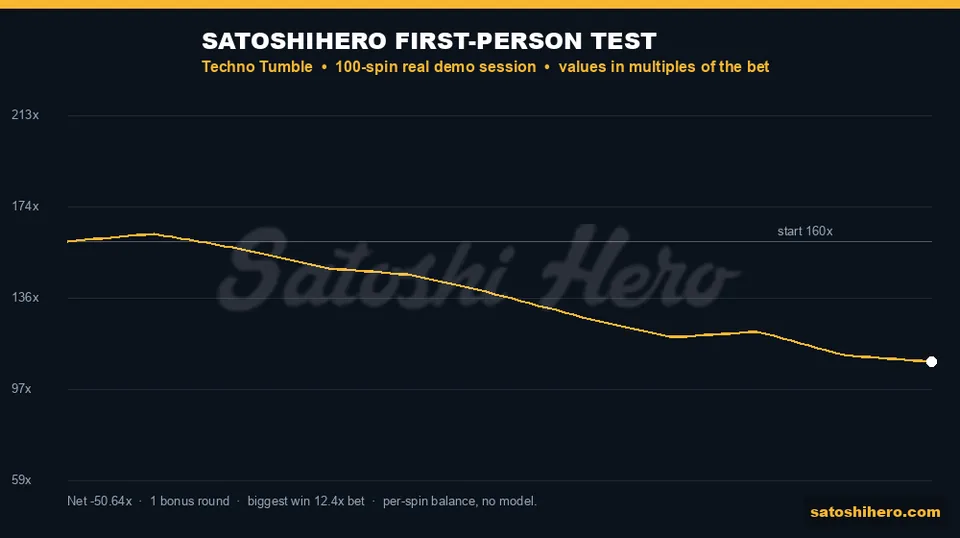
The free games arrived late on spin 92. Four Scatters gave me 12 games, and the feature paid $77.00. Base wins stayed small, with a $3.00 hit feeling typical rather than strange.
That result didn’t shock me. At this volatility level, a losing 100-spin stretch can happen even with a strong RTP. The numbers help with bankroll planning, not outcome prediction. I’d read the test as a caution about stake sizing, because the biggest logged spin and the bonus together still left the session well behind.
Theoretical RTP is the operator’s published return figure, and a single 100-spin session has no bearing on that return. Simulator results model possible session shape, not the next outcome, and feature behavior can sit slightly differently from base-game expectation by design.
How the session actually played
The session felt choppy, quiet and late-loaded. I spent most of the test watching the balance drift down, then saw a brief lift around spin 80. If you try this game, you need room for dead patches.
Session rhythm
Base-game hits came often enough to keep the board moving, but most didn’t matter much. The $3.00 base win in my screenshot captured the usual feel. You see a tumble resolve, the game pays, then the balance still struggles.
The biggest hit at $155.50 gave the only real mid-session punch. It looked good in the moment, yet it didn’t change the wider direction. That’s the kind of result that teaches you not to overread one decent spin.
Free games landed on spin 92, so the main feature arrived late. I liked the timing drama, but I didn’t like the payout. The feature gave me something to watch, then left the loss mostly intact.
Bankroll feel
You should reduce stake size if you want to spend time with the chamber. A $12.50 stake made every quiet patch feel sharp, even in demo mode. Smaller bets let you see more tumbles before the balance pressure takes over.
Don’t judge this slot from ten spins. The physics engine can make each round look busy, but the pay profile still runs cold for stretches. My practical takeaway is simple: bring patience, lower the stake and expect the board to tease. The best sessions here are the ones where your stake lets you watch enough settled boards to understand the rhythm, because one small cluster, one badge group or one modest feature does not define the game by itself.
Frequently Asked Questions About Techno Tumble
How do wins work in Techno Tumble?
Wins happen after the balls drop, move and settle under the physics engine. Groups of five or more touching matching balls pay by the table, winning balls disappear, new balls tumble in and the multiplier rises by +1 after each extra winning tumble.
How many Scatters start the Techno Tumble free games?
Three green triangle Scatters anywhere start 8 free games. Each extra Scatter adds 4 more, and my test landed 4 Scatters for 12 games. The feature can’t retrigger, but an Extra Chance free game appears if the bonus ends without a payout.
What is the Techno Tumble RTP and max win?
Techno Tumble has 98.05% RTP, very-high volatility and a 1,593x max win. The game lists 25 lines, but my tested payout mechanic used touching groups of settled balls rather than normal left-to-right line wins.
What does the 1000-spin simulator show?
The simulator showed a median result of 86.7x down at a $1 bet. Its 5th to 95th percentile band ran from 425x down to 707.8x up, with about 14% paying spins and a 100x or larger win roughly once in 788 spins.
How did the 100-spin Techno Tumble test go?
I started with $2,000.00, played 100 spins at $12.50 and finished at $1,367.00. That was 50.6x down, with one free-games trigger on spin 92, a $77.00 feature result and a 12.4x biggest single-spin win.
Can you buy the bonus in Techno Tumble?
I didn’t find a bonus buy or ante bet in the demo. You need Scatters to trigger the free games, which makes regular spin pacing and stake size more important.
Final Take
Techno Tumble stands out because the physics chamber changes how you read every spin. Its main drawback is the gap between constant motion and meaningful payouts, which can make cold stretches feel busier than they really are.

My Read
Curious slot players should try a small-stake demo first and watch how the settled groups pay. Expect unusual pacing, late bonus tension and sharp balance movement. I’d play it for the mechanic, not for steady returns.
I like the fresh board reading and the way Wilds can connect several groups at once. I don’t like how my 12 free games paid only $77.00 from a $12.50 stake, because that result barely dented the session loss. The strongest moment was the physics feel, while the weakest was the modest top-end feel beside the risk.
Techno Tumble is checked regularly on SatoshiHero, including the simulator assumptions and hands-on notes. I’d keep this one in the “try with discipline” folder, because the game feels clever but doesn’t forgive oversized stakes.

Pros:
 Fresh win engine: Settled-ball groups make every spin feel different.
- Clear symbol set: Three paying balls keep the board readable.
- Strong RTP: The headline return looks generous for patient players.
- Bonus clarity: Scatter rules and result cards make free games easy to follow.

Cons:
 Sharp droughts: Very-high volatility can drain short sessions fast.
- Modest cap: The 1,593x ceiling feels low for this risk.
- Small bonus hit: My tested feature softened losses without changing direction.

Best For: Physics-slot explorers and patient bankroll managers get the most from this chamber. You need to enjoy watching unusual win shapes form, then accept that many busy-looking rounds still pay lightly. If you want steady line hits, choose a calmer slot instead.

































































Bets
All Bets
Game
Player
Date
Wager
Mult.Multiplier
Prize
 4 Lucky Nuggets
 whodey39311
- 00:20:29
- 0×
- Halloween Harvest: Rapid Link
 Hidden
- 00:20:29
- 3.09×
- Aztec Magic Deluxe
 RicoSoul
- 00:20:28
- 0×
- Aztec Magic Deluxe
- RicoSoul
- 00:20:27
- 0×
- Halloween Harvest: Rapid Link
- Hidden
- 00:20:27
- 0×
- Halloween Harvest: Rapid Link
- Hidden
- 00:20:27
- 1.59×
- 4 Lucky Nuggets
- whodey39311
- 00:20:26
- 1.83×
- Royal Fruits 9: Hold 'n' Link
 mdp0fxo
- 00:20:26
- 0×
- Halloween Harvest: Rapid Link
- Hidden
- 00:20:25
- 0×
- Aztec Magic Deluxe
- RicoSoul
- 00:20:24
- 0×